The 2 National Conference of Chemistry
DOI:http://dx.doi.org/10.21123/bsj.2016.13.2.2NCC.0143
Density functional theory study of molecular structure,
Electronic properties, UV–Vis spectra on coumarin102.
Falah A-H. Mutlak* Ali T. Mohi**
Tariq J. Alwan**
*Department of Physics, College of Science, University of Baghdad, Baghdad, Iraq **Department of Physics, College of Education, Al-Mustansiriyah University, Baghdad, Iraq
E-mail :[email protected]
Received 17/9/2015 Accepted 20/12/2015
This work is licensed under a Creative Commons
Attribution-NonCommercial-NoDerivatives 4.0 International Licens
Abstract:
The various properties of the ground and excited electronic states of coumarins 102 using density functional theory (DFT) and time-dependent density functional theory (TDDFT) was calculated by the B3LYP density functional model with 6-31G(d,p) basis set by Gaussian 09 W program. Spectral characteristics of coumarin102 have been probed into by methods of experimental UV-visible, and quantum chemistry. The UV spectrum was measured in methanol. The optimized structures, total energies, electronic states (HOMO- LUMO), energy gap, ionization potentials, electron affinities, chemical potential, global hardness, softness, global electrophilictity, and dipole moment were measured. We find good agreement between experimental data of UV spectrum and TDDFT excitationenergies.
Key words: DFT, TDDFT, Ionization potential, electron affinity, energy gap, and UV spectra.
Introduction
Coumarins are widely occurring in including polarity and viscosity nature, with coumarin itself first isolated in 1820 from a specific variety of bean, and many other coumarin derivatives found in a wide range of plants [1]. Many natural and synthetic derivatives of coumarin (2H-chromen-2-one) are used in different applications in chemistry, biology, medicine and physics. The reasons for their wide range of applications are their spectral properties, mainly the intense
fluorescence observed for many derivatives with appropriate substitution [2]. These derivatives are important components of fluorescence probes, sensors and switches. coumarins exhibit interesting fluorescence properties, which include a high degree of sensitivity to their
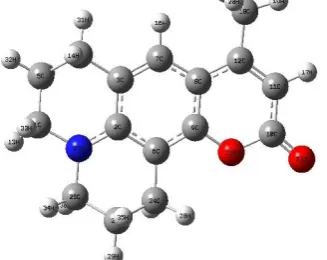
perfumery and cosmetic industry [4]. Theoretical investigations of the physical and chemical properties of dye sensitizers are very important in order to disclose the relationship between the structure, properties and performance, and to help in the design and synthesis of new dye sensitizers [5]. Coumarin 102 (C102) has been known as a solvatochromic dye and the fluorescence minimum wavelength (λmax) of C102 depends on the microenvironment surrounding the dye [6]. The structure of C102 (C16 H17 NO2) is shown in Figure 1.
Fig. 1 The optimized structures of C102 obtained by B3LYP/6-31G (d, p)
Many studies have shown that the molecular structures and vibration frequencies calculated by Density functional theory DFT methods [7].Density functional theory (DFT) is nowadays one of the most popular methods for ground state electronic structure calculations in quantum chemistry and solid state physics. Compared to traditional ab initio, contemporary density functional methods show a favorable balance between accuracy and computational efficiency [8].
The present work represents an experimental and theoretical approach to study the structure, electronic properties and electronic spectra of Coumarin 102 in Methanol solvents by using the TDDFT method.
Materials and Methods:-
Coumarine dye laser (C-102) supplied from Lambda physics has a molecular mass (255.31 gm/mole), molecular formula ( C16 H17 NO2 ) and it can be dissolved in polar and nonpolar solvent Ethanol, Methanol, Benzene, Acetone, etc. The solvent used in this search was Methanol from (American Thomas baker com.) with purity (99.9%), molecular formula (CH3OH) molecular mass (32 gm/mole), Polarity (0.68). The materials are used in this search without further purification.
The coumarin-102 dye dissolved in Methanol at three concentration (10–4, 10–5& 10–6 mole /L ) . For preparing lasing dye solutions, dye powder solved in methanol in a specific concentration according to the relation:
Wt = (C × V × w) / 1000 (1) Where, Wt is the weight of the dye (gm).
C: is concentration needed in Molars. V: is volume of the solvent in cm3.
w: is a molecular weight of the substance(dye) in gm/mole.
The spectrum of absorbance was taken by Shimadzu spectrometer (UV-Visible, UV-160). This spectrophotometer covers a wide range in EM spectrum from UV to near IR. The absorption spectra of Coumarine 102 have been investigated by using Methanol solvent in various concentrations.
Absorption spectra can give much information related to the molecule under investigation. Absorption spectrum was measured by (UV-VIS spectrophotometer sp–3000 plus), this device operates within the range (200– 1100 nm) of the visible and ultraviolet region. Polymer films thickness was measured by using a Japanese aperture. (MITUToyo) which measured the thickness of the films ranging between (0-25 mm).
In the present study, we focus on considerable attention on the application of DFT and TDDFT to the C102. All the computational studies were carried out by using (DFT & TDDFT) method at B3LYP/6-31G(d,p) levels of theory. This study of C102 has been carried out by using the Gaussian 09 code and Gauss-View molecular visualization program package on the personal computer [9].
The gradient-corrected B3LYP functional form (i.e. Becke’s 3-parameter hybrid exchange functional [10] and Lee, Yang, and Parr correlation functional [11]) was employed in the calculations. DFT is the best method to calculate ground state structures and the electronic variables, and time-dependent density functional theory (TD-DFT) methods at B3LYP/6-31G(d,p) level were used for the calculation of electronic excitations and UV-Vis spectra for any molecules. The polarized continuum model (PCM) was used to model the effects of methanol salvation. The energy and oscillator strength calculated by (TD-DFT) result complements with the experimental findings. The geometry optimized structures are obtained by restricted closed-shell formalism and without any symmetry restriction, In this investigation, the more relevant ionization potential (IP), electron affinities (EA), chemical potential (K) (it is the negative of electronegativity (χ)), hardness (η), softness (S), electrophilic index (ω) and the dipole moment (µ) were calculated. These are confirming the charge transfer within the molecule and also the molecular electrostatic potential (MESP) contour map shows the various electrophilic region of the title molecule [12]. The HOMO and LUMO energy was used to estimate the IP and EA in the frame work of Koopmans’ theorem: 𝐼𝑃 = −𝜀𝐻𝑂𝑀𝑂 and 𝐸𝐴 = −𝜀𝐿𝑈𝑀𝑂 [11, 13].
All parameters are calculated as follows [14,15]:
Electronegativity (χ):
𝐾 ≈ −𝜒 = − (𝐼𝑃 + 𝐸𝐴) 2 (2)⁄
Hardness
𝜂 ≈ (𝐼𝑃 − 𝐸𝐴) 2⁄ (3) Softness
𝑆 =2𝜂1 (4) Electrophilic index
𝜔 = 𝜅2
2𝜂 (5)
Density functional theory has also been used to calculate the dipole moment µ, the total dipole moment in a Cartesian frame is defined by [16]: µ = (µx2 + µy2 +µz2)1/2 (6)
The dipole moment in a molecule is an important property that is mainly used to study the intermolecular interactions involving the nonbonded type dipole–dipole interactions, because the higher the dipole moment, the stronger will be the intermolecular interactions [17].
Results and Discussion:
Molecular geometry
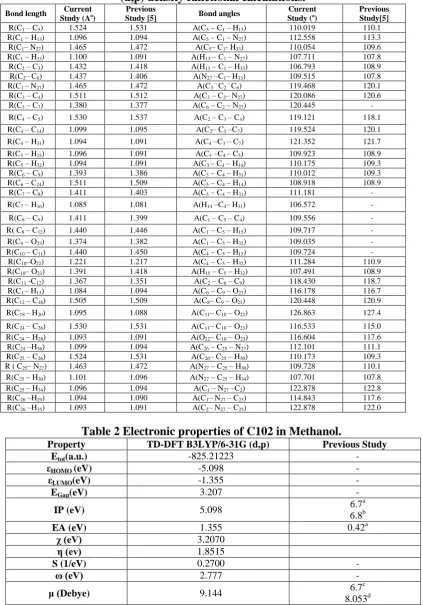
The calculated geometrical parameters (bond lengths and bond angles) were compared with another study [5]. The optimized structural parameters of C102 from B3LYP/6-31G(d,p) calculations and also another study values are listed in Table 1, in accordance with the atom numbering scheme given in Figure 1. The B3LYP method leads to geometry parameters, which are close to another study data [5], and we find that most of the optimized parameters are in agreements with another study.
Electronic properties
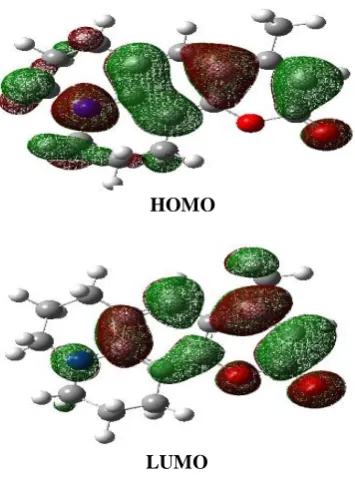
of LUMO and HOMO and their energy gap reflect the chemical activity of themolecule. LUMO as an electron acceptor represents the ability to obtain an electron, while HOMO as an electron donor represents the ability to donate an electron [19]. The smaller energy gaps of the LUMO-HOMO, the easier HOMO electrons to be excited; the higher the HOMO energies, the easier to donate electrons; to be donated so the lower LUMO
energies, easier to accept electrons [20]. Table (2) shows the values of the total energy and electronic states forthe analyzed structure and the energy gap (ℇ𝐿𝑈𝑀𝑂− ℇ𝐻𝑂𝑀𝑂), and dipole moment
(µ) of the C102. for the Coumarin-102 molecule. The experimental ground-state dipole moment, measured in the presence ofchloroform is 6.98 Debye [5]. Thus, there is a slight disagreement betweenour result and the experimental one that could be caused by solvent effects.
B3LYP functional used in this study has a high efficiency to calculate the electronic properties for the organic studied molecules, such as ionization potentials (IP), electron affinities (EA), chemical potential (K), absolute hardness (η), absolute softness (S), electrophilic index (ω). The results from
Crespo-Hernandez et al. [21] for IP and EA are not directly comparable because they have been calculated in the presence of C102 instead of ethanol, and different calculated way (adiabatic, vertical). Thus, there is a slight disagreement between our result and the another study that could be caused by solvent effects and different calculated way (adiabatic, vertical)
Frontier
molecular
orbital
analysis
Table 1 Optimized geometrical parameters of C102 obtained by B3LYP/6-31G (d,p) density functional calculations.
Bond length Current
Study (Ao) Study [5]Previous Bond angles Study (Current o) Previous Study[5]
R(C1 – C5) 1.524 1.531 A(C5 – C1 – H13) 110.019 110.1
R(C1 – H13) 1.096 1.094 A(C5 – C1 – N27) 112.558 113.3
R(C1– N27) 1.465 1.472 A(C5– C1- H33) 110.054 109.6
R(C1 – H33) 1.100 1.091 A(H13 – C1 – N27) 107.711 107.8
R(C2 – C3) 1.432 1.418 A(H13 – C1 – H33) 106.793 108.9
R(C2– C6) 1.437 1.406 A(N27 –C1– H33) 109.515 107.8
R(C1 – N27) 1.465 1.472 A(C3 – C2 – C6) 119.468 120.1
R(C3 – C4) 1.511 1.512 A(C3 – C2– N27) 120.086 120.6
R(C3 – C7) 1.380 1.377 A(C6 – C2 – N27) 120.445 -
R(C4 – C5) 1.530 1.537 A(C2 – C3 – C4) 119.121 118.1
R(C4 – C14) 1.099 1.095 A(C2– C3 –C7) 119.524 120.1
R(C4 – H31) 1.094 1.091 A(C4 –C3 – C7) 121.352 121.7
R(C5 – H15) 1.096 1.091 A(C3 –C4 – C5) 109.923 108.9
R(C5 – H32) 1.094 1.091 A(C3 – C4 – H14) 110.175 109.3
R(C6 – C9) 1.393 1.386 A(C3 – C4 – H31) 110.012 109.3
R(C6 – C24) 1.511 1.509 A(C5 – C4 – H14) 108.918 108.9
R(C7 – C8) 1.411 1.403 A(C5 – C4 – H31) 111.181 -
R(C7 – H16) 1.085 1.081 A(H14 –C4– H31) 106.572 -
R(C8 – C9) 1.411 1.399 A(C1 – C5 – C4) 109.556 -
R( C8 – C12) 1.440 1.446 A(C1 – C5 – H15) 109.717 -
R(C9 – O23) 1.374 1.382 A(C1 – C5 – H32) 109.035 -
R(C10 – C11) 1.440 1.450 A(C4 – C5 – H15) 109.724 -
R(C10–O22) 1.221 1.217 A(C4 – C5 – H32) 111.284 110.9
R(C10– O23) 1.391 1.418 A(H15 – C5 – H32) 107.491 108.9
R(C11 -C12) 1.367 1.351 A(C2 – C6 – C9) 118.430 118.7
R(C1 – H13) 1.084 1.094 A(C6 – C9 – O23) 116.178 116.7
R(C12 – C18) 1.505 1.509 A(C8– C9 – O23) 120.448 120.9
R(C18 – H20) 1.095 1.088 A(C11– C10 – O22) 126.863 127.4
R(C24 – C26) 1.530 1.531 A(C11– C10 – O23) 116.533 115.0
R(C24 – H28) 1.093 1.091 A(O22– C10 – O23) 116.604 117.6
R(C24 –H36) 1.099 1.094 A(C26 – C25 – N27) 112.101 111.1
R(C25 – C26) 1.524 1.531 A(C26– C25 – H30) 110.173 109.3
R ( C25– N27) 1.463 1.472 A(N27 – C25 – H30) 109.728 110.1
R(C25 – H30) 1.101 1.096 A(N27 – C25 – H34) 107.701 107.8
R(C25 – H34) 1.096 1.094 A(C1 – N27 –C2) 122.878 122.8
R(C26 –H29) 1.094 1.090 A(C1– N27 – C25) 114.843 117.6
R(C26 –H35) 1.093 1.091 A(C2– N27 – C25) 122.878 122.0
Table 2 Electronic properties of C102 in Methanol.
Property TD-DFT B3LYP/6-31G (d,p) Previous Study
Etot(a.u.) -825.21223 -
εHOMO (eV) -5.098 -
εLUMO(eV) -1.355 -
EGap(eV) 3.207 -
IP (eV) 5.098 6.7
a
6.8b
EA (eV) 1.355 0.42a
χ (eV) 3.2070
η (ev) 1.8515
S (1/eV) 0.2700 -
ω (eV) 2.777 -
μ (Debye) 9.144 6.7
c
Fig. (2): Frontier molecular orbital's ofC102 in Methanol.
Molecular electrostatic potential
(MEP)
Molecular Electrostatic Potential (ESP) at a point in the space around a molecule gives an indication of the net electrostatic effect produced at that point by the total charge distribution (electron + nuclei) of the molecule and correlates with dipole moments, electronegativity, partial charges and chemical reactivity of the molecules [22-24].
Knowledge of the charge distributions can be used to determine how molecules interact with one another. One of the purposes of finding the electrostatic potential is to find the reactive site of a molecule. The three-dimensional electrostatic potential maps of the C102 are shown in Figure (3). A portion of the molecule that has a negative electrostatic potential is susceptible to electrophilic attack. The red and blue regions in the EPS map refer to the regions of negative and positive potentials and correspond to the electron-rich and electron-deficient regions respectively whereas the green
color signifies the neutral electrostatic potential [25].
As can be seen from the figure, the positive charge is located on the C8 and N27 atoms (blue colors). It is clear from Figure (3) the electrostatic surface potential indicates that electron density increased in the center and Oxygen atoms. The hydrogen atom attached to Carbons bears the maximum brunt of zero potential (green colors).
Fig. (3): Molecular Electrostatic potential surface (EPS) mappedonto a surface of total electron density for C102 dissolved in Methanol (value in a.u.)
5. Absorption spectra
Figure (4) show the experimental electronic absorption spectra of C102 in the solvent Methanol in different concentration. The (0-0) bands of the absorption spectra are shifted to shorter wavelengths.
Time-dependent density functional theory(TD-DFT) calculation has been performed for C102 on the basis of fully optimized ground state structure to investigate the electronic absorption properties for the singlet-singlet transition. The max values are obtained from the UV-Vis spectra analyzed theoretically with B3LYP/6-31G(d,p) basis set for 10 excited states. The calculated UV-visible absorption maxima which are a function of electron availability theoretical electronic excitation energies are all tabulated in Table(3).
HOMO
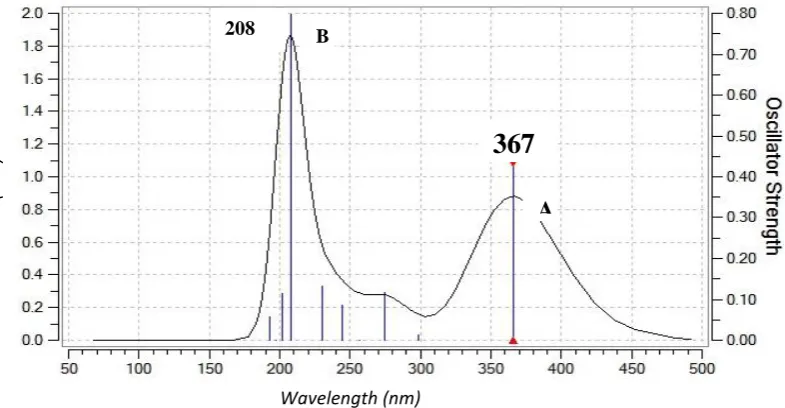
As illustrated in table (3), we can find the values of calculate absorption λmax (nm) and oscillator strength (f) along with main excitation configuration of the studied compound. As shown in Fig. 5 and Table 4, all compounds exhibit a strong absorption band in the UV region. It can be seen from the Table (3) and figure (5) , the calculated absorption values for C102 have been found to be 208 nm (band B) which corresponds
to the experimental value of 208 nm (band A) for 10-6 M concentration, This peak mainly represents excitation from HOMO-1 →LUMO+1 ,HOMO-1 → LUMO+2. The maximum for band A, was calculated and found to be 367 nm, and it corresponds to the experimental value of 389 nm for 10-6 M. This essentially refers to a HOMO→LUMO transition, involving excitation from π to π*.
Table (3): The values of λma,excitation energy, oscillator strength and Exp. λmax
of C102 in Methanol .
Case Assignments Wavelength λ (nm) energy ∆E (eV) excitation oscillator strength f (a.u.)
Exp. λmax(nm)
A (Excited State 1) HOMO→LUMO 367 3.382 0.4346
391a
390b
389c
B (Excited State 7) HOMO-1→LUMO+1
HOMO-1→LUMO+2 208 5.958 0.796
220a
216b
208c
Fig.4 Absorption spectra for C102 in Methanol at different concentrations.
Fig. (5): Theoretical absorption spectra for C102 in Methanol. Wavelength (nm)
Ab
so
rb
a
n
ce
(a.
u
.)
367
208
A
Conclusions:
In this work, the structures and electronic spectra of Coumarin 102 dissolved in Methanol are investigated by using the DFT/TDDFT methods and the solvent effect has been taken into account using the PCM model. Our results indicate that TDDFT is a powerful tool for treating the spectroscopy and properties of the Excitation state of the C102.
The energies of important MOs, absorption wavelength (λmax), oscillator strength, and excitation energies of the compound were also determined from TD-DFT methods and were compared with other experimental method values.
References
[1]Sethna, S.M. and Shah, N.M. 1945. The Chemistry of Coumarins. Chem. Rev., 36 :1-62.
[2]Hrdlovic, P.; Donovalova J.; Stankovicova H. and Gaplovsky, A. 2010. Influence of Polarity of Solvents on the Spectral Properties of Bichromophoric Coumarins. Molecules, 15 (12):8915-8932.
[3]Brian D. Wagner 2009. The Use of Coumarins as Environmentally-Sensitive Fluorescent Probes of Heterogeneous Inclusion Systems. Molecules, 14(1):210-237.
[4]Sheng, J. R.;Feng, F.;Qiang, Y.; Liang, F. G.;Sen, L. and Wei, F.-H. 2008. A coumarin derived fluorescence chemosensors selective for copper(II). Anal. Lett., 41(12): 2203-2213.
[5]Glossman-Mitnik, D. 2009. Computational molecular characterization of Coumarin-102. J. of Mol.Struct.: THEOCHEM, 911(1-3):105–108.
[6]Nakatani, K. and Matsuta, E. 2015. External and Intraparticle Diffusion of Coumarin 102 with Surfactant in the ODS-silica Gel/water System by Single Microparticle Injection and Confocal Fluorescence
Microsp-ectroscopy. Analytical Sciences, 31(6): 557-560.
[7]Redah, I.; Mahdi, F. R.; and Al-Amiery, A. A. 2012. Solvent-Free Synthesis of New Coumarins,Org. Chem. International, 2012:1-8.
[8]Furche, F. and Rappoport, D. 2005. Density functional methods for excited States: Equilibrium structure and electronic spectra.Theoretic. Comp. Chem., Elsevier, 16:93–128.
[9]Frisch, M. J.; Trucks,G. W.; Schlegel, H. B.; Scuseria,G. E.; Robb,M. A;. Cheeseman, J. R.; Scalmani, G.; Barone, V.;Mennucci,B.;Petersson, G. A.;Nakatsuji,H.;Caricato,M.; Li, X.;Hratchian, H. P.; Izmaylov,A. F.;Bloino,J.;Zheng,G.;Sonnenberg,J. L.;Hada,M.;Ehara,M.; Toyota,K.; Fukuda, R.; Hasegawa, J.; Ishida,M.; Nakajima,T.;Honda,Y.;Kitao,O.;Nakai , H.;Vreven,T.; . Montgomery, J. A.; Jr.; Peralta,J. E.; Ogliaro, F.; Bearpark, M.; Heyd,J. J.; Brothers, E.; Kudin,K. N.;Staroverov,V. N.; Kobayashi, R.; Normand, J.; Raghavachari, K.; Rendell, A.; Burant,J. C.;Iyengar,S. S.;Tomasi,J.;
Cossi,M.;Rega,N.;Millam,J.
M.;Klene,M.;Knox,J. E.;Cross,J. B.;Bakken,V.;Adamo, C.; Jaramillo, J.; Gomperts,R.;Stratmann, R. E.;
Yazyev,O.; Austin,A.
J.;Cammi,R.;Pomelli,C.;Ochterski,J. W.; Martin,R. L.; Morokuma, K.; Zakrzewski, V. G.;Voth,G. A.; Salvador, P.; Dannenberg,J. J.; Dapprich, S.; Daniels,A. D.;Farkas,O.;Foresman,J. B.; Ortiz,J. V.;Cioslowski,J.; and Fox, D. J. 2009. Gaussian 09, revision A. 02 Gaussian, Inc., Wallingford CT.
[10] Becke, A. D. 1993. Density‐ functional thermochemistry. III. The role of exact exchange, J. Chem. Phys., 98(7):5648-5652.
into a functional of the electron density, Phys. Rev. B, 37(2):785-789. [12] Raj, R. K.; Gunasekaran,
S.;Gnanasambandan, T. andSeshadri, S. 2015. Structural, Spectroscopic (FT-IR, FT-Raman & UV-Vis) and theoretical studies of 4,6-Dichloro-3-formyl coumarin. Int. J. Curr. Res. Aca. Rev., 3(3):130-149.
[13] Nyulászi, L. andBenkő, Z. 2008. Aromatic Phosphorus Heterocycles, Springer-Verlag Berlin Heidelberg. 27-31.
[14] Dhayakala, P. U.;Rajendiran, T. V.;Seshadri, S. andGunasekaran, S. 2011. Quantum chemical vibrational study, molecular property and
HOMO-LUMO energies of
3-bromoacetophenone for
pharmaceutical application, J. Chem. Pharm. Res., 3(3): 610-625.
[15] Oftadeh, M.; Naseh, S. and Hamadanian, M. 2011. Electronic properties and dipole polarizability of thiophene and thiophenol derivatives via density functional theory.Comp. Theoretic. Chem., 966(1):20-25. [16] Demetrio Da Silva, A;Coropceanu,V.
and Fichou, D. 2007, Hole-vibronic coupling in oligothiophenes: impact of backbone torsional flexibility on relaxation energies, Phil. Trans R. Soc. A, 365(1855):1435-1452.
[17] Kumar, S.; Rajesh V.; Amarendra, N.;Onkar, K., and Leena,P. S. 2012. Theoretical Studies on the Isomers of Quinazolinone by first Principles, Res. J. of Recent Sciences, 1(3):11-18. [18] Priya, P. A.; Kala, C.P. and
Thiruvadigal, D. J. 2010. Investigation on the influence of substitute groups in organic nanodevices, Int. J. Nanoelectronicsand Materials, 3(1):1-7.
[19] Dhumad, A. M. 2011. Theoretical study for Synthesis Reactions of α-Alkylidene-γ-butyrolacton-2-ones (Tetronic acid Derivatives), J. of Basrah Res. Sciences, 37(5 A):92-89 [20] Wang, Z. and Wu, S. 2008.
Electronic structures and spectra of conducting anthracene derivatives, J. Serb. Chem. Soc., 73(12):1187-1196. [21] Carlos, E. C. H.; David, M.; Close, L.
G. and Jerzy L. 2007.Determination of Redox Potentials for the Watson−Crick Base Pairs, DNA Nucleosides, and Relevant Nucleoside Analogues, J. Phys. Chem. B,111(19): 5386-5395.
[22] Bhawani, D. J.;Poonam, T. and Sudha, J. 2012. Molecular characterization of yohimbine hydrochloride using vibrational spectroscopy and quantum chemical calculations, BIBECHANA. 8:73-80. [23] Arivazhagan, M.and Kumar, J. S.
2012. Vibrational assignment, HOMO – LUMO, first-hyperpolarizability and Mulliken’s charge analysis of 2,7-dinitrofluorene. In. J. Pure & Applied Phy.,50(6):363-373.
[24] Murugana, M.;Balachandrana, V.andKarnan, M. 2012. Vibrational spectra and electrostatic potential surface of 2-fluoro-6-methoxybenzonitrile based on quantum chemical calculations, J. Chem. Pharm. Res., 4(7): 3400-3413. [25] Chen, X.-K. ;Zou, L.-Y. ; Huang, S.;
فيطلا و ةينورتكللاا صئاصخلاو يئيزجلا بيكرتل ةفاثكلا ةلاد ةيرظن ةسارد
نيراموكلل ةيجسفنبلا قوف ةعشلأاو يئرملا
201
*كلطم نسحلا دبع حلاف
يحم رهاط يلع
**ناولع رفعج قراط
*
ءايزيفلا مسق ،
،مولعلا ةيلك ةعماج
دادغب
**
ءايزيفلا مسق ،
،ةيبرتلا ةيلك .ةيرصنتسملا ةعماجلا
:ةصلاخلا
نيراموكلل ةفلتخملا صئاصخلا ةسارد مت 312
ةيرظن لامعتساب جيهتملا يوتسملاو يضرلأا يوتسملا دنع
ةفاثكلا ةلاد (DFT)
نمزلا ىلع ةدمتعملا ةفاثكلا ةلاد ةيرظنو (TDDFT)
جذومنلا ةطساوبو B3LYP
عم
يوتسملا 6-31G(d,p)
نيسواك جمانرب لامعتسابو 09
نيراموكلا فيط صئاصخ . 312
نيتقيرطب هتسارد تمت
نيراموكلل ةيجسفنبلا قوف ةعشلأا قوف فيط ناو ةيمكلا ءايميكلا لامعتساب ةيناثلاو ةيلمعلا ىلولأا 312
هسايق مت
ا تايوتسملا ,ةيلكلا ةقاطلا ,ىلثملا بيكارتلا.لوناثيملا عم ةفللأا , نيأتلا دهج ,ةقاطلا ةوجف ,ةينورتكللا
يئانث مزعو ,طيحملا عم ةينورتكللاا ةفللأاو ,)لعافتلا ةيلباق( ةموعنلاو ,ةدلاصلا ,يئاميكلا دهجلا ,ةينورتكللاا و ةيجسفنبلا قوف ةعشلأا فيطل ةيلمعلا تاءارقلا نيب ديج قباطت كانه ناب اندجوو . بطقلا (TDDFT)
تاقاطل
جيهتلا .
لا تاملك لا هيحاتفم
: ةفاثكلا ةلاد ةيرظن (DFT) ,
نمزلا ىلع ةدمتعملا ةفاثكلا ةلاد ةيرظن (TDDFT)
دهج ,