Page 109
APPLICATION OF NETWORK THINKING METHODOLOGY IN ANALYZING THE QUALITY OF SCHOOL WORK
Krzysztof Kubiak
Poznan University of Technology, Pl. M. Skłodowskiej-Curie 5, 60-965 Poznań, Poland
Abstract
One way to gain competitive advantage for educational services market is to constantly strive to increase the level of quality. The purpose of this article is to identify the key factors for improving the quality of work conducted by schools. These factors are determined from the perspective of different groups of stakeholders, namely students, teachers, parents, and headmasters. Those factors were analyzed using the methodology of network thinking that allows one to look at the problem and take into account different criteria and to determine the strength and nature of relationships between individual network elements. The subject of the research was a selected upper secondary school of a vocational profile.
Key words: quality of school work, network thinking methodology
1. IMPORTANCE OF QUALITY IN EDUCATIONAL SERVICES
The interdisciplinarity of the approach to quality management not only broadens but also deepens its scope. Quality can be managed in business, social, government and public organizations (Szczepańska 2011, p. 7). Today, it is assumed that quality management is a comprehensive approach to governance in all its aspects, levels, spheres of corporate activity, management systems, diagnostic and analytical methods all focusing on a widely understood improvement of organizational environment in managerial aspects (Szczepańska 2015, p. 53).
According to the theory of quality, improvement in all dimensions is a natural part of management. It is linked to a widely understood variation, factors and conditions of which must be sought in internal and external environment of an organization. Achieving a state of perfection by an organization is theoretically possible only in relatively short periods of time. Therefore, the pursuit of excellence in quality management should be considered in the long term. Striving for perfection can be understood in several aspects, namely: market, functional, managerial and social. All these simultaneously set the basis for determining the criteria and courses of actions. New methods of management and methodological solutions relate, to varying degrees, to the principle of continuous improvement in quality management. For this reason, it is difficult to distinguish which are more useful (Szczepańska 2011, p. 7).
The dynamics of change in the education market in Poland has increased competitiveness between schools. Fundamental causes of this phenomenon include the emergence of demographic decline in the first decade of the twenty-first century and increasing aspirations of the public seeking better education.
Polish education system is becoming increasingly market oriented. School system (primary, lower secondary and upper secondary education) is financed from the budgets of local governments. The decision whether to open a new school or close an existing one remains on behalf of citizens or inhabitants through their elected representatives in local governments (Gawrecki 2003, p. 13). Basic market elements of the Polish education system include the following (Gawrecki 2003, p. 13):
- freedom of choice regarding curriculum and the system of assessment, - diversity of educational offer,
- diversity of school funding sources,
Page 110
- growing influence of parents and local environment on schools,
- development of mechanisms to measure the quality of work of schools and teachers.
The principles of good governance are beginning to apply in Polish education. Pressure to improve the quality of both educational processes and results of education is now noticeable (Fazlagić 2009, p.6). The concept of quality in public services (education, upbringing and education are among public services of social nature) is quite complex. It is possible to state that "good governance" largely depends on quality management in public institutions as it equips political authorities and the managers of public institutions with necessary tools to achieve socially acceptable goals (Opolski, Modzelewski 2004, p. 13). One method of defining quality is to highlight the substance of services. It consists of creating a multi-dimensional value. The second way is focused on the perception and experience of clients and expresses their satisfaction with provided services. Student and their parents are clients for schools. In this context, quality refers to the reduction of the gap between clients' expectations and experiences. The third way is the active participation of the public and other stakeholders in the creation of quality (Opolski, Modzelewski 2004, p. 14-15).
The quality of the services of public nature can be understood in different dimensions and in different ways. It is worth remembering, however, that the field of quality management, regarding services in the public sector, is relatively young and it is constantly evolving (Opolski, Modzelewski 2004, p. 17). The primary factors affecting the quality of services may include the following (Chrząścik 2009, p.179):
- material elements (equipment, facilities, devices),
- reliability (ability to provide desired services in a reliable, accurate and consistent fashion), - response speed (the provision of services in a timely manner),
- hard competence of service providers (knowledge, experience and qualifications),
- soft competence of service providers (an ability to create the atmosphere of trust and confidence), - empathy (caring for the "client" student, individual approach).
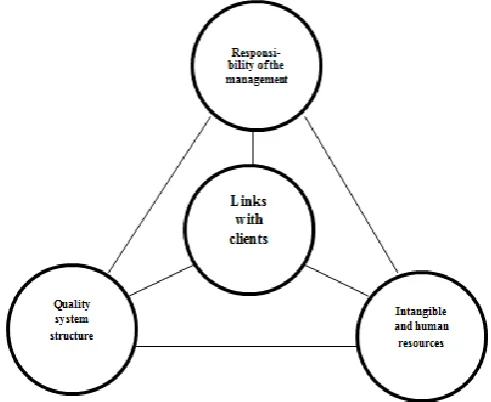
For the above factors to contribute to the quality assurance, it is necessary to support managers in education. The key aspects of the quality system in public services are shown in Figure 1.
Page 111
Continuous improvement is one of the key principles of quality management systems. Modern organizations, according to the paradigm of variation, in order to meet the demands of competitive environment, should respond quickly to changes and try to anticipate them and direct their efforts into the improvement of products, processes, skills and management systems (Brajer-Marczak 2015, p.11). Competitiveness in education, an increasing role of parents at schools, and the development of student self-governments all make it necessary to look for mechanisms that would allow for objective measurement of the quality of school work (Gawrecki 2003, p. 18). In this context, network thinking methodology allows one to diagnose key factors influencing the quality of school work.
2. RESEARCH METHODOLOGY
The article uses the methodology of network thinking supported by in-depth interviews. Network thinking methodology has its own system origin and allows one to analyze the studied phenomena in a holistic way. According to Deming, E.C. "the system should have a specific purpose - it should generate value - in other words, the result” (Deming 2000). The system in this sense should be understood as a relationship between various elements present in the network. Speaking of improving the operation of a company as a system, one needs to thoroughly investigate its processes. According to Kozminski, system analysis allows to control variability, diversity and complexity by realizing dependencies and relationships between various elements (Piekarczyk, Zimniewicz 2010, p. 27). Effective and efficient systems enable organizations to satisfy their clients' requirements. It is, therefore, necessary to manage system processes in order to achieve agreed goals in accordance with the adopted policy, as well as to introduce, exploit and evaluate effective and efficient quality systems. System approach to management refers to managing networks of interrelated processes and their connecting interfaces and improving the system by constant measures and evaluations. Applying the system approach to management requires the identification of related elements, their borders, relations with the environment, processes running in the system and feedback to maintain the system in a state of dynamic equilibrium with the environment (Prusak 2006, p. 48-49).
The purpose of the study was to identify the key factors for improving the quality of work conducted by schools. The subject of the research was a selected upper secondary school with vocational profile. The study was conducted among a group of experts composed of students, teachers, students' parents and headmasters of selected facilities.
Network thinking allows approaching the problem from different perspectives, analyzing the factors occurring in the network and determining the type and strength of interactions of all components. It also enables the development of scenarios and possibilities for change management. Thus, it allows a better understanding of the whole system and its individual parts. Network thinking methodology was developed in the late eighties of the last century in Switzerland by Gomez, P., Probst, G. and Urlich, H. It is based on the following seven basic principles (Grzelczak, Werner 2011, p. 22-23):
- the whole and the parts (the system is part of an existing whole, which can also be the system). - networkingness (in which system components are connected to each other),
- openness (which requires the recognition that there is a completely autonomous system that does not require any adaptation to the environment),
- complexity (describing the operation of an educational facility in a dynamic environment),
- order (resulting from simultaneous connections of parts in a network with structures built on the basis of the pattern of conduct),
- control, or driving (based on the system's ability to self-control by controlling and regulating), - development (social systems are able to pose questions regarding their own structures and
Page 112
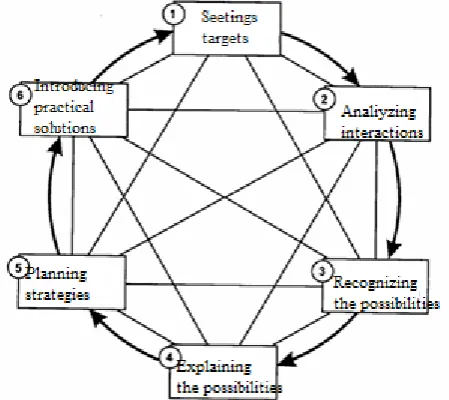
The methodology consists of the following six phases: setting targets and modeling problem situations, analyzing interactions, recognizing and interpreting the possibilities of situational changes, explaining the possibilities of management, planning strategies and operations and introducing practical solutions to problems (Figure 2).
Fig 2. Network thinking methodology phases Source: Piekarczyk, Zimniewicz 2010.
Solving problem situations by using network thinking methodology requires an analysis within individual phases. The essence of modeling a problematic situation lies in establishing system elements that are necessary to be changed. The analysis of interactions between network elements should determine the type of impact, its intensity and time. In terms of the interpretation of possible developments, it is necessary to specify expectations for the future, on the basis of which it will be possible to create optimistic, pessimistic and probable scenarios. The explanation of the capabilities of change management is associated with indicating important factors in the implementation of the process, managing their division into controllable and uncontrollable, and identifying early warning indicators before the occurrence of any problematic, feedback and anticipatory situations. The phase for planning strategies and actions refers to the search for alternative strategies, their evaluation and their choice. The practical implementation of solutions should ensure the smooth functioning of the system by taking adequate actions to solve both current and anticipated difficulties (Grzelczak, Werner 2011, p. 24-33). This methodology allows for the identification of errors in the management process. The aforementioned errors include the following (Piekarczyk, Zimniewicz 2010, p. 81):
- uncritical acceptance of values and goals,
- lack of criticism in the perception of the situation and static thinking, - ignoring interactions and feedbacks,
- lack of creativity in the search for something new, - return to the cause - effect thought pattern, - ignoring time factor in the analysis,
Page 113
Network thinking methodology requires a convergence of views - a developed network of links between factors must be planned to its very end, and its operation must remain within a certain timeframe (Piekarczyk, Zimniewicz 2010, p. 82).
3. SCHOOL IN NETWORK TERMS
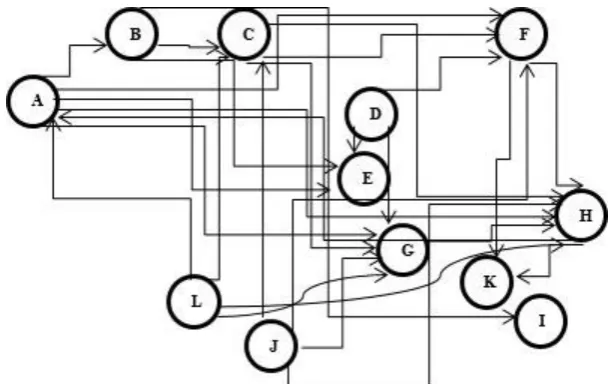
The purpose of the research was to identify the key factors for improving the quality of work conducted by schools. The evaluation involved factors based on an in-depth interview with experts (students, teachers, parents, headmasters). The aforementioned factors included the following:
- knowledge and commitment of staff (indicated by A symbol in the network) - teaching base (B),
- a variety of extracurricular activities (C), - caring for students (D),
- student safety (E),
- results of external examinations (F), - results of subject competitions (G), - students' successes (H),
- class size (I),
- cooperation with universities (J), - the fate of graduates (K),
- international exchange (L).
The identified factors and their relationships are presented in the form of a relationship network (Fig. 3).
Page 114
To determine the strength of the interaction between the factors, the following scale has been implemented (0 - no impact, 1 - low intensity of the impact, 2 - high intensity of the impact, 3 - very high intensity of the impact). The strength of the interaction between the factors has been listed in the matrix of influence. It allows one to identify which of the factors belong to the group of active ones (very strongly influence other elements, and are themselves subject to very little influence), passive ones (little impact on other elements and are themselves subject to strong influence), critical ones (strongly influence other elements, and are also subject to strong influence themselves) and lazy ones (weakly interact with other elements and are subject to weak influence themselves). The matrix is illustrated by tab. 1.
Tab 1. The matrix of influence
Factors A B C D E F G H I J K L Ł The sum of A
A Knowledge and commitment of staff X 2 0 0 2 3 3 3 0 0 0 0 0 13
B Teaching base 0 X 1 0 1 0 0 0 1 0 0 0 0 3
C Variety of extracurricular activities 0 0 X 0 0 2 2 3 0 0 0 0 0 7
D Caring for students 0 0 0 X 3 2 2 0 0 0 0 0 0 7
E Student safety 0 0 0 0 X 0 0 0 0 0 0 0 0 0
F Results of external examinations 0 0 0 0 0 X 0 3 0 0 2 0 0 5
G Results of subject competitions 0 0 0 0 0 0 X 3 0 0 2 0 0 5
H Successes of students 2 0 0 0 0 0 0 X 0 0 2 0 0 4
I Class size 0 0 0 0 0 0 0 0 X 0 0 0 0 0
J Cooperation with universities 0 0 1 0 0 1 1 1 0 X 0 0 0 4
K The fate of graduates 0 0 0 0 0 0 0 2 0 0 X 0 0 2
L International exchange 1 0 1 0 0 1 1 1 0 0 0 X 0 5
P The sum of P 3 2 3 0 6 9 9 16 1 0 6 0 0 X
Source: Own study
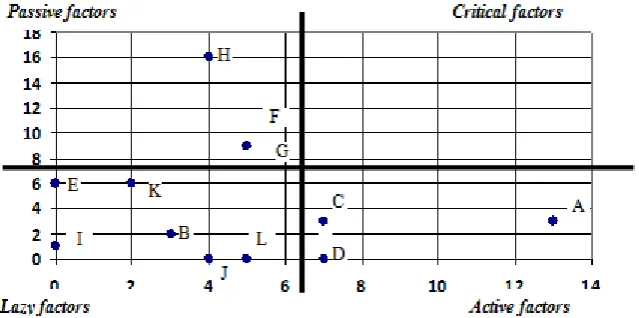
The resulting ratios were applied to the map of intensity. The division on the map of intensity was based on the maximum values of A and P, and dividing by two. Under this assumption, it was possible to obtain the position of lines dividing the chart area A = 6.5, P = 8.
Page 115
On the basis of the intensity map shown in Fig. 4 the key factors can be pointed out (active ones - the impact of these factors will result in high efficiency of activities. These are the elements that exercise a significant impact on other elements; however, they are subject to very little influence themselves). The factors include the following:
- knowledge and commitment of staff (A), - a variety of extracurricular activities (C), - caring for students (D).
The above active indicators determine the possibility of introducing changes and helping to improve the quality of school work. Knowledge and commitment of staff remain crucial factors. In this regard special attention should be paid to the processes of its creation, dissemination and its use by school staff. Leaders of knowledge should be identified, and the transfer of their knowledge should be supported and disseminated. Its dissemination depends on innovation in its transmission, transfer channels and the structure of the flow. Organizational culture of a given entity is also significant. Culture is perceived as a fact of organizational life and remains the basis for development programs, but it can also block this development and significantly affect knowledge and its increase or decrease in value. With the knowledge it is possible to use information in practice, acting as a "seamless connection of experience, values, information about the context of the situation and expert insight into an issue that provides a framework for the assessment and inclusion of new experiences and information (Grudzewski, Hejduk 2004, p. 73).
Another active factor is the variety of extracurricular activities. The educational process should, therefore, become more innovative, use and support the creativity of learners and implement new concepts and technologies into the process of learning (Badzińska 2014, p. 252). Caring for students is also an important factor. Ensuring health and safety at school is an important element organizing the work of educational institutions. Due to the fact that contemporary schools have become a place where in addition to positive there are also negative phenomena, caring for students plays an important role. It also contributes to better performance of students in external examinations and competitions. In contrast, a diversity of extracurricular activities primarily affects the development of the passions and interests of students, and thus translates into their greater successes.
In the analyzed unit the knowledge and commitment of staff were assessed high. This is reflected by inter alia, the success of students in subject competitions (finalists of Russian language, construction trades and wood, or economics competitions). There is also a wide range of extracurricular activities available. Students may participate in drama, film, mathematical and physics circles and select an additional language like Spanish or Japanese.
4. SUMMARY
The choice of methods and tools for the improvement of quality processes is important in order to best suit the needs and expectations of clients and the objectives of the organization.
The idea of continuous improvement in raising quality also applies to educational institutions. Until recently quality management systems in the public sector used to be fashionable, but today they are becoming a necessity.
Page 116 REFERENCES
Badzińska, E 2014, ‘Potencjał urządzeń mobilnych i gamifikacji w usługach edukacyjnych’, Business Informatics 2(32), Uniwersytet Ekonomiczny we Wrocławiu, Wrocław, pp. 251-261.
Brajer-Marczak, R 2015, Doskonalenie zarządzania jakością procesów i produktów w organizacjach, Uniwersytet Ekonomiczny we Wrocławiu, Wrocław.
Chrząścik, M. 2009, ‘Zarządzanie jakością usług publicznych’, in. Toruński, J (ed.), Zarządzanie jakością w przedsiębiorstwie. Wybrane problemy, Wyd. Akademii Podlaskiej, Siedlce, pp. 172-205.
Deming, W.E. 2000, The new Economic for Industry, Government, Education, 2nd edition, MIT Press, Cambridge.
Fazlagić, J 2009, Zarządzanie wiedzą w polskiej oświacie, Uniwersytet Ekonomiczny w Poznaniu, Poznań.
Gawrecki, L 2003, Kompetencje menedżera oświaty, Wyd. Empi2, Poznań.
Grudzewski, W.M. & Hejduk, I 2004, Zarządzanie wiedzą w przedsiębiorstwach, Difin, Warszawa. Grzelczak, A & Werner, K 2011, ‘Podstawy teoretyczne metodyki myślenia sieciowego’, in Wyrwicka, M.K (ed.), Budowa scenariuszy wiedzy wspierających innowacyjną Wielkopolskę, Politechnika Poznańska, Poznań, pp. 21-34.
Opolski, K & Modzelewski, P 2004, Zarządzanie jakością w usługach publicznych, CeDeWu, Warszawa.
Piekarczyk, A & Zimniewicz, K 2010, Myślenie sieciowe w teorii i praktyce, PWE, Warszawa. Prusak, W 2006, Zarządzanie jakością. Wybrane elementy, Politechnika Poznańska, Poznań.
Szczepańska, K 2015, Zarządzanie jakością. Koncepcje, metody, techniki, narzędzia, Oficyna Wyd. Politechniki Warszawskiej, Warszawa.