Page 154
THE EDUCATIONAL FUNCTION OF THE RURAL CULTURAL HERITAGE IN THE POLISH EXPERIENCE
Julita Markiewicz-Patkowska1, Piotr Oleśniewicz2, Krzysztof Widawski3
1WSB University in Wrocław, Poland
2University School of Physical Education in Wrocław, Poland
3University of Wrocław, Poland
Abstract
The paper describes the phenomenon of pedagogical farms, indicating their significance for the rural environment protection in the cultural aspect. The authors outline the role of the cultural heritage – both material and spiritual – in the development of rural tourism, as well as the role of tourism in the heritage preservation. The importance of pedagogical farms in the process is emphasized. The formal and legal context of the pedagogical farm idea is shortly presented. The authors also describe the way the pedagogical farm offer functions in the field of education, especially with reference to the Lower Silesia region in Poland.
Key words: pedagogical farm, rural cultural heritage, rural tourism, thematic workshops
1. INTRODUCTION
The educational function of tourism is one of the most popular ones, which is often emphasized in the subject literature (Kowalczyk 2001; Kruczek, Kurek & Nowacki 2007; Oleśniewicz & Widawski 2013). Rural cultural heritage constitutes a significant resource that tourism can draw from. The technological changes, migrations from the country to cities, dynamic urbanization – all these factors give rise to a whole generation who perceives rural regions – with their culture and customs – as equally exotic as far-away countries. Thus, an educational need emerges – and it is realized, among others, by tourism. Lessons on pedagogical farms are an offer that appeared in the 1950s in the United States, and in the 1980s in Europe, in France first (Widawski 2011). Within the latest two decades, the idea of pedagogical farms has also begun to develop in Poland. In 2011, efforts were taken to put it in a specific practical shape. The very concept, its potential, and effects of operating in the rural environment are worth closer consideration.
2. RURAL CULTURAL HERITAGE AND TOURISM
The rural environment is the natural space for rural tourism development. It provides the basis for practising many forms of tourism that draw from various rural values. Among the main types of tourist activities that make use of the rural cultural resources, Page and Getz (1997) enumerate agritourism, farm tourism, soft tourism, and even ecotourism, although this is based primarily on the natural resources of the rural environment.
According to Beeton (2006), within any rural tourist activity of cultural background, it is not forms of tourism which is important but the ‘rural experience’ as the basis for understanding the environment. Beeton (2004) goes even further, employing the expression of ‘rural idyll’, which is a significant component of rural tourism. The key trait of the rural idyll is the memory of the rural environment of the pre-industrial period, with the characteristic simplicity of life close to nature; in this setting, the human being was a substantial component, harmonized with the environment. A similar longing emerged in Europe after the period of the industrial revolution, which also resulted in pulling man out of their natural environment.
Page 155
transportation, or free time, the author emphasizes the growing interest in the broadly understood heritage, including the search for one’s own roots, perceived both literally and symbolically. The other significant factor is curiosity about specific, characteristic food with its regional varieties. The vital value in rural tourism seems to be the local community, and the author considers the cultural aspect of the environment to be the main reason for tourist migrations in a region, underscoring the value of contact with the local community who cultivate their traditions. As any activity undertaken by the local community awakens interest, the possibility to participate in a farm lesson significantly raises the tourist attractiveness of the rural environment.
Richards (1996), in turn, points at two essential motives of cultural tourism in the rural environment: education, with its more or less formalized process of learning, and novelty, referring to authenticity, uniqueness, and exceptionality. All this can be found in the offer of pedagogical farms.
Rural cultural tourism is more and more often perceived as an attractive offer, and at the same time as a chance to preserve the rural cultural heritage. An opportunity to change is ascribed to the development of the idea of agritourism or pedagogical farm tourism, as well as ecotourism. All these elements, constituting the basis of rural cultural tourism, can simultaneously turn out helpful in preserving the heritage, to begin with the rural landscape. According to Smith (1989), one of the main roles to be played by cultural tourism in the rural environment is the one of a memory guard. Cultural tourism is understood by this author as traveling in order to experience and take part in the life of communities whose everyday way of living is becoming more and more extinct.
An interesting point of view, gaining more significance especially in the recent literature, is the perspective of sustainable development with reference to cultural tourism in the rural environment, presented, for instance, in the research by McKercher and du Cros (2002). The authors indicate the necessity to find a balance between the needs of tourism and the specificity of cultural heritage management. As observed in practice (Boniface 1998; Garrod & Fyall 2000), the situation often remains far from what would be ideal. A preventive attitude in heritage management is raised, in which the main result of any activity should be the most effective heritage preservation, sometimes leading to its exclusion from the tourist movement. On the other hand, a too simplified perception of the heritage values in the context of tourism may result in their gradual degradation. Pedagogical farms, which teach through play, represent a balanced approach, taking into account the needs of the heritage representatives, as well as the tourist reality, with the heritage left unhurt. The excellent basis for creating tourist products of this kind includes such heritage elements as traditional events and customs bound with folklore, the traditional way of living, as well as all related activities, also those in the field of gastronomy, local products, and traditional food (Sethi 2005).
Numerous heritage elements should be and are represented in the practice of farm tourism, which is divided into the one bound and not bound with the accommodation offer. Within the latter one, the significance of pedagogical farms is underscored, which characteristically present, among others, the traditional rural way of living. Rural farms additionally constitute museums gathering various values, most often related to the rural cultural heritage. An important component of the farm offer is the local gastronomy.
Page 156 3. THE ORGANIZATION OF PEDAGOGICAL FARMS
Pedagogical farms are another element of rural tourism development. The idea has been present for a long time within the scope of ecological agritourist farms (Widawski 2010). The very concept was created at the beginning of the 21st century in the Centre for Agricultural Consulting in Brwinów, Division in Cracow, Poland, in an active cooperation with the Ministry of Agriculture and Rural Development, based on the means assigned to the Rural Development Programme for 2007–2013. The formal and legal framework for the educational offer functioning within rural farms was formulated, together with the uniform educational programme. Then, a cycle of seminars was arranged in each province, aiming mainly to spread information about and promote the project. The programme included 550 inhabitants of rural regions (Kmita-Dziasek 2015). Creating the project resulted from the conviction about the need to facilitate the contact of city inhabitants with the rural cultural environment, the work of a farmer, the process of food production, animal farming, or the traditions of everyday rural life. Such knowledge can be primarily obtained on a farm, owing to its appropriate resources, which allow to achieve specific educational aims. This is where the natural environment is present, in which ecological attitudes and the resulting appropriate consumer behaviours can be promoted. It is also worth emphasizing that educational services on a rural farm can constitute a significant source of additional income for farmers, which may, in turn, contribute to the preservation of cultural resources in the rural regions (Widawski 2011; Kmita-Dziasek et al. 2014).
The Polish Pedagogical Farm Network operates by the Centre for Agricultural Consulting, subordinate to the Ministry of Agriculture and Rural Development. Its scope of duties includes qualifying and accepting new members of the Network. It is also responsible for implementing the periodic trainings for Network members, as well as for promoting the idea at farm-related fairs (Kmita-Dziasek 2015).
3.1. A pedagogical farm – formal, legal, and substantial assumptions
As indicated by Raciborski (2011), the economic basis for pedagogical farms’ operating may be the income from the services provided in the areas of education, gastronomy, accommodation, facility or equipment rental, and selling processed and non-processed farm products.
Educational activity can supplement the already existing or starting agritourist activity. No specific legal solutions refer to conducting specialized commercial activity bound with making the farm accessible for educational purposes. Therefore, it falls within the general regulations concerning business activity, for instance those included in the Act on Freedom of Business Activity.
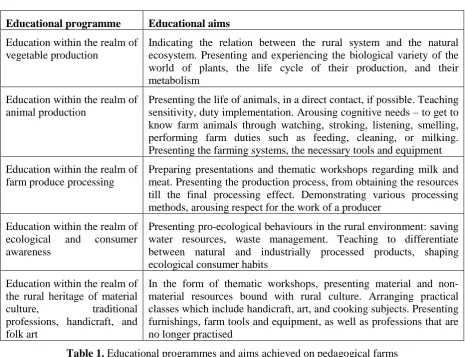
The very definition of a pedagogical farm was first developed for the purposes of the project. It indicates that a pedagogical farm is ‘an enterprise carried out by inhabitants of rural regions within these regions, achieving at least two educational aims out of the following: education within the realm of vegetable production; education within the realm of animal production; education within the realm of farm produce processing; education within the realm of ecological and consumer awareness; education within the realm of the rural heritage of material culture, traditional professions, handicraft, and folk art. The facility should possess farm animals or grow plants designed for being presented to groups of children and youth within the framework of school programmes or, as a tourist attraction, to families with children and individual adult travellers (Kmita-Dziasek 2011; Zagroda Edukacyjna n.d.).
As Kmita-Dziasek emphasizes (2011), each educational programme mentioned in the definition includes a focus on a widely understood community knowledge on the processes observed in the rural environment, which should translate into specific educational aims obtained with the use of the educational potential of a farm, as well as its natural and cultural environment.
Page 157 Educational programme Educational aims Education within the realm of
vegetable production
Indicating the relation between the rural system and the natural ecosystem. Presenting and experiencing the biological variety of the world of plants, the life cycle of their production, and their metabolism
Education within the realm of animal production
Presenting the life of animals, in a direct contact, if possible. Teaching sensitivity, duty implementation. Arousing cognitive needs – to get to know farm animals through watching, stroking, listening, smelling, performing farm duties such as feeding, cleaning, or milking. Presenting the farming systems, the necessary tools and equipment
Education within the realm of farm produce processing
Preparing presentations and thematic workshops regarding milk and meat. Presenting the production process, from obtaining the resources till the final processing effect. Demonstrating various processing methods, arousing respect for the work of a producer
Education within the realm of ecological and consumer awareness
Presenting pro-ecological behaviours in the rural environment: saving water resources, waste management. Teaching to differentiate between natural and industrially processed products, shaping ecological consumer habits
Education within the realm of the rural heritage of material culture, traditional professions, handicraft, and folk art
In the form of thematic workshops, presenting material and non-material resources bound with rural culture. Arranging practical classes which include handicraft, art, and cooking subjects. Presenting furnishings, farm tools and equipment, as well as professions that are no longer practised
Table 1. Educational programmes and aims achieved on pedagogical farms Source: Zagroda Edukacyjna n.d.
Among the most significant elements influencing the quality of the tourist product in the rural environment, there is the authenticity of what is being presented and of the way a specific heritage component is being shown (Richards 1996; Ivanovic 2008). The same applies to the educational activity in the rural environment. Therefore, those elements of the offer are emphasized which in a natural way maximize the opportunity to preserve authenticity when the product is passed on. This should also translate into its higher attractiveness. It is thus postulated that education should take place in a natural, free space, typical of rural activity. The key is to secure a direct contact with the everyday farm life, and to present equipment and techniques applied in agricultural production and farming.
Page 158
landscape. Achieving these aims requires an adjustment of the interpretation to specific technical conditions; that is why the whole unique didactic process must be suitably planned, and referred to the number and experience of the participants. In the interpersonal contacts, what is underscored is the warmth and patience in the educator’s attitude towards the recipients (in this case, the educator is most often the farmer). Also, freedom is important in the access to the direct experience in those parts of the farm that are appropriately adjusted. The very length of the presentation should be suitable both to the subject and to the specificity of the recipient group. Thus, an educational programme can last from one even to several hours. The offer may also be widened to a whole-day stay, which would include additional elements of fresh air recreation and a catering offer.
In 2015, the Polish Pedagogical Farm Network promoted offers of 181 members running their agricultural or agritourist farms. The unquestioned leader among the regions is the Dolnośląskie province. The 26 farms constitute 14% of the general number of registered entities. The next province, Małopolskie, is represented by 18 farms (10% of the general number). The third location belongs to the Pomorskie and Mazowieckie provinces together: 16 farms each (8% of the general number). The idea of pedagogical farms is the least popular in the Zachodniopomorskie province: only 5 farms (under 3%), and in the Łódzkie province: 6 farms.
The majority of the farms are small ones, with the area of 1–10 ha. These represent 75% of the whole number. Farms of less than 1 ha of arable land constitute 7%. Legally they are non-agricultural farms as for the Act on Social Insurance for Farmers, but conducting agricultural, gardening, or apicultural activity.
As for the profiles of agricultural production practised on pedagogical farms, according to the Network declarations for 2014, 82% conducted vegetable production, 65% – animal production, 43% – multidirectional activity, 17% – gardening, and only 13% – apiculture (note that a farm could declare more than one profile of agricultural production). Considering the declared achieving of the five educational aims enumerated in the pedagogical farm definition, the most popular in the fifth aim, i.e. education within the realm of the rural heritage of material culture, traditional professions, handicraft, and folk art. In is obtained by 74% of all the pedagogical farms. Education within the realm of ecological and consumer awareness holds the second position, being significant in the programme of 69% of farms. The third location is occupied by education within the realm of vegetable production (67% of the offered programmes). Slightly over 60% of farms conduct education within the realm of animal production, and the least popular is education within the realm of farm produce processing, (58% of the programmes) (Kmita-Dziasek et al. 2014).
3.2. Pedagogical farms in the region of Lower Silesia, Poland
The educational offer in the rural environment is most dynamically developed in Lower Silesia, outpacing even the pioneer of the realm, the Małopolskie province. The offer relatively proportionally covers the region, although there is a slight prevalence in the Sudety mountains and the foothills. One should emphasize, however, that almost each type of the rural landscape in Lower Silesia is represented in the Polish Pedagogical Farm Network (Oleśniewicz, Widawski & Markiewicz-Patkowska 2016). Also, all educational aims are achieved in the region, as depicted in the thematic workshops offered in the whole of 26 farms. Among the proposed subjects there are workshops in applying old tools in the production of bread or in apiculture, or presentations of no longer practised professions, such as blacksmithing.
Page 159
Figure 1. Achieving the educational aims on the Lower Silesian pedagogical farms
Source: own elaboration based on: Ogólnopolska Sieć Zagród Edukacyjnych. Katalog 2015 (2015)
The most popular among the enumerated aims, contrary to the general Polish tendency for 2014, is not education within the realm of vegetable production, but education within the realm of the rural heritage of material culture, traditional professions, handicraft, and folk art. Almost each farm offers a workshop referring to the rural heritage of material and non-material culture. Workshops in cultural elements or no longer existing professions belong to the standard. The farms also frequently offer presentations or exhibitions of old tools used in manufacturing various products based on farm produce. In this context, the score for educational programmes concerning farm produce processing is not surprising. This aim is obtained on almost 70% of farms. The most widespread subjects include also corn processing, and the programme under the common title ‘From the grain to the loaf’ can be regarded the most popular workshop referring to farm produce processing. Education within the realm of animal and vegetable production turns out an almost equally frequent didactic offer, as present in 54% and 50% of all farms, respectively. The significant aim of education within the realm of ecological and consumer awareness is represented by surprisingly few farms. Only 5 from among 26 centres in the region (less than 20% of the total number of farms) declare its implementation. One has to emphasize, however, that the research is based on data which were used to elaborate a catalogue highlighting mainly the aims constituting the grounds to prepare specific thematic workshops. Undoubtedly, shaping ecological and consumer awareness is an indispensable component of each programme bound with processing for the majority of farms. Probably it is as obvious that the need to underscore it explicitly has not been noticed.
4. CONCLUSIONS
Pedagogical farms, as a product present in the rural space for some time already, are significant for the environment for many reasons, which has been frequently emphasized by the authors of the idea. One could not agree more with this statement. The changes taking place in the contemporary world, resulting in pulling man out of their centuries-long habitat, make our community lose contact with what was still natural for the generation of our fathers. This phenomenon, apparently unavoidable, impacts our lives; it makes it easier technologically, but at the same time impoverishes the human being. The contemporary man, efficiently navigating through the virtual world, somewhere on the way of the civilizational hurry has lost values that had defined them for centuries. Surprisingly enough, seeking exoticism in remote parts of the world has suddenly stopped to be so urgent. It turns out that
13 14
18
5
23
0 5 10 15 20 25
Vegetable production
Animal production
Farm produce processing
Ecological and consumer awareness
Page 160
exoticism is at our fingertips, just behind the city gates, where whole worlds are waiting to be discovered anew. There, a cow giving non-UHT milk does not seem less strange than a zebra or a giraffe. There, in a way difficult to comprehend, bread does not land on market shelves. Corn must be transformed into flour first, the sourdough must be prepared, and the bread must taste differently. There, new words appear, and the older ones turn out impossible to understand. The rural environment does not provide answers to all civilizational problems, but offers an opportunity to come back, at least for a while, to the human roots. Therefore, the role of pedagogical farms as a new place of teaching about the past, about everyday life without a hurry, and about being bound with nature cannot be overestimated. If the product, didactic in its character, is suitably prepared, the result can take – and often takes – the shape of an attractive offer, a significant educational tool, and, at last, a valuable innovation, appreciated by tourists, harmonizing with the idea of sustainable development, and bringing satisfaction to all parts of the didactic process: tourists, students (for its cognitive importance), and promoters (for the economic significance).
REFERENCES
Beeton, S 2004, ‘Rural tourism in Australia – has the gaze altered? Tracking rural images through film and tourism promotion’, International Journal of Tourism Research, vol. 6, no. 3, pp. 125–35.
Beeton, S 2006, Community Development through Tourism, Landlinks Press, Collingwood.
Boniface, P 1998, ‘Tourism culture’, Annals of Tourism Research, vol. 25, no. 3, pp. 746–9.
Garrod, B & Fyall, A 2000, ‘Heritage tourism: a question of definition’, Annals of Tourism Research, vol. 28, no. 4, pp. 1049–52.
Ivanovic, M 2008, Cultural Tourism, Juta & Company Ltd., Cape Town.
Kmita-Dziasek, E 2011, Wprowadzenie do zagadnień edukacji w gospodarstwie rolnym, Centrum Doradztwa Rolniczego w Brwinowie Oddział w Krakowie, Kraków.
Kmita-Dziasek, E 2015, Koncepcja i funkcjonowanie Ogólnopolskiej Sieci Zagród Edukacyjnych, Krajowa Sieć Obszarów Wiejskich, Kraków.
Kmita-Dziasek, E, Kieljan, K, Klimowska-Bobula, E, Raciborski, J & Sajdera, J 2014, II Ogólnopolski
Zlot Zagród Edukacyjnych. Materiały informacyjne, Centrum Doradztwa Rolniczego w Brwinowie Oddział w Krakowie, Kraków.
Knudson, DM, Cable, TT & Beck, L 1995, Interpretation of Cultural and Natural Resources, Venture Publishing Inc., State College.
Kowalczyk, A 2001, Geografia turyzmu, Wydawnictwo Naukowe PWN, Warszawa.
Kruczek, Z, Kurek, A & Nowacki, M 2007, Krajoznawstwo: zarys teorii i metodyki, Proksenia, Kraków.
Lane, B 1994, ‘Sustainable rural tourism strategies: A tool for development and conservation’, in B Bramwell, B Labe (eds.), Rural tourism and sustainable development, Channel View Publications, Clevedon, pp. 102–11.
Majewski, J 2008, ‘Turystyka kulinarna i kreowanie marki obszaru’, Rocznik Naukowy Wyższej Szkoły
Turystyki i Rekreacji w Warszawie, vol. 7, pp. 127–32.
McKercher, B & du Cros, H 2002, Cultural Tourism: The Partnership Between Tourism and Cultural Heritage Management, Hayworth Hospitality Press, New York.
Ogólnopolska Sieć Zagród Edukacyjnych. Katalog 2015 2015, Krajowa Sieć Obszarów Wiejskich, Warszawa.
Page 161
Oleśniewicz, P, Widawski, K & Markiewicz-Patkowska, J 2016, ‘Atrakcyjność oferty zagród edukacyjnych w kontekście rozwoju agroturystyki’, Gospodarka Rynek Edukacja, vol. 17, no. 2, pp. 25–31.
Page, SJ & Getz, D 1997, The business of rural tourism: international perspectives, Alden Press, Oxford.
Raciborski, J 2011, Uwarunkowania formalno-prawne funkcjonowania gospodarstwa edukacyjnego, Centrum Doradztwa Rolniczego w Brwinowie Oddział w Krakowie, Kraków.
Richards, G (ed.) 1996, Cultural Tourism in Europe, CAB International, Wallingford.
Sethi, P 2005, Heritage Tourism, Anmol Publications Pvt. Ltd., New Delhi.
Sharpley, R 1996, Tourism and Leisure in the Countryside, ELM, Huntingdon.
Smith, S 1989, Tourism analysis: A handbook, Longman Scientific & Technical, Harlow, Essex, New York.
Tilden, F 1977, Interpreting our heritage, The University of North Carolina Press, Chapel Hill.
Urry, J 1995, Consuming places, Routledge, London.
Widawski, K 2010, ‘Perspektywy rozwoju agroturystyki w gminie Szczytna’, in D Knecht (ed.),
Uwarunkowania integracji w agroturystyce, Wydawnictwo Wyższej Szkoły Zarządzania „Edukacja”, Wrocław, pp. 15–29.
Widawski, K 2011, Wybrane elementy dziedzictwa kulturowego środowiska wiejskiego – ich
wykorzystanie w turystyce na przykładzie Hiszpanii i Polski, Rozprawy Naukowe Instytutu Geografii i Rozwoju Regionalnego Uniwersytetu Wrocławskiego no. 17, Uniwersytet Wrocławski, Wrocław.