STUDIES O OPTIMIZATIO OF FERMETATIO PARAMETER FOR PUFAs PRODUCTIO
Nakuleshwar D. Jasuja and Suresh C. Joshi*
Reproductive Toxicology Unit, Center for advanced studies, Department of Zoology, University of Rajasthan, Jaipur – 302055
*e-mail: [email protected]
Summary
The effects of culture condition, pH, salinity and carbon sources on the production of docosahexaenoic acid (DHA) were investigated. Monosaccharides (glucose) and acetic acid supported good cell growth and DHA yield. A high content of DHA was obtained from culture on glucose. Thraustochytrids, in particular Schizochytrium spp., were used for the production of the valuable polyunsaturated fatty acid (PUFA), docosahexaenoic acid (DHA; 22:6, n-3). Growth of Schizochytrium spp., in a defined medium was initially made in shake-flask cultures to determine the optimum concentrations of carbon (glucose) and nitrogen (NaCH3COO) that could be used by this microorganism. Fatty acid profile was affected by the different nutrient concentrations provided during fed batch culture. Consequently, lipid accumulation can be induced through the carbon and nitrogen source concentration in the medium to maximize the TFA (total fatty acid) and subsequently DHA productivity by this microorganism.
Key words: Docosahexaenoic acid (DHA), Monosaccharides, Polyunsaturated fatty acid (PUFA)
____________________________________________________________________________________________________ ______
*Correspondence to: Dr. Suresh C. Joshi, Associate Professor, 170, Vishwakarma Nagar-I, Maharani Farm, Durgapura, Jaipur (INDIA)-302018.
Introduction
Omega-3 highly unsaturated fatty acids (HUFAs) particularly the very long chain ones of
eicosapentaenoic acid (EPA; 22:5, n - 3) and docosahexaenoic acid (DHA; 22:6, n - 3), are of significant
commercial interest as important dietary compounds for preventing abnormalities in immune system,
inflammatory system, endocrine system, nervous system, arteriosclerosis and coronary heart disease, for
alleviating inflammatory conditions and for retarding the growth of tumor cells (1,2,3). DHA is regarded
to be essential for the proper visual and neurological development of infants, because of its role as a
structural lipid component (4, 5, 6). DHA supplementation of juice at either 50 mg/day or 100 mg/day for
6 weeks was effective in increasing plasma phospholipid DHA contents of children (7). A high content of
DHA in the brain and retina is important for proper nervous and visual function (8, 9). Long chain ω-3
polyunsaturated fatty acids can act as breast and colon cancer chemopreventive agents (10, 11).
Docosahexaenoic acid (DHA) and arachidonic acid (ARA) are produced exclusively from
microorganisms Schizochytrium sp. is a marine thraustochytrids that synthesizes polyunsaturated fatty
acids in which the valuable dietary docosahexaenoic acid (DHA; 22:6, n−3) represents 30–40% of the
total fatty acids (12,13). In present investigation lipid and docosahexaenoic acid (DHA) accumulation into
Schizochytrium spp. SC-I was studied under fed batch culture. Different incubation and nutrients were
supplemented in a defined medium. The whole biomass of this organism may also be useful for the
development of aquafeeds for farmed fish, which require a source of DHA for the development of fish fry
(14, 15).
The strain Schizochytrium sp. SC-I was obtained from Regional
Research Laboratory, Jammu Tawi (CSIR Lab., RRL, J&K, INDIA).
The strain was maintained on nutrient agar plates by streaking as tree
like manner as mentioned in fig. 1.1 and subcultured after every five
days. The isolation medium was modified (16) & consisted of glucose
20 g/L, KH2PO4 0.25 g/L, yeast extract 5 g/L, peptone 5 g/L, agar 2%,
Seawater1000 ml, penicillin solution3 µg/ml, streptomycin solution 3
µg/ml, pH 7.0. All ingredients except antibiotic solutions were mixed
and autoclaved. After autoclaving antibiotic solutions were added
through micro filter. Above medium was poured on sterile petriplates, streaked and incubated for 24 hrs at
30oC.
Preparation of seed flask:
Seed flask was prepared for fermentation process using production medium (M4) consisting glucose 20g/L,
KH2PO4 0.25 g/L, yeast extract 10 g/L, peptone 10 g/L, sea salt 35 g/L., then autoclaved and inoculated with
culture suspension harvested from agar petriplate. This flask was then kept on rotary shaker (210rpm) for 24
hrs at 30oC.After 24 hrs seed flasks were used for inoculation.
Biomass production and lipid extraction
After desired incubation period the culture broth from each flask was harvested separately by centrifugation at
8000 rpm for 10 min at 200C. Pellet and supernatant were separated. Weighing of the pellet was done for wet
biomass estimation.
Ethyl acetate and methanol solvent system
Culture broth was centrifuged at 8000 rpm for 10 min at 20oC. 10ml methanol was added to pellet and
maceration was done in pester motor. 20ml ethyl acetate was added in the separating funnel and shacked
vigorously. After the separation of upper layer containing ethyl acetate, again 20ml ethyl acetate was added to
lower layer and shacked vigorously. This process was repeated twice. Around 2-3 gm sodium sulphate was
added to the polled upper layer. The above solution was filtered and distilled on rotor vapor at 45-65oC. The
oil obtained was dissolved in 1ml of hexane and transfer to a pre weighed vial. The vial was kept open
overnight for complete evaporation of solvent and weight of the lipid was taken.
Fig. 1.1. Petriplates
showing 24 hrs and 120
Production of DHA on different fed-batches
a) Glucose Fed Batch
100ml of autoclaved media consisting glucose 20g/L, KH2PO4 0.25 g/L, yeast extract 5 g/L, peptone 5 g/L,
inoculum’s volume 10%, sea salt 35 g/L. was taken in 500ml of flask.10% inoculum’s was added in each flask
from seed flask. After inoculation all flasks were kept on rotary shaker and incubated at 300C. Glucose 10g/L
was added after every 24 hrs and after 72, 96, 120 hrs experiment was terminated.
b) Acetic acid Fed Batch
Fed batch was done with acetic acid to production medium flask containing glucose as carbon source at
concentration of 10 ml/l after each 24 hrs. Experiment was terminated on 48, 72, 96, 120 and 144 hrs and
extraction of lipid was done as described above.
c) Sodium acetate Fed Batch
Fed batch was done with sodium acetate to production medium flask containing glucose as carbon source at
concentration of 10g/l after each 24 hrs. i.e glucose was replaced with sodium acetate as a carbon source.
Experiment was terminated on 96, 120 and 144 hrs and lipid was extracted and analyzed.
Effect of Sodium sulfate on production of DHA
100ml of autoclaved media containing glucose 20g/L, KH2PO4 0.25 g/L, yeast extract 10 g/L, peptone 10 g/L,
sodium sulfate 5 g/L. was taken in 500ml of flask. Glucose fed batch was done to respective flask at
concentration of 2% after every 24 hrs. Experiment was terminated on 72, 96, 120, 144 and 168 hrs and
extracted as described above.
Effect of Incubation time on DHA production
Glucose Fed batch was done at concentration of 2% after every 24 hrs.Experiment was terminated on 120,
144, 172, 198 and 216 hrs and extracted out.
Optimization of pH for DHA production
Different initial medium pH used were 4, 5, 6, 7, 8, 9, and 10. M4 medium was prepared in phosphate buffer.
pH above 7.7 and below 6.1 were adjusted using NaOH (1 N) and HCl (1 N) respectively. Glucose Fed batch
Results
Production of DHA by fed-batch glucose at shake
flask level
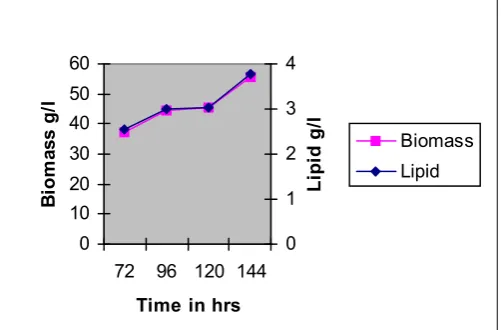
Fig.1.2 shows that the production of DHA and
biomass by fed batch glucose at shake level was
higher at incubation of 120 and 144 hrs. Incubation at
72 and 96 hrs had given significant production of
DHA. Carbon source is necessary for any organism to
survive and have a great impact on the lipid
production, when used in various concentrations and
also mode of addition.
Effect of acetic acid fed batch on biomass and lipid production
At the incubation of 144 hrs in presence of Acetic acid
as carbon source the biomass increases but cell count
was reduced. There was no tremendous change in lipid
production between incubation periods of 96, 120 and
144 hrs. It was thought that instead of glucose, acetic
acid may incorporate in the medium as a source of
acetyl-CoA to increase the yield of PUFAs. But contrary
to that when acetic acid was incorporated in medium
both the biomass and lipid yield decreased markedly.
This may be due to the pH effect that acetic acid
decreased the pH of the medium to as low as 3.3 and
hence created the unfriendly environment for the organism to grow effectively and hence lipid production was
also low. 0 10 20 30 40 50 60
72 96 120 144
Time in hrs
B io m a s s g /l 0 1 2 3 4 L ip id g /l Biomass Lipid
Fig. 1.2. Production of Lipid by SC-1 at different time intervals
0 10 20 30 40
24 72 96 120144 Time in hrs
B io m a s s g /l 0 0.5 1 1.5 2 L ip id g /l Biomass Lipid
Effect of sodium acetate on biomass and lipid production
In continuation to the above experiment sodium acetate
was incorporated in the medium as a source of
acetyl-CoA.
As the organism of interest was of marine origin, it was
necessary that the medium contain sodium so that
marine environment can be created for the proper
growth. But sea salt, which was normally being used,
was around 35 g/l and hence owing to its high
concentration was not environmental friendly. So as an
alternative to sea salt, sodium acetate (5 g/l) was used as a source for sodium ions.
Effect of sodium sulfate when used in place of sea salt on biomass and lipid production
The lipid production was very less from
incubation period of 72 hrs to 144 hrs but after
144 hrs, the cell counts were increased double
and lipid production was four fold at 168 hrs.
0 20 40 60 80
96 120 144 Time in hrs
B io m a s s g /l 0 0.5 1 1.5 2 2.5 L ip id g /l Biomass Lipid
Fig.1.4. Graph showing effect of
sodium acetate 0 10 20 30 40 50 60 70
72 96 120144168
Time in hrs
B io m a s s g /l 0 0.5 1 1.5 2 2.5 3 L ip id g /l Biomass Lipid
Fig. 1.5. Graph showing effect of sodium
Effect of Incubation time and glucose fed batch on
biomass and lipid production
Effect of prolonged incubation period was studied by
increasing the incubation period up to 216 hrs. Due to
increase in the incubation period, the lipid
accumulation was maximum than before reaching up
to 6.7 g/L indicating that continuous glucose supply
was utilized efficiently by the organism for lipid
production.
Optimization of initial medium pH for the production of biomass and lipid
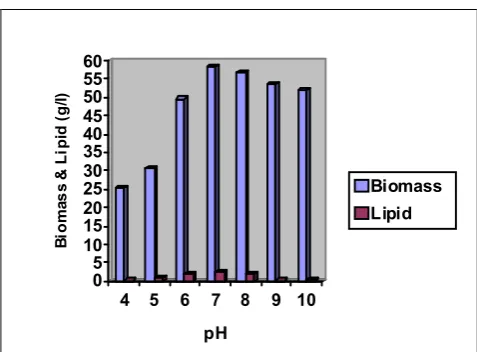
The more productive culture conditions for DHA
production by SC-1 in this work was obtained at initial
pH of 7.0 with 20 g L−1glucose at 8-day incubation.
Discussion
This research work tried to maximize DHA yield from oleaginous microorganism by optimization of glucose
concentration, giving different carbon source, fed batch acetic acid and fed batch glucose in optimal conditions.
In this study it was found that instead of taking initial high concentration of glucose, addition of glucose in
batches enhances the accumulation of lipid. As evident from the residual sugar estimation (17) that the
supplied glucose is consumed within 24 hrs, fed batch of glucose enhanced the lipid production.
When supplying the acetic acid as carbon source in place of glucose, the biomass increases but lipid
0 20 40 60 80 100
120 144 168 216 time in hrs
B io m a s s g /l 0 2 4 6 8 L ip id g /l Biomass Lipid
Fig 1.6. Graph showing effect of incubation time
Fig. 1.7. Graph showing effect of different initial medium pH
0 5 10 15 20 25 30 35 40 45 50 55 60 B io m a s s & L ip id ( g /l )
4 5 6 7 8 9 10
pH
When as an alternative to sea salt, sodium acetate (5 g/l) was used as a source for sodium ions high biomass
was obtained (60 g/l) but the lipid accumulated was not adequate when compared to biomass. When sodium
acetate was replaced by sodium sulfate there was tremendous change in lipid production at 168hrs incubation.
The lipid content increases to four fold as compare to sodium acetate. Incubation period is very important for
any fermentation process. When studied the effects of incubation time with glucose fed batch on lipid
production it was found that productivity increases as the incubation time increases.
The results presented in this study illustrated that the organism's growth, the lipid profile and the fatty-acid
profile of SC-I can be enhanced by adjusting cultivation time, initial pH and medium composition. The
dynamic interactions among the growth, fatty acid synthesis and nutrient limitation result in significant
variation in the biomass and lipid production.
References
1. Linko YY, Hayakawa K. Docosahexaenoic acid: A valuable nutraceutical? Trends food Sci Technol 1996; 7: 59-63.
2. Sauer LA, Dauchy RT, Blask DE. Polyunsaturated fatty melatonin, and cancer prevention. Biochem Pharmacol 2001;61: 1455-1462. 3. Sinclair AJ, Attar-Bashi N, Jayasooriya A, Gibson RA, Makrides M. Nutritional aspects of
single cell oils: Uses and applications of arachidonic acid and docosahexaenoic acid. AOCS Press 2005; 182–201 chapter in Book.
4. Nettleton JA. Are n-3 fatty acids essential nutrients for fetal and infant development? J Am Diet Assoc1993; 93:58–64.
5. Crawford MA, Costeloe K, Ghebremeskel K, Phlactos A, Skirvin L, Stacey F. Are deficits of arachidonic and docosahexaenoic acids responsible for the neural and vascular complications of pre-term babies? Am J Clin Nutr 1997; 66:1032S–1041S.
6. Das UN, Fams MD. Long-chain polyunsaturated fatty acids in the growth and development of the brain and memory. Nutrition 2003; 19:62–65.
7. Hawthorne KM, Abrams SA, Heird WC. Docosahexaenoic acid (DHA) supplementation of orange juice increases plasma phospholipid DHA content of children. J Am Diet Assoc2009;109(4):708-12.
8. Simpoulos AP, Kifer RR, Martin RE. Health Effects of Polyunsaturated Fatty Acids in Seafoods. Orlando, FL, Academic Press 1986.
9. Metha L, Lopez LM, Lowton D, Wargovich T. Dietary Supplementaion with omega-3 Polyunsaturated Fatty Acids in patient stable coronary disease: effects on indices of platelet and neutrophil function and exercise performance. Am J Med 1988; 84: 45-51.
11. Rose DP, Connolly JM. Omega-3 fatty acids as cancer chemopreventive agents.Pharmacol Ther 1999; 83: 217-244.
12. Yokochi T, Honda D, Higashihara T et al. Optimization of docosahexaenoic acid production by Schizochytrium limacinum SR21. Appl Microbiol Biotechnol 1998; 29:72–76
13. Wynn JP, Ratledge C. Microbial oils: production, processing and markets for specialty long-chain omega-3 polyunsaturated fatty acids. In: Breivik H (ed) Long-long-chain omega-3 specialty oils. The Oily Press Bridgwater, 2007; 43–72.
14. Izquierdo MS. Essential fatty acid requirements in Mediterranean fish species. Cah Options Mediterr 2005; 63: 91–102.
15. Ganuza E, Benı´tez-Santana T, Atalah E, et al. Crypthecodinium cohnii and Schizochytrium sp. as potential substitutes to fisheries derived oils in Sparus aurata microdiets. Aquaculture 2008; 277: 109-116.
16. Bajpai PK, Bajpai P, Ward OP. Optimization of production of docosahexaenoic acid (DHA) by Thraustochytrium aureum ATCC 34304. J Am Oil Chem Soc1991; 68: 509-514.