A Survey Paper On A Novel Approach For Image
Classification Based On SUSAN Low Level
Image Processing Algorithm From Real Time
Video
Shafiqua T. Pathan, Sharyu S. Waghmare, Pranali P. Khadse, Pratik P. Shukla, Shrikant A. Wawre
Abstract: This survey paper basically focuses on the design approach of a security system based on the modern Digital Image Processing techniques. We can detect and classify an image feature using the Image Processing Technique. This paper explains a way to process a video from any video device such as CCTV, Mobile Camera, etc. Firstly, we will obtain continuous frames from the video and then apply all the image processing techniques on the frame. After applying basic image preprocessing, the image will be again processed with SUSAN (Smallest Univalue Segment Assimilating Nucleus) to extract certain kinds of features and infer the contents of an image. The extracted features data then compared with the data stored in standard database and can be classified.
Index Terms: Artificial Intelligence, Corner detection, Digital Image Processing, Edge detection, OpenCV, Security, SUSAN
————————————————————
1
I
NTRODUCTIONSECURITY at public places such as Airport, Railway Station is always a big issue for security concern since the terrorist threats have increased at such places nowadays. From small cities to big metropolitans, one can’t assure that he is secure at the Railway station or at the Airport. These public places have been always targeted for unsocial causes such as bombing or mass killing as these places can insure maximum damage to the health and power of a nation. These places are always targeted as the security at such places is comparatively low so one can do what he wish to do there. So to fight this issue we finally moved towards the latest technology and a result of this we installed CCTV’s, X-RAY scanners, Metal Detectors at such places. Now, though we are powered with such modern technologies we are unable to manage these issues and the reason for this is that we are not fully utilizing the current available technologies.
One of the promising field at such issues is the Digital Image Processing through which we can enhance the power of present security system and subsequently reduces the threat level. One of the solution for this is that we should continuously adopt for the new technologies so that the threat level is always minimized. Like the public places there are some other places such as historical and ancient jewels museum, the banks, the big corporations and the big companies always have the threat of being robbed or being attacked by anti-social peoples. We have CCTV’s, surveillance cameras everywhere but less man power to supervise this system and even though we will have enough man power then also it is not possible to supervise perfectly. As a result we are not perfectly secured but still thinking that we are secured. Digital Image Processing provides a solution for all these issues. Nowadays, everywhere we see Mobile cameras, CCTV’s, Digital Cameras, Handycams, etc. The number of captured images from these devices are huge and monitoring all these images simultaneously is impossible by a human being. That’s why using the existing system of surveillance cameras or any other image capturing digital device, we can analyze the data digitally for a particular feature such as a Gun or any other object. The computer System can process vast amount of image data very quickly. It will be very helpful if a computer can be played a role to classify a gun image or similar object.
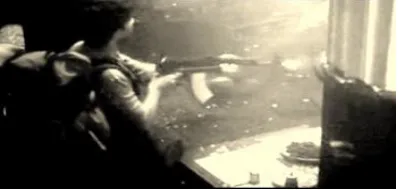
Fig. 1. A Sample Image from a CCTV
According to the author, an image database preparation can be divided into 2 groups; a model image and an experiment image. Then, all images will be processed preparation by ___________________________
Shrikant A. Wawre is currently pursuing Bachelor of Engineering degree program in Computer engineering in RTMNU Nagpur University, INDIA, PH-+919730129694. E-mail: [email protected]
Pratik P. Shukla is currently pursuing Bachelor of Engineering degree program in Computer engineering in RTMNU Nagpur University, INDIA, PH-+919975181284. E-mail: [email protected]
Shafiqua T. Pathan is currently pursuing Bachelor of Engineering degree program in Computer engineering in RTMNU Nagpur University, INDIA, PH-+919860498742. E-mail: [email protected]
Sharyu S. Waghmare is currently pursuing Bachelor of Engineering degree program in Computer engineering in RTMNU Nagpur University, INDIA, PH-+919960266198. E-mail: [email protected]
Pranali P. Khadse is currently pursuing Bachelor of Engineering degree program in Computer engineering in RTMNU Nagpur University, INDIA,
preprocessing of scale and gray scale to process data finding out the image detection quicker. Then the image detection by Canny compared with other methods. The method of Canny will provide high definition and utilize for small color difference. After getting the image detection, a line of the image detection need to be found and examined a corner by SUSAN (Smallest Univalue Segment Assimilating Nucleus ). Density of SUSAN will be used for arranging parameter. It is a basic and easier than other algorithms. Then, the line and corner will be examined similarity between a model block and a tested image. Determining a block size to be differing from a block size effects to the processing time and accuracy of the image classification. A result from a block comparison will be a match point and AVG similarity of the image which compared with the image model will be recorded in a database. If an average of similarity shown at the image with highest value will be the Gun's Type of such model as a research's objective. A researcher hopes that the development of the image recognition system will be useful to guide the research study and other fields in the future[1].
2
L
ITERATURER
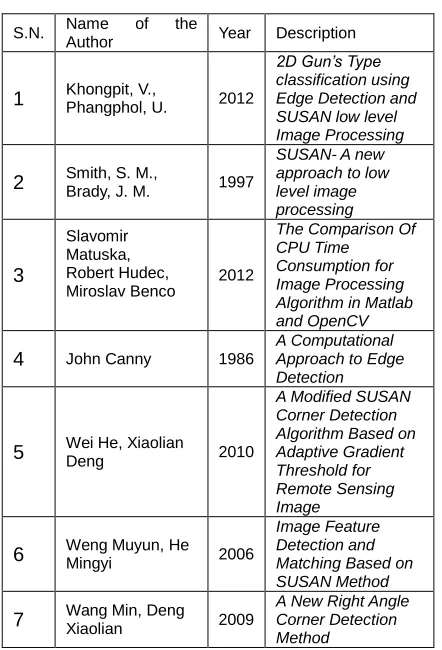
EVIEWWe have referred various papers published by different researchers in the international conferences and journals. All these papers described the basic ideas and concepts which we are implementing through our paper. The various literature papers are as:
Table 1.1 Literature Review
S.N. Name Author of the Year Description
1 Khongpit, V., Phangphol, U. 2012
2D Gun’s Type classification using Edge Detection and SUSAN low level Image Processing
2 Smith, S. M., Brady, J. M. 1997
SUSAN- A new approach to low level image processing 3 Slavomir Matuska, Robert Hudec, Miroslav Benco 2012
The Comparison Of CPU Time Consumption for Image Processing Algorithm in Matlab and OpenCV
4 John Canny 1986
A Computational Approach to Edge Detection
5 Wei He, Xiaolian Deng 2010
A Modified SUSAN Corner Detection Algorithm Based on Adaptive Gradient Threshold for Remote Sensing Image
6 Weng Muyun, He Mingyi 2006
Image Feature Detection and Matching Based on SUSAN Method
7 Wang Min, Deng Xiaolian 2009
A New Right Angle Corner Detection Method
The first literature paper describes the approach to detect and classify a 2D gun image using edge detection and SUSAN low level image processing. The authors have experimented and
obtained the results at the accuracy of 99.06%. The second and subsequent all the papers describes various methods of Image Processing such as edge detection, corner detection and feature extraction. We can implement all these research work to solve our issues.
3
R
ELATEDW
ORKThe related work in the Image Processing using SUSAN corner detection algorithms according to various research papers are as follows:
1. In the year 2010, the paper published in International Conference on Optoelectronics and Image Processing describes a modified SUSAN corner detection algorithm based on adaptive gradient threshold for remote sensing image. It can improve computing speed and reduce false points [5].
2. The paper published in ICICIC 2006 presented a new image feature matching algorithm which employs NMI (Normalized Moment of Inertia) in combination with area, perimeter, and intensity information based on SUSAN edge detection to complete recognition and tracking for a target. [6].
4
A
LGORITHMS4.1 Canny Edge Detection
The edge detection process serves to simplify the analysis of images by drastically reducing the amount of data to be processed, while at the same time preserving useful structural information about object boundaries [4]. The Canny edge detector is an edge detection operator that uses a multi-stage algorithm to detect a wide range of edges in images. It was developed by John F. Canny in 1986. Canny also produced a computational theory of edge detection explaining why the technique works.
4.1.1 Smoothing
Because the Canny edge detector is susceptible to noise present in raw unprocessed image data, it uses a filter based on a Gaussian (bell curve), where the raw image is convolved with a Gaussian filter.
(1)
Where, σ is standard deviation.
4.1.2 Gradient Calculation
An edge in an image may point in a variety of directions, so the Canny Algorithm uses four filters to detect horizontal, vertical and diagonal edges in the blurred image. From this the edge gradient and direction can be determined:
. (2)
. (3)
4.1.3 Non-Maximum Suppression
Given estimates of the image gradients, a search is then carried out to determine if the gradient magnitude assumes a local maximum in the gradient direction. From this stage, a set of edge points, in the form of a binary image, is obtained. These are sometimes referred to as "thin edges".
4.1.4 Thresholding
Large intensity gradients are more likely to correspond to edges than small intensity gradients. It is in most cases impossible to specify a threshold at which a given intensity gradient switches from corresponding to an edge into not doing so. Therefore Canny uses thresholding with hysteresis. Even though the image has passed the smoothing process, it is possible that the image still has inexact edges due to the noise or the surface with so many details. In order to solve this problem, the thresholds will be added covering the upper threshold ( Tl ) and the lower threshold (T2). If value of the pixel is higher than Tl, it will be adjusted to be 1 ( the edged pixel). In contrast, pixel is lower than T2 will be adjusted to be O. For the value between the two thresholds, the way to adjust to be 0 or 1 depends on the surrounding pixels. If the pixels around the edged pixel (value >Tl ) is higher than T2 , value of the pixel should be 1, as same as in the edged pixel [1].
Fig. 2. Canny Edge Detection of Sample Image
4.2 SUSAN Corner Detection
Corner detection is an approach used within computer vision systems to extract certain kinds of features and infer the contents of an image. Corner detection is frequently used in motion detection, image registration, video tracking, panorama stitching, 3D modelling and object recognition. SUSAN is an acronym standing for Smallest Univalue Segment Assimilating Nucleus. This method is the subject of a 1994 UK patent which is no longer in force. For feature detection, SUSAN places a circular mask over the pixel to be tested (the nucleus). The region of the mask is Μ, and a pixel in this mask is represented by . The nucleus is at . Every pixel is compared to the nucleus using the comparison function:
. (4)
Where 't' determines the radius, and the power of the exponent has been determined empirically. This function has the appearance of a smoothed top-hat or rectangular function. The area of the SUSAN is given by:
. (5)
If 'c' is the rectangular function, then 'n' is the number of pixels in the mask which are within 't' of the nucleus. The response of the SUSAN operator is given by:
. (6)
Where 'g' is named the `geometric threshold'. In other words the SUSAN operator only has a positive score if the area is small enough. The smallest SUSAN locally can be found using non-maximal suppression, and this is the complete SUSAN operator. The value 't' determines how similar points have to be to the nucleus before they are considered to be part of the univalue segment. The value of 'g' determines the minimum size of the univalue segment. If 'g' is large enough, then this becomes an edge detector. For corner detection, two further steps are used. Firstly, the centroid of the SUSAN is found. A proper corner will have the centroid far from the nucleus. The second step insists that all points on the line from the nucleus through the centroid out to the edge of the mask are in the SUSAN.
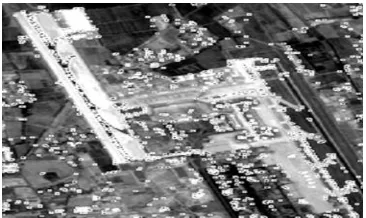
Fig. 3. SUSAN Corner Detection [5].
5
P
ROPOSEDW
ORKVideo from a Camera
Obtaining frames from video
Basic Image Preprocessing
Edge Detection
SUSAN Corner Detection
Feature Detection
Feature Matching
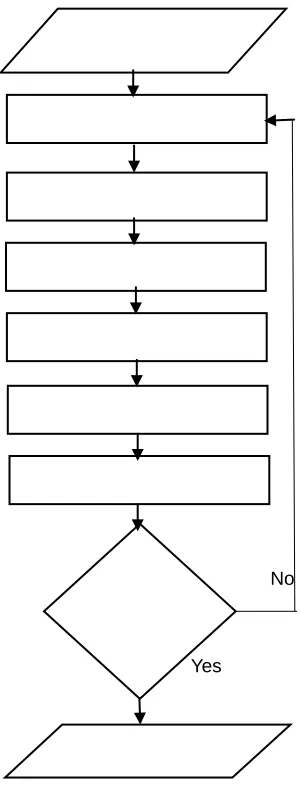
Alert…!!! Is Feature Matched? proposed work can be shown as:
No
Yes
Fig. 4. Flowchart of Design
6
F
UTUREW
ORKThis system can be extended to recognition of various features such as Face Detection. The location of the place can be traced from where the alert has been obtained. SMS or Alarm system can be employed if a particular feature is obtained. This will effectively reduce the crimes and provide an immediate response system at emergency. Together all this technology features forms a basis of improved security systems. In future, efficient Image Processing tools will change the face of this security system.
7
C
ONCLUSIONWe have proposed a security system which is automated and can be used to detect various features from a video to reduce the security issues at places like Airport, Bank, Railway Station, Office, Colleges, Hotels, etc. where an individual person cannot observe every CCTV camera output. The Canny Edge detection method is more accurate than other methods and SUSAN corner detection algorithm can be used as it involves less calculation complexity and easier than other techniques. The feature can be detected and required output can be produced at faster rate. If different sensors and
advanced technologies are used then the output from this system will be more reliable.
A
CKNOWLEDGMENTThe authors wish to thank A, B, C. This work was supported in part by a grant from XYZ.
R
EFERENCES[1] Khongpit, V., Phangphol, U., “2D Gun’s Type classification using Edge Detection Algorithm and SUSAN Low Level Image Processing”, International Conference for Internet Technology and Secured Transactions, Dec 2012, pp. 520-523.
[2] S. M. Smith, J. M. Brady, “SUSAN-a new approach to low level image processing,” International Journal of Computer Vision, vol. 23, 1997, pp. 45—78.
[3] Slavomir Matuska, Robert Hudec, Miroslav Benco, “The Comparison Of CPU Time Consumption for Image Processing Algorithm in Matlab and OpenCV”, IEEE 2012, pp. 75-78.
[4] Canny, J. F., “A Computational Approach to Edge Detection”, Pattern Analysis and Machine Intelligence, vol. 8 - no. 6, November 1986, pp.679 -698.
[5] Wei He, Xiaolian Deng, “A Modified SUSAN Corner Detection Algorithm Based on Adaptive Gradient Threshold for Remote Sensing Image”, International Conference on Optoelectronics and Image Processing, 2010, pp. 40-43.
[6] Weng Muyun, He Mingyi, “Image Feature Detection and Matching Based on SUSAN Method”, Proceedings of the First International Conference on Innovative Computing, Information and Control, 2006.
[7] Wang Min, Deng Xiaolian, “A New Right Angle Corner Detection Method”, International Conference on Artificial Intelligence and Computational Intelligence, 2009, pp. 28-30.
[8] M. Ben Hmid, Y. Ben Jemaa, “Fuzzy Classification, Image Segmentation and Shape Analysis for Human Face Detection”, ICSP2006 Proceedings, 2006.
[9] Mahesh, Subramanyam, M. V., “Automatic Image Mosaic System Using Steerable Harris Corner Detector”, IEEE, 2012, pp. 87-91.
[10] Hang-Ki Ryu, Jae-Kook Lee, Eoun-Taeg Hwang, Liu Jing, Hong-Hee Lee, Won-Ho Choi, “A New Corner Detection Method of Gray-Level Image Using Hessian Matrix”, IEEE, 2007, pp. 537-540.
[11] A de Carvalho, M. C. Fairhurst, D. L. Bisset, “Integrated Boolean Neural Networks for Feature Extraction and Image Classification”, 1992, pp. 2.1-2.3.
[13] The OpenCV Tutorials, Release 2.4.6.0, http://docs.opencv.org/opencv_tutorials.pdf, July 1, 2013.
[14] Wikipedia Online Documentation on Corner Detection, http://en.wikipedia.org/wiki/Corner_detection.
[15] Wikipedia Online Documentation on Edge Detection, http://en.wikipedia.org/wiki/Edge_detection