Corresponding Author: Wong Wai Loong, National Defence University of Malaysia, Kuala Lumpur, +60 012-3837041 e-ISSN: 2600 - 9056
© RMP Publications, 2018 DOI: 10.26666/rmp.jssh.2018.6.4
Implementing Quality Management in Organisation:
An Introduction to Six Sigma Methodology
W.L.Wong1, Jessica Ong Hai Liaw1
1Faculty of Defence Studies and Management, National Defence University of Malaysia,
Malaysia.
Abstract: The quality management concept had been well accepted by many majo r
organisations which include manufacturing, production, services, defenc e and security. Presently, most organisations focus on quality management as priority in order to remain competitive with its competitors. One of the quality management concept which is the Six Sigma is widely adopted by organisation s globally. Six Sigma is known as a database methodology to improve performance by reducing variability. It requires thorough understanding of product and process knowledge and is completely driven by customer expectations. Motorola adopted the Six Sigma methodology in 1981 and was successful in improving its performance and quality of its products. Subsequently, General Electric (GE) adopted the Six Sigma in 1995 and made it as the culture in its organisation. GE manages to achieve huge profit and suc cess by implementing Six Sigma. By mapping Motorola and GE’s success as a model, this study will provide an insight on introducing the six sigma methodology into an organisation. The discussion will focus on the evolvement of quality management over the years and link past ideas to the current thinking about quality management . It will also briefly elaborate on the best practice to implement Six Sigma into an organisation.
Key words: Quality Management, Six Sigma, Quality, Product, Customer and Customer Satisfaction
Background
In the current competitive market, the demands of customers are increasing and challenging as they require improved quality of products and services. Hence, this has caused the quality concept to evolve over the years to cater for those desired demand for products and services. Joseph Juran defines quality as “fitness for use in terms of design, conformance, availability, safety, and field use” [1]. Peter Drucker mentioned that management involves the people. His definition for management is that “Management is the art of getting things done through and with people in formally organised groups” [2]. Hence, organisations focus on quality management as priority in order to remain competitive with its competitors. Therefore, by looking at the history of quality management, it can provide organisations with ideas from the past to deal with the current thinking about quality management.
The History of Quality Management
In this section, the discussion on history of quality management can be traced back by dividing into the pre-industrial era and industrial era.
Pre-Industrial Era
inspect and test products through sound, smell, touch and looking at it before buying them to avoid buying poor quality products. The concept of quality during this time is seen to be related to basic human senses. As for the craftsmen, they were producing high quality products to safeguard their reputation since most of the buyers are also living in the same village as they do. These villages were soon turned into big towns due to development and enhanced transport system. This prompted the growth of commerce and expansion of trading between regions. During this period, the buyers bought products through merchandisers and not direct from the producer (craftsmen). With this taking place, the quality protection of products were reduced and required a quality warranty as an alternative for quality assurance [5]. Most producers were concerned and gave priority to the quality of its product. This quality warranty includes warranty implied by laws and warranty provided by the producers and guilds. Due to this, the specifications of quality were addressed by producers and sellers by establishing the test and inspection specification to avoid differences between them [6].
Industrial Era
During industrial era, many factories were set up to increase productivity and the development of modern mechanical machinery and new technology contributed to the growth of factories. The industrial era require more complex processes and quality concept to meet the demand of mass production. As a result of this, “basic quality practices such as sampling inspection, the use of statistical methods within a framework of scientific management, standardization and a functionalisation of the discipline was developed” [7]. The framework of scientific management had an impact on the organisation structure and working environment. Under this framework, the aspect of quality
emphasise on quality control. By comparing with the pre-industrial era, the quality assurance is now being shifted back to the producers instead of the buyers (customers). In 1910s, Ford Motor Organisation initiated quality inspection on its car to determine the quality. Those cars with poor quality were sold at a lower price, write off and modified [8]. During the period of 1920s and 1930s, Walter A. Shewhart developed Statistical Quality Control to “identify problems earlier and control the manufacturing process, instead of rejecting or repairing afterwards” [9]. In 1924, Shewhart invented the control chart to prevent non-conforming items being produced. In 1950, the Deming Cycle of quality control was introduced to examine business processes to identify the sources of deviation by placing it in a continuous feedback loop for managers to identify faults and improve the processes as required [10]. The Juran Trilogy was established in 1951 focussed on quality planning, quality control and quality improvement. According to Juran, he emphasizes the “importance of system thinking and laid the foundation for transition from Statistical Quality Control SQC to Total Quality Control (TQC) in Japan” [11]. Feigenbaum introduced the concept of Total Quality Control requiring the involvement of all functional areas of the organisation to manage the quality of manufactured products. According to him “The underlying principle of total quality control is that, to provide genuine effectiveness, true quality control management must start with the design of the product and end only when the product has been placed in the hands of the customer who has remained satisfied…(thus) quality is everybody's job in a business” [12]. As for quality assurance, it concentrates on pre-production activities and relies on quality standards and directives. This can provide support to processes by reducing errors and risk of failures. The development of quality discipline in the 20th century can be illustrated in Figure 1.
Figure 1: The Development of Quality Discipline in the 20th Century. Quality
Inspection
Quality Control
Total Quality Control
The summary for timeline on the evolution of quality management can be illustrated in Figure 2.
Figure 2: Timeline on the Evolution of Quality Management. Source: [14]
Linking Past Ideas to the Current Thinking about Quality Management
The past ideas of quality management were influential to the current thinking about quality management. The current quality management scope focussed on customer satisfaction, continuous improvements, eliminating waste, cost reduction, process focussed and knowledge workers [15]. The World War 2 (WW2) contributed significantly in shaping the thinking about management. This was obvious in Japan’s approach on quality until present when the country was mostly destroyed during WW2. Japan need to redevelop the country from scratch and had to depend on its own industrial creativeness to reconstruct her economy. The Japanese decided to use quality improvement and management as the platform for this purpose where they invited quality gurus such as Deming and Juran to assist and taught them on quality control methods. The Japanese effort was successful by integrating quality control with management science and engineering technology to emphasise on Total Quality Control. The idea on Statistical Quality Control (SQC) is widely adopted into current quality philosophies such as Total Quality Control (TQC), TQM is a methodology used to manage work processes according to the organisation vision and strategies. According to Kim, he defines TQM as “a corporate culture that is characterized by increasing customer satisfaction through continuous improvements involving all employees in the organization” [16]. The Six Sigma methodology involves application of statistical for process improvement. Knowledge management (KM) is essential to improve organisation effectiveness and efficiency through intellectual. The success of achieving quality in organisation can be indicated by KM. KM can be supported by the quality principles
which include a focus on process, employee participation, continuous improvement, measurement and standardization [17].
Introducing Six Sigma Methodology
Firstly, the role of the champion needs to be look at to provide an overview to the organisation before introducing the six sigma methodology. The champion plays a significant role in ensuring success in Six Sigma. The roles of a champion are as follows [18]:
a. To remove roadblocks and initiate Six Sigma projects.
b. Assess potential projects and select projects for improvement.
c. To ensure project selection is align with organisation objectives.
d. Ensure project implementation happens primarily for improvement.
e. To mediate any issues between black belts and top management.
f. Assist black belts to concentrate on project problems and develop new ideas.
Therefore, with the understanding on champion’s role, the introduction of Six Sigma in an organisation will create a balanced business practices that are efficient at producing products of the highest quality.
Six Sigma Training
The training will be conducted for employees according to their position with different level of Six Sigma. Table 1 illustrate the recommended training level for the employees in the organisation.
Pre-Industrial
1924
1920s 1980s
Present
Statistical Quality Control
Total Quality Management
ISO Six Sigma Caveat
Emptor 1910s
Quality Inspection
Control Chart
1950
Feedback Loop
1951
Quality Planning,
Quality Control, Quality Improvement
1960s
Table 1: Recommended Training Level for the Employees.
Source: [19] It is recommended that the senior management
should be trained at the highest levels of Six Sigma training to motivate and as role model to other employees. During the initial stage, the priority should be given to train master black belts. This is due to fact that once fully trained, the master black
organisation. This can assist the organisation to reduce cost on the training the people. The training method can be divided into two option of in-house training and on-line training. The in-house training conducted by attending classes can utilise the organisation working time while the on-line training
Position at Organisation
Responsibility Level of Six
Sigma Training
Remarks
1. Senior Management
2. Functional and process managers
3. Quality manager
4. Main Staff
5. Supporting Staff
Ccommunicate and drive the overall business objectives within the company.
Report directly to senior
management within the company. Assist functional and process managers in the company. Maintain timelines and budgets and are the main contact for process improvement projects. Responsible for doing most of the statistical data collection and analysis.
Conduct the basics task and on board with all of the change within the company.
Master Black Belt
Black Belt
Black Belt
Green Belt
Yellow Belt
Expert coaches on Six Sigma. They assist Champions to implement Six Sigma and integrate the methodology throughout the organisation. Apply Six Sigma methodology to various projects specified. Their primary focus is the execution of Six Sigma project. Work on Six Sigma implementation along with other job responsibilities.
computer and internet system independently. Hence, the training can be conducted using both the mentioned methods. The training can be provided to all employees through prioritisation and proper planning. The selection of employees to attend the training will be delegated to the head of departments and only employees that are willing will be selected. However, it is best to involve all employees since Six Sigma implementation requires teamwork and participation from everyone. This training can be look upon as an investment for the organisation for long term benefit and success.
Project Selection
The selection of suitable projects should be centred towards total customer satisfaction and increased return of investment (Tony Jacowski, 2012). The senior management of the organisation can identify the desired objectives and strategies for the project. The projects is selected and assessed through a proper strategy. Value stream mapping (VSM) can be used to identify fault in the process flow which reduces the quality of the product. A good quality product will provide customers satisfaction while generate sales and profit to the organisation. Another important factor for project selection is the ability and resource of the organisation is adequate to complete the project. The extent and cost of the project can be evaluated using the cost-benefit analysis to ascertain its feasibility. At the same time the management of the organisation must be able to manage and complete the project within the specified duration. A prolonged project will incur high cost and cause the organisation management to reduce their commitment and disintegrate.
Measuring Performance
The performance of the improved process had to be measured to determine that the changes made are significant to the organisation’s success. By measuring the performance, this will ensure the project had its value to the organisation. By evaluating the customer’s complaint towards the organisation, the purpose of introducing Six Sigma is to eliminate defects that are found within the products. Defects can be defined as “the process outputs that do not meet consumer requirements or what leads to creation of outputs that are below required standards” [20]. The quality of products will increase when defects are measured and removed accordingly. Hence, the total cost of production for the product will decrease due to minimal rework. In addition, once the product defects is removed, the quality will improve along with customer satisfaction. This can generate loyalty
of the customer towards the product and organisation. Therefore, the measurement of performance can be look upon at the frequency of customer’s complaint and the organisation’s financial standing after the process improvement is implemented [21]. This measurement can be used to gauge the effectiveness of the six sigma methodology. The reduction in customer’s complaint and cost incurred for product rework will signify an improvement from this methodology. Hence, the organisation will be able to increase its return on investment (ROI) and deliver satisfaction to customers by adopting Six Sigma methodology.
Human Factor
In order for an organisation to achieve success in Six Sigma, it requires the importance of the human factor which includes the people, strong management and good leadership [22]. The management will need to nominate an individual who is experienced and understands the use of Six Sigma tools and methodology to lead the project. At the same time it need the participation of the entire employees in the organisation to work towards it. The employees from all levels have to be trained and exposed in the Six Sigma methodology including the senior management in particular. This is because the senior management are responsible for the success of Six Sigma. The participation of senior management in attending Six Sigma training can project unity and set examples to their employees [23]. Apart from that, the senior management need to communicate to the employees on the benefit of the project to the employees and the organisation. By doing so, this will motivate the employees to enjoy working under the new changes to produce quality products. The organisation can develop a reward plan to reward employees who plays a significant role and top contributer to the Six Sigma project. Brain storming session can be held to gather the views of the employee pertaining matters to improve the product and organisation. All employee will be given the freedom to voice out their opinions and the management must be prepared to listen effectively to look for solutions. By doing all the above, this can led the organisation to enjoy higher return of investment and better reputation. A good reputation will gain the confidence and satisfaction of the customers to use the organisation’s product
Time Scale
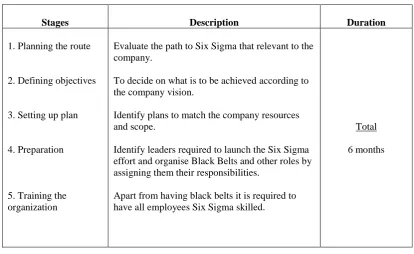
Table 2: Time scale for a project to get started.
Source: [24] For the best option, the project must be realistic and
get started within six months in order for the management not to lose interest if the project planning gets prolonged.
Managing Risk
The organisation ought to be faced with risk associated with the introduction of Six Sigma methodology. There are two apparent risks identified as follow [25]:
a. Perception on Six Sigma. The perception of the
employees towards Six Sigma can be shown from their team working behaviour and responses. The employees may have a mixed perception towards this new methodology. The organisation’s vision and leadership examples from the senior management can shape the employees perception and willingness to accept Six Sigma. The Six Sigma culture had to be embedded into the organisation’s culture for employees to accept it in a positive way. The organisation can create awareness programme to educate the benefit and importance of Six Sigma to the employees. This will enable the organisation to improve its performance by minimizing the defects in its products without barriers.
b. Resistance to Change. Most employees enjoy working in the condition of status-quo under the comfort zone. The introduction of Six Sigma can have an impact on the nature of their task. The detailed and tedious requirement of Six Sigma can
productivity and quality to suffer due to the employee’s dissatisfaction. The organisation senior management need to anticipate the resistance from employees prior to the Six Sigma introduction. They can relate the success from other companies to prove their point to the employees. In addition, the senior management can communicate the importance and benefit of Six Sigma to their employees through brain storming and informal dialogue session. The employees in return can provide feedbacks and opinions to the senior management to keep them aware the situation on the ground. Effective communication will provide everyone with the clarity on Six Sigma approach.
Benefits of Introducing Six Sigma Methodology
The benefit of Six Sigma to an organisation can be in terms of operational and financial benefit. As for the operational benefits, employee workload is reduced when there is less rework. The improvement in the process would lead to elimination of defects and increase product quality. The enhanced product quality will lead to customer satisfaction and this will elevate the organisation’s reputation. In addition, the Six Sigma can enhance the organisation’s team spirit and improve top-down and bottom-up communication [26]. In terms of financial benefits, the total production cost will be reduced due to less rework. This will increase the organisation’s profitability from the improved product. As a whole, overall performance of the organisation can be enhanced when customer
Stages Description Duration
1. Planning the route
2. Defining objectives
3. Setting up plan
4. Preparation
5.Training the organization
Evaluate the path to Six Sigma that relevant to the company.
To decide on what is to be achieved according to the company vision.
Identify plans to match the company resources and scope.
Identify leaders required to launch the Six Sigma effort and organise Black Belts and other roles by assigning them their responsibilities.
Apart from having black belts it is required to have all employees Six Sigma skilled.
CONCLUSION
Six Sigma is one of the quality management methodology available for improving the performance of organisation by minimizing the defects in its product. This defect has a cost associated to it in form of losing customers and redoing a task. Hence, with proper planning on the introduction of Six Sigma, it is desired that the organisation can be able to provide satisfaction to the customers and achieve a high return of investment. This can only be achieved through strong management, good leadership and participation from all employees to change for improvement.
REFERENCES
[1] Juran, J. M. (1999). Juran’s Quality Handbook (5th ed.). New York: McGraw-Hill.
[2] Peter F. Drucker. (2017). What Makes an
Effective Executive. Harvard Business Review Press.
[3] Bursk, Edward C. (1962). The World of Business. New York: Simon and Schuster.
[4] Juran, J. M. (1995). A History of Managing For Quality: The Evolution, Trends and Future Directions of Managing for Quality. United States: Quality Press.
[5] Bursk, Edward C. (1962). The World of Business. New York: Simon and Schuster.
[6] Juran, J. M. (1999). Juran’s Quality Handbook (5th ed.). New York: McGraw-Hill.
[7] Juran, J. M. (1995). A History of Managing For Quality: The Evolution, Trends and Future Directions of Managing for Quality. United States: Quality Press.
[8] Ford, H. (2003). Today and Tomorrow. New York: Productivity Press.
[9] Shewhart, W.A. (2015). Economic Control of Quality of Manufactured Product. Martino Fine Books.
[10] Deming, W.E. (1986). Out of the Crisis. Massachusetts Institute of Technology: Center for Advanced Engineering Study. Cambridge: MA.
[11] Juran, J. M. (1999). Juran’s Quality Handbook (5th ed.). New York: McGraw-Hill.
[12] Feigenbaum, A. (1983). Total Quality Control. (3rd ed.) New York: McGraw Hill.
[13] Weckenmann, A., Akkasoglu, G., & Werner, T. (2015). Quality Management: History and trends. TQM Journal, 27(3).
[14] Weckenmann, A., Akkasoglu, G., & Werner, T. (2015). Quality Management: History and
trends. TQM Journal, 27(3).
https://doi.org/10.1108/TQM-11-2013-0125
[15] Kim, G. (2016). Effect of Total Quality Management on Customer Satisfaction. International Journal of Engineering Sciences & Research Technology, 5(June), 507–514. https://doi.org/10.5281/zenodo.55618
[16] Ooi, K. B., Bakar, N. A., Arumugam, V., Vellapan, L., & Loke, A. K. Y. (2007). Does TQM Influence Employees’ Job Satisfaction? An Empirical Case Analysis. International Journal of Quality and Reliability
Management, 24(1), 62–77. https://doi.org/10.1108/02656710710720330 [17] Obeidat, B. Y., Hashem, L., Alansari, I.,
Tarhini, A., & Al-salti, Z. (2016). The Effect of Knowledge Management Uses on Total Quality Management Practices : A Theoretical Perspective. Journal of Management and
Strategy, 7(4), 18–29.
https://doi.org/10.5430/jms.v7n4p18
[18] Bhardwaj, Y. (2013). Total Quality Management and Six Sigma Instrument. International Journal of Management & Business Studies, 3(4), 70–72. https://doi.org/10.5772/2559
[19] Catt, E. A. (2015). Lean Six Sigma & A3 Thinking Workbook.
[20] Bhardwaj, Y. (2013). Total Quality Management and Six Sigma Instrument. International Journal of Management & Business Studies, 3(4), 70–72. https://doi.org/10.5772/2559
[21] Kim, G. (2016). Effect of Total Quality Management on Customer Satisfaction. International Journal of Engineering Sciences & Research Technology, 5(June), 507–514. https://doi.org/10.5281/zenodo.5561
[22] Klefsjo, B., Bergquist, B., & Edgeman, R. L. (2014). Six Sigma and Total Quality Management: different day, same soup? International Journal of Six Sigma and Competitive Advantage, 2(2), 162–178. https://doi.org/10.1504/IJSSCA.2006.010107 [23] Salah, S., Carretero, J. A., & Rahim, A. (2009).
Six Sigma and Total Quality Management (TQM): similarities, differences and relationship. International Journal of Six Sigma and Competitive Advantage, 5(3), 237–249. https://doi.org/10.1504/IJSSCA.2009.028095 [24] Sanuri Mohd Mokhtar, S., Adiana Hiau
Abdullah, N., Kardi, N., & Idzwan Yacob, M. (2013). Sustaining a quality management system: process, issues and challenges. Business Strategy Series, 14(4), 123–130. https://doi.org/10.1108/BSS-12-2011-0032 [25] Talib, F. (2013). An Overview of Total Quality
![Figure 1: The Development of Quality Discipline in the 20th Century. Source: [13]](https://thumb-us.123doks.com/thumbv2/123dok_us/8440990.1701402/2.595.255.339.557.721/figure-development-quality-discipline-th-century-source.webp)
![Figure 2: Timeline on the Evolution of Quality Management. Source: [14]](https://thumb-us.123doks.com/thumbv2/123dok_us/8440990.1701402/3.595.169.409.116.214/figure-timeline-evolution-quality-management-source.webp)