R E S E A R C H
Open Access
An efficient privacy-preserving
comparison protocol in smart metering
systems
Majid Nateghizad
*, Zekeriya Erkin and Reginald L. Lagendijk
Abstract
In smart grids, providing power consumption statistics to the customers and generating recommendations for managing electrical devices are considered to be effective methods that can help to reduce energy consumption. Unfortunately, providing power consumption statistics and generating recommendations rely on highly
privacy-sensitive smart meter consumption data. From the past experience, we see that it is essential to find scientific solutions that enable the utility providers to provide such services for their customers without damaging customers’ privacy. One effective approach relies on cryptography, where sensitive data is only given in the encrypted form to the utility provider and is processed under encryption without leaking content. The proposed solutions using this approach are very effective for privacy protection but very expensive in terms of computation and communication. In this paper, we focus on an essential operation for designing a privacy-preserving recommender system for smart grids, namely comparison, that takes two encrypted values and outputs which one is greater than the other one. We improve the state-of-the-art comparison protocol based on Homomorphic Encryption in terms of computation and communication by 56 and 25 %, respectively, by introducing algorithmic changes and data packing. As the smart meters are very limited devices, the overall improvement achieved is promising for the future deployment of such cryptographic protocols for enabling privacy enhanced services in smart grids.
Keywords: Smart metering, Secure comparison, Recommender system, Privacy, Homomorphic encryption
1 Introduction
Smart grids, as the next generation of power grid, are utilizing both communication technologies and informa-tion processing to monitor and manage power grids to enhance reliability, efficiency, and sustainability of power generation. One of the advantages of smart grids com-pared to traditional power grids is the ability to observe the power consumption of households in very short time intervals in the order of seconds to minutes. As a result of the fine-coarse data reporting, it is possible to provide power consumption statistics to the consumers, which might help to reduce the overall consumption by chang-ing customer behavior, as pointed out in several works [1–5]. For example, Honebein et al. [6] defined people as the only true smart part of a smart grid; therefore,
*Correspondence: [email protected]
Cyber Security Group, Department of Intelligent Systems, Delft University of Technology, Mekelweg 4, 2628 CD, Delft, The Netherlands
monitoring, understanding, and promoting the end-users’ roles from passive to active is considered as a fundamental action in smart grids. To this end, there are already sev-eral utility companies providing their customers devices and smart phone applications to monitor their real-time consumption. Furthermore, one of the goals of the util-ity providers, balancing the supply and the demand, also known as demand response (DR), can be achieved more effectively if the utility provider can also provide statistics about the power usage in the surrounding area and gener-ate personalized recommendations, for example, to man-age electrical devices like electric cars, heating systems, and ovens in the household [7].
Providing statistics on power consumption and generat-ing personalized recommendations to inform customers are heavily dependent on the smart meter consumption readings. Unfortunately, these readings are highly privacy-sensitive [8–10]. The utility provider can use the readings from the smart meters for other purposes, misuse them or
even transfer them to other entities without the consent of the customers. As seen in many cases, privacy is con-sidered to be a big challenge for using smart meters to the fullest extent, e.g., enabling personalized services such as generating recommendations.
In this paper, we assume that the utility provider gener-ates statistics and recommendations for the customers so that the customers can adjust the electrical devices for the most cost-effective and environmentally friendly manner. To achieve this, we rely on cryptography, which pro-vides us tools to create privacy by design algorithms. For instance, there are already a number of studies for com-puting bills and aggregating data [11–14]. The main idea in this research line is to provide only the encrypted power consumption to the utility provider and enable processing the encrypted data without decrypting any sensitive infor-mation. This way, the utility provider cannot access to the content but at the same time can perform the algorithms required for the service. Unfortunately, the cryptographic algorithms for this purpose are expensive in terms of computation and communication, which mostly require smart meters to be involved in the computation [15–18]. Since the smart meters are very limited devices, improv-ing the efficiency of the cryptographic algorithms is a challenge.
We address the efficiency problem of a fundamen-tal operation, namely comparison, which is required to design any recommender system. In our setting, the encrypted consumption readings are collected from the customers by an aggregator and the utility provider has the decryption key. For privacy reasons, the aggregator cannot transfer the data directly to the utility provider but can co-operate with the utility provider to generate rec-ommendations. One important step in the system is to compare values, which are only available in the encrypted form. More precisely, the aggregator has two encrypted values, and it needs to know which one is greater than the other one without revealing their contents to anyone including itself.
There are numerous comparison protocols designed for comparing encrypted values [15, 16, 18]. In this paper, we improve the state-of-the-art comparison protocol that relies on homomorphic encryption in terms of run-time by 56 % by introducing algorithmic changes. Furthermore, we also reduce communication cost of the protocol by 25 % by deploying data packing [19, 20]. Together, these improvements increase the overall efficiency of the com-parison protocol with encrypted inputs, bringing smart meters one step closer to run privacy-preserving crypto-graphic protocols based on homomorphic encryption.
Note that a secure comparison protocol with encrypted values is needed in many applications, not only for gener-ating recommendations, like face recognition [17], finger-code authentication [21], and K-means clustering [22].
Therefore, the protocol we improved in this paper pro-vide a significant performance improvement for other applications as well.
2 Preliminaries
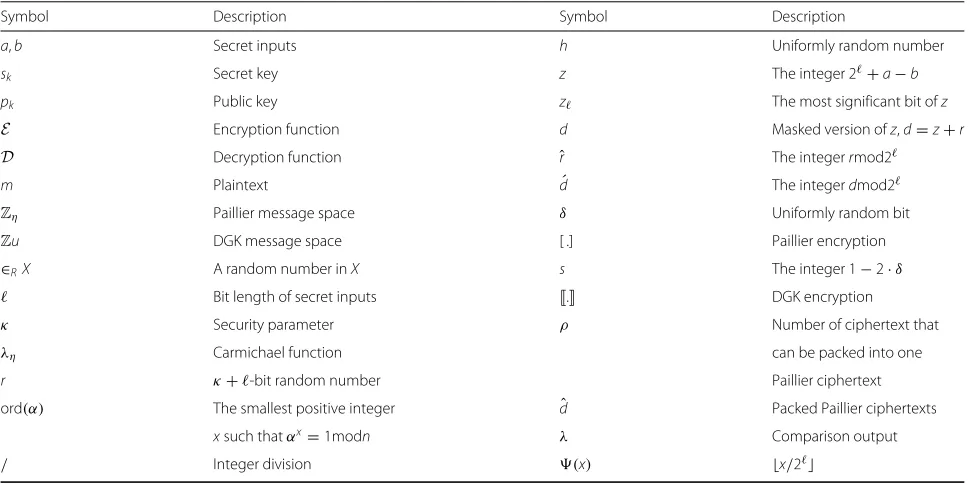
In this section, we describe the application setting, the security assumptions, and the cryptographic tools used in this work. We also present the symbols and their descrip-tions in Table 1.
2.1 Application setting
In our application setting, we define three roles: (1) smart meters installed at the households, (2) a data aggregator, and (3) a utility provider. Smart meters measure, encrypt, and send consumers’ power consumption to the data aggregator, which collects and analyzes encrypted power consumption. Then, the utility provider generates recom-mendations for its customers by running a cryptographic protocol with the data aggregator. The output of the cryp-tographic protocol, which depends on the purpose of the recommender system, is in the encrypted form; thus, it is not available neither to the data aggregator nor to the util-ity provider. The output is then revealed to the customer by using another protocol, secure decryption, which is explained in [23].
2.2 Security model
The proposed protocol in this work is built on the semi-honest adversarial model, where the data aggregator and the utility provider are honest in the sense that they faith-fully follow the designed protocol but will try to infer information from the protocol execution transcript. This assumption is realistic since companies are expected to properly perform required services mentioned in the ser-vice level agreement, when engaging in a collaboration. We assume that the utility provider is the only party holding the private keys, while the smart meters and the data aggregator have the public keys for the encryption schemes. We assume that neither party colludes.
2.3 Homomorphic encryption
In this work, we rely on two additively homomor-phic cryptosystems, Paillier [24] and Damgård, Geislet and Krøigaard (DGK) [15]. An additively homomorphic encryption scheme preserves certain structure that can be exploited to process ciphertexts without decryption. Given Epk(m1) and Epk(m2), a new ciphertext whose
decryption yields the sum of the plaintext messages m1
andm2 can be obtained by performing a certain
opera-tion over the ciphertexts: Dsk(Epk(m1))⊗(Epk(m2)) =
m1+m2.
Consequently, exponentiation of any ciphertext with a public value yields the encrypted product of the original plaintext and the exponent:Dsk
Epk(m)e
Table 1Symbols and their descriptions
Symbol Description Symbol Description
a,b Secret inputs h Uniformly random number
sk Secret key z The integer 2+a−b
pk Public key z The most significant bit ofz
E Encryption function d Masked version ofz,d=z+r
D Decryption function ˆr The integerrmod2
m Plaintext d´ The integerdmod2
Zη Paillier message space δ Uniformly random bit
Zu DGK message space [ .] Paillier encryption
∈RX A random number inX s The integer 1−2·δ
Bit length of secret inputs . DGK encryption
κ Security parameter ρ Number of ciphertext that
λη Carmichael function can be packed into one
r κ+-bit random number Paillier ciphertext
ord(α) The smallest positive integer dˆ Packed Paillier ciphertexts
xsuch thatαx=1modn λ Comparison output
/ Integer division (x) x/2
2.4 Paillier cryptosystem
The Paillier encryption function for a given messagem∈
Zηis defined as follows:
c=Epk(m,τ)=gm·τηmodη2, (1) whereηis the product of two distinct large prime numbers
pandq, ciphertextc∈Z∗η2,τ ∈RZ∗ηandgis a generator
of orderη. The decryption function is,
Lηcληmodη2
Lηgληmodη2modη=m, (2)
where λη is the Carmichael value that is the smallest positive integer such that{∀a ∈ Z∗η :aλη ≡ 1(modη)}
andLη(x) = x−1η . The public key is(g,η)and the private key isλη.
The homomorphic property can be shown as below:
Dsk((Epk(m1))×(Epk(m2))=Dsk
gm1·τη
1×gm2 ·τ2η
=Dsk(gm1+m2·(τ1·τ2)η)=Dsk(Epk(m1+m2))
=m1+m2. (3)
2.5 DGK cryptosystem
We also use the DGK cryptosystem [15, 25], which is used in constructing cryptographic protocols [17, 23] for its efficiency due to its small message size. For generating the public and the private keys, there are three parameters:k,
t, and, where <t< k. The process of key generation is as follows:
1. Choose two distinctt-bit prime numbersvp, vq.
2. Construct two distinct prime numberspandq, wherevp|(p−1)andvq|(q−1)such thatn=pqis a
k-bit RSA modulus.
3. Chooseu, the smallest possible prime number but greater than+2.
4. Choose a randomrthat is a2.5t-bit integer [15]. 5. Choosegandhsuch that ord(g)=uvpvqand
ord(h)=vpvq.
The public and the private keys are pk = (n,g,h,u)
andsk = (p,q,vp,vq), respectively. The encryption of a
plaintextm∈Zuis given as follows:
c=Epk(m,r)=gm·hrmodn. (4)
To decrypt the ciphertext, one can build a look-up table for allm ∈ Zu values and obtain mfromcvp modp = (gvp)mmodp. However, DGK scheme can efficiently check whether a ciphertext is an encryption of zero or not. To achieve this, we check whethercvpvq modn= 1 or more efficiently we only need to prove thatcvpvqmodp= 1 or
cvpvq modq=1, sinceu<p.
In the rest of the paper, we denote the ciphertext of a messagemby [m] for the Paillier cryptosystem andm
for the DGK.
its efficiency. The DGK comparison protocol is a sub-protocol in the SCP, where each party possesses a secret but plaintext value. The sub-protocol also uses the DGK cryptosystem for efficiency reasons.
The comparison protocol in [25] is modified and used by Erkin et al. in [17], and Veugen proposed an improved DGK comparison protocol (IDCP) in [18]. In the follow-ing, we describe the SCP construction.
For the sake of simplicity, we use the names Alice and Bob as the data aggregator and the utility provider, respec-tively. We assume that Bob has the secret keyskand Alice has access to two encrypted values, [a] and [b], and wants to know ifa<b.
Initially, Alice computes [z]= 2+a−b =
2·[a]·[b]−1and then obtains the result of comparison as follows:
[z]=2−·z−zmod 2
=
[z]·
zmod 2 −1 2−
, (5)
where [z] is the most significant bit of [z] and the result of comparison. If z = 1 then we have a > b, and otherwise a < b. A more efficient method of comput-ing [z] is based on the IDCP, where we can compute
z= z/2and [a<b]=[1−z]=[1]·[z]−1, but we still need to computezmod 2. A more detailed explanation regarding computation of [z] is provided in the following sections.
3.1 Computingzmod 2
Notice that Alice has access only to [z], and interaction with Bob, who has the private key, is needed to compute modulo reduction, [zmod 2]. However, Alice cannot give [z] directly to Bob since this value reveals information on the difference ofaandb. Therefore, Alice masks [z] using a random value as follows:
[d]=[z+r]=[z]·[r] , (6) where ris a(κ +)-bit uniformly random number and
κ is a security parameter. After masking, Alice sends [d] to Bob to perform modulo reduction, where Bob first decrypts [d], then computesd´ =dmod 2and sends [d´] and [d/2] back to Alice. Subsequently, to obtain [zmod 2], Alice computes [z˜mod 2]=[d´ −rmod 2]=[d´]·[r
mod 2]−1.
Note thatzmod 2=˜zmod 2ifd´ >rmod 2. When
´
d< rmod 2, an underflow occurs, and Alice has to add 2to [z˜] to make the value positive again. Therefore, Alice needs to determine whether d´ > rmod 2 or not. This is achieved by computing an encrypted value, [λ], which
shows the relation betweend´ andrmod 2. Then, Alice can perform following computation to obtain [zmod 2]:
zmod 2 =z˜+λ2 =[z˜]·[λ]2 . (7) Alice can obtain [z] by using Eq. 5. [z] can be com-puted more efficiently as follow:
[z]=[ (z)]=[ (d)]·[ (r)]−1·[λ]−1, (8) where (x)= x/2. For computing [λ], we run a secure comparison protocol with private inputs as described in the following section.
3.2 Computing [λ]
This protocol outputs an encrypted bit, which shows whether d´ > rˆ = r mod 2 or not. However, differ-ent than the original problem of comparing encrypteda
andb, in this protocol Alice and Bob possessrˆandd´ in plaintext, respectively. Based on this setting, the IDCP for computing [λ] securely works as follows:
1. Bob sends a bitwise encryption of his input,
d´0,. . .,d´−1, to Alice.
2. Alice chooses uniformly random bitδ, where
δ∈ {0, 1}. Then she computess=1−2·δandci
as follows,
ci=d´i− ˆri+s+3
−1
j=i+1
´
dj⊕ ˆrj
=d´i·rˆi−1·s·
⎛ ⎝−1
j=i+1
d´j⊕ ˆrj
⎞ ⎠
3
, (9)
whered´j⊕ ˆrj=d´j·ˆrj·d´j−2·ˆrj, and
i=0,. . .,−1.
3. Alice blinds eachciwith a uniformly random
hi∈RZ∗usuch that
ei=ci·hi=cihi, (10)
then permuteseiand sends them to Bob. Note that
ifct=0, wheret∈ {0,. . .,−1}thenet=0as well.
4. Bob checks whether there is a zero amongei
values. If none of theeivalues are encrypted zero
then he setsλ˜ =0, otherwiseλ˜ =1. Then he encryptsλ˜and sends[λ˜]to Alice.
5. Alice corrects[λ˜]to obtain[λ]as follows:
[λ]=
[λ˜] ifs=1 [1]·[λ˜]−1 ifs= −1
4 Efficient privacy-preserving comparison protocol
In this section, we describe a new version of the original SCP based on the DGK construction, which is signifi-cantly more efficient in terms of run-time and communi-cation cost.
4.1 Proposed comparison protocol
Complexity analysis and experimental results reveal that the XOR operation in computing ci, in Eq. 9, has a
significant impact on the overall efficiency of the DGK comparison protocol for the following two reasons:
1. Computing XOR is computationally expensive, since
rˆ⊕ ´d=rˆ·d´·d´−2·ˆr. Veugen [18] proposed a more efficient technique of computing XOR, where
rˆ⊕ ´d=d´whenrˆ=0; otherwise,
rˆ⊕ ´d=1·d´−1(recall that Alice and Bob have access to valuesrˆandd´, respectively and Alice is computing XOR). Thus, ifrˆequals to 1, one
multiplication and one exponentiation with negative exponent should be computed over DGK ciphertexts, which affects the performance of DGK comparison protocol significantly.
2. Since the equation that involves XOR is computed during the protocol with encrypted inputs, it is not possible to introduce pre-computation forcito
obtain a more efficient protocol.
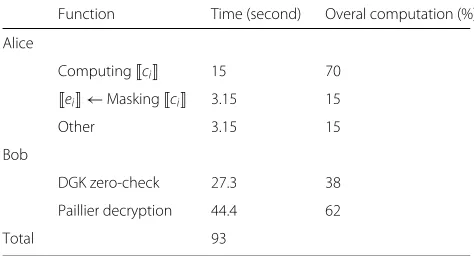
Table 2 shows that computingciconstitutes 70 % of the
overall run-time of the IDCP for Alice.
Based on these two facts, we propose a more efficient way of computingci, which does not rely on the original
XOR computation. The value ci can be re-written as
follows:
ci=
d´i− ˆri+s+ −1
j=i+1
´
dj·2j − ˆrj·2j
. (11)
Table 2Run-time performance for several steps of the IDCP
Function Time (second) Overal computation (%)
Alice
Computingci 15 70
ei←Maskingci 3.15 15
Other 3.15 15
Bob
DGK zero-check 27.3 38
Paillier decryption 44.4 62
Total 93
Alice computes Eq. 11 in three steps:
1. Bob computesti=
´
di+j=−1i+1d´j·2j ,and
sendstito Alice.
2. Alice computesvi=
s− ˆri−j=−1i+1rˆj·2j .
3. Alice computescias follows,
ci=ti+vi=ti·vi. (12)
Note that Alice can pre-computeviand factor “3” is
not needed in the computation ofci. After computing all civalues, Alice masks eachciand sends masked values
to Bob, where he checks if any of the given maskedci
is zero, then generates [λ˜], and sends it to Alice. She cor-rects [λ˜] based on valuesto obtain [λ], computes Eq. 7, and 5 to obtain [z] as in the original protocol. Note that we compare 2d´and 2ˆrinstead ofd´ andrˆrespectively for technical reasons explained in the following section.
4.1.1 Correctness proof of computingci
In this section, we prove the correctness of generatingci
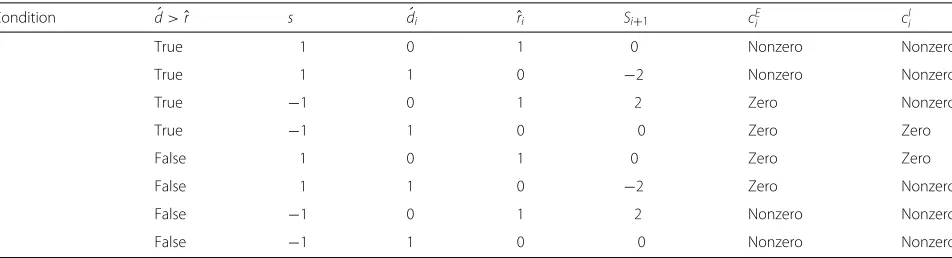
by Eq. 12. In order to do that, we check if Eq. 12 generates encrypted zero in the same conditions as the Eq. 9. Table 3 shows the values of ci computed based on the efficient
privacy-preserving comparison protocol (EPPCP) and the IDCP, which are denoted ascEi andcIi, respectively. Table 3 analyzes the existence of zero incEi generated based on thes,d´,ˆr, andSi+1 =
−1
j=i+1
´
dj·2j − ˆrj·2j
values.
Based on this table, the value ofcIDCPi can be zero in two conditions, where{´d< ˆr, s= 1,d´i = 0, andrˆi =1}and
{´d > ˆr, s = −1, d´i =1, andˆri =0}. However,cEi
gener-ates zero in more conditions thancIi does. For instance, if
{Si+1= 2,s = −1,d´ > ˆr, andd´i = ˆri = 1}, thencEi = 0.
Table 3 shows that values ofcIi can be zero in the condi-tions 4 and 5; however,cEi values are zero in the conditions 3, 4, 5, and 6 based on the assumed values ofSi+1for each
condition. We note that ifd´1d´0∗ ˆr1rˆ0 = 2 andd´i = ˆri
for 2 i −1, then the value ofcE0becomes zero. To fix this problem, we compare 2d´ and 2rˆinstead ofd´ and
ˆ
r. Therefore, Eq. 12 does not generate zero in the condi-tions 3 and 6. Furthermore, for the comparison protocol to work whend´= ˆr, we compare 3d´and 3rˆ+1 instead of
´
dandˆrrespectively, as suggested similarly in [17].
4.2 Data packing
Table 3Different conditions based ons,d´andˆr
Condition d´>ˆr s d´i ˆri Si+1 cEi cIi
1 True 1 0 1 0 Nonzero Nonzero
2 True 1 1 0 −2 Nonzero Nonzero
3 True −1 0 1 2 Zero Nonzero
4 True −1 1 0 0 Zero Zero
5 False 1 0 1 0 Zero Zero
6 False 1 1 0 −2 Zero Nonzero
7 False −1 0 1 2 Nonzero Nonzero
8 False −1 1 0 0 Nonzero Nonzero
Assume thatzandrareand+κ-bit integers, respec-tively. Then, [d]=[z+r] is a (+κ+1)-bit integer. Let the message space of the Paillier cryptosystem beη=pq, then Alice packsρ = (+κ +1)/ηinto one Paillier message as follows:
[dˆ]=
ρ−1
j=0
[d]j·
2+κ+1j, (13)
and sends [dˆ] to Bob. Then, Bob computes Dsk
[dˆ]
, unpacks ρdifferent values and performs modulo reduc-tion on each unpacked value.
Employing the data packing technique not only reduces the number of very expensive Paillier decryption to be performed but also decreases the number of encrypted messages to be transmitted.
5 Performance analysis
In this section, we analyze the number of operations over ciphertexts, since they are computationally expensive compared to operations on the plaintext and dominate the protocol execution run-time and provide experimen-tal results for run-time performance. For this purpose, we implemented the EPPCP using C++ and SeComLib [26] library, on a Linux machine running Ubuntu 14.04 LTS, with 64-bit microprocessor and 8 GB of RAM. The experiments are repeated for 10,000 comparisons. Table 4 provides more information about parameters and their corresponding values in our implementation.
Table 4Parameters and their values used in the implementation
Parameter Symbol Value
Bit size of inputs 25 bits
Security parameter κ 40 bits
Paillier message space η 2048 bits
DGK message space n 2048 bits
Number of [d] packed
into one Paillier ciphertext ρ 31
Table 5 shows the computational complexity of the orig-inal DGK comparison protocol, the IDCP, and the EPPCP. Note that the number of multiplications and exponenti-ations are regarding the computation of ci. According
to the Table 5, the original DGK comparison protocol suffers from its high computational complexity regarding the number of multiplications and exponentiations over ciphertexts. Veugen [18] presented two improvements to decrease the computational cost of the DGK comparison protocol, namely an efficient method to compute XOR and an algorithm to mask less ci, which results in a
lower number of exponentiations with positive exponent. However, according to Table 5, the new technique of com-puting XOR have a slight impact on the overall number of multiplications and exponentiations. Moreover, Table 2 shows that computation ofeitakes 15 % of the
proto-col run-time in Alice (the improvement for computingei
[18] is not applied in the implementation); therefore, even a significant improvement over computation ofeidoes
not provide a significant influence on the overall run-time. Table 5 shows that the computational complexity of computingciin the EPPCP is decreased to
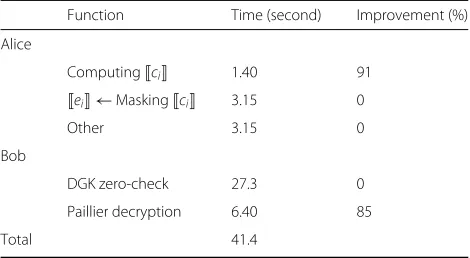
multiplica-tions over ciphertexts, and there is no exponentiation with positive or negative exponent. According to Table 6, this low computational complexity results in 91 % decrease in computation ofcicompared to the IDCP. This
improve-ment also reduces the run-time of all computations per-formed by Alice by 64 %.
Table 5Computational complexity of original DGK [17, 25], the IDCP, and the EPPCP
Function Original DGK IDCP EPPCP
Encryption 1Paillier+DGK 1Paillier+DGK 1Paillier+DGK
Decryption 1Paillier 1Paillier
1 ρ
Paillier
DGK zero-check
Multiplication (+2) ∼ (+11)
4
Exponentiation(+) 0
Exponentiation(−) (+1)
2 ∼
(+3)
Table 6Run-time performance of the several steps of the EPPCP and the improvements compared to the IDCP
Function Time (second) Improvement (%)
Alice
Computingci 1.40 91
ei←Maskingci 3.15 0
Other 3.15 0
Bob
DGK zero-check 27.3 0
Paillier decryption 6.40 85
Total 41.4
Table 2 also shows that Paillier decryption dominates 62 % of the IDCP run-time by Bob. According to the Table 6, by deploying data packing the run-time of the Paillier decryption and all Bob’s computations are decreased by 85 and 53 %, respectively.
Table 7 shows the running times of the Paillier decryp-tion (PD), computadecryp-tion of ci, and the total run-time
(online phase) of both the EPPCP and the IDCP for dif-ferent key sizes. It shows that the EPPCP achieves better efficiency compared to the IDCP for the large key sizes.
According to Table 8, running EPPCP 10,000 times takes 41 s, where it takes 93 s for the IDCP. Table 8 also shows that pre-computation phase takes more time in EPPCP as a result of the new method of computingci, which
allows performing more initial computations before run-time. The communication cost between Alice and Bob is decreased by 25 % in EPPCP because of using data packing technique.
6 Security and privacy of comparison protocol In this section, we provide a security sketch of the pro-posed privacy-preserving comparison protocol in the semi-honest model. For a more elaborate security proof, we refer readers to [25].
As mentioned before, smart meters encrypt the power consumption using the Paillier cryptosystem, which is semantically secure under the decisional composite resid-uosity assumption (for more information about the security of Paillier cryptosystem, we refer reader to [24]); thus, Alice (data aggregator) has only encrypted values. Here, we show that not only does Bob (utility provider)
Table 8Overall performance of the IDCP and the EPPCP
Protocol Run-time Pre-computation Number of
(second) (second) communications
IDCP 93 7.4 40k
EPPCP 41.4 13.8 30k
Improvement +56 % −87 % +25 %
not learn anything about the given encrypted values but also Alice does not learn any information about encrypted output of the algorithm at the end of the proposed com-parison protocol.
Alice computes together with Bob [zmod 2] without revealing any information about [z] to him. Since this value reveals information on the distance betweenaand
b; therefore, Alice masks [z] by adding a random value, [d]=[z+r], and sends [d] to Bob instead of [z]. Sincer
is a uniformly random(k+)-bit value, [z] is statistically indistinguishable from [d] to Bob.
Bob sends back [d mod 2] to Alice in the encrypted form, which means she cannot learn any information about the content of [z], but only [z mod 2]. Then Alice sends ei values, which are the masked and the
permuted ci values, to Bob who checks the existence
of an encrypted zero among given ei. Therefore, Bob
only receives a list of uniformly random values. Moreover, using a binary random values through computation of ciprevents Bob from drawing any conclusions about the
result of the comparison by checkingei. Since Alice is
not authorized to know the result of the comparison, Bob only sends the encrypted value ofλ˜, [λ˜], to Alice. Then, she can only correct the [λ˜] based onsto obtain [λ] and compute [z].
7 Conclusions
Comparing consumers’ power consumption profiles is a necessary part of smart grids for a number of services including generating personalized recommendations. Since personal profiles contain private information about consumers’ power consumption, privacy-preserving approaches should be considered. One of the most effec-tive approaches is based on using cryptographic tools that enable processing encrypted data. Unfortunately, secure and privacy-sensitive versions of such services are com-putationally expensive, which hinders the deployment of
Table 7Performance of the IDCP and the EPPCP for different key lengths
512 bits 1024 bits 2048 bits
Protocol ci PD Run-time ci PD Run-time ci PD Run-time
IDCP 2.7 0.8 6.9 5.9 6.1 21.5 15.0 44.4 93.0
EPPCP 0.1 0.5 4.2 0.3 2.0 13.2 1.4 6.4 41.4
such protocols in practice. In this paper, we investigated a vital operation that is invoked numerous times during many algorithms, namely comparison, and improve its performance significantly by introducing algorithmic changes and deploying data packing. By doing so, we improve the efficiency of the state-of-the-art secure comparison protocol based on homomorphic encryption. More precisely, we reduce the run-time of computations by the data aggregator and the utility provider by 64 and 52 %, respectively. In terms of overall performance, the proposed comparison protocol is faster than state-of-the-art by 56 % and the communication cost is reduced by 25 %. This improvement in performance leads to a more practical comparison protocol that can be used for designing privacy-preserving protocols.
Competing interests
The authors declare that they have no competing interests.
Authors’ contributions
MN proposed the improvements for the DGK comparison protocol and implemented the EPPCP. ZE and RLL participated in improving the EPPCP in terms of security, carried out performance and security analysis, and contributed in designing, drafting, and revising the manuscript. All authors read and approved the final manuscript.
Acknowledgements
This publication was supported by Dutch national program COMMIT.
Received: 14 July 2015 Accepted: 19 April 2016
References
1. GP Verbong, S Beemsterboer, F Sengers, Smart grids or smart users? Involving users in developing a low carbon electricity economy. Energy Policy.52, 117–125 (2013)
2. I Lampropoulos, G Vanalme, W Kling, inProceedings of Innovative Smart Grid Technologies Conference Europe (ISGT Europe). A methodology for modeling the behavior of electricity prosumers within the smart grid (IEEE PES, Gothenburg, 2010), pp. 1–8
3. T Jackson,Motivating Sustainable Consumption: A Review of Evidence on Consumer Behaviour and Behavioural Change: a Report to the Sustainable Development Research Network. (Centre for Environmental Strategy, University of Surrey, 2005)
4. S Van Dam, Smart energy management for households. A+BE | Architecture and the Built Environment.3(5), 1–334 (2013). doi:10.7480/ abe.2013.5
5. A Spagnolli, N Corradi, L Gamberini, E Hoggan, G Jacucci, C Katzeff, L Broms, L Jönsson, Eco-Feedback on the go: motivating energy awareness. IEEE Comput.44(5), 38–45 (2011)
6. PC Honebein, RF Cammarano, C Boice, Building a social roadmap for the smart grid. Electr. J.24(4), 78–85 (2011)
7. V Giordano, F Gangale, G Fulli, MS Jiménez, I Onyeji, A Colta, I Papaioannou, A Mengolini, C Alecu, T Ojala, et al.,Smart Grid Projects in Europe: Lessons Learned and Current Developments. (Publications Office of the European Union, Luxembourg, 2011)
8. J Liu, Y Xiao, S Li, W Liang, C Chen, Cyber security and privacy issues in smart grids. IEEE Commun. Surv. Tutor.14(4), 981–997 (2012) 9. P McDaniel, S McLaughlin, Security and privacy challenges in the smart
grid. IEEE Sec Privacy.7, 75–77 (2009)
10. FG Marmol, C Sorge, O Ugus, GM Pérez, Do not snoop my habits: preserving privacy in the smart grid. IEEE Commun. Mag.50(5), 166–172 (2012)
11. K Birman, M Jelasity, R Kleinberg, E Tremel, Building a secure and privacy-preserving smart grid. ACM SIGOPS Oper. Syst. Rev.49(1), 131–136 (2015)
12. Z Erkin, G Tsudik, inApplied Cryptography and Network Security (ACNS 2012),Vol. 7341 of Lecture Notes in Computer Science. Private computation of spatial and temporal power consumption with smart meters (Springer, 2012), pp. 561–577
13. K Kursawe, G Danezis, M Kohlweiss, inProceedings of the 11th international conference on Privacy enhancing technologies, PETS’11. Privacy-friendly aggregation for the smart-grid (Springer-Verlag, Berlin, Heidelberg, 2011), pp. 175–191. http://dl.acm.org/citation.cfm?id=2032162.2032172 14. C Efthymiou, G Kalogridis, inFirst IEEE International Conference on Smart
Grid Communications. Smart grid privacy via anonymization of smart metering data (IEEE, 2010), pp. 238–243
15. I Damgard, M Geisler, M Kroigard, A correction to ‘efficient and secure comparison for on-line auctions’. Int. J. Appl. Cryptogr.1(4), 323–324 (2009)
16. T Veugen, F Blom, S de Hoogh, Z Erkin, Secure comparison protocols in the semi-honest model. IEEE J. Sel. Top. Signal Process.9(7), 1217–1228 (2015) 17. Z Erkin, M Franz, J Guajardo, S Katzenbeisser, I Lagendijk, T Toft, inPrivacy
Enhancing Technologies (PET’09), Vol. 5672 of LNCS. Privacy-preserving face recognition (Springer, 2009), pp. 235–253
18. T Veugen, inIEEE Workshop on Information Forensics and Security. Improving the DGK comparison protocol (IEEE WIFS, Tenerife, 2012), pp. 49–54
19. JR Troncoso-Pastoriza, S Katzenbeisser, MU Celik, AN Lemma, inACM Workshop on Multimedia and Security. A secure multidimensional point inclusion protocol (ACM, 2007), pp. 109–120
20. T Bianchi, A Piva, M Barni, Composite signal representation for fast and storage-efficient processing of encrypted signals. IEEE Trans. Inf. Forensics Sec.5(1), 180–187 (2010)
21. M Barni, T Bianchi, D Catalano, Raimondo Di M, R Donida Labati, et al., in ACM Proceedings of the 12th ACM workshop on Multimedia and security. Privacy-Preserving Fingercode Authentication, (2010), pp. 231–240 22. MRT Beye, Z Erkin, RL Lagendijk, inProc. in IEEE Workshop on Information
Forensics and Security (WIFS’11). Efficient privacy preserving k-means clustering in a three-party setting, (2011), pp. 1–6
23. Z Erkin, T Veugen, T Toft, RL Lagendijk, Generating private
recommendations efficiently using homomorphic encryption and data packing. IEEE Trans. Inf. Forensics Sec.7(3), 1053–1066 (2012)
24. P Paillier, inEurocrypt ’99. Public-Key Cryptosystems Based on Composite Degree Residuosity Classes (Springer, 1999), pp. 223–238
25. I Damgård, M Geisler, M Krøigaard, inAustralasian Conference on Information Security and Privacy (ACISP’07), Vol. 4586 of LNCS. Efficient and secure comparison for on-line auctions (Springer, 2007), pp. 416–430 26. Cyber Security Group, SeComLib Secure Computation Library. http://
cybersecurity.tudelft.nl. Accessed 2013
Submit your manuscript to a
journal and benefi t from:
7Convenient online submission 7Rigorous peer review
7Immediate publication on acceptance 7Open access: articles freely available online 7High visibility within the fi eld
7Retaining the copyright to your article