e-ISSN: 2278-7461, p-ISSN: 2319-6491
Volume 6, Issue 10 [October. 2017] PP: 47-56
Face Recognition System Based on Infrared Image
Yong Tang
School of Electronics and Information Engineering,Tianjin Polytechnic University,Tianjin 300387,China
Abstract:
With the rapid development of computer vision and pattern recognition technology, people began to focus research on face recognition technology.And it has a wide range of applications, such as public safety, monitoring, identification and so on. Infrared image face recognition technology is that the face image collected by infrared imaging equipment is detected and identified. Detecting infrared radiation emitted by facial tissue and vascular distribution, face recognition system based on infrared image has the advantages of strong anti-interference, anti camouflage, fraud prevention and no light source dependence. Based on Matlab platform, the infrared face image captured by infrared thermal imager is detected and recognized with Principal Component Analysis(PCA): Firstly, graying and size normalized infrared face image to form a training library; Secondly, detecting and identifying faces with the method of Principal Component Analysis; Finally, the graphical user interface is fabricated, and the process of detecting and recognizing multiple infrared face image samples is realized.The experimental results show that the recognition rate can reach 100% through self-building face training library .Key Words: Infrared Image; Face Recognition; Principal Component Analysis; Image Processing;
--- Date of Submission: 25-10-2017 Date of acceptance: 04-11-2017
---I.
INTRODUCTION
Face recognition system based on infrared image is a technology that classifying and identifying infrared images with the methods of pattern recognition and image processing. Nowadays, it has become a new research focus in the face recognition field. Infrared image recognition has strong anti-interference ability and can effectively compensate for the lack of visible light recognition[1]. So it can promote the application of face recognition to mature.
With the rapid development of computer vision and pattern recognition technology, face recognition technology has been used more and more widely in the fields of public security and authentication identification. There is still a shortage of visible light face recognition technology. For example, it cannot accurately distinguish between the real person or photo in front of the camera. In addition, the efficiency of visible light recognition is greatly reduced when the light is weak[2].
Based on the principle of face recognition algorithm, the Guide Infrared Thermal Imager is used to capture face images to solve the problem mentioned above. Then, the facial feature values are extracted according to PCA algorithm. Finally, an experimental platform is built to verify the reliability and accuracy of infrared face recognition[3]. The results show that infrared face recognition can distinguish the real person from photo. What’s more, it can show good performance in low light condition.
II.
FACE DATABASE SYSTEM
Any face recognition system needs to build a good face database system, and it is very important for face recognition. Face database system is the basis of face recognition. In order to improve the recognition accuracy, the database needs to contain various facial expressions[4]. In this experiment, the infrared thermal imager is used to collect face images that are stored in the infrared face image database. Generally, face images are vague and their resolution is low[5]. So,it is necessary to preprocess the face images to improve the accuracy of recognition.
2.1 Collecting infrared face images
Figure 2-1 different face images of four people
2.2 Graying infrared face images
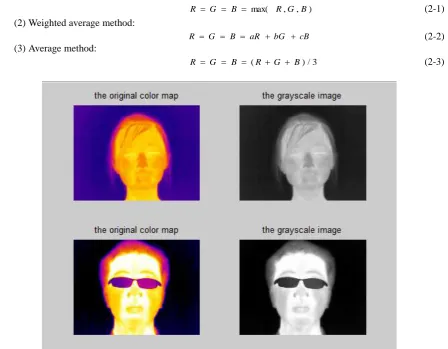
The face images captured by infrared thermal imager are colorful. They contain a lot of information that decreases the efficiency of face recognition. In addition, in order to reduce the influence of the external factors, the infrared face image must be grayed out before recognition.
There are three ways to gray infrared face images: (1)the maximum method:
) , ,
max( R G B
B G
R (2-1) (2)Weighted average method:
cB bG aR B G
R (2-2) (3)Average method:
3 / )
(R G B
B G
2.3 Normalization of infrared face images
The normalization of infrared face images is mainly because the relative positions of human faces in images are different. If the infrared face images are not normalized, the location of the face in the image may be greatly shifting, this will seriously affect the accuracy of face recognition[6].
The eye location method is used in this paper. Firstly, we need to calculate the angle between two eyes and the horizontal line. According to this angle, the face images can be rotated、scaled and cut to make the position of each image is relatively consistent.
2.3.1 Rotation of infrared face images
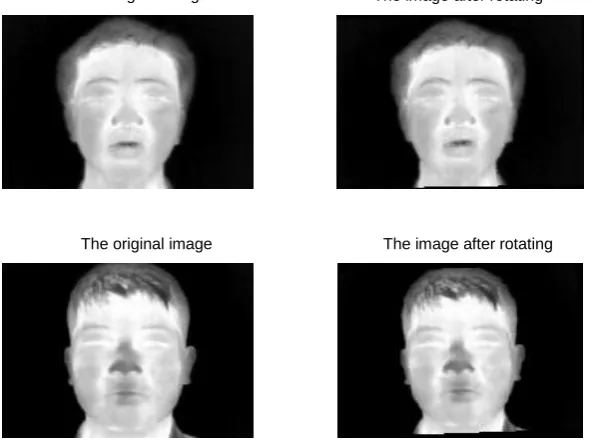
Before the image is rotated, the position of the human face and the angle (θ) between two eyes and the horizontal line should be determined. The coordinates of two eyes can be calculated manually, and then the value of θ can be determined. Finally, rotate the images according to the formal so that both eyes are on the same horizontal line.
1 0 0 0 cos sin 0 sin cos 1 , , 1 , , v u yx (2-4)
The function of this formula is to rotate the image so that both eyes are on the horizontal line. The function imrotate() in Matlab can be used to rotate face images directly, and the processing result is shown in figure 2-3.
Figure 2-3 the results of rotating face images
2.3.2 Scaling infrared face images
After the infrared face image rotation, the eyes are on the horizon, but the size of size and the distance between the two eyes may be different. So it is necessary to scale infrared face images. We need to determine a standard distance between two eyes, which is used to calculate the scaling ratio.
1 0 0 0 0 0 0 1 , , 1 , , y x r r v u yx (2-5)
This formula (2-5) is used to scale face images. We also use the function imresize() to scale face images in Matlab. The results are shown in figure 2-4.
The image after rotating
Figure 2-4 the results of scaling face images
2.3.3 Cutting infrared face images
In order to improve the accuracy of face recognition, the effect of hair and background on face recognition should be reduced. Therefore, face images need to be cut and only the human face can be preserved. Infrared face images can be cut according to figure 2-5. After processing, the face images contain the main features of the human face: nose, mouth, eyes and eyebrows, which improves the accuracy of face recognition.
d
d
d
Er
El
0.5d
1.5d
Figure 2-5 sketch map of cutting face images
The original image
100 200 300
50 100 150 200 250
The image after scaling
50 100 150
20 40 60 80 100 120 140
The original image
100 200 300
50 100 150 200 250
The image after scaling
100 200 300
50
100
150
Figure 2-6 the results of cutting face images
2.4 Preprocessing of gray infrared face images
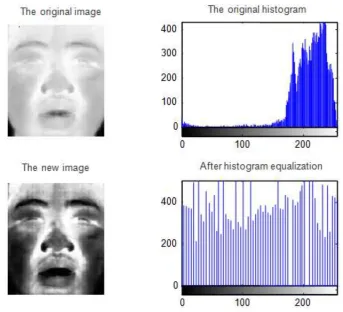
Histogram equalization is a mathematical method to make the pixels inside histogram evenly distribute in gray level. The uniform distribution of pixels in the image makes the contrast ratio of the image increased and the display effect is enhanced.
After the histogram equalization processing, the infrared face image becomes the histogram evenly distributed image, which makes the contrast ratio of the image increase greatly. The pixels of the image are evenly distributed and the entropy of the image are the largest. The probability of all gray levels appearing in the image is the same, and the amount of information is the largest[7]. In Matlab, the function histeq () in the image processing tool library can used to perform histogram equalization to the image. The processing results of the histogram equalization are shown in figure 2-7.
The original image
100
0
200
0
300
0 50
0 100
0 150
0 200
0 250
0
The original image after cutting
50
0
100
0
150
0 50
0 100
0 150
0
The original image
100
0
200
0
300
0 50
0 100
0 150
0 200
0 250
0
The original image after cutting
50
0
100
0
150
0 150
0 50
0 100
0150
Figure 2-7 the results of the histogram equalization
III. INFRARED FACE RECOGNITION ALGORITHM
At present, there are two algorithms widely used in the field of face recognition. One is the principal component analysis based on the whole feature extraction of face, and the other is face recognition based on the local feature analysis of face. The PCA algorithm is used to complete the process of infrared image face recognition in this paper.
3.1 PCA algorithm
PCA algorithm is a very practical and popular data analysis method that can simplify the data of high dimension and complexity. The basic idea is to reduce the complexity and dimension of the original data structure, remove the noise and redundancy in the data, and find the main elements and structural features of the data. The advantage of principal component analysis is that it is easy to operate and widely used.
The basis of the principal component analysis is Karhunen-Loeve Transform. It removes the correlation between the components of the original data vector and creates a new coordinate system. Then the object spindle is aligned along the feature vector. The coordinate systems that carry less information should be removed as much as possible.
3.2 The process of PCA infrared image face recognition
After a series of preprocessing, infrared face images should be extracted and recognized by infrared face features. Feature extraction is the basic content of pattern recognition. it needs to find the features that can best represent the pattern in high-dimensional data. Data compression is performed under the condition that the classification information of each model is not lost too much.
to be measured is projected into this new human face space. The similarity between the two spaces is analyzed and the face recognition is realized according to the similarity judgment.
(1)Creating eigenface space
A portion is selected as the training library from infrared face images after preprocessing and the remaining images are used as the samples for face recognition. The pixels of the normalized face image are assumed to be N*N, then these pixels are connected one by one in order to form a vector of N2 dimensions. The vector is transformed with K-L transform.
If the number of face images in training library is M, vectors are represented as: X1,X2,X3,X4……XM. The average value is
,... 3 , 2 , 1 1 1
i X M X M ii (3-1)
The deviation of each image is
,... 3 , 2 , 1 '
X X i
Xi i (3-2) The covariance matrix is
M i T i i X X M C 1 ' ' ) ( 1 (3-3)The deviation matrix is
' '
3 ' 2 ' 1 ' ... ,,X X XM
X
X (3-4) According to formula (3-4), formula (3-3) can be expressed as follow:
T
X X M
C 1 '( ') (3-5)
Finally, the eigenvalues and eigenvectors of the matrix C are calculated.
(2)Projecting the sample into the feature space
The eigenvalues are arranged in order from large to small (λ1,λ2,λ3……λM) and the corresponding eigenvectors are μk. A vector space consisting of all eigenvectors contains the feature information of infrared face image. M images in training library are projected into the human face space that composed of feature vectors. Generating projection vectors as follow:
y y y
i MYi)T i, i... N 1,2,3,...
( 1 2 (3-7)
N j
X u
yji ( j)T 'j 1,2,3,... (3-8)
Getting the projection vector of the difference vector between the face image and X :
N j
X I u
Pj ( j)T( i ) 1,2,3,... (3-9)
Finally, the nearest neighbor classifier is used to determine the location of the infrared face image in the training library and identify whether it is the face in the face training library and which face it is.
IV.
SOFTWARE DESIGN
The design process of a machine vision system should include the design of hardware and software. A good hardware design can reduce the influence of hardware factors on measurement quality. A good software system can further ensure the realization of the system function and the improvement of performance. The software design process generally follows the principle of simplicity and efficiency, so as to ensure the speed and stability of the system.
4.1 Software operation interface module
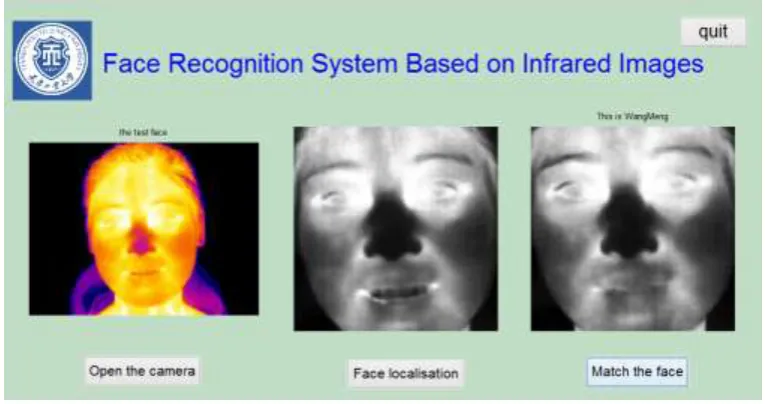
Figure 4-1 software interface of face recognition system
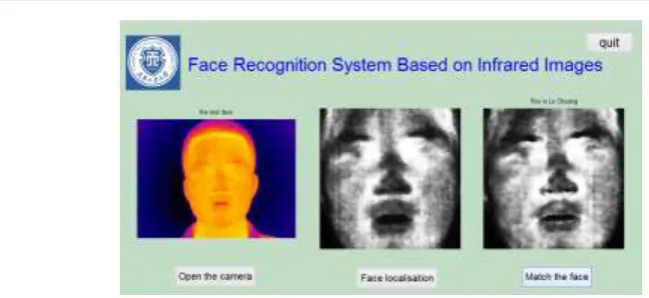
In order to control the operation of the system conveniently, the software interface is designed in this topic. The interface mainly includes two parts: the control menu and the images display window. The function of the menu includes reading the pictures to be measured, locating the faces, looking for faces and exiting the system. The picture reading display window shows the original image collected from the infrared camera and face location window displays human face feature localization. After looking for the face, it displays the matched target image and the name of the person in the library.
4.2 Image processing and face recognition module
Image processing and face recognition module ensure the realization of the system function, so it is the core part of the whole software. The processing functions include preprocessing function of image, graying function, normalized function and so on. These functions are integrated together to accomplish the task. The overall flow of programming is shown in figure 4-2.
Start
collecting image
face location and feature extraction
Is it in the training library?
Is he or she in the training library?
He or she is XXX. He or she is not in
the training library?
End Yes
No
System testing and error analysis
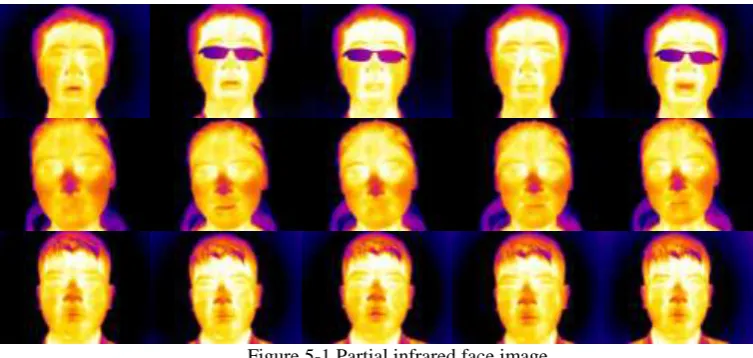
In the experiment, 120 students were selected as subjects. There were obvious differences among them. Five images of different expression and posture were collected for each person. We considered the special circumstances, such as glass can prevent the penetration of infrared, so we also collected the infrared face images of person with glasses.
Figure 5-1 Partial infrared face image
Figure 5-2 face recognition results
The experimental results show that the recognition rate of the self built face library is 100%. However, the number of face images in the training library is a bit small. It doesn't take into account all facial expression features and poses, so it still has its limitations. In the follow-up research process, we need to increase the experimental data.
V.
CONCLUSION
In recent years, face recognition technology has been applied to all aspects of social life and various face recognition technologies have sprung up like mushrooms. But many face recognition methods have their own inevitable shortcomings. For example, the environmental requirement of visible light face recognition is higher. This paper introduces the PCA face recognition method based on infrared image in detail. Infrared face images have a great advantage over visible images, such as not dependent on light, anti-camouflage and anti-fraud. Finally, the experimental results show that the face recognition system is reliable and the recognition rate can reach 100%.
REFERENCES
[1] Bourlai T, Hornak L A. Face recognition outside the visible spectrum[J]. Image and Vision Computing, 2016, 55: 14-17.
[2] Banaee M A, Khazaei A. Recognition and Face Detection Using Infrared Images and Visible Light[J]. International Journal of Scientific Engineering and Technology, 2016, 5(5): 290-291.
[3] Li L Q, Zhang H L. Thermal infrared face recognition based on visual information[J]. Computer Engineering and Applications,2014, (20):182-186
[4] [4] Wu S I F I. Infrared Face Recognition[J]. Journal of Xian University of Posts & Telecommunications, 2013.
[5] Han H, Shan S, Chen X, et al. A comparative study on illumination preprocessing in face recognition[J]. Pattern Recognition, 2013, 46(6):1691-1699.
[6] Bi Y, Lv M, Wei Y, et al. Multi-feature fusion for thermal face recognition[J]. Infrared Physics & Technology, 2016, 77:366-374.