e-ISSN: 2278-067X, p-ISSN: 2278-800X, www.ijerd.com
Volume 12, Issue
6
(
June
2016), PP.31-38
Content Based Image Retrieval Using Color, Texture and Hybrid
Features
Nikita S. Naik
1, Shirish S. Kulkarni
2, Anuja L. Kadam
31M.E. Student, Dept. Of Instrumentation, Ramrao Adik Institute Of Technology, Mumbai, India. 2Asst. Prof., Dept. Of Instrumentation, Ramrao Adik Institute Of Technology, Mumbai, India. 3
M.E. Student, Dept. Of Instrumentation, Ramrao Adik Institute Of Technology, Mumbai, India.
Abstract:-
Image Retrieval system is an effective and efficient tool for managing large image databases. In content based image retrieval system, user provides a query image in order to retrieve relevant images stored in the database. Feature extraction is an important step for extracting valuable information from the image. Color is one of the most important low-level features used in most of the content based image retrieval systems. However, image retrieval using only color features often provide very unsatisfactory results because in many cases, images with similar colors do not have similar content. As a solution for this problem, proposed approach describes a novel algorithm for content based image retrieval based on color and texture features. The proposed algorithm also generates a feature vector that combines both color and texture features. For extracting color features, histogram and color moments are used in order to represent global color distribution and to include spatial color information, color autocorrelogram is used. Wavelet decomposition is used to reduce size of the feature vector and simultaneously preserving the content details for texture feature extraction.To take advantage of their strong orientation selectivity, log Gabor filter is also adopted to extract texture feature. The robustness of the system is tested against query image. Wang’s image database is used for experimental analysis and results are shown in terms of precision.Keywords:- Content based image retrieval (CBIR), autocorrelogram, Discrete wavelet transform (DWT), log
Gabor filterI.
INTRODUCTION
A picture is worth thousands of words. Due to the exponential growth of image data in many applications, such as medical diagnose, art collections, crime prevention, architectural and engineering design, and geographical information and remote sensing systems, there is a compelling need for innovative tools which can easily manage, retrieve and visualize images from large multimedia databases. Traditional technique for image retrieval is by keywords e.g., file-names, categories, annotated keywords, and other manual descriptions. is a template. Unfortunately, this kind of textual-based image retrieval always suffers from two problems. First, images have to be annotated manually, which is a tedious task and is not efficient because it is practically impossible to annotate all the images in the databases. Second it is also very difficult to label the same annotations to the same image by different users. As a result, a number of powerful image retrieval algorithms have been proposed to deal with such problems over past few years. Content based image retrieval (CBIR) is the mainstay of current image retrieval systems [1].
into two: statistical and structural approaches that use the idea that textures are made up of primitives appearing in a near-regular repetitive arrangement [6]. Statistical methods are widely used where pixels are used as the unit elements and features were extracted for pixel neighborhoods. These methods were mainly applied for identification of stochastic textures or micro-textures where the texture primitives appeared at fine scales. Statistical approaches includes, second-order statistical features for texture analysis are derived from co-occurrence matrices [7], model based texture analysis like Markov random field model [8], and transform methods of texture analysis like Fourier transform [9], wavelet transforms [10], Gabor filters [11]. Fourier transform perform poorly in practice, due to its lack of spatial localization. Wavelet transform provide means for better spatial localization. Gabor filter has been shown to be very efficient and also image retrieval using Gabor features outperforms other transform features. Structural approaches, on the other hand, are used to model macro-textures where the texture primitives are distinguished at coarser scales. The main goal of these approaches are identification of the texture primitives, also called texels or textons, and their placement patterns, also called lattice or grid layout, in a given structural texture [6].
In the proposed system, for color feature extraction color histogram, color moments and color autocorrelogram is used. For extracting texture feature, transform based method is used. Proposed system uses wavelet transform, image decomposition and sub-band technology for texture representation. Also log Gabor filter at 4 different scales and 6 orientations is also used for extraction of texture feature. A combination of color and texture features called hybrid technique is used for efficient image retrieval because it has been observed so many times that when color and texture both features are used for retrieval process then the result obtained through these retrieval processes are more efficient.
II.
PROPOSED
SYSTEM
CBIR is defined as a process to find similar images from the image database when a query image is given. Given a picture of a dinosaur, the system should be able to present all similar images of a dinosaur in the database to the user. This is done by extracting the features of the images such as color, texture and shape. These image features is used to compare between the query image and images in the database. CBIR systems extract features from images in the database based on the value of the image pixels. These features are smaller than the image size and stored in a database called feature database. Thus the feature database contains an abstraction of the images in the image database; i.e. each image is represented by a compact representation of its contents (e.g. color, texture, shape). Retrieval results are obtained by calculating the similarity between the query and images stored in the database using predefined distance measure. The results are than ranked according to the highest similarity score. Images in the database which has similar image features to the query image (acquiring the highest similarity measure) or highest rank is retrieved as relevant results ([12]-[13]). Fig. 1 represents block diagram of the proposed system. The function of each block is discussed below:
Fig.1: Block diagram of proposed CBIR system
A. Image Database
Fig. 2: Example Image of WANG Database [14]
B. Query Image
Query is the image that a user wants to search from within the image database.
C. Feature Extraction
Feature extraction involves extracting the meaningful information from the images. So that it reduces the storage required and hence the system becomes faster and effective in CBIR. Once the features are extracted, they are stored in the database for future use. The degree to which a computer can extract meaningful information from the image is the most powerful key to the advancement of intelligent image interpreting systems. One of the biggest advantages of feature extraction is that, it significantly reduces the information (compared to the original image) to represent an image for understanding the content of that image. There has been tremendous work on different approaches to the detection of various kinds of features in images.
Image feature can be classified as Semantic and Visual which can further be classified as low level, mid level and high level features. Semantic Feature, also known as the high level feature like text annotation. Visual Feature, also known as the low level feature like color, texture and shape. Most of the CBIR systems explore low-level image features because they can be computed automatically. Middle-level features like regions and blobs which can be generated without human assistance are used in object-level image retrieval. In the proposed approach two low level features, color and texture is used for feature extraction.
D. Feature Database
Feature database is database created by extracting features of the image database.
E. Feature Vector
Feature vector is the vector created by extracting features from the query image.
F. Similarity Measure (Matching)
In similarity measure, the query image feature vector and database image feature vector are compared using distance metrics. Three distance metrics are used in the proposed approach, Manhattan, Euclidean and Standardized Euclidean. The images are ranked based on the distance value. A similarity algorithm is used to calculate the degree of similarity between those two images. Images in the database which has similar image features to the query image (acquiring the highest similarity measure) is then ranked and presented to the user.
III.
FEATURE
EXTRACTION
TECHNIQUES
In the proposed system three different feature extraction techniques are used as shown in Fig. 3 and are discussed in detail in this section.
A. Color Feature Extraction
For extraction of color feature three different methods have been used - histogram, autocorrelogram and color moments.
1) Color Histogram: The main method of representing color information of images in CBIR systems is through color histograms. The color histogram is a method for describing the color content of an image; it counts the number of occurrences of each color in an image. A color histogram H for a given image is defined as a vector H = {h[1], h[2],.. h[i],.., h[N]} where i represents a color in the color histogram, h[i] is the number of pixels in color i in that image, and N is the number of bins in the color histogram, i.e., the number of colors in the adopted color model. A color histogram is a type of bar graph, where each bar represents a particular color of the color space being used. The bars in a color histogram are referred to as bins and they represent the x-axis. The number of bins depends on the number of colors there are in an image. The y-axis denotes the number of pixels there are in each bin. For the purpose of saving time, color quantization is applied (H=8, S=2, V=2 levels). As a color space, HSV (Hue, Saturation, and Value) space is used. HSV color space is found to be more suitable in case of plotting a histogram since it separates the color components (HS) from the luminance component (V) and is less sensitive to illumination changes [18].
2) Color Autocorrelogram: A color histogram captures only the color distribution in an image and does not include any spatial information, and therefore tend to give poor results. As shown in Fig. 4, the histogram for Image 1 and Image 2 will be same even though the images differ from each other. This is because color histograms fail to incorporate spatial information.
Fig. 4: Sample images: image 1, image 2 [4]
A correlogram of an image describes the joint distribution of two color levels, when the two color levels are spatially at a defined distance in the image. The distance between two color levels is defined as follows. Consider an image as a two-dimensional matrix with a size as H × W. If one color level ci is at position {x1, y1}, 1 ≤ x1 ≤ H, 1 ≤ y1 ≤ W, and the other color level cj is at position {x2, y2}, 1 ≤ x2 ≤ H, 1 ≤ y2 ≤ W, the distance between the two color levels ci and cj is: Distance(ci, cj) = max{|x1 −x2|, |y1 −y2|}. To extract a correlogram, an image is quantized into n sets of colors C = {c1, . . . , cn}. A correlogram at a distance d is a two-dimensional matrix.
Correlogram =
ch(1,1) ⋯ ch(1, n)
⋮ ⋱ ⋮
ch(n, 1) ⋯ ch(n, n)
with each bin ch(i, j) as the frequency of the existence of the two colors ci and cj at the distance d. Thus, a correlogram is indexed in three dimensions: the two color levels, and the distance between the two color levels. The elements in the correlogram are the frequency of the color pairs at a given distance. The size of a correlogram for an 8-bit grey-level image without any quantization is 256×256. This size is considerably too large to provide faster image retrieval [4].
The autocorrelogram, counts the frequency of two identical color levels at a given distance. The autocorrelograms are indexed by two dimensions: a color level, and the distance between the identical two color levels. The elements in the autocorrelograms are the frequencies of the occurrence of the two identical color levels at a given distance. In proposed approach autocorrrelogram is used because of its smaller size and for faster retrieval color is quantized to 64 colors.
as follows: first order (mean), second order (standard deviation), third order (skewness) and higher orders. The mean and standard deviation color moments have been used in the proposed approach and have proved to be efficient and effective in representing color distributions of images. RGB color space is used and two color moments are computed per channel.
Mean : The first color moment(mean) can be interpreted as the average color in the image, and it can be calculated by using the following formula:
Ei=
1 N N
j=1 pij
where N is the number of pixels in the image and pij is the value of the j-th pixel of the image at the i-th color
channel.
Standard Deviation : The second color moment, standard deviation, is obtained by taking the square root of the variance of the color distribution. It can be calculated using following formula:
σi = 1
N pij− Ei 2 N
j=1
where Ei is the mean value, or first color moment, for the i-th color channel of the image.
B. Texture Feature Extraction
For extraction of texture feature 2 different methods have been used – discrete wavelet transform, log Gabor filter.
1) Discrete Wavelet Transform: The Discrete Wavelet Transform (DWT) is used in a variety of signal processing applications such as video compression and image processing. It can efficiently represent some signals, especially ones that have localized changes. This transform is discrete in time and scale. In DWT, one filter of the analysis (wavelet transform) pair is a lowpass filter, while the other is a highpass filter. Each filter has a down-sampler after it to make the transform efficient. The synthesis (inverse wavelet transform) pair consists of an inverse lowpass filter and an inverse highpass filter, each preceded by an up-sampler. A lowpass filter produces the average signal while a highpass filter produces the detail signal. While the average signal would look much like the original, there is a need of details to make the reconstructed signal match the original. Multiresolution analysis feeds the average signal into another set of filters which produces the average and detail signals at the next octave. Each octave’s outputs have only half the input’s amount of data. Thus, the wavelet representation is approximately the same size as the original. A 2D transform can be accomplished by applying the lowpass and highpass filters alongthe rows of the data then applying each of these filters along the columns of the previous results. The four subbands for one level of decomposition are low-low, low-high, high-low, high-high as shown in figure. Multiple levels of decompositions are generated by iterating the LL band. In the proposed approach coiflets is used as a base function and mean and standard deviation of the fourth level decomposed image is used as a feature for analysis of texture([15-[16]).
2) Log Gabor Filter: When considering filters that extract local frequency information, there is a relationship between frequency resolution and time/space resolution. When more samples are taken, the resolution of frequency information is higher, however time/space resolution will be lower and vice versa. The Gabor filter is a good method for simultaneously localizing spatial/temporal and frequency information. A Gabor filter in the space domain is formulated as a Gaussian envelope multiplied by a complex exponential. At certain bandwidths, the Gabor filter has a non-zero DC component. This means that the response of the filter depends on the pattern recognition, this DC component is undesirable because it gives a feature that change with the average value. Log-Gabor filter does not exhibit this problem.
Field introduced the Log-Gabor filter and showed that it is able to better encode natural images compared with the original Gabor filter. For a 2-D log-Gabor filter, the filter is not only designed for a particular frequency, but also is designed for a particular orientation ([17]-[20]).
G ρ,θ = e
−1 log (ρ/u0) 2
2 log (αρ/u0) 2
e
−1 (θ−θ0) 2
2 αθ2
where (ρ, θ) represent the polar coordinates, u0 is the central frequency, θ0 is the orientation angle. αρ and αθ
determine the scale and the angular bandwidth respectively. After applying log-Gabor filter on the image, Mean Squared Energy and Mean Amplitude for each scale and orientation are obtained as a feature for texture analysis.
C. Hybrid Feature Extraction
In order to take advantage of combined effect of color and texture, hybrid technique is used. In this technique, feature database and feature vector is created from features extracted using histogram, autocorrelogram, color moments, discrete wavelet transform and log Gabor filter methods.
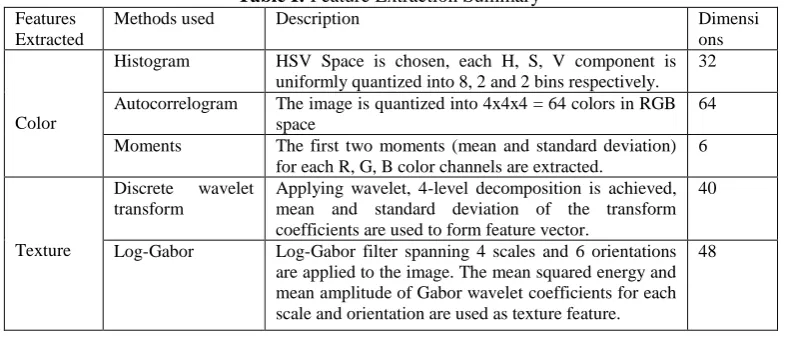
Summary of feature extraction
Below are the 190 extracted color and texture features for an efficient image retrieval process.
Table I: Feature Extraction Summary Features
Extracted
Methods used Description Dimensi
ons
Color
Histogram HSV Space is chosen, each H, S, V component is uniformly quantized into 8, 2 and 2 bins respectively.
32
Autocorrelogram The image is quantized into 4x4x4 = 64 colors in RGB space
64
Moments The first two moments (mean and standard deviation) for each R, G, B color channels are extracted.
6
Texture
Discrete wavelet transform
Applying wavelet, 4-level decomposition is achieved, mean and standard deviation of the transform coefficients are used to form feature vector.
40
Log-Gabor Log-Gabor filter spanning 4 scales and 6 orientations are applied to the image. The mean squared energy and mean amplitude of Gabor wavelet coefficients for each scale and orientation are used as texture feature.
48
IV.
RESULT
The level of retrieval accuracy achieved by a system is important to establish its performance. In CBIR, precision is the most widely used measurement method to evaluate the retrieval accuracy. Precision is defined as the ratio of the number of retrieved relevant images to the total number of retrieved images.
Precision = Number of relevant images retrieved Number of retrieved images
Fig. 6: Flower, Dinosaur and Bus Query and retrieved images
The Average precision of proposed CBIR system for top 10 retrieved images for 5 different queries using three different distance metrics from each class is shown in Fig. 7.
Fig. 7: Average Precision for proposed CBIR system
V.
CONCLUSIONS
In this research, an efficient image retrieval method based on color and texture features is proposed. Similarity is calculated for color based, texture based and hybrid based techniques using Manhattan, Euclidean and Standardized Euclidean distances. The experiment shows that only color features and texture features are not sufficient to describe an image. The proposed system is giving better accuracy when both color and texture features are combined because each extracted feature adds its unique advantages. Future work can be extended by designing classifiers in order to make retrieval more efficient and accurate.
REFERENCES
[1]. Gulfishan Firdose Ahmed, Raju Barskar, “A Study on Different Image Retrieval Techniques in Image Processing”, International Journal of Soft Computing and Engineering, Volume-1, Issue-4, September 2011.
[2]. Chesti Altaff Hussain, Dr. D. Venkata Rao, T. Praveen, “Color histogram based image retrieval”, International Journal of Advanced Engineering Technology, September 2013.
[3]. S.R. Kodituwakku, “Comparison of Color Features for Image Retrieval”, Indian Journal of Computer Science and Engineering, Vol. 1 No. 3, 207-211.
[5]. H. B. Kekre, Kavita Patil, “Standard Deviation of Mean and Variance of Rows and Columns of Images for CBIR”, International Journal of Computer, Electrical, Automation, Control and Information Engineering Vol 3, No 3, 2009.
[6]. Ismet Zeki Yalniz, Selim Aksoy “Unsupervised detection and localization of structural textures using projection profiles”, Elsevier, Pattern Recognition, 43 (2010) 3324–3337.
[7]. R.M. Haralick, K. Shanmugam, I. Dinstein, “Textural features for image classification”, IEEE Transactions on Systems, Man, and Cybernetics SMC-3 (6) (1973) 610–621.
[8]. A. Speis, G. Healey, “An analytical and experimental study of the performance of Markov random fields applied to textured images using small samples”, IEEE Transactions on Image Processing, 5 (3) (1996) 447–458.
[9]. A. Rosenfeld and J. Weszka, “Picture Recognition” in Digital Pattern Recognition, K. Fu (Ed.), Springer-Verlag, 135-166, 1980.
[10]. J. Daugman, “Uncertainty Relation for Resolution in Space, Spatial Frequency and Orientation Optimised by Two-Dimensional Visual Cortical Filters”, Journal of the Optical Society of America, 2, 1160-1169, 1985.
[11]. S. Mallat, “Multifrequency Channel Decomposition of Images and Wavelet Models”, IEEE Trans. Acoustic, Speech and Signal Processing, 37, 12, 2091-2110, 1989.
[12]. Vadhri Suryanarayana, Dr. M.V.L.N. Raja Rao, Dr. P. Bhaskara Reddy, “Image retrieval system using hybrid feature extraction technique”, International Journal of Computer Science & Information Technology Vol 4, No 1, Feb 2012.
[13]. Nitin Jain & Dr. S. S. Salankar, “Color & Texture Feature Extraction for Content Based Image Retrieval”, IOSR Journal of Electrical and Electronics Engineering, PP 53-58.
[14]. J.Z. Wang, “Wang Database,” [Online], Available at: http://wang.ist.psu.edu/
[15]. Micheal Weeks. “Digital Signal Processing- using MATLAB and Wavelets”, Electrical Engineering series, ISBN: 0-9778582-0-0, 2007.
[16]. Satyabrata Rout. “Orthogonal vs. Biorthogonal Wavelets for Image Compression”, Virginia Polytechnic Institute and State University, August 2003.
[17]. Rodrigo Nava, “Texture Image Retrieval Based on Log-Gabor Features, Progress in Pattern Recognition, Image Analysis, Computer Vision, and Applications”, Volume 7441, 2012.
[18]. Bhavik M. Patel, “A Novel Approach For CBIR Using Multi-feature Extraction And SVM Classification”, International Journal of Advance Engineering and Research Development, Volume 1, Issue 5, May 2014.
[19]. Sylvain Fischer, “Self-Invertible 2D Log-Gabor Wavelets”, International Journal of Computer Vision 75(2), 231–246, Springer, 2007.
![Fig. 2: Example Image of WANG Database [14]](https://thumb-us.123doks.com/thumbv2/123dok_us/1403218.1652464/3.595.132.467.585.725/fig-example-image-wang-database.webp)