A survey on Digital Stereo Image Watermarking
Technique
Ankita Choubey Student M.Tech Oriental College of Technology
Dr. Kavita Burse
Director Oriental College of Technology
Arvind Sahu HOD,EC
Oriental College of Technology
Abstract - The availability of digital data such as audio, images and videos to the public has increased by the usage of internet and computers. Throughout the world there is an increasing demand for protecting privacy and copyright as per the privacy by design concept. Digital watermarking is a technology being developed in response to ensure and facilitate data authentication, security, owner identification and copyright protection of digital media .In this paper we start with an overview ,framework, requirement, applications, classification, performance evaluation metric, and a comparative analysis of some major watermarking techniques. In this survey our prime concern is stereo image only. Digital watermarking holds significant promise as one of the keys to protecting proprietary digital content in the coming years thus working synchronously. It focuses on embedding information inside a digital object such that the embedded information is inseparable bound to the object. In this paper we aim to present a survey of different techniques on digital image watermarking by highlighting their comparisons. In this developing world of internet and technology to make the data transferring secure from illegal interferences digital watermarking is used as a key solution.
I. INTRODUCTION
Over the last few years, security of digital data has been a popular topic due to the development of multimedia techniques because of World Wide Web. Rapid development of Internet increases the copyright protection issues for multimedia data. Traditional security mechanisms based on cryptography has its own limitation. The digital watermarking overcomes the limitations of traditional security mechanisms. Digital watermark was first discovered in 1992 by Andrew Tirkel and Charles Osborne [1].Watermark is derived from the German word “Wessmark”.
Digital watermarking is the process of adding a watermark on digital images or files without noticeable altering the image itself and verifies the authenticity of the image. It provides proof that it is copyrighted to a particular person and it cannot be owned by third party. It is like a digital signature, which gives the image a sense of ownership or authenticity [2]. Multimedia contents such as text, image, video and audio has been widely used because of rapid development of Internet technology. Now using digital image watermarking humans can easily distribute or access any multimedia data from Internet.
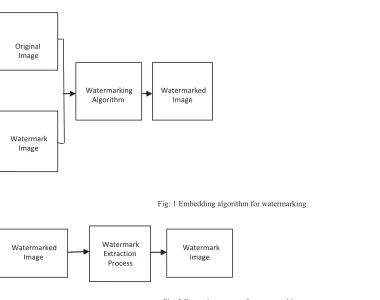
Fig: 1 Embedding algorithm for watermarking
Fig: 2 Extraction process for watermarking
Watermarking can be seen as a special type of steganography. Watermarking is very similar to steganography but the basic difference is that in steganography a secret message is embedded in the image and the image has no relation to the secret message. The digital image is merely used as a cover to hide its existence. In digital watermarking a watermark or digital message is embedded inside another digital data so that the data cannot be easily accessed by third party. The two messages i.e. watermark and original data are related to each other [3]. In past few years, numerous digital watermarking have been proposed, which is based on different sets of criteria. According to the working domain watermarking can be categorized into two types: spatial domain techniques and frequency domain techniques. In Spatial domain, watermark is embedded by changing pixel values of the host image. In Frequency domain, watermark is added to the values of its transform coefficients. After this perform the inverse transform to get the watermarked image. Frequency domain includes DCT (Digital Cosine Transform), DFT (Digital Fourier Transform), and DWT (Digital Wavelet Transform).
II. CLASSIFICATION OF WATERMARKING
TABLE 1 WATERMARKING CLASSIFICATION
S. No Criteria Classification
1 Robustness
1. 2.
Fragile : Easily attacked . Semi Fragile : Resists some attacks .
3. Robust :Not affected by attacks . 2 Perceptivity 1. 2. Visible: Logos . Invisible :Steganography .
3 Watermark Type 1. Noise :chaotic ,Gaussian , pseudo Noise. 2. Image :stamp ,Label ,Logo.
4 Domain 1. Spatial: LSB ,Predictive ,correlation.
2. Frequency: DFT,DWT,DCT
Original Image
Watermarking Algorithm
Watermark Image
Watermarked Image
Watermarked Image
Watermark Extraction
Process
5 Key Type 1. 2. Asymmetric watermarking. Symmetric Watermarking.
6 Host data
1. Image Watermarking . 2. Audio Watermarking. 3. video Watermarking 4. Text Watermarking. 5. Graphic Watermarking.
7 Data extraction
1. Blind. 2. Semi-blind. 3. Non-blind.
III COMPARISON
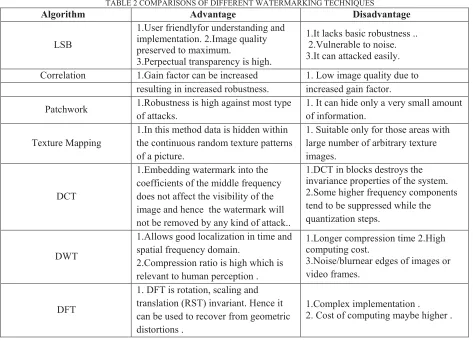
The comparison of different watermarking techniques has been done in the table2.
TABLE 2 COMPARISONS OF DIFFERENT WATERMARKING TECHNIQUES
Algorithm Advantage Disadvantage
LSB
1.User friendlyfor understanding and implementation. 2.Image quality preserved to maximum.
3.Perpectual transparency is high.
1.It lacks basic robustness .. 2.Vulnerable to noise. 3.It can attacked easily.
Correlation 1.Gain factor can be increased 1. Low image quality due to
resulting in increased robustness. increased gain factor.
Patchwork 1.Robustness is high against most type of attacks.
1. It can hide only a very small amount of information.
Texture Mapping
1.In this method data is hidden within the continuous random texture patterns of a picture.
1. Suitable only for those areas with large number of arbitrary texture images.
DCT
1.Embedding watermark into the coefficients of the middle frequency does not affect the visibility of the image and hence the watermark will not be removed by any kind of attack..
1.DCT in blocks destroys the invariance properties of the system. 2.Some higher frequency components tend to be suppressed while the quantization steps.
DWT
1.Allows good localization in time and spatial frequency domain.
2.Compression ratio is high which is relevant to human perception .
1.Longer compression time 2.High computing cost.
3.Noise/blurnear edges of images or video frames.
DFT
1. DFT is rotation, scaling and translation (RST) invariant. Hence it can be used to recover from geometric distortions .
1.Complex implementation . 2. Cost of computing maybe higher .
IV LITERATURE SURVEY
In 1998, Huang and Shi [2] proposed an adaptive spread-spectrum watermark scheme based on human visible method. It used to be adaptive in the force of watermarks by way of accounting the human visible masks: brightness sensitivity and texture sensitivity
In 1999, Kim et al.’s[3] proposed a watermarking system using the human visible method centered on wavelet change into. The number of watermark factors are proportional to the vigour contained in every wavelet turn into bands. To estimate the characteristic of the photograph, the changing price of a sinusoidal sample per subtended visible perspective in cycles per degree is calculated. The influence is used because the visual weight of watermarks in every wavelet turn into band.
In 2000, Chen et al.’s [4] proposed an adaptive watermarking scheme. This scheme embeds a binary picture as watermark in DCT process. The watermarked snapshot is imperceptible with the aid of human visual system. It makes use of a function-centered method to locate the watermark positions for the duration of embedding and extracting. The function-founded method uses the Sobel aspect-detector to receive the gradient magnitude and this outcomes is proportional to the amount of watermark bits.
In (2001) Hsieh, et al.’s the researchers proposed an image accreditation technique by embedding digital watermarks in images. The technique based on wavelet transform and embeds a watermark with visual recognizable patterns by modifying the frequency part of the images. In the proposed approach, the original image is decomposed into wavelet coefficient. Then, multi-energy watermarking based on the qualified significant wavelet tree is used to achieve the robustness watermarking.
In (2005) Emek, et al.’s they proposed a new watermarking algorithm using DWT prior to the DCT to provide better imperceptibility in harmony with the human visual system. Their algorithm showed resistance to common signal processing operation
In (2006) Jaylakshmi, et al.’s the researchers proposed a new method of nonblind digital image watermarking in contourlet domain. In this method the number of directions in the band pass image is doubled at every other scale of decomposition according to curve scale relation and the simulation results which prove that contourlet domain watermarking is well suited for image like maps where a lot of curves and texts are inherently present.
In (2007) Al-Haj, et al.’s the researcher described imperceptible and robust combined DWT-DCT digital image watermarking algorithm and the performance evaluation result show that combining the two transform improves the performance of the watermarking algorithm that are based solely on the DWT transform.
In (2008) Yingkun, et al., in this paper, they developed a new filter bank based on non subsample contourlet and wavelet hybrid transform (NSCWHT) and study its application. They proposed a new image watermarking based on developed NSCWHT.
In (2009) Shu, et al., this paper proposed a watermarking algorithm in the frequency domain based on the selection of a high frequency range containing a large amount of information. The selected high frequency range contributes to the imperceptibility of the watermark while the robustness against compression is achieved because the selected frequency range contains large amount of information. The entropy-based algorithm is used to find the host tree of the wavelet based contourlet packet transform (WCPT).
In 2011, Aree Ali Mohammed et al.’s [5] proposed an image watermarking scheme established on multi bands wavelet transformation procedure. In the beginning, the proposed scheme is validated on the spatial domain (for each a non and semi blind approaches) with a purpose to examine its results with a frequency area. In the frequency area, an adaptive scheme is designed and carried out centered on the bands decision criteria to embed the watermark.
In 2013, G. DayalinLeena et al.’s [6] proposed a watermarking scheme wherein digital snapshot is watermarked with the aid of utilizing wavelet transforms which is an efficient multi-resolution frequency area method. The low frequencies of wavelet decomposition of the provider image which is a color snapshot is watermarked with a colour emblem shuffled with the aid of making use of a chaotic map system. Embedding method is extremely secured as chaotic map process shuffles the watermark with a view to confuse any unauthorized character who tries to switch or do away with.
In 2014, H.D Kim et al. In this paper, author propose a robust watermarking scheme for DIBR 3D images by quantization on dual-tree complex wavelet transform (DT-CWT) FRHI¿FLHQWVZLWKFRQVLGHUDWLRQRILPSHUFHSWLELOLW\
To make the proposed scheme robust to DIBR process, two characteristics of DT-CWT are employed: approximate
VKLIWLQYDULDQFHDQGGLUHFWLRQDOVHOHFWLYLW\:HVHOHFWFHUWDLQFRHI¿FLHQWVXE-blocks and group WKHFRHI¿FLHQWURZV
based on the properties of DIBR. On the extraction side, the threshold is carefully chosen with a low false positive rate.
A year wise PSNR value comparison survey
V IMPROVEMENT AS A COPYRIGHT PROTECTING METHOD IN STEREO IMAGE
an unauthorised copy of a multimedia file (e.g. on a peer-peer network), it should be possible to trace, since the watermark present in it can reveal the identity of the consumer who originally bought the copied content. Thus aim of digital sterio watermarking is provide a robust and adaptive system for multimedia protection, where hidden watermark provides a desired requisition against the copyright infringement. The impact of loss of intellectual property is two fold. Firstly , the inventor loses the loyalty or benefit which he would have got by selling the rights for the intellectual property. Secondly, there is a great chance that sensitive information or technology goes into the wrong hands and is misused by the people against the society. Lot of work has been done in digital watermarking as a copyright protection tool.
VI PROPOSED STEREO WATERMARKING ALGORITHM
Discrete wavelet transform and singular value decomposition are used for embedding and extracting the watermark. The left image from the stereo-pair is used as the host image. The estimated disparity-image from the stereo-pair is used as the watermark image . Let us consider Ilbe the left image of stereo-pair, which is gray scale images of size m×n. The disparity-image estimated by the algorithm is considered as watermark. Therefore, the size of watermark image is one fourth of the host image Il. In order to enhance the security and robustness of proposed watermarking algorithm, host image Ilis degraded using Arnold transformation before embedding process.
VII CONCLUSION
This paper reviewed the basic model of digital image watermarking for embedding along with some latest research work done on digital sterio image watermarking. Next, it mentioned the requirements of any digital image watermarking System . Then it listed some of the applications of digital image watermarking . Next it showed the classification based on different catagories . Next it highlighted the evaluation system of watermarking technologies by comparing their advantages and disadvantages . Finally it presents some workdone on improving watermark as a copyright protection method. In stereo imaging
REFERENCES
[1] Huang, J. and Shi, Y. Q., “Adaptive Image Watermarking Scheme blind watermarking approach for vector geo-spatial data”, Elsevier [2] Cox, I. J., Kilian, J., Leighton, F. T., andShamoon, T.,“Secure watermarking”, 7th International Sym. on Image and Signal
Spread Spectrum Watermarking for Multimedia,” IEEE Processing and Analysis (ISPA 2011) Dubrovnik, Croatia, pp. 431Transactions on Image Processing, Vol. 6,No. 12, pp. 1673-1687, 436.
[3] Kim, Y.-S., Kwon, O.-H., and Park, R.-H., “Wavelet Based Watermarking Method for Digital Images Using The Human Visual System,” IEE Electronics Letters, Vol. 35, No. 6, pp. 466-468, 1999.
[4] Chen, D.-Y., Ouhyoung, M., and Wu, J.-L.,”A Shift-Resisting Public Watermark System for Protecting Image Processing Software,” IEEE Transactions on Consumer Electronics, Vol. 46, No. 3, pp.404-414, 2000.
[5] Aree Ali Mohammed & Haval Mohammed Sidqi,” Robust Image Watermarking Scheme Based on Wavelet Technique”, International Journal of Computer Science and Security (IJCSS), Volume (5) : Issue (4) : 2011
[7] H. Guo et al.,” A fragile watermarking scheme for detecting malicious modifications of database relations”, Information Sciences 176 (2006) 1350–1378
[8] C.-M. Chou, D.-C. Tseng,” A public fragile watermarking scheme for 3D model authentication”,Computer-AidedDesign 38 (2006) 1154– 1165 Available:www.sciencedirect.com
[9] W.-C. Chen, M.-S. Wang (2009), “A Fuzzy c-Means Clustering based Fragile Watermarking Scheme for Image Authentication”, Expert Systems with Applications, Volume 36, Issue 2, Part 1, pp. 1300-1307. Available:www.sciencedirect.com Journal of Computers, Environment and Urban Systems, Volume 35, Issue 6, pp. 485–492.
[12] Huang-Chi Chen, Yu-Wen Chang, Rey-Chue Hwang (2012), “A Watermarking Technique based on the Frequency Domain”, Journal of Multimedia, Vol. 7, No. 1, pp. 82-89.
[13] Hongxia Wang, Ke Ding, Changxing Liao (2008), “Chaotic Watermarking Scheme for Authentication of JPEG Images”, International Symposium on Biometrics and Security Technologies, pp. 1-4.
[14] A. Kannammal, K. Pavithra, S. Subha Rani (2012), “Double Watermarking of Dicom Medical Images using Wavelet DecompositionTechnique”, European Journal of Scientific Research, Vol. 70, No. 1, pp. 46-55.
[15] P.Jain and A. S. Rajawat,” Fragile Watermarking for Image Authentication: Survey”, International Journal of Electronics and Computer Science Engineering”, Available: www.ijecse.org ISSN 2277-1956/V1N3-1232-1237
[16] Archana Tiwari, Manisha Sharma,”Semifragile Watermarking Schemes for Image Authentication- A Survey”, I.J. Computer Network and Information Security, 2012, 2, 43-49
[17] Chitla Arathi,’’ A Semi Fragile Image Watermarking Technique Using Block Based SVD”,International Journal of Computer Science and Information Technologies, Vol. 3 (2), 2012,3644-3647