167 | P a g e
HIERARCHICAL FUZZY RELATIONAL
CLUSTERING ALGORITHM FOR SENTENCE LEVEL
TEXT
Ms. Kirti M. Patil
1, Dr. Jagdish.W.Bakal
2 1PG
Scholar, Department of Computer Engineering, ARMIET, Shahapur, Thane (E).(India)
2
Principal,
Department of Computer Engineering, SSJCOE, Dombivali, Thane (E), (India)
ABSTRACT
Now a days, Data mining clustering can be done at the sentence level and document level. Mostly the clustering
is depends on the how the cluster is similar or dissimilar between the data points. Clustering algorithms are
mostly unsupervised methods that can be arranging data into groups. These groups are called as clusters. In
sentence clustering domains, a sentence is related to more than one theme in document or set of documents. Due
to this, the proposed system will be captures fuzzy relationships to increase the scope of problems. In this paper,
we present a new hierarchical fuzzy relational clustering algorithm and clustering is done at the sentence level.
This algorithm has been shown an algorithm produces a good result than existing algorithm. The algorithm
operates on relational input data.
Keywords: Clustering, Data Mining, Similarity, Sentence, Fuzzy.
I. INTRODUCTION
Data mining is important part of Knowledge Discovery in database (KDD). Data mining is the process which
used to find important information throughout the data, is a powerful new technology.
Clustering can be used in many applications like image processing, bio-informatics, business planning, Data
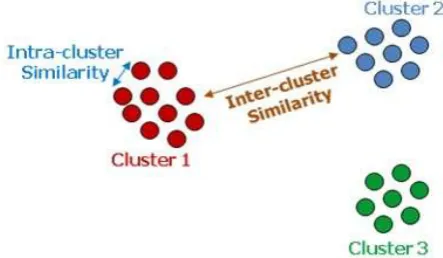
compression, etc. Clustering is based on the similarity or dissimilarity between the data points. When the
similarity concept used the high quality of clustering is to obtain high intra-cluster similarity and low
inter-cluster similarity. Dissimilarity concept used the high quality of inter-clustering to obtain low intra-inter-cluster
dissimilarity and high inter-cluster dissimilarity.
168 | P a g e
Clustering is an effective technique for data analysis and has various applications in a wide variety of areas. Theexisting methods of clustering categorized into hard clustering and soft clustering. Clustering is a process of
knowledge discovery or interactive multi-objective optimization.
II. RELATED WORK
A. Skabar, K. Abdalgader. [1] In this paper a novel fuzzy clustering algorithm that operates on relational input
data and that data is in form of a square matrix of pairwise similarities. The pairwise similarities are between the
data objects.The algorithm is uses a graph representation of data.
J. C. Dunn [4] In this paper, the proposed algorithm generates a limiting partition with membership functions
which closely approximate the characteristic functions of the clusters.
Brendan J. Frey* and Delbert Dueck [10] Clustering data based on a measure of similarity is a critical step in scientific data analysis and in engineering systems. Affinity propagation takes as input a collection of
real-valued similarities between data points, where the similarity indicates how well the data point with index is
suited to be the exemplar for data point.
III. EXISTING SYSTEM
In existing system, most popular vector space model is successful. This model is able to capture the semantic
content of document level text. In high dimensional vector space, the data points similar to a unique keyword,
follows to a rectangular representation. Documents are semantically related and to contain more words which
are common and which based on word co-occurrence. That semantic similarity can measured in terms of word
co-occurrence at document level, this is not hold small sized text fragments. The two sentences are semantically
related, if words are common. For this a number of sentence similarity measures are suggested
Limitations:
The traditional algorithm results undergoes from instability in optimization algorithms.
High dimensionality introduced by representing objects with all other objects.
IV. PROPOSED SYSTEM
In proposed system, we are implementing the hierarchical clustering development using a fuzzy clustering
algorithm based on relational eigenvector algorithm. The dataset of the system is given by the searched query in
the search box. The system extracts the links from the google search engine. The proposed algorithm is based on
the Fuzzy C- means (FCM) algorithm. The proposed hierarchical fuzzy clustering algorithm is clusters a data
object. The data objects are the retrieved .xml files.
4.1 PageRank Algorithm
PageRank algorithm is a graph centrality based algorithm. PageRank is an algorithm which measures the
importance of website pages. PageRank assigns a numerical weight to each element or sentence of a set of
documents which are hyperlinked and measures its relative importance in the sentences. The PageRank score is
169 | P a g e
4.2 EM algorithm
EM is a general algorithm for finding the maximum likelihood estimates of parameters in a statistic model,
where the data are “incomplete” or the likelihood function involves latent variables. Intuitively, what EM does is iteratively “completes” the data by “guessing” the values of hidden variables then re-estimates the parameters
by using the guessed values as true values.
The EM algorithm is divided into two steps to find the maximum likelihood. They are as follows.
E-step: Compute the expected log likelihood function where the expectation is taken with respect to the
computed conditional distribution of the latent variables given the current settings and observed data.
M-step: Find the parameters that maximize the Q function in the E-step to be used as the estimate of for the next
iteration.
4.3 Fuzzy Relational Clustering
A fuzzy relational clustering approach produces the clusters with sentences. Some produced clusters are related
to some content. The FRECCA (Fuzzy Relational Eigen Vector Centrality based Clustering Algorithm)
proposed by Andrew Skabar and Khaled Abdalgader [1].
4.4 Hierarchical FRECCA
This algorithms main goal is the dividing the data objects into number of clusters. This algorithm is the extended
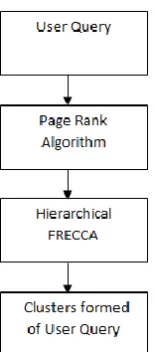
form of fuzzy relational clustering algorithms. In this algorithm the PageRank algorithm is used to ranking the
retrieved files that is .xml files.
Fig 2. Hierarchical FRECCA Clustering Process
V. EVALUATION CRITERIA
Some evaluation criteria are used to measure the performance of the proposed system. The clustering is the
unsupervised learning framework. In the following, L= is the set of clusters, C = is
170 | P a g e
5.1 Purity and Entropy
The purity of cluster is the fraction of the cluster size and the entropy of a cluster is a measure of how mixed the
objects within the clusters. The formula to calculate the purity (Pj) for j cluster is:
The entropy of a cluster j is a measure of how mixed the objects within the cluster are, and is defined as
5.2 V-Measure
This metric overcomes the problems related to purity and entropy. V -measure is also known as the Normalized
Mutual Information (NMI). It is defined as the harmonic mean of homogeneity h and completeness (c); i.e.
.……….. (3)
5.3. Rand Index and F-Measure
This measure considers each possible pair of objects. It is based on a combinatorial approach. It considers each
possible pair of objects. Each pair can fall into one of four groups: if both objects belong to the same class and
same cluster then the pair is a true positive (TP); if objects belong to the same cluster but different classes the
pair is a false positive (FP); if objects belong to the same class but different clusters the pair is a false negative
(FN); otherwise the objects belong to different classes and different clusters, and the pair is a true negative (TN).
F
-measure=
2PR
/
(P+R)
where
P
=
TP
/
(TP+FP)
and
R
=
TP
/
(TP+FN)
VI. ADVANTAGES
We can create cluster of clusters of sentences having similar meaning.
It can also be used for increasing efficiency of creating a group of similar pages in automated way.
VII. RESULTS
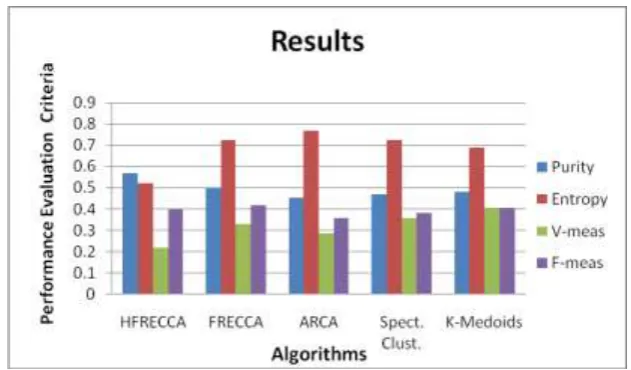
The proposed algorithm overcomes the problems with the existing system. The algorithm achieves a superior
performance and shows a high degree of overlapping clusters. The values of purity, Entropy, v-measure and the
F-measure for three clusters are shown in the given table. It shows that the performance of proposed algorithm
171 | P a g e
Table 1. Proposed algorithm output with the existing algorithms values
On the basis of generated output by the system which is shown in above table the graphical representation is
shown below.
Graph 1. Graphical Representation of Proposed and existing algorithms
VIII. CONCLUSION
Hierarchical fuzzy clustering algorithm plays an important role in the sentence level text clustering. This
algorithm works on the relational data which is in the form of relational matrix. This proposed algorithm uses
the PageRank and EM algorithm for the sentence text clustering. This paper was motivated by our interest in the
sentence level text clustering using fuzzy clustering algorithm. The algorithm is a generic fuzzy clustering
algorithm and applied to any domain and relational clustering problems. This algorithm can be applied to
various domains.
IX. ACKNOWLEDGEMENT
I would like to thanks Dr. Jagdish W. Bakal for his motivating support and useful advice about this paper.
3-Cluster
Purity
Entropy V-measure
F-measure
172 | P a g e
REFERENCES
[1] Andrew Skabar and Khaled Abdalgader, “Clustering Sentence Level Text Using A Novel Fuzzy Clustering Algorithm”. January 2013, IEEE Transactions on Knowledge and Data Engineering, Vol. 25, no. 1, pp
62-75.
[2] Yuhua Li,David Mclean, ZuhairBandar,James D. Oshea & Keeley Crokett, “Sentence Similarity Based on
Semantic Nets and Corpus Statistics”,Aug. 2006 IEEE Trans. Knowledge and Data Eng vol. 8, no. 8 pp.
1138-1150.
[3] M.S.Yang, “A Survey Of Fuzzy Clustering”, 1993, Math. Computer Modelling, vol. 18, no. 11, pp 1-16. [4] Ulrike von Luxburg, “A Tutorial On Spectral Clustering”. 2007, Statistics and Computing, vol. 17, no. 4,
pp. 395-416.
[5] Raymond Kosala and Hendrik Blockeel, “Web Mining Research: A Survey”. 2000, ACM SIGKDD
Explorations Newsletter, vol. 2, no. 1, pp. 1-15.
[6] Brendan J. Frey* and Delbert Dueck, “Clustering By Passing Messages Between Data Points”, 2007, Science, vol. 315, pp. 972-976.algorithms” The Journal of Mathematics and Computer Science Vol .5
No.3 (2012), 229-240.
[7] A.K. Jain, M.N. Murty, and P.J. Flynn, ªData Clustering: A Review,º ACM Computing Surveys, vol. 31,
no. 3, pp. 264-323,1999.
[8] M. Jordan and R. Jacobs. Hierarchical mixtures of experts and the em algorithm. Neural Computation,
6:181–214, 1994.
[9] C.F.J. Wu. “On the convergence properties of the em algorithm”. The Annals of Statistics, 11(1):95–103,
1983.
[10] P. Corsini ,B. Lazzerini,F.Marcelloni.,“A New Fuzzy Relational Clustering Algorithm Based On The Fuzzy
C-Means Algorithm”, 24 ,April 2004,Soft Computing, pp-439-447.
[11] J. C. Dunn,“A Fuzzy Relative Of The ISODATA Process And Its Use In Detecting Compact
Well-Separated Clusters”, 1974, Journal of Cybernetics., 3, 3, pp. 32-57.
[12] G. Erkan and D.R. Radev, ”LexRank: Graph-Based Lexical Centrality As Salience In Text