CBR TECHNIQUES WITH SPARSE CODEWORDS TO
RETRIEVE FACE IMAGE
Shruthi K.C
1, Dr.Y.P. Gowramma
2 1Mtech Scholar, Kalpataru Institute of Technology, Tiptur, Karnataka, (India)
2
Professor & H.O.D Kalpataru Institute of Technology, Tiptur, Karnataka, (India)
ABSTRACT
Now a days the popularity of social networks like face book, twitter are mostly used by the people. Many of them
use human face images for their profile. And also we can maintain large scale database for the image storage.
To avoid the large database use two algorithms like attribute enhanced sparse codewords and attribute
embedded inverted indexing . In large image database have problem regarding the image retrieval .By using
this algorithm we can efficiently retrieve the images from the large image database. It will give the 80% perfect
matched images. Photos with people (e.g., family, friends, celebrities, etc.) are the major interest of users. Thus,
with the exponentially growing photos, large-scale content-based face image retrieval is an enabling technology
for many emerging applications. In this work, we aim to utilize automatically detected human attributes that
contain semantic cues of the face photos to improve content-based face retrieval by constructing semantic
code-words for efficient large-scale face retrieval. By leveraging human attributes in a scalable and systematic
framework, we propose local color histogram to improve the face retrieval.
Keywords: Attribute Enhanced Sparse Codewords, Attribute Embedded Inverted Indexing,
Ranking, Attributes.
I. INTRODUCTION
Due to the recognition of digital devices and also the rise of social network/photo sharing services (e.g., Facebook, Flipcart), there area unit mostly growing shopper photos on the market in our life. Among all those photos, an enormous proportion of them area unit photos with human faces (estimated quite 60%). The importance and also the sheer quantity of external body part photos build manipulations (e.g., search and mining) of large-scale external body part pictures a extremely necessary analysis downside and alter several world applications.
Retrieval . Content primarily based Image Retrieval is used in several areas like art galleries, criminal investigation, medical and geographic databases. For the simple feature extraction, in , the RGB (Red inexperienced, Blue) color pictures square measure reworked into YUV color area and therefore the Y elements representing the grey level pictures square measure reworked into riffle domain. By victimisation Mallat's pyramid algorithmic program, the grey level image is rotten into its riffle coefficients.
To analyze the effectiveness of various human attributes across datasets and notice informative human attributes. , the contributions of attribute increased thin codewords include: within the mix mechanically detected high-level human attributes and low-level options to construct linguistics codewords. To the simplest of developer information, this can be the primary proposal of such combination for content-based face image retrieval. To balance international representations in image collections and domestically embedded facial characteristics, within the scalable face image retrieval victimisation attribute increased thin codewords system 2 orthogonal ways to utilize mechanically detected human attributes to boost content-based face image retrieval beneath a scalable framework. It conducts intensive experiments and demonstrates the supported of the planned ways on 2 separate public datasets and still ensures real time response. within the any establish informative and generic human attributes for face image retrieval across totally different datasets. the chosen descriptors square measure promising for different applications from last decade, there's tremendous growth within the use of technology and art galleries, nature, diversion, education, industry, varied areas have resulted in giant amounts of pictures within which the various areas in medicine field, etc in these applications. so as to retrieve the dataset wants immense image particularly image is extremely complicate task to recover; thus
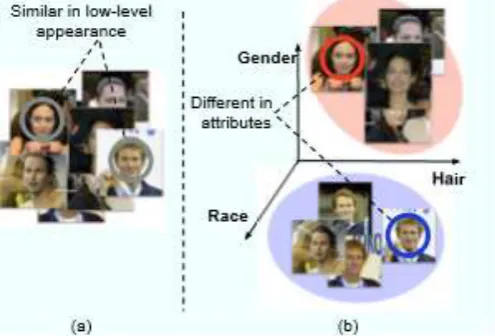
Fig. 1. (a) Because low-level features are lack of semantic meanings, face images of two different people might be close in the traditional low-level feature space. (b) By incorporating high-level human attributes into feature representations, we can provide better discriminability for face image retrieval. there should be an automated system which can input the number of queries image matching to retrieve images. Designing such systems research is quite challenging there is much image retrieval
That is, the perspective of textual descriptions given by an annotator could be different from the perspective of a user. In other words, there are textual user queries and image annotation. Incompatibility to correct the problem, Image according to image content retrieval such a strategy carries out so-called content-based image retrieval (CBIR). Physical symptoms of CBIR system [2] to build glossery description of images to facilitate efficient and effective retrieval [1], the primary goal of the CBIR system is basically sewage facilities and queries image color, shape and texture with each dataset.
II. RELATED WORK
B.C.Chen et.al [2] developed a scalable face image retrieval system which can integrate with partial identity information to improve the retrieval result. To achieve this goal, B.C.Chen et.al first apply sparse coding on local features extracted from face images combining with inverted indexing to construct an efficient and scalable face retrieval system. Then propose a novel coding scheme that refines the representation of the original sparse coding by using identity information. Using the proposed coding scheme, face images with large intra-class variances will still be quantized into similar visual words if they share the same identity. Experimental results show that the system can achieve salient retrieval results on LFW dataset (13K faces) and outperform linear search methods using well known face recognition feature descriptors.
Recently shown to give excellent results for category recognition. A. Ramisa et al. [3] discuss their performance in the context of image retrieval; show that retrieving images of particular objects based on attribute vectors gives results comparable to the state of the art. A. Ramisa et al. demonstrate that combining attribute and Fisher vectors improves performance for retrieval of particular objects as well as categories. Implement an efficient coding technique for compressing the combined descriptor to very small codes. Experimental results on the Holidays dataset show that our approach significantly outperforms the state of the art, even for a very compact representation of 16 bytes per image. Retrieving category images is evaluated on the “web-queries” dataset. A.
Ramisa et al. show that attribute features combined with Fisher vectors improve the performance and that combined image features can supplement text features. Huang, G. [5] discussed about the labeled faces in the wild. Face recognition has benefitted greatly from the many databases that have been produced to study it. Most of these databases have been created under controlled conditions to facilitate the study of specific parameters on the face recognition problem. These parameters include such variables as position, pose, lighting, expression, background, camera quality, occlusion, age, and gender. While there are many applications for face recognition technology in which one can control the parameters of image acquisition, there are also many applications in which the practitioner has little or no control over such parameters. This database is provided as an aid in studying the latter, unconstrained, face recognition problem.
is possible to enhance the base matching accuracy of a traditional face identification system through intelligent score weighting. Factor any attribute differences between people into our match score calculation, it can deemphasize incorrect results, and ideally lift the correct matching record to a higher rank position. Naturally, the presence of all descriptive attributes during a match instance cannot be expected, especially when considering non- biometric context.
III. EXISITING SYSTEM
Gabor filter is a group of wavelets. Many methods utilize the capability of edge detectors lIike sobel, prewit and canny; however, the results are unsatisfactory in case of illumination and noise. The algorithm utilizes the odd Gabor filter whose edge detection capability has been proven better when compared to other edge detectors. With different values of filter parameters, Gabor filters yield different filter banks.Many methods utilize the capability of edge detectors like sobel, prewit and canny; however, the results are unsatisfactory in case of illumination and noise
IV. PROPOSED SYSTEM
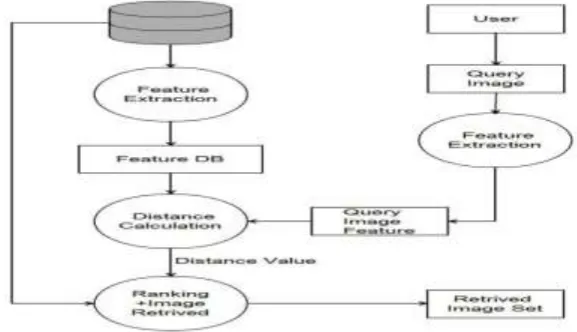
In this planned system image retrieval method embody 2 a lot of algorithms to expeditiously retrieve the image from giant image dataodewords to the image within the info. It split the one image into grides and generates the codewords relying upon the attributes. base. The attribute encodewords to the image within the info. It split the one image into grides and generates the codewords relying upon the attributes.In planned technique, the face feature is extracted with the facilitate native color bar graph. This forms the feature vector. The options square measure extracted for the question image.The on top of method is conjointly applied to the info image. euclidian distance live between feature vector of question image and have vector of every image in the info is computed. The uppermost 'n' similar pictures from the info square measure retrieved
In this planned system image retrieval method embody 2 a lot of algorithms to expeditiously retrieve the image from massive image dataodewords to the image within the information. It split the one image into grides and generates the codewords relying upon the attributes. base. The attribute encodewords to the image within the information. It split the one image into grides and generates the codewords relying upon the attributes.In planned technique, the face feature is extracted with the facilitate native color bar chart. This forms the feature vector. The options ar extracted for the question image.The on top of method is conjointly applied to the information image. euclidian distance live between feature vector of question image and have vector of every image in the information is computed. The uppermost 'n' similar pictures from the information ar retrieved.
Usinglocal color bar chart for retrieving the pictures the retrieval performance was improved alternative
than mistreatment Dennis Gabor filters.
Various ways do not represent the face properly, and thus it is troublesome to do normalisation
(matching is somewhat hard). Here, we have a tendency to ar ready to determine the faces of Asian, western ,African and Indian.
4.1 Observations
4.1.1 Content-Based Image Search
Content-based image retrieval (CBIR) conjointly called question by image content (QBIC) is that the presentation of pc vision techniques to the image retrieval drawback of penetrating for digital pictures in massive databases. Some researchers have attentive on associating the linguistics gap by finding linguistics image representations to extend the CBIR performance. Content-based face image retrieval is associated to face recognition problems however they consider finding applicable feature representations for climbable compartmentalization systems.
4.1.2 Attribute Primarily Based Search
Attribute detection has appropriate quality on numerous of various human attributes. mistreatment these human attributes many researchers have earned promising ends up in totally different applications corresponding to face recognition, face identification, keyword-based face image retrieval, and similar attribute search.
4.1.3 Face Image Retrieval
The recommended work could be a facial image retrieval model for similar facial pictures retrieval within the search area of the facial pictures by combining content-based image retrieval (CBIR) techniques and face recognition techniques with the linguistics rationalization of facial image. the target is to the decrease the linguistics gap among high level question demand and low level of the facial expression of external body part image.
4.2 Experiments on Attribute Enhanced Sparse Committal to Writing (ASC)
4.2.1 Performance of Single Attribute
attribute detection accuracy. ASC performs higher in most attributes, as a result of it will cash in of the qualified attribute scores and is therefore most uses the sturdy to attribute detection error. we have a tendency to conjointly notice that mistreatment sure attributes like smiling,harsh lighting can decrease the performance in each datasets. it's maybe as these attributes aren't related to the identity of the person.
4.2.2 Performance of Multiple Attributes
Using qualities hierarchical by ASC across 2 datasets ar capable to categorize informative attributes. Here we will reason high twenty overlapped attributes into 5 totally different classes together with gender connected attributes (G): Male, sporting Earrings, sporting Lipstick, engaging Woman; hair colors (H): Blond Hair, Black Hair, grey Hair; races (R): White, Asian, Indian; ages (A): Youth, Senior; and private options (P): Receding Hairline, Bald, No Beard, No Eyeglasses, Bushy Eyebrows, mentum. Merging these attributes mistreatment ASC we've more attain higher performance.
V. CONCLUSTION
This system propose, strategies to utilize mechanically detected human attributes to considerably improve content-based face image retrieval. To the most effective of our data, this can be the primary proposal to automatically detected human attributes for content-based face image retrieval. Attribute-enhanced thin secret writing exploits the world structure and uses many human attributes to construct semantic-aware codeword within the offline stage. Attribute-embedded inverted compartmentalization more considers the native attribute signature of the question image and still ensures economical retrieval within the on-line stage.
REFERENCES
[1] Y.-H. Lei, Y.-Y. Chen, L. Iida, B.-C. Chen, H.-H. Su, and W. H. Hsu, “Photo search by face positions and facial attributes on touch devices,” ACM Multimedia, 2011.
[2] D. Wang, S. C. Hoi, Y. He, and J. Zhu, “Retrieval-based face annotation by weak label regularized local coordinate coding,” ACM Multimedia, 2011.
[3] U. Park and A. K. Jain, “Face matching and retrieval using soft biometrics,” IEEE Transactions on Information Forensics and Security, 2010.
[4] Z. Wu, Q. Ke, J. Sun, and H.-Y. Shum, “Scalable face image retrieval with identity- based quantization and multi-reference re- ranking,” IEEE Conference on Computer Vision and Pattern Recognition, 2010. [5] B.-C. Chen, Y.-H. Kuo, Y.-Y. Chen, K.-Y. Chu, and W. Hsu, “Semisupervised face image retrieval using
sparse coding with identity constraint,” ACM Multimedia, 2011.
[6] M. Douze and A. Ramisa and C. Schmid, “Combining Attributes and Fisher Vectors for Efficient Image Retrieval,” IEEE Conference on Computer Vision and Pattern Recognition, 2011.
[7] N. Kumar, A. C. Berg, P. N. Belhumeur, and S. K. Nayar, “Describable visual attributes for face verification and image search,” in IEEE Transactions on Pattern Analysis.
[8] W. Scheirer, N. Kumar, K. Ricanek, T. E. Boult, and P. N. Belhumeur, “Fusing with context: a bayesian approach to combining descriptive attributes,” International Joint Conference on Biometrics, 2011. [9] B. Siddiquie, R. S. Feris, and L. S. Davis, “Image ranking and retrieval based on multi- attribute queries,”
[10] W. Scheirer and N. Kumar and P. Belhumeur and T. Boult, “Multi- Attribute Spaces: Calibration for Attribute Fusion and Similarity Search,” IEEE Conference on Computer Vision and Pattern Recognition,
2012.
[11] G. B. Huang, M. Ramesh, T. Berg, and E. Learned-Miller, “Labeled faces in the wild: A database for studying face recognition in unconstrained environments,” University of Massachusetts, Amherst, Tech.
Rep. 07-49, October 2007.
[12] N. Kumar, A. C. Berg, P. N. Belhumeur, and S. K. Nayar, “Attribute and simile classifiers for face verification,” International Conference on Computer Vision, 2009.
[13] T. Ahonen, A. Hadid, and M. Pietikainen, “Face recognition with local binary patterns,” European Conference on Computer Vision, 2004.
[14] J. Zobel and A. Moffat, “Inverted files for text search engines,” ACM Computing Surveys, 2006. [15] A. Gionis, P. Indyk, and R. Motwani, “Similarity search in high dimensions via hashing,” VLDB, 1999.
[16] J. Sivic and A. Zisserman, “Video google: A text retrieval approach to object matching in videos,” International Conference on Computer Vision, 2003.
[17] D. Lowe, “Distinctive image features from scale-invariant keypoints,” International Journal of Computer Vision, 2003.
[18] O. Chum, J. Philbin, J. Sivic, M. Isard and A. Zisserman, “Total Recall: Automatic Query Expansion with a Generative Feature Model for Object Retrieval,” IEEE International Conference on Computer Vision,
2007.