ARTICLE
Effectiveness of Educational Materials Designed to
Change Knowledge and Behaviors Regarding Crying
and Shaken-Baby Syndrome in Mothers of Newborns:
A Randomized, Controlled Trial
Ronald G. Barr, MDCM, FRCPCa, Frederick P. Rivara, MD, MPHb,c,d, Marilyn Barr, BIS, SSWe, Peter Cummings, MD, MPHc,d, James Taylor, MDb,
Liliana J. Lengua, PhDf, Emily Meredith-Benitz, BAd
aDepartment of Pediatrics and Centre for Community Child Health Research, Child and Family Research Institute, University of British Columbia, Vancouver, British
Columbia, Canada; Departments ofbPediatrics andcEpidemiology anddHarborview Injury Prevention and Research Center, University of Washington, Seattle,
Washington;eNational Center on Shaken Baby Syndrome, Ogden, Utah;fDepartment of Psychology, University of Washington, Seattle, Washington
Financial Disclosure: Ms Barr is the executive director of the National Center on Shaken Baby Syndrome (NCSBS), a 501(c)3 nonprofit organization. She receives no support other than her salary as executive director of the NCSBS. Dr Barr is a member of the International Advisory Board of the NCSBS. He receives no compensation for this role other than travel and lodging expenses for meetings. Dr Barr and Ms Barr are married. The NCSBS and Dr Barr jointly hold the registered trademark forThe Period of PURPLE Crying(registration No. 2962262). Dr Barr received no financial benefit fromThe Period of PURPLE Crying products sold by the NCSBS through the end of June 2007. In December 2007, the governing board of the NCSBS offered a royalty agreement to Dr Barr for a minor share of net profits from the future sale of The Period of PURPLE Cryingproducts in recognition of the intellectual property contribution by Dr Barr. Ms Barr was not involved in the creation of the agreement and was intentionally excluded and uninvolved in terms of the discussions, preparations, and review of the agreement to avoid any perception of a conflict of interest. The agreement was signed on December 22, 2007. The other authors have no financial relationships relevant to this article to disclose.
What’s Known on This Subject
Infant crying is the most common stimulus for SBS. SBS is probably largely prevent-able through education of caregivers about crying and the dangers of shaking. There have been no randomized, controlled trials of the effectiveness of interven-tions to prevent SBS.
What This Study Adds
The PURPLE education materials produced some differences in knowledge and behav-iors relevant to preventing SBS in mothers of newborn infants when provided at the time of prenatal classes, maternity stays, and pediatric office visits. They may be useful in community-based prevention programs to reduce SBS.
ABSTRACT
BACKGROUND.Infant crying is an important precipitant for shaken-infant syndrome.
OBJECTIVE.To determine if parent education materials (The Period of PURPLE Crying
[PURPLE]) change maternal knowledge and behavior relevant to infant shaking.
METHODS.This study was a randomized, controlled trial conducted in prenatal classes, maternity wards, and pediatric practices. There were 1374 mothers of newborns randomly assigned to the PURPLE intervention and 1364 mothers to the control group. Primary outcomes were measured by telephone 2 months after delivery. These included 2 knowledge scales about crying and the dangers of shaking; 3 scales about behavioral responses to crying generally and to unsoothable crying, and caregiver self-talk in response to unsoothable crying; and 3 questions concerning the behaviors of sharing of information with others about crying, walking away if frustrated, and the dangers of shaking.
RESULTS.The mean infant crying knowledge score was greater in the intervention group (69.5) compared with controls (63.3). Mean shaking knowledge was greater for intervention subjects (84.8) compared with controls (83.5). For reported mater-nal behavioral responses to crying generally, responses to unsoothable crying, and for self-talk responses, mean scores for intervention mothers were similar to those for
controls. For the behaviors of information sharing, more intervention mothers reported sharing information about walking away if frustrated and the dangers of shaking, but there was little difference in sharing information about infant crying. Intervention mothers also reported increased infant distress.
CONCLUSIONS.Use of the PURPLE education materials seem to lead to higher scores in knowledge about early infant crying and the dangers of shaking, and in sharing of information behaviors considered to be important for the
prevention of shaking.Pediatrics2009;123:972–980
S
HAKEN BABY SYNDROME(SBS), or inflicted traumatic brain injury, is the result of violent shaking with or withoutcontact with a hard surface resulting in head trauma, including subdural hematomas, diffuse axonal injury, and
retinal hemorrhages. The estimated rate of inflicted traumatic brain injury is 25 to 31 cases in 100 000 children⬍1
year of age per year.1,2Because it is intentional and caregivers may lack awareness of the damage shaking causes, it
may be largely preventable.3
www.pediatrics.org/cgi/doi/10.1542/ peds.2008-0908
doi:10.1542/peds.2008-0908
Key Words
prevention, crying, shaken baby syndrome
Abbreviations
CI— confidence interval PURPLE—The Period of PURPLE Crying SBS—shaken-baby syndrome Accepted for publication Jul 7, 2008 Address correspondence to Ronald G. Barr, MDCM, FRCPC, Centre for Community Child Health Research, 4480 Oak St, L408, Vancouver, British Columbia, Canada V6H 3V4. E-mail: [email protected]
Infant crying is a common stimulus for shaking.4–8
Anticipatory guidance about crying is included in policy statements for SBS prevention.9,10Age-specific SBS
inci-dence curves have a similar onset, shape, and peak pat-tern as crying manifested by normal infants.11,12Distress
(fussing, crying, and inconsolable crying) increases in the first month, peaks in the second, and decreases by 4
months of age13–15and includes prolonged, unsoothable,
and unpredictable crying bouts that cluster in the evening. They are unique to the first few months and a source of frustration and anger for parents.16,17The Period
of PURPLE Crying(PURPLE) prevention materials18
edu-cate caregivers about the crying properties in normal infants and the possibility that their infant could be shaken, and encourage parents to share this information with all caregivers of their infant.
There have been no randomized, controlled trials of
interventions to prevent SBS.19 We wished to estimate
the effects of the PURPLE materials on knowledge and behaviors relevant to SBS prevention. Because SBS in-cidence increases during the first month and peaks dur-ing the third,1,11,12 prevention information needs to be
received before or soon after the infant’s birth. We of-fered the materials to women recruited from prenatal classes, maternity wards, and pediatricians’ offices.
SUBJECTS AND METHODS
Study Design
This randomized, controlled trial was approved by the institutional review boards of all participating institu-tions. The study was registered at www.clinicaltrials.gov (NCT00105963). Individual mothers of newborns were chosen as the unit of randomization. Both study arms received booklets and a DVD. The intervention group received the PURPLE materials; the control group re-ceived injury-prevention materials.
Procedures
Mothers were recruited at 3 groups of sites: prenatal classes (10 sites), maternity wards (3 hospitals), and pediatric offices (11 practices) in Washington between December 9, 2004, and October 9, 2006.
A separate allocation sequence was generated for each of the 24 sites by using a computerized pseudoran-dom number generator to assign subjects to both arms by using permuted blocks randomly selected to be of size 4 or 6. Lists were prepared by an investigator with no contact with study participants.
At prenatal sites, research assistants obtained in-formed consent, followed by a baseline telephone inter-view. They then opened a sealed opaque envelope with the treatment assignment and sent the materials, a diary with written instructions, a sample diary page, and a practice page, to the mother’s home. Verbal telephone instructions for diary completion were given 3 days be-fore the diary began. At maternity sites, the procedure was similar, except that baseline interview and diary demonstration was provided in person at enrollment. In pediatric practices, office staff approached interested mothers who were contacted by project staff. The
pro-cedure was similar to that in maternity wards, but ma-terials were delivered at a home visit. In some sites, research assistants completed enrollment at the clinic after the pediatric visit was finished. If materials were provided at maternity sites and pediatric practices, moth-ers did not view them at that time.
During the infant’s fifth week, mothers were tele-phoned and reminded to complete the diary. One day after beginning the diary, another call was made to answer questions about diary completion. Diaries were returned in self-addressed stamped envelopes. Two months after birth, the mother completed a telephone interview by a professional survey firm. Up to 18 at-tempted calls were allowed, including nights and week-ends.
Intervention Materials
The PURPLE materials consisted of an 11-page booklet and 12-minute DVD. Control materials consisted of 2 brochures and a DVD about infant safety.
The PURPLE materials were designed and produced
by the National Center on Shaken Infant Syndrome.18
The letters in the word “PURPLE” each stand for a prop-erty of crying that is frustrating to caregivers: P for peak pattern, where crying increases weekly, peaks during the second month, and then declines; U for unexpected onset of crying bouts; R for resistance to soothing; P for pain-like facial grimace; L for long crying bouts; and E for evening clustering. The materials reinforce the nor-mality of crying, suggest ways to comfort an infant, clearly state that comforting may not work sometimes, describe why unsoothable crying is frustrating, and sug-gest 3 “action steps” when faced with a crying infant: (1) increase “carry, comfort, walk, and talk” responses; (2) if the crying is too frustrating, it is okay to walk away, put the infant down safely, calm yourself, and return to check on your infant; and (3) never shake or hurt an infant. The materials describe SBS, and emphasize “tell-ing other caregivers” about PURPLE, the dangers of shaking, and action steps. Consistent with the
evi-dence,14–16,20 the PURPLE materials do not claim that
unsoothable crying bouts are soothable if caregivers use a specific technique. Rather, they acknowledge the frus-tration caregivers will experience when the infant does not soothe.
Control materials included a DVD on infant safety
excerpted from the I Am Your Child Foundation,21
American Academy of Pediatrics brochures on infant
safety,22and US Department of Health and Human
Ser-vices brochures on safe sleep.23Control materials did not
mention crying as a trigger for SBS, nor did PURPLE materials mention safe sleep or injury-prevention strat-egies.
Outcome Assessments
Interview
tem-porary caregivers, and whether the mother’s behavior in-cluded sharing information with each caregiver. Because there were no previous relevant measures of crying, shak-ing, or safety knowledge and behaviors, all questions were created for this study.
Primary Outcomes
We defined 8 primary outcome variables. Five were scales created after data collection but before analysis: crying knowledge, shaking knowledge, responses to cry-ing generally, responses to unsoothable crycry-ing, and care-giver self-talk responses to unsoothable crying. Because
⬎95% of mothers “agreed” or “strongly agreed” with 4
of 12 crying-knowledge questions at baseline before in-tervention, only 8 questions were included in the crying knowledge scale after intervention. Scales were trans-formed to the range of 0 to 100; higher scores indicated better knowledge or improved reported behaviors.
Three other primary outcomes were prespecified be-haviors around sharing information, defined as percent of mothers who shared information with at least 1 tem-porary caregiver for each of 3 topics: crying, walking away if frustrated, and dangers of shaking.
Baby’s Day Diary
The Baby’s Day Diary24has been tested for reliability and
validity and extensively used.17,25–30Caregivers recorded
infant states (awake alert, fussing, crying, unsoothable crying, sleeping, feeding) on the top half of a 24-hour ruler and caregiver carrying and holding on the bottom. “Distress” occurred whenever fussing, crying, or un-soothable crying was recorded.31The smallest recordable
unit was 5 minutes. As in previous studies,32,33parents
could indicate 4 prespecified events “above” the time rulers with event-specific symbols. Two events were ac-tions recommended in the PURPLE materials (“pick up your crying infant” and “put your infant down, walk away, and take a break”).
Diaries were transcribed into a diary-counting soft-ware program (RonNicLog31). Mean interrater reliability
()34for duration or frequencies measures was 0.99 for
behavioral states and 0.80 for event codes (3% sample of recoded diaries).
Secondary Outcomes
Six secondary outcomes agreed on before analysis in-cluded 3 measures of caregiving from diary recordings: (1) caregiver contact when the infant was distressed (minutes/day); (2) pick-up events when the infant was distressed (events/day); and (3) walk-away events when the infant cried unsoothably (events/day). The fourth outcome was a diary measure of frustration recorded once daily on a 6-point Likert scale in response to the question “How frustrating to you was your infant’s cry-ing today?” There were 2 measures of pediatric office visit frequency (all visits, and all visits for colic, crying, fussing, or feeding problems).
Missing Data
Of 2738 women enrolled, age was missing for 59 (2%), education for 60 (2%), family income for 213 (8%), and
marital status for 36 (1%). Eight primary outcomes were missing for 16% and at least 1 was missing for 33%. Women missing all 5 knowledge and behavior scale outcomes were younger (29.5 vs 31.3 years of age), less often married (67% vs 86%), had less education (14.3 vs 15.9 years) and lower incomes ($71 000 vs $88 000), and were less often in the intervention arm (15.5% vs 16.3%) compared with those with complete data. Four diary measures (caregiver contact when infant dis-tressed, pick-up events when disdis-tressed, walk-away events with unsoothable crying, and daily frustration) were missing for 25% and at least 1 measure was miss-ing for 68%. Missmiss-ing data proportions were similar in both groups.
Results from parallel analyses using known data or multiple imputation techniques to account for missing data were similar. To reduce bias from nonrandom miss-ing of data, we reported only the results by usmiss-ing mul-tiple imputation. We imputed 20 sets of data that were identical concerning known information, but could dif-fer, 1 from another, on imputed values for missing
in-formation.35,36 We used the method of chained
equa-tions, randomly sampling the imputed values from the posterior predictive distribution of the missing data37,38
with variance estimates adjusted to account for imputed
values not actually being measured.39
Power
Using different outcomes and a variety of assumptions, an estimated total sample of 1052 to 4058 was needed to achieve 90% power to detect a 10% mean difference
between intervention and control subjects, by using␣⫽
.05 (2-sided) and equal subject numbers in each arm.
Given resource constraints, we sought to enroll⬃1500
subjects in each arm.
Statistical Analyses
We compared baseline intervention and control subject characteristics by using2tests. We tested whether the probability of intervention allocation was associated with the 8 primary outcomes, adjusting for treatment assignment and enrollment center.40,41
For continuous scores or measures of time outcomes, we estimated mean differences between intervention and control subjects at follow-up by using least squares linear regression.42For diary events or office visit counts,
we estimated incidence rate ratios by using negative
binomial regression.43,44Confounding by center was
ex-amined by adjusting for center in the analyses. We used linear mixed models to see if clustering by center influ-enced results: the effect was minimal so these models were not used.45We used tests of statistical interaction to
examine subgroups based on education level, recruit-ment site, whether the intervention was read or viewed, whether this was the first infant, and whether the infant cried unsoothably. All tests of interactions included main
effects terms.46Analyses were performed by using Stata
RESULTS
Sample Characteristics
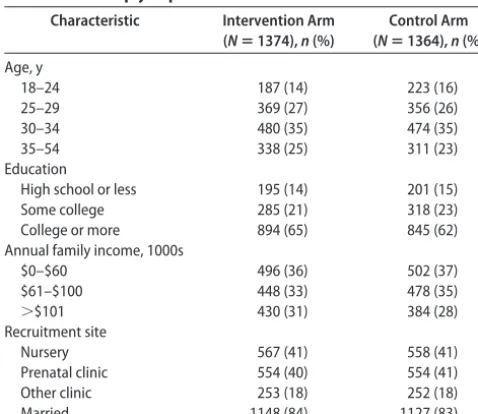
We enrolled and randomly assigned 2738 mothers (Fig 1): 1374 were assigned to the PURPLE intervention, with 1364 as controls. We found no evidence of selec-tion bias. Baseline characteristics were similar in both groups (Table 1). Probability of allocation to the inter-vention was not associated with any of 8 primary
out-comes (P⫽.22–.87).
Primary Outcomes
Knowledge scores were higher in intervention compared with control arms for crying (6.2-point difference) and shaking (1.3-point difference) scales (Table 2).
Behavioral responses to crying scores were higher in the intervention than control arms (a 0.2-point difference for crying generally, a 1.3-point difference for unsoothable crying, and a 1.3-point difference for self-talk), but no difference was statistically significant (Table 3).
Sharing Information Behaviors
More intervention mothers (6.5%) shared information concerning walking away if frustrated by inconsolable crying, and 5.6% more shared information about the dangers of shaking (Table 4). They were not more likely to share information about crying.
Secondary Outcomes
Diary
Compared with controls, the intervention group had 8.6 more minutes/day of contact when the infant was dis-tressed (Table 5). Rates of picking up when disdis-tressed, of walking away when the infant cried unsoothably, or daily frustration scores were not significantly different.
The intervention group recorded significantly more distress (13.8 minutes) and each form of distress: 6.4 minutes of fussing, 5.5 minutes of crying, and 1.9 min-utes of unsoothable crying (Table 6).
Eligible 5060
Consented 2741 Refused to participate
(n=2319)
- Too busy/stressed - Not interested - No reason given - Didn’t want to do diary - Didn’t want to do survey - Other
Randomly assigned 2738
Assigned to PURPLE group 1374
Assigned to control group 1364
Approached for study 5723
Ineligible (n=663)
- No/poor English - Baby’s age/health - Mother’s age/health - Expecting multiples (twins, etc.)
- Other
Did not complete study (n=171) 17 phone disc/unable to contact 29 dropped study: 5 no longer interested 3 too stressed/overwhelmed 7 too busy to continue 1 moved out of state 3 mother’s medical condition 2 husband demanded they
withdraw 3 study was too hard/much 1 going back to work 1 English lang. difficulties 3 no reason given 10 removed from study 2 infant demise 3 infant premature 5 unable to contact post due date 86 unable to reach for telephone interview and diary not turned in 29 refused to complete telephone interview and diary not turned in
Did not complete study (n=199) 16 phone disc/unable to contact 33 dropped study: 10 no longer interested 5 too stressed/overwhelmed 6 too busy to continue 4 moved out of state 2 mother’s medical condition 1 English lang. difficulties 5 no reason given 7 removed from study 2 infant premature 1 infant medical condition 4 unable to contact post due date 110 unable to reach for telephone
interview and diary not turned in 33 refused to complete telephone
interview and diary not turned in
Not randomly assigned (n=3) - Unable to complete pretest
Completed either after test or diary N=1200
Completed after test N=1162
Completed either after test or
Completed after test N=1141 diary N=1173
Completed
FIGURE 1
Pediatric Visits
Incidence rates for 2 months after birth differed little: 3.9 for the intervention group and 4.0 for controls (rate ratio: 0.98 [95% confidence interval (CI): 0.87– 1.09]). Rates of visits for colic, crying, fussing, or feeding problems differed little: 0.8 for the interven-tion group and 0.9 for controls (rate ratio: 0.86 [95% CI: 0.63–1.17]).
Subgroup Analyses
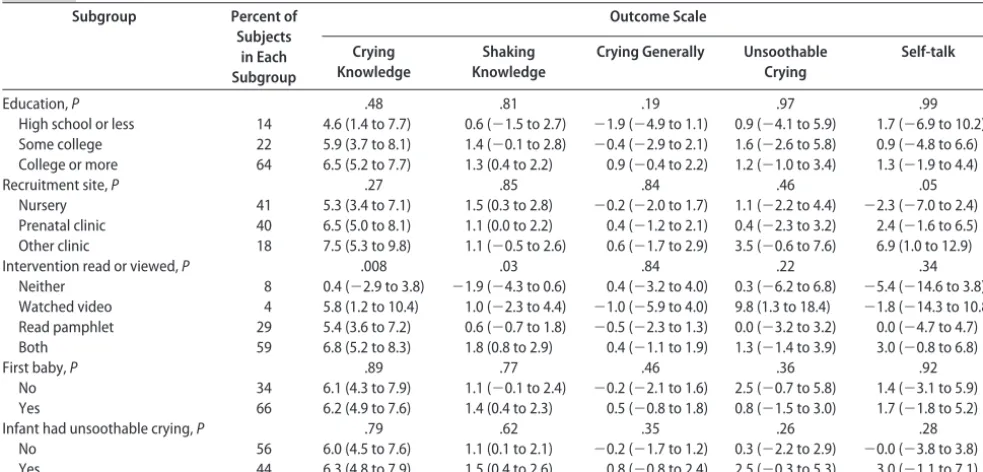
The intervention effect on crying knowledge and shak-ing scores was greater among women who read the booklet, watched the DVD, or both, and not related significantly to behavior scale scores (Table 7). The effect
of the intervention varied little on any primary knowl-edge or behavior outcome scale by parent education, recruitment site, being mother’s first infant, or occur-rence of unsoothable crying during the 4-day diary re-cording.
DISCUSSION
Of 8 primary outcomes, the PURPLE materials were asso-ciated with statistically significant improvements on 2 knowledge scales and 2 behaviors compared with controls: intervention mothers scored 6% higher in knowledge about infant crying; 1% higher in knowledge about shak-ing; more often (6% difference) shared advice to walk away if frustrated by crying; and more often (7% differ-ence) warned others about the dangers of shaking. For scales concerning maternal responses about crying gener-ally, unsoothable crying specificgener-ally, and self-talk regarding unsoothable crying, none of the small improvements were statistically significant. Intervention mothers did not in-crease information sharing about crying with other care-givers. Maternal-infant contact during distress was 9 min-utes greater in intervention mothers. Daily frustration levels were nearly the same. Pick-up events during distress, walk-away events during unsoothable crying, and office visit rates did not differ significantly.
These results provide evidence of increases in mater-nal knowledge considered important to SBS prevention when materials are provided at times of prenatal classes, maternity ward stays, or pediatric visits. Because knowl-edge that the frustrating properties of early crying are
normal is not widespread,48 this was an important
do-main to effect. Awareness of the danger of shaking was
expected to be high (Dias49 reported 93% awareness);
however, there was an additional small gain in inter-vention group mothers. Score differences were greater if mothers read or watched (or both) the materials, implying that differences were causally related to the materials. We found little evidence that intervention
TABLE 2 Primary Outcomes for Knowledge Scale Differences at the End of the Study, According to Trial Arm, Using Known and Multiply Imputed Data
Scale Intervention Arm (Nⴝ1374) Control Arm (Nⴝ1364) Difference 95% CI
na Mean SD na Mean SD
Crying knowledge 1138 69.5 18.5 1117 63.3 12.3 6.2 5.0–7.3
Shaking knowledge 1157 84.8 10.7 1138 83.5 9.4 1.3 0.5–2.1
Scales range from 0 to 100. A positive difference favors the PURPLE intervention arm.
aNumber of subjects with known data.
TABLE 3 Primary Outcomes for Responses to Crying in Past-Month Behavior Scale Differences at the End of the Study, According to Trial Arm, Using Known and Multiply Imputed Data
Scale Intervention Arm (Nⴝ1374) Control Arm (Nⴝ1364) Difference 95% CI
na Mean SD na Mean SD
Crying generally 1004 50.8 15.1 995 50.6 15.0 0.2 ⫺0.9 to 1.4
Unsoothable crying 1094 35.0 29.9 1077 33.7 24.9 1.3 ⫺0.7 to 3.2
Self talk 1093 48.9 41.3 1072 47.6 35.5 1.3 ⫺1.6 to 4.2
All scales range from 0 to 100. A positive difference favors the PURPLE intervention arm.
aNumber of subjects with known data.
TABLE 1 Characteristics of Study Mothers at Enrollment, According to Intervention Arm, Using Known and Multiply Imputed Data
Characteristic Intervention Arm (Nⴝ1374),n(%)
Control Arm (Nⴝ1364),n(%)
Age, y
18–24 187 (14) 223 (16)
25–29 369 (27) 356 (26)
30–34 480 (35) 474 (35)
35–54 338 (25) 311 (23)
Education
High school or less 195 (14) 201 (15)
Some college 285 (21) 318 (23)
College or more 894 (65) 845 (62)
Annual family income, 1000s
$0–$60 496 (36) 502 (37)
$61–$100 448 (33) 478 (35)
⬎$101 430 (31) 384 (28)
Recruitment site
Nursery 567 (41) 558 (41)
Prenatal clinic 554 (40) 554 (41)
Other clinic 253 (18) 252 (18)
effects varied with maternal education, being the mother’s first child, intervention site, or occurrence of unsoothable crying. This suggests that the PURPLE program might be equally effective in other popula-tions, unless those populations differed from ours in ways not tested.
Behaviors that increased with exposure to PURPLE materials included sharing information about walking away if frustrated and the dangers of shaking. These mothers recorded more contact time with distressed in-fants. Interpreting this finding is difficult because re-corded minutes of distress were also greater in this group. Because mothers did not report differences on the responses to crying scales, and unsoothable crying is not changed by caregiving responses,16the increased
report-ing of distress and/or contact time with distress may have been an artifact of the focus on crying in the PURPLE materials. Nevertheless, the finding of increased crying in the intervention group is of some concern and will require attention in future research.
This study was neither intended nor sufficiently large to test whether PURPLE materials might prevent SBS. It was intended as a conservative assessment of the mate-rials’ effects on maternal knowledge and reported
be-haviors. Stronger effects might be observed if the mate-rials were provided by clinicians, nurses, or instructors with clinical reinforcement, as occurred in the study of Dias et al.3In principle, implementation would be
rein-forced by multiple exposures through prenatal, mater-nity and postnatal sites, media, and commumater-nity-abuse prevention organizations. With the “Back to Sleep” cam-paign, the overall impact of clinician and nurse advice, reading materials, and print and broadcast media was most effective in changing behavior.50
This study has a number of limitations. First, knowledge and behavior changes were assessed only for mothers, although males are the most common perpetrators of abuse.8,51–53Besides feasibility constraints of studying males,
mothers were still considered the most important group, because mothers (1) are the primary caregivers; (2) need to know about normal properties of crying, the frustration it produces, and the dangers of shaking; (3) can choose ap-propriate temporary caregivers and educate them; and (4) although less strong physically, remain the second or third most common perpetrators.8,51–53
Second, many subjects failed to provide outcome data. Restricting analysis to persons with complete data can produce biased estimates unless data were missing TABLE 4 Percent of Mothers Who Shared Information About Infant Crying or Shaking With Other Caregivers According to Study Arm
Information Category Intervention Arm (Nⴝ1374) Control Arm (Nⴝ1364) Difference 95% CI
na Mean SD na Mean SD
Infant crying 1004 53.9 58.4 994 54.3 56.4 ⫺0.4 ⫺4.5 to 3.6
Walk away if frustrated with crying 1004 41.4 60.7 995 34.9 53.7 6.5 2.3 to 10.6
Dangers of shaking 1004 35.3 54.6 995 29.7 53.0 5.6 1.6 to 9.6
A positive difference favors the PURPLE intervention.
aNumber of subjects with known data.
TABLE 5 Diary Behavior Measures With Means (of Minutes per Day or Frustration Level Scores) or Rates (of New Events per Person-Day as Recorded on Diaries) Using Known or Multiply Imputed Data
Measure Intervention Arm (Nⴝ1374) Control Arm (Nⴝ1364) Difference 95% CI
na Mean SD na Mean SD
Contact when child distressed, min/d 927 102.6 72.6 910 94.0 76.1 8.6 3.0 to 14.2
Frustration level 917 1.20 1.19 892 1.20 1.05 0.00 ⫺0.08 to 0.09
Pick-up events when child distressed 940 3.08b 3.39 917 3.03b 3.21 1.02c 0.95 to 1.09
Walk-away events when child has unsoothable crying 940 0.052b 0.215 917 0.046b 0.208 1.13c 0.85 to 1.51
Intervention mothers were compared with control mothers using either differences in means or rate ratios.
aNumber of subjects with known data. bEvents per person per day. cRate ratio.
TABLE 6 Minutes of Child Distress Reported in Diaries, According to Trial Arm, Using Known and Multiply Imputed Data
Scale Intervention Arm
(Nⴝ1374)
Control Arm (Nⴝ1364) Difference 95% CI
na Mean SD na Mean SD
Crying 940 44.9 38.9 917 39.4 38.4 5.5 2.7–8.4
Unsoothable crying 940 11.1 21.5 917 9.2 16.1 1.9 0.4–3.3
Fussing 940 102.1 64.8 917 95.7 64.4 6.4 1.6–11.2
Total distress (crying, unsoothable crying, fussing) 940 158.1 84.7 917 144.3 85.9 13.8 7.6–20.0
Results are mean minutes per day. A positive difference indicates more minutes in the PURPLE intervention arm.
completely at random.34,35We used multiple imputation
methods that require the less stringent assumption that data were missing at random conditional on the impu-tation variables. Bias may still occur if missing values were strongly related to factors not used in our models. Third, the outcomes were not actual observations of parents. Behavior recorded by diaries was less suscepti-ble to memory bias, but diary sampling was limited to 4 days. This may not have been sufficient to capture changes in response to relatively infrequent inconsolable crying bouts.
Fourth, we do not know how well the results might generalize to other populations.
The study strengths include its being a large trial using a randomized, controlled design. Those collecting data were blinded to the treatment arm of interviewed subjects. We used intention-to-treat analysis when we could. Where missing data made that difficult, we reduced bias by mul-tiple imputation.
CONCLUSIONS
These prevention materials seem to produce some dif-ferences in knowledge that may be relevant to reducing SBS. The behaviors of sharing information with caregiv-ers about the dangcaregiv-ers of shaking and walking away if the crying was frustrating were higher as the PURPLE materials recommend. Knowledge differences varied with the materials used, evidence that actually read-ing or viewread-ing the materials resulted in the observed differences. These results are encouraging as the first test of these materials to change knowledge and be-havior. Their effectiveness in reducing SBS and other forms of inflicted infant trauma remains to be
exam-ined when implemented in clinical practice in com-munity settings.
ACKNOWLEDGMENTS
This study was supported by the Doris Duke Charitable Foundation (New York, NY) and the George S. and Dolores Dore Eccles Foundation (Salt Lake, UT). Neither the Doris Duke Charitable Foundation nor the George S. and Dolores Dore Eccles Foundation had any role in the design or conduct of the study; the collection, manage-ment, analysis, or interpretation of the data; or the prep-aration, review, or approval of the manuscript.
We gratefully acknowledge collaboration of the follow-ing: at Harborview Injury Prevention and Research Center (Seattle, WA): Sue Haugen, AA, Sarah Luce, BA, Kaila Staub-DeLong, BA, Arianne Stevens, MA, and Kendra Wight BA; Centre for Community Child Health Research (Vancouver, British Columbia, Canada): Nicole Catherine, MSc, and Jessica Lam, BSc; the prenatal staffs at Highline Community Hospital, Valley Medical Center, Providence Everett Medical Center, Auburn Regional Medical Center, Great Starts Prenatal Classes, Gracewinds Perinatal Ser-vices, Stevens Hospital, Overlake Hospital Medical Center, Swedish Medical Center, and University of Washington Medical Center; the maternity staffs at University of Wash-ington Medical Center, Overlake Hospital Medical Center, and Evergreen Hospital Medical Center; the physicians and staffs of the following pediatric practices: Odessa Brown Children’s Clinic, Valley Children’s Clinic, Mercer Island Pediatrics, Pediatric Associates, Ballard Pediatrics, Virginia Mason, Skagit Pediatrics, Tacoma Pediatrics, and the Van-couver Clinic; and the parents and newborn infants, with-out whose help this study could not have been performed. TABLE 7 Subgroup Analyses of 5 Primary Study Outcomes Using Known and Multiply Imputed Data
Subgroup Percent of Subjects
in Each Subgroup
Outcome Scale
Crying Knowledge
Shaking Knowledge
Crying Generally Unsoothable Crying
Self-talk
Education,P .48 .81 .19 .97 .99
High school or less 14 4.6 (1.4 to 7.7) 0.6 (⫺1.5 to 2.7) ⫺1.9 (⫺4.9 to 1.1) 0.9 (⫺4.1 to 5.9) 1.7 (⫺6.9 to 10.2) Some college 22 5.9 (3.7 to 8.1) 1.4 (⫺0.1 to 2.8) ⫺0.4 (⫺2.9 to 2.1) 1.6 (⫺2.6 to 5.8) 0.9 (⫺4.8 to 6.6) College or more 64 6.5 (5.2 to 7.7) 1.3 (0.4 to 2.2) 0.9 (⫺0.4 to 2.2) 1.2 (⫺1.0 to 3.4) 1.3 (⫺1.9 to 4.4)
Recruitment site,P .27 .85 .84 .46 .05
Nursery 41 5.3 (3.4 to 7.1) 1.5 (0.3 to 2.8) ⫺0.2 (⫺2.0 to 1.7) 1.1 (⫺2.2 to 4.4) ⫺2.3 (⫺7.0 to 2.4) Prenatal clinic 40 6.5 (5.0 to 8.1) 1.1 (0.0 to 2.2) 0.4 (⫺1.2 to 2.1) 0.4 (⫺2.3 to 3.2) 2.4 (⫺1.6 to 6.5) Other clinic 18 7.5 (5.3 to 9.8) 1.1 (⫺0.5 to 2.6) 0.6 (⫺1.7 to 2.9) 3.5 (⫺0.6 to 7.6) 6.9 (1.0 to 12.9)
Intervention read or viewed,P .008 .03 .84 .22 .34
Neither 8 0.4 (⫺2.9 to 3.8) ⫺1.9 (⫺4.3 to 0.6) 0.4 (⫺3.2 to 4.0) 0.3 (⫺6.2 to 6.8) ⫺5.4 (⫺14.6 to 3.8) Watched video 4 5.8 (1.2 to 10.4) 1.0 (⫺2.3 to 4.4) ⫺1.0 (⫺5.9 to 4.0) 9.8 (1.3 to 18.4) ⫺1.8 (⫺14.3 to 10.8) Read pamphlet 29 5.4 (3.6 to 7.2) 0.6 (⫺0.7 to 1.8) ⫺0.5 (⫺2.3 to 1.3) 0.0 (⫺3.2 to 3.2) 0.0 (⫺4.7 to 4.7) Both 59 6.8 (5.2 to 8.3) 1.8 (0.8 to 2.9) 0.4 (⫺1.1 to 1.9) 1.3 (⫺1.4 to 3.9) 3.0 (⫺0.8 to 6.8)
First baby,P .89 .77 .46 .36 .92
No 34 6.1 (4.3 to 7.9) 1.1 (⫺0.1 to 2.4) ⫺0.2 (⫺2.1 to 1.6) 2.5 (⫺0.7 to 5.8) 1.4 (⫺3.1 to 5.9)
Yes 66 6.2 (4.9 to 7.6) 1.4 (0.4 to 2.3) 0.5 (⫺0.8 to 1.8) 0.8 (⫺1.5 to 3.0) 1.7 (⫺1.8 to 5.2)
Infant had unsoothable crying,P .79 .62 .35 .26 .28
No 56 6.0 (4.5 to 7.6) 1.1 (0.1 to 2.1) ⫺0.2 (⫺1.7 to 1.2) 0.3 (⫺2.2 to 2.9) ⫺0.0 (⫺3.8 to 3.8)
Yes 44 6.3 (4.8 to 7.9) 1.5 (0.4 to 2.6) 0.8 (⫺0.8 to 2.4) 2.5 (⫺0.3 to 5.3) 3.0 (⫺1.1 to 7.1)
REFERENCES
1. Barlow KM, Minns RA. Annual incidence of shaken impact
syndrome in young children. Lancet. 2000;356(9241):
1571–1572
2. Keenan HT, Runyan DK, Marshall SW, Nocera MA, Merten DF, Sinal SH. A population-based study of inflicted traumatic
brain injury in young children.JAMA.2003;290(5):621– 626
3. Dias MS, Smith K, deGuehery K, Mazur P, Li V, Shaffer ML. Preventing abusive head trauma in infants and young children:
a hospital-based parent education program. Pediatrics. 2005;
115(4). Available at: www.pediatrics.org/cgi/content/full/115/ 4/e470
4. Dykes LJ. The whiplash shaken infant syndrome: what has
been learned?Child Abuse Negl.1986;10(2):211–221
5. Levitt CJ, Smith WL, Alexander RC. Abusive head trauma. In:
Reece RM, ed.Child Abuse: Medical Diagnosis and Management.
Baltimore, MD: Williams and Wilkins; 1994:1–22
6. Ludwig S. Shaken baby syndrome: a review of 20 cases.Ann
Emerg Med.1984;13(2):104 –107
7. Reijneveld SA, van der Wal MF, Brugman E, Sing AH,
Ver-loove-Vanhorick SP. Infant crying and abuse. Lancet. 2004;
364(9442):1340 –1342
8. Brewster AL, Nelson JP, Hymel KP. Victim, perpetrator, family, and incident characteristics of 32 infant maltreatment deaths in the U.S. airforce.Child Abuse Negl.1998;22(2):91–101 9. American Academy of Pediatrics, Committee on Child Abuse
and Neglect. Shaken baby syndrome: rotational cranial inju-ries—technical report.Pediatrics.2001;108(1):206 –210 10. Canadian Association of Chiefs of Police, Canadian Institute of
Child Health, Canadian Pediatric Society, Canadian Public Health Association, Child Welfare League of Canada, Health Canada, Saskatchewan Institute on Prevention of Handicaps, The Canadian Bar Association. Joint statement on shaken baby syndrome.J Paediatr Child Health.2001;6(9):663– 667 11. Barr RG, Trent RB, Cross J. Age-related incidence curve of
hospitalized shaken baby syndrome cases: convergent evidence for crying as a trigger to shaking.Child Abuse Negl.2006;30(1): 7–16
12. Lee C, Barr RG, Catherine N, Wicks A. Age-related incidence of publicly reported shaken baby syndrome cases: is crying a trigger for shaking?J Dev Behav Pediatr.2007;28(4):288 –293 13. Barr RG. The normal crying curve: what do we really know?
Dev Med Child Neurol.1990;32(4):356 –362
14. Barr RG. Crying behavior and its importance for psychosocial development in children. In: Tremblay RE, Barr RG, Peters RD, eds.Encyclopedia on Early Childhood Development [online April 13, 2006 edition]. Montreal, Quebec, Canada: Centre of Excellence for Early Childhood Development; 2006:1–10
15. Barr RG. Excessive crying. In: Sameroff AJ, Lewis M, Miller
SM, eds. Handbook of Developmental Psychopathology. 2nd ed.
New York, NY: Kluwer Academic/Plenum Press; 2000:327–350 16. St James-Roberts I, Alvarez M, Csipke E, Abramsky T, Good-win J, Sorgenfrei E. Infant crying and sleeping in London, Copenhagen and when parents adopt a ‘proximal’ form of care.Pediatrics.2006;117(6). Available at: www.pediatrics.org/ cgi/content/full/117/6/e1146
17. Barr RG, Paterson J, MacMartin L, Lehtonen L, Young SN. Prolonged and unsoothable crying bouts in infants with and without colic.J Dev Behav Pediatr.2005;26(1):14 –23
18. National Center on Shaken Baby Syndrome; Barr RG. Period of PURPLE Crying Shaken Baby Syndrome Prevention Program. Ogden, UT: National Center on Shaken Baby Syndrome; 2004 19. Klevens J. Prevention of inflicted neurotrauma: what we know, what we don’t know, and what we need to know. In: Reece RM, Nicholson CE, eds.Inflicted Childhood Neurotrauma. Elk Grove Village, IL: American Academy of Pediatrics; 2003: 269 –279
20. Soltis J. The signal functions of early infant crying.Behav Brain Sci.2004;27(4):443– 458
21. I Am Your Child Foundation.Keeping Your Infant Safe. Beverly Hills, CA: I Am Your Child Foundation; 2007
22. American Academy of Pediatrics. TIPP: Birth to 6 Months.
HE0021-A[rep0405]. Elk Grove Village, IL: American Acad-emy of Pediatrics; 1994:3–39
23. US Department of Health and Human Services.Safe Sleep for
Your Baby. Washington, DC: US Department of Health and Human Services, National Institutes of Health; 2005. 05–7040
24. Barr RG.Baby’s Day Diary.Montreal, Quebec, Canada; 1985
25. Barr RG, Kramer MS, Leduc DG, Boisjoly C, McVey-White L, Pless IB. Parental diary of infant cry and fuss behaviour.Arch Dis Child.1988;63(4):380 –387
26. Hunziker UA, Barr RG. Increased carrying reduces infant crying: a randomized, controlled trial.Pediatrics. 1986;77(5): 641– 648
27. Barr RG, Kramer MS, Pless IB, Boisjoly C, Leduc D. Feeding and temperament as determinants of early infant cry/fuss be-haviour.Pediatrics.1989;84(3):514 –521
28. St James-Roberts I, Hurry J, Bowyer J. Objective confirmation of crying durations in infants referred for excessive crying.Arch Dis Child.1993;68(1):82– 84
29. Calinoiu N, Barr RG, Lehtonen L, Wertheim L, Barr FW, Young SN. Diary indices of pacifier use: convergence with interview measures. Program of the International Society of Infant Studies. 1998:5
30. Majnemer A, Barr RG. Association between sleep position and
early motor development.J Pediatr.2006;149(5):623– 629
31. Barr RG, Calinoiu N.RonNicLog Baby’s Day Diary Counting Pro-gram. Montreal, Quebec, Canada; 1997
32. Lehtonen L, Barr RG, Calinoiu N, Wertheim L, Barr FW, Young SN. Pacifier use in infants with and without colic: is it really effective?Infant Behav Dev.1998;21(special issue):G16 33. Kramer MS, Barr RG, Dagenais S, et al. Pacifier use, early
weaning, and cry/fuss behavior: a randomized, controlled trial. JAMA.2001;286(3):322–326
34. Kramer MS, Feinstein AR. Clinical biostatistics LIV: the biosta-tistics of concordance.Clin Pharmacol Ther.1981;29(1):111–123 35. Schafer JL.Analysis of Incomplete Multivariate Data. New York,
NY: Chapman & Hall; 1997
36. Raghunathan TE. What do we do with missing data? Some options for analysis of incomplete data.Annu Rev Public Health. 2004;25:99 –117
37. van Buuren S, Boshuizen HC, Knook DL. Multiple imputation of missing blood pressure covariates in survival analysis.Stat
Med.1999;18(6):681– 694
38. Royston P. Multiple imputation of missing values: update of ice.Stata J.2005;5(4):527–536
39. Little RJA, Rubin DB. Statistical Analysis With Missing Data. Hoboken, NJ: John Wiley & Sons; 2002
40. Berger VW, Exner DV. Detecting selection bias in randomized clinical trials.Control Clin Trials.1999;20(4):319 –327 41. Berger V.Selection Bias and Covariate Imbalances in Randomized
Clinical Trials. Chichester, England: John Wiley & Sons; 2005 42. Lumley T, Diehr P, Emerson S, Chen L. The importance of the
normality assumption in large public health data sets.Annu Rev Public Health.2002;23:151–169
43. Glynn RJ, Buring JE. Ways of measuring rates of recurrent
events.BMJ.1996;312(7027):364 –367
44. Cummings P, Norton R, Koepsell TD. Rates, rate denominators, and rate comparisons. In: Rivara FP, Cummings P, Koepsell TD, Grossman DC, Maier RV, eds.Injury Control: A Guide to Research and Program Evaluation. New York, NY: Cambridge University Press; 2001:64 –74
for center in multicenter studies: an overview.Ann Intern Med. 2001;135(2):112–123
46. Brookes ST, Whitely E, Egger M, Smith GD, Mulheran PA, Peters TJ. Subgroup analyses in randomized trials: risks of subgroup-specific analyses; power and sample size for the in-teraction test.J Clin Epidemiol.2004;57(3):229 –236
47. Stata Statistical Software [computer program]. Release 9.2. College Station, TX: Stata Corp; 2006
48. Catherine N, Ko J, Barr RG. Causes of, responses to, and consequences of crying and colic in popular parenting magazines: a descriptive study.J Dev Behav Pediatr.2008; 29: 508 –511
49. Dias MS. Program reminds new parents of dangers of violent
shaking.AAP News.2003;23:16
50. Willinger M, Ko CW, Hoffman HJ, Kessler RC, Corwin MJ. Factors associated with caregivers’ choice of infant sleep posi-tion, 1994 –1998: the national infant sleep position study. JAMA.2000;283(16):2135–2142
51. Lazoritz S, Baldwin S. The whiplash shaken infant syndrome: has Caffey’s syndrome changed or have we changed his
syn-drome?Child Abuse Negl.1997;21(10):1009 –1014
52. Starling SP, Holden JR, Jenny C. Abusive head trauma: the relationship of perpetrators to their victims.Pediatrics. 1995; 95(2):259 –262
53. Starling SP, Patel S, Burke BL, Sirotnak AP, Stronks S, Rosquist P. Analysis of perpetrator admissions to inflicted traumatic brain injury in children.Arch Pediatr Adolesc Med.2004;158(5): 454 – 458
FOOD ALLERGY: ADVERSE REACTIONS TO FOODS AND FOOD ADDITIVES, 4TH EDITION
Editors: Metcalfe, Dean D., MD; Sampson, Hugh A., MD; Simon, Ronald A., MD
Publisher: Blackwell Publishing List Price: $249.95
Reviewer: Maxcie Sikora, MD (Ochsner Clinic Foundation)
Description:This is the fourth edition of a comprehensive reference on food allergy that provides an excellent review of adverse reactions to foods and food additives as well as diagnostic criteria and treatment strategies.
Purpose:The purpose is to gain a general understanding of the background/ etiology of adverse reactions to foods as well as to introduce contemporary topics encountered by physicians and nutritionists dealing with food-sensi-tized patients. The objectives are worthy considering there is growing recog-nition of adverse reactions to foods and food additives in the general popu-lation.
Audience:The book is written for pediatricians, nutritionists, general inter-nists, family practitioners, and allergists.
Features:The five sections of the book cover basic and clinical perspectives of adverse reactions to food antigens, adverse reactions to food additives, and a variety of topics in adverse reactions to foods. This edition also reviews a variety of topics not only related to general food allergy, but also eosinophilia associated with foods, occupational exposure to food antigens, food biotech-nology and genetic engineering, and toxin-related adverse food reactions. The most helpful topics are the specific treatments for food allergies, espe-cially adequate nutritional considerations when food allergy limits certain important nutrients, as well as explanations of the different forms of testing involved in diagnosis.
Assessment:This excellent book covers a wide variety of topics pertinent to adverse reactions to foods. It contains an overview of information unparal-leled by other books on general allergy or nutrition.
DOI: 10.1542/peds.2008-0908
2009;123;972
Pediatrics
Liliana J. Lengua and Emily Meredith-Benitz
Ronald G. Barr, Frederick P. Rivara, Marilyn Barr, Peter Cummings, James Taylor,
Newborns: A Randomized, Controlled Trial
Behaviors Regarding Crying and Shaken-Baby Syndrome in Mothers of
Effectiveness of Educational Materials Designed to Change Knowledge and
Services
Updated Information &
http://pediatrics.aappublications.org/content/123/3/972
including high resolution figures, can be found at:
References
http://pediatrics.aappublications.org/content/123/3/972#BIBL
This article cites 35 articles, 8 of which you can access for free at:
Subspecialty Collections
ub
http://www.aappublications.org/cgi/collection/child_abuse_neglect_s Child Abuse and Neglect
following collection(s):
This article, along with others on similar topics, appears in the
Permissions & Licensing
http://www.aappublications.org/site/misc/Permissions.xhtml
in its entirety can be found online at:
Information about reproducing this article in parts (figures, tables) or
Reprints
http://www.aappublications.org/site/misc/reprints.xhtml
DOI: 10.1542/peds.2008-0908
2009;123;972
Pediatrics
Liliana J. Lengua and Emily Meredith-Benitz
Ronald G. Barr, Frederick P. Rivara, Marilyn Barr, Peter Cummings, James Taylor,
Newborns: A Randomized, Controlled Trial
Behaviors Regarding Crying and Shaken-Baby Syndrome in Mothers of
Effectiveness of Educational Materials Designed to Change Knowledge and
http://pediatrics.aappublications.org/content/123/3/972
located on the World Wide Web at:
The online version of this article, along with updated information and services, is
by the American Academy of Pediatrics. All rights reserved. Print ISSN: 1073-0397.