HYPERION UNIVERSITY www.hyperion.ro
20
THE RELATION BETWEEN PERSONAL NEED FOR
THOUGHTS STRUCTURE, HOPE AND WELL-BEING
TEODOR, VASILE a a
University of Bucharest, Department of Psychology
Abstract
In our times, when individuals sense the lack of balance and face stress and tension in all aspects of life, the need for structure and finding ways to improve our well-being, has become a necessity. Authors cited in this study underline the relation between mindfulness and attitude change (Petty and Cacioppo, 1986), or mindfulness and depression (Teasdale, 1999 cited by Herbert and Forman, 2011). Also, according to Litalien et al. (2013) cited by Ciarrochi et al. (2015) hope and established goals are predictors of well-being. The participants were a number of 16 people, the instruments were: Adult Dispositional Hope Scale (Snyder et. al, 1991), Personal Need for Structure - PNS (Thompson, Naccarato, and Parker, 1989), The Mindfulness Attention Awareness Scale - MAAS (Brown and Ryan, 2003); the results confirmed on two hypothesis regarding the positive correlation between hope and mindfulness attention awareness and the negative correlation between lack of hope and mindfulness attention awareness. Experiencing mindfulness can mean letting go of the thoughts that resurface obsessively, calm our mind, focus on the basic experiences, such as breathing or the awareness of the body sensations, and just let the natural energy flow through our mind and body.
Keywords: thoughts, structure, awareness, well-being
1. INTRODUCTION
Vago and Silbersweig (2012) published a theoretical review focused on neurobiological mechanism of mindfulness. They were interested in underlining the way that awareness, regulation and transcendence modulate self-specifying and narrative self-networks through frontal-parietal brain hemisphere. The authors evidenced that perceptual cognitive, emotional and behavioural processes are mechanisms that support awareness, regulation and self-transcendence. Vago and Silbersweig (2012) underline that mindfulness practice modulate neuroplastic changes in network brain structure.
Corresponding author: Teodor Vasile
21
Kabat-Zinn (1990), Bishop et al. (2004), Carmody (2009) cited by Vago and Silbersweig (2012) highlighted that mindfulness practice may increase awareness and responding skills to mental processes, having as a result the emotional distress.
Krech (2006) was focussed in his dissertation, to develop a state mindfulness scale. The author underlines the relationship between mindfulness, personality and cognition. He cited Messick (1976) and Sternberg (1997) by presenting that cognitive styles are related to personality and mindfulness. Hence, Sternberg and colleagues (1997) underline that mindfulness is a capacity for an individual to access cognitive abilities.
Cook-Cottone and Guyker (2018) developed and validated the Mindful Self Care Scale (MSCS) in the way to support positive embodiment. The authors involved in the study a number of 448 participants, aged between 18 and 71. Previous studies of Cook-Cottone were focused on: supportive relationship related with well-being (Cook-Cottone, 2015), sense of purpose related with sense of mission, value, strength and meaning (Cook-Cottone, 2015; Norcross and Guy, 2007), relationship between rest and self-care (Cook-Cottone, 2015). The author highlighted that rest meant getting enough sleep, taking restful breaks, and planning time to rest, and also the effects of environmental micro-stressors on individual’s resilience and ability to cope (Cook-Cottone, 2015).
Luttrell, Briñol and Petty (2014) published a theoretical review focused on how the process of thinking can be related to persuasion. In this way, the authors analysed the concepts of mindful and mindless thinking as active processes of elaboration in relationship with persuasion. Hence, there were approached subjects as: mindfulness and attitude change, elaboration likelihood model of persuasion (Petty and Cacioppo, 1986) and body awareness and persuasion.
Ciarrochi et al. (2015) published a six year study evaluating hope and emotional well-being. In this study participated a total of 975 high school students. The authors analysed if hope relates to emotional experiences in time and the results showed that hope is an antecedent to positive affect. Also, the study revealed that high levels of hope in individuals lead to implementing and achievement of goals.
Snyder (2000) cited by Ciarrochi (2015) is of the opinion that positive emotional states appear as a consequence of hopeful thoughts and goals oriented thoughts.
Even if further research is necessary, according to Litalien et al. (2013) cited by Ciarrochi et al. (2015) hope and established goals are predictors of well-being in a period of time full of changes, such as progressing from school to university.
22
individuals, as they learn to prevent depression relapses. Also, as the authors highlight, mindfulness-based cognitive therapy (Segal, et al., 2002) and mindfulness-based stress reduction (Kabat-Zinn, 1990) help individuals focus on the present moment, on the simple aspects of their lives, and on the basic experiences, thus avoiding obsessive thoughts and practising nonattachment.
2. OBJECTIVE AND HYPOTHESES
2.1.OBJECTIVES
1. To highlight the possible relationship between: adult hope and mindfulness attention awareness.
2. To highlight the possible relationship between: adult lack of hope and mindfulness attention awareness.
3. To highlight the possible relationship between hope and personal need for organization and structure.
2.2.HYPOTHESES
1. We assume that there are statistically significant positive correlations between hope and mindfulness attention awareness in adults.
2. We assume that there are statistically significant negative correlations betweenadult lack of hope and mindfulness attention awareness.
3. We assume that there are statistically significant positive correlations between hope and personal need for organization and structure in adults.
4. We assume that there are statistically significant positive correlations between need for structure and mindfulness attention awareness.
3. METHOD
3.1.PARTICIPANTS
23
3.2. THE INSTRUMENTS
1. Adult Dispositional Hope Scale (Snyder et. al, 1991). The scale is composed from 12 items and is used to measure an adult’s dispositional hope. The answers are scored from 1 to 4 on a Likert scale. The authors found that the test-retest correlation for the Adult Dispositional Hope Scale is around the value .80. Also, the scale evidences the internal consistency with Alpha Cronbach ranging from .74 to .84.
2. Personal Need for Structure - PNS (Thompson, Naccarato, and Parker, 1989). PNS is a scale composed from 12 itemsthat assesses the general preference for cognitive simplicity. The PNS contains 2 subscales:
I. General need for structure; II. Responding to lack of structure.
Scoring: The 12-items of the PNS are rated according to a 6-point Likert-type scale ranging from 1 (strongly disagree) to 6 (strongly agree). Van den Berg (2003) found out that the Alpha Cronbach reliability coefficient of the PNS in this sample was .76, M = 2.53, SD = 0.39.
3. The Mindfulness Attention Awareness Scale - MAAS (Brown and Ryan, 2003).The MAAS is a 15 item instrument that measures people’s tendency to be mindful of moment to moment experience.
Scoring: Respondents are asked to indicate how frequently they have the experience described in each of the 15 statements. Scoring is rated using a 6-point Likert scale from 1 to 6. The MAAS instrument has a good internal consistency, with Alpha Cronbach ranging of .82 and .87 in student and adult samples (according the authors).
3.3. PROCEDURE
The questionnaires were applied to a total of 16 people, during the afternoon. Conditions have been met for ethics in research on human subjects, such as volunteering, anonymity, possibility to leave the research at any time. Also, the General Data Protection Regulation’s legal framework was respected (GDPR; May 25, 2018).
3.4. EXPERIMENTAL DESIGN
24
4. RESULTS
The collected data was computed using the program SPSS 15 for statistics. In table 1 – Descriptive Statistics can be seen mean standard deviation for the variables: adult hope, adult lack of hope,need for structure, responding to lack of structure, and mindfulness attention awareness.
4.1.TABLES AND FIGURES
Table 1 – Descriptive Statistics
Mean Std. Deviation N
Hope 26.5625 3.53966 16
Lack of hope 8.8125 2.19754 16
Need for structure 16.0000 2.89828 16
Responding to lack of
structure
26.2500 4.44972 16
Mindfulness Attention
Awareness
64.8125 9.68999 16
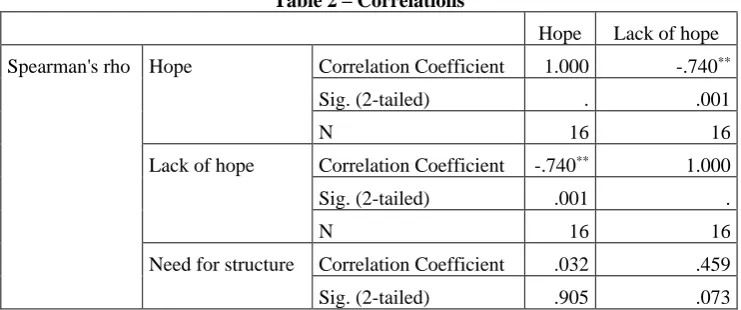
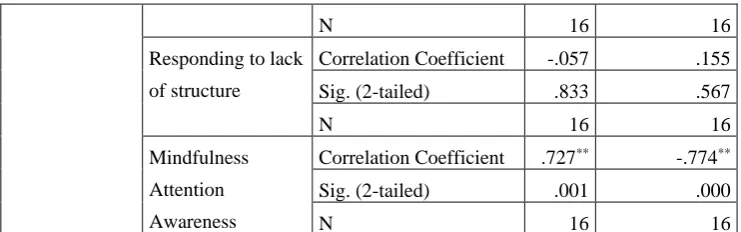
In table 2, we can observe correlations between adult hope variable and mindfulness attention awareness (rho=.727; p<0.01) and between lack of hope variable and mindfulness attention awareness (rho=.774; p<0.01), and lack of hope and hope (rho=.74; p<.01).
Table 2 – Correlations
Hope Lack of hope
Spearman's rho Hope Correlation Coefficient 1.000 -.740**
Sig. (2-tailed) . .001
N 16 16
Lack of hope Correlation Coefficient -.740** 1.000
Sig. (2-tailed) .001 .
N 16 16
Need for structure Correlation Coefficient .032 .459
25
N 16 16
Responding to lack
of structure
Correlation Coefficient -.057 .155
Sig. (2-tailed) .833 .567
N 16 16
Mindfulness
Attention
Awareness
Correlation Coefficient .727** -.774**
Sig. (2-tailed) .001 .000
N 16 16
**. Correlation is significant at the 0.01 level (2-tailed).
In table 3 there are not statistically significant correlations.
Table 3 – Correlations
Need for structure
Responding to lack of structure
Spearman's
rho
Hope Correlation Coefficient .032 -.057
Sig. (2-tailed) .905 .833
N 16 16
Lack of hope Correlation Coefficient .459 .155
Sig. (2-tailed) .073 .567
N 16 16
Need for structure Correlation Coefficient 1.000 .136
Sig. (2-tailed) . .614
N 16 16
Responding to lack
of structure
Correlation Coefficient .136 1.000
Sig. (2-tailed) .614 .
N 16 16
Mindfulness
Attention
Awareness
Correlation Coefficient -.389 -.264
Sig. (2-tailed) .136 .323
26
5. CONCLUSIONS
The authors Munoz, Hoppes, Hellman and Cummins (2016) found out that meditation can increase hope via stress reduction. Faria (2016) underlines that mindfulness and hope were positively correlated to happiness and also that hope mediated the relationships between flow, mindfulness and happiness.
Regarding our study, analysing the results in tables 2 and 3 can be highlighted the following hypotheses:
1. We assume that there are statistically significant positive correlations between hope and the awareness of the present moment in adults.
2. We assume that there are statistically significant negative correlations between adult lack of hope and the awareness of the present moment.
The other hypotheses have not been confirmed at the threshold of significance (p<0.05) for a number of 16 persons. A future study can confirm the finding with the possibility of enlarging the sample. In this way, it would be interesting if there could be statistically significant correlations between need for personal structure and mindfulness attention awareness, responding to lack of structure and mindfulness attention awareness.
Received at: 06.09.2018, Accepted for publication on: 19.09.2018
REFERENCES
Brown, K. W., Ryan, R. M. (2003). The benefits of being present: Mindfulness and its role in psychological well-being. Journal of Personality and Social Psychology, 84(4), 822-848.
Ciarrochi, J., Parker, P., Kashdan, T. B., Heaven, P. C. L., Barkus, E. (2015). Hope and emotional well-being: A six-year study to distinguish antecedents, correlates, and consequences. The Journal of Positive Psychology 10(6):1-13. DOI: 10.1080/17439760.2015.1015154
Cook-Cottone, C. P. (2015).Mindfulness and yoga for self-regulation: A primer for mental health professionals. New York: Springer.
Cook-Cottone, C. P., Guyker, W. M. (2018). The Development and Validation of the Mindful Self-Care Scale (MSCS): an Assessment of Practices that Support Positive Embodiment. Mindfulness, 9:161-175. DOI 10.1007/s12671-017-0759-1.
Faria, N. (2016). Positive Psychology and Student Success: How Flow, Mindfulness, and Hope are Related to Happiness, Relationships, and GPA, Senior Research article. California State University.
27
Krech, P. R. (2006). Development of a state mindfulness scale. A Thesis Presented In Partial Fulfilment of the Requirements for the Degree Master of Arts. Arizona State University.
Luttrell, A., Briñol, P., Petty, R. E. (2014). Mindful Versus Mindless Thinking and Persuasion. In A. le, C. T. Ngnoumen, E. J. Langer (Eds.), The Wiley Blackwell handbook of mindfulness (pp. 258-278), Wiley-Blackwell.
http://dx.doi.org/10.1002/9781118294895.ch14
Munoz, R. T., Hoppes, S., Hellman, C. M., Cummins, C. (2016). The Effects of Mindfulness Meditation on Hope and Stress. Research on Social Work Practice 28(6). DOI: 10.1177/1049731516674319.
Norcross, J. C., Guy, J. D. (2007). Leaving it at the office: A guide to psychotherapist self-care. New York: The Guildford Press.
Petty, R. E., Cacioppo, J. T. (1986). The elaboration likelihood model of persuasion. In L. Berkowitz (Ed.), Advances in experimental social psychology, Vol. 19, pp. 123–205, New York, NY: Academic Press.
Snyder, C. R., Harris, C., Anderson, J. R., Holleran, S. A., Irving, L. M., Signon, S. T., Yoshinobu, I., Gibb, J., Langelle, C. & Harney, P. (1991). The will and the ways: Development and validation of an individual differences measure of hope. Journal of Personality and Social Psychology, 60, 570-585.
Snyder, C. R. (2000). Handbook of Hope: Theory, measures and applications. San Francisco: Academic Press.
Sternberg, R. J., Grigorenko, E. L. (1997). Are Cognitive Styles Still in Style? American Psychologist, 52, 700 – 712.
Thompson, M. M., Naccarato, M. E., & Parker, K. E. (1989). Assessing cognitive need: The development of the Personal Need for Structure and Personal Fear of Invalidity scales. Paper presented at the annual meeting of the Canadian Psychological Association, Halifax, Nova Scotia.
Vago, D. R., Silbersweig D. A. (2012). Self-awareness, regulation, and self-transcendence (S-ART): a framework for understanding the neurobiological mechanisms of mindfulness. Frontiers in Human Neuroscience, 25; 6:296. DOI: 10.3389/fnhum.2012.00296.
Van den Berg, A. E. (2003). Personal Need for Structure and Environmental Preference, In Hendrickx, L., Jager, W., & Steg, L. (2003). Human decision making and environmental perception: Understanding and assisting human decision making in real-life settings. Liber Amoricum for Charles Vlek. Groningen: Rijksuniversiteit Groningen.