International Research Journal of Pharmaceutical and Biosciences (IRJPBS) 4 (4) 9
RESEARCH ARTICLE
International Research Journal of Pharmaceutical and Biosciences
Pri
-
ISSN: 2394 - 5826http://www.irjpbs.com e-ISSN: 2394 - 5834
Formulation and Evaluation of ethanolic extract of
Cissus
quadrangularis
herbal gel
Ayesha Siddiqua* and Sirisha Mittapally
Deccan School of Pharmacy, Dar-Us-Salam, Aghapura, Hyderabad, Telangana-500001.
Article info Abstract
Article history: Received 29 July 2017 Accepted 04 AUG 2017
*Corresponding author:
Copyright 2017 irjpbs
In this study topical as well as ethosomal gels of Ethanolic extract of
Cissus quadrangularis was formulated and is made for better patient
compliance. The topical gels F1-F8 were formulated using different concentrations of polymer carbopol (1-2.5%). The ethosomal gels E1-E8 were formulated with ethanol (10%) and phospholipid (2-3%). The prepared topical and ethosomal gels were subjected to physical evaluations, in vitro diffusion studies, PH determination, viscosity,
spreadability, entrapment efficiency, zeta potential and SEM. The diffusion studies have shown that the percentage drug release of optimized formulations F4,F8 and E2,E6 after 6 hours were found to be 78.21%, 83.78 % of 20 and 40% topical gels of Cissus quadrangularis and 97.68, 99.76 of 20 and 40% ethosomal gels of Cissus quadrangularis
respectively. All the formulations were found to be easily washable, spreadable and free from grittiness. The in vitro drug release studies, evaluation, stability and accelerated stability studies of the topical and ethosomal gels shown that the entrapment efficiency of ethosomes containing 10% w/w ethanol has highest value 96.45% with respect to all other formulations. Hence, the formulation E6 containing 40% w/w of Ethanolic extract of Cissus quadrangularis has shown the promising results with 99.76% drug release after 6 hours with PH 6.8, viscosity
40,300 cps, Zeta potential -60.9 (mV), with specific vesicular size and shape was observed by SEM.
Key words:-Cissus quadrangularis gel, Herbal gel, Ethosomes, Phosholipids, Entrapment efficiency.
INTRODUCTION
International Research Journal of Pharmaceutical and Biosciences (IRJPBS) 4 (4) 10 Transdermal route offers several potential advantages over conventional routes like avoidance of first pass metabolism, predictable and extended duration of activity, minimizing undesirable side effects, utility of short half-life drugs, improving physiological and pharmacological response, avoiding the fluctuation in drug levels.
Ethosomes has permeation of drug molecules (relatively small vesicle size) to and through the skin to the systemic circulation. In ethosomes, ethanol interacts with lipid molecules in the polar head group region resulting in a reducing the rigidity of the stratum corneum lipids, increasing their fluidity. In addition to the effect of ethanol on stratum corneum structure, the ethosome itself may interact with the stratum corneum barrier. Better stability, solubility and
patient compliance. Though, Ethosomes are advantageous over other vesicular system these
have poor yield.
Cissus quadrangularis is a succulant herbal plant belonging to family, Vitaceae. It is fleshy, cactus in nature. It is also known as Vitis quadrangularis, Lycopodium imbricatum or Heliotropium indicum. In Ayurveda, it is used as Pachana (digestive aid), Sara (relieves constipation), Athiyuk (strengthening bones), Vrushya (Aphrodisiac), etc. In Unani, it is used to treat gastritis. The whole plant is used in treatment of asthma, Powdered root is specifically used in treatment of bone fractures.
The usual dose of the powder is 30-40 grains. Leaves and young shoots are frequently taken with curry in Southern India. In Chennai, young shoots of the plant are dried, powdered, burnt to ashes in a closed vessel. These ashes are administered in dyspepsia, indigestion and certain bowel complaints. Leaves and young shoots are also considered as powerful alternatives in the gastro intestinal treatments. Juice of stem is dropped into the ear in otorrhoea and into the nose in epistaxis. The plant has many therapeutic uses [13].
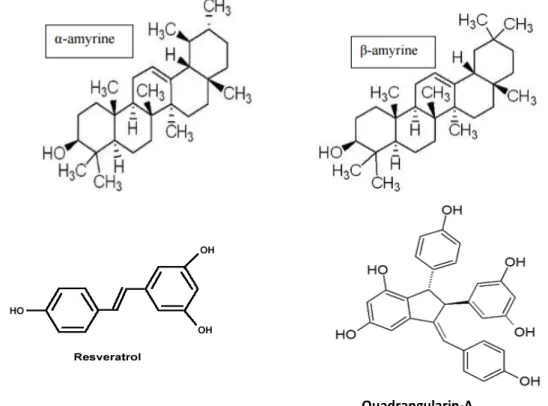
Phytochemical studies on ethanolic extract revealed the presence of triterpenes including β-sitosterol, α- and β- amyrins, ketosteroids, phenols, tannins, carotene and vitamin C. Seven
alicyclic lipids constituents have also been reported from Cissus quadrangularis. unsymmetric
tetracyclic triterpenoids such as d-amyrin, onocer-7-ene-3a, 21b-diol, d-amyrone and 3,3',4,4'-tetra hydroxy biphenyl, 3,3',4,4'-tetrahydroxybiphenyl have been isolated from plant and were quantitatively determined by HPTLC method.Several other constituents such as flavonoids quercetin and kaempferol, and stilbene derivatives, quadrangularins A,B,C and many others e.g. resveratrol, piceatanon, pallidol, perthenocissi and phyto-sterols have been isolated from plant.Stem extract contains a high percentage of calcium ions and phosphorus, both essential for bone growth [1] .
International Research Journal of Pharmaceutical and Biosciences (IRJPBS) 4 (4) 11
Quadrangularin-A
MATERIALS AND METHODS
Table no.1: Table showing list of materials with manufacturer
S.NO NAME OF THE
MATERIAL CATEGORY MANUFACTURER
1. ETHANOLIC EXTRACT OF
CISSUS
QUANDRANGULARIS
HERBAL PLANT
EXTRACT HIMALAYA DRUG COMPANY, BANGAL ORE,
KARNATAKA.
2. LECITHIN
CHOLESTEROL PHOSPHOLIPID S.D FINE CHEMICALS, MUMBAI, INDIA.
3. POLYETHYLENE GLYCOL AS A SKIN
PENETRATION ENHANCER
FISCHER SCIENTIFIC, MUMBAI, INDIA.
4. CARBOPOL 934 GELLING AGENT RESEARCH LAB FINE
CHEM. INDUSTRIES, MUMBAI, INDIA.
5. ETHANOL VOLATILE SOLVENT SIGMA-ALDRICH
CORPORATION.
6. SODIUM BENZOATE BACTERIOSTATIC
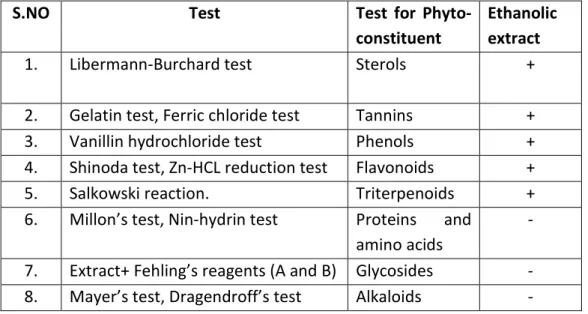
International Research Journal of Pharmaceutical and Biosciences (IRJPBS) 4 (4) 12 PHYTO CHEMICAL EVALUATION OF ETHANOLIC EXTRACT OF CISSUS QUADRANGULARIS The qualitative tests for various phytoconstituents were carried out by using Ethanolic extract of Cissus quadrangularis.
Table no.2: Qualitative Chemical Examination of Cissus quadrangularis
S.NO Test Test for
Phyto-constituent
Ethanolic extract
1. Libermann-Burchard test Sterols +
2. Gelatin test, Ferric chloride test Tannins +
3. Vanillin hydrochloride test Phenols +
4. Shinoda test, Zn-HCL reduction test Flavonoids +
5. Salkowski reaction. Triterpenoids +
6. Millon’s test, Nin-hydrin test Proteins and
amino acids
-7. Extract+ Fehling’s reagents (A and B) Glycosides
-8. Mayer’s test, Dragendroff’s test Alkaloids
-HPTLC
HPTLC systems equipped with Linomat-5 applicator with WinCATS-4 software were used. All
the solvents used for HPTLC analysis were of selective grade. Cissus quadrangularis ethanolic
extract was dissolved in methanol and used for HPTLC analysis. The samples (5 μl) spotted in the bands of width 8 mm with a Camag microlitre syringe on pre-coated silica gel glass plate. The sample loaded plate was kept in TLC twin trough developing chamber (after saturated with Solvent vapour) with respective mobile phase and the plate was developed up to optimum level. The Toluene: Ethyl acetate (80:20) and Hexane:Ethyl acetate (70:30) were employed as mobile phase for separation. Linear ascending development was carried out in glass chamber saturated with the mobile phase. The developed plate was dried by hot air to evaporate solvents from the plate. The plate was scanned by UV at 254 and 366 nm. Densitometric scanning was performed on Camag scanner and operated by CATS software.
Preparation of Ethanolic Extract of Cissus quadrangularis Ethosomal gels
A gift sample of ethanolic extract of the Plant Cissus quadrangularis was given by Himalaya
Drug Company, Bangalore, Karnataka.
Ethosomal gels containing Ethanolic Extract of Cissus quadrangularis were prepared by using
the method suggested by Touitou et al., with modification. The ethosomal formulation of
Ethanolic extract of Cissus quadrangularis was formulated using different compositions of
2-3% phospholipid, 10-30% ethanol, 5% of polyethylene glycol (PEG) and 5g of cholesterol.
The ethanolic extract of Cissus quadrangularis was dissolved separately in a covered vessel at
International Research Journal of Pharmaceutical and Biosciences (IRJPBS) 4 (4) 13 constant mixing at 800 rpm. Mixing was continued for additional 5 minutes. The size of the ethosomes vesicles can be decreased using sonication or extrusion method. Ethosomes formulation was stored under refrigeration.
Ethosomal vesicles suspension were incorporated into carbopol gel (1%, 1.5%, 2% and 2.5% w/w). the specified amount of carbopol 934 powder was slowly added to ultrapure water and
kept at 1000C for 20min. tri ethanolamine was added to it drop wise. Appropriate amount of
formulation of ethosomes containing Ethanolic extract of Cissus quadrangularis was then
incorporated into gel-base. Water q.s was added with other formulation ingredients with continuous stirring until homogenous formulation were achieved [16].
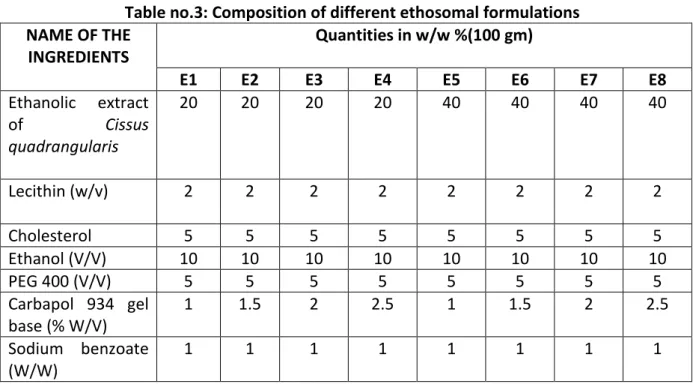
Table no.3: Composition of different ethosomal formulations NAME OF THE
INGREDIENTS Quantities in w/w %(100 gm)
E1 E2 E3 E4 E5 E6 E7 E8
Ethanolic extract of Cissus quadrangularis
20 20 20 20 40 40 40 40
Lecithin (w/v) 2 2 2 2 2 2 2 2
Cholesterol 5 5 5 5 5 5 5 5
Ethanol (V/V) 10 10 10 10 10 10 10 10
PEG 400 (V/V) 5 5 5 5 5 5 5 5
Carbapol 934 gel
base (% W/V) 1 1.5 2 2.5 1 1.5 2 2.5
Sodium benzoate
(W/W) 1 1 1 1 1 1 1 1
Preparation of Ethanolic extracts of Cissus quadrangularis topical gels
Topical Gels containing 20 and 40% of ethanolic extract of Cissus quadrangularis were
prepared by using different concentrations of polymer such as carbopol 934 1% to 2.5%. The specified amount of carbopol 934 powder was slowly added to ultrapure water and kept for
12 hours for the polymer to swell. Appropriate amount of ethanolic extract of Cissus
quadrangularis was dissolved, polyethylene glycol and sodium benzoate was added to it, this mixture is incorporated to the above mixture. Water q.s was added with other formulation ingredients with continuous stirring at 800rpm after complete addition the mixture is stirred
till the homogeneous gels was obtained.(23) These formulations were then stored in the wide
International Research Journal of Pharmaceutical and Biosciences (IRJPBS) 4 (4) 14 Figure 1: Ethosomal Formulation
Table.4: Composition of different Topical formulations NAME OF THE
INGREDIENTS F1 F2 F3 Quantities in W/W % (100gm) F4 F5 F6 F7 F8 Ethanolic extract of
Cissus quadrangularis 20 20 20 20 40 40 40 40
Carbapol 934 gel base
(% w/w) 1 1.5 2 2.5 1 1.5 2 2.5
PEG 4000 (w/w) 5 5 5 5 5 5 5 5
Sodium benzoate 1 1 1 1 1 1 1 1
Figure.2: Topical Formulation
Evaluation of Ethanolic extract of Cissus quadrangularis ethosomal and topical gels
Visualization
International Research Journal of Pharmaceutical and Biosciences (IRJPBS) 4 (4) 15 Entrapment Efficiency
Separation of unentrapped drug and evaluation of entrapment efficiency can be measured by ultracentrifugation.
Zeta Potential Measurement
Zeta potential was used to measure the electrostatic or charge repulsion or attraction between particles of ethosomal formulation. Zeta potential was determined using a computerized inspection system.
In-Vitro Drug Release Studies Using Franz Diffusion Apparatus
In vitro absorption studies are generally carried out in vertical Franz diffusion apparatus. It has
a receptor and a donor chamber, which is filled with phosphate buffer (PH 6.8). The dialysis
membrane (Hi media 60) is sandwiched between the two chambers and clamped in place tightly.
Figure.3: Diffusion release of gels by using Franz-diffusion apparatus
PH measurements
The PH of topical and ethosomal gels was measured by using electrode based digital PH meter.
Drug Content
The drug content of topical and ethosomal gel formulation was determined by using
phosphate buffer PH 6.8.
Drug entrapment efficiency
International Research Journal of Pharmaceutical and Biosciences (IRJPBS) 4 (4) 16 Spreadability and density of topical and ethosomal gels
The spread ability of gel formulations was determined by measuring the spreading diameter of 1g of gel between two horizontal plates (20 cm × 20 cm) and the density of gels is determined by using densitometer.
Viscosity
Viscosities (in cps) of the prepared topical gels and ethosomal gels formulations of Ethanolic
extract of Cissus quadrangularis were determined with LV Brookfield, DV-E viscometer using
spindle no 64.
The viscosities of the formulations were found to be 38,200 of cps for topical F8 gel formulation and 40,300 of cps for ethosomal E6 formulation were found to be satisfactory.
Stability study
The stability study was studied by using ICH guidelines. Ethosomal formulations were observed for any change in appearance or color for a period of 8 weeks. Loss in percentage of drug release during stability studies of the optimized batch (4±2°C & 30±2° C).
The prepared formulations were tested for accelerated stability. They were kept in stability
chambers at 30°C ± 2°C and 60% ± 5 % Relative humidity for 6 months and observed for the
physical appearance.
RESULTS AND DISCUSSIONS
FTIR Drug-Excipient Compatibility Studies
FTIR of the formulation of topical and ethosomal gels of ethanolic extract of Cissus
quadrangularis have shown that there is no change in the functional groups. Hence, the activity of active constituent i.e, β-sitosterol is protected in the formulations showing compatibility with the formulations of gels.
FTIR of β-sitosterol
International Research Journal of Pharmaceutical and Biosciences (IRJPBS) 4 (4) 17
FTIR of Ethanolic extract of Cissus quadrangularis
Figure.5: FTIR of Ethanolic Extract of Cissus quadrangularis
FTIR of 20% Ethanolic extract of Cissus quadrangularis topical gel
International Research Journal of Pharmaceutical and Biosciences (IRJPBS) 4 (4) 18
FTIR of 40% Ethanolic extract of Cissus quadrangularis topical gel
Figure.7: FTIR of 40% Ethanolic extract of Cissus quadrangularis topical gel
• FTIR of 20% Ethanolic extract of Cissus quadrangularis ethosomal gel:
Figure.8: FTIR of 40% Ethanolic extract of Cissus quadrangularis ethosomal gel
CALIBRATION CURVE OF β-SITOSTEROL
Preparation of Standard curve of β-sitosterol in Phosphate buffer PH 6.8
Table.5: Calibration curve data of β-sitosterol CONCENTRATION (µg/ml) ABSORBANCE
50 0.101
100 0.221
150 0.325
200 0.489
300 0.655
400 0.882
International Research Journal of Pharmaceutical and Biosciences (IRJPBS) 4 (4) 19 Figure.9: Calibration curve of β-sitosterol
HPTLC Of Ethanolic extract of Cissus quadrangularis
Figure.10: HPTLC of Cissus quadrangularis
Mobile phase: Toluene : Ethyl acetate:- 80:20 Spray: Vanillin/H2SO4
Sample preparation: 0.5 gm of sample in 10ml methanol Volume of injection: 5ul
Figure.11: HPTLC of Cissus quadrangularis by employing different mobile phase
y = 0.0021x + 0.0207 R² = 0.9897
0 0.2 0.4 0.6 0.8 1 1.2
0 200 400 600
Absorban
ce
International Research Journal of Pharmaceutical and Biosciences (IRJPBS) 4 (4) 20 Mobile phase: Hexane : Ethyl acetate:- 70:30
Spray: Vanillin/H2SO4
Sample preparation: 0.5 gm of sample in 10ml methanol Volume of injection: 5ul
Evaluation of topical gel
Color: Dark brown
Physical Appearance: The gel containing 1.5 and 2.0%
of carbapol was too liquidy in appearance. Greasiness: Non greasy
Grittiness: Free from grittiness Ease of application: Easily/smoothly applied Skin irritation: No skin irritation
Washability: Easily washable
Size And Shape Analysis: Microscopic analysis was performed under different magnification to visualize the vesicular structure, lamellarity and to determine the size of topical preparations.
Scanning Electron microscopy of Topical formulations
Figure.12 and 13: SEM of 20% and 40% of Ethanolic extract of Cissus quandrangularis topical gels.
Evaluation of Ethosomal gels
Colour: Dark brown
Physical Appearance: The gel containing 2.0 and 2.5% of carbapol was too tough in nature. Greasiness: Non greasy
Grittiness: Free from grittiness Ease of application: Easily/smoothly applied Skin irritation: No skin irritation
Washability: Easily washable
International Research Journal of Pharmaceutical and Biosciences (IRJPBS) 4 (4) 21 Scanning Electron microscopy of Ethosomal formulations
Figure.14 and 15: SEM of 20% and 40% of Ethanolic extract of Cissus quandrangularis Ethosomal gels.
Zeta Potential
Zeta potential of Ethanolic extract of Cissus quadrangularis Topical gel.
International Research Journal of Pharmaceutical and Biosciences (IRJPBS) 4 (4) 22 Zeta potential of Ethanolic extract of Cissusquadrangularis Ethosomal gel
Figure.17: Zeta potential of Cissus quadrangularis Ethosomal gel
PH measurements
The PH of topical and ethosomal gels was measured by using electrode based digital PH meter.
Table.6: PH Values of gels.
Formulation PH Value Formulation PH Value Ethanolic extract of
Cissus quadrangularis
20% Topical gel (F4)
6.9 Ethanolic extract of Cissus
quadrangularis 20% Ethosomal gel (E2)
7.2
Ethanolic extract of
Cissus quadrangularis
40% Topical gel (F8)
7.1 Ethanolic extract of Cissus
quadrangularis 40% Ethosomal gel (E6)
7.3
Drug Content
The drug content of topical and ethosomal gel formulations of the extract was also evaluated.
Table.7: Drug content in gel formulations
Formulation Drug content (%) Formulation Drug content (%) Ethanolic extract of
Cissus quadrangularis
20% Topical gel (F4) 88.6 ±1.3
Ethanolic extract of
Cissus quadrangularis
20% Ethosomal gel (E2)
98.3 ±1.1
Ethanolic extract of
Cissus quadrangularis
40% Topical gel (F8)
89.8 ±1.8 Ethanolic extract of Cissus quadrangularis 40% Etosomal gel (E6)
International Research Journal of Pharmaceutical and Biosciences (IRJPBS) 4 (4) 23 Spreadability and density of topical and ethosomal gels
The Spreadability and density of gel formulations was also evaluated.
Table.8: Spreadability, Density and Viscosity of Formulation gels.
Formulation Spreadability [cm] Density [gm/ml] Viscosity (in cp)
Ethanolic extract of
Cissus quadrangularis
20% Topical gel (F4)
8.3 2.15 37200
Ethanolic extract of
Cissus quadrangularis
40% Topical gel (F8)
7.2 2.21 38200
Ethanolic extract of
Cissus quadrangularis
20% Ethosomal gel (E2)
7.0 1.20 39600
Ethanolic extract of
Cissus quadrangularis
40% Ethosomal gel (E6)
8.6 1.22 40300
Drug entrapment efficiency
Drug entrapment efficiency of Ethanolic extract of Cissus quadrangularis ethosomal gel was
evaluated.
Table.9: Drug entrapment efficiency of Ethosomal gels
Formulation β-sitosterol Entrapment efficiency(%)
Ethanolic extract of Cissus quadrangularis
20% Ethosomal gel (E2) 94.34%
Ethanolic extract of Cissus quadrangularis
40% Ethosomal gel (E6) 96.45%
In-vitro Diffusion studies
Table.10 showing % Drug Release Of Topical Gel containing Ethonolic extact of Cissus
quadrangularis In Phosphate Buffer PH 6.8.
Time % CDR of 20% Ethanolic extract of Cissus
quadrangularis topical gel (F4) % CDR of 20% Ethanolic extract of Cissus quadrangularis topical gel (F8)
10 22.42 25.65
15 29.23 33.64
30 39.67 43.87
45 47.74 53.55
60 52.98 58.98
90 56.78 60.58
120 60.79 68.54
180 68.43 74.66
240 73.98 79.38
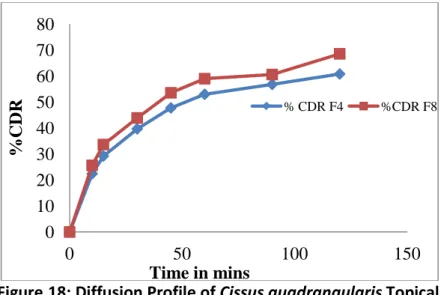
International Research Journal of Pharmaceutical and Biosciences (IRJPBS) 4 (4) 24 Figure.18: Diffusion Profile of Cissus quadrangularis Topical gels
Table 11. Showing % Drug Release Of Ethosomal Gel containing Ethonolic extact of Cissus
quadrangularis In Phosphate Buffer PH 6.8.
Time % CDR of 20% Ethanolic extract of Cissus
quadrangularis ethosomal gel (E2) % CDR of 40% Ethanolic extract of quadrangularis ethosomal gel (E6) Cissus
10 39.56 48.37
15 49.98 56.28
30 57.85 68.32
45 69.78 74.45
60 77.82 79.75
90 80.54 83.87
120 87.76 90.12
180 89.73 93.98
240 94.39 95.31
360 97.68 99.76
Figure. 19: Diffusion Profile of Cissus quadrangularis Ethosomal gels 0
10 20 30 40 50 60 70 80
0 50 100 150
% CDR F4 %CDR F8
%
CDR
Time in mins
0 20 40 60 80 100 120
0 100 200 300
%CDR OF E2 % CDR OF E6
%
CDR
International Research Journal of Pharmaceutical and Biosciences (IRJPBS) 4 (4) 25 Stability study
Ethosomal formulations were observed for any change in appearance or color for a period of 8 weeks. There was no change in appearance in Ethosomal formulations throughout the period of study.
The prepared formulations were tested for accelerated stability. They were kept in stability
chambers at 30°C ± 2°C and 60% ±5 % Relative humidity for 6 months and observed for the
physical appearance. It was found that there was no change in the formulations and were stable even after 6 months.
Table.12 : Stability study of Ethanolic extract of Cissus quadrangularis Ethosomal gels
Stability study
period % CDR of Ethanolic extract of Cissus quadrangularis 20% Ethosomal gel (E2)
% CDR of Ethanolic extract of
Cissus quadrangularis 40%
Ethosomal gel (E6)
Initial 4±2 ° C 99.5 99.7
30±2° C 98.6 99.8
After 2 weeks 4±2 ° C 98.4 99.6
30±2° C 98.4 99.4
After 4 weeks 4±2 ° C 98.3 99.1
30±2° C 98.1 98.9
After 6 weeks 4±2 ° C 97.9 98.8
30±2° C 97.8 98.7
After 8 weeks 4±2 ° C 97.5 98.5
30±2° C 97.3 98.3
RELEASE KINETIC PROFILE FOR ETHOSOMAL GEL (E6)
Table. 13: Release kinetic profile for Ethosomal gel (E6)
ZERO ORDER FIRST ORDER HIGUCHI PEPPAS
%CDR Vs T Log % Remain
Vs T % CDR Vs √𝐓 Log C Vs Log T
Slope 1.5183393 -0.0179672 1.0476754 0.2819543
Intercept 15.720984 2.6221986 2.3677891 -0.0546732
Correlation 0.9678531 0.8954319 0.8795213 0.8943561
International Research Journal of Pharmaceutical and Biosciences (IRJPBS) 4 (4) 26 Figure.20: Zero order Kinetics for E6 gel
Figure 21: First Order Kinetics for E6 gel
Figure 22: Higuchi’s model for E6 gel
y = -0.0172x + 2.6227 R² = 0.9417
0 0.5 1 1.5 2 2.5 3
0 20 40 60 80
LO G % DRUG RE M AI NE D TIME FIRST ORDER
y = 1.0474x + 2.3677 R² = 0.9672
0 20 40 60 80 100 120
0 50 100 150
% C D R
SQUARE ROOT OF TIME
HIGUCHI PLOT
y = 1.5181x + 15.721 R² = 0.9498
0 20 40 60 80 100 120
0 20 40 60 80
TIME IN HRS %
C D R
International Research Journal of Pharmaceutical and Biosciences (IRJPBS) 4 (4) 27 Figure.23: Peppas model for E6 gel
R² of E6 formulation was found to be 0.949 of Zero order Kinetics therefore release pattern of E6 formulation follows zero order release.
R² of E6 formulation was found to be 0.967 of Higuchi therefore release pattern of E6 formulation follows diffusion release mechanism.
CONCLUSION
The Ethosomal system is a highly efficient drug delivery system. The Ethanolic extract of
Cissus quadrangularis is used to prepare the gels.
The method described by Touitou et al., (2000) was employed with modification for the preparation of various ethosomal formulations containing concentration of ethanol (10%) with sonication. The entrapment efficiency of ethosomes containing 40% w/w ethanolic
extract of Cissus quadrangularis (E6) has shown highest value with respect to all other
formulation The PH values for ethosomal gels formulations were in the range of 7.2 to 7.3. The
PH values for topical gels formulations were in the range of 6.9 to 7.1.
The viscosities of the formulations were found to be 38200 of cps for topical F8 gel formulation and 40300 of cps for ethosomal E6 Gel formulation.
The maximum entrapment efficiency of ethosomal vesicles as determined by
ultracentrifugation was 94.34 % for 20% Ethanolic extract of Cissus quadrangularis ethosomal
gel (E2) and 96.45% for 40% Ethanolic extract of Cissus quadrangularis ethosomal gel
(E6).Results of entrapment efficiency also suggest that 2% phospholipids is optimal concentration for entrapment efficiency.
Ethosomal gel of Ethanolic extract of Cissus quadrangularis has shown 99.76% drug release,
zeta potential of -60.9 (mV), viscosity was found to be 40,300 of cps, with specific vesicular size and shape observed by SEM
Stability studies was carried out for a period of 8 weeks and showed no significance changes in the characteristics of ethosomes and further the loss of drug is not more than 2%.
From the above observations it was concluded that ethosomal gel formulation E6 was found to be the best formulation among all the formulation of topical gels and ethosomal gels.
y = 0.2815x - 0.0544 R² = 0.9697
-0.2 0 0.2 0.4 0.6 0.8 1 1.2 1.4 1.6
0 2 4 6
International Research Journal of Pharmaceutical and Biosciences (IRJPBS) 4 (4) 28 ACKNOWLEDGEMENT
The Successful accomplishment of this Article would not have been possible but by the timely help and guidance rendered by many people. I would like to take this opportunity to place it in record. Though it’s not possible to name all of them, I would like to mention few of them. My first salutation goes to Almighty Allah and my Parents for being ever so kind and courteous. It gives me an immense pleasure to acknowledge a debt of gratitude to my guide Mrs. Sirisha Mittapally M.Pharm, PGDCA,(Ph.D) Associate Professor, Deccan School of Pharmacy for
her constant encouragement, suggestions, supervision and support and also to Dr. Roshan.S
M.Pharm, Ph.D Professor and Head of the Department of Pharmacognosy, Deccan School of
Pharmacy for his strong support, guidance and co-operation.
I would like to express profound gratitude to Dr. Syed Abdul Azeez Basha, honourable
Principal of Deccan School of Pharmacy, Hyderabad, for guiding me as well.
REFERENCES
1. Ayesha Siddiqua, Sirisha Mittapally, A Review article on Cissus quadrangularis, AkiNik
Publications ,The Pharma Innovation Journal, 2017; 6 (7);329-334.
2. Shah U. Cissus quadrangularis L.: Phytochemicals, Traditional uses and
Pharmacological Activities - A review, International Journal of Pharmacy and Pharmaceutical Sciences 2011; 3 (4): 41-44.
3. Mishra G, Srivastava S, .Nagori BP. Pharmacological and Therapeutic Activity of Cissus
quadrangularis: An Overview. International Journal of PharmTech Research 2010; 2(2):1298-1310.
4. Srivastava AK, Srivastava P, Behera BR. Pharmacognostical & Phyto-chemical
Investigation of Cissus quadrangularis linn. Stem. Ijprd 2011; 3(1):207-15.
5. Rastogi RP, Mehrotra BN. Compendium of Indian Medicinal Plants, Part I, Publication
and information directorate 1995, 104.
6. Quality standard of Indian medicinal plant, Indian council of Medical Research, New
Delhi. 2005;(2):62.
7. Sharma PC, Yelne MB, Dennis TI. Database on medicinal plant used in Ayurveda.
Central council for research in Ayurveda and Siddha, New Delhi. 2000;(1):43-49.
8. Barry BW. Novel mechanism and devices to enable successful transdermal drug
delivery. European J Pharm Sci., 2004; 14: 101-114.
9. Jain N, Talegonkar S, Jain NK. New ways to enter the blood stream: Emerging
strategies in transdermal drug delivery. The Pharma Review. Sep - Oct 2004; 41-60.
10. Jain NK. Advances in controlled and novel drug delivery. 1ed, New Delhi: st CBS
publication, 2001; 428-451.
11. Jain S, Bhandra D, Jain S and Jain NK. Transfersomes- A novel carrier for effective
transdermal drug delivery. Controlled and novel drug delivery 1st Edition. CBS publishers and distributors new Delhi, 1997; 426-451.
12. Vyas SP, Khar RK. Controlled drug delivery concepts and advances. Vallabh prakashan
New Delhi. First Edition, 2002; 173-243.
13.Tauitou E, Dayan N, Bergelson L, Godin B and Eliaz M. Ethosomes – novel vesicular
International Research Journal of Pharmaceutical and Biosciences (IRJPBS) 4 (4) 29
14.Jain S, Umamaheshwari RB, Bhadra D and Jain NK. Ethosomes: A novel vesicular carrier
for enhances transdermal delivery of a Anti HIV agent. Indian J Pharm Sci., 2004; 66(1): 72-81.
15.Kaplun-Frischoff Y and Touitou E. Testosterone skin permeation enhancement by
method through formation of eutectic with drug and interaction with skin lipids. J Pharm Sci., 1997; 86: 1394-9.
16.Touitou E, Godin B, Dayan N, Weiss C, Piliponsky A and Levi-Schaffer f. Intracellular
delivery mediated by and ethosomal carrier. Biomaterials, 2001; 22: 3053-3059.
17. Lodzki M, Godin B, Rakou L, Mechoulan R, Gallily R and Touitou E. Cannabidiol -
transdermal delivery and anti-inflammatory effect in a murine model. J Control Rel., 2003; 93: 377-387.
18.H. Ralph Schumacher. Rheumatology Research Foundation. (2012).
19. Rodrigues MVN, Reyes FGR, Magalhaes PM, Rath S. GC-MS determination of
organochlorine pesticides in medicinal plants harvested in Brazil. J Braz Chem Soc, 2007; 18: 135-142.
20. Gherman C, Culea M, Cozar O. Comparative analysis of some active principles of herb
plants by GC/MS. Talanta 2000; 53: 253-262.
21. Kingston DGI. Recent advances in the chemistry of taxol. J Nat Prod. 2000;
63:726-734.
22. Pongboonrod S. Mai Thed Mung Muang Thai. Bangkok: Kaeseambunnakit Printing,
Thailand, 1995; 428-429.
23. Shirwaikar A, Khan S, Malini S. Antiosteoporotic effect of ethanol extracts of C.
quadrangularis Linn. on ovariectomized rat. J Ethnopharmacol 2003; 89: 245-250.
24. Nagani KV, Kevalia J, Chanda SV. Pharmacognostical and phytochemical evaluation of
stem of C. quadrangularis L. Int J Pharmaceut Sci Res 2011; 2: 2856-2862.
25. Sumitra Chanda, Yogesh Baravalia, Krunal Nagani, Spectral analysis of methanol
extract of Cissus quadrangularis L. stem and its fractions Journal of Pharmacognosy and Phytochemistry, 2013; 2(4): 149-157.
26. Datar, P. A. Formulation and Evaluation of the Polyherbal Gel Prepared Using
Carbopol 934 for Treating Skin Diseases in Comparison with Ointment Using Emulsifying Ointment. Research & Reviews: Journal of Pharmaceutics and Nanotechnology, 2013; 1(1): 19-21.
27.Mishra, U. S., Murthy, P. N., Mishra, D., & Charana, K. Formulation And