K. Prasanti, Dr. K.V. Satyanarayana IJSRE Volume 05 Issue 07 July 2017 Page 6793 Volume||5||Issue||07||July-2017||Pages-6793-6803||ISSN(e):2321-7545 Website: http://ijsae.in Index Copernicus Value- 56.65 DOI: http://dx.doi.org/10.18535/ijsre/v5i07.15
MIMO Antenna Selection Using Binary Search Algorithm
Authors
K. Prasanti1, Dr. K.V. Satyanarayana2
1
PG Scholar, Vishnu Institue of Technology, Bhimavaram, Westgodvari Dist., Andhra Pradesh
2
Ph. D Professor, Vishnu Institue Of Technology, Bhimavaram, Westgodvari Dist., Andhra Pradesh
ABSTRACT
A practical antenna selection (AS) scheme is investigated for downlink multiuser massive multiple input multiple output (MIMO) networks where a base station (BS) is equipped with many antennas (N) and communicates with K mobile stations (MSs) simultaneously. In the proposed antenna selection technique, S antennas (S≤N) are selected for transmission based on the knowledge of channel coefficients of each MS for reducing the number of RF chains which mainly induce cost increase in terms of size, hardware, and power. In the proposed AS technique, a BS first ranks antenna elements according to the sum of their channel gains to all MSs. Then, the BS computes the downlink sum-rate with S consecutive antenna elements in the ordered set, where the subset consisting of S consecutive antennas is called a window . The BS selects the window resulting in the highest sum-rate. The selected S antenna elements are used for transmitting signals to multiple users, while the remaining (N−S) antenna elements are turned off for the time slot. Therefore, the proposed AS technique requires only (N−S+1) sum-rate computations, while the optimal AS technique involves N S computations. We analyze downlink sum-rate with the proposed AS technique and compare it with that of a reference system with the same number of antenna elements without AS.
Keywords: antenna selection, downlink, multiple users, MIMO, channel coefficients
INTRODUCTION
In the past years, the problem of energy efficiency has mainly been studied for power-limited applications. However, with growing energy demand and increasing energy price, this problem has been noticed in the development of future mobile cellular systems such as long term evolution advanced(LTE-A) . As is known to all, for a point-to-point communication system, using multiple antennas can allow one to dramatically decrease the transmit power. Recently, there has been a great deal of interest in large scale multiple antenna systems, which typically means that wireless systems are allowed to use much more antennas than in systems being built today, say a hundred antennas or more . Simple signal detectors are proposed to alleviate the computational complexity problem in multiple antenna systems . In, the authors show that when the number of Base Station antennas M grows without bound, it can reduce the transmit power of each user proportionally to 1/M if the BS has perfect channel state information (CSI).
K. Prasanti, Dr. K.V. Satyanarayana IJSRE Volume 05 Issue 07 July 2017 Page 6794
the transmit power is large enough and the number of used RF chains is small. But, when the transmit power is relatively small, especially in large scale multiple antenna system where the circuit power consumption can be comparable to or even dominates the transmit power , it would be worthwhile to investigate whether large scale multiple antenna systems can outperform the systems with less antennas in energy efficiency. With these problems stated above, antenna selection can be introduced as a means to alleviate this hardware complexity, while still retaining the diversity advantages. Antenna selection in multiple antenna systems has been evaluated in terms of capacity, outage probability and so on .
Also, due to the computational burden required to select the best set of antennas among all available antennas, fast algorithms have been proposed. To the best of our knowledge, there are very few papers that analyze the behaviour of antenna selection in large scale multiple antenna systems. In the authors explore the behavior of MIMO systems in the limit of large number of antennas and a phenomenon called channel hardeningis observed, i.e., the variance of the mutual information shrinks as the number of antennas grows. The same phenomenon has been observed in with only selecting the best one transmit antenna. However, for a large scale multiple antenna system that a certain number of transmit antennas has to be selected due to lower power RF constraint, few results of the approximation of the distribution of the mutual information have been given yet.
In this paper, we focus on transmit antenna selection with a large number of available antennas at the transmitter. Under such a scenario, for the first time we derive a good approximation of the distribution of the mutual information with selecting any number of antennas. In our system, with large number of available antennas at the transmitter, it shows that our results include the asymptotic distribution of the mutual information in as a special case when the number of selected antennas equals to the number of total available transmit antennas. Besides, we model the power consumption as the addition of the transmit power and the circuit power consumption, and analyze the performance of the energy efficiency. We find that when the circuit power consumption is comparable to or dominates the transmit power, an optimal number of selected antennas can be obtained, and thus, less or more used antennas can decrease the energy efficiency. Based on these conclusions, we propose two antenna selection algorithms to improve the energy efficiency. The rest of this paper is organized as follows. Presents the system model and then the channel hardening phenomenon in antenna selection system with large number of available antennas is proved.
REVIEW ON LITERATURE
Also, due to the computational burden required to select the best set of antennas among all available antennas, fast algorithms have been proposed. To the best of our knowledge, there are very few papers that analyze the behaviour of antenna selection in large scale multiple antenna systems. In the authors explore the behavior of MIMO systems in the limit of large number of antennas and a phenomenon called channel hardeningis observed, i.e., the variance of the mutual information shrinks as the number of antennas grows. The same phenomenon has been observed in with only selecting the best one transmit antenna. However, for a large scale multiple antenna system that a certain number of transmit antennas has to be selected du e to lower power RF constraint, few results of the approximation of the distribution of the mutual information have been given yet.
K. Prasanti, Dr. K.V. Satyanarayana IJSRE Volume 05 Issue 07 July 2017 Page 6795
the circuit power consumption is comparable to or dominates the transmit power, an optimal number of selected antennas can be obtained, and thus, less or more used antennas can decrease the energy efficiency. Based on these conclusions, we propose two antenna selection algorithms to improve the energy efficiency. The rest of this paper is organized as follows. Presents the system model and then the channel hardening phenomenon in antenna selection system with large number of available antennas is proved.
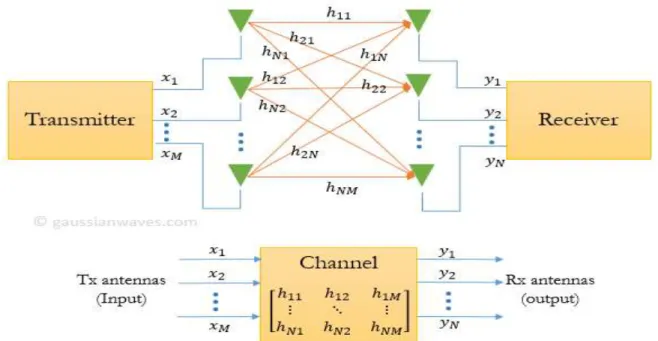
Here, the system configuration typically contains MM antennas at the transmitter and NN antennas at the receiver front end as illustrated in the next figure. Here, each receiver antenna receives not only the direct signal intended for it, but also receives a fraction of signal from other propagation paths. Thus, the channel response is expressed as a transmission matrix HH. The direct path formed between antenna 1 at the transmitter and the antenna 1 at the receiver is represented by the channel response h11h11 . The channel response of the path formed between antenna 1 in the transmitter and antenna 2 in the receiver is expressed as h21h21 and so on. Thus, the channel matrix is of dimension N×MN×M.
Figure 1: MIMO from channel persepective
The received vector yy is expressed in terms of the channel transmission matrix HH, the input vector xx and noise vector nn as
y=Hx+ny=Hx+n
Lincoln Laboratory is investigating multiple-input multiple output(MIMO) techniques to improve the robustness and performance of wireless links. Here, the term multiple-input multiple-output refers to the use of an array of antennas for both transmitting and receiving. MIMO approaches show promise of enabling better wireless communications because they mitigate problems inherent in ground-to-ground links, which are the most common links used by wireless devices, including cell phones and WiFi. Typically, ground-to-ground links are not line of sight. The electromagnetic waves transmitted from the antennas bounce around the environment in a complicated fashion and end up at the receiver coming from multiple directions and with varying delays.
K. Prasanti, Dr. K.V. Satyanarayana IJSRE Volume 05 Issue 07 July 2017 Page 6796
being asked of the links in terms of flexibility of use and higher data rates. Furthermore, ad hoc wireless networks, which are inevitably becoming integrated into military and commercial applications, require more robust, flexible, and higher-data-rate links. Lincoln Laboratory is pushing the limits of MIMO technology, developing record-setting space-time codes. Space time codes describe what is transmitted by the array of transmitters in a MIMO communication link.
METHODOLOGY
An antenna (plural antennae or antennas), or aerial, is an electrical device which converts electric power into radio waves, and vice versa.[1] It is usually transmit radio or transmit receiver. In transmittion a radio transmitter supplies an electric current oscillating at radio frequency to the antenna's terminals, and the antenna radiates the energy from the current electromagnetic waves (radio waves). In reception, an antenna intercepts some of the power of an electromagnetic wave in order to produce a tiny voltage at its terminals, that is applied to a receiver to be amplified. Antennas are essential components of all equipment that uses radio.. They are used in systems such as broadcasting broadcast, television, two-way radio, communications, receivers, radar, cell phone, and satellite communications, as well as other devices such as garage door openers, wireless micro phone Bluetooth enabled devices, computer networks, baby monitors. RFID tags merchandise.
Typically an antenna consists of an arrangement of metallic conductors electrically connected to the receiver or transmitter. An oscillating current of electrons forced through the antenna by a transmitter will create an oscillating magnetic field around the antenna elements, while the charge of the electrons also creates an oscillating electric field along the elements. These time-varying fields radiate away from the antenna into space as a moving transverse electromagnetic field wave. Conversely, during reception, the oscillating electric and magnetic fields of an incoming radio wave exert force on the electrons in the antenna elements, causing them to move back and forth, creating oscillating currents in the antenna.
Antennas can be designed to transmit and receive radio waves in all horizontal directions equally (omni directional antennas), or preferentially in a particular direction (directional or high gain antennas). In the latter case, an antenna may also include additional elements or surfaces with no electrical connection to the transmitter or receiver, such as parasitic elements, parabolic reflectors or horns which serve to direct the radio waves into a beam or other desired radiation pattern.
The first antennas were built in 1888 by German physicist Hertz in his pioneering experiments to prove the existence of electromagnetic waves predicted by the theory of James Clerk Maxwell. Hertz placed dipole antennas at the focal point of parabolic reflectors for both transmitting and receiving. He published his work in Annalen der Physik und Chemie .
3.1 Selection algorithm:
In computer science, a selection algorithm is an algorithm for finding the kth smallest number in a list or array; such a number is called the kth order statistic. This includes the cases of finding the minimum, maximum, and median elements. There are O(n) (worst-case linear time) selection algorithms, and sublinear performance is possible for structured data; in the extreme, O(1) for an array of sorted data. Selection is a subproblem of more complex problems like the nearest neighbour and shortest path problems. Many selection algorithms are derived by generalizing a sorting algorithm, and conversely some sorting algorithms can be derived as repeated application of selection.
3.2 Sequential Search Algorithm (SSA):
K. Prasanti, Dr. K.V. Satyanarayana IJSRE Volume 05 Issue 07 July 2017 Page 6797
is larger than or equals to Rch, i.e., the number of available RF chains, the algorithm terminates. This is due to the consideration of the RF chains constraint. With the RF chains constraint satisfied, at every loop, we choose the best antenna from the complementary set of U1to form a temporary newset U_1. If the energy efficiency with U_1, η (U_1), is smaller than or equals to the energy efficiency with U1(i.e., η (U1)), the algorithm terminates, otherwise, set U1 = U_1. This can beillustrated by the conclusions we obtained in
Theorem 2, i.e.,the energy efficiency increases first and then decreases as the number of selected antennas increases. When the algorithm terminates, U1 is the optimal antenna subset. The algorithm uses at most
O(Rch − 1) comparisons to find the optimal subset. The algorithm is briefly summarized in Table I.
3.3 Binary Search Algorithm (BSA):
The traditional BSA is used to find the position of a specified value within a sorted array. This algorithm requires far fewer comparisons than a linear search especially for large arrays. It takes logarithmic time, but it imposes the requirement that the list be sorted. Although, the energy efficiency with different number of selected antennas is not sorted monotonously, we can decide which part the maximum value locates in according to the middle value. In the following, we will use the binary search algorithm with modification to find the maximum value. First, we initialize the three variables: the lower bound of the used antenna, the upper bound of the used antennas, and the midpoint of the lower bound and upper bound, which are denoted as low value, high value and mid value respectively.
The initial value of low value and high value are 1 and Rch respectively. mid value is calculated as mid value = (low value + high value)/2.
The energy efficiency achieved by using L antennas is denoted as η(L). At every loop, we compare η(mid value) with η(mid value +1), and decide which subset the maximum value locates in. If η(mid value + 1) > η(mid value), the maximum value is in the upper subset, change low value = mid value+1 to search the upper subset; if η(mid value+1) < η(mid value) the maximum value is in the lower subset, change high value = mid value to search the lower subset; otherwise, the maximum value is found by selecting mid value antennas. At the end of every loop, mid value is updated with new low value and high value. To avoid locking up, we terminate the algorithm when the equation high value−low value = 1 is satisfied. Then, the maximum value is either η(low value) or η(high value).We denote L∗as the optimal number of selected antennas corresponding to the maximum energy efficiency. The optimal antenna subsetis achieved by selecting the best L∗antennas. The algorithm will never use more than O(log2Rch + 1) comparisons tofind the maximum value. We know that the complexity of the traditional BSA is O(log2Rch). The one more comparisonin our modified BSA is due to the property that we need tocompare the two consecutive values in the array.
Discussion for the Energy Efficiency with M >1:
In order to analyze the energy efficiency, we have to obtain the closed-form expression for the mutual information of MIMO with transmit antenna selection. For a MIMO system with N transmit antennas and M
receive antennas, M >1, the received signal is given by y = Hx+ n, where y, x,n are the received signal, the transmitted signal and the zero-mean additive noise vectors, respectively, H is the M×N channel matrix, the element is the same as defined in Section II. For simplicity, we assume that H is unknown at the transmitter. Thus, to maximize the mutual information, the total power ρ is equally allocated to all transmit antennas.The capacity of the MIMO channel in is given by
K. Prasanti, Dr. K.V. Satyanarayana IJSRE Volume 05 Issue 07 July 2017 Page 6798
correlated channels have been studied extensively, showing that the diversity order cannot exceed the rank of the spatial correlation matrix of the channel. Performance analysis of selection combining and generalized selection combining has been the subject of much research. In particular, Alouini and Simon analyzed the generalized selection combining over Rayleigh fading channels using the moment generating function method, and later extended and simplified the expressions for independent but non identically distributed Rayleigh paths. Mallik and Win analyzed generalized selection combining in correlated Nakagami fading. There is a large body of work in this area, but further discussion of performance evaluation is beyond the scope of this tutorial.
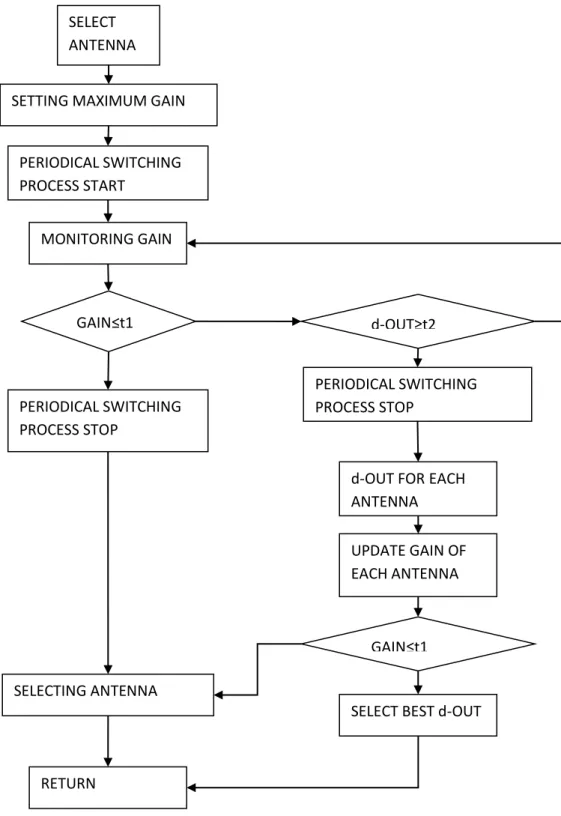
Figure 2 Flow Chart for antenna selection approach
SELECT ANTENNA
SETTING MAXIMUM GAIN
PERIODICAL SWITCHING PROCESS START
MONITORING GAIN
GAIN≤t1 d-OUT≥t2
PERIODICAL SWITCHING PROCESS STOP
PERIODICAL SWITCHING PROCESS STOP
d-OUT FOR EACH ANTENNA
UPDATE GAIN OF EACH ANTENNA
GAIN≤t1
SELECTING ANTENNA
SELECT BEST d-OUT
K. Prasanti, Dr. K.V. Satyanarayana IJSRE Volume 05 Issue 07 July 2017 Page 6799 RESULTS
The energy efficiency is defined as the spectral efficiency divided by the total power consumed, which is first introduced can be written as
where E denotes the expectation, I is the mutual information, Ptotal is the total power consumption which is the addition of the transmit power ρ and the circuit power consumption Pc in our model, i.e., Ptotal = ρ +
Pc. As is known to all, for every employed antenna, a separate radio frequency chain is need. We use the circuit power consumption model. It is given byPc ≈Nt (PDAC + Pmix + Pfilt) + 2Psyn+ Nr (PLNA + Pmix
+ PIFA + Pfilr + PADC)
where Nt and Nr are the numbers of transmitter and receiver antennas, respectively, PDAC, Pmix, Pfilt,
Psyn, PLNA,PIFA, Pfilr, and PADC are the power consumption values for the DAC, the mixer, the active filters at the transmitter side, the frequency synthesizer, the low noise amplifier, the intermediate frequency amplifier, the active filters at the receiver side, and the ADC, respectively. For more details about the parameters of these variables, the references therein.
To simplify notation, we denote thatP1 = 2Psyn+PLNA+ Pmix+PIFA+Pfilr+PADC and
P2 = PDAC+Pmix+Pfilt, so Pc = P1 + LP2. Obviously, P1 > P2. With large N, the tails of the distribution of I is extremely small, the mean of can be approximated by the mean of its corresponding normal distribution. Thus, the closed-form expression of the energy efficiency is
Most of the studies about antenna selection focus on the performance with small and fixed number of selected antennas.But in large scale multiple antenna systems, there are large number of available antennas. Thus, the range to be selected extends widely. Next, we anal yze the effects of the transmit power and the number of selected antennas on the energy efficiency. For our power consumption model stated above,we get the following statement.
The problem of energy efficiency has mainly been studied for power-limited applications in the past years. However, with growing energy demands and increasing energy price, this problem has been noticed in the development of future mobile cellular systems. Recently, there has been a great deal of interest in large scale multiuser MIMO systems, which typically means that wireless systems with hundreds of antennas serve tens of users simultaneously. Simple signal detectors are proposed to alleviate the computational complexity problem in multiple antenna systems, and shows that it can reduce the transmit power of each user proportionally to 1/M if the Base Station (BS) has perfect channel state information (CSI) when the number of BS antennas M grows without bound. However, one of the disadvantages of employing multiple antennas is the associated complexity which results from employing a separate radio frequency (RF) chain for every employed antenna, which will greatly limit the practical application of large MIMO technology.
K. Prasanti, Dr. K.V. Satyanarayana IJSRE Volume 05 Issue 07 July 2017 Page 6800
system, which improves the capacity of downlink. Two antenna selection schemes maximizing the energy efficiency of the single -user massive MIMO systems are proposed in, without the consideration of the problem of energy efficiency maximization in the multiuser scenario. To the best of our knowledge, however, there are very few previous papers that study the downlink performance with transmitting antenna selection in multiuser large scale MIMO system.
In this paper, we perform transmit antenna selection to improve the energy efficiency of multiuser large scale MIMO systems. Under such a scenario, we establish a new power consumption model as the addition of the transmit power and the circuit power consumption, and based on this model, analyze the effects of the number of transmitting antennas at the base station and the number of users at the receiver on the total power consumption and the energy efficiency respectively. We focus on the multiuser scenario where the zero-forcing (ZF) precoding is used to reduce inter-user interference, and we analytically derive the optimal number of selected antennas which can maximize the energy efficiency in this case. Based on the optimal number of transmit antenna, we compare the energy efficiency improvement by antenna selection with using all of the given transmit antennas.
In this paper, we define the energy efficiency as total P is the total power consumption which includes both the transmit power tx P and the circuit power consumption cir P in our model is the power amplifier efficiency. In this paper, the circuit power consumption is modelled as power consumption values for the frequency synthesizer, the DAC, the mixer, the filters at the transmitter side, respectively.
For multiuser MIMO, we consider the 10MHz OFDM system. And the large scale multiuser MIMO baseband computation model which was presented in [7] is used
where is the baseband power consumption, and are the power consumption values for the frequency synthesizer, the DAC, the mixer, the filters at the transmitter side, respectively. BP For multiuser MIMO, we consider the 10MHz OFDM system. And the large scale multiuser MIMO baseband computation model which was presented in is used
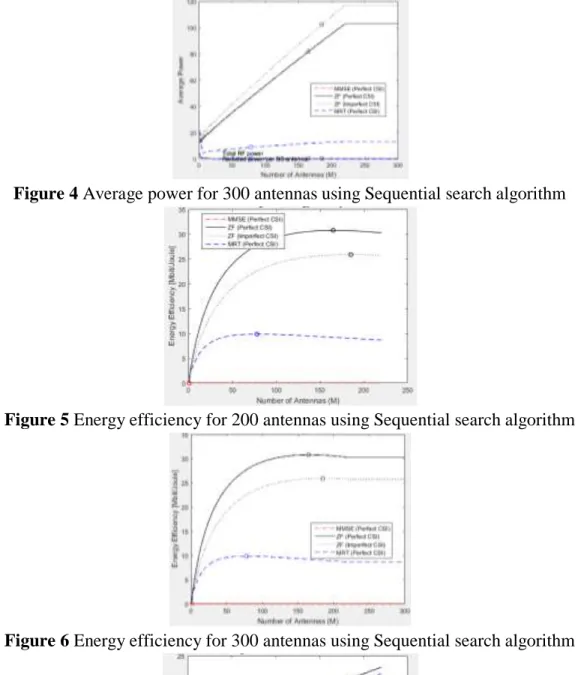
K. Prasanti, Dr. K.V. Satyanarayana IJSRE Volume 05 Issue 07 July 2017 Page 6801 Figure 4 Average power for 300 antennas using Sequential search algorithm
Figure 5 Energy efficiency for 200 antennas using Sequential search algorithm
Figure 6 Energy efficiency for 300 antennas using Sequential search algorithm
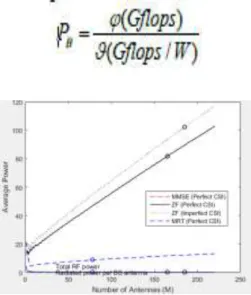
Figure 7 Average power for 200 antennas using Binary search algorithm
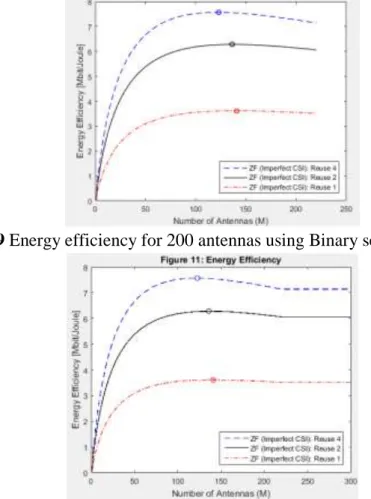
K. Prasanti, Dr. K.V. Satyanarayana IJSRE Volume 05 Issue 07 July 2017 Page 6802 Figure 9 Energy efficiency for 200 antennas using Binary search algorithm
Figure 10 Energy efficiency for 300 antennas using Binary search algorithm
Figure 11 Average power on varying transmitting using Binary search and Sequential search algorithms.
CONCLUSION
K. Prasanti, Dr. K.V. Satyanarayana IJSRE Volume 05 Issue 07 July 2017 Page 6803 REFERENCES
1. C. Reeder, A. Okatmoto, M. Anderson, and D. Edwards, “Two-hydrophone heading and range sensor applied to formation-flying for underwater AUVs,” in Oceans’04 Techno., Kobe, Japan, Nov. 9–12 2004.
2. D. B. Edwards, T. Bean, D. Odell, and M. J. Anderson, “A leader-follower algorithm for multiple AUV formations,” in IEEE/OES Autonomous Underwater Vehicles, Sebasco Estates, Maine, June 17–18 2004.
3. Q. Wen and J. Ritcey, “Spatial diversity equalization applied to underwater communications,” IEEE J. Oceanic Eng., vol. 19, no. 2, pp. 227–241, Apr. 1994.
4. J. A. Catipovic and L. Freitag, “Spatial diversity processing for underwater acoustic telemetry,”
IEEE J. of Oceanic Eng., vol. 16, no. 1, pp. 86–97, Jan. 1991.
5. J.G. Proakis, Digital Communications, 4th ed., McGraw-Hill, New York, USA 2001.
6. J. G. Proakis , “Adaptive equallzation techniques for acoustic telemetry channels,’’ IEEE J. Oceanic Eng., vol. 16, no. 1, pp. 21-31, 1991.
7. S. Qureshi, “Adaptive equalization,” Proceedings ofIEEE, vol. 73, no. 9, pp. 1349-1387, 1985. 8. M. Stojanovic, “ Underwater Acoustic Communication”, in Wiley Encyclopedia of Electrical and
Electronics Engineering, Boston, MA 02115.
9. M .Stojanovic, J. Catipovi and J. Proakis, “Adaptive multichannel combining and equalization for underwater acoustic communications,” The J. of the Acoustical Society of America, Volume 94, Issue 3, September 1993, pp.1621-1631.
10.M. Stojanovic, J. Catipovic, and J. G. Proakis. “Phase Coherent Digital Communication for Underwater Acoustic Channels,” IEEE Journal of Oceanic Engineering, Vol. 19(1):100--111, January 1994.
11.L. Szczecinski and A. Gei, “Blind decision feedback equalizers, how to avoid degenerative solutions,” Signal Process., vol. 82, no. 11, pp. 1675–1693, 2002.
12.L. kinsler, A. Frey, A. Coppens, and J. Sanders, Fundamentals of Acoustics, John Wiley & Sons, New York, United States of America (2000).
13.L. Brekhovsikish, Waves in Layered Media, 2nd ed., New York: Academic Press, 1980.
14.Q. Paulraj, R. Nabar, and D. Gore, Introduction to Space-Time Wireless Comms., Cambridge, New York, United States of America (2003).
15.M. Jankiraman, Space-time codes and MIMO sys., Artech House Publications, Boston, United States of America (2004).
16.H. SATO and T. OHTSUKI, “Computational Complexity and Performance of RAKE Receivers,” IEICE Trans. Fundaments, Vol.E88–A, NO.9 September 2005.
17.T.S. Rappaport, Wireless Communications – Principles and Practice, 2nd ed., Prentice Hall, Upper Saddle River, New Jersey, United States of America (2002).
18.A.J. Viterbi, “Error bounds for convolutional codes and an asymptotically optimum decoding algorithm,” IEEE Trans on Information Theory, vol. IT-13, pp.260-269, 1967.
19.A. Goldsmith, Wireless Communications, 1st ed., Cambridge, New York, United States of America (2006).