Indonesian Language Learning Based on Teachers’
Directive Speech Act Strategy (TDSAS) and
Students’ Positive Affective Color Response
(SPACR) with a Synectic Model
Sumarti
FKIP Universitas Lampung, Indonesia
Iing Sunarti
FKIP Universitas Lampung, Indonesia
Mulyanto Widodo
FKIP Universitas Lampung, Indonesia
Abstract—Love and self-esteem can be fulfiled by the teacher through teachers’ directive speech act strategy (TDSAS). Teachers need to use teachers’ directive speech act strategy to make the students feel loved and respected and emerge the students’ positive affective color response (SPACR) which creates a fun, effective and conducive learning process. Some verbal abuses made by the teachers affect the students’ psychology (inferiority, trauma, laziness, and has no motivation to come to school). This study aimed to portray the Indonesian language learning in junior high school using TDSAS-SPACR with a synectics model to improve the quality of the process and learning outcomes. Using the descriptive-qualitative method, the results showed that the TDSAS based learning which emerges SPACR creates an effective and fun Indonesian language learning in junior high school.
Index Terms—teachers’ directive speech act strategy, affective color response, synectics model
I. INTRODUCTION
The realization and the selection of teachers’ directive speech act strategy (hereinafter referred to as TDSAS) play an important role in learning. They are closely related to the students’ affective color response both positive and negative since they influence the learning effectiveness (Zhang, 2011). In his research, Fried (2011) shows that in learning, affective color or emotion greatly influences the cognitive learning process, motivation and class’ interaction. Emotion increases the cognitive process and it becomes an integral part of the learning process.
TDSAS can be used to create the students’ optimal competencies and trigger the students’ self-actualization. Maslow in Slavin (2011) states that each student has deficiency needs; physiological needs, safety needs, love, and belonging needs as his/her basic needs before the growth needs emerge. The students’ growth needs include knowing and understanding, aesthetics, and self-actualization.
The teachers should admit that the learning process will be disrupted when the students’ basic needs are not fulfilled. The most important deficiency needs are love and self-esteem. The students who feel unloved and unappreciated even though they are capable, will not be able to have strong a motivation to achieve goals in growth needs (Stipek, 2001). The teachers who can soothe the students and make them feel accepted and appreciated as an individual will help the students enjoy learning and be creative in building their self-actualization.
The nature of education as stipulated in the National Education System in Law number 20 act 1 (2003) states that “education is a conscious and planned effort to create a learning process and atmosphere so that the students actively develop their potential to have religious strength, self-control, personality, intelligence, noble character, and achievable skills”. Hence, the TDSAS and students’ affective color response research in learning are important. In addition to the theoretical background and policy base mentioned earlier, this research is based on the empirical study in the field.
non-physical abuse includes cursing, snapping, and insulting. Psychological nonphysical abuses include looking at the students cynically and condescendingly, ostracizing, ignoring, and embarrassing the students.
In her research, Sumarti (2015) finds that teachers’ directive speech act strategy created students’ affective color response, both positive and negative. This finding confirms McDonald (2011) who states that when the teachers speak in the learning process, the students subconsciously respond affectively. Moreover, Jansen (2010) states that when the students have been humiliated or demeaned in front of the class by the teacher in their childhood, it leaves an emotional scar. For students, emotion is the most memorable thing in learning. Emotion influences belief, decision, and action. Its effects will last and the emotional strength immediately occurs. The positive emotion built is associated with the students’ success at school (Jensen, 2010). Therefore, in directive speech, the strategy to trigger the positive emotion is needed to create a fun learning and make the students feel excited to do the tasks.
By having passion and enthusiasm, the students’ competency can be explored and the learning objectives will be achieved. This effective teachers’ speech strategy orientation will emerge the students’ creativity and productivity. The teachers who can soothe the students and make them feel accepted and appreciated as an individual will help the students becoming creative for their self-actualization. Teachers’ directive speech act strategy and students’ affective color response can fulfill the students’ deficiency needs which then will make the students feel motivated to fulfill their growth needs.
Love and self-esteem, as the students’ basic needs, can be accommodated through TDSAS. TDSAS which emerges the students’ positive affective color response (hereinafter referred to as SPACR) to create an effective, fun and conducive to learning and also improve students’ confidence can be applied to preserve the students’ feeling, to feel loved and appreciated (Ormrod, 2009).
By using Brown and Levinson’s speech strategy parameters (1987), it is discovered that TDSAS which emerges SPACR are (a) direct speech, (b) praising, (c) using terms of endearment or name, (d) avoiding using the words saya (I) and kamu (you), (e) involving speakers and interlocutors in activities, (f) using polite request, (g) containing jokes and humor, (h) considering the interlocutor’s wishes, (i) seeking agreement, and (j) indirect speech. Meanwhile, the teachers’ directive speech act which results in students’ negative affective color response (hereinafter referred to as SNACR) are (a) sarcastic indirect speech, (b) greeting in high tone, (c) comparing, and (d) insulting (Sumarti, 2015).
Education creates ideas and emotions continuously (Joyce et al. 2012). Changes in human awareness occur endlessly and it gives a distinctive character to the educational process. Therefore, learning becomes a joyful and lifelong process. Good teaching is a boundless learning experience on how ideas and emotions interact with the classroom atmosphere and how both can change according to the changing atmosphere (Joyce, 2012)
Every learner has great potential to develop. Educators are expected to be able to explore and develop the students’ potential by providing the opportunities for students to be actively involved in expressing all of their potential, such as by using the application of synectics learning. This learning emphasizes the students’ active involvement to experience themselves and solve problems so that their potential develops optimally.
Improving the quality of the process and the result of Indonesian language learningcan be done in various efforts. This study tries to discover the TDSAS which brings out positive emotional responses from students to prompt their enthusiasm and learning creativity. The students’ positive behavior can improve students’ learning outcomes. The professional teachers can encourage and motivate the students to learn. The learning products should improve students' previous competencies. The learning process will depend on teachers’ performance and personality, students’ attitudes, and learning facilities assuming that conducive learning will affect teachers’ performance and students’ learning achievement.
Speech act strategy relates to ways of speaking or speaking technique. Each speech act has a realization strategy. Yule (1996) reveals that strategy is a tendency to use certain lingual forms as a consideration of the social distance between speakers and speech partners. As an example, the solidarity strategy is used by the speakers because of their closeness to the interlocutor who uses a nickname or term of endearment, or another expression due to intimacy.
To maintain the effectiveness of the learning process, as the educators, the teachers should know and understand the positive and negative impacts of emotions on learning (Fried, 2011). In his research, Zhang (2007) reveals that the TDSAS, especially teachers’ request speech act, has an impact on the students’ emotions and behavior. Therefore, the study of affective color or emotion associated with the teacher and student interaction context in learning is very essential. The emotions are very important for students’ motivation, learning, performance, identity development, and health (Schutz & Pekrun, 2007).
into activities and using jokes) and negative politeness strategy (indirect speech, using questions, and avoiding the use of words saya (I) and kamu (you)); (5) teachers’ directive speech act strategies (TDSAS) which emerges students’ positive affective color response (SPACR) are; (a) direct strategy, (b) praising, (c) using term of endearment and name (d) avoiding the use of words saya (I) and kamu (you), (e) involving speakers and interlocutors in activities, (f) using polite request, (g) using jokes, (h) considering the interlocutor’s wish, (i) seeking for agreement, dan (j) indirect speech; (6) teachers’ directive speech act strategies (TDSAS) which emerges students’ negative affective color response (SNACR) are; (a) indirect speech containing irony, (b) greeting using exclamation, (c) comparing, and (d) speech containing admonishment.
These findings emerge the issues of whether TDSAS which generated SPACR is applicable as the basis or reference in managing the learning process with a synectic model. Thus, this research aimed to (1) identify the purpose of Indonesian language learning based on TDSAS-SPACR with a synectic model; (2) describe the design of
TDSAS-SPACR-based learning model; (3) demonstrate the effectiveness of Indonesian language learning based on TDSAS-SPACR with a synectic model in Junior High School.
II. RESEARCH METHOD
This research used a descriptive qualitative method. The research was conducted in SMPN 22 (Public Junior High School) and SMP IT Fitrah Insani (Private Junior High School) Bandar Lampung, Indonesia. The data were collected continuously for three months. In collecting the data, observation, audio-visual recording, questionnaire, interview, and test were used in this research. The observation technique and audio-visual recording were used to collect the learning process data which covered students’ activities and TDSAS-SPACR-based learning with a synectic model. Questionnaire and interview were used to collect students’ and teachers’ responses toward the use of TDSAS-SPACR- based learning model, while the test was used to measure the students’ writing skills before and after using TDSAS-SPACR- based learning with a synectic model.
III. RESULT AND DISCUSSION
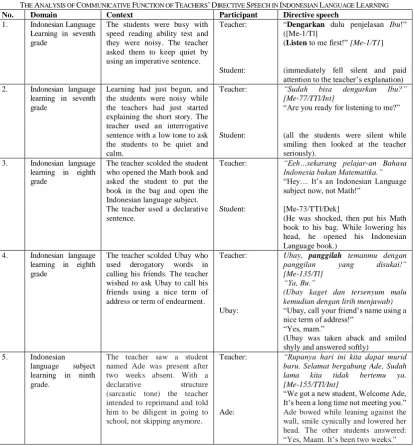
In her previous research, Sumarti (2015) found that the communicative functions of teachers’ directive speech act in Indonesian language learning in junior high school involve ordering, asking, forbidding, suggesting, asking, and inviting. The use of communicative functions can be seen on the table (1) below.
TABLE 1
COMMUNICATIVE FUNCTION OF TEACHERS’DIRECTIVE SPEECH IN INDONESIAN LANGUAGE LEARNING IN JUNIOR HIGH SCHOOL
Domain
Communicative Function
Total Ordering Asking Forbiddin
g
Suggestin g
Asking Inviting
Indonesian language learning in seventh grade
41 14 8 5 3 5 76
Indonesian language learning in eighth grade
82 40 2 7 18 8 157
Indonesian language learning in ninth grade
35 13 21 16 14 5 104
Total 158 67 31 28 35 18 337
TABEL 2
THE ANALYSIS OF COMMUNICATIVE FUNCTION OF TEACHERS’DIRECTIVE SPEECH IN INDONESIAN LANGUAGE LEARNING
No. Domain Context Participant Directive speech
1. Indonesian Language Learning in seventh grade
The students were busy with speed reading ability test and they were noisy. The teacher asked them to keep quiet by using an imperative sentence.
Teacher:
Student:
“Dengarkan dulu penjelasan Ibu!” ([Me-1/Tl]
(Listen to me first!” [Me-1/T1]
(immediately fell silent and paid attention to the teacher’s explanation) 2. Indonesian language
learning in seventh grade
Learning had just begun, and the students were noisy while the teachers had just started explaining the short story. The teacher used an interrogative sentence with a low tone to ask the students to be quiet and calm.
Teacher:
Student:
“Sudah bisa dengarkan Ibu?” [Me-77/TTl/Int]
“Are you ready for listening to me?”
(all the students were silent while smiling then looked at the teacher seriously).
3. Indonesian language learning in eighth grade
The teacher scolded the student who opened the Math book and asked the student to put the book in the bag and open the Indonesian language subject. The teacher used a declarative sentence.
Teacher:
Student:
“Eeh…sekarang pelajar-an Bahasa Indonesia bukan Matematika.”
“Hey… It’s an Indonesian Language subject now, not Math!”
[Me-73/TTl/Dek]
(He was shocked, then put his Math book to his bag. While lowering his head, he opened his Indonesian Language book.)
4. Indonesian language learning in eighth grade
The teacher scolded Ubay who used derogatory words in calling his friends. The teacher wished to ask Ubay to call his friends using a nice term of address or term of endearment.
Teacher:
Ubay:
Ubay, panggilah temanmu dengan panggilan yang disukai!” [Me-135/Tl]
“Ya, Bu.”
(Ubay kaget dan tersenyum malu kemudian dengan lirih menjawab)
“Ubay, call your friend’s name using a nice term of address!”
“Yes, mam.”
(Ubay was taken aback and smiled shyly and answered softly)
5. Indonesian language subject learning in ninth grade.
The teacher saw a student named Ade was present after two weeks absent. With a
declarative structure
(sarcastic tone) the teacher intended to reprimand and told him to be diligent in going to school, not skipping anymore.
Teacher:
Ade:
“Rupanya hari ini kita dapat murid baru. Selamat bergabung Ade, Sudah lama kita tidak bertemu ya. [Me-155/TTl/Int]
“We got a new student, Welcome Ade, It’s been a long time not meeting you.” Ade bowed while leaning against the wall, smile cynically and lowered her head. The other students answered: “Yes, Maam. It’s been two weeks.”
TABLE 3
STRUCTURAL MARKERS AND REALIZATION OF COMMUNICATION FUNCTION OF TEACHERS’DIRECTIVE SPEECH
No. Communication function Speech structure marker Speech act realization 1. Ordering (a) is started with a verb
(b) uses verbs with prefix di-,per-,
verbs with suffix –kan,
verbs with an article –lah, and verbs with prefix per- and suffix -kan
(a) direct speech (using imperative structures, function as ordering) (b) indirect speech (using declarative
and interrogative structure, functions as ordering) 2. Requesting is started with verbs: coba (try) , silakan, or
tolong (please)
(a) direct speech (using imperative structure, functions as asking) (b) indirect speech (using declarative
and interrogative structure, functions as asking) 3. Forbidding is started with adverb jangan (don’t) and
phrase nggak boleh (should not)
(a) direct speech (using declarative and interrogative structure, functions as forbidding) (b) indirect speech (using declarative
and interrogative structure, function as forbidding) 4. Suggesting (a) uses conjugation agar, supaya,
sebaik-nya, makanya, and jika/ kalau (so, should, if)
(b) uses phatic ya at the end of the speech
Direct speech (using imperative structure, functions as suggesting)
5. Asking (a) uses questions marks (apa, siapa, berapa, bagaimana, mengapa, siapa, kapan, dan di mana)
(b) uses particle –kah (c) uses “asking” tone
Direct speech (using interrogative structure, functions as asking)
6. Inviting is started with ayo and mari Direct speech (using imperative structure, functions as inviting)
Furthermore, they were implemented in Indonesian language learning in junior high school by using the synectic model. This model was used because it is oriented towards the students’ creativity through teachers’ speech based on analogies and metaphors. The results of the study entitled "Indonesian language learning based on teachers’ directive speech act strategy and students’ positive affective color response with synectic model” are presented based on the objectives of the study as revealed in the introduction as follows.
A. The Purpose of Using Indonesian Language Learning Based on TDSAS-SPACR with the Synectic Model
The general purpose of using the synectic learning model is the personal development of creativity and creative problem-solving (Weil et al. 1978: 7). Gordon's creative ideas are described in detail by Joyce (2012: 252-253) based on the four views; 1) creativity is important in daily activities. The model is designed to increase the capacity of problem-solving, creative expression, empathy, and insight into social relations. 2) The creative process is not constantly mysterious, everything can be expressed and trained with certain procedures. 3) The creative innovation in all fields - art, science, and engineering – is considered equal and characterized by the same intellectual process. 4) the invention of individual and group creative mindsets is merely the same.
The specific purpose of using TDSAS-SPACR in writing class in Indonesian language subject is the students are able to (1) discover and develop ideas creatively into a creative writing through analogy and metaphor which include these following steps: (a) current situation description, (b) direct analogy, (c) personal analog, (d) solid conflict, (e) direct analogy based on solid conflict, (f) initial tasks rechecking; (2) determine the ideas used as topics in writing through two synectic strategies; creating something new and making something unfamiliar become familiar thing (3) develop ideas into writing through two synectic strategies; creating something new and making something the strange familiar.
By using this synectic model, the students’ basic needs fulfillment- love and affection- can emerge their potential and creativity optimally. This is fully described in Sumarti, et al (2018) who confirm the importance of teacher’ directive speech strategy in learning.
B. The Design of Indonesian Language Learning Based on TDSAS-SPACR with Synectic Model
TABLE 4
THE DESIGN OF LEARNING BASED ON TDSAS-SPACR WITH SYNECTIC MODEL
Synectic Syntax TDSAS SPACR
a. Creating something new
1) current situation description Avoiding the word ‘kamu’, avoiding the word ‘saya’,
paying attention, praising, avoiding differences, seeking agreement
positive (happy, enthusiast, proud, joyful)
2) direct analogy Polite greeting, praising, avoiding the word ‘saya’,
avoiding the word ‘kamu’, involving the speaker and
interlocutor in activities, seeking agreement.
positive (happy, enthusiast, proud, happy)
3) personal analogy Polite greeting, paying attention, avoiding the word ‘kamu’ and ‘saya’
involving the speaker and interlocutor in activities.
positive (happy and enthusiast)
4) solid conflict avoiding the word ‘kamu’ and ‘saya’,
praising, involving the speaker and interlocutor in activities, using a polite greeting, seeking agreement.
Positive (happy and enthusiast)
5) direct analogy involving the speaker and interlocutor in activities, praising, avoiding the word ‘kamu’, giving accomplishment.
Positive (happy and enthusiast)
6) initial tasks checking To praise, involving the speaker and interlocutor in activities, avoiding the word ‘kamu’, seeking agreement.
positive (happy and enthusiast) b. Making the strange familiar
1) substantive input praising, involving the speaker and interlocutor in activities, avoiding the word ‘kamu’, seeking for agreement.
positive (happy dan enthusiast)
2) direct analogy polite greeting, paying attention, avoiding the word ‘kamu’
and ‘saya’,
involving the speaker and interlocutor in activities.
positive (happy and enthusiast)
3) personal analogy polite greeting, paying attention, avoiding the word ‘kamu’
and ‘saya’,
involving the speaker and interlocutor in activities, seeking agreement, hinting the similar point of view.
positive (happy, enthusiast, proud, joyful)
4) comparing analogies paying attention, avoiding the word ‘kamu’ and ‘saya’, involving the speaker and interlocutor in activities
positive (happy and enthusiast) 5) explaining differences praising, involving the speaker and interlocutor in
activities, avoiding the word ‘kamu’, seeking agreement.
positive (happy and enthusiast) 6) exploration avoiding the word ‘kamu’ and ‘saya’,
praising, involving the speaker and interlocutor in activities, giving accomplishment, polite greeting, and seeking agreement.
positive (happy and enthusiast)
7) making an analogy polite greeting, praising, indirect speech, avoiding the word ‘kamu’ and ‘saya’, involving the speaker and interlocutor in activities, seeking agreement.
positive (happy, enthusiast, proud, joyful)
C. The Effectiveness of the Use of Indonesian Language Learning Based on Teachers’ Directive Speech Act Strategy (TDSAS) and Students’ Affective Color Response (SPACR) with Synectics Model
The complete notion of the effectiveness of the use of Indonesian language learning based on TDSAS-SPACR with synectics model is described as follow:
TABLE 5
THE PROCESS OF INDONESIAN LANGUAGE LEARNING BASED ON TDSAS-SPACR WITH ASYNECTIC MODEL IN JUNIOR HIGH SCHOOL
The Steps of Synectic Model
Teacher’s Activities Students Activities TDSAS SPACR
Opening activities The teacher conditions the class by leading the students to pray, checking attendance, and doing apperception
Students pray and listen to the teacher who staring the class
a) Direct speech b) involving speakers and interlocutor c) avoiding using the words
saya
and kamu
procedures performed on the frog
b) the teacher invites students to write down the steps to dissect frogs as they have done in the laboratory.
explore them further. speaker and interlocuter c) avoiding using the words
saya and kamu
d) increase attention e) praising f) using jokes
proud
Step 3: Personal Analogy
The teacher invites students to develop procedures to dissect frogs in sequential and logical steps.
Students act as the analogy they have chosen in the second step. a) praising b) involving speakers and interlocutor c) paying attention to interlocutor’s needs d) direct speech e) greeting by using the term of endearment Step 4:
solid conflict
The teacher tells the students to develop each step in the procedure to dissect frogs into complete, cohesive and coherent sentences.
Students take the descriptions from the second and third steps, proposing some analogies of solid conflict and choosing one of them.
a) directive speech b) involving speaker and interlocutor c) avoid using the words saya
and kamu
d) increase attention e) praising f) using jokes
neutral happy proud
Step 5: direct analogy
The teacher asks students to make an analogy of dissecting frogs with other ideas, such as building a house or
disassembling/fixing a bicycle
Students create and choose other direct analogies based on solid conflict
a) indirect speech b) praising c) direct speech d) greeting by using term of endearment e) seeking for agreement
neutral happy joyful proud
Step 6: rechecking initial tasks
The teacher asks students to return to the initial assignment or problem and use the final analogy and / or the whole synectic experience
a) students arrange the steps of the chosen ideas procedurally.
b) students develop the steps into a complete essay
a) direct speech b) involving speaker and interlocutor c) avoid using the words saya
and kamu
d) increasing attention e) praising f) seeking for agreement
neutral happy proud
Closing Activities a) the teacher evaluates by inviting students to read the results of their writing in front of the class which then are responded by all students
b) The teacher and students summarize and reflect the learning of that day.
a) reading the results of the writing then responded by all friends
b) summarize and reflect the learning (together with the teacher).
a) indirect speech b) praising c) direct speech d) greet with a term of endearment d) avoiding using the words
saya
and kamu
e) paying attention f) seeking agreement g) involving speaker and interlocutor neutral happy
In addition to the results of observations on Indonesian language learning based on teachers’ directive speech act
answers to the open questionnaire techniques about their reflection on the learning conducted were also obtained. Based on the qualitative data analysis, the students' answers to the open questionnaire revealed that all the students (100%) were happy to take part in the learning and the language used by the teacher was easily understood. It increased the students’ motivation and enthusiasm for learning, and they were not tense nor bored.
The learning outcomes of writing skills have significantly increased after using TDSAS-SPACR- based learning model. Before using the model, the mean score of students’ writing skills was 67 and after using the model, the mean score increased to 81. Therefore, the empirical validity of TDSAS-SPACR-based learning with a synectic model was effective. The effectiveness of learning can be seen from the success of the learning process and result. Therefore, further research on TDSAS-SPACR-based learning with a synectic model in a broader scale experimental study should be done.
IV. CONCLUSION AND SUGGESTION
Love and self-esteem as the students’ basic needs can be accommodated by teachers’ directive speech act strategy (TDSAS). TDSAS which emerges the students’ positive affective color response (SPACR) to create an effective, fun and conducive to learning and also improve students’ confidence can be applied to preserve the students’ feeling, to feel loved and appreciated.
Based on the empirical validity test, Indonesian language learning based on teachers’ directive speech act strategy in junior high school and students’ positive affective color response with a synectic model can increase the quality and learning outcomes. By using that model, Indonesian language learning in junior high school is fun and effective.
REFERENCES
[1] Alwasilah, C. (2002). Pokoknya kualitatif (It has to be qualitative). Jakarta: Dunia Pustaka Jaya.
[2] Brown, P. dan Levinson, S.C. (1987). Universal in language use: Politeness phenomena. In Esther N. Goody (editor) Question and politeness. Cambridge: Cambridge University Press.
[3] Dascal, M. (1983). Pragmatics and the philosophy of mind. Amsterdam: John Benjamins.
[4] Davidson, R.J. (2009). List of emotions - human emotion chart. Retrieved from http:
http://www.findingauthentichappiness.com/list-of-motions.html.
[5] Diener, E., Smith H., dan Fujita F. (1995). The personality structure of affect. Journal of Personality and Social Psychology. 50: 130—140
[6] Fried, L.J. (2011). Emotion and motivation regulation strategy use in the middle school classroom. Australian Journal of Teacher Education. Volume 36. Retrieved from http//www.ecu.edu.au/egi/viewcontent.egi/article=1543&context=ajte. [7] Joyce, B. Marsha, W. and Emily. C. (2011). Models of teaching. Eighth Edition. USA Pearson Education, Inc. [8] Maslow, A.H. (1954). Motivation and personality. New York: Harper&Row.
[9] McDonald, Emma S. and Dyan M. Hershman. (2011). Guru dan kelas Cemerlang [Teacher and brilliant class]. Jakarta: PT Indeks,
[10] Ormrod, J.E. (2009). Educational psychology developing learners, Sixth Edition. Prentice Hall: Pearson Education
[11] Pekrun, Reinhard, et al. (2011). Measuring emotions in students' learning and performance: The Achievement Emotions Questionnaire (AEQ). Contemporary Educational Psychology. Volume 36, hlm.36—48
[12] Yule. G. (1996). Pragmatics. New York: Oxford University Press.
[13] Yusuf, L.N.S. (2005). Psikologi perkembangan anak dan remaja [Psychology of children and adolescents’ development]. Bandung: PT Remaja Rosdakarya.
[14] Sumarti. (2015). Strategi tindak tutur direktif guru dan respons warna afektif siswa [Teacher’s directive speech act strategy and students’ affective color response]. Proceeding of conference ADOBSI. Surakarta: FKIP UNS.
[15] Sumarti, Iing Sunarti, Mulyanto Widodo. (2018). The Fulfilment of student’s deficiency need by teacher’s directive speech act strategy. Proceedings of the fourth Prasasti international seminar on linguistics. Atlantis Press. Doi: https://dot.org/10.2991/prasasti-18.2018.80.
[16] Zhang, Q. (2011). Teacher request politeness: effects on student positive emotions and compliance intention. Journal of Human Communication. A Publication of the Pacific and Asian Communication Association. Vol. 14, No 4, hlm. 347-356.
Dosen Budaya Daerah Indonesia/ IKADBUDI), and Association of Indonesian Cultural Scholars (Himpunan Sarjana Kebudayaan Indonesia/ HISKI). She has published several publications; (1) Strategi Tindak Tutur Direktif Guru dan Respons Warna Afektif Siswa (UPI Educational Research Journal, 2015), (2) Prinsip Tenggang Rasa Masyarakat Etnis Cirebon di Pulau Pasaran Bandar Lampung (IKADBUDI International Conference Proceeding, 2016), (3) Pembelajaran Berbicara Berbasis Tipologi Bahasa dan Kearifan Lokas bagi Penutur Asing di Universitas Lampung (International Conference Proceeding of Teaching Indonesian to speakers of other languages KIPBIPA X, 2017), (4) Bahasa Cirebon di Pulau Pasaran Bandar Lampung (International Conference Proceeding, 2017), (5) Faktor-Faktor yang Menentukan Pemilihan Bentuk Sapaan Bahasa Lampung Pubian (International Conference Proceeding, 2018), dan (6) The Fulfilment Of Student's Deficiency Need By Teacher' S Directive Speech Act Strategy Which Get Positive Affective Color Response (Thomson Reuters, 2018).
Iing Sunarti, M.Pd. was born in Sukabumi, West Java, Indonesia, on November 16th, 1958. She earned her undergraduate degree in Indonesian language and literature education of faculty of teacher training and education, University of Lampung. She then continued her master in the same program in Indonesia University of Education and earned her doctoral degree at Gajah Mada University in 2016
Iing has become a lecturer in Indonesian language and literature education, Faculty of Education and Teacher Training, the University of Lampung for undergraduate students since 1987. She is now also teaching a master's program in the Indonesian language and literature education and master program in Lampungese Language and Literature Education. She teaches linguistics, sociolinguistics, psycholinguistics, semantics, language research methods, and speaking class. She interested in Indonesian language and literature education.
Iing Sunarti joins the Indonesian Linguistics Society (Masyarakat Linguistik Indonesia/MLI), Indonesian Regional Culture Lecturer Association (Ikatan Dosen Budaya Daerah Indonesia/ IKADBUDI), and Association of Indonesian Cultural Scholars (Himpunan Sarjana Kebudayaan Indonesia/ HISKI). She has published some articles such as (1) Tutur/Tutor Bahasa Lampung (International Conference Proceeding IKADBUDI, 2016), (2) Etika Budaya Bertutur Sapa Masyarakat Etnis Lampung (National Seminar Proceeding, 2017), (3) Faktor-Faktor yang Menentukan Pemilihan Bentuk Sapaan Bahasa Lampung Pubian (International Seminar Proceeding, 2018), (4) Bahasa Cirebon di Pulau Pasaran Bandar Lampung (International Seminar, 2018), and (5) (6) The Fulfilment Of Student's Deficiency Need By Teacher' S Directive Speech Act Strategy Which Get Positive Affective Color Response (Thomson Reuters, 2018).
Mulyanto Widodo, M.Pd. was born in Purbolinggo on February 3rd, 1962. He earned his undergraduate degree at the Indonesian Language and Literature Study Program, Faculty of Teacher Training and Education, the University of Lampung in 1986. He completed his master's degree in the Indonesian Language and Literature Study Program at Indonesia University of Education and inn 2009, he got his doctoral degree in the same program and the same university.
Since 1988, Mulyanto has become a lecturer in Indonesian language and literature education, Faculty of Education and Teacher Training, the University of Lampung for undergraduate students. He teaches the theory of language learning, research on language, morphology, and language learning design. He is now also teaching a master's program in the Indonesian language and literature education and master program in Lampungese Language and Literature Education. His focus and interest in research are Indonesian Language Education.