MOLECULAR STRUCTURE MODELS OF Al
2Ti
3AND Al
2V
3CLUSTERS ACCORDING TO DFT QUANTUM-CHEMICAL
CALCULATIONS
Oleg V. Mikhailov
[a]*and Denis V. Chachkov
[b]Keywords: Metal cluster. aluminum; titanium; vanadium; molecular structure; DFT method.
Basic parameters of molecular structures of Al2Ti3 and Al2V3 metal clusters (bond lengths, bond angles, and torsion (dihedral) angles), have been calculated using DFT method at the OPBE/QZVP level. It has been shown that the Al2Ti3 cluster may exist in 14 modifications and Al2V3 in 11 ones, differing noticeably in their total energy. Besides, the molecular structures of these metal clusters differ significantly in terms of geometric parameters as well as in external form. Moreover, the most energetically stable modifications of Al2Ti3 and Al2V3 clusters differ each other considerably in geometric form also.
* Corresponding Authors
E-Mail: [email protected]
[a] Kazan National Research Technological University, K. Marx Street 68, 420015 Kazan, Russia
[b] Kazan Department of Joint Supercomputer Center of Russian Academy of Sciences – Branch of Federal Scientific Center”Scientific Research Institute for System Analysis of the RAS”, Lobachevski Street 2/31, 420111 Kazan, Russia
INTRODUCTION
Earlier quantum chemical calculations of a number of heterobimetallic metal clusters containing atoms of various
p- and d-elements 1–18 has been carried out using the density
functional theory (DFT) method. Some of such metal clusters have been applied in various fields of science and technology.10-14 In the works cited above, the objects of
study were the so-called (dd) heterobimetallic metal clusters, which included atoms of two different d-elements, namely (Cu, Fe),1 (Pd, Fe),2 (Pd, Ag),3-5 (Pt, Cu),6 (Au, Fe),7 (Au,
Pd)8 and (Au, Ag).9 However, of no less interesting are the
(pd) heterobimetallic metal clusters that include atoms of different categories of metals, namely, p- and d-elements, since theoretically it can be expected that they will demonstrate such new properties that are not inherent of metal clusters containing metal atoms of only one category.
Among the most important p-elements is aluminum, which has a very wide industrial application. Nevertheless, only a few (pd) metal clusters containing this p-element and any of d-metals are described in the literature.15-18 On the
one hand, such metal clusters can serve as efficient catalysts for a number of sol–gel technology processes that occur in inorganic as well as in organic silicate media. On the other hand, they can play the role of specific “precursors” for the production of micro- and nano-particles of metal oxides and metal chalcogenides, that, in turn, are very convenient starting materials for the creation of various composite materials. Previously16–21 we have carried out quantum
chemical calculations, using the DFT method, of molecular structures of four different (pd) metal clusters with the Al2M3 composition (M = Cr, Mn, Fe, Co, Ni, Cu, Zn) and
showed that each of them exists in various modifications. Besides, the number of such modifications varies from 8 in
the case of Fe17,19 and Cu19,20 to 25 in the case of Mn.21 On
the other hand, it seems reasonable to see how, with the same formal stoichiometric composition of Al2M3, the
nature of another 3d-metal affects the number of possible modifications of the corresponding metal cluster and their relative stability. Taking into account this circumstance, as well as the fact that the Al2M3 metal clusters for M = Cr, Mn,
Fe, Co, Ni, Cu, Zn have already been studied by us,16–21
metal clusters having the same stoichiometric composition Al2M3 but containing Ti and V as a 3d-metal, were selected
as the objects of this study. These two elements are the first two members of a group of 3d-elements (electronic configurations are 4s23d1 and 4s23d2, respectively), and
calculations of metal clusters of the Al2M3 type by DFT
method has not yet been carried out for them. In view of this, this investigation is devoted to the identification of possible modifications of metal clusters of Al2Ti3 and Al2V3
composition, the calculation of the basic parameters of their structures [metal-metal bond lengths, bond and torsion (dihedral) angles] and relative stability of these modifications from an energy point of view.
CALCULATION METHODS
The quantum-chemical calculations of Al2Ti3 and Al2V3
metal clusters were carried out using the density functional method (DFT) combining the standard extended split-valence QZVP basis22,23 and the OPBE functional.24,25 The
data of previous works26–29 give us reason to assert that the
given method allows to obtain the most accurate estimation of ratio between energies of the high-spin state and low-spin state and, at the same time, rather reliably predicts the key geometric parameters of molecular structures for various compounds of 3p- and 3d-elements. To build quantum chemical models of the molecular structures of the metal clusters under examination, GAUSSIAN09 software was used.30 As before,16-21 the accordance of the found stationary
Eur. Chem. Bull. 2020, 9(2), 62-68 DOI:http://dx.doi.org/10.17628/ecb.2020.9.62-68
determined using the so-called unrestricted method (UOPBE) and for MS = 1, using the so-called restricted method (ROPBE). Along with this, the unrestricted method in conjunction with the GUESS = Mix option was used for the cases when MS was equal to 1. The data, obtained as a result of such a procedure, are similar to those obtained using ROPBE method.
RESULTS AND DISCUSSION
According to results of DFT quantum-chemical
calculation of Al2Ti3 and Al2V3 metal clusters, 14 forms of
cluster Al2Ti3 and 11 forms of cluster Al2V3 are capable to
autonomous existence. Molecular structures of Al2Ti3
cluster are presented in Figure 1. Relative total energies of these structures are given in table 1. As may be seen from these data, only half of the 14 modifications of Al2Ti3,
namely Al2Ti3(I), Al2Ti3(II), Al2Ti3(IV), Al2Ti3(V),
Al2Ti3(VII), Al2Ti3(VIII) and Al2Ti3(X), contain a covalent
Al–Al bond, in the other seven Al2Ti3 structures, there are
only the Ti–Ti and Ti–Al bonds.
Table 1. Relative total energies of different structures of the Al2Ti3 clusters.
Structure symbol
Spin multi-plicity of ground state
Relative total energy, kJ mol-1
Number of chemical bonds in the structure Al–Al Al–Ti Ti– Ti
Al2Ti3 (I) 3 80.9 1 6 2
Al2Ti3 (II) 1 24.1 1 6 2
Al2Ti3 (III) 1 93.0 0 6 2
Al2Ti3 (IV) 5 60.7 1 6 1
Al2Ti3 (V) 5 19.7 1 5 2
Al2Ti3 (VI) 3 37.2 0 5 3
Al2Ti3 (VII) 1 44.8 1 5 3
Al2Ti3 (VIII) 1 77.5 1 5 3
Al2Ti3 (IX) 5 73.0 0 6 1
Al2Ti3 (X) 3 37.0 1 6 2
Al2Ti3(XI) 5 0.0 0 6 3
Al2Ti3 (XII) 3 12.6 0 6 3
Al2Ti3 (XIII) 1 21.5 0 6 3
Al2Ti3 (XIV) 1 51.1 0 6 3
From the information contained in it clearly follows that the most stable in total energy is the modification of Al2Ti3 (XI),
having a geometry of a trigonal bipyramid, in the “equatorial flatness” of which there are three titanium atoms, the atoms of aluminium are located at its vertices. The modification showing the next higher total energy, namely Al2Ti3 (XII), has a similar structure (Figure 1). It is
interesting to note in this connection that in both these most stable modifications, Al–Al bond is absent. In most of the Al2Ti3 modifications, 10 out of 14, there are six Ti–Al bonds,
and only in four of them, namely in Al2Ti3 (V)-Al2Ti3 (VIII),
there are five. Complete set of Ti–Ti bonds, that is 3, occurs in seven structures, Al2Ti3 (VI)-Al2Ti3 (VIII), Al2Ti3 (XI
)-Al2Ti3(XIV); two such bonds are present in five
modifications, Al2Ti3 (I)- Al2Ti3 (III), Al2Ti3(V) and
Al2Ti3(X). Finally, in two modifications, Al2Ti3(IV) and
Al2Ti3(IX) have one.
I II
III IV
V VI
VII VIII
IX X
XI XII
XIII XIV
The most energetically favorable Al2Ti3 (XI) modification
contains maximal possible number of Al–Ti and Ti–Ti bonds (6 and 3, respectively). On the whole, it can be stated that most of the modifications of the given metal cluster have the structure of a trigonal bipyramid or close to it. The exceptions are only Al2Ti3 (V) with a structure close to the
tetragonal pyramid and also Al2Ti3 (IV), Al2Ti3 (VI) and
Al2Ti3 (IX), which have the structure of a “cap” tetrahedron
(Figure 1). The Ti–Ti bond lengths in Al2Ti3 metal clusters
are in the ranges of 210–260 pm, and the lengths of the Al– Ti and Al–Al bonds are in the ranges of 252–270 nm and 255–280 nm, respectively, that taking into account the atomic radii of these elements, 143 pm for Al and 132 pm for Ti, seems quite natural and predictable.
Among all modifications of cluster under examination, four modifications, namely Al2Ti3 (IV), Al2Ti3 (V), Al2Ti3
(IX), and Al2Ti3 (XI), have MS = 5, four, Al2Ti3 (I), Al2Ti3
(VI), Al2Ti3 (X), and Al2Ti3 (XII) have MS = 3 and the other
six have MS = 1 (Table 1). It is noticed from these data that
the last spin state for the given metal cluster is predominant. Nevertheless, in fairness, it should be noticed that the nearest in energy to the conformation Al2Ti3(XI), Al2Ti3
(XII), and Al2Ti3(V), with relative total energies 12.6 and
19.7 kJ mol-1, respectively, have in the ground state M S = 3
and MS = 5, respectively (Table 1). The most high-energetic
modification of the considered metal cluster, and namely Al2Ti3 (III), has relative total energy 93.0 kJ mol-1 and MS =
1. It should be noted in this connection that the most stable modification of Al2Ti3 with MS = 1, is Al2Ti3 (XIII) having
relative total energy 21.5 kJ mol-1 (Table 1).
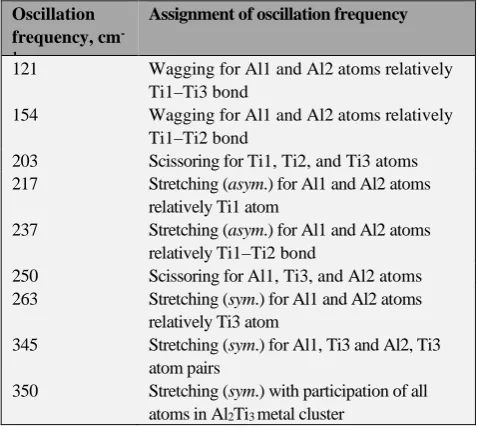
Nine oscillations, active in IR spectrum, should appear in a nonlinear five-atom molecule (to number of which belongs Al2Ti3) according to theoretical expectations. This quantity
turns out to be correct in Al2Ti3 (XI) metal cluster according
to our calculation (Table 2).
Table 2. The oscillation frequencies in most stable modification of Al2Ti3 (XI) cluster.
Oscillation frequency, cm -1
Assignment of oscillation frequency
121 Wagging for Al1 and Al2 atoms relatively Ti1–Ti3 bond
154 Wagging for Al1 and Al2 atoms relatively Ti1–Ti2 bond
203 Scissoring for Ti1, Ti2, and Ti3 atoms 217 Stretching (asym.) for Al1 and Al2 atoms
relatively Ti1 atom
237 Stretching (asym.) for Al1 and Al2 atoms relatively Ti1–Ti2 bond
250 Scissoring for Al1, Ti3, and Al2 atoms 263 Stretching (sym.) for Al1 and Al2 atoms
relatively Ti3 atom
345 Stretching (sym.) for Al1, Ti3 and Al2, Ti3 atom pairs
350 Stretching (sym.) with participation of all atoms in Al2Ti3 metal cluster
Molecular structures of the various Al2V3 metal clusters
are shown in Figure 2 and the relative total energies of them are given in the table 3. As may be seen from these data in six of 11 of these structures, the direct valence bond of Al–Al occurs, the exceptions are the structures of AlV (VII)-AlV
(XI). Also, in most of the modifications of metal cluster under the study, excluding only Al2V3 (VIII) and Al2V3 (IX), there
are at least one V–V bond. Nevertheless, in each of the modifications of Al2V3, there are at least five Al–V bonds. It
is noteworthy that in Al2V3 (VIII) and Al2V3 (IX)
modifications mentioned above, there are only Al-V bonds (6 in the each of them). Besides, the most stable modification of this metal cluster, namely Al2V3(V), contains 7 metal–metal
bonds (Table 3).
I II
III IV
V VI
VII VIII
IX X
XI
Eur. Chem. Bull. 2020, 9(2), 62-68 DOI:http://dx.doi.org/10.17628/ecb.2020.9.62-68
It should be noted especially that, on the whole, molecular structures of Al2V3 differ substantially from molecular
structures of Al2Ti3, at that, not only by the number of
metal-metal bonds, but, also, by its geometrical form (Figures 1 and 2).
As can be seen from the data of Table 3, the most stable modification, namely Al2V3 (V), has not the highest spin
multiplicity (6), but a lower one (4). Besides, which is characteristic, the structures with the highest MS = 6
generally have noticeably larger values of the total energies than those with multiplicities MS = 2 and MS = 4. It is
characteristic that the Al2V3 (II) structure nearest to Al2V3
(V) in energy has the same spin multiplicity as Al2V3(V),
and its molecular structure, at least in general terms, resembles Al2V3 (V). At the same time, the following three
structures with increasing energy, namely Al2V3(III), Al2V3
(I) and Al2V3 (IV), have different MS values, namely, 6, 2,
and 2, respectively. The least stable in terms of energy is the modification of Al2V3 (IX), the total energy of which is not
only much higher (by almost 150 kJ mol-1) than that of
Al2V3(V), but also of all the other modifications of the metal
cluster under study. Remarkably, it has the highest spin multiplicity (6). The V–V bond lengths in the Al2V3 metal
cluster considered here are in the 170-275 pm range, while the Al–V and Al–Al bond lengths are in the 250–270 nm and 255–270 nm ranges, respectively (Table 3). Taking into account the radii of the atoms of these elements, 143 pm for Al and 134 pm for V, it seems quite natural.
Table 3. Relative total energies of different structures of the Al2V3 clusters.
Structure
symbol Spin multi-plicity of ground state
Relative total energy, kJ mol-1
Number of chemical bonds
in the structure Al–Al Al–V V–V
Al2V3 (I) 2 25.9 1 6 1
Al2V3 (II) 4 2.4 1 6 1
Al2V3 (III) 6 18.8 1 6 1
Al2V3 (IV) 2 26.7 1 5 2
Al2V3 (V) 4 0.0 1 5 1
Al2V3 (VI) 6 26.8 1 5 1
Al2V3 (VII) 2 30.2 0 6 2
Al2V3 (VIII) 4 71.3 0 6 0
Al2V3 (IX) 6 141.0 0 6 0
Al2V3 (X) 4 59.6 0 6 1
Al2V3 (XI) 6 74.6 0 5 1
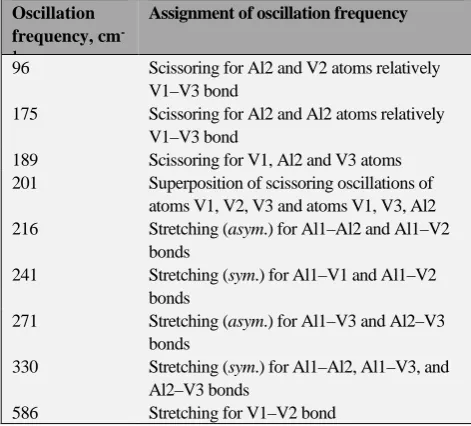
As in Al2Ti3 metal clusters, nine oscillations active in IR
spectrum developed in Al2V3 ones also, according to our
calculation. Frequencies of such oscillation for most stable modification of Al2V3, namely Al2V3 (V), are presented in
table 4. It should be noted in this connection that, despite the same the total number of oscillations active in the IR spectra of the Al2Ti3 (XI) and Al2V3 (V) clusters, their
characteristics differ very strongly from each other. It is enough to compare the range of frequencies that are active in the IR spectrum. In the case Al2Ti3 (XI), it is less than 250
cm-1 (from 121 to 350 cm-1), while in the case of Al 2V3 (V)
is almost 500 cm-1 (from 96 to 586 cm-1) i.e., almost twice
as large. The values of these frequencies are also considerably different among themselves. At the same time, which is noteworthy, there are dissimilarities not only in
terms of the frequencies of these oscillations, but also in their nature. No close similarity between the frequencies of the metal clusters considered here and the composition of the metal clusters described previuosly,16-21 is found.
The general structural feature of both Al2Ti3 and Al2V3
metal clusters under examination, is the presence of several M–M bonds (M= Ti, V) formed by the same atom with its "neighbors" (Figures 1 and 2). On the average, the number of Al–Al, Al–M and M–M bonds in Al2Ti3 metal clusters, as
can see by comparing figures 1 and 2, is somewhat more than in Al2V3 ones. At the same time, here, as well as in the
metal clusters described earlier,16-21 the values of most of the
bond angles and, also, torsion (dihedral) angles, are significantly lower than 90° (see Tables 1 and 3).
Table 4. The oscillation frequencies in most stable modification of Al2V3 (V) cluster.
Oscillation frequency, cm -1
Assignment of oscillation frequency
96 Scissoring for Al2 and V2 atoms relatively V1–V3 bond
175 Scissoring for Al2 and Al2 atoms relatively V1–V3 bond
189 Scissoring for V1, Al2 and V3 atoms 201 Superposition of scissoring oscillations of
atoms V1, V2, V3 and atoms V1, V3, Al2 216 Stretching (asym.) for Al1–Al2 and Al1–V2
bonds
241 Stretching (sym.) for Al1–V1 and Al1–V2 bonds
271 Stretching (asym.) for Al1–V3 and Al2–V3 bonds
330 Stretching (sym.) for Al1–Al2, Al1–V3, and Al2–V3 bonds
586 Stretching for V1–V2 bond
There are many common features of the both Al2Ti3 and
Al2V3 metal clusters studied by us. The most typical
structure according to theoretical expectations, is a trigonal bipyramid. This is especially pronounced for Al2Ti3. At the
same time, as is apparent from figures 1 and 2. A greater structural diversity is noted among Al2V3 metal clusters,
although the total number of their modifications is less than the number of such modifications for Al2Ti3 metal clusters.
All of them are also characterized by relatively high values of the lengths of these Al–Al, Al–M and M–M bonds, which, as a rule, exceed 200 pm almost in every case. The few exceptions to this rule are only V1-V2 bond lengths in the Al2V3 (I)-Al2V3(VI), Al2V3(X) and Al2V3(XI) structures,
which lie in the range from 171.7 pm, in the Al2V3 (VI) to
188.1 pm, in the Al2V3 (I) (see Supporting Information).
Curiously enough in the structures of Al2Ti3 metal clusters
there is no such examples, although the radius of the Ti atom (132 pm) is even slightly smaller than the radius of the V atom (134 pm). The overwhelming majority of the aluminum-titanium and aluminum-vanadium metal clusters considered here, either has no symmetry elements at all, or has only one plane of symmetry. The only exception is the Al2V3 (IX) metal cluster, which has one axis of symmetry of
the third order, three axes of symmetry of the second order, and, also, three planes of symmetry (Figure 2). The Al2Mn3
(XVIII) and Al2Zn3 (XIV) metal clusters described in our
has three M–M bonds, which are absent in Al2V3 (IX). In
this connection, we would like to note that this cluster has the highest energy among all the Al2V3 metal clusters.
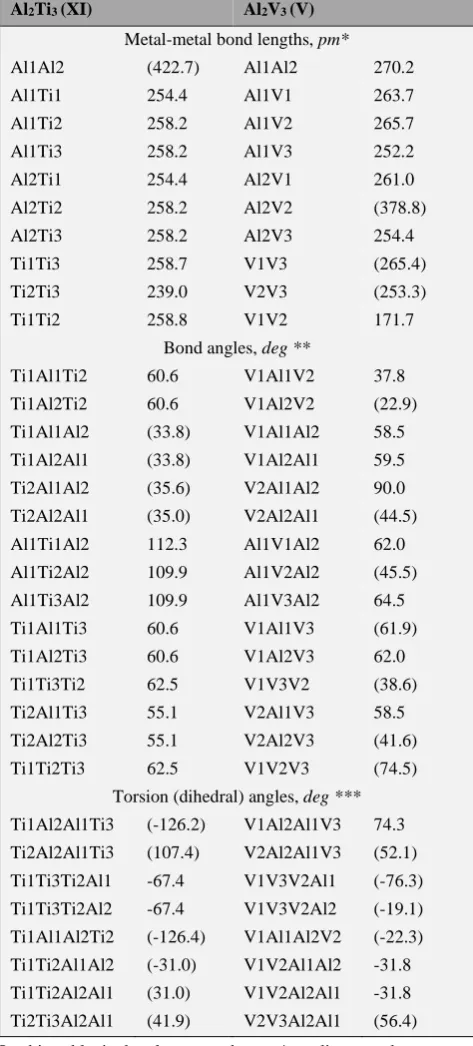
The key structural parameters of most stable Al2Ti3 and
Al2V3 metal clusters, and namely Al2Ti3 (XI) and Al2V3 (V),
are presented in the table 5. As can be seen from it, the longest are Al–Al bonds, the shortest are Ti–Ti bonds. Similar situation, in average, occurs for both types of metal clusters under examination.
Table 5. Metal–metal bond lengths, bond and torsion angles in the molecular structures of most stable modifications of Al2Ti3 (XI) and Al2V3 (V) metal clusters.
Al2Ti3 (XI) Al2V3 (V) Metal-metal bond lengths, pm*
Al1Al2 (422.7) Al1Al2 270.2
Al1Ti1 254.4 Al1V1 263.7
Al1Ti2 258.2 Al1V2 265.7
Al1Ti3 258.2 Al1V3 252.2
Al2Ti1 254.4 Al2V1 261.0
Al2Ti2 258.2 Al2V2 (378.8)
Al2Ti3 258.2 Al2V3 254.4
Ti1Ti3 258.7 V1V3 (265.4)
Ti2Ti3 239.0 V2V3 (253.3)
Ti1Ti2 258.8 V1V2 171.7
Bond angles, deg **
Ti1Al1Ti2 60.6 V1Al1V2 37.8
Ti1Al2Ti2 60.6 V1Al2V2 (22.9)
Ti1Al1Al2 (33.8) V1Al1Al2 58.5
Ti1Al2Al1 (33.8) V1Al2Al1 59.5
Ti2Al1Al2 (35.6) V2Al1Al2 90.0
Ti2Al2Al1 (35.0) V2Al2Al1 (44.5)
Al1Ti1Al2 112.3 Al1V1Al2 62.0
Al1Ti2Al2 109.9 Al1V2Al2 (45.5)
Al1Ti3Al2 109.9 Al1V3Al2 64.5
Ti1Al1Ti3 60.6 V1Al1V3 (61.9)
Ti1Al2Ti3 60.6 V1Al2V3 62.0
Ti1Ti3Ti2 62.5 V1V3V2 (38.6)
Ti2Al1Ti3 55.1 V2Al1V3 58.5
Ti2Al2Ti3 55.1 V2Al2V3 (41.6)
Ti1Ti2Ti3 62.5 V1V2V3 (74.5)
Torsion (dihedral) angles, deg ***
Ti1Al2Al1Ti3 (-126.2) V1Al2Al1V3 74.3
Ti2Al2Al1Ti3 (107.4) V2Al2Al1V3 (52.1)
Ti1Ti3Ti2Al1 -67.4 V1V3V2Al1 (-76.3)
Ti1Ti3Ti2Al2 -67.4 V1V3V2Al2 (-19.1)
Ti1Al1Al2Ti2 (-126.4) V1Al1Al2V2 (-22.3)
Ti1Ti2Al1Al2 (-31.0) V1V2Al1Al2 -31.8
Ti1Ti2Al2Al1 (31.0) V1V2Al2Al1 -31.8
Ti2Ti3Al2Al1 (41.9) V2V3Al2Al1 (56.4)
In this table in brackets are shown * = distances between two atoms not involved in chemical bonds, ** = angles formed by three atoms among which at least two atoms do not form chemical bonds, and *** = dihedral angles formed by four atoms among which at least two atoms do not form chemical bonds are parenthesized.
Taking into account the atomic radii of the chemical elements contained in Al2M3 metal clusters considered here,
Al 143 pm, Ti 132 pm and V 134 pm, the indicated ratio between these bond lengths seems quite normal. Since the radii of titanium and vanadium atoms differ among themselves only slightly, one would expect that, in average, M–M bonds in the metal clusters considered here, should be close to each other. The data of our calculation, in general, are in accordance with this expectation (see Supporting Information).
When characterizing the spin multiplicity of the ground state of the most stable modifications of each of these metal clusters, we would like to stress the following. Despite the fact that the low-spin state for both of them as a whole, judging by the data of tables 2 and 4, is less characteristic compared to high-spin, the latter is realized only in the case of the most stable aluminum-titanium metal cluster of Al2Ti3
(XI). At the same time, for the most stable aluminum-vanadium metal cluster of Al2V3 (V), the ground state has spin
multiplicity which is an intermediate between the minimum and the maximum value of the spin multiplicity. By taking into consideration the electron configurations of the titanium and vanadium atoms (3d24s2 and 3d34s2, respectively), this
tendency is quite expected.
CONCLUSION
As can be seen from the calculated data presented above, the five-atomic metal clusters Al2Ti3 and Al2V3 under study,
form a fairly significant number of structural modifications, that differ significantly from one another in their structural geometrical parameters and in terms of total energies. In addition, the number of modifications of both the one and the other metal cluster (14 and 11, respectively) exceeds the number of modifications of the Al2Fe3 metal cluster20 (of
which there are only 8), but turns out to be much smaller than the number of modifications of Al2Mn3, 25.21 Most of
the modifications of these metal clusters, both Al2Ti3 and
Al2V3, either have no symmetry elements at all, or have only
one plane of symmetry. Moreover, in the modifications of Al2Ti3 metal cluster, as a rule, each of the aluminum and
titanium atoms in their composition, has been connected through chemical bonds to its three neighbors, whereas in the modifications of Al2V3 one, this is manifested to a
considerably lesser degree. It is noteworthy that the lowest-energetic modification in the case of Al2Ti3 has a spin
multiplicity of the ground state 5, in the case of Al2V3 it is 4,
although judging by the electronic configurations of the atoms in them (3s23p1, 4s23d1 and 4s23d2, respectively), the
total number of unpaired electrons in Al2Ti3 should be less
than in Al2V3. Besides, the difference between the energies
of the lowest-energy and the highest-energy modifications in the case of Al2V3 (141.0 kJ mol-1) was significantly larger
than in the case of Al2Ti3 (93.0 kJ mol-1), although much less
than in the case of a metal cluster Al2Fe3, where it exceeds
300 kJ mol-1.20
ACKNOWLEDGEMENT
Eur. Chem. Bull. 2020, 9(2), 62-68 DOI:http://dx.doi.org/10.17628/ecb.2020.9.62-68
competitive part of the state task of the Russian Federation on the 2017–2019 years. All quantum-chemical calculations were performed at the Kazan Department of Joint Supercomputer Center of Russian Academy of Sciences – Branch of Federal Scientific Center “Scientific Research Institute for System Analysis of the RAS”. Contribution of author Chachkov D.V. was funded by the state assignment to the Federal State Institution "Scientific Research Institute for System Analysis of the Russian Academy of Sciences" for scientific research.
REFERENCES
1Ling, W., Dong, D., Shi-Jian, W., Zheng-Quan, Z., Geometrical, electronic, and magnetic properties of CunFe (n=1–12) clusters: A density functional study, J. Phys. Chem. Solids,
2015, 76, 10-16. https://doi.org/10.1016/j.jpcs.2014.07.022 2Ma, L., Wang, J., Hao, Y., Wang, G., Density functional theory
study of FePdn (n = 2–14) clusters and interactions with small molecules, Comput. Mater. Sci. 2013, 68, 166-173. https://doi.org/10.1016/j.commatsci.2012.10.014
3Kilimis, D. A., Papageorgiou, D. G., Density functional study of small bimetallic Ag–Pd clusters J. Mol. Struct. (TheoChem),
2010, 939, 112-117.
https://doi.org/10.1016/j.theochem.2009.09.048
4Zhao, S., Y. Ren, Y., J. Wang, J., W. Yin, W., Density functional study of NO binding on small AgnPdm (n + m ⩽ 5) clustersComput. Theor. Chem. 2011, 964, 298-303. https://doi.org/10.1016/j.comptc.2011.01.009
5Al-Odail, F., Mazher, J., Abuelela, A. M., A density functional theory study of structural, electronic and magnetic properties of small PdnAg (n = 1–8) clusters, Comput. Theor. Chem.
2018, 1125, 103-111.
https://doi.org/10.1016/j.comptc.2018.01.005
6Chaves, A. S., Rondina, G. G., Piotrowski, M. J., Da Silva, J. L. F., Structural formation of binary PtCu clusters: A density functional theory investigation, Comput. Mater. Sci. 2015, 98, 278-286. https://doi.org/10.1016/j.commatsci.2014.11.022
7Dong, D., Xiao-Yu, K., Jian-Jun, G., Ben-Xia, Z., First-principle study of AunFe (n = 1–7) clusters, J. Mol. Struct. 2009, 902, 54-58. DOI: 10.1016/j.theochem.2009.02.009
8Liu, X., Tian, D., Meng, C., DFT study on stability and H 2 adsorption activity of bimetallic Au79−nPdn (n = 1–55) clusters, Chem. Phys., 2013, 415, 179-185. https://doi.org/10.1016/j.chemphys.2013.01.014
9Hong, L., Wang, H., Cheng, J., Huang, X., Sai, L., Zhao, J., Atomic structures and electronic properties of small Au–Ag binary clusters: Effects of size and composition, Comput. Theor. Chem., 2012, 993, 36-44. https://doi.org/10.1016/j.comptc.2012.05.027
10Maroun, F., Ozanam, F., Magnussen, O. M., Behm, R. J., The Role of Atomic Ensembles in the Reactivity of Bimetallic Electrocatalysts, Science, 2001, 293, 1811-1814.
11Eberhardt, W., Clusters as new materials, Surf. Sci. 2002, 500, 242-270. https://doi.org/10.1016/S0039-6028(01)01564-3
12Yang, J. X., Guo, J. J., Die, D., Ab initio study of Au
nIr (n = 1–8) clusters, Comput. Theor. Chem. 2011, 963, 435-438. https://doi.org/10.1016/j.comptc.2010.11.013
13Singh, N. B., Sarkar, U., A density functional study of chemical, magnetic and thermodynamic properties of small palladium clusters, Mol. Simul. 2014, 40, 1255-1264. https://doi.org/10.1080/08927022.2013.861903
14Bouderbala, W., Boudjahem, A. G., Soltani, A., Geometries, stabilities, electronic and magnetic properties of small PdnIr (n=1–8) clusters from first-principles calculations, Mol.
Phys., 2014, 112, 1789-1798.
https://doi.org/10.1080/00268976.2013.865089
15Wen, J. Q., Xia, T., Zhou, H., Wang, J. F., A density functional theory study of small bimetallic PdnAl (n=1–8) clusters, J. Phys. Chem. Solids, 2014, 75, 528-534. https://doi.org/10.1016/j.jpcs.2013.12.018
16Mikhailov, O. V., Chachkov, D. V., Models of molecular structure of heteronuclear clusters Al2Fe3, Al2Co3, and Al2Ni3 according to the data of quantum-chemical density functional simulation, Russ. J. Gen. Chem., 2016, 86, 1991-1999. https://doi.org/10.1134/S1070363216090036
17Mikhailov, O. V., Chachkov, D. V., Models of molecular structures of aluminum–iron clusters AlFe3, Al2Fe3, and Al2Fe4 according to quantum-chemical DFT calculations, Russ. J. Inorg. Chem. 2017, 62, 336-343. https://doi.org/10.1134/S0036023617030135
18Mikhailov, O. V., Chachkov, D. V., Models of Molecular Structures of Al2Cr3 and Al2Mo3 Metal Clusters according to Density Functional Theory Calculations, Russ. J. Inorg. Chem., 2018, 63, 786-799.
https://doi.org/10.1134/S0036023618060177
19Mikhailov, O. V., Chachkov, D. V., DFT calculation of molecular structures of Al2Fe3 and Al2Cu3 heterobinuclear clusters, Struct. Chem., 2018, 29, 1543-1549. https://doi.org/10.1007/s11224-018-1146-9
20Chachkov, D. V., Mikhailov, O. V., DFT Quantum Chemical Calculation of the Molecular Structures of the Metal Clusters Al2Cu3 and Al2Ag3, Russ. J. Inorg. Chem., 2019, 64, 79-87. https://doi.org/10.1134/S0036023619010030
21Mikhailov, O. V., Chachkov, D. V., Quantum-chemical calculation of molecular structures of Al2Mn3 and Al2Zn3 clusters by using DFT method, Struct. Chem. 2019, 30, 1289-1299. https://doi.org/10.1007/s11224-019-1283-9
22Schaefer, A., Horn, H., Ahlrichs, R., Fully optimized contracted Gaussian basis sets for atoms Li to Kr, J. Chem. Phys., 1992, 97, 2571-2577. https://doi.org/10.1063/1.463096
23Weigend, F., Ahlrichs, R., Balanced basis sets of split valence, triple zeta valence and quadruple zeta valence quality for H to Rn: Design and assessment of accuracy, Phys. Chem. Chem. Phys. 2005, 7, 3297-3305. https://doi.org/10.1039/b508541a
24Hoe, W.-M., Cohen, A., Handy, N. C., Assessment of a new local exchange functional OPTX, Chem. Phys. Lett., 2001, 341, 319-328. https://doi.org/10.1016/S0009-2614(01)00581-4
25Perdew, J. P., Burke, K., Ernzerhof, M., Generalized Gradient Approximation Made Simple, Phys. Rev. Lett., 1996, 77, 3865-3868. https://doi.org/10.1103/PhysRevLett.77.3865
26Paulsen, H., Duelund, L., Winkler, H., Toftlund, H., Trautwein, A. X., Free Energy of Spin-Crossover Complexes Calculated with Density Functional Methods, Inorg. Chem., 2001, 40, 2201-2203. https://doi.org/10.1021/ic000954q
27Swart, M., Groenhof, A. R., Ehlers, A. W., Lammertsma, K., Validation of Exchange−Correlation Functionals for Spin States of Iron Complexes, J. Phys. Chem. A., 2004, 108, 5479-5483. https://doi.org/10.1021/jp049043i
28Swart, M., Ehlers, A.W., Lammertsma, K., Performance of the OPBE exchange-correlation functional, Mol. Phys., 2004, 102, 2467-2474. https://doi.org/10.1080/0026897042000275017
29Swart, M., Metal–ligand bonding in metallocenes: Differentiation between spin state, electrostatic and covalent bonding, Inorg. Chim. Acta, 2007, 360, 179-189. https://doi.org/10.1016/j.ica.2006.07.073
Staroverov, V. N., Kobayashi, R., Normand, J., Raghavachari, K., Rendell, A., Burant, J. C., Iyengar, S. S., Tomasi, J., Cossi, M., Rega, N., Millam, J. M., Klene, M., Knox, J. E., Cross, J. B., Bakken, V., Adamo, C., Jaramillo, J., Gomperts, R., Stratmann, R. E., Yazyev, O., Austin, A. J., Cammi, R., Pomelli, C., Ochterski, J. W., Martin, R.L., Morokuma, K., Zakrzewski, V. G., Voth, G.A., Salvador, P., Dannenberg, J. J., Dapprich, S., Daniels, A. D., Farkas, O., Foresman, J. B., Ortiz, J. V., Cioslowski, J., and Fox, D. J. Gaussian, Inc., Wallingford CT, 2009.