Research Article
a
August
2018
Computer Science and Software Engineering
ISSN: 2277-128X (Volume-8, Issue-8)
The Relation of Clothing Shop Information Systems to
Levels of Organization
Swe Zin Aung, Thida Tun, Nay Zar Oo, Hlaing Htake Khaung Tin
University of Computer Studies, Yangon, Myanmar
[email protected], [email protected], [email protected], [email protected]
Abstract— The popular of e-commerce market in the 21st century, more and more consumers are changing their shopping behaviour and prefer to do their usual shopping from the comfort of their homes rather than putting up with the time consuming physical store deal. The information needs are different at different organizational levels. Accordingly the information can be categorized as: strategic information, managerial information and operational information. The proposed system can be used for shopping information system activities and it is an easy to use information system that will assist both buyers and sellers shop effectively. This paper objective is to show the relation of clothing shop information systems to levels of organization. Another objective is to know the major information system in organization and their relationship.
Keywords— System, Clothing, Implementation, Information, Customer, Organization, Relation.
I. INTRODUCTION
In Myanmar buying and selling of goods are done in a market. This condition is faced with diverse problems. These problems include the need for buyers and sellers to come into physical contact, the necessary need for potential buyers to visit the shop and non-flexibility in time usage. In order to overcome these problems, this clothing shop information system is developed.
Everyone wants to wear the bright, trendy, and diverse clothes of their choice and needs to be taken care of while shopping the clothes it becomes very tedious to select clothes when we do not know the clothes to which area it is according to the choice and many options here we have the system which has the capability of making the clothes of a kind to register on the different places which could be further taken care when needed.
Mainly this system is concerned with the classification of the clothes. However these shirts, blouses, skirt, trousers are taken care that which colour it is an which gender it supports and which size it is of and then it like this all clothes also managed in the particular area of the shop and administered by the staff of the store then the admin takes it care. Whenever the user wants according to the choice, he/she can select the particular clothes and get it.
In recent years, with the improvement of people's living standard and the popularization of personal computers, online shopping has become an indispensable part of people's life. Therefore, more and more stores online are opened to expand the business scale and market influence, effectively reducing the operating costs for enterprises and improving the work efficiency. Compared to the traditional shopping style with features of high-cost, low efficiency and extensiveness and a variety of waste and corruption happening in the intermediate links, online shopping, with features of the "directness" and "transparency" in the business activities, can effectively reduce the economic costs and set up a good economic order. Online shopping system has a powerful interactive function which makes businessmen and users transfer information easily. [1]
II. RELATED WORK
The marketing concept is the strategy that firms implement to satisfy customers’ needs, increase sales, maximize profit and beat the competition. There are five marketing concepts that organizations adopt and execute.[3]
ISSN(E): 2277-128X, ISSN(P): 2277-6451, pp. 115-119
III. THE MAJOR INFORMATION SYSTEM IN ORGANIZATION
Information systems differ in their business needs. Also depending upon different levels in organization information systems differ.[2] Three major information systems are:
1. Transaction processing systems
2. Management information systems
3. Decision support systems
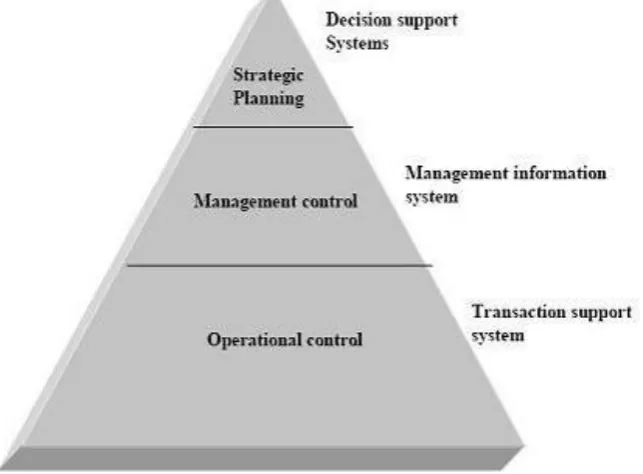
Figure 1 shows relation of information system to the levels of organization. The information needs are different at different organizational levels. Accordingly the information can be categorized as: strategic information, managerial information and operational information.
Strategic information is the information needed by top most management for decision making. For example the trends in revenues earned by the organization are required by the top management for setting the policies of the organization. This information is not required by the lower levels in the organization. The information systems that provide these kinds of information are known as Decision Support Systems.
Figure 1. Relation of information systems to levels of organization
The second category of information required by the middle management is known as managerial information. The information required at this level is used for making short term decisions and plans for the organization. Information like sales analysis for the past quarter or yearly production details etc. fall under this category. Management information system (MIS) caters to such information needs of the organization. Due to its capabilities to fulfill the managerial information needs of the organization, Management Information Systems have become a necessity for all big organizations. And due to its vastness, most of the big organizations have separate MIS departments to look into the related issues and proper functioning of the system.
The third category of information is relating to the daily or short term information needs of the organization such as attendance records of the employees. This kind of information is required at the operational level for carrying out the day-to-day operational activities. Due to its capabilities to provide information for processing transaction of the organization, the information system is known as Transaction Processing System or Data Processing System. Some examples of information provided by such systems are processing of orders, posting of entries in bank, evaluating overdue purchaser orders etc.
1. Transaction Processing Systems
ISSN(E): 2277-128X, ISSN(P): 2277-6451, pp. 115-119 This provides high speed and accurate processing of record keeping of basic operational processes. These include calculation, storage and retrieval. Transaction processing systems provide speed and accuracy, and can be programmed to follow routines functions of the organization.
2. Management Information Systems
These systems assist lower management in problem solving and making decisions. They use the results of transaction processing and some other information also. It is a set of information processing functions. It should handle queries as quickly as they arrive. An important element of MIS is database.
A database is a non-redundant collection of interrelated data items that can be processed through application programs and available to many users.
3. Decision Support Systems
These systems assist higher management to make long term decisions. These type of systems handle unstructured or semi structured decisions. A decision is considered unstructured if there are no clear procedures for making the decision and if not all the factors to be considered in the decision can be readily identified in advance.
These are not of recurring nature. Some recur infrequently or occur only once. A decision support system must very flexible. The user should be able to produce customized reports by giving particular data and format specific to particular situations.
4. Summary of Information Systems
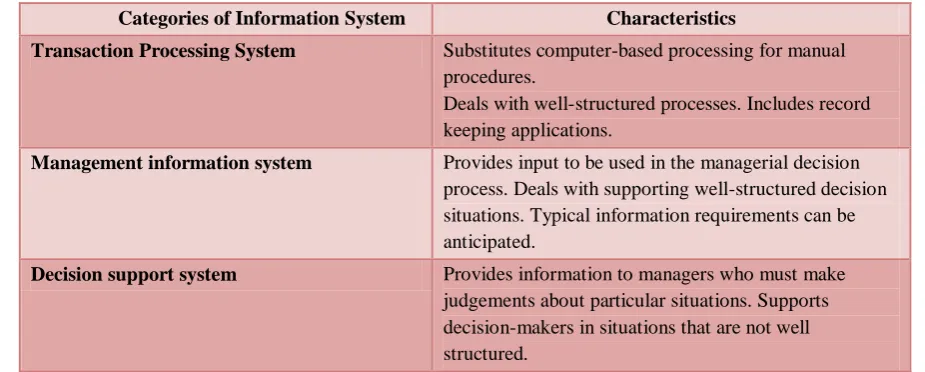
The following table 1 shows the summary of information systems. In the following table1, the three major information systems (transaction processing system, management information system and decision support system) and their characteristics of the information system.
Table 1. Summary of Information Systems
Categories of Information System Characteristics
Transaction Processing System Substitutes computer-based processing for manual procedures.
Deals with well-structured processes. Includes record keeping applications.
Management information system Provides input to be used in the managerial decision process. Deals with supporting well-structured decision situations. Typical information requirements can be anticipated.
Decision support system Provides information to managers who must make judgements about particular situations. Supports decision-makers in situations that are not well structured.
IV. THE DESIGN OF THE CLOTHING SHOP INFORMATION SYSTEM
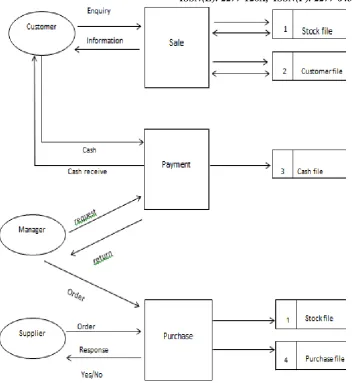
This system design is showed about clothing shop system. In this design information of the system consists of 5tables (Men-ware, Women-ware, Child-ware and Staff). All clothes information is kept in Man-wares, Woman-wares, and Child-wares tables respectively. All information of employee such as ID, name, NRC number, Rank, Address, Phone no and Salary are kept in Staff table. All payment information is stored in payment table. Customer information is stored in customer table.
We will earn profits by selling our merchandise. Our pricing structure will remain flexible, as we will implement suggested retail pricing on common brands as well as the standard practice of key stoning prices. Additionally, we will use a value-based pricing structure, which measures the value of our products to our customers such as easy access, quality, customer service and styles flattering to our target consumer. We will implement end of season sales, holiday and overstock sales, multi-buy savings and promotional coupons at strategic intervals.
ISSN(E): 2277-128X, ISSN(P): 2277-6451, pp. 115-119
Figure 2. The data flow diagram of the clothing shop information system
V. CONSTRAINTS OF THE SYSTEM
The store's computer system receives the fully confirmed order; the staffs collect the product for a delivery service. In some stores, if you get an order into their system by a certain time from early morning until right after lunched, their time you order is shipped/delivered that day or the next morning. For instance, most orders for go out the same day if ordered before lunched time. Most stores take 24 to 48 hours before the actually hand the package over to the delivery service.
Every business is different, but there are many examples of clothing shops that have been run on only a small number of staff, between3-5. As your business venture takes off, you will usually need more staff- particularly handing items such as Managers, Stock controllers, Accounting, Customer services, Purchasers and delivery for sending out your products and taking out your products from suppliers and so on. The overall budget is needed for one million kyats, but if you would to more used it would be more than. And the time duration is one week. The following table 2 shows the constraints of the system.
Table 2. Constraints of the system Operating system windows 7/8/10, MySQL for database
Memory Minimum 512MB
Language Requirement Software must be only in English.
Budget Constraints The overall budget is needed for one million kyats, but if you would to more used it would be more than. And the time duration is one week.
Implementation Constraints Application should be based on java only.
ISSN(E): 2277-128X, ISSN(P): 2277-6451, pp. 115-119
VI. CONCLUSIONS
The proposed system is easy to use information system that will assist both buyers and sellers shop effectively. This system can support developing an information system database that stores and processes information about buyer’s orders, sellers and products. Information systems differ in their business needs. Also depending upon different levels in organization information systems differ. This paper can show the relation of clothing shop information systems to levels of organization. The three major information systems are very important for clothing shop information system.
ACKNOWLEDGMENT
I would like to thank all of my current and previous colleagues, teachers and friends at Computer University for their support and encouragement during my research work.
REFERENCES
[1] Guoyong Zhao and Zhiyu Zhou, “Design and Implementation of the Online Shopping System”, Springer-Verlag
Berlin Heidelberg 2012.
[2] https://www.freetutes.com/systemanalysis/types-of-information-system.html
[3] https://iedunote.com/marketing-concept
[4] Awoyelu, I.O (Corresponding Author) & Tangba O, “Development of On-line Shopping Mart System for Developing
Countries”, www.ccsenet.org/cis Computer and Information Science Vol. 3, No. 3; August 2010.
[5] Rafter V. (1998). Reengineering Customer Service. The Industry Standard. Available at:
http://www.thestandard.com/article/0,1902,1031,00.html. Accessed on 15th March, 2007.
[6] Hoffman D.L., Novak T.P., & Chatterjee, P. (1995). Commercial Scenarios for the Web: Opportunities and Challenges. Journal of Computed-Mediated Communication, Special issue on Electronic Commerce, Vol. 1 No 3.
ABOUT AUTHOR
I received the B.C.Sc degree from Computer University (Pathein) at 2014. I also received Post Graduated Diploma in Multimedia Art from Yangon University of Education (YUOE) at 2015. Now I am attending the M.C.Sc(Q) Class at University of Computer Studies, Yangon, Myanmar.
I received the B.C.Sc degree from Computer University (Pathein) at 2010. Now I am attending the M.C.Sc(Q) Class at University of Computer Studies, Yangon, Myanmar.
I received the B.C.Sc degree from Computer University (Mandalay) at 2005. Now I am attending the M.C.Sc(Q) Class at University of Computer Studies, Yangon, Myanmar.