ORIGINAL ARTICLE
Development of a multiplex PCR assay
for the simultaneous and rapid detection of six
pathogenic bacteria in poultry
Zhihao Wang
1,2, Jiakun Zuo
1, Jiansen Gong
3, Jiangang Hu
1,2, Wei Jiang
1, Rongsheng Mi
1, Yan Huang
1,
Zhaoguo Chen
1, Vanhnaseng Phouthapane
4, Kezong Qi
2*, Chen Wang
5*and Xiangan Han
1*Abstract
Escherichia coli, Pasteurella multocida, Proteus mirabilis, Pseudomonas aeruginosa, Salmonella spp. and Staphylococcus aureus are six bacterial pathogens of avian. However, these pathogens may cause many similar pathological changes, resulting in clinical isolates that are difficult to quickly and simultaneously detect and identify. Here, a multiplex polymerase chain reaction (m-PCR) assay is reported to rapidly identify targets genes (phoA, KMT1, ureR, toxA, invA, and nuc) of these six pathogens in clinical samples. Six pairs of specific primers were designed. The optimal reaction conditions, specificity, and sensitivity of the m-PCR assay were investigated. The results showed that betaine remark-ably improved amplification of the target genes. Specific test results showed that all six pathogens were detected by the proposed m-PCR protocol without cross-amplification with viruses or parasites. Sensitivity test results showed that the m-PCR system could amplify the six target genes from bacterial genomes or cultures with template amounts of 500 pg or 2.8–8.6 × 10³ colony forming units, respectively. Furthermore, the six bacterial pathogens isolated from
the infected tissue samples were successfully identified. The proposed m-PCR assay is a useful tool to monitor and diagnose bacterial infection in birds with high specificity, sensitivity and throughput.
Keywords: Avian, Six pathogenic bacteria, Multiplex PCR assay, Specificity
© The Author(s) 2019. This article is distributed under the terms of the Creative Commons Attribution 4.0 International License (http://creat iveco mmons .org/licen ses/by/4.0/), which permits unrestricted use, distribution, and reproduction in any medium, provided you give appropriate credit to the original author(s) and the source, provide a link to the Creative Commons license, and indicate if changes were made.
Introduction
Several factors have been linked to the spread of patho-genic bacteria to poultry, including the expansion of the poultry industry, the increased mobility of humans and animals, water pollution, environmental climate change (Rodriguez-siek et al. 2005; Benskin et al. 2009). Further-more, antibiotic administration is conventionally used for the control of bacterial diseases in poultry. However, the failure to diagnose the bacterial diseases of poultry,
which may result in the misuse of antibiotic regimens and subsequent severe economic losses to the poultry industry and potential public health risks due to the con-sumption of contaminated poultry products (Van Den Bogaard et al. 2002).
A variety of methods have been established for the effective diagnosis of avian bacterial diseases, which include antigen-specific enzyme-linked immunosorbent assays (ELISAs), immunogold labeling and various other molecular biology techniques (Kotetishvili et al. 2002; Yano et al. 2007; Reischl 1996), especially polymerase chain reaction (PCR) technologies. However, the failure of multi-pathogen detection still was one of major defi-ciencies to these detection methods. For example, Park et al. (2011) established a triple PCR method for analy-sis of Campylobacter spp., Escherichia coli O157:H7 and Salmonella serotypes. Hu et al. (2011) established a triple PCR method for analysis of Riemerella anatipes-tifer, Escherichia coli (E. coli) and Salmonella with high
Open Access
*Correspondence: [email protected]; [email protected]; [email protected]
1 Shanghai Veterinary Research Institute, The Chinese Academy of Agricultural Sciences (CAAS), 518 Ziyue Road, Shanghai 200241, People’s Republic of China
2 College of Animal Science and Technology, Anhui Agricultural University, 130 Changjiangxilu, Hefei 230036, People’s Republic of China 5 College of Animal Science and Technology, Henan University of Science and Technology, No.263 Kaiyuan Road, Luoyang 471023, Henan, People’s Republic of China
sensitivity and specificity. Moreover, Belgrader et al. (1999) developed a rapid PCR assay that detected bac-teria in 7 min and Han et al. (2011) established a loop-mediated isothermal amplification technique based on the GroEL gene for rapid detection of Riemerella anatipestifer.
Furthermore, although the most important diseases are viral in poultry, the bacterial diseases are also important, some studies have shown that the main bacterial patho-gens of poultry (including avian pathogenic Escherichia coli, Pasteurella multocida, Salmonella spp. and Staphy-lococcus aureus) also caused severe economic losses and restricted the development of the poultry industry (Bisgaard 1993). In addition, although Proteus mirabilis and Pseudomonas aeruginosa are not considered among major bacterial pathogens for chickens, which still may spontaneously cause infection for chickens (Walker et al. 2002). More importantly, bacterial and viral infections often occur simultaneously, but the similarity of clinical signs of infected animals and the lack of high-through-put methods for the detection of pathogens, especially opportunistic species, such as Proteus mirabilis and Pseudomonas aeruginosa, have seriously hampered the control of epidemic diseases (Salmon and Watts 2000;
Tanaka et al. 1995). Additionally, the sensitivity and spec-ificity of colloidal gold detection technologies and ELISA techniques are relatively low, but yet these tests are costly. In contrast, multiplex PCR (m-PCR) can detect multiple pathogens with only one reaction with high sensitivity and specificity to distinguish between very closely related organisms, which greatly reduce costs. Hence, m-PCR is a promising tool for the efficient and accurate identifica-tion of pathogenic microbes.
To address these problems, a m-PCR assay for the simultaneous and rapid detection of six bacterial patho-gens of poultry was developed in this study. The m-PCR assay showed high specificity, sensitivity and throughput, which should facilitate the prevention and rapid diagno-sis of avian bacterial diseases.
Materials and methods
Bacterial strains and growth conditions
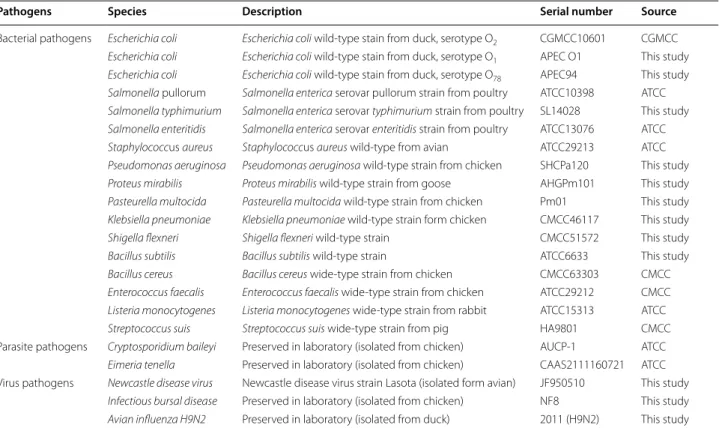
Six pathogenic bacteria were isolated from diseased birds (Table 1). The bacterial, viruses and parasites were preserved in our laboratory (Table 1). Pasteurella multocida was cultured in sterile Martin broth medium (Qingdao Hope Bio-Technology Co., Ltd., Qingdao, Shandong, China) overnight at 37 °C. Streptococcus
Table 1 Pathogens used in this study
CGMCC China General Microbiological Culture Collection Center, ATCC American Type Culture Collection, CMCC China Medical Microbial Culture Collection Management Center
Pathogens Species Description Serial number Source
Bacterial pathogens Escherichia coli Escherichia coli wild-type stain from duck, serotype O2 CGMCC10601 CGMCC Escherichia coli Escherichia coli wild-type stain from duck, serotype O1 APEC O1 This study Escherichia coli Escherichia coli wild-type stain from duck, serotype O78 APEC94 This study Salmonella pullorum Salmonella enterica serovar pullorum strain from poultry ATCC10398 ATCC Salmonella typhimurium Salmonella enterica serovar typhimurium strain from poultry SL14028 This study Salmonella enteritidis Salmonella enterica serovar enteritidis strain from poultry ATCC13076 ATCC Staphylococcus aureus Staphylococcus aureus wild-type from avian ATCC29213 ATCC Pseudomonas aeruginosa Pseudomonas aeruginosa wild-type strain from chicken SHCPa120 This study Proteus mirabilis Proteus mirabilis wild-type strain from goose AHGPm101 This study Pasteurella multocida Pasteurella multocida wild-type strain from chicken Pm01 This study Klebsiella pneumoniae Klebsiella pneumoniae wild-type strain form chicken CMCC46117 This study
Shigella flexneri Shigella flexneri wild-type strain CMCC51572 This study
Bacillus subtilis Bacillus subtilis wild-type strain ATCC6633 This study
Bacillus cereus Bacillus cereus wide-type strain from chicken CMCC63303 CMCC Enterococcus faecalis Enterococcus faecalis wide-type strain from chicken ATCC29212 CMCC Listeria monocytogenes Listeria monocytogenes wide-type strain from rabbit ATCC15313 ATCC
Streptococcus suis Streptococcus suis wide-type strain from pig HA9801 CMCC
Parasite pathogens Cryptosporidium baileyi Preserved in laboratory (isolated from chicken) AUCP-1 ATCC Eimeria tenella Preserved in laboratory (isolated from chicken) CAAS2111160721 ATCC Virus pathogens Newcastle disease virus Newcastle disease virus strain Lasota (isolated form avian) JF950510 This study
suis was cultured in sterilized Todd-Hewitt broth (BD Medical Technology Ltd., New Jersey, USA) at 37 °C. Listeria monocytogenes were cultured in Brain–Heart Infusion broth (BD Medical Technology Ltd., New Jer-sey, USA) at 37 °C. Escherichia coli, Proteus mirabilis, Pseudomonas aeruginosa, Salmonella spp. and Staphy-lococcus aureus and the other bacteria were all cultured overnight at 37 °C in sterilized Luria–Bertani (LB) broth (Oxoid Ltd., Hampshire, UK).
All bacteria were cultured until the mid-log phase, and then the bacterial genomes were extracted accord-ing to the previous methods (Velegraki et al. 1999) with some modifications. The genomes of the parasites and viruses were preserved in our laboratory.
The enzymes Ex Taq polymerase (Mg2+ free)
(Lot#KA7201HA), loading buffer (Lot#KA701A), and DNA Maker (Lot#A2301A) were purchased from TaKaRa Biotechnology Co., Ltd. (Dalian, China). A genome extraction kit was purchased from Tiangen Biotech Co., Ltd. (Beijing, China). Betaine was pur-chased from Sigma-Aldrich Corporation (St. Louis, MO, USA).
Numbers of colony forming units (CFU) of the six pathogens
After culturing of the six pathogenic bacteria overnight on agar plates, the cells were collected and washed twice with phosphate-buffered saline. The optical den-sity at 600 nm (OD600) of the bacterial suspensions was adjusted to 1, then 104-, 105-, 106-, and 107-fold dilu-tions were prepared. Aliquots (2 μL) of the bacteria solution were placed in agar plates, which were cul-tured overnight at 37 °C. After 12 h, the CFUs of six pathogens (OD600= 1.0) were counted, respectively.
Design of primers and amplification of target genes In this study, m-PCR assay primers were designed with Primer premier 5.0 software (Premier Biosoft Interna-tional, Palo Alto, CA, USA) according to the conserved regions of the following target genes: Escherichia coli phoA gene (NC_000913.3), Pasteurella multocida KMT1 gene (NZ_CP008918.1), Proteus mirabilis ureR gene (NC_010554.1), Pseudomonas aeruginosa toxA gene (CP017306.1), Salmonella spp. invA gene (AE014613.1), and Staphylococcus aureus gene (AP017922.1).
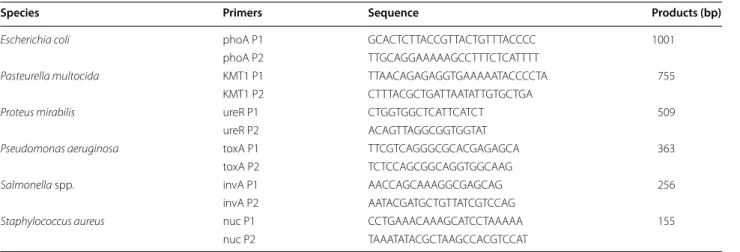
The sequences of the phoA, KMT1, ureR, toxA, invA, and nuc genes were obtained from the GenBank data-base (http://www.ncbi.nlm.nih.gov/Genba nk/). All oli-gonucleotide primers used in this study were synthesized by Shanghai Sunny Biotechnology Co., Ltd. (Shanghai, China). The sequences of the PCR primers are shown in Table 2.
In order to evaluate and verify the specificity of the primers, PCR analysis was performed using the genomes of the six pathogens as DNA templates.
Optimization of m‑PCR primers
Optimization of the primer combinations was based on the orthogonal experimental method. In the 15 double combinations, the optimal combination was selected as the initial double PCR and the remaining four primer pairs (the initial concentration of each primer was 0.4 µM) were added to the double combination to form a triple PCR. An optimal triple PCR was then selected and the remaining three primer pairs were added to form a quadruple PCR, until completion of the m-PCR.
After the addition of a new primer pair to an optimal PCR, if the combination was not optimal, the prim-ers were redesigned, and then the concentration of each
Table 2 Primers used in this study
Species Primers Sequence Products (bp)
Escherichia coli phoA P1 GCA CTC TTA CCG TTA CTG TTT ACC CC 1001
phoA P2 TTG CAG GAA AAA GCC TTT CTC ATT TT
Pasteurella multocida KMT1 P1 TTA ACA GAG AGG TGA AAA ATA CCC CTA 755
KMT1 P2 CTT TAC GCT GAT TAA TAT TGT GCT GA
Proteus mirabilis ureR P1 CTG GTG GCT CAT TCA TCT 509
ureR P2 ACA GTT AGG CGG TGG TAT
Pseudomonas aeruginosa toxA P1 TTC GTC AGG GCG CAC GAG AGCA 363
toxA P2 TCT CCA GCG GCA GGT GGC AAG
Salmonella spp. invA P1 AAC CAG CAA AGG CGA GCA G 256
invA P2 AAT ACG ATG CTG TTA TCG TCCAG
Staphylococcus aureus nuc P1 CCT GAA ACA AAG CAT CCT AAAAA 155
primer was adjusted from initial concentration of 0.4 µM to achieve the best results.
Optimization of m‑PCR conditions
The PCR reaction is affected by many factors. Therefore, the parameters of the m-PCR assay were optimized by varying concentration of deoxyribonucleotide triphos-phate (dNTPs; 0.1–0.4 mM), Mg2+ (0.2–0.5 mM), Taq
DNA polymerase (1.0, 1.5, 2.0, and 2.5 U), and betaine (0.05–0.4 mM) in a 25-µL reaction volume.
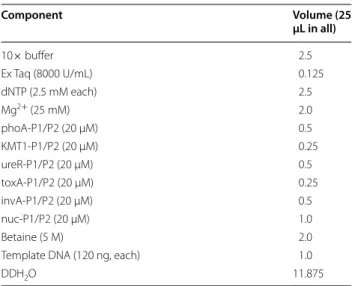
A mixture of the genomic DNA, which contained same amount of genomic DNA of the six types of bacteria, was used as a template to amplify the corresponding target genes. The total volume of each reaction system (recom-mended system) was 25 μL, which included 1 μL of tem-plate DNA (about 150 ng of genomic DNA).
PCR cycles were as follows: pre-denaturation at 94 °C for 4 min, denaturation at 94 °C for 40 s, annealing at 58 °C for 30 s, extension at 72 °C for 1 min, for 25–35 cycles, extension at 72 °C for 10 min, and preservation at 16 °C. After the reaction, 5 μL of the reaction solution was mixed with 1 μL of loading buffer (6×; TaKaRa Bio-technology) for 1.5% agarose gel electrophoresis.
Specificity of the m‑PCR assay
In order to confirm the specificity of the m-PCR estab-lished in this experiment, the genomes of seven species of bacteria (including Klebsiella pneumoniae, Shigella spp., Bacillus subtilis, Bacillus cereus, Enterococcus faecalis, Listeria monocytogenes and Streptococcus suis), two avian parasites (Cryptosporidium baileyi and Eimeria tenella) and three viruses (NDV, IBDV and AIV) were selected as the DNA template for m-PCR under optimized con-ditions (Table 3). The m-PCR test was performed with the genomes of six bacteria as the template DNA, which served as a positive control.
Furthermore, different serotypes of bacterial species were selected to verify the specificity of the multiplex PCR detection system: including O1, O2 and O78 serotype of avian pathogenic Escherichia coli, Salmonella typh-imurium, Salmonella enteritidis and Salmonella pullo-rum of Salmonella spp.
Sensitivity of the m‑PCR assay
The sensitivity of the m-PCR assay was evaluated using a tenfold serial dilution method. Briefly, the six strains were cultured to OD600= 1 and then diluted to 0.1, 0.01, and 0.001, and 2 µL of the above diluents were used as PCR templates.
The six strains were cultured until the mid-logarith-mic phase. After extraction, the genomes were diluted to concentrations of approximately 100 ng/μL, 75 ng/ μL, 50 ng/μL, 25 ng/μL, 12.5 ng/μL, 10 ng/μL, 5 ng/μL,
1 ng/μL, 500 pg/μL, and 250 pg/μL, after which 1 µL of these diluents was tested as the m-PCR template DNA for verification.
M‑PCR for the detection of six pathogenic bacteria from experimentally or naturally infected tissue samples The ability of the m-PCR assay to detect six pathogens in liver, spleen, and blood samples from experimentally infected chicks was evaluated. The 7-day-old San Huang chicks were obtained from Songjiang Chicken Farm (Shanghai, China) and were housed in cages under a con-trolled temperature of 28–30 °C and a 12 h light/dark cycle with free access to food and water during the study period. Briefly, 7-day-old San Huang chicks were injected with 5 × 10⁵ CFU of Escherichia coli, 5 × 10³ CFU of Pas-teurella multocida, 2 × 10⁸ CFU of Proteus mirabilis, 1 × 10⁸ CFU of Pseudomonas aeruginosa, 5 × 10⁴ CFU of Salmonella spp. and 2 × 10⁷ CFU of Staphylococcus aureus in the leg muscle, respectively. Then, the liver, spleen, and blood samples were aseptically collected 24 h after injection in accordance with the guidelines of the Animal Management and Use Committee of the Shang-hai Veterinary Research Institute (Chinese Academy of Agricultural Sciences). The liver, spleen, and blood sam-ples were homogenized in phosphate-buffered saline, then cultured for 4 h in LB broth, and boiled for 5 min to extract the genomic DNA for m-PCR detection. Genomic DNA was extracted using a DNA extraction mini kit (Tiangen Biotech Co., Ltd., BeiJing, China) according to the manufacturer’s instructions. Furthermore, the 6 bacterial genome mixtures (including Escherichia coli, Pasteurella multocida, Proteus mirabilis, Pseudomonas aeruginosa, Salmonella spp. and Staphylococcus aureus) were prepared in advance as DNA template, which was used as a positive control for the m-PCR assay.
Table 3 Composition of m-PCR system
Component Volume (25
µL in all)
10× buffer 2.5
Ex Taq (8000 U/mL) 0.125
dNTP (2.5 mM each) 2.5
Mg2+ (25 mM) 2.0
phoA-P1/P2 (20 µM) 0.5
KMT1-P1/P2 (20 µM) 0.25
ureR-P1/P2 (20 µM) 0.5
toxA-P1/P2 (20 µM) 0.25
invA-P1/P2 (20 µM) 0.5
nuc-P1/P2 (20 µM) 1.0
Betaine (5 M) 2.0
Template DNA (120 ng, each) 1.0
Moreover, for evaluation of the potential application of this PCR in clinical investigation, some tissue samples from diseased chicks from different poultry farms were processed during 2018–2019. The tissue samples were tested as described above.
Results
Amplification of target genes
The designed primers successfully amplified 1001 bp of the Escherichia coli PhoA gene (Fig. 1, lane 1), 755 bp of the Pasteurella multocida KMT1 gene (Fig. 1, lane 2), 509 bp of the Proteus mirabilis ureR gene (Fig. 1, lane 3), 363 bp of the Pseudomonas aeruginosa toxA gene (Fig. 1, lane 4), 256 bp of the Salmonella spp. invA gene (Fig. 1, lane 5), and 155 bp of the Staphylococcus aureus nuc gene (Fig. 1, lane 6). Different sizes of the PCR products of each target gene were produced for size discrimination by agarose gel electrophoresis.
Number of CFUs of the six pathogens
The plate counting results showed that amounts of Escherichia coli, Pasteurella multocida, Proteus mirabilis, Pseudomonas aeruginosa, Salmonella spp. and Staphy-lococcus aureus were 5.00 × 10⁸, 3.08 × 10⁸, 1.41 × 10⁹, 4.28 × 10⁹, 1.88 × 10⁹, and 2.79 × 10⁹ CFU at OD600 of 1.0, respectively. The results of three independent experi-ments were similar.
Optimization of the m‑PCR primers
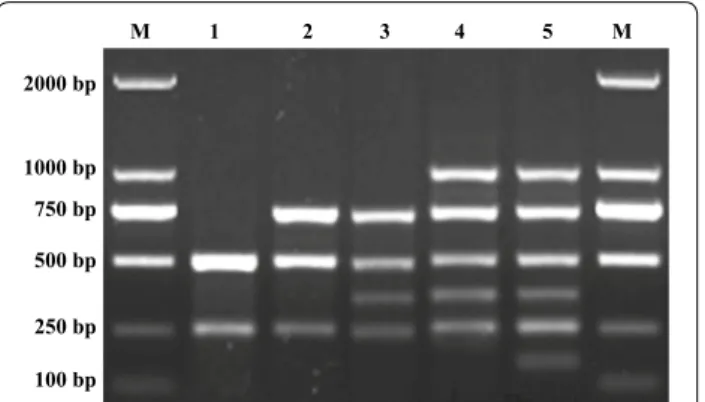
As shown in Fig. 2, of the 15 double combinations, the optimal combination of Proteus mirabilis and Salmo-nella spp. (Fig. 2, lane 1) was selected for the initial double PCR assay. Subsequently, a third primer pair was added to form a triple PCR. For the triple m-PCR assay, the combination of Proteus mirabilis, Salmonella spp. and Pasteurella multocida (Fig. 2, lane 2) was optimal. According to the orthogonal experiments,
quadruple, quintuple, and sextuple m-PCR assays were successively established (Fig. 2, lanes 3, 4, and 5, respectively).
Optimization of the m‑PCR conditions
The results showed that the optimal annealing tempera-ture of the m-PCR reaction was 54 to 58 °C, while the optimal dNTP and Mg2+ concentrations were 0.1 mM
and 2.5 mM, respectively (data not shown). The optimum betaine concentration was 0.4 M (data not shown).
In addition, the concentrations of each pair of primers were optimized based on the orthogonal experimental method, the results showed that the optimal concentra-tions of each pair of oligonucleotide primers were 0.2 µM (Pseudomonas aeruginosa and Pasteurella multocida), 0.4 µM (Proteus mirabilis, Salmonella spp. and Escheri-chia coli) and 0.8 µM (Staphylococcus aureus), respec-tively (data not shown).
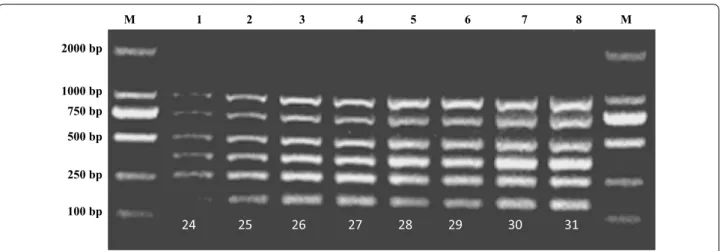
Furthermore, the number of cycles largely determines the required total duration of the m-PCR assay. The opti-mal number of m-PCR cycles was 25, which is consider-ably shorter the normally required 30–35 cycles (Fig. 3).
Specificity of the m‑PCR assay
The results showed that oligonucleotide primers specific for the phoA, KMT1, ureR, toxA, invA and nuc genes pro-duced amplification products with sizes of 1001, 755, 509, 363, 256, and 155 bp, respectively. The addition of DNA from Klebsiella pneumoniae (Fig. 4a, lane 2), Shi-gella flexneri (Fig. 4a, lane 3), Bacillus subtilis (Fig. 4a, lane 4), Bacillus cereus (Fig. 4a, lane 5), Enterococcus
2000 bp
1000 bp 750 bp 500 bp 250 bp 100 bp
M 1 2 3 4 5 6 7
Fig. 1 Amplification of target gene of the multiplex PCR. Lane M: 2000 bp DNA marker; Lanes 1–6: the template of m-PCR respectively were Escherichia coli, Pasteurella multocida, Proteus mirabilis, Pseudomonas aeruginosa, Salmonella spp. and Staphylococcus aureus; Lane 7: negative control
M 1 2 3 4 5 M
2000 bp
1000 bp 750 bp
500 bp
250 bp
100 bp
faecalis (Fig. 4a, lane 6), Listeria monocytogenes (Fig. 4a, lane 7), Streptococcus suis (Fig. 4a, lane 8), Cryptosporid-ium baileyi (Fig. 4a, lane 9), Eimeria tenella (Fig. 4a, lane
10), Newcastle disease virus (NDV) (Fig. 4a, lane 11), Infectious bursal disease virus (IBDV) (Fig. 4a, lane 12) and Avian Influenza virus H9N2 (Fig. 4a, lane 13) as PCR
2000 bp
1000 bp 750 bp 500 bp
250 bp
100 bp
M 1 2 3 4 5 6 7 8 M
24 25 26 27 28 29 30 31
Fig. 3 Determination of time of the multiplex PCR. Lane M: 2000 bp DNA marker; Lane 1: 24 running cycles; Lane 2: 25 running cycles; Lane 3: 26 running cycles; Lane 4: 27 running cycles; Lane 5: 28 running cycles; Lane 6: 29 running cycles; Lane 7: 30 running cycles; Lane 8: 31 running cycles
2000 bp
1000 bp 750 bp 500 bp 250 bp 100 bp
M 1 2 3 4 5 6 7 8 9 10 11 12 13 14
M 1 2 3 4 5 6 7 8
2000 bp
1000 bp 750 bp 500 bp
250 bp 100 bp
a
b
templates did not amplify the corresponding sizes of PCR product bands.
Furthermore, the results also indicated that different serotypes of avian pathogenic Escherichia coli (Fig. 4b, lanes 1–3) or Salmonella spp. (Fig. 4b, lanes 5–7) could be detected by m-PCR assay.
Sensitivity of the m‑PCR assay
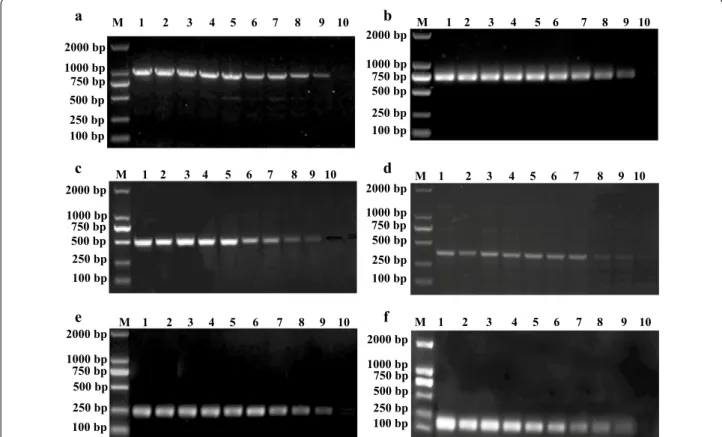
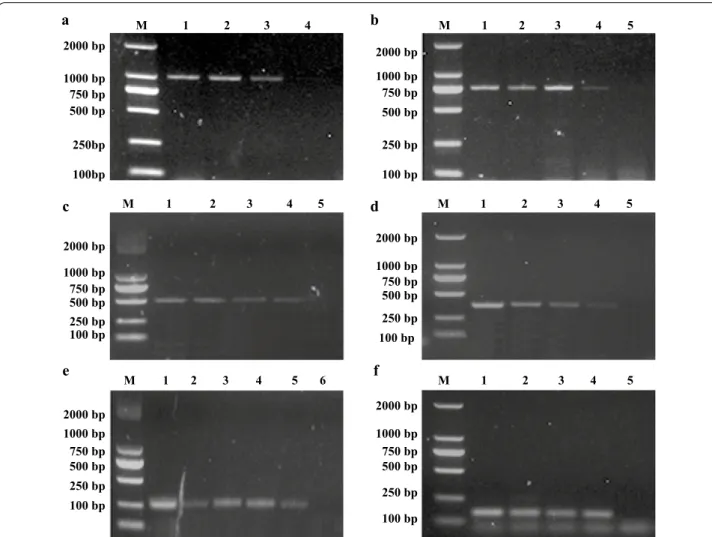
The detection limits of the genomic DNA concentra-tions for Escherichia coli (Fig. 5a), Pasteurella multocida (Fig. 5b), Proteus mirabilis (Fig. 5c), Pseudomonas aer-uginosa (Fig. 5d), Salmonella spp. (Fig. 5e) and Staphylo-coccus aureus was all about 500 pg (Fig. 5f), respectively. The detection limits of CFUs of Escherichia coli was 5 × 10³ (Fig. 6a), Pasteurella multocida was 6 × 10³ (Fig. 6b), Proteus mirabilis was 2.8 × 10³ (Fig. 6c), Pseu-domonas aeruginosa was 8.6 × 10³ (Fig. 6d), Salmonella spp. was 3.2 × 10³ (Fig. 6e) and Staphylococcus aureus
was 5.6 × 10³ (Fig. 6f), respectively. All experiments were conducted in triplicate.
M‑PCR analysis of experimentally or naturally infected tissue samples
As shown by the results of experimentally infected tissue samples in Table 4, all pathogens can be detected in the liver samples, while Escherichia coli, Pasteurella multo-cida and Salmonella spp. were detected in the blood sam-ples, and all, except for Proteus mirabilis, were detected in the kidney samples.
Besides, for evaluation of the potential application of this PCR in clinical investigation, some samples of chicks from natural outbreaks were processed during 2018– 2019. These results of detection of natural infections samples showed 82 strains of Escherichia coli, 6 strains of Pasteurella multocida, 40 strains of Proteus mirabilis, 2 strains of Pseudomonas aeruginosa, 30 strains of Salmo-nella spp. and 5 strains of Staphylococcus aureus were
1000 bp 750 bp 2000 bp
500 bp 250 bp 100 bp
2000 bp
1000 bp 750 bp 500 bp 250 bp 100 bp
2000 bp 1000 bp 750 bp 500 bp 250 bp 100 bp
750 bp 2000 bp 1000 bp
500 bp 250 bp 100 bp
M 1 2 3 4 5 6 7 8 9 10 M 1 2 3 4 5 6 7 8 9 10
M 1 2 3 4 5 6 7 8 9 10 M 1 2 3 4 5 6 7 8 9 10
M 1 2 3 4 5 6 7 8 9 10 M 1 2 3 4 5 6 7 8 9 10
2000 bp 1000 bp 750 bp 500 bp 250 bp 100 bp
b a
e f
d c
500 bp 250 bp 2000 bp 1000 bp
100 bp 750 bp
Fig. 5 Determination of the sensitivity of the multiplex PCR for bacterial genomic DNA detection. Lane M: 2000 bp DNA marker; a Lanes 1–10: the concentration of Escherichia coli DNA were 100 ng, 75 ng, 50 ng, 25 ng, 12.5 ng, 7.5 ng, 2.5 ng, 1 ng, 500 pg and 250 pg, respectively. b Lanes 1–10: the concentration of Pasteurella multocida DNA were 100 ng, 75 ng, 50 ng, 25 ng, 12.5 ng, 7.5 ng, 2.5 ng, 1 ng, 500 pg and 250 pg, respectively. c
Lanes 1-8: the concentration of Proteus mirabilis DNA were 100 ng, 75 ng, 50 ng, 25 ng, 12.5 ng, 7.5 ng, 2.5 ng, 1 ng, 500 pg and 250 pg, respectively.
identified and isolated by the assay, respectively (data not show).
The results indicated that the assay can provide specific detection of six pathogenic bacteria in experimentally or naturally infected tissue samples.
Discussion
Bacterial infection remains an important issue in the poultry industry (Cox and Pavic 2010) because of the huge economic losses due to infectivity, high mortality, and widespread drug resistance. Furthermore, the clini-cal signs several different bacterial pathogens are very similar and is very difficult to identified the agent with-out laboratorial analyses. For example, although Proteus
2000 bp
1000 bp 750 bp 500 bp
250bp
100bp
2000 bp 1000 bp 750 bp 500 bp 250 bp 100 bp
2000 bp 1000 bp 750 bp 500 bp 250 bp 100 bp
2000 bp 1000 bp 750 bp 500 bp
500 bp 750 bp
750 bp 500 bp 2000 bp 1000 bp
250 bp
250 bp 100 bp 1000 bp 2000 bp 100 bp 250 bp
100 bp
M 1 2 3 4 M 1 2 3 4 5
M 1 2 3 4 5 M 1 2 3 4 5
M 1 2 3 4 5 6 M 1 2 3 4 5
a b
c d
e f
Fig. 6 Determination of the sensitivity of the m-PCR for bacterial CFU detection. Lane M: 2000 bp DNA Marker. a Lanes 1–4: the template of Escherichia coli respectively were 5 × 10⁵, 5 × 10⁴, 5 × 10³ and 5 × 10² CFU, respectively. b Lanes 1–5: the template of Pasteurella multocida respectively were 6 × 10⁶, 6 × 10⁵, 6 × 10⁴, 6 × 10³ and 6 × 10² CFU, respectively. c Lanes 1–5: the template of Proteus mirabilis respectively were 2.8 × 10⁶, 2.8 × 10⁵, 2.8 × 10⁴, 2.8 × 10³ and 2.8 × 10² CFU, respectively. d Lanes 1–5: the template of Pseudomonas aeruginosa respectively were 8.6 × 10⁶, 8.6 × 10⁵, 8.6 × 10⁴, 8.6 × 10³, 8.6 × 10² CFU, respectively. e Lanes 1–6: the template of Salmonella spp. respectively were 3.2 × 10⁷, 3.2 × 10⁶, 3.2 × 10⁵, 3.2 × 10⁴, 3.2 × 10³ and 3.2 × 10² CFU, respectively. f Lanes 1–5: the template of Staphylococcus aureus respectively were 5.6 × 10⁶, 5.6 × 10⁵, 5.6 × 10⁴, 5.6 × 10³ and 5.6 × 10² CFU, respectively
Table 4 M-PCR detection filtrates from tissues and organs after enrichment for 4 h
+, can be detected −, can’t be detected
Species Liver Kindey Blood Detected
Escherichia coli + + + +
Pasteurella multocida + + + +
Proteus mirabilis + − − +
Pseudomonas aeruginosa + − + +
Salmonella spp. + + + +
mirabilis and Pseudomonas aeruginosa were conditional pathogens, which still could cause respiratory diseases (Walker et al. 2002), while avian pathogenic Escherichia coli and Pasteurella multocida cause high mortality in chicks (Dho-moulin and Fairbrother 1999). Hence, devel-opment an m-PCR assay with high specificity, sensitivity and throughput would be very useful for monitoring and diagnose bacterial infections in birds. However, at pre-sent, there is no molecular method for the simultaneous detection of the six major pathogens of chickens ( Escheri-chia coli, Pasteurella multocida, Proteus mirabilis, Pseu-domonas aeruginosa, Salmonella spp. and Staphylococcus aureus).
Primer specificity is a critical determinant of the suc-cess of an m-PCR assay. In this study, an m-PCR assay was developed to target specific genes of six pathogens (invA, phoA, KMT1, toxA, ureR, and nuc) based on the following previous studies. Rahn et al. (1992) reported the use of the invA gene for specific detection of Sal-monella spp. Thong et al. (2011) established an m-PCR assay for detection of the phoA gene of Escherichia coli. Townsend et al. (1998) and Blackall and Miflin (2000) developed PCR assays for identification of the KMT1 gene of Pasteurella multocida. Song et al. (2000) designed specific primers for the rapid identification of the Pseu-domonas aeruginosa toxA gene. The Proteus mirabilis ureR gene was identified as a transcriptional regulator of the urease enzyme (Nicholson et al. 1993) and has been used as target gene for the detection of Proteus mirabilis by PCR (Huang et al. 1999). Brakstad and Maeland (1995) established a method for the direct identification of the Staphylococcus aureus nuc gene.
Further, to test cross reaction by agents that could be found as secondary infection with avian parasites (cryptosporidium and coccidia) and viruses (NDV, IBDV and AIV) showed that the proposed m-PCR assay had very high specificity. Moreover, the specificity also was tested by the different major serotype of the avian pathogenic Escherichia coli and Salmonella spp. which were the most important bacterial pathogens of poultry according to the clinical isolation samples. In addition, in poultry infections, the major serotype of the other bac-teria such as Pasteurella multocida, Proteus mirabilis, Pseudomonas aeruginosa and Staphylococcus aureus is single.
In most cases, the sensitivity of an m-PCR assay will be reduced with increased numbers of target genes in the system. However, the detection limit of the pro-posed m-PCR assay was 2.8–8.6 × 10³ CFU of each bac-terial species, which is in agreement with the results of previous studies. For example, the sensitivity of Escheri-chia coli detection with the proposed m-PCR assay was 103 CFU/mL, which was superior to that reported by
Kong et al. (2002) of 104 CFU/mL. The detection lim-its of Proteus mirabilis and Pasteurella multocida were 8.6 × 10³ and 2.8 × 10³ CFU/mL, which were the same orders of magnitude as those reported by Huang et al. (1999), Takeuchi et al. (1996). On the contrary, previ-ously reported PCR assays for the detection of these six pathogens were single, triple, or quadruple methods. In comparison, the PCR detection sensitivities established in this study were close to or even exceeded those of the cited PCR assays. Moreover, as compared with traditional detection methods, the six pathogens tested in this study can be detected at one time with high sensitivity, thereby greatly reducing the detection time, while improving the efficiency.
For optimization of the m-PCR assay, the concentra-tions of primers, Taq DNA polymerase, and dNTPs, as well as the addition of a PCR additive, were optimized in this study. In pre-experiments, the concentrations of the first primer pairs for Proteus mirabilis and Salmonella spp. were set at 0.4 µM. For the following orthogonal experiments, a third pair of primers was added and the concentration was adjusted from 0.1 to 0.8 µM until the specificity was judged as appropriate.
dNTPs are raw materials for the synthesis of target fragments. Hence, to synthesize larger target fragments, more dNTPs are consumed. In this study, the target frag-ments were all within 1000 bp, but six were synthesized. Therefore, under consideration of cost, we recommend a dNTP concentration of 0.25 mM to amplify the corre-sponding target fragments.
Betaine is widely used as an enhancer to optimize vari-ous PCR assays. For example, Marshall et al. (2015) used betaine to enhance the formation of long PCR products and Henke et al. (1997) reported that betaine improved the amplification of genes by reducing the formation of secondary structures caused by GC-rich regions. As compared to dithiothreitol and dimethyl sulfoxide, betaine had the best PCR enhancing properties at a con-centration of 0.8 M for all primer pairs and was more effective since the PCR output was enhanced for all of the target fragments (Hengen 1997; Kang et al. 2005; Lajin et al. 2013). The major limitation of detection is a low quantity of the template. In this study, the addition of 0.4 M betaine improved the sensitivity of the PCR assay so that the detection limit of the sextuple PCR assay was similar to that of a single assay.
m-PCR assay. Besides, more than 150 bacterial strains were identified and isolated from diseased chicken by the assay. The results indicated that the assay also can be used in clin-ical investigation.
In conclusion, a rapid diagnostic m-PCR assay was estab-lished for the detection of six pathogenic bacteria in a short time. Moreover, this method can effectively and rapidly detect most pathogenic bacterial infections in poultry with good specificity, accuracy, and sensitivity.
Abbreviations
m-PCR: multiplex polymerase chain reaction; ELISAs: enzyme-linked immuno-sorbent assays; LB: Luria–Bertani; CFU: colony forming units.
Acknowledgements Not applicable.
Authors’ contributions
XGH, CW and KZQ designed the work; ZHW, JKZ and WJ performed the research study; JSG, ZC, RSM, VP and YH analysis the data; XGH and ZHW drafted the manuscript. All authors read and approved the final manuscript.
Funding
This work was supported by the National Natural Science Foundation of China (31572546, 31872483 and 31772707), the Key Project of Inter-govern-mental International Scientific Technological Innovation Cooperation (No. 2018YFE0102200), the Shanghai Science and Technology Standard Fund (Grant No. 18140900700), Shanghai Agriculture Applied Technology Develop-ment Program, China (Grant No. G20150109), National Basic Fund for Research Institutes, which is supported by the Chinese Academy of Agricultural Sci-ences (2019JB01) and the open projects of key laboratory for poultry genetics and breeding of Jiangsu province (JQLAB-KF-201802).
Availability of data and materials
The data on which the conclusions are made are all presented in this paper.
Ethics approval and consent to participate
This article does not contain any studies with human participants or animals performed by any of the authors.
Consent for publication Not applicable.
Competing interests
The authors declare that they have no competing interests.
Author details
1 Shanghai Veterinary Research Institute, The Chinese Academy of Agricultural Sciences (CAAS), 518 Ziyue Road, Shanghai 200241, People’s Republic of China. 2 College of Animal Science and Technology, Anhui Agricultural University, 130 Changjiangxilu, Hefei 230036, People’s Republic of China. 3 Poultry Institute, Chinese Academy of Agricultural Sciences, Yangzhou 225125, Jiangsu, People’s Republic of China. 4 Biotechnology and Ecology Institute, Ministry of Science and Technology (MOST), 22797 Vientiane, Lao People’s Democratic Republic. 5 College of Animal Science and Technology, Henan University of Science and Technology, No.263 Kaiyuan Road, Luoyang 471023, Henan, People’s Republic of China.
Received: 11 July 2019 Accepted: 30 October 2019
References
Belgrader P, Benett W, Hadley D, Richards J, Stratton P, Mariella R Jr, Milanovich F (1999) PCR detection of bacteria in seven minutes. Science 284:449–450
Benskin CM, Wilson K, Jones K, Hartley IR (2009) Bacterial pathogens in wild birds: a review of the frequency and effects of infection. Biol Rev Camb Philos Soc 84:349–373
Bisgaard M (1993) Ecology and significance of Pasteurellaceae in animals. Zentralbl Bakteriol 279:7–26
Blackall PJ, Miflin JK (2000) Identification and typing of Pasteurella multocida: a review. Avian Pathol 29:271–287
Brakstad OG, Maeland JA (1995) Direct identification of Staphylococcus aureus in blood cultures by detection of the gene encoding the thermostable nuclease or the gene product. Apmis 103:209–218
Cox JM, Pavic A (2010) Advances in enteropathogen control in poultry produc-tion. J Appl Microbiol 108:745–755
Dho-Moulin M, Fairbrother JM (1999) Avian pathogenic Escherichia coli (APEC). Vet Res 30:299–316
Han X, Ding C, He L, Hu Q, Yu S (2011) Development of loop-mediated isother-mal amplification (LAMP) targeting the GroEL gene for rapid detection of Riemerella anatipestifer. Avian Dis 55:379–383
Hengen PN (1997) Optimizing multiplex and LA-PCR with betaine. Trends Biochem Sci 22:225–226
Henke W, Herdel K, Jung K, Schnorr D, Loening SA (1997) Betaine improves the PCR amplification of GC-rich DNA sequences. Nucleic Acids Res 25:3957–3958
Hu Q, Tu J, Han X, Zhu Y, Ding C, Yu S (2011) Development of multiplex PCR assay for rapid detection of Riemerella anatipestifer, Escherichia coli, and Salmonella enterica simultaneously from ducks. J Microbiol Methods 87:64–69
Huang HS, Chen J, Teng LJ, Lai MK (1999) Use of polymerase chain reaction to detect Proteus mirabilis and Ureaplasma urealyticum in urinary calculi. J Formos Med Assoc 98:844–850
Kang J, Lee MS, Gorenstein DG (2005) The enhancement of PCR amplification of a random sequence DNA library by DMSO and betaine: application to in vitro combinatorial selection of aptamers. J Biochem Biophys Methods 64:147–151
Kong RY, Lee SK, Law TW, Law SH, Wu RS (2002) Rapid detection of six types of bacterial pathogens in marine waters by multiplex PCR. Water Res 36:2802–2812
Kotetishvili M, Stine OC, Kreger A, Morris JG Jr, Sulakvelidze A (2002) Multilocus sequence typing for characterization of clinical and environmental Salmonella strains. J Clin Microbiol 40:1626–1635
Lajin B, Alachkar A, Alhaj Sakur A (2013) Betaine significantly improves multi-plex tetra-primer ARMS-PCR methods. Mol Biotechnol 54:977–982 Marshall PL, King JL, Budowle B (2015) Utility of amplification enhancers in low
copy number DNA analysis. Int J Legal Med 129:43–52 Nicholson EB, Concaugh EA, Foxall PA, Island MD, Mobley HL (1993)
Proteus mirabilis urease: transcriptional regulation by UreR. J Bacteriol 175:465–473
Park SH, Hanning I, Jarquin R, Moore P, Donoghue DJ, Donoghue AM, Ricke SC (2011) Multiplex PCR assay for the detection and quantification of Campylobacter spp., Escherichia coli O157:H7, and Salmonella serotypes in water samples. FEMS Microbiol Lett 316:7–15
Rahn K, De Grandis SA, Clarke RC, Mcewen SA, Galan JE, Ginocchio C, Curtiss R 3rd, Gyles CL (1992) Amplification of an invA gene sequence of Salmo-nella typhimurium by polymerase chain reaction as a specific method of detection of Salmonella. Mol Cell Probes 6:271–279
Reischl U (1996) Application of molecular biology-based methods to the diagnosis of infectious diseases. Front Biosci 1:e72–77
Rodriguez-Siek KE, Giddings CW, Doetkott C, Johnson TJ, Nolan LK (2005) Characterizing the APEC pathotype. Vet Res 36:241–256
Salmon SA, Watts JL (2000) Minimum inhibitory concentration determina-tions for various antimicrobial agents against 1570 bacterial isolates from turkey poults. Avian Dis 44:85–98
Song KP, Chan TK, Ji ZL, Wong SW (2000) Rapid identification of Pseudomonas aeruginosa from ocular isolates by PCR using exotoxin A-specific primers. Mol Cell Probes 14:199–204
Takeuchi H, Yamamoto S, Terai A, Kurazono H, Takeda Y, Okada Y, Yoshida O (1996) Detection of Proteus mirabilis urease gene in urinary calculi by polymerase chain reaction. Int J Urol 3:202–206
Thong KL, Lai MY, Teh CS, Chua KH (2011) Simultaneous detection of methicil-lin-resistant Staphylococcus aureus, Acinetobacter baumannii, Escherichia coli, Klebsiella pneumoniae and Pseudomonas aeruginosa by multiplex PCR. Trop Biomed 28:21–31
Townsend KM, Frost AJ, Lee CW, Papadimitriou JM, Dawkins HJ (1998) Devel-opment of PCR assays for species- and type-specific identification of Pasteurella multocida isolates. J Clin Microbiol 36:1096–1100 Van Den Bogaard AE, Willems R, London N, Top J, Stobberingh EE (2002)
Antibiotic resistance of faecal enterococci in poultry, poultry farmers and poultry slaughterers. J Antimicrob Chemother 49:497–505
Velegraki A, Kambouris M, Kostourou A, Chalevelakis G, Legakis NJ (1999) Rapid extraction of fungal DNA from clinical samples for PCR amplifica-tion. Med Mycol 37:69–73
Walker SE, Sander JE, Cline JL, Helton JS (2002) Characterization of Pseu-domonas aeruginosa isolates associated with mortality in broiler chicks. Avian Dis 46:1045–1050
Yano A, Ishimaru R, Hujikata R (2007) Rapid and sensitive detection of heat-labile I and heat-stable I enterotoxin genes of enterotoxigenic Escherichia coli by loop-mediated isothermal amplification. J Microbiol Methods 68:414–420
Publisher’s Note