Opportunistic Networks: Present Scenario-A Mirror
Review
Anand Nayyar
1, Ranbir Singh Batth
2,
Dac Binh Ha
3and
G. Sussendran
4l
Graduate School Duy Tan University, Da Nang, Vietnam 2
School of Computer Science and Engineering, Lovely Professional University, India 3
Faculty of Electric and Electronics Engineering, Duy Tan University, Da Nang, Vietnam 4
School of computing Sciences, Department of Information and Technology, VELS University, Chennai, India
Abstract: Opportunistic Network is form of Delay Tolerant Network (DTN) and regarded as extension to Mobile Ad Hoc Network. OPPNETS are designed to operate especially in those environments which are surrounded by various issues like- High Error Rate, Intermittent Connectivity, High Delay and no defined route between source to destination node. OPPNETS works on the principle of “Store-and-Forward” mechanism as intermediate nodes perform the task of routing from node to node. The intermediate nodes store the messages in their memory until the suitable node is not located in communication range to transfer the message to the destination. OPPNETs suffer from various issues like High Delay, Energy Efficiency of Nodes, Security, High Error Rate and High Latency. The aim of this research paper is to overview various routing protocols available till date for OPPNETs and classify the protocols in terms of their performance. The paper also gives quick review of various Mobility Models and Simulation tools available for OPPNETs simulation.
Keywords: Opportunistic Networks, Delay Tolerant Network(DTN), Ad Hoc Network, Routing, Routing Protocols, Mobility Models, Simulation Tools, Forwarding.
1.
Introduction
In 21st Century, communication technologies are becoming smarter day by day, providing the planet with faster, reliable and secure connectivity. With the extensive research in wireless communications, new applications continue to emerge and now with advanced communication techniques, communication is even possible in those areas where at one time, building a simple communication infrastructure was a huge forefront challenge. The traditional wireless networks like: Mobile Adhoc Networks [1], Wireless Sensor Networks, Wireless Mesh Network face some difficulty in network operation as sometimes, links gets disconnected and sometimes connection fails which degrades the overall performance of the network. With the requirement of efficient and secure operational network environment, researchers put up hard efforts to create novel network topology to meet service quality needs which in turn has led to the development of Opportunistic Networks (OPPNETs) [2].
Opportunistic is a category of delay tolerant network. It is formed by the nodes which have the capability to support this kind network. The nodes in this are connected wirelessly. Opportunistic Networks are derived from Disruption-Tolerant Networks (DTN) [3] and MANETs. The primary objective behind the design of OPPNETs or Opportunistic Networks is to operate in critical environments in effective manner like Warfield communications, Under-water communications, Flying Autonomous Vehicles (FAV)
communications, Satellite Communication etc., where communication usually faces long delays, high error rates and have no reliable end-to-end connection. OPPNETs provide reliable connectivity between source node and destination node. But OPPNETs are also surrounded by lots of challenges like, nodes operational in OPPNETs have high mobility, low power, short radio communicating range, low density and are also prone to various sorts of network attacks via malicious nodes. The only difference between routing in Delay Tolerant Networks and Opportunistic Networks is, in DTN networks, when a packet is sent between source node to destination node, an end-to-end path is first searched out and established and then message is transmitted, if no defined path is found, then message is sent opportunistically. In case of OPPNETs, the message is sent directly in opportunistically manner, and no end-to-end path is identified before transmission. Another challenge faced by OPPNETs in real-time operation is frequent network topology change [4], so no existing end-to-end routing techniques can be implemented in OPPNETs.
In MANETs, all the nodes operating in network remains connected to each other via common inter-network which is not possible in pervasive networks, where mobile devices are used to remain connected to the network, as users in between turn off their devices to save energy of the nodes. So, traditional routing protocols like AODV, DSDV, DSR and other basic Internet routing protocols like TCP/IP fails in OPPNETs. These protocols lay a defined and well-connected path between source and destination which is absolutely not possible in OPPNETs scenario.
technique to ensure successful delivery of packages but message delivery can suffer prolonged delays, as network buffer increase, waiting for the path between source to destination node. Because of this, OPPNETs are subclass of DTN and nodes must be equipped with high buffer space to store messages for unpredictable period of time to avoid packet dropping.
Figure. 1 Seed OPPNET & Expanded OPPNET Routing is one of the serious challenges in opportunistic networks due to network topology change at fast manner, long delays and no reliable end-to-end connection. Many routing protocols and techniques are proposed till date by various researchers to avoid these challenges like- Replication, Forwarding and Hybrid, but every technique has its shortcomings.
Replication based protocols provide faster delivery rates at lower delays by making multiple copies of packets in the network and are reliable as compared to forwarding protocols but creates lots of overhead in the network as compared to forwarding protocols. Hybrid protocols tend to derive the features of both replication and forwarding routing protocols and are tend to be more efficient till date in OPPNETs routing by providing reliable data transmission, lower delay, less overhead. But still, lots of research is required in OPPNETs to come up with efficient routing protocol to ensure overall network performance.
1.1. Organization of Paper
Section II lays more detailed overview of Definition, Architecture, Challenges and Applications of OPPNETs. Section III covers routing protocols in OPPNETs – Replication, Forwarding and Hybrid. Section III evaluates routing protocols in OPPNETs on varied parameters to analyze the overall performance of protocols. Section IV gives overview of Mobility Models and Simulation Tools available for OPPNETs. Section V concludes the paper with future scope.
2.
O
PPNETS-
DEFINITION,
A
RCHITECTURE,
C
HALLENGES&
A
PPLICATIONS2.1. Opportunistic Networks- Definition & Architecture
Till date, there is no formal definition of Opportunistic Networks. Considering the Literature review and other observations of researchers, Opportunistic Network is defined as “Network of wirelessly connected nodes”. It doesn’t require any end-to-end path between two communicating nodes. Nodes are connected to each other in temporary manner and network topology changes due to
node mobility or activation or deactivation. The network communicates the packets via Node Discovery. A node discovers other nodes in communication range (1-Hop) distance and send the data to other nodes hop-by-hop till the message reaches the destination.
Figure. 2 Typical Opportunistic Network 2.2. Architecture
Opportunistic Network is completely different from traditional multi-hop wireless network in the manner, there is no unified node deployment and there is no initial location of node and even the topology and network-size not defined, means there is no appropriate path between source node and destination node.
In opportunistic network, a network is segregated into network partitions called “Regions” and nodes interconnect with each other via store-carry-and-forward mechanism. This is implemented via new layer addition called “Bundle Layer”. The architecture of Opportunistic Network as compared to traditional TCP/IP model is shown in Figure 3.
Figure. 3 Architecture of Opportunistic Networks V/s TCP/IP based Networks
In this layer, all the intermediate nodes use store-carry-and-forward message mechanism in bundle layer. Every node in the bundle layer, acts as host, router and gateway to store, carry and forward the bundles (Packets or Fragments) from nodes in same region.
Nodes when acting as Hosts: Bundle layer, sends and receives packets but can’t forward it.
all sorts of security checks and require large storage size.
Nodes when acting as Router: Bundle layer can store, carry and forward bundles across the entire region. 2.3. Challenges of Opportunistic Networks
Like other networks, Opportunistic Networks are also surrounded by lots of challenges. The main challenges which disrupt the overall network performance are: Contact Opportunity and Node Storage.
The following are some of the challenges for OPPNETs: 1. Energy Efficiency: Opportunistic network nodes
make use of more energy for routing, storing the information in the network.
2. Interoperability Issue: OPPNET is regarded as heterogenous network which consists of different types of Mobiles, Sensors, Portable Devices, Camera etc. and every device is distinct from each other in terms of technology which sometimes leads to interoperability issue.
3. Intermittent Connectivity: All the nodes in OPPNETs have high mobility, and data transmission happens opportunistically, as there is no end-to-end connection between nodes and no defined path is laid in network, so it leads to intermittent connectivity.
4. Storage Issue: The intermediate nodes operational in OPPNETs requires lots of storage capacity to store messages as transmission is done via store-carry-and-forward mechanism and there is no exact time till how much the intermediate nodes have to store the data in their memory, till the exact path is laid to next node for packet transfer. If the storage capacity is not enough, then it may lead to packet drop. 5. Long Delay: As messages gets transferred from node
to node via Store-Carry-and-Forward manner, sometimes the message gets delayed until the path is defined for next node delivery.
6. Malicious Nodes: Security in OPPNET is not as strong as compared to other traditional and other modern wireless networks, as sometimes malicious nodes can join and hamper the privacy of other nodes.
7. Data Integrity and Security: In order to assure secure data transmission between sender and receiving node, digital signature and other cryptographic techniques are required. But implementing those techniques, can hamper the node battery power and battery quickly degrades after certain period of time.
8. Network Overhead: Some of the protocols proposed by researchers for routing operation in OPPNETs, can create network overhead by creating multiple copies of packets in the network.
2.4. Applications of OPPNETS
The following are the various applications of OPPNETs which are implemented in real-time:
2.4.1. Wildlife Monitoring via ZebraNet, CenWits and SWIM
The most prominent and foremost application of OPPNET is monitoring wildlife. It primarily deals with tracking wild species to understand the behavior and interactions and influences with one another. Wildlife monitoring based projects are implemented by Researchers to work as reliable, low-cost and efficient medium for monitoring large wildlife population in vast expanded forest region.
ZebraNet [5] is OPPNET, WMSN (Wireless Mobile Sensor Network) based project was implemented by Princeton University in the vast savanna area of the central Kenya under Mpala Research Center for tracking animals in wildlife area with powerful sensors operating as P2P networks attached to the neck of the animals. Every sensor is equipped with high end features like GPS, memory, wireless transceiver and CPU. All the sensors nodes fitted on animals exchange the information with base station via flooding-routing techniques. In ZebraNet, data storage, efficient network bandwidth and energy efficiency of nodes is specially taken care off. It is primarily designed to monitor the speed and movement of animals in wild region.
CenWits [6] (Connection-less Sensor-Based Tracking System Using Witnesses) is a smart search and rescue system designed to operate especially in emergency conditions like Wildlife areas, remote locations, mountain regions and is carried by bikers, mountaineers, researchers. It is equipped with Mobile based sensor sensors, Access Points (AP) to collect data from sensors, GPS sensors to provide exact location of the person. The sensors send the location data to the base station to estimate the exact location of the sensor.
Shared Wireless Infostation Model [7] based on OPPNETs was proposed to monitor blue whale’s species and data is replicated between whales similarly like ZebraNet and finally reverted back to SWIMs stations which can either be fixed or mobile.
2.4.2. Underwater Sensor Network (UWSN)
Underwater Sensor Networks (UWSN) [8] [9] has tons of new opportunities to explore oceans, and also improvises the research towards understanding underground environmental issues like change in climate, understanding aquatic life and study the variations of coral reef population. In underwater sensor communications, all the communicating nodes make use of TDMA protocols [10] for communication and make use of 3D distribution localization algorithms for network self-localization without making use of any sort of external clock like GPS. An underwater robot is implemented to collect the data from the sensor nodes by travelling around and also performs the task of sensor relocation.
2.4.3. Underwater Acoustic Communication
frequency. As a result, radio waves can travel only to short distances. Therefore, the communication especially underwater can be possible via acoustic signals with frequency range of 10 Hz and 1 MHz.
2.4.4. Space Communication Network
NASA’s reliable space communication and navigation (SCaN) networks is regarded as NASA’s space mission’s backbone and provides all communication services for all Earth, space science and human flight missions. It includes telemetry, tracking and commanding (TTandC) [12] [15] required by every spacecraft to transfer day to ground stations to manage all sorts of space communications with human space flight missions and transfer data for all earth and space science missions. Space Communication is impacted by various factors like long-delay, high error-rate and intermittent links. NASA and even Space X are planning to send long range Universe missions to gather images and planet-based data back to earth’s surface for advanced research. The most popular protocol “Saratoga” [13] was especially designed to transfer images from satellite sensors back to earth. The primary reason for the development is to reduce delay, error rate and combat intermittent connectivity problems. In [14], a novel deep space Internet was applied via OPPNET networks. The Disruption Tolerant Networking (DTN) program assures improvised communication by data storage in case of any connection failures or forwarding the data to destination via relay station nodes.
2.4.5. Airborne Networks
Airborne Networks [16] is primarily designed by U.S. Airforce to enhance Global Information Grid (GIG) to interconnect all forces: Army, Navy and Airforce. Airborne network is designed and engineered in such a manner to connect with space and all surface networks to provide fault-free communication across all domains. Modern Airborne networks make use of 100% real-time communication as compared to Store-and-Forward techniques. During communication, if communication fails, the signal is directed to next aircraft to reach the destination. It is a complete meshed network, where all the nodes are connected via multiple links [17]
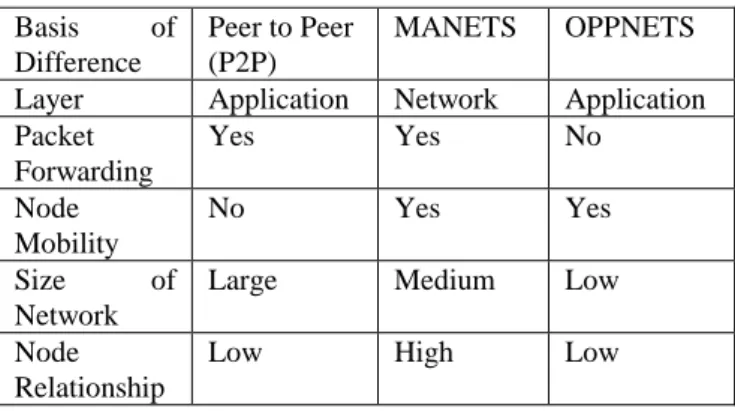
2.5. Peer to Peer Networks v/s MANETS v/s OPPNETS
The Table 1 highlights the differences between Peer-to-Peer Networks, MANETs and OPPNETs.
Table 1. Differences between P2P, MANETs and OPPNETs. Basis of
Difference
Peer to Peer (P2P)
MANETS OPPNETS
Layer Application Network Application Packet
Forwarding
Yes Yes No
Node Mobility
No Yes Yes
Size of
Network
Large Medium Low
Node Relationship
Low High Low
3.
Routing Protocols in OPPNETS
All the routing protocols in Opportunistic Networks are based on the concept of “Store-and-Forward” technique because there is no definite end-to-end connection between source and destination node.
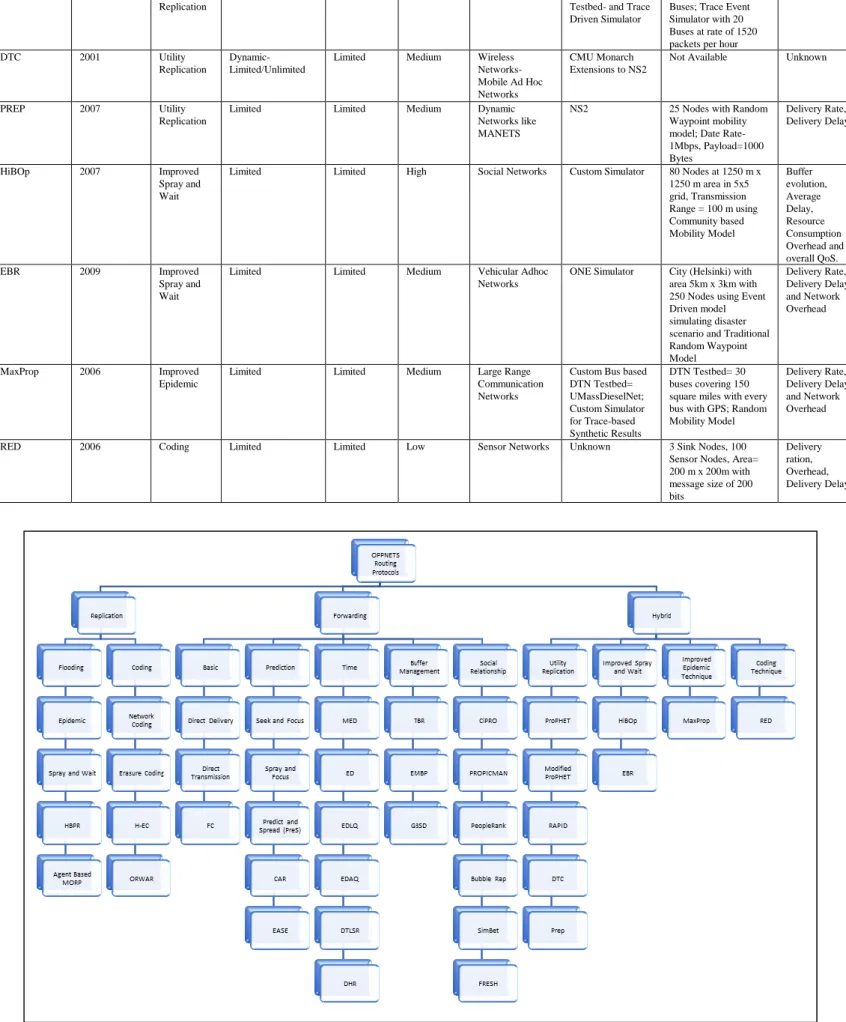
Routing Protocols in OPPNETS can be classified into three main categories [18-20, 75-77]:
Replication
Forwarding
Hybrid
Figure.4 gives complete scenario of Routing Protocols of OPPNETS- Replication, Forwarding and Hybrid.
3.1. Replication based Routing Protocols for OPPNETS
Under replication-based methodology, all the protocols work on the scenario of message duplication in the network. Two copies of a single message exist on network at a particular point of time. The protocols under replication category assures efficient delivery but lots of network congestion is created side by side.
The following are the two sub-categories of Replication based Routing Protocols:
Flooding Technique
Coding Technique 3.1.1. Flooding Technique
In order to spread multiple copies of message to the network at single point of time, replication-based protocols use flooding technique.
The following are the Routing protocols under Flooding technique of Replication based Routing protocols for OPPNETS:
Epidemic Routing
Spray and Wait
History-based Prediction Routing (HBPR)
Agent-Based MORP
3.1.1.1. Epidemic Routing [21-23]:
It is regarded as the most traditional flooding technique to perform message forwarding in OPPNETs. The main objective behind the development of Epidemic Routing is to assure message delivery, minimize latency and consumption of network resources (Memory and Bandwidth) utilized for message delivery from source to destination node. The protocol works on theory of Epidemic Algorithm, in which every node in the OPPNET maintains two buffers, one to store the original message and other act as Secondary Buffer on behalf of other nodes. Nodes receive and transfer messages even if there exists no definite path to the destination node. It uses the simple technique called “FIFO” for managing all node buffers. When buffer stands full, the node will be unable to store new message originated by other nodes and in turn drops the first message in the buffer to store the new message. Messages received are differentiated on the basis of unique 32-bit Identification number and weighted via hop-count.
available but overhead and congestion caused in network is very high.
3.1.1.2. Spray and Wait Protocol [24]:
Spray and Wait routing protocol is regarded as efficient controlled replication protocol which overcomes all shortcomings of epidemic routing and other flooding-based schemas and intermittent connectivity.
The Spray and Wait routing protocol works in two phases: Spray Phase and Wait Phase.
Spray Phase- A numbers of message copies are broadcasted by the source node in the network. All the nodes receive the copies and store them in the buffer.
Wait Phase- The nodes will hold the copy of the message and waits for opportunity to deliver the message. The destination node receives the copy when the node comes within the range of communication.
The protocol was proposed with objective to broadcast less messages as compared to Epidemic routing, generate low congestion, assure better delivery delay as compared to existing schemes and high scalability in performance. Simulation based results prove that Spray and Wait method is most optimal scheme in order to assure message delivery with less network congestion.
3.1.1.3. History-Based Prediction Routing (HBPR) Protocol [25]:
HBPR routing protocol considers behavioral information of the nodes to determine the next best possible node for routing.
The protocol operates on following three assumptions: (1) All the nodes in the network operate via Human Mobility Pattern;
(2) All the nodes are cooperative in nature and don’t have any malicious node between them;
(3) Operational area is divided into cells with unique numbers for storing the tables.
The protocol operates in three phases- (1) Home Location Determination; (2) Generation of Message and (3) Selection of Next Hop.
HBPR makes use of Markov Predictor method to determine the best possible path from source to destination node. Performance of protocol is evaluated using ONE Simulator and the simulation-based results prove that HBPR protocol is better as compared to Epidemic Routing Protocol in terms of Delay, Probability of Delivery, Time-to-live and node speed. 3.1.1.4. Agent Based MORP (Multicast Opportunistic
Routing Protocol) [26]:
Makes use of stateless approach and forwarding nodes are divided into probable relay regions and only on-demand routing paths are established. The protocol plays a crucial role to reduce the load of source node by link re-establishment with multicast member nodes via opportunistic link attributes.
Simulation based results clarifies that Agent Based MORP routing protocol creates less overhead and improvises the overall network performance by saving energy level of node.
3.1.2. Coding Technique
Apart from Flooding Techniques, Replication based routing protocols make use of Coding Techniques to relay the messages from source to destination and improvise the overall efficiency in network.
The following routing protocols of OPPNETS are categorized under Coding Technique:
Network Coding (NC)
Erasure Coding (EC)
H-EC
ORWAR
3.1.2.1. Network Coding (NC) and Erasure Coding (EC) [27, 28] are two different techniques which are used to encode the original packet into streams of encoded packets. Under Network Coding, encoding is done by intermediate node and makes use of encoded blocks of very small size to optimize network performance. Network coding approach is based on dissemination-based algorithms. The working of protocol is same as Epidemic Routing but reduces network flooding to a high level.
Under Erasure Coding (EC), only source node encodes the message to create big blocks of encoded message which reduces overhead. It serves as basis to design a Forwarding Algorithm.
3.1.2.2. H-EC (Hybrid Erasure Coding) [29]:
H-EC is novel forwarding technique and improvement over Erasure Coding (EC) technique. In H-EC protocol, two erasure coded blocks are developed on basis of erasure coding and replication technique and are sent by source node. The first copy of EC block is sent the same way as original EC scheme and second block is transmitted after first block using A-EC algorithm. H-EC is best as compared to EC in delivering best performance and less delay.
Simulation based comparative results of A-EC and H-EC protocols reveal that H-EC performs better in both general as well as black hole attack scenarios in terms of packet delivery ratio and latency.
3.1.2.3. ORWAR [30]:
ORWAR is a resource-efficient quota-based replication protocol for opportunistic routing in delay-tolerant networks. It proposes a multi-copy routing scheme via controlled replication and only fixed number of copies of packets are distributed across entire network. In the first contact, every node transfers half of the message and rest of the message is kept in storage memory and methodology works in same form as Spray and Wait Mechanism. In ORWAR protocol, only those messages with best bit ratio are selected and sent only if size meets contact properties. Replication factor is considered for forwarding which increases overall delivery ratio.
3.2. Forwarding Routing Protocols for Opportunistic Networks
Forwarding Routing Protocols is another category of routing protocols for forwarding the packets between sender and receiver in Opportunistic Networks. In this category of routing protocols, messages are forwarded between nodes only after selecting the best next hop-node in the path. Under these categories of routing protocols, messages are sent only 1 time by sender node as compared to multiple messages in case of replication protocols, which makes these protocols efficient in terms of network utilization but delivery ratio of forwarding routing protocols is less as compared to Replication routing protocols.
The following are the five types of categories of Forwarding Routing Protocols:
Basic
Prediction
Time
Buffer Management
Social Relationships
3.2.1. Basic-Forwarding Routing Protocols for OPPNETs
The following are the Routing Protocols for Basic Forwarding for OPPNETs:
Direct Delivery (DD) Direct Transmission (DT) First Contact (FC)
3.2.1.1. Direct Delivery (DD) [31]:
It is highly simple and easy protocol to deploy for message routing in OPPNETs. Under Direct Delivery Routing scheme, the messages are not routed to any neighboring nodes, rather the messages are kept by the source node itself, unless any direct contact is not linked up to the destination node. Only after getting direct link with destination node, the message is forwarded. DD protocol makes efficient utilization of bandwidth and network resources as message transmission only happens when destination node comes in direct contact. The technique is not highly reliable, as message routing can face prolonged delays as it is impossible to determine the time, the source node has to keep the packet in memory till the packet is delivered to the destination node. The situation can also arise, if the source node fails, the entire message is destroyed because only 1 copy of the message is available in entire network. DD protocol cannot be termed as efficient protocol in packet delivery especially in those situations where reliability is utmost urgent.
3.2.1.2. Direct Transmission (DT) Scheme [32]:
In this protocol, the source node doesn’t utilize any intermediate nodes for message forwarding, rather it stores the message in buffer till direct contact with destination node doesn’t happen. With contact with destination node, the message is forwarded directly. The protocol works in same manner as Direct Delivery (DD) and utilizes less network resources and this protocol suffers in the same manner like DD in terms of prolonged times of delivery to destination node.
Both Direct Delivery and Direct Transmission protocols use single hop rather than multiple hop for message transmission i.e. Source Node can transmit the packet directly to destination nodes rather than making use of any intermediate nodes for routing the packets.
3.2.1.3. First Contact (FC) [33]:
In First Contact (FC) routing protocol, the source node forwards the packet in random fashion to the first intermediate node encountered i.e. “Random Walk Search” methodology is followed for destination node.
If no node is available, the message stays in the buffer of source node, waiting to get forwarded. First Contact protocol performs poorly in nontrivial topologies as the intermediate node chosen in random and forwarding along the selected node may not result in any sort of progress towards the destination node.
FC Protocol can be only used for multicast messages and doesn’t many sorts of assumptions of the network and is highly easy to implement.
Under FC protocol, the message can again face too prolonged delays and sometimes the problem of packet dropping can occur in the network, making this protocol less efficient for routing in OPPNETs.
3.2.2. Prediction-Forwarding Routing Protocols for OPPNETs
Prediction routing protocols makes use of Prediction based approach to locate the best intermediate nodes from source to destination to route messages and also assure reliable delivery in network.
The following are the Prediction based Forwarding routing protocols for OPPNETs:
Seek and Focus
Spray and Focus
PreS
CAR
EASE
3.2.2.1. Seek and Focus Protocol [32]:
Seek and Focus protocol is combined protocol derived from Randomized Routing Protocol and Utility-based routing protocol. The protocol makes of randomized approach in initial stage and transforms to utility-based forwarding on discovery of high utility node. Seek and Focus Routing algorithm works in two phases- Seek Phase and Focus Phase. In seek phase, the sender performs forwarding of packets to nearby nodes with parameter p if utility around the source node is low. In focus phase, when a high utility node is found, the forwarding is switched to utility-based.
Simulation based analysis and results state that Seek and Focus performs better in terms of less delay and is efficient in message delivery.
3.2.2.2. Spray and Focus Protocol [34]:
Spray and Focus protocol is advanced extension to Spray and Wait routing protocol, in terms of utility function and queuing policy.
During Spray Phase, a predefined number of copies of messages is transmitted in the network. During Focus phase, utility-based scheme is followed by relay node to forward the message to best suitable node in the network.
The functionality of Spray and Focus Protocol:
Message Summary Vectors: Every node operating in OPPNETS has a vector with IDs of all messages stored in the buffer, when two nodes encounter, exchange of vectors is done and cross checking of similar messages is performed as every message has TTL, if the message TTL has expired, the message gets chunked out and vector entry is also removed. Last Encounter Timer: Every node in OPPNET has a timer which contains a time a node has taken to move from one place to another via mobility model.
Spray and Focus Forwarding: If a new message is to be forwarded source node use utility-based forwarding to transfer the message to destination.
Simulation based results prove that Spray and Focus protocol performs excellent in terms of transmission speed, delivery rate and reduces network congestions to high extent.
3.2.2.3. Predict and Spread (PreS) Routing Protocol [35]:
PreS is regarded as efficient routing algorithm for Opportunistic networks and makes use of Markov Chain to model node’s mobility pattern and acquire social characteristics. PreS routing protocol makes the base assumption that the location of nodes in near future will be completely different from the existing and past. Nodes can exchange the messages only when they are in close contact with one another which improvises the performance of message forwarding in networks.
Simulation based results comprehend that PreS routing protocol outshines in terms of performance especially packet delivery ratio and latency as compared to other protocols like PER, Epidemic, SW and SF.
3.2.2.4. CAR (Context-Aware Adaptive Routing) Protocol [36]:
The primary objective behind the design and development of Context-Aware Adaptive Routing (CAR) protocol is to facilitate communication in intermittently connected networks like MANETS. CAR protocol deploys Kalman filter base prediction technique for determining the next intermediate node / next hop for routing in OPPNETs. In CAR protocol, the nodes operational in environment calculates their respective delivery probability at regular intervals of time in various parameters like Mobility and Energy Level. All the nodes transmit their probability information to reachable nodes using DSDV routing protocol via Synchronous Routing. CAR selects the optimal node with highest probability delivery to transmit the message to the destination node via Asynchronous Routing. CAR protocol relies heavily on the prediction model accuracy.
Simulation based results clarifies that CAR outshines in delivery delay, packet delivery ratio, predictability level as compared to other routing protocols like Random, Epidemic, Flooding, PRoPHET and Spray and Wait.
3.2.2.5. EASE (Exponential Age SEarch) [37]:
EASE routing protocol was proposed specially to facilitate routing in large-scale mobile and ad-hoc networks where node movement is highly dynamic. In order to perform efficient geographic routing, an efficient location service is required where node mobility is efficient to transmit location information without bearing any additional communication overheads. EASE algorithm is considered efficient in large scale geographic routing where nodes perform independent random walks on square lattice and the distance computation will be the same for short as well as large distance nodes. In EASE protocol, every node maintains a routing table which contains the time and location of the last visited node and it is used as forwarding decision to transmit the packet.
3.2.3. Time Forwarding Routing Protocols for Opportunistic Networks
In order to forward the packets from source to destination, time forwarding techniques can also be used by Opportunistic Networks.
The following are the Time Forwarding Routing Protocols for Opportunistic Networks:
MED
ED
EDLQ
EDAQ
DTLSR
DHR
3.2.3.1. Minimum Expected Delay (MED) Protocol [33]: Minimum expected delay is regarded as the expected earliest time in which messages can be delivered in successful manner to sink node.
In MED Protocol, the time to reach the next hop is determined on three parameters:
Average Waiting Time, Propagation Delay and Transmission Delay.
It uses proactive routing methodology to deliver the messages i.e. Same path is followed for all types of messages from source to destination. MED algorithm has nothing to combat with regard to congestion or message dropping if the buffer memory of the node is filled.
3.2.3.2. Earliest Delivery (ED) Protocol [33]:
Earliest Delivery (ED) computes path from source to destination via Dijkstra’s Shortest Path Algorithm. In this protocol, the route is determined from source to destination before delivery and remains fixed and is computed without considering any storage capacity of intermediate nodes and therefore packet dropping can be faced seriously in communication if buffer/storage memory of the nodes gets filled up.
3.2.3.3. Earliest Delivery with Local Queuing (EDLQ) Protocol [33]:
EDLQ protocol is better as compared to ED (Earliest Delivery) as it uses “Local Queuing Delay”. This protocol makes use of modified Dijkstra Algorithm to determine new paths, when a node is met, as optimal paths change from time to time.
3.2.3.4. Earliest Delivery with All Queues (EDAQ) [33]: EDAQ is enhanced version of EDLQ which considers not only local queueing delay but all queuing delays in the path. Queue sizes can be determined using queuing oracles. In this protocol, the optimal path is calculated by source node and the capacity of all intermediary nodes between source to destination is reserved during message transfer to ensure efficient transfer and less packet dropping.
3.2.3.5. Delay-Tolerant Link State Routing (DTLSR) Protocol [38]:
DTLSR routing protocol is implementation of classical link-state routing in Delay Tolerant Networks (DTNs). DTLSR protocol broadcasts link-state updates throughout the network. Every node in the network makes use of these updates to maintain a Graph representing the network topology information and uses modified Dijkstra Algorithm to find the optimal path from source to destination.
Simulation based results states DTLSR outshines LSR protocol in determining the link probabilities based on history and selection of optimal path from source to destination.
3.2.3.6. DTH Hierarchical Routing (DHR) Protocol [39]: DHR is hop-by-hop routing protocol. In this protocol, every node forwards the message to intermediary node in two phases. The first phase will occur, only if the cluster of source node and destination node is different and, in this phase, messages will be routed via static hierarchical routing. The second phase is optimal path determination Dijkstra Algorithm.
Simulation based results comprehends that DHR routing protocol gives optimal performance as compared to optimal result from the optimal time-space Dijkstra Algorithm or flooding algorithm combined with mobile nodes and static nodes in different ratios and networks and in different levels of uncertain information. DHR protocol performs well in message delay and hop count determination.
3.2.4. Buffer Management- Forwarding Routing Protocols for OPPNETs
In order to enhance efficiency in Opportunistic Networks, forwarding routing protocols also make use of Buffer Management technique. As nodes operational in OPPNETs have limited buffer memory to store packets and sometimes they need to store packets for prolonged period of time, more packets incoming can result in packet loss. So, efficient buffer management is essential for optimal performance. The following protocols are Buffer Management- Forward Routing protocols for OPPNETs:
TBR
EMBP
GBSD
3.2.4.1. TBR (TTL-Based Routing) Protocol [40]: TTL Based routing protocol (TBR) is efficient buffer management routing protocol for OPPNETs as it introduces priority-based methodology to all the messages with close deadline. In TBR, every node schedules or prioritize when the message to be forwarded and when the messages to be dropped out of buffer. The priority is based on parameters like: Time to Live (TTL), Message Hop Count, Message Replication Count and Message Size.
Simulation based results clarifies TBR is better in terms of packet delivery ratio and creates less overhead in the network as compared SNW, MaxProp, ORWAR and EBR routing protocols.
3.2.4.2. Enhanced Buffer Management Policy (EBMP) [41]:
Enhanced Buffer Management Policy (EBMP) makes use of utility messages to assure efficient message delivery, less delay and efficient performance. EBMP makes use of three types of messages: Estimated number of replicas, age of message and pending Time-to-Live.
Simulation based results proves that EBMP outperforms in buffer management policy as compared to traditional policies like HBD, MOFO and SHLI in terms of shortest lifetime first, message delivery and average delay.
3.2.4.3. Global Knowledge based Scheduling and Drop (GBSD) Protocol [42]:
GBSD technique makes use of global information about the network to derive per message utility for any given routing metric. GBSD maximize the average delay rate and average delivery rate.
3.2.5. Social Relationship- Forwarding Routing Protocols for OPPNETs
Social Relationship is another approach utilized by forwarding routing protocols for routing of packets from source to destination.
The following are the Routing Protocols of Social Relationship:
CiPRO
PROPICMAN
PeopleRank
BUBBLE Rap
SimBet
FRESH
3.2.5.1. Context Information Prediction for Routing in OPPNETs (CiPRO) [43]:
received hashed value to determine probability with the destination node. The node selects the higher probability value from the neighbors and returns to the sender to transmit the message.
Simulation based results clarifies that CiPRO outshines other routing protocols like Epidemic, ProPHET and PROPICMAN in terms of overall packet delivery ratio less network overhead.
3.2.5.2. PROPICMAN (Probabilistic Routing Protocol for Intermittently Connected Mobile Ad Hoc Network) [44]:
PROPICMAN routing protocol was proposed to attain the following- (1) Efficiency in message distribution in OPPNETs in probabilistic manner; (2) Resource utilization reduction to deliver messages from source to destination, (3) Optimal network delivery.
In this protocol, there is no bounding requirement by transmitting nodes to send their information to neighboring nodes, rather sender node selects the best neighboring node on the basis of highest message probability which is determined by sending the message header to only 2-hop neighbors containing some information regarding the destination node. On the basis of information, the neighbor calculates delivery probability by mobility prediction. Every node compares its own hashed values with regard to the pair of hashed values in the message. And even the content of the message is encrypted/hashed/hidden so that other nodes except the destination node will not be able to see.
Simulation based results states PROPICMAN protocol is better in delay and reduces overhead as compared to Epidemic and Prophet routing protocols.
3.2.5.3. PeopleRank [45]:
The main inspiration behind the development of PeopleRank algorithm is Google PageRank Algorithm which performs random search on WWW online, where nodes can act as pages and edges are regarded as links between pages. There are two types of PeopleRank Algorithms- Centralized and Distributed.
PeopleRank algorithm reduces the number of message re-transmissions in OPPNETS.
Simulations based results clarifies that PageRank performs better in message re-transmissions reduction to a large extent as compared to Epidemic Routing protocol.
3.2.5.4. BUBBLE Rap [46]:
Bubble Rap is social networking based forwarding protocol, which makes use of social metrics to ascertain which node will perform the task of message relay. Every node operational in OPPNET belongs to atleast one community with local or global ranking. When any source node wants to transmit any message, it searches for the nodes of the same community as destination node. If, destination node is not located it broadcasts the message to global nodes to meet up with destination node.
Simulation based results demonstrate that Bubble Protocol is better in overall packet delivery ratio as compared to DiBUBB, SIMBET and PROPHET routing protocols.
3.2.5.5. SimBet [47]:
SimBet is centrality-based routing protocol which makes use of ego network analysis to perform data forwarding in DTN in highly efficient manner. It makes use of three methods to achieve centrality of nodes- Freeman’s Degree, Closeness and between measures. In this protocol, if any node wants to transmit a message to the destination, it makes use of nodes centrality combination and social similarity to locate the suitable intermediate forwarder node till data packet reaches the destination.
Simulation based performance analysis states that as compared to Epidemic Routing and PRoPHET routing protocol, SimBet performs better in terms of number of messages delivered, Average End-to-End Delay, Average number of hops per message and total number of forwarders. 3.2.5.6. FResher Encounter SearcH (FRESH) [48]: FRESH protocol was proposed in order to optimize the procedure of discovering optimal routes from source to destination via omni-directional approaches. In FRESH protocol, all the nodes maintain a routing table of all traversed/encountered nodes. Encounter between two nodes takes place when those nodes are one-hop neighbors. Encounters can be detected by overhearing any packet like “Hello” send by neighboring nodes to be detected at link layer. Considering static nodes, FRESH routing protocol reduces to single-step in discovering routers from source to destination.
Simulation based results clarifies that FRESH routing protocol reduces overhead and is best route discovery algorithm especially when it comes to ad hoc networks. 3.3. Hybrid Routing Protocols for Opportunistic
Networks
Under Hybrid routing protocols category, protocols combine features of replication and forwarding mechanisms and become efficient and even more powerful in routing activities for opportunistic networks.
The following are the categories of Hybrid Routing Protocols for Opportunistic Networks:
Utility Replication Protocols
Improved Spray and Wait
Improved Epidemic
Coding Technique
3.3.1. Utility Replication Protocols- Hybrid Routing Protocols
Utility replication protocols make use of utility replication technique to determine the best next-hop intermediate neighbor to undertake the task of routing in opportunistic networks.
The following are the Utility Replication protocols for opportunistic networks:
ProPHET
Modified ProPHET
RAPID
DTC
3.3.1.1. ProPHET (Probabilistic Routing in intermittently connected Networks) [49]: ProPHET protocol has similar working like epidemic routing. In this protocol, every node operating in opportunistic networks, calculates a “Probabilistic Metric” known as Delivery Predictability for every estimated / known destination which enables the source node to ascertain the success of message delivery. The calculation of Delivery Predictability is done on the basis of encountered nodes history or nodes visited history. When two nodes came in contact to one another, summary vectors are exchanged containing Delivery Predictability. If two nodes are encountered on regular basis, they will have higher delivery predictability and those nodes which are having less predictability or never encountered have less changes of successful message delivery to the destination. The delivery predictability varies time to time.
Simulation based analysis clarifies that ProPHET protocol takes less message exchanges, low communication overhead, less delay and has better packet delivery ratio as compared to epidemic routing.
3.3.1.2. Modified ProPHET [50]:
Modified ProPHET is advanced version of ProPHET. Considering ProPHET routing protocol, when two nodes encounter with each other on regular basis, the delivery predictability will increase. But in next possible situation, if the two nodes don’t encounter because of any sort of network failure, the delivery predictability will variate at certain level and message transfer will also be halted till network fault is not rectified. Side by side, routing jitter problem will also arise because of frequency fluctuation in predictability value. In order to combat routing jitter issue, average delivery predictability value is utilized rather than delivery predictability to perform message routing.
Simulation based result demonstrates that as compared to ProPHET, Modified ProPHET performs better in terms of overall network performance and also counterfeits the problem of routing jitter.
3.3.1.3. RAPID [51]:
RAPID protocol makes use of utility function to assign utility value to every packet on the basis of average delay metric. RAPID protocol performs the task of packet replication in decreasing order of their marginal utility at every transfer opportunity.
RAPID protocol has three main components: Selection Algorithm; Inference Algorithm and Control Channel. Selection algorithm is used to determine which packets to replicate at transfer opportunity considering their utilities. Inference algorithm is used to determine the packet utility for every routing metric. The control channel utilizes the required metadata which is required by inference algorithm. RAPID protocol only works, when two nodes are within radio range and have located one another and protocol operates in symmetric manner.
Simulation based results state that RAPID protocol performs effectively in terms of Average Delay, Packet Delivery Ration and Overall Efficiency in DTN / OPPNETS as
compared to MaxProp, Spray and Wait, Prophet, Random and Optimal routing protocols.
3.3.1.4. DTC (Disconnected Transitive Communication) Protocol [52]:
In DTC protocol, the source node selects the next hop on the basis of node utility values like: most recently noticed, most frequently noticed, future plans, power and rediscovery interval. DTC protocol runs at frequent intervals of time and has three phases of operation: Utility Probe, Utility Collection and Message redistribution.
Simulation based results state that DTC routing protocol performs better in terms of route determination, better node to node connectivity as compared to DSDV, DSR, TORA and AODV routing protocols.
3.3.1.5. Prep (PRioritized Epidemic) Protocol [53]: PRioritized Epidemic routing protocol is extended version of epidemic routing protocol to overcome some challenges of epidemic protocol. Prep protocol is efficient in terms of successful delivery of packets, makes less utilization of network resources as compared to Epidemic routing protocol. Prep proposes a novel approach towards packet forwarding. When the load in the network increases, Epidemic routing protocol tends to drop the packets due to limited storage capacity of nodes, but Prep makes use of message prioritizing scheme to make the decision to drop or keep only those packets which are required.
Prep protocol consists of two main components: Topology Awareness Scheme- to determine the cost of routing from source node to destination node; Priority Scheme- Bundle processing.
Simulation based results clarifies that Prep routing protocol is better in terms of packet delivery as compared to Epidemic and AODV routing protocol.
3.3.2. Improved Spray and Wait Routing- Hybrid Routing Protocols
In order to perform optimal routing via selecting the best neighboring node, Hybrid Protocols also utilize Spray and Wait protocols in improvised forms.
The following are the Hybrid protocols which come under Improved Spray and Wait routing:
HiBOp
EBR
3.3.2.1. HiBOp (History based Routing Protocol for Opportunistic Networks) [54]:
messages copies. So, HiBOp protocol minimizes the process of message replication.
The forwarding process of HiBOp protocol has three stages: Emission: The source node broadcasts the message in the network. In order to maintain reliability, the message is replicated.
Forwarding: Every copy of the message in the network starts getting transferred to destination.
Delivery: When the node determines the destination node, the process stops.
Simulation based results state that HiBOp protocol is better in terms of buffer occupation and traffic overhead as compared to Epidemic and PROPHET routing protocols. 3.3.2.2. Encounter Based Routing (EBR) Protocol [55]: EBR is a quota based opportunistic routing protocol especially designed to perform better in packet delivery without congestion. It restricts the number of message replication by taking routing decision on basis of encountering rates of nodes and giving preference to messages exchanges to nodes having high encounter rates. Under EBR, information regarding encounter rate of node is local metric and can be tracked via small amounts of variables. EBR, maintains low overhead and is less complex as compared to other protocols.
Every node in EBR maintains an encounter rate to determine the future encounter rate. When two nodes encounter, the ration of encounter rates is determined to estimate the proper fraction of message replicas. In order to estimate the node encounters ratio- two types of local information is required- (1) Encounter Value & (2) Current Window Counter (CWC). Encounter value contains node’s previous encounter rate in weighted average manner. Current Window Counter obtains the current encounters of the node.
Simulation based results clarifies that EBR is better routing protocol in terms of MDR, Average Delay and Goodput as compared to Basic Epidemic, Prophet, Spray and Wait, Spray and Focus and MaxProp protocol.
3.3.3. Improved Epidemic Routing Technique
Hybrid Routing protocol also make use of Improved Epidemic Routing Technique to improvise the overall routing process of OPPNETs.
The following Hybrid protocol comes under Improved Epidemic Routing Technique category:
MaxProp Protocol
3.3.3.1. MaxProp Protocol [56]:
MaxProp routing protocol was designed with an objective to improvise the delivery rate and latency rate of message delivery. MaxProp protocol makes use of several novel techniques to arrange the packet order of transmission and deletion. MaxProp protocol works by ranking the stored packets in node’s memory on the basis of cost assigned and is based on delivery likelihood. It makes use of acknowledgement technique which is transmitted to all the nodes regarding delivery of packets. MaxProp gives high priority to new packets and prevent duplication of packets in network. The priorities to the packet is given on the basis of historical data, hop count, acknowledgement, head start for new packets and previous intermediary nodes.
The mechanism of MaxProp protocol working is:
o All the messages designated to the peer neighbor are transmitted in the network.
o Routing information is transmitted among the nodes.
o Acknowledgements regarding data delivered is done regardless of source and destination node.
o Packets not transmitted in the network till now, are given higher priority for transmission.
Simulation based results gives clear visualization that MaxProp protocol is better in delivery rate and has low latency in OPPNETs as compared to Dijkstra, ME/DLE and Random protocols.
3.3.4. Coding-Hybrid Routing Technique
To determine the best neighboring node, Hybrid protocols makes use of coding techniques. The objective behind this is to combat the issue of network overhead.
The following Hybrid routing protocol comes under Coding category:
RED Algorithm
3.3.4.1. RED (Replication based Efficient Delivery Scheme) [57]:
RED protocol was proposed to optimize packet delivery ratio and overall energy efficiency in OPPNETs. The two key components of RED protocol are: Data Delivery and Message Management.
Data Delivery: It is primarily concerned with looking after the data transmission as per highest delivery probability of nodes and buffer availability. Delivery probability is regarded as the likelihood that a node can deliver data messages back to the sink node.
Message Management: It is concerned with the management of all messages in OPPNETs to optimize packet delivery ratio and reduce data delivery rate.
Simulation based results clarifies that RED protocol is highly efficient in terms of data management and creates less overhead in OPPNET network.
4.
Performance
Comparison
of
Routing
Protocols in OPPNETS
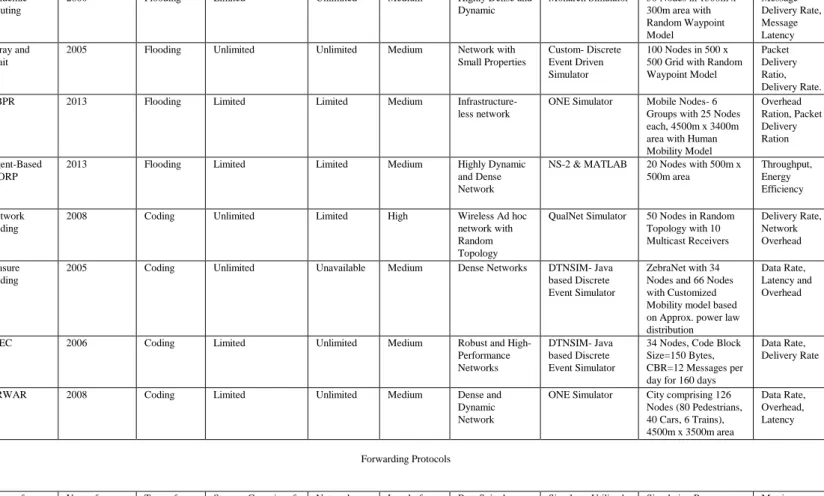
Table 2 provides an effective evaluation of various routing protocols on basis of varied characteristics like: Year of Development, Type of Routing, Storage Capacity of Nodes, Network Bandwidth Utilization, Level of Complexity, best suited network scenario, Simulator utilized for Testing, Simulation Parameters and metrics optimized for OPPNETs by respective protocols.
5.
MOBILITY
MODELS
AND
SIMULATION
TOOLS
FOR
OPPNETS
5.1. Mobility Models for OPPNETS
movement and even the obstacles. So, it is utmost important to determine the best mobility model to mirror real-time scenario for deployment of protocol.
The following points determine the properties of Mobility Models [63]:
Realism: It determines the degree of accuracy of mobility model with regard to nodes movement in real-time scenario. Higher the realism, better is mobility model determining the performance of overall network system in real-time scenario.
Diversification: It determines the ability of the model to scale up / flexible enough to work in different scenarios with varied types of nodes.
Complexity: It determines analysis of computational resources required to produce simulation traces. Various wireless propagation models drastically slow down overall network simulation.
The following are the Mobility Models used in OPPNETs: Random Walk: A simple mobility model based on
random directions and speeds. It was proposed to emulate the particles unpredictable movement in Physics.
Random Direction: A model that forces Mobile Nodes to travel to the edge of simulation area before making any change with regard to speed and direction. After the node, reaches the boundary of the simulation area and stops, the node can randomly and uniformly can choose another direction to travel. Under this mobility model, the nodes are distributed uniformly during simulation. Random Waypoint: It is most commonly used in
studying simulation. It was proposed by Johnson and Maltz and is regarded as “Benchmark” mobility model for evaluation of routing protocols in Mobile Adhoc Networks as it is very simple and available in almost all simulation tools. In this model, the nodes take a pause time to put changes in destination and speed.
Probabilistic Random Walk: Probabilistic model is variant of Random walk model. This model deploys probabilities to determine the next possible destination for the mobile node. Via different possibilities, the node calculates the new position and start moving towards the new position.
Boundless Simulation Area: A boundless simulation area model is one, that converts a 2-D rectangular simulation area into torus-shaped simulation area. This model has no limit or border for nodes to operate. But the nodes, might have obstacles in path with regard to speed and acceleration depending on the values. Gauss Markov Model: Gauss Markov model makes
use of one tuning parameter to vary the degree of randomness in mobility. This model makes use of random variables to estimate the speed, direction of the nodes at regular intervals of time. It can also create paths with varied directions at regular intervals of time. Voronoi Diagram Model: This model makes use of
Voronoi Graphs to design a movement environment for nodes. It defines movement channels rather than movement paths as this approach models the simulation environment in better way depicting the real-world
scenario. This model can map sidewalks, streets, building entrances, multistory buildings into realistic simulations.
RPGM (Reference Point Group Model): This model is used to simulate group behavior in network, where every node belongs to a group and every node follows the group leader to determine the overall behavior of group. In this model, all nodes use different mobility models and add them to reference point which drives them in direction of the group. This model is especially suitable for Battlefield monitoring, Disaster prone areas. Social Networks Interaction Model: It incorporates a
social community-based model, in which simulation area is divided into regions so that every node can move at any corner of the region with certain probability. City Section Model [64]: Under this model, the speed
limits and street directions are taken into account. The objective of this model is to determine the most optimal path between source and destination to minimize the travel time considering speed limitations.
Stop Sign Model [64]: Under this model, every vehicle has to stop at the signal for specified period of time. The vehicle cannot move unless the front vehicle moves. The primary objective of this mobility model is to estimate the impact of stop signs in order to estimate the performance of forwarding routing protocols. Probabilistic Traffic Sign Model [64]: It helps in
estimation of the operation of traffic signs by not coordinating with different directions. When any node reaches a stop sign with no vehicles, it stops for signal and continues on Green. Unless, there are other vehicles in front, the vehicle has to stop unless the ahead vehicles move. Under this model, there is no vehicle coordination while crossing an interaction from different directions.
Traffic Light Model [64]: This model facilitates better coordination at traffic lights and makes use of multiple lanes at different road categories.
5.2. Simulation Tools for OPPNETS
In this section of research paper, Simulation Tools suitable for evaluating OPPNETs are highlighted.
5.2.1. ONE Simulator [65, 66]:
ONE (Opportunistic Network Environment) Simulator was designed especially for simulating OppNets. It is agent based discrete event simulator, highly efficient for doing all sorts of routing simulations of OPPNETS using time slicing approach. It was developed at Aalto University in 2009 and now it is updated, maintained and supported jointly by Aalto University and Technische Universität München. ONE Simulator is fully equipped with map-based movement models and even supports import of mobility data from various external sources.
mode allows the users to run simulations at varied parameters. It is written purely in JAVA. Latest Version available as of April 2018 is 1.6.
5.2.2. Network Simulator 3 (NS-3) [67-71]:
Network Simulator 3 is discrete event simulator and was designed to provide open, extensible network simulation platform for performing research on networks specially IP-based networks with stress towards Network Layer and above layers in protocol stack. It is designed as combination of libraries that can be combined together with external software libraries. It makes use of C++ and Python languages to create simulation scenarios. It consists of “NetAnim” tool to provide node mobility visualizations and comes under GPLv2 license. NS-3 is completely open source and is an extension to NS-2 simulator.
For simulating OPPNETs, NS-3 is regarded as general-purpose simulator. The simulator can be configured to simulate the entire OPPNET scenario via Data Propagation protocol, traffic control, mobility and Link control etc. 5.2.3. OMNET++ [72, 73]:
OMNET++ is extensible, modular, object-oriented, public-source discrete event simulator based on C++ for simulating communication networks. OMNeT++ model comprise of modules that communicate with message passing. Active modules (Simple Modules) are written in C++ using simulation class library. Compound Modules looks after messages to be sent via connections.
Main features of OMNeT++ are: Modules are hierarchically nested; modules are instances of module types; modules link up with messages via channels; highly flexible parameters of modules; TDL (Topology Description Language).
OMNeT++ consists of framework- INET which comprise of tons of IP protocols well suitable for simulating various protocols of OPPNETs. Other frameworks which are designed especially for OPPNET are OPPONET, OppSim.
OPPONET: It provides mechanisms for simulating Delay Tolerant and Opportunistic networks in OMNeT++. It allows simulating open systems of wireless mobile nodes. It facilities simulation of UAVs OPPNETs. Under this framework, OPPNETS routing schemes are declassified into four tasks: Forwarder Candidate Selection, Forwarder Selection, Forwarder Role Change Notification and Collision Avoidance. OppSim: It is simulation framework built on MiXiM
framework designed especially for OPPNET simulation and has four layers: Application, Routing, MAC and PHY.
5.2.4. Adyton [74]:
Adyton is event-driven network simulator designed in C++ especially for Opportunistic networks for processing contact traces. It has no GUI interface and can run only on Linux. It was designed and developed by Nikolaos Papanikos and Dimitrios-Georgios Akestoridis, students of Department of Computer Science and Engineering at University of Ioannina, Greece under supervision of Prof. Evangelos Papapetrou. It has wide variety of supported routing protocols for OPPNETS like: Direct Delivery, Epidemic Routing, PRoPHET, SimBet, Bubble Rap, Spray and Wait, LSF Spray
and Wait, MSF Spray and Wait, PRoPHET Spray and Wait, LSF Spray and Focus, Compare and Replicate, Encounter-based Routing, Delegation Forwarding, Coordinated Delegation Forwarding, Optimal Routing. It also supports various congestion control mechanism and scheduling policies. It overcomes all the unique limitations of ONE Simulator.
6.
Conclusions and Future Scope
Opportunistic Networks are advanced networks belonging to the category of ad hoc networks. In this network, mobile nodes use the mechanism of “Store-and-Forward” to route the packets after coming in contact with each other. In this network, end to end connection is absent as there is no definite path between source node and destination node. All the routes are created in dynamic fashion and intermediate nodes perform the task of creating optimal paths for message delivery in short interval of time. In this research paper, we investigated the complete scenario of Opportunistic Networks with regard to Architecture, Applications, Issues and above all routing protocols surrounding OPPNETS. We analyzed and classified the routing protocols in various categories to determine which protocol is best in which type of OPPNET. The paper also includes all Mobility models as well as simulation tools available for OPPNETS, to give a strong base for researchers to undertake investigation and identify the best simulation tool without any hiccup for performing advanced research-based simulations in OPPNETS scenarios.
Future Scope
In near future, we tend to investigate existing routing protocols of OPPNETS on different simulation scenarios on ONE Simulator, NS-3 Simulator and Adyton simulator to measure the delivery rate, overhead rate and latency in network scenario. Our approach will be to design and propose a novel Swarm Intelligence or Machine Learning or Deep Learning based Routing protocol for OPPNETS to overcome the issue of Energy Utilization, Security, Latency and Delivery Delay in networks.
References
[1] G. Mohandas, S. Silas and S. Sam, "Survey on Routing Protocols on Mobile Adhoc Networks", International Multi-conference on Automation, Computing, Communication, Control and Compressed Sensing (IMAC4s), (2013) March; Kerala, India.
[2] G. Mohandas, S. Silas and S. Sam, "Survey on Routing Protocols on Mobile Adhoc Networks", International Multi-conference on Automation, Computing, Communication, Control and Compressed Sensing (IMAC4s), (2013) March; Kerala, India.
[3] M. J. Khabbaz, C. M. Assi and W. F. Fawaz, "Disruption-tolerant Networking: A Comprehensive Survey on Recent Developments and Persisting Challenge", Communications Surveys & Tutorials, vol. 14, no. 2, (2012).
[4] WenZhong, Y., ChuanHe, H., Bo, W., ZhenYu, Z., & Tong, W. (2010, June). A reliable multicast for MANETs based on opportunistic routing and network coding. In Wireless Communications, Networking and Information Security
(WCNIS), 2010 IEEE International Conference on (pp.