The Money Supply Process
FINC 402: MONETARY THEORY
Dr. Edward Asiedu
University of Ghana Business School,Department of Finance
Oce Hours: Wednesdays 11:00am - 12:00 noon (UGBS Graduate Campus, First Floor 1W10)
Email: [email protected]
The Money Supply Process
Outline
1 The Money Supply Process
Money Supply Process
The Money Supply Process Money Supply Process
Outline
1 The Money Supply Process
Money Supply Process
The Money Supply Process Money Supply Process
The Money Supply Process
The Central bank: Bank of Ghana
Banks: depository institutions; nancial intermediaries Depositors: individuals and institutions .
The Money Supply Process Money Supply Process
The Money Supply Process
The Central bank: Bank of Ghana
Banks: depository institutions; nancial intermediaries
Depositors: individuals and institutions .
The Money Supply Process Money Supply Process
The Money Supply Process
The Central bank: Bank of Ghana
Banks: depository institutions; nancial intermediaries Depositors: individuals and institutions .
The Money Supply Process Money Supply Process
The BoG's Balance Sheet
Bank of Ghana System
Assets Liabilities
Securities Currency in Circulation Loans to Financial Institutions Reserves
Liabilities
Currency in circulation: in the hands of the public Reserves: bank deposits at the BOG and vault cash
Assets
Government securities: holdings by the BOG that aect money supply and earn interest
Discount loans: provide reserves to banks and earn the discount rate
The Money Supply Process Money Supply Process
The BoG's Balance Sheet
Bank of Ghana System
Assets Liabilities
Securities Currency in Circulation Loans to Financial Institutions Reserves Liabilities
Currency in circulation: in the hands of the public Reserves: bank deposits at the BOG and vault cash
Assets
Government securities: holdings by the BOG that aect money supply and earn interest
Discount loans: provide reserves to banks and earn the discount rate
The Money Supply Process Money Supply Process
The BoG's Balance Sheet
Bank of Ghana System
Assets Liabilities
Securities Currency in Circulation Loans to Financial Institutions Reserves Liabilities
Currency in circulation: in the hands of the public Reserves: bank deposits at the BOG and vault cash
Assets
Government securities: holdings by the BOG that aect money supply and earn interest
Discount loans: provide reserves to banks and earn the discount rate
The Money Supply Process Money Supply Process
Control of the Monetary Base
High-powered money
MB = C + R
C = Currency in Circulation
R = total reserves in the banking system.
The Money Supply Process Money Supply Process
Control of the Monetary Base
High-powered money
MB = C + R
C = Currency in Circulation
R = total reserves in the banking system.
The Money Supply Process Money Supply Process
Control of the Monetary Base
High-powered money
MB = C + R
C = Currency in Circulation
R = total reserves in the banking system.
The Money Supply Process Money Supply Process
Open Market Purchase from Banks
Banking System
Assets Liabilities
Securities -Ghc 100m Reserves +Ghc 100m
Bank of Ghana System
Assets Liabilities
Securities +Ghc 100m Reserves +Ghc 100m
The Money Supply Process Money Supply Process
Open Market Purchase from Banks
Banking System
Assets Liabilities
Securities -Ghc 100m Reserves +Ghc 100m Bank of Ghana System
Assets Liabilities
Securities +Ghc 100m Reserves +Ghc 100m
The Money Supply Process Money Supply Process
Open Market Purchase from Banks
Net result is that reserves have increased by Ghc100
No change in currency
Monetary base has risen by Ghc100
The Money Supply Process Money Supply Process
Open Market Purchase from Banks
Net result is that reserves have increased by Ghc100 No change in currency
Monetary base has risen by Ghc100
The Money Supply Process Money Supply Process
Open Market Purchase from Banks
Net result is that reserves have increased by Ghc100 No change in currency
Monetary base has risen by Ghc100
The Money Supply Process Money Supply Process
Open Market Purchase: Summary
The eect of an open market purchase on reserves depends on whether the seller of the bonds keeps the proceeds from the sale in currency or in deposits.
. The eect of an open market purchase on the monetary base always increases the monetary base by the amount of the purchase.
The Money Supply Process Money Supply Process
Open Market Purchase: Summary
The eect of an open market purchase on reserves depends on whether the seller of the bonds keeps the proceeds from the sale in currency or in deposits.
. The eect of an open market purchase on the monetary base always increases the monetary base by the amount of the purchase.
The Money Supply Process Money Supply Process
Open Market Sale
Reduces the monetary base by the amount of the sale
Reserves remain unchanged
The eect of open market operations on the monetary base is much more certain than the eect on reserves.
The Money Supply Process Money Supply Process
Open Market Sale
Reduces the monetary base by the amount of the sale Reserves remain unchanged
The eect of open market operations on the monetary base is much more certain than the eect on reserves.
The Money Supply Process Money Supply Process
Open Market Sale
Reduces the monetary base by the amount of the sale Reserves remain unchanged
The eect of open market operations on the monetary base is much more certain than the eect on reserves.
The Money Supply Process Money Supply Process
Other Factors that Aect the Monetary Base
Float
Treasury deposits at the Bank of Ghana Interventions in the foreign exchange market
The Money Supply Process Money Supply Process
Other Factors that Aect the Monetary Base
Float
Treasury deposits at the Bank of Ghana
Interventions in the foreign exchange market
The Money Supply Process Money Supply Process
Other Factors that Aect the Monetary Base
Float
Treasury deposits at the Bank of Ghana Interventions in the foreign exchange market
The Money Supply Process Money Supply Process
Overview of The BoG's Ability to Control the Monetary Base
Open market operations are controlled by the BoG.
The BoG cannot determine the amount of borrowing by banks from the BoG.
Split the monetary base into two components:
MBn = MB - BR
The money supply is positively related to both the non-borrowed monetary base MBn and to the level of borrowed reserves, BR, from the BoG.
The Money Supply Process Money Supply Process
Overview of The BoG's Ability to Control the Monetary Base
Open market operations are controlled by the BoG.
The BoG cannot determine the amount of borrowing by banks from the BoG.
Split the monetary base into two components:
MBn = MB - BR
The money supply is positively related to both the non-borrowed monetary base MBn and to the level of borrowed reserves, BR, from the BoG.
The Money Supply Process Money Supply Process
Overview of The BoG's Ability to Control the Monetary Base
Open market operations are controlled by the BoG.
The BoG cannot determine the amount of borrowing by banks from the BoG.
Split the monetary base into two components:
MBn = MB - BR
The money supply is positively related to both the non-borrowed monetary base MBn and to the level of borrowed reserves, BR, from the BoG.
The Money Supply Process Money Supply Process
Overview of The BoG's Ability to Control the Monetary Base
Open market operations are controlled by the BoG.
The BoG cannot determine the amount of borrowing by banks from the BoG.
Split the monetary base into two components:
MBn = MB - BR
The money supply is positively related to both the non-borrowed monetary base MBn and to the level of borrowed reserves, BR, from the BoG.
The Money Supply Process Money Supply Process
Multiple Deposit Creation: A Simple Model
Deposit Creation: Single Bank
First National Bank
Assets Liabilities
Securities -Ghc 100m Loans +Ghc 100m
Reserves +Ghc 100m (borrowing from BoG) First National Bank
Assets Liabilities
Securities -Ghc 100m Checkable deposit +Ghc 100m Reserves +Ghc 100m
Loans +Ghc100m
The Money Supply Process Money Supply Process
Multiple Deposit Creation: A Simple Model
Deposit Creation: Single Bank First National Bank
Assets Liabilities
Securities -Ghc 100m Loans +Ghc 100m
Reserves +Ghc 100m (borrowing from BoG)
First National Bank
Assets Liabilities
Securities -Ghc 100m Checkable deposit +Ghc 100m Reserves +Ghc 100m
Loans +Ghc100m
The Money Supply Process Money Supply Process
Multiple Deposit Creation: A Simple Model
Deposit Creation: Single Bank First National Bank
Assets Liabilities
Securities -Ghc 100m Loans +Ghc 100m
Reserves +Ghc 100m (borrowing from BoG) First National Bank
Assets Liabilities
Securities -Ghc 100m Checkable deposit +Ghc 100m Reserves +Ghc 100m
Loans +Ghc100m
The Money Supply Process Money Supply Process
Multiple Deposit Creation: A Simple Model
First National Bank
Assets Liabilities
Securities -Ghc 100m Loans +Ghc 100m
Excess reserves increase
Bank loans out the excess reserves
Creates a checking account Borrower makes purchases The Money supply has increased
The Money Supply Process Money Supply Process
Multiple Deposit Creation: A Simple Model
First National Bank
Assets Liabilities
Securities -Ghc 100m Loans +Ghc 100m Excess reserves increase
Bank loans out the excess reserves
Creates a checking account Borrower makes purchases The Money supply has increased
The Money Supply Process Money Supply Process
Multiple Deposit Creation: A Simple Model
First National Bank
Assets Liabilities
Securities -Ghc 100m Loans +Ghc 100m Excess reserves increase
Bank loans out the excess reserves
Creates a checking account Borrower makes purchases The Money supply has increased
The Money Supply Process Money Supply Process
Multiple Deposit Creation: A Simple Model
First National Bank
Assets Liabilities
Securities -Ghc 100m Loans +Ghc 100m Excess reserves increase
Bank loans out the excess reserves
Creates a checking account Borrower makes purchases
The Money supply has increased
The Money Supply Process Money Supply Process
Multiple Deposit Creation: A Simple Model
First National Bank
Assets Liabilities
Securities -Ghc 100m Loans +Ghc 100m Excess reserves increase
Bank loans out the excess reserves
Creates a checking account Borrower makes purchases The Money supply has increased
The Money Supply Process Money Supply Process
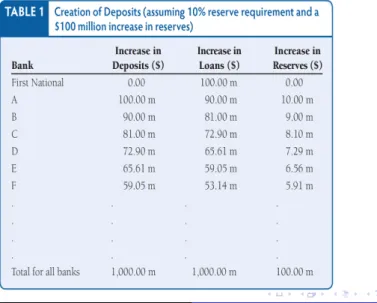
Table 1 Creation of Deposits (assuming 10% reserve
requirement and a $100 increase in reserves)
The Money Supply Process Money Supply Process
Deriving The Formula for Multiple Deposit Creation
Assuming banks do not hold excess reserves Required Reserve (RR) = Total Reserve (R)
RR = Required Reserve Ratio (r) times the total amount of checkable deposit (D)
Substituting
r * D = R
Dividing both side by r
D = 1
r * R
Taking the change in both sides yields 4D= 1r * 4R
The Money Supply Process Money Supply Process
Deriving The Formula for Multiple Deposit Creation
Assuming banks do not hold excess reserves Required Reserve (RR) = Total Reserve (R)
RR = Required Reserve Ratio (r) times the total amount of checkable deposit (D)
Substituting
r * D = R
Dividing both side by r
D = 1
r * R
Taking the change in both sides yields 4D= 1r * 4R
The Money Supply Process Money Supply Process
Deriving The Formula for Multiple Deposit Creation
Assuming banks do not hold excess reserves Required Reserve (RR) = Total Reserve (R)
RR = Required Reserve Ratio (r) times the total amount of checkable deposit (D)
Substituting
r * D = R
Dividing both side by r
D = 1
r * R
Taking the change in both sides yields 4D= 1r * 4R
The Money Supply Process Money Supply Process
Deriving The Formula for Multiple Deposit Creation
Assuming banks do not hold excess reserves Required Reserve (RR) = Total Reserve (R)
RR = Required Reserve Ratio (r) times the total amount of checkable deposit (D)
Substituting
r * D = R
Dividing both side by r
D = 1
r * R
Taking the change in both sides yields 4D= 1r * 4R
The Money Supply Process Money Supply Process
Critique of the Simple Model
Holding cash stops the process
Currency has no multiple deposit expansion
Banks may not use all of their excess reserves to buy securities or make loans.
Depositors' decisions (how much currency to hold) and bank's decisions (amount of excess reserves to hold) also cause the money supply to change.
The Money Supply Process Money Supply Process
Critique of the Simple Model
Holding cash stops the process
Currency has no multiple deposit expansion
Banks may not use all of their excess reserves to buy securities or make loans.
Depositors' decisions (how much currency to hold) and bank's decisions (amount of excess reserves to hold) also cause the money supply to change.
The Money Supply Process Money Supply Process
Critique of the Simple Model
Holding cash stops the process
Currency has no multiple deposit expansion
Banks may not use all of their excess reserves to buy securities or make loans.
Depositors' decisions (how much currency to hold) and bank's decisions (amount of excess reserves to hold) also cause the money supply to change.
The Money Supply Process Money Supply Process
Factors that Determine the Money Supply
Changes in the nonborrowed monetary base MBn
The money supply is positively related to the non-borrowed monetary base MBn
Changes in borrowed reserves from the Fed
The money supply is positively related to the level of borrowed reserves, BR, from the Fed
The Money Supply Process Money Supply Process
Factors that Determine the Money Supply
Changes in the nonborrowed monetary base MBn
The money supply is positively related to the non-borrowed monetary base MBn
Changes in borrowed reserves from the Fed
The money supply is positively related to the level of borrowed reserves, BR, from the Fed
The Money Supply Process Money Supply Process
Factors that Determine the Money Supply
Changes in the required reserves ratio
The money supply is negatively related to the required reserve ratio.
Changes in currency holdings
The money supply is negatively related to currency holdings.
Changes in excess reserves
The money supply is negatively related to the amount of excess reserves.
The Money Supply Process Money Supply Process
Factors that Determine the Money Supply
Changes in the required reserves ratio
The money supply is negatively related to the required reserve ratio.
Changes in currency holdings
The money supply is negatively related to currency holdings.
Changes in excess reserves
The money supply is negatively related to the amount of excess reserves.
The Money Supply Process Money Supply Process
Factors that Determine the Money Supply
Changes in the required reserves ratio
The money supply is negatively related to the required reserve ratio.
Changes in currency holdings
The money supply is negatively related to currency holdings.
Changes in excess reserves
The money supply is negatively related to the amount of excess reserves.
The Money Supply Process Money Supply Process
Overview of the Money Supply Process
The Money Supply Process Money Supply Process
The Money Multiplier
Dene money as currency plus checkable deposits:
M1 Link the money supply (M) to the monetary base (MB) and let m be the money multiplier
M = m * MB
The Money Supply Process Money Supply Process
The Money Multiplier
Dene money as currency plus checkable deposits:
M1 Link the money supply (M) to the monetary base (MB) and let m be the money multiplier
M = m * MB
The Money Supply Process Money Supply Process
The Money Multiplier
Dene money as currency plus checkable deposits:
M1 Link the money supply (M) to the monetary base (MB) and let m be the money multiplier
M = m * MB
The Money Supply Process Money Supply Process
Deriving the Money Multiplier
Assume that the desired holdings of currency C and excess reserves ER grow proportionally with checkable deposits D.
Then,
c = {C/D} = currency ratio e = {ER/D} = excess reserves ratio
The Money Supply Process Money Supply Process
Deriving the Money Multiplier
Assume that the desired holdings of currency C and excess reserves ER grow proportionally with checkable deposits D. Then,
c = {C/D} = currency ratio e = {ER/D} = excess reserves ratio
The Money Supply Process Money Supply Process
Deriving the Money Multiplier
The total amount of reserves (R) equals the sum of the required reserve (RR) and the excess reserve
R = RR + ER
The total amount of required reserves (RR) equals the required reserve ratio (r) times the amount of checkable deposits
RR = r * D
Substituting for RR in the rst equation
R = (r * D) + ER
The Fed sets r to less than 1
The Money Supply Process Money Supply Process
Deriving the Money Multiplier
The total amount of reserves (R) equals the sum of the required reserve (RR) and the excess reserve
R = RR + ER
The total amount of required reserves (RR) equals the required reserve ratio (r) times the amount of checkable deposits
RR = r * D
Substituting for RR in the rst equation
R = (r * D) + ER
The Fed sets r to less than 1
The Money Supply Process Money Supply Process
Deriving the Money Multiplier
The total amount of reserves (R) equals the sum of the required reserve (RR) and the excess reserve
R = RR + ER
The total amount of required reserves (RR) equals the required reserve ratio (r) times the amount of checkable deposits
RR = r * D
Substituting for RR in the rst equation
R = (r * D) + ER
The Fed sets r to less than 1
The Money Supply Process Money Supply Process
Deriving the Money Multiplier
The total amount of reserves (R) equals the sum of the required reserve (RR) and the excess reserve
R = RR + ER
The total amount of required reserves (RR) equals the required reserve ratio (r) times the amount of checkable deposits
RR = r * D
Substituting for RR in the rst equation
R = (r * D) + ER
The Fed sets r to less than 1
The Money Supply Process Money Supply Process
Deriving the Money Multiplier
The monetary base MB equals currency (C) plus reserves (R):
MB = C + R = C + (r x D) + ER
Equation reveals the amount of the monetary base needed to support the existing amounts of checkable deposits, currency and excess reserves.
The Money Supply Process Money Supply Process
Deriving the Money Multiplier
The monetary base MB equals currency (C) plus reserves (R):
MB = C + R = C + (r x D) + ER
Equation reveals the amount of the monetary base needed to support the existing amounts of checkable deposits, currency and excess reserves.
The Money Supply Process Money Supply Process
Deriving the Money Multiplier
c = (C / D) ⇒ C = c * D and e = (ER / D) ⇒ ER = e * D
Substituting in the previous equation
MB = (r * D) + (e * D) + (c * D) = ( r + e + c) * D
Dividing both sides by the term in parentheses
D = 1
(r+e+c) *MB
M = D + C and C = c * D M = D + (c * D) = (1 + c) *D
Substituting again
M = 1+c
(r+e+c) *MB The money multiplier is then
m = 1+c (r+e+c)
The Money Supply Process Money Supply Process
Deriving the Money Multiplier
c = (C / D) ⇒ C = c * D and e = (ER / D) ⇒ ER = e * D Substituting in the previous equation
MB = (r * D) + (e * D) + (c * D) = ( r + e + c) * D
Dividing both sides by the term in parentheses
D = 1
(r+e+c) *MB
M = D + C and C = c * D M = D + (c * D) = (1 + c) *D
Substituting again
M = 1+c
(r+e+c) *MB The money multiplier is then
m = 1+c (r+e+c)
The Money Supply Process Money Supply Process
Deriving the Money Multiplier
c = (C / D) ⇒ C = c * D and e = (ER / D) ⇒ ER = e * D Substituting in the previous equation
MB = (r * D) + (e * D) + (c * D) = ( r + e + c) * D
Dividing both sides by the term in parentheses
D = 1
(r+e+c) *MB
M = D + C and C = c * D M = D + (c * D) = (1 + c) *D
Substituting again
M = 1+c (r+e+c) *MB The money multiplier is then
m = 1+c (r+e+c)
The Money Supply Process Money Supply Process
Intuition Behind the Money Multiplier
r = required reserve ratio = 0.10 C = currency in circulation Ghc400B D = chekable deposits Ghc800B ER = excess reserves Ghc0.8B
M = money supply (M1) = C + D = Ghc1200B
c = Ghc400B Ghc800B = 0.5
e = Ghc0.8B
Ghc800B = 0.001
m = 1+0.5
0.1+0.001+0.5 = 01.601.5 = 2.5
This is less than the simple deposit multiplier. Although there is multiple expansion of deposits, there is no such expansion for currency
The Money Supply Process Money Supply Process
Intuition Behind the Money Multiplier
r = required reserve ratio = 0.10 C = currency in circulation Ghc400B D = chekable deposits Ghc800B ER = excess reserves Ghc0.8B
M = money supply (M1) = C + D = Ghc1200B
c = Ghc400B Ghc800B = 0.5
e = Ghc0.8B
Ghc800B = 0.001
m = 1+0.5
0.1+0.001+0.5 = 01.601.5 = 2.5
This is less than the simple deposit multiplier. Although there is multiple expansion of deposits, there is no such expansion for currency
The Money Supply Process Money Supply Process
Intuition Behind the Money Multiplier
r = required reserve ratio = 0.10 C = currency in circulation Ghc400B D = chekable deposits Ghc800B ER = excess reserves Ghc0.8B
M = money supply (M1) = C + D = Ghc1200B
c = Ghc400B Ghc800B = 0.5
e = Ghc0.8B
Ghc800B = 0.001
m = 1+0.5
0.1+0.001+0.5 = 01.601.5 = 2.5
This is less than the simple deposit multiplier. Although there is multiple expansion of deposits, there is no such expansion for currency
The Money Supply Process Money Supply Process
Intuition Behind the Money Multiplier
r = required reserve ratio = 0.10 C = currency in circulation Ghc400B D = chekable deposits Ghc800B ER = excess reserves Ghc0.8B
M = money supply (M1) = C + D = Ghc1200B
c = Ghc400B Ghc800B = 0.5
e = Ghc0.8B
Ghc800B = 0.001
m = 1+0.5
0.1+0.001+0.5 = 01.601.5 = 2.5
This is less than the simple deposit multiplier. Although there is multiple expansion of deposits, there is no such expansion for currency
The Money Supply Process Money Supply Process
Intuition Behind the Money Multiplier
r = required reserve ratio = 0.10 C = currency in circulation Ghc400B D = chekable deposits Ghc800B ER = excess reserves Ghc0.8B
M = money supply (M1) = C + D = Ghc1200B
c = Ghc400B Ghc800B = 0.5
e = Ghc0.8B
Ghc800B = 0.001
m = 1+0.5
0.1+0.001+0.5 = 01.601.5 = 2.5
This is less than the simple deposit multiplier. Although there is multiple expansion of deposits, there is no such expansion for currency
The Money Supply Process Money Supply Process
Quantitative Easing and the Money Supply, 2007-2014
When the global nancial crisis began in the fall of 2007, the Fed initiated lending programs and large-scale asset-purchase programs in an attempt to bolster the economy.
By June 2014, these purchases of securities had led to a quintupling of the Fed's balance sheet and a 377% increase in the monetary base.
The Money Supply Process Money Supply Process
Quantitative Easing and the Money Supply, 2007-2014
When the global nancial crisis began in the fall of 2007, the Fed initiated lending programs and large-scale asset-purchase programs in an attempt to bolster the economy.
By June 2014, these purchases of securities had led to a quintupling of the Fed's balance sheet and a 377% increase in the monetary base.
The Money Supply Process Money Supply Process
Quantitative Easing and the Money Supply, 2007-2014
These lending and asset-purchase programs resulted in a huge expansion of the monetary base and have been given the name quantitative easing.
This increase in the monetary base did not lead to an
equivalent change in the money supply because excess reserves rose dramatically
The Money Supply Process Money Supply Process
Quantitative Easing and the Money Supply, 2007-2014
These lending and asset-purchase programs resulted in a huge expansion of the monetary base and have been given the name quantitative easing.
This increase in the monetary base did not lead to an
equivalent change in the money supply because excess reserves rose dramatically
The Money Supply Process Money Supply Process
Figure 1 M1 and the Monetary Base, 2007-2014
Source: Federal Reserve Bank of St. Louis, FRED database: http://research.stlouisfed.org/fred2/.
The Money Supply Process Money Supply Process
Figure 2 Excess Reserves Ratio and Currency Ratio,
2007-2014
Source: Federal Reserve Bank of St. Louis, FRED database: http://research.stlouisfed.org/fred2/.Dr. Edward Asiedu Monetary Theory 2017\2018