SERIAL HISTORIOGRAPHY: LITERATURE, NARRATIVE HISTORY, AND THE ANXIETY OF TRUTH
James Benjamin Bolling
A dissertation submitted to the faculty at the University of North Carolina at Chapel Hill in partial fulfillment of the requirements for the degree of Doctor of Philosophy
in the Department of English and Comparative Literature.
Chapel Hill 2016
Approved by: Minrose Gwin Jennifer Ho
©2016
ABSTRACT
Ben Bolling: Serial Historiography: Literature, Narrative History, and the Anxiety of Truth (Under the direction of Megan Matchinske)
Dismissing history’s truths, Hayden White provocatively asserts that there is an “inexpugnable relativity” in every representation of the past. In the current dialogue between literary scholars and historical empiricists, postmodern theorists assert that narrative is enclosed, moribund, and impermeable to the fluid demands of history. My critical intervention frames history as a recursive, performative process through historical and critical analysis of the narrative function of seriality. Seriality,
through the material distribution of texts in discrete components, gives rise to a constellation of entimed narrative strategies that provide a template for human experience. I argue that serial form is both fundamental to the project of history and intrinsically subjective. Rather than foreclosing the historiographic relevance of storytelling, my reading of serials from comic books to the fiction of William Faulkner foregrounds the possibilities of narrative to remain open, contingent, and responsive to the potential fortuities of historiography. In the post-9/11 literary and historical landscape, conceiving historiography as a serialized, performative
ACKNOWLEDGEMENTS
Foremost I would like to thank my dissertation director Megan Matchinske for her unwavering support, friendship, and serial challenges to advance this project. I am profoundly indebted to the members of my dissertation committee, Minrose Gwin, Jennifer Ho, John McGowan, and Timothy Marr; the guidance and
encouragement of this group of scholars have made me a better academic and hopefully a better person.
My sincerest thanks to all of the faculty in the University of North Carolina at Chapel Hill’s Department of English and Comparative Literature and Department American Studies for your ongoing feedback on this project. I am particularly
grateful for the counsel I received from Reid Barbour, Tyler Curtain, Florence Dore, Connie C. Eble, Randall Kenan, Michelle Robinson, Beverly Taylor, Matthew Taylor, Todd Taylor, and Jane F. Thrailkill.
This project was completed with the generous support of a Frankel
Dissertation Fellowship from UNC-CH’s Department of English and Comparative Literature, the Jacob K. Javits Fellowship from the U.S. Department of Education, and a Graduate Research Fellowship from UNC-CH’s Program in Sexuality Studies.
responses to drafts of this material. Without the perpetual engagement of some of my best good Judys this project may not exist, so sincerest thanks go to Meagan Blair and Harry Thomas for your friendship. Heath Sledge was a loyal writing companion and a phenomenal editor.
Much of my comics studies research is indebted to friends and coworkers at Ultimate Comics in Durham, North Carolina. For those of us working in the popular arts, comics specialty shop employees often serve as research librarians. As such, this project is indebted to Patrick Gill, Thomas Haire, Marta Mickelson, Chuck Mikitin, Jack Pileggi, Jeremy Tarney, Christopher Winfield, and Jenny Valle. I also owe a debt of gratitude to Tommy Lee Edwards, Bo Fader, Brockton McKinney, Tyler Wehrwein, and everyone involved with NC Comicon for providing a dynamic experience that has shaped my research of the popular arts. I would especially like to thank Alan Gill for his infectious love of comics and for including me in
numerous popular media events (and providing me a job during the dark-night-of-the-soul period of my graduate education).
Lauren Du Graf has been a stalwart supporter, friend, and colleague throughout this project; this work is shaped by our dialectic conversations. My deepest gratitude also goes to Sarah Allen whose feedback, encouragement, and humor kept me focused throughout this project and the last fifteen years of our friendship.
TABLE OF CONTENTS
LIST OF FIGURES………vi
INTRODUCTION: THE LAW OF SERIALITY………..1
CHAPTER 1: SERIAL HISTORIOGRAPHY: NARRATIVE, TRUTH, AND THE IRREDUCIBLE ELEMENTS OF THE PAST………7
CHAPTER 2: NARRATIVE RE-VISION: THE ENGINE OF SERIAL HISTORIOGRAPHY………...………...……..52
The Gutter………...…...54
On the Deadness of the Past………...…………...…83
We Need to Talk About Matt……….………….101
CHAPTER 3: ON THE MAKE: TRUMAN CAPOTE, SERIALITY, AND THE PERFORMANCE OF CELEBRITY………...……….118
CHAPTER 4: “WHERE THE STORY LIVES”: BIG STONE GAP AND THE SERIALITY OF PLACE……….……….…149
LIST OF FIGURES
Figure 1.1- The polylogic text…..………35 Figure 1.2- Martha Wayne’s pearls in Batman #1 (1940),
The Dark Knight Returns (1986), Tim Burton’s Batman (1989), the animated adaptation of Batman: Year One (2011), the television series Gotham (2014-), and the animated film
Batman: The Dark Returns Part 1 (2012)..………..……41 Figure 2.1- The universality of cartoon imagery by
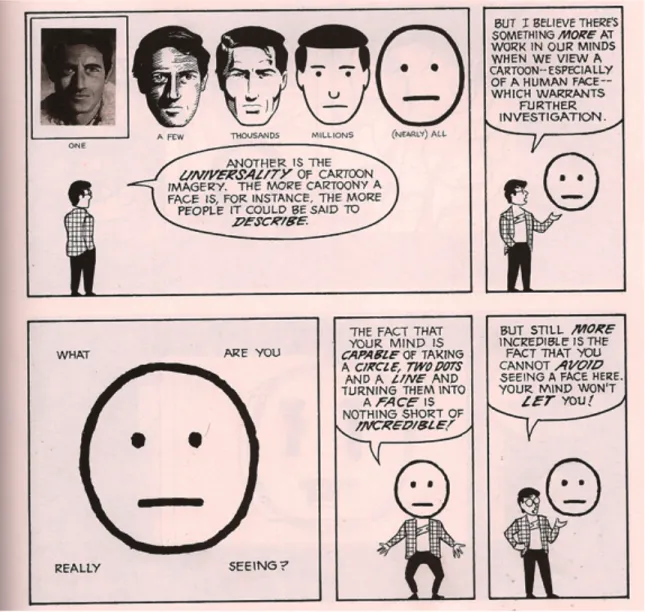
Scott McCloud in Understanding Comics………55 Figure 2.2- McCloud discusses the reader’s agency
in Understanding Comics ………..…..………56 Figure 2.3- The negotiation of time, space, and narrative
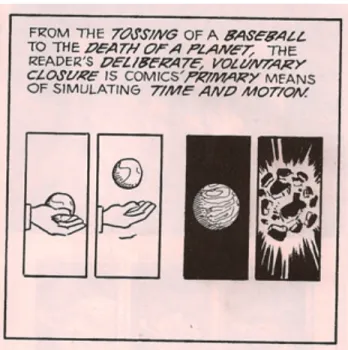
in McCloud’s Understanding Comics.……….………57 Figure 2.4- Images of Spider-Man’s unmasking from the
cover of Civil War Front Line #2, the interior of Civil War Front Line #2, the interior of Civil War,
and the cover of Civil War The Amazing Spider-Man……….…………69 Figure 4.1- Roadside sign welcoming visitors to Big Stone Gap…….………151 Figure 4.2- Photo collage of Big Stone Gap businesses.………..………153 Figure 4.3- Photo of Lonesome Pine painting in window of
a Big Stone Gap business. ………..………171 Figure 4.4- Photo of sign welcoming visitors to John Fox, Jr.
Museum and photo of exterior of John Fox, Jr. Museum……….…173 Figure 4.5- Promotional brochures for 1964 and contemporary
productions of The Trail of the Lonesome Pine
Outdoor Drama. ……….………175 Figure 4.6- Advertisement for June Tolliver House and Craft Shop
and photo of the June Tolliver House in 2010.……….……….………176 Figure 4.7- Photos of Ben Bolling with Jack McClanahan in
Patrick Wilson on the set of Big Stone Gap.……….…….…185 Figure 4.8- Photo of banner above L. J. Horton Florist in
downtown Big Stone Gap ………..………186 Figure 4.9- Cover of “The Big Stone Gap Map” and inside
listing of area locations mentioned in Trigiani’s novel
Big Stone Gap………..………187 Figure 4.10- Photos of the “real” Carmine’s, empty Big Stone Gap
gas station, and conversion of the gas station to
Big Stone Gap set piece Carmine’s.………...…189 Figure 4.11- Screencap of Adriana Trigiani’s Facebook post
telling the design story of the set piece Carmine’s and photo of R.W. Lindholm Service Station in Cloquet,
INTRODUCTION: THE LAW OF SERIALITY
As I finished drafting this project, Walt Disney Studios released Star Wars: Episode VII- The Force Awakens. At the time of this writing, the movie has
generated global box office revenue approaching two billion U.S. dollars, becoming the third highest-grossing film of all time (McClintock). The Force Awakens has permeated the marketplace with apps, action figures, clothing, video games, comics, fan-generated content, and more things than I can begin to account for here. In the contemporary moment, I can think of few texts that are more resonant in American popular culture. So it wasn’t surprising when, on different occasions during the months-long marketing build-up to the release of The Force Awakens, I found myself talking with parents of young kids about Star Wars literacy.
then circle back to what is commonly called the “prequel trilogy” kicked off by 1999’s Episode I- The Phantom Menace before returning to The Force Awakens. Viewers who prize continuity maintain that the films should be screened in chronological order beginning with Episode I. Still others question the place of feature-length films at the edge of the metanarrative like the 1984 made-for-TV Caravan of Courage: An Ewok Adventure (that saw theatrical release in Europe) or the truly bizarre Star Wars Holiday Special that has become a cult classic following its single televised broadcast in 1978.
In the first chapter, I define seriality as “the material distribution of a unified narrative in discrete components” and argue that this phenomenon is not historical, but rather a timeless function of narrative that transcends critical and aesthetic distinctions between high and low forms. The composition of this project, like most academic discourse, has been serial in nature. Each chapter has been consumed by different audiences, some with access to other installments in the project, others with only one piece of the overall argument. Considering the chorus of voices who have responded to this work as it was written, readers have rarely taken issue with my definition of “seriality,” but a number of respondents have questioned the boundaries of a serial’s resonance or, simply put, what determines which stories comprise a serial’s metanarrative. As I discuss in detail in chapters 1 and 2, because seriality requires the consumer’s active engagement to bridge a spatial/temporal gap between texts, the serial narrative is unrestrained.
their consumption. The Holiday Special and The Force Awakens are both
constituent stories in the Star Wars metanarrative, the canonicity of each narrative only mediated by its resonance (which Wai Chee Dimock describes as a text’s “timeful unwieldiness” as it generates new meanings moving through space-time, traversing semantic networks) (1062). Resonant stories vibrate across disparate media, forging narrative links like synaptic connections. Minority readings are no less valid than any sort of communal consensus. Furthermore, George Lucas may offer a recommended viewing order for Star Wars films, the Council of Trent may proscribe the canon of Christian biblical texts, and literary scholars may discount The Plowman’s Tale as apocryphal within Chauncer’s Canterbury Tales, but rules for consumption generated by textual producers, critics, scholars, and among communities of consumers are only guides, not fundamental laws of media consumption.
-century proliferation of transmedia seriality, I contend that the dispersion of a unifiable narrative across multiple delivery channels is not a historically bound phenomenon. From classical pottery depicting stories from the Iliad and the Odyssey “with marked deviations from Homer’s narrative” to the wide array of public performances, paraphernalia, and unsanctioned sequels that accompanied Samuel Richardson’s 18th-century novel Pamela, serialized stories have always been capable of resonating across media platforms (Birch 5; Fysh 58-60). The
proliferation of media platforms in the 20th and early 21st centuries have, however, provided a means for consumers to engage serial narratives across more dialogic networks than ever before.
But ultimately the question at the heart of most concerns about what is included in the canon of a serial’s metanarrative is a question of authority. Who chooses what is a constituent part of a serial and what is not? Again, I find
The first section of this project outlines the theoretical and narratological parameters of serial historiography across media, forms, and genres. My analysis of the sprawling, transmedia Batman mythos and the popular 2014 podcast Serial suggests that all serialized texts draw our attention to the irreducible elements of their telling. They persistently return us to the truth claims that order their narrative worlds, at once undermining the ontological certainty of the event (i.e. a definitive telling) while honoring that truth claim’s timeful unwieldiness. I argue that
serialized discourse has a unique ability to acknowledge the complexity of historical referents in human time, figuring truth as history is represented in narrative rather than truth as history happens in space-time. In my second chapter, I consider common narrative strategies among three uncommon serial metanarratives: Marvel Comics’ Civil War, William Faulkner’s Yoknapatawpha, and the Tectonic Theater Project’s The Laramie Project Cycle. Analysis of these diverse serial constructs reveals discursive forms that are self-aware of their representational limits and the ineffability of a totalized understanding of time while acknowledging the impact of communal and individual memory on narratives of the past.
Chapter three pivots to examine performance and the serialized accrual of narrative in the transmedia celebrity construct of Truman Capote. Through historical and literary analysis of texts ranging from the travelogue The Muses are Heard, the profile of Marlon Brando in “The Duke in His Domain,” and the nonfiction novel In Cold Blood, I argue that Capote’s most enduring text is his celebrity—an embodied serial that may be read as the performance of his “unfinished masterpiece”
narrative identity, and place in Big Stone Gap, Virginia, a small Appalachian town that resonates through American literature and popular culture in texts like John Fox’s, Jr.’s novel The Trail of the Lonesome Pine, the films and theatre inspired by Fox’s work, and most recently Adriana Trigiani’s series of popular novels and her feature film Big Stone Gap. Fox was a key progenitor of the “hillbilly” stereotype and as his popular portrayals of Appalachian people accrued narrative gravity, the place of Big Stone Gap offers a sight for exploring the impact that stories have on conceptions of individual, ethnic, and regional identities over time. The long arc of the project analyzes the theoretical parameters of seriality and expands the corpus of texts and performances we may read as serials to examine how each of us is an embodied serial, imbricated in an expanding network of intersectional narratives that shape conceptions of self, place, and time.
Ultimately, my dissertation argues that history is a form of literature, but narrative history’s constructedness does not necessitate the total foreclosure of history’s claims to truth. Rather by refiguring truth as history is told rather than truth as history happens, we foreground critical analysis of the act of telling as an integral part of historiography. In fact, by examining some of the representational possibilities engendered by seriality in other forms of literature, it is my aim as an interdisciplinary scholar dually invested in history’s claims of epistemological veracity as well as narratology’s anxieties of representation, to refigure
historiography as an ongoing, open-ended enterprise of human knowledge
CHAPTER 1: SERIAL HISTORIOGRAPHY: NARRATIVE, TRUTH, AND THE IRREDUCIBLE ELEMENTS OF THE PAST
To characterize conversations between postmodern theorists of history and historical empiricists as a dialogue or even a debate is misleading. Since the 1990s, scholars in opposing camps have squared off as theorists and historians in a
recursive, intractable exchange regarding the communion of history and truth.1 As the firebrand of postmodern historiography, Hayden White exemplifies the theorists’ perspective, dismissing history’s claims to objective truth by asserting that there is an “inexpugnable relativity in every representation of historical phenomena” (“Historical Emplotment” 37). White expands the critique of history’s ability to objectively record or represent truths of the past beyond Jean-François Lyotard’s grands récits (i.e. hegemonic grand narratives such as Progress, Marxism, and Enlightenment emancipation that order cultural knowledge). For White,
“historiography is a species of the genus narrative” and “narrative is an expression in discourse of a distinct mode of experience and thinking about the world, its
1 Some prominent interchanges that typify the trend include those between Perez Zagorin
and Frank Ankersmit in History and Theory from 1989 to 1990, the volleys among Carlo Ginzburg, Hayden White, and Martin Jay in Saul Friedländer’s seminal 1992
collection Probing the Limits of Representation: Nazism and the "Final
Solution," Georg Iggers and White in the pages of Rethinking History in 2000, and
structures, and its processes” (Fiction of Narrative 112, 274). Simply put, every narrative is someone’s grand récit— enclosed, limited, and incomplete.
In the face of postmodernist critique, historians champion disciplinary and methodological convictions to fend off the twin anxieties of narrative
constructivism and inherent bias. These historians claim that theorists have no practical knowledge of history as praxis; theorists ignore unique research and composition methods intrinsic to the practice of history by flattening all knowledge into forms of literary production, in the process opening history to a range of anxieties regarding the impossibility of representation in the wake of the linguistic turn (Sarkar 293-296). For Perez Zagorin, postmodernism and its jumble of
tangential philosophies are the purview of literary scholars while “history, by contrast has shown itself to be considerably more resistant to postmodernist trends” (“History, Referent, and Narrative” 70). And indeed, through quantitative and critical analysis of responses to White’s body of scholarship, Richard Vann and others2 conclude that contemporary historians regard White as “a decidedly
marginal figure” and that overall, postmodern narrative theory has had little effect on the praxis of writing history (Finney 103-104). The fundamental stance of historians is perhaps best enacted in a quotation of a quotation when Zagorin notes:
2 In “The Reception of Hayden White” Vann provides quantitative analysis of historians’
To all appearances, the prevailing attitude of historians in the United States might be typified in the statement made in 1994 by Bernard Bailyn, a leading senior scholar of early American history, that “the accuracy and adequacy of representations of past actualities, the verisimilitude or closeness to fact of what is written about them, remain the measure, in the end, of good history…” (“History, Referent, and Narrative” 70).
The theorist/historian dichotomy in which scholars repetitively (in the words of Jenkins) “speak past each other,” fails to assuage anxieties about the legitimacy of history’s claims to an objective truth or steer historiography toward a praxis more responsive to the ever-elusive past figured by postmodernists (70). So I suggest we reconsider the concept at the heart of this ideological conflict: narrative.
In the pages that follow, I seek a middle ground between “historians” and “theorists” by expanding the postmodernist characterization of narrative to illustrate that narrative history is always incomplete and biased, but may still remain open and responsive to the raucous demands of an ephemeral past. Let me be clear, like White and other postmodern theorists, I believe that historiography is a species of narrative and narrative is inherently fragmentary and limited in its representational capacity. But unlike many postmodernists, I contend that the disavowal of narrative history is a dismissal of narrative narrowly defined—narrative as a hermetic
My critical intervention reframes narrative history as a recursive, but
productive process through analysis of the narrative function of seriality. Seriality, the material distribution of texts in discrete components, gives rise to a constellation of entimed narrative strategies that provide a template for representing human experience through self-conscious attention to what Paul Ricouer terms “narrative identities” (274). Ricouer argues in the three volumes of Time and Narrative that the phenomenology of time unveils innumerable aporias (e.g. failures in the
representational power of language, gaps in historical accounts, logical disjunctions, etc.) that may only be untangled via the imposition of ordered human thought, specifically the “indirect discourse of narration” (241). But for Ricouer, narrative does not resolve the aporias in the phenomenology of time; narrative may identify aporias as sights of human inquiry, but time as signified always escapes the human “will to mastery” (261). Our inability to represent the communion of time and human experience via language need not precipitate a wholesale disavowal of narrative in the face of time’s ontological elusiveness, however (274). Ricoeur suggests that “the idea of the unity of history, with its ethical and political implications” may be rescued from epistemological overreach in a form that lays bare the “limits of its validity,” namely the “narrative identities” of the individuals and communities who shape and receive a unified history-narrative (274).
sense of being a subject as a “fundamentally dialogic” structure of witnessing— a productive tension between subject-position (i.e. our changeable relations to culture, politics, and circumstance) and a sense of agency tantamount to one’s capacity to respond to otherness (81-82). To unpack the concept of witnessing, Oliver draws upon the research of psychoanalyst Dori Laub, providing a provocative example in which an Auschwitz survivor gives an eyewitness account of four chimneys
exploding during a prisoner uprising (83). Historians participating in the Video Archive for Holocaust Testimonies at Yale insist that the eyewitness account is irrelevant and unreliable; the factual record asserts that only one chimney was destroyed during the failed rebellion (83). However, Laub and Oliver argue that the witness’s testimony is significant because it speaks to something ineffable: the radical possibility of resistance in the camps in which “[s]eeing the impossible— what did not happen—gave [the eyewitness] the strength to make what seemed impossible possible, surviving the Holocaust” (83). In this instance, by considering the socio-historical subject-position of the witness, we may learn something other than the factual “truth” that is nonetheless invaluable in achieving a more fulsome understanding of the past (84).
talking to others” (83). Recall that White defines narrative as “an expression in discourse of a distinct mode of experience and thinking about the world, its
structures, and its processes” (Fiction of Narrative 274). I contend that this “distinct mode of experience and thinking” is described more robustly by Oliver’s inner witness, the subject’s experience of itself as subject. The jumble of experiences and perceptions that we order in our accounts of human time do not constitute time as it is, but time as experienced by a narrative identity. So on the most basic level, I define narrative as the imposition of human time via the act of inner witnessing (complete with the aporias intrinsic to narrative identity) onto space-time.
Building from Oliver’s conception of the experience of human subjectivity as a dialogical, recursive witnessing, I argue that we are each of us embodied serials: loci of constantly shifting, separate, but interrelated narratives—stories we tell ourselves about ourselves and the world, stories others tell us, stories we tell others, down to the genetic stories encoded in our DNA. Recent cognitive and neuroscientific research in memory grounds my analysis of narrative identities and embodied seriality.
An increasing collection of research3 posits that memories are far from the unchanging impressions on the wax tablet of the mind that Plato describes in The
3 As early as 1968, Donald Lewis and other researchers presented the results of an
Theaetetus—a conception of memory that has remained dominant in the popular and scientific imagination for centuries (Burnyeat 90-94). In a finding published in 2000 in the journal Nature, Karim Nader asserts that memories are not forged and
immaculately preserved (722-726). Rather, memories are constructed anew each time they are accessed by the brain. Nader’s colleague, neuroscientist Joseph Le Doux, explains that “[t]he brain isn’t interested in having a perfect set of memories about the past. Instead, memory comes with a natural updating mechanism, which is how we make sure that the information taking up valuable space inside our head is still useful” (Lehrer). So that seemingly pristine memory of my first encounter with the transmedia construct called Batman—replete with flashes of Michael Keaton and Jack Nicholson on the screen of a rural Tennessee movie theatre, the denim jacket with a Batman-logo button (ubiquitous in the summer of 1989) that would go missing next school year, the thrill of having talked my parents into a PG-13 movie —is not a film, a fixed, unchanging representation of the past digitally imprinted on a hard drive called the mind. Instead each time I call upon my knowledge of this past moment, the mind presents something more like a stage play, creating, re-presenting with nuanced differences the information that constitutes the memory. In
first decade of the twenty-first century. Ingie Hong, et al.’s "AMPA Receptor Exchange Underlies Transient Memory Destabilization on Retrieval" (2013) and Roger Pitman, et al.’s "Systemic Mifepristone Blocks Reconsolidation of Cue-Conditioned Fear;
a subtle dance of proteins, “every time we think about the past we are delicately transforming its cellular representation in the brain, changing its underlying neural circuitry” (Lehrer). This paradigm termed dynamic recollection exemplifies on an individual, neuro-psychological level, the recursive nature of our own narrative identities and perhaps a more ‘accurate' and ‘authentic' accounting of historical truth by virtue of that fidelity to human memorialization. So rather than claiming a
totalized knowledge via mastery of time, seriality foregrounds the contingency of human memory, understanding, and to borrow White’s terminology—the content of the form, the implicit meaning and biases that all narrative displays through
valuation of received research and composition methodologies including representational strategies, emplotments, and philosophies that govern the presentation of evidence as truth.
Historians may balk at theoretical analysis of the form of history not only due to the scrutiny such analysis brings to potential ideological biases, but because narrative constructivist arguments seemingly strip history of any special correlation with truth. I contend that history is a form of literature, but narrative history’s
constructedness does not necessitate the total foreclosure of history’s claims to truth. Rather by refiguring truth as history is told rather than truth as history happens, we foreground critical analysis of the act of telling as an integral part of historiography. In fact, by examining some of the representational possibilities engendered by seriality in other forms of literature, it is my aim as an interdisciplinary scholar dually invested in history’s claims of epistemological veracity as well as
open-ended enterprise of human knowledge production in which the form reflects the contingency of the content. I contend that the representational possibilities of seriality address the anxieties of postmodern theorists by acknowledging the immensity and complexity of historical referents, eschew criticisms of univocality and enclosure often leveled at narrative histories, while respecting key
historiographic methodologies including research practices, verisimilitude, and the representation of facts vis-à-vis evidence. In its persistent recursivity, seriality does not resolve the fundamental disjuncture between signifier and signified—the word and the thing— at the heart of postmodern disquietude regarding the inadequacies of language. Nor does seriality emphasize the limits of narrative in corralling the totality of space-time, but rather acknowledges the bounds of narrative identities’ experiences of human time while positing each as a part of a larger, ephemeral whole. Seriality foregrounds the representational limits of language not as a bleak, intractable reality, but as an impetus for history’s persistent, ongoing analysis of the aporetics of time.
This figuration of seriality is not a historically-bound discursive phenomenon formulated merely to assuage contemporary ideological conflicts regarding the limits of language and representation. Rather, seriality is a transhistorical function of narrative that transcends technological innovations, modes of production,
undergird a wide range of texts across time and cultures. A cursory review of key figures, events, and places in accounts of the past reveals that human attempts to order aporia via narrative result not in essentialized stories, but, as Ricouer suggests in the conclusion of Time and Narrative, in a swirl of unresolved and ultimately unresolvable narratives that foreground narrative identities as components of both production and reception.
Consider Jesus of Nazareth, the central religious figure of Christianity and undoubtedly one of the most influential figures in human history. As C. Stephen Evans indicates in The Historical Christ and the Jesus of Faith, the “incarnational narrative” of Jesus as the Son of God who was born, died, and rose from the dead is the cornerstone of Christian theology, yet no single, unified narrative may contain the unwieldiness of the historical Jesus and/or the Christ of faith (2-26). Instead the Synoptic Gospels (the Christ narratives of Matthew, Mark, and Luke), the Fourth Gospel (John), other secondary accounts in the New Testament from Acts to Revelation, and a wide array of apocrypha such as the gnostic gospels (e.g. the gospels of Mary, Thomas, Philip, and Judas) present a constellation of stories that accentuate the narrative identities of textual producers while simultaneously entreating the textual consumer to forge a composite understanding of the
identity of the consumer synthesizes a unified narrative via multiple encounters with a serialized text.
As evidenced here, seriality knows no distinction between flimsy, socio-aesthetic distinctions between “high” and “low” discursive forms.4 Days of Our Lives, the popular American soap opera, is a serial narrative told over 50 years in more than 12,000 separate television episodes (at the time of this writing) (“Days”). So too is the Odyssey a serial because of its division into discrete books (due at least in part to its early history as an oral text) as well as its relationship to the
interlocking narratives of the Iliad and the lost Telegony (Minchin 353). I linger on this claim to the transhistoricity of seriality because in the pages that follow, much of my focus is squarely on post-’45 American texts. My own interests and scholarly expertise—my personal narrative identity— shape my inquiry. In the interest of enacting the discursive form I set out to delineate, I will rely on autoethnography to engage my biases as I perceive them creeping into my analysis. However, I want to reiterate that seriality is an intrinsic, timeless function of narrative; it is the
4 In “Interpreting Serials,” Umberto Eco aligns himself with Walter Benjamin’s politics
experience of narrative identities navigating the aporias of time via the poetics of narrative.
Serial historiography then is a process of intellectual systemization of knowledge of the past that relies upon forms of “re-vision” to audit not only what we know of the past but how we know it while adhering to the following
methodological principles:
1.) The form recovers discursively the diathesis that was lost with the extinction of the grammatical middle voice.
2.) The rhetorical situation collapses the power differentials and the
communicative distances among the producer, text, textual referent, and consumer.
3.) The text is self-conscious of its referential stability and acknowledges that as a form of discourse it is dependent upon human agency for its claims to truth.
The key concept necessary to unpacking the methodological principles above is the irreducible element. An irreducible element is a truth claim or historical referent in narrative that defies elimination, radical sublimation, and certain modes of
emplotment. Building upon Ricouer’s conclusions in Time and Narrative, the irreducible element is a site where narrative identities confront an aporia in the phenomenology of time resulting not in a unified, essential story, but in a proliferation of narratives. The irreducible element resists enclosure via a
delineate among “seriality,” “narrative identities,” and “irreducible elements.” Narrative identities are the embodied, mercurial swirl of stories that constitute individual human experience. Irreducible elements are the sites of aporias in the phenomenology of time that give rise to a plurality of unresolved and unresolvable stories via the function of narrative called seriality. Through the process I term serial historiography, then, the narrative identity does not perpetually act out or fetishize the irreducible element,5 but conscientiously draws ever-closer to the representation of a truth claim while respecting the ultimately unrepresentable totality of that irreducible element.
Let me provide a brief account of a historical irreducible element to flesh out the stakes of serial historiography: on November 22, 1963, United States President John F. Kennedy was fatally shot as his presidential motorcade travelled through Dealey Plaza in Dallas, Texas. Though a ten-month investigation by the Warren Commission from 1963 to 1964 concluded that Lee Harvey Oswald acted alone in assassinating the president, doubts regarding its complete truth haunt the Warren
5 Many responses to White’s proposed historiography rely on trauma theory for the
argumentative framework of their objections. In “Notes on Trauma and Community,” Kai Erikson describes trauma as an event in which “[s]omething alien breaks in on you, smashing through whatever barriers your mind has set up as a line of defense. It invades you, takes you over, becomes a dominating feature of your interior landscape […]” and Minrose Gwin adds that “the nature of trauma is its resistance to a departure into history” (Erickson 183; Gwin 22). In these terms, Dominick LaCapra aspires to a historiography that does not encourage a resistance to a Freudian working through by “convert[ing] trauma into an occasion for sublimity,” but rather fosters a “coming-to-terms with” the wounds of the past while avoiding specious claims of healing (Gwin 23; LaCapra 23, 42). While this conception of trauma is helpful in considering the ethical dimensions of
Commission narrative. From the 1979 U.S. House Select Committee on
Assassinations’ conclusion that Kennedy “was probably assassinated as a result of a conspiracy” to Oliver Stone’s 1991 film thriller JFK that offers what Roger Ebert describes as a “countermyth” of monstrous conspiracies to oppose “the official establishment myth” of a lone gunman, the irreducible element of Kennedy’s death is a fount of narrative. A quick Google search turns up a genuinely overwhelming range of conspiracy theories and alternate hypotheses that dispute every imaginable truth-claim presented by the “official establishment myth.” No matter how many times I watch the Zapruder film, I am no closer to the truth of Kennedy’s
assassination. I have seen a man murdered on film, but the truth that constitutes the history of the Kennedy assassination is the product of competing narratives told about the irreducible element, the one fact that is (rarely) denied: Kennedy’s death. In this sense, I suggest that serial historiography never presents narrative or
narratives as historical truth, but rather a practice of serial historiography is productive in our ongoing pursuit of historical truth, offering means of analyzing competing narratives to generate complex metanarratives of the past that remain self-aware of the narrative identities at play in their reception and ongoing production.
forge a composite metanarrative bound by our own narrative identity. In the
instance of Kennedy’s assassination, as is the case with most historically referential irreducible elements, the ongoing accrual of knowledge and the dynamics of
interpretation create a glut of information over time. So I suggest that an
examination of serialized works across media may provide insight into narrative strategies common in plumbing irreducible elements, both fictional and historical, that may ultimately provide analytic strategies useful to both narratologists and historians.
To counterpose my account of the Kennedy assassination, consider the function of an irreducible element in a fictional metanarrative: a wealthy couple and their young son step out of the warm safety of the theater. The city looms dark, lost to cancerous urban decay. The family cuts down an alley where they encounter an armed robber. The gunman shoots the couple in cold blood. The woman’s pearls clatter to the pavement. Footfalls clap as the murderer flees into the maw of the city. The boy is left alive to witness.
notable not for its timelessness, but for its “timeful unwieldiness,” its contingency (1062). There is no definitive telling of the deaths of Thomas and Martha Wayne. Each time we apprentice young Bruce in witnessing the murders, new details emerge. The story defies closure. As the irreducible element traverses media— comics, animation, live-action television, radio, video games, and feature films— artists harness the unique capacities of different genres and forms, extending the representative possibility of its telling.6 As evidenced here, as a site where narrative identities confront limits to representations of human time, the irreducible element does not foreclose the possibility of narrative representation, but rather the narrative function of seriality multiplies the range of narratives to be considered as the
consumer integrates knowledge into her own narrative identity, in the process forging a composite metanarrative.
To clarify the process of creation, reception, and integration of narrative in the schema of serial historiography, I will return to the methodological principles outlined above. But first, I must clarify three key terms indispensible to literary studies, in general, but particularly germane to my analysis of seriality: medium, form, and genre. The slipperiness of these terms in literary studies is endlessly confounding to students of literature as well as scholars in related fields throughout
6 In 2014 multimedia journalist Abraham Riesman created “Batman’s Parents Dying: The
the humanities and social sciences. For my purposes, I want to delineate among what I perceive as one objective taxonomic category and two culturally determined categories. By no means do I advocate for taxonomy as a particularly fruitful enterprise of literary studies, but I do believe that precision in terminology is imperative to assuaging the doubts of historians like Zagorin who characterize postmodern strategies of interpretation as baggy or sloppy.
Medium is the broadest taxonomic category and is a generally stable term in literary studies because it relies on more-or-less objective descriptions of textual objects. Drawing heavily on the rhetoric of the visual arts, the medium describes the substances a producer uses to create a text. So, the medium of Pablo Picasso’s iconic 1937 painting Guernica is oil on canvas. Though media may seem fixed and objective, complexity arises when a single text appears in multiple media. As I have chosen the sprawling Batman metanarrative as a site for examining the function of seriality, I will ground my textual analysis in a particularly resonant work in this transmedia construct, The Dark Knight Returns.
First published in 1986 by DC Comics, The Dark Knight Returns is a dismal meditation on the Batman mythos written and illustrated by Frank Miller with
psychopathic opponents from his past and former allies anesthetized by Reagan-era double-speak and a supersaturated media landscape. Through a series of brutal altercations, Bruce Wayne grapples with his own sadistic motivations to wage urban warfare in a recurrent effort to rend order from violent chaos. It is genuinely
difficult to overstate the narrative gravity of The Dark Knight Returns within the Batman transmedia construct. Numerous scholars and critics cite the text as one of the best Batman stories, one of the best comics, and one of the most influential stagings of the Batman mythos that reverberates across media to affect producers from Tim Burton to Christopher Nolan.7
When I ask students to read The Dark Knight Returns, some may encounter the text as a collected graphic novel (pen, ink, and watercolor illustrations
juxtaposed with text and printed on paper), others may seek an ebook (pen, ink, and watercolor illustrations juxtaposed with text and rendered digitally), while the intrepid few may seek the narrative in its original print medium (pen, ink, and watercolor illustrations juxtaposed with text and printed on paper in four installments). Seemingly minor variations in the medium in which consumers encounter a text may have a significant impact on interface, reception, and
understanding, particularly as an ever-expanding catalogue of texts are translated to
7 In a 2005 retrospective, critic Hilary Goldstein notes that The Dark Knight Returns
digital formats.8 So although I argue that the medium is the most objective form of literary taxonomy, I also recognize its contingency and suggest we remain attuned to subtle variations when texts slide between media.
“Form” is one of the most ubiquitous, but slippery terms in literary criticism. Though the word is often used interchangeably with “genre” to describe either a literary type or structure, I want to delineate clearly between these terms. My conception of form draws on the Chicago School of criticism and the seminal work of R. S. Crane, in particular. In The Language of Criticism and the Structure of Poetry, Crane expands upon Aristotelian poetics to describe the form of a text variously as the author’s intent to evoke effects via adherence to received rhetorical methods, the plot, and the dynamis or “working power” of the text. Crane’s project is evaluative in that he seeks methods for adjudicating the ways in which a poet successfully actualizes principles signifying “good form”—that is, received types of texts distinguished by their ability to represent human action. As my purposes are less evaluative and more descriptive, my definition of form seeks to avoid the intentional fallacy (i.e. questions of authorial intent) and aesthetic judgment of plot and rhetoric, focusing primarily on the dynamis and received rhetorical conventions of a text. I define form as a discursive context made legible by a text’s adherence to rhetorical methods of representation. In this sense, form is the potential energy that a text draws upon to structure its presentation of information. As is the case with
8 In “Reading Digital Texts,” Maureen Walsh, Jennifer Asha, and Nicole Sprainger report
genre, form is less an adjective that describes a text and more a verb the text may perform or participate in.
Returning to Miller’s The Dark Knight Returns as an example, we find that the medium may limit and/or order form. If I encounter The Dark Knight Returns in its original medium, a print publication released in four installments, separated by temporal gaps in production and reception, then I would describe the form as a “comics miniseries.”9 However, if, as is the case with most contemporary readers, I encounter The Dark Knight Returns as either a digital or print publication collecting the miniseries as a unified narrative, the form is most often described as a “graphic novel” in which the serial quality of the original form has been flattened if not effaced. In this instance, I contend that the rhetorical conventions of the text may signify multiple forms: comics, comic book miniseries, and graphic novel. The form of a text may be porous and far less objective than the description of medium. And formal descriptors are often laden with aesthetic value judgments. For instance, in literary studies the “graphic novel” is conventionally prized as a unified and thus superior work of art whereas the comic book series is more likely to be
characterized as “popular arts.”
9 In fact, in its original medium, each issue of what is today collected as The Dark Knight
Genre, then, is the most complex and idiosyncratic category of literary taxonomy. As is the case with many contemporary genre theorists,10 I am a nominalist; I figure genre as a mercurial, socially and culturally contingent organizational strategy. Some scholars posit objective, observable (if historically fluid) discursive qualities such as linguistic function, textual organization, and rhetorical situation as metrics for diagnosing textual belonging within genre
categories ranging from lyric and epic to sci-fi and chick-lit (Charaudeau 278–280). However, I find Jacques Derrida’s conception of genre as “a sort of participation without belonging—a taking part in without being part of” more compelling as it distances genre from an Aristotelian taxonomy that prizes a hierarchical, pseudo-biological resemblance among a class of texts and its constituents in favor of a performative model in which texts shape and are shaped by a constellation of received discursive conventions (227). As I merely seek to clarify my use of key terms and the concept of genre as a cultural category that exceeds texts to operate within the cultural practices of production, reception, and consumption, I echo John Frow’s assertion that:
[G]enres are cultural forms, dynamic and historically fluid guiding people’s behavior; they are learned, and they are culturally specific;
10 In his significant 2000 collection Modern Genre Theory, David Duff assembles a range
they are rooted in institutional infrastructures; they classify objects in ways that are sometimes precise, sometimes fuzzy, but always sharper at the core than at the edges; and they belong to a system of kinds, and are meaningful only in terms of the shifting differences between them. (128)
When I recently asked students to identify the genre of The Dark Knight Returns, they were almost unanimous in their first response: superhero. Pushed to distinguish the defining set of features that signify superhero genre, the class was scattered, suggesting types of characters (people with extraordinary abilities), themes (questions of morality and vengeance, the balance of power and responsibility, sacrifice), modes of dress (spandex, capes), and tropes (city as beloved, order as counterbalance to chaos) to name just a few. The students were also very quick to assert that The Dark Knight Returns is not just a superhero story; they described it as drama, sci-fi, dystopian, thriller, political commentary, and a host of other genres. My point here is that many contemporary consumers (myself included) seem to consider genre an unfixed, plural, and ultimately pragmatic means of classifying texts not for hierarchical valuation, but as a means of situating a text within multiple, converging discursive traditions in which it may participate.
the responses it inspired from scholars including Carlo Ginzburg, Martin Jay, and Dominick LaCapra. In this text White issues what Jay refers to as an “injunction to jettison realist modes of historical writing in favor of modernist alternatives,” and more specifically advocates for a form of intransitive historical writing as
prefigured by Roland Barthes and Berel Lang (Jay 97; White 47-48). Many scholars have addressed the flaws in White’s conception of what he calls “modernist
historiography,”11 but a number of postmodern theorists including Alun Munslow and Robert Rosenstone have reiterated White’s argument that formal
experimentation is the only viable means of advancing historiography’s proximity to truths of the past. Even one of White’s most incisive critics, Dominick LaCapra, concedes that White’s critique of “conventional narratives seeking resonant closure” and subsequent championing of experimental techniques in the writing of history are
11 In Writing History, Writing Trauma, Dominick LaCapra offers a fulsome
critique of White’s arguments. LaCapra notes that in White’s intransitive writing the self-referential focus in the relation between writer and discourse eschews the issue of
reference and in the process elides the authorial responsibility to truth claims (19). LaCapra also critiques the ethical implications of White’s characterization of the middle voice as the voice of “radical ambivalence” signified by its enactment of Derridian différance through language play that resists dichotomies such as past and present, transitive and intransitive, active and passive, and perpetrator and victim. The repercussions of such “unregulated différance” could lead to the collapse of all distinctions including those involving agency and tense (e.g. past and present), thus enabling what LaCapra describes as “post-traumatic acting out in which one is haunted or possessed by the past and performatively caught up in the compulsive repetition of
traumatic scenes” (21). For LaCapra, “The question is whether historiography in its own way may help not speciously to heal but to come to terms with the wounds and scars of the past” (42). So in LaCapra’s schema where White’s middle voice is aligned with the Freudian notion of “acting out,” or “an endlessly melancholic, impossible mourning, and a resistance to working through,” a historiography based in the middle voice is
“often thought-provoking even when [White] does not show precisely how they might be applied or enacted” (16).
White’s provocative, though nebulous historiographic model deserves earnest reconsideration. First, like LaCapra, I suggest we jettison White’s “modernist” modifier. White relies upon a Manichean opposition between “modernist” and “realist” narratives while the historiography he envisions opposes closure, definitive representation, and claims to objective Truth— narrative qualities hardly exclusive to “Modernism,” however one chooses to define the term.12 Parsing out the semantic confusion between White’s conflation of “intransitive writing” and the “middle voice” proves more challenging, but allows me to refigure modernist historiography more precisely as serial historiography. As such, I propose that we conceive of intransitive writing as a rhetorical situation and the middle voice as a question of diathesis and agency.
Barthes reminds us that any question of diathesis or voice is a question of “the way in which the subject of the verb is affected by the action” (18). When the subject is the agent of action the verb is active (as in “Tom beats the drum”) and when the subject is the recipient of action the verb is passive (“The drum is beaten by Tom”). Unlike languages such as Ancient Greek, Sanskrit, and Icelandic, contemporary English does not have a verb form for the middle voice. Until the
12 Ultimately, I contend that self-consciousness or self-reflexivity is the primary textual
quality that White describes as “modernist.” White is seemingly aligned with scholars like William Everdell who describes a Modernist “ontological discontinuity” in the late nineteenth century as a radical disjuncture from Victorian “realist” predecessors who figured the world as intact, knowable, and motivated by progress. Recently, historians and literary scholars ranging from Herbert Schneidau to Jay Winter have made
nineteenth century the passival construction was used in English to express an active progressive with passive meaning such as in the case of “the drums are beating” where the seemingly active verb in a state of incompletion belies a passive subject position (i.e. the drums are being beaten) (Hundt 79-81). The passival and its remnants in contemporary English (e.g. the plane is boarding) offer a helpful means of conceptualizing a diathesis in which a subject may be both active and passive to the action of a verb.
Regarding historiography, if we define the middle voice as discourse in which “the subject is presumed to be interior to the action,” then the shrinkage of communicative distance requires that all of the communicative agents (i.e.
producers, text, textual reference, and consumers) be interior to historiographic colloquy (White 48). This formulation of the middle voice is perhaps best
exemplified in Barthes’s assertion that “the middle voice corresponds exactly to the modern state of the verb to write” in which “the subject is constituted as
immediately contemporary with the writing, being effected and affected by it” as in the “exemplary case of the Proustian narrator” (18-19).13 In the context of serial historiography, a more fulsome account of a subject being interior to the dynamis of narrative may be found in Wai Chee Dimock’s theory of resonance.
In outlining her theory, Dimock offers a reading of Longinus in which “[t]he ear is not a passive receptacle; it is a force that remakes what it hears. The aesthetics associated with Longinus, Frances Ferguson notes, ‘culminates in a dissolution of
13 The Proustian narrator here points to the “petites madeleines” scene in Swann’s Way
the subject in the person of the author and in a reinscription of the subject in the person of the reader.’ The text “yield[s] the words to the hearer” (1067). In the Dimock/Ferguson reading of Longinus, both author and reader are configured as co-makers of text and thus contemporary with the subject of the text. Though this formulation seems to leave responsibility to the textual referent unchecked, Dimock suggests that “the traveling frequencies of literary texts: frequencies received and amplified across time, moving farther and farther from their point of origin, causing unexpected vibrations in unexpected places” encourage constant evaluation and re-evaluation of the text and its fidelity to the textual referent as “meanings are produced over and over again, attaching themselves to, overlapping with, and sometimes coming into conflict with previous ones” (1061-1062).
Dimock’s theory of resonance offers an account not only of the resonance of content through time, but of textual form as middle voice in the schema of serial historiography. As rhetorical strategies for confronting irreducible elements move through time, they are persistently adapted and re-inscribed in the narrative
perpetual reception and re-inscription and the producer’s re-presentation, each of us is entrenched in ongoing negotiations regarding the content of myriad forms.
Returning to my previous example, the narrative of The Dark Knight Returns resonates within the Batman metanarrative; it re-presents irreducible elements of the mythos like the murders of Thomas and Martha Wayne, the Joker as Batman’s nemesis, and the pseudo-familial relationship between Batman and Robin. But the content of the form of The Dark Knight Rises is equally resonant. As noted above, the text was conceived and initially produced as a comics miniseries—four
a Batman comic that builds upon decades of preceding stories and has in turn influenced decades of stories in various media since its publication. It is a comics miniseries set outside the constraints of narrative continuity so that an auteur (i.e. Miller) may imagine Batman’s “last case” (Miller 6). It is also a graphic novel that tells a unified story, a narrative that grounded Batman as a “dark” and “gritty” hero for a maturing comics audience in the last two decades of the twentieth century (Daniels 151). As the consumer contextualizes The Dark Knight Returns in terms of form, she reconstitutes the text in overlapping, sometimes contradictory discursive genealogies. The narrative identity of the consumer is where formal descriptors emerge via the active engagement of the consumer with the text in human time.
rhetorical scenario encourages an active engagement with a referent while also collapsing the power differentials and communicative distances among all of the agents in the discursive circuit. Additionally, by condensing the agents of meaning-making and leveling the power ascribed to each, such a rhetorical situation avoids White and LaCapra’s shared concern regarding the authoritarian position of the historian who purports to channel historical Truth through narrative emplotment.
Polylogism best describes the serial text’s enactment of Lang’s intransitive writing—the mode of composition in which writer, subject, text, and reader are imbricated in an ongoing act of meaning-making via mutual, circuitous exchanges (Figure 1).
Batman comics offer an excellent example of polylogic material production. Since the character first appeared in Detective Comics #27 in 1939, most Batman comics have been created in a collaborative process that includes writers, pencilers, inkers, colorists, letterers, marketing specialists, and teams of editors. Collaboration
requires multiple agents to act as writer and reader, artist and viewer, producer and consumer as they work to render a composite vision of a referent in a text (a text most often designed for integration into a larger metanarrative). However, comics producers are not the only agents negotiating the representation of an irreducible element; through forums such as blogs, letters columns, fan/industry magazines, message boards, and industry conventions, comics consumers have a number of means of interacting with creators and holding them accountable for the ways in which they present or re-present fictional irreducible elements. As I have noted elsewhere,14 although the perceived impact of these communicative exchanges varies among consumers and producers, all parties agree that at least in the contemporary moment purchase power is an effective way for consumers to communicate their ideas about ongoing narratives to textual producers. In this instance, the close proximity of producer and consumer smacks of commercialism, perhaps one of the most negatively connotative words in literary criticism. However, serial historiography inverts this schema in which the literary text eschews
exchanges among consumers, producers, and texts in the marketplace of ideas. If
14 See my ethnographic essay on queer-identified comics consumers attending San
serial historiography refigures history as narratives defiant to resonant closure, generative in their accrual of factual knowledge and formal analysis, and self-conscious of being tidily resolved into a composite metanarrative via the narrative identity of the consumer, then literature is the texts that spark communicative interchanges, that defy definitive readings, and that remain obstinately unresolved and unresolvable as they move through time.
For example, in the early 1980s, comics sales were in a major slump; in 1984 Batman’s eponymous title sold around 89,000 copies annually, down from nearly half a million copies in 1968 despite fan and industry polls consistently naming Batman America’s favorite superhero (Collura). The late 1960s Batman television serial had cast the mythos in a distinctly camp aesthetic. In the late 1970s and early 1980s, a number of producers including Julius Schwartz, Denny O’Neil, and Dick Giordano worked to distance the character from his campy small screen incarnation, in an effort to attract new consumers and re-engage lapsed readers nostalgic for the darker detective stories that typified Batman’s early adventures in the 1940s
(Collura). So when Frank Miller began devising the text that would become The Dark Knight Returns (as early as 1977), he was working in a rhetorical situation in which consumers were hankering for a more fatalistic Batman (Miller 6-7). From 1979 to 1983, Miller revitalized Daredevil for Marvel Comics, casting the street-level crime-fighter in downbeat, serious stories aimed at a more mature readership, earning praise from critics and consumers, and convincing DC executive Dick Giordano that he had a vision for the Dark Knight (7; Daniels 147). Miller
time, fans responded enthusiastically to the “dark, gritty” take on Batman, the miniseries was quickly collected in a graphic novel form, and Miller was contracted to produce another reworking of the mythos, Batman: Year One, a dismal
re-presentation of Bruce Wayne’s early days behind the cowl (151). My account above emphasizes exchanges between consumers and the textual referent (i.e. the swirl of irreducible elements that constitute “Batman”) and consumers and
Miller-as-producer, but the rhetorical situation that gave rise to The Dark Knight Returns is much more complex. For instance, Miller collaborated with a number of editors at DC, his artistic co-producers Janson and Varley, and even colleagues such as writer-artist John Byrne who suggested that “Robin must be a girl,” a mandate that resulted in the creation of fan-favorite character Carrie Kelley (Miller 8). In this sense, The Dark Knight Returns as polylogic composition situates the text as a gateway between the producers and the irreducible elements (that constitute “Batman”) and the consumer and the same irreducible elements while the producers and consumers have communicative access to one another and work together to forge textual meaning that approaches, but never offers definitive representation of the irreducible elements.
the serial must necessarily consider the work performed by textual narrative as well as the text as a physical object.
In his aesthetics of seriality, Umberto Eco underscores the ways in which the discursive and material qualities of the serial are dependent. He notes that the serial’s discursive function relies upon an aesthetic of the familiar in which the savvy consumer derives pleasure from perceiving the dialectic between schema and innovation, order and novelty that manifests during ongoing encounters with the “repetitive art” (91, 84). While Eco figures repetition as fundamental to the aesthetics of the serial, I propose accretion as a more precise concept in both the aesthetics and epistemology of seriality.
The distinction between “accretion” and “repetition” here is significant as it marks the difference between accumulation and tautology. Eco suggests that seriality rejects the modern values of innovation and originality in favor of a postmodern “neobaroque aesthetic” in which pleasure is rendered to consumers capable of perceiving the most miniscule of variations in a repeated scheme (97). Ultimately this neobaroque paradigm results in a “scheme-variation knot, where the variation is no longer more appreciable than the scheme” (98). But Eco arrives at a problem as he proposes that baroque music (the scheme-variation knot par
excellence) is asemantic and abstract whereas a purportedly neobaroque text like a television serial is decisively figurative (99).
complex adaptive systems (CAS) provide the necessary explanation for the creation and evolution of the schemes upon which serials rely (319). CAS account for the spontaneous emergence of structure and order from “the individual, disconnected actions of groups of organisms” via the creation of rules “for both storing previous experience and using that experience to guide future expectations” (319). One way that rules function is to serve as “alternative, competing hypotheses” that undergo testing and confirmation to determine which rules accurately anticipate a given outcome (Holland qtd. in 319-320). Rules that survive testing constitute established knowledge (the familiar) while the system perpetually expands by advancing new competing hypotheses and rendering different potentials (variations) visible (320). Ultimately, this proposition of an evolving scheme supports the familiar but variable progression of “accretion” rather than the mimetic reproduction connoted by
“repetition.”
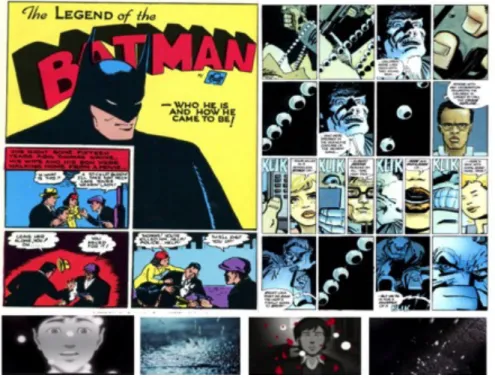
Bruce Wayne in The Dark Knight Returns (24-25). In a host of other media, the scattered pearls are framed against the Waynes’ spilled blood to signify Bruce’s loss of innocence, the senseless destruction of life, and the sullying effect of gun
violence (Figure 1.2).
Fig. 1.2. Martha Wayne’s necklace has become an irreducible element of the
Batman metanarrative as it resonates through texts and time. Clockwise from the top left, we see the first account of the Waynes’ murders in Batman #1 (1940) and subsequent depictions in The Dark Knight Returns (1986), Tim Burton’s Batman (1989), the animated adaptation of Batman: Year One (2011), the television series Gotham (2014-), and the animated film Batman: The Dark Returns Part 1 (2012).
And in fact, when I encounter the ur-text from Batman #1, I read Martha’s necklace not as pearls, but as a chain with a pendant. Perhaps Martha’s pearls simply offer a convenient constellation of metaphors for some producers to symbolize the Wayne trauma, but the pearls’ narrative persistence across time and media ensconce them as irreducible elements in the metanarrative. Presented with “alternative, competing hypotheses” regarding Martha’s jewelry on the night of her murder, consumers and producers are persistently reminded that claims to truth—what really happened to the Waynes in Crime Alley—are textually contingent. Via the accrual of narrative representations the consumer may test competing hypothesis for validity (i.e. proximity to truth), but in the telling, reception, and integration of narrative claims into a composite metanarrative (through the narrative identities of consumers), the fallibility of human agency is always foregrounded.
A serial text displays reflexivity when it is self-conscious of its referential stability. The reflexive text perpetually questions its modes of representation, methods of emplotment, and epistemic functionality with regard to the truth claims it purports to treat. The text does not destabilize claims to authenticity in its
such as soap operas, comics, bodies of myth, and certain film franchises in which multiple agents mold narratives over time. But given the very different ethical concerns of historiography and fiction writing the question remains, what would a serial with historically referential irreducible elements at its center look like?
The 2014 podcast (serendipitously titled) Serial provides an example.
Produced by WBEZ Chicago, Serial spun off from This American Life in October of 2014, distributing twelve more-or-less weekly episodes via digital download
services such as iTunes. On its website, Serial describes its intention to tell “one story - a true story - over the course of an entire season. Each season, we'll follow a plot and characters wherever they take us. And we won’t know what happens at the end until we get there, not long before you get there with us” (“Serial”). Even in this mission statement, the rhetorical situation is compressed—only via close proximity with a text produced in discrete installments will producers and consumers approach an understanding of the truth of the narrative. And as devoted Serial listeners well know, truth is maddeningly elusive in this story.
The first season of Serial focuses on the murder of Hae Min Lee, a student
who disappeared after leaving her Baltimore County, Maryland high school on the
afternoon of January 13, 1999 (Koenig “The Alibi”). When police discovered Lee’s
body buried in a park weeks later, they charged her ex-boyfriend, 17-year-old
Adnan Syed with first-degree murder (“The Alibi”). Though Syed claimed (and
continues to maintain) innocence, the police and prosecutors built a case against him
based primarily on the capricious testimony of Jay Wilds, an acquaintance to whom
Lee’s body (“The Alibi”). After a dramatic mistrial, a second six-week trial resulted
in Syed’s conviction and subsequent life imprisonment for Lee’s murder (“The
Alibi”). The first season of Serial is not a cold case story; rather its focus is a
narrative that has been legally resolved. Its first episode presents a story purportedly
enclosed by legal discursive forms.
But Serial quickly unsettles the state’s narrative claims to truth. In the first
episode, listeners are introduced to Asia McClain, a classmate who provides an alibi
for Syed during the time prosecutors allege the young man was strangling his
ex-girlfriend (“The Alibi”). Due to defense attorney Cristina Gutierrez’s missteps or
malfeasance, state prosecutor Kevin Urick’s alleged disincentivizing, and a
fundamental misunderstanding of the exonerating power her testimony may have
had, listeners learn that McClain never testified on Syed’s behalf (“The Alibi”).
McClain’s story becomes one among legion that conflict with the state’s account of
Lee’s murder.
The second episode, “The Break-Up” mines Lee’s diary, friends’ accounts of
the relationship between Syed and Lee (recalled imperfectly 15 years after the fact),
and other character witnesses to test the “jealous boyfriend” hypothesis advanced as
motive in the state’s narrative. Episodes four, five, and eight attempt to make sense
of radical inconsistencies in the multiple, conflicting stories that Jay Wilds told
police. In episode ten, Koenig investigates the ways in which anti-Muslim sentiment
biased or at least colored the state’s narrative of events. Each episode offers