Young people on the autism spectrum can suffer from a wide degree of challenges, which could limit them from taking advantage of the public library space, whereas school libraries are in a better position to engage and support these students. This study describes a series of semi-structured interviews performed with library staff from schools in two school districts in North Carolina. These interviews were performed to determine the challenges, approaches,
knowledge and considerations present as school library staff worked to best serve the autistic patrons. The objective of these interviews was to assimilate the knowledge in order to create a model of service that a public library could utilize to better serve young autistic patrons.
Headings:
Library services for children
Library services for teenagers with disabilities
School libraries
by Deane Rynerson
A Master's paper submitted to the faculty of the School of Information and Library Science of the University of North Carolina at Chapel Hill
in partial fulfillment of the requirements for the degree of Master of Science in
Library Science.
Chapel Hill, North Carolina
December, 2019
Approved by:
________________________
Introduction
The autism spectrum disorder can provide a challenging experience for those who are
on that spectrum, such as myself, complicating what may be simple for others. In the past, I’ve
been able to better succeed with the support of the faculty at my school and my parents,
helping me to meet the challenges I’ve come up against. And that was with my being very high functioning on the autism spectrum. One of the places where I was often able to find a
comforting space and the support that I needed was in the school library. The same sort of
challenges that would give me trouble outside of the library were never a problem for me there
and my strengths and skills were developed in that setting. The school library became a regular
part of my life and when school was out, I would try to an extent to use the public library as a
sort of replacement. But I just never quite found myself as comfortable in the public library and
was less inclined to spend my free time there. I don’t blame public libraries for this; they have a very different set of concerns than school libraries and cater to a much wider range of patrons.
And there definitely exist public libraries that have made the effort to consider the autistic
patrons who use their resources (Harper, 2014, p. 50-1). Despite that, I feel that it would be
possible for public libraries to find ways to better serve and assist young people who are on the
autism spectrum, even ones who could be less high-functioning on the autism spectrum and
who would likely have more significant challenges than I have faced. I want to find and give the
public librarians at least some of the same advantages that school librarians have, training,
that would allow a public library to practically utilize the same knowledge and resources that
school libraries use in order to best serve their young autistic patrons.
Research question
Can a model of services and training be created for public libraries to use in order to
better serve the young autistic patrons that they serve, based on the training, resources and
Literature Review
In preparing for this topic to try and understand what research studies in the field were
worth considering, I had to consider the factors that were important to understand this topic.
This paper will utilize knowledge from three major subjects as the background literature. First is
a thorough understanding of what challenges and needs autistic students have. This will help
give me an idea of what services I can be on the lookout for, things to ask about and other
points to serve as the largest base of my research. Second is an understanding of school/public
library interaction and what limits it. With this knowledge, I can think of ways that a school
librarian can better help support public librarians, while ensuring the model can be executed
efficiently. The last major area of knowledge to be covered is what school libraries are currently
doing to try and help autistic patrons. This, like the first area, will be a significant part of my
model. After all, this is what I want transferred directly over to my model for the most part and I
want to find out how widely implemented certain methods are.
Needs of Autistic Youth
The articles that discussed the needs of autistics youth covered similar general points. A
recurring point was the concerns of the parents. For example, they worried about their children
not being in the hands of adults who were educated on how best to support autistic youth
(Galpin et al., 2017, p. 571-2). This point alone made it sound as if public libraries could use the
model my study will create, to give parents more confidence in the public librarians and their
ability to better understand young autistic individuals. I also noticed the recurring point that
needed to find out more about the training school librarians might take part in to apply to a
model of improvement for public librarians.
In one study I looked at, autism spectrum disorder was primarily described as a
neurodevelopmental spectrum disorder with a variety of ways that it affects those on the
spectrum (Cho, 2018, p. 326-7). And it lived up to that description, with many different
behaviors being brought up as being those of people having autism. It included lacking social
skills, a need for visual instructions, and general difficulty in adapting to situations they are not
used to (Remy and Seaman, 2014, p. 24-6). Young autistic people also tended to take in
information in a more literal sense, another thing that can make their ability to adapt difficult
(Ennis-Cole and Smith, 2011, p. 87-8). So, there’s a myriad of challenges that young autistic
people were described as facing, which is likely the reason that many of these articles focused
on one element of the autism disorder or approached it from a specific perspective that focused
on one field. They mostly seemed to have a quantitative perspective, trying to see what seemed
to most commonly cause certain difficulties for autistic youth and how often they occurred.
School/Public Library Collaboration
Benefits and Outcomes
Public and school library collaboration seemed to have occurred in many forms
according to the articles that I came across in my research. Giving support to school programs
like summer reading, homework help, and general school activities were mentioned as helpful
habits in an article in New Library World (Smith, 2014 p. 162). Public libraries also served as a
and internet access for example (Genest, 2014, p. 1). And these collaborations are clearly
beneficial and important. A community in Illinois described how the collaboration program
between the libraries was helpful to uniting their community and dealing with serious issues
(Collen, 2013, p. 18). This information made me all the more certain that this model could be
valid and helpful to the public library.
What’s the Issue?
But the articles also made it clear that there were issues to accomplishing collaboration.
Getting collaboration started was very difficult partly because the two parties didn’t have an
invested interest, made worse by lack of support from administrators and others who could help
ease the process (Collen, 2013, p. 18). And to exacerbate the problem, the lack of interest can
lead to a disconnect where school and public librarians don’t understand what duties the other
type performs (de Groot and Branch, 2009, p. 56-7). There are more practical considerations
that create trouble as well, such as money and time; budgets can be particularly problematic for
school libraries (Masterson, 2012, p. 2-3). However, all of this just made me believe that this
kind of model could even help public libraries make up for when school libraries might have to
make cutbacks. This collaboration required keeping in mind what each library type brought to
the table and focusing on full on collaboration as opposed to basic cooperation (Smith, 2014, p.
163). Given that there are such limitations to how much a public library can do with what school
libraries execute, I realized that I needed to ensure my model was as practical as possible to
ensure it can be utilized.
The articles going over how librarians can better assist autistic youth tended to describe
the various ways that the disorder tends to affect individuals on the spectrum. However, I came
upon a point that I think is very important, that a library does not have to feature entirely
specialized features just for their autistic patrons. Rather, there are services or changes that
could be made to make libraries more suitable for them that will benefit all youth. In fact, trying
to call attention to changes made could make autistic individuals less willing to utilize services
offered specifically to them (Ennis-Cole and Smith, 2011, p. 92-3). Knowing this made proposing
a model that asked for certain changes seem more reasonable for the public library if the new
services could be utilized by more than just the autistic patrons.
Understanding was the most key element brought up by articles describing how to work
with autistic youth in a library position. Recommended actions included continually working to
improve in all areas that could benefit young people with the disorder, how you understand it
and what actions to take. One recurring approach to take included adding to instructions and
grounding information to make autistic youth as easily able to navigate and function in the
library as possible (Remy and Seaman, 2014, p. 26). We also need to keep in mind the social
limitations of young ASD individuals and building familiarity is critical to ensuring librarians can
best work with them (Cho, 2018, p. 330). School librarians also need to consider leaving behind
the traditional ideas for interaction in order to engage autistic youth better. A library at Adelphi
University held information literacy events for the autistic students, but constantly had low
attendance. Thus, they had to find an alternative, which took the form of webinars or other less
traditional methods that wouldn’t require in person involvement. As mentioned before, being stigmatized by standing out for being on the autism spectrum is very much a concern (Cho,
2018, p. 330-3). So, a major change to introduce would be for a public library to find ways to get
But changes beyond just staff training, knowledge and behavior are to be considered.
There should also be consideration for “assistive technology,” which is any type of technology that is used for working with individuals who are disabled. The technologies that would benefit
autistic youth are ones that would encourage their independent interests and allow them to
study on their own. Examples of useful technologies are VR, Apple touchpad products, and
online simulation programs. But just implementing these technologies isn’t enough, there needs to be an effort to help patrons learn to use them and know that they are there (Ennis-Cole and
Smith, 2011, p. 87-95). Given that public libraries are becoming host to more and more varieties
of technology, adding in new technologies that would enhance the experience of autistic
patrons, but also others, seems to be a practical consideration.
Methods
I was able to find a great deal of information from my literature review about the needs
of young people on the autism spectrum, how school and public libraries collaborate, and how
school libraries have striven to better serve their autistic patrons. The next step was to get a
practical perspective - to gain a direct understanding of what is possible. To this end, I utilized a
qualitive approach with semi-structured interviews. This allowed me to gain a fully rounded
understanding of what approaches are effective, what resources are most practical, and so on.
My approach was qualitative since I am more interested in considering factors beyond what
quantitative analysis will yield. There are nuances and more complicated factors to consider in
creating the kind of model that I want this study to yield, partly because of the great range of
ways that autism affects people; this is after all why it is referred to as a spectrum disorder. My
goal was to analyze the meaning behind the responses. This study utilized face-to-face
semi-structured interviews with school librarians in the area. Interviews were best suited to getting
the viewpoints and information that I needed. The interviews were conducted at venues chosen
by the interviewees, usually their places of work, but also at other locations they deemed most
convenient or suitable. As I mentioned, autism being a spectrum disorder means that it can
affect people in a variety of ways. So, while I had certain points that I wished to cover, I used
semi-structured interviews. Other researchers mentioned that this approach was useful for
hitting on set points but expanding into the personal experiences of interview subjects
(Rabionet, 2011, p. 563-4). That way if the interviewees hit upon a point that I found interesting
or helpful, I was able to give them the chance to elaborate and discuss these new matters more
in depth. This ensured I got the most out of the experience and discovered all that my
Participants
My participants were a group of individuals that worked in school libraries chosen from
the local area. Each of them was recommended to me by my advisor, Sandra Hughes-Hassell,
and received emails from me, describing the idea behind the project to them. I ensured that
they had to make clear their consent to participate and have the audio of the interviews
recorded and when that consent was received, I communicated electronically with each of them
to arrange interview locations. The interviews each lasted around 45 minutes.
My main questions for these interviews were as follows:
1. How long have you been in a school librarian position? How long have you worked at your
current school?
2. Have you had any specific training to help you work with autistic students?
3. What needs do you think are the most important to meet to better work with young autistic
patrons?
4. What do you find most challenging about better providing for the autistic students? How do you
try to deal with those challenges?
5. Do you find that autistic students frequently make use of the library space on their own? What
kinds of uses do they get out of the space?
6. How do you primarily work with the autistic students? For example, do you do any work
specifically with autistic students, do you mostly work with them as part of larger class groups or
do you mainly work with them in unscheduled interactions? Do you particularly find any type of
interactions more effective than others? Do you interact at all with autistic students outside of
7. Do you have any sort of specific process that you go through when you begin to consider how to
better work with autistic students and if so, do you have set steps to the process? Who do you
coordinate with? What knowledge do you consider?
8. What kind of sources of information do you prefer to use in order to be informed on how to
work best with autistic students? Do any of those sources include any formal programs?
9. Have you made any permanent changes in the library to better serve autistic patrons? Do you
try to implement any assistive technology, that being technologies intended to specifically help
those patrons?
10. Do you receive any particular kind of support from the administration and other faculty outside
of the library in helping you to better work with autistic patrons?
11. What do you consider the most important or effective individual service or consideration that
you provide for your autistic patrons?
12. How do you assess your success in working with autistic patrons? What do you do to figure out
how to improve?
13. Do you collaborate, advise or generally work at all with public libraries? Do you find it helpful?
What challenges are involved?
14. Do you involve the public library in helping any specific groups amongst your students, i.e.
students suffering from a disability, students of a certain ethnicity?
15. Are there any services or resources that you think are most important for public libraries to
consider implementing in order to better serve young autistic patrons?
Analysis
To analyze my results, I analyzed the responses from each of the interviewees for the
elements that were emphasized repeatedly. I also made sure to consider what points were
mentioned as being the most effective and the factors that would have to be considered in
implementing them. While using these results to help develop my model fully, I also took those
results and compared it to the information I found during my literature review. This practical
Results
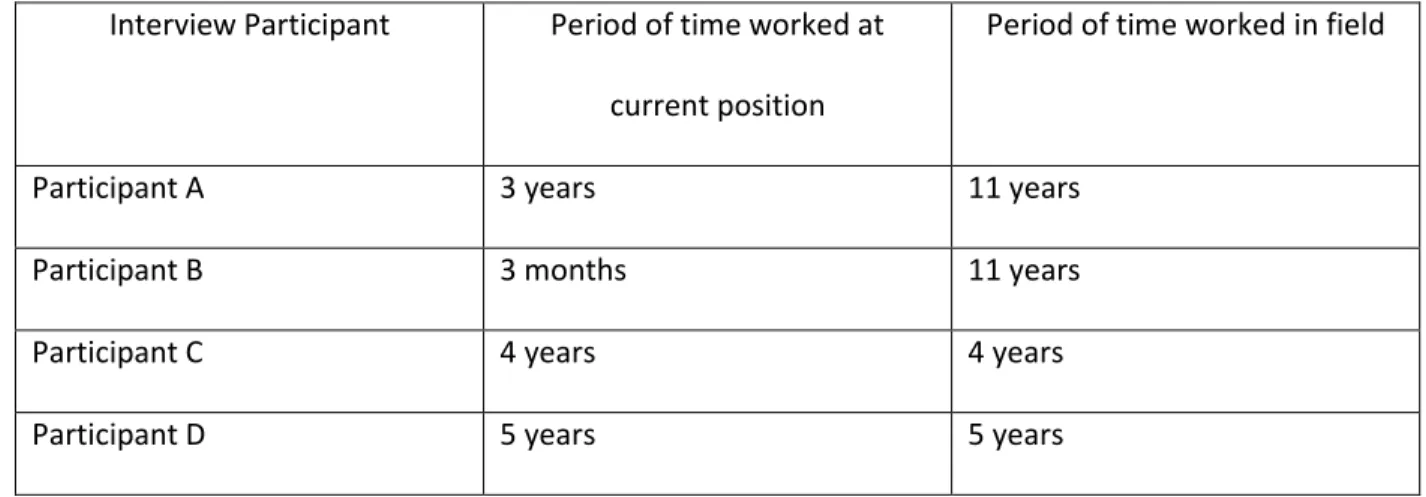
The four participants who were involved shall be referred to as Participant A, Participant
B, Participant C and Participant D. Table 1 provides demographic data on each of the
participants.
Interview Participant Period of time worked at
current position
Period of time worked in field
Participant A 3 years 11 years
Participant B 3 months 11 years
Participant C 4 years 4 years
Participant D 5 years 5 years
Table 1. Participant Demographic Data
Most of the participants mentioned that their studies in becoming a school librarian had
not included any sort of training for serving autistic patrons. Instead, most training, if any, came
after their initial school library training. Participant C mentioned that she had studied material
about the needs of young autistic students on her own due to having a child on the autism
spectrum while Participant B took an elective course on special education in college. Participant
C also noted that her research and training took her to resources away from the more common
academic sources, such as blogs and sources directly from the perspectives of people with
knowledge of the spectrum. Some of the participants said that they had received some
professional development training on the subject through their school districts. However,
Participant D noted that she had received only minor training through the school district and
that there was planned in depth training for the staff in that regard. The problem was that
cancelling training days. She did receive general training from the Exceptional Children staff
which touched on working with autistic students and more extensive training had been
promised to the staff at her schools. Unfortunately, this training had not occurred.
The participants mentioned two different things as being most prominent among the
needs of autistic patrons. First was that teachers and other adults who worked with them need
to be knowledgeable, trained and educated on how to serve them properly. Teachers and
similar individuals needed to work in order to get the knowledge and make serious efforts to
know their autistic patrons and how to work with them. In a school setting, this should include
trying to turn towards the faculty that DO have more knowledge. This would include their
teachers who work with and get to know the students by meeting with them regularly and the
Exceptional Children specialists who are at each school. The latter group are the ones who are
fully trained in this subject after all. What’s more, it isn’t entirely about having the general knowledge of autism spectrum disorder. Being knowledgeable also means getting to know the
individual students, with one participant saying that it was important to go outside the library
and observe the students in other contexts as much as possible. Not having individual
knowledge or focusing on individual needs could be a serious pitfall. The participants mentioned
that there were times when they had seen faculty and educators who had good intentions but
had lacking knowledge in the matter. It is important for educators to know how varied young
people on the autism spectrum can be and that they need adaptable library staff.
The second major need mentioned was that autistic students needed to have a
supportive library space that was suitable for the autistic patrons, that one should think about
universal design for all patrons. Suggestions for such a space included an area with plenty of
needs the participants mentioned needing to meet were structure: creating routines, clear
instructions for using the resources and space, and planning out a schedule.
When asked what they found most challenging about trying to work with autistic
students, the most common response was the difficulties in understanding them and being able
to adapt to them. Because the needs of individuals on the spectrum varied so much, it was
difficult to meet all the needs that they required, and it required constant work and adaption on
the part of the participants. Participant A said that she overcame such a challenge by accepting
the fact that the process was one of trial and error, but risk taking to try new ideas helped her to
find new ways to serve autistic patrons better. Other participants also brought up trial and error
as being key and having the patience to continue trying new ideas. For example, Participant B
mentioned having a student that was in a self-contained autism classroom, who was severely
unresponsive. However, by working continually with that student, she was able to discover that
the student indeed had reading ability, something that none of the other faculty had been
aware of.
The libraries of each of the participants indeed had autistic students visiting their space
on their own, though the degree varied between the different libraries. Some of the participants
said that the number was about average compared to the number of other students, while
others said these students would come in notably more than others. Participant B mentioned
that one of the reasons was that the autism spectrum students enjoyed the autonomy and
freedom that the library space and resources offered to them. They did not feel as if there were
pressure or expectations on them to act what was considered “normal.” The autistic students used the library space in order to find the time for their own interests, which lead to the
participant trying to make sure the library had plenty of materials that tied into those interests.
comforting space. They went there when they needed a break or, when they had free periods,
would go and visit the library instead because they preferred to be away from the noise and
disorder of other places in the school, finding quiet nooks or corners to read or do activities.
Activities or interests that were often popular with these students included organized tasks such
as Lego, origami and technology focused activities.
The participants interacted with the autistic students in a variety of ways, but usually
interacted with them as part of the larger classes, either mixed in with the usual classes or with
specifically challenged classes. However, the participants emphasized that familiarity and trust
was important with these students and this led to their trying to be present in as much of the
events and activities of the school as possible. This could include visiting the classes, helping
manage assemblies and other events, supervising and assisting bus dismissals and in general,
just keeping an eye on all the students and greeting the students on the autism spectrum
whenever possible. Participant A even mentioned that having events for families was especially
good for building trust with the autistic students and their families. That trust was essential as
Participant C mentioned that if autistic students got the sense that a teacher or otherwise did
not like them, then it would affect them deeply. This could just cause a child to shut down and
be disinclined from going to that teacher for help because of a fear that they annoy their
teacher. Participant D also found that club settings were a very effective and comfortable
setting to engage with and connect to autistic students. This was because students usually
joined these kinds of clubs to engage in activities they were genuinely interested in and that was
where autistic students managed to thrive.
The participants did not have any extremely laid out process that they used when they
wanted to make changes to better serve their autistic patrons, though all of them generally liked
Most of the time, this meant consulting with the staff at their schools who were the Exceptional
Children specialists. But Participant C did work with various committees throughout the school
to make decisions, including Exceptional Children teachers and equity committees. She also had
a student advisory board that she met with on a regular basis to get their feedback on what
should be implemented in the library for all students. But outside of those organizations, the
participant did her best to keep her ears open, taking any opportunity to hear about what was
going on with the students, what they need, what they were enjoying, etc. Participant A
mentioned that she worked to use the knowledge to institute goals for both the faculty and the
autistic students that they worked with, focusing on behavior as opposed to just a learning goal.
Assessing success revolved around seeing how well the students could function and behave
while within the different areas of the school. Making the space easier was the main goal of
Participant D and she used that as her guiding principal for decisions. And in addition to the
experts, she would make a point of using online resources to try and find more information on
ideas to implement and how to do so successfully. Participant B also mentioned that she
would’ve liked more research-based approaches and methods, but there sadly were not many that she had found.
Aside from the other sources of knowledge mentioned, Participant B mentioned that
she used the Project Enable program to guide her. She also utilized any training program that
touched on working with autistic students, partly because she only had the time for so many
different presentations or programs. Participant C used Teaching Tolerance as a resource while
Participant D said that she frequently turned to various publications for article resources, library
conferences and webinars related to the subject and resources offered by the North Carolina
When asked about any major changes that they’d made to help their autistic students, the participants all had very different answers. Participant B described how she had
implemented a more scheduled set up for the library programs that continued and adapted to
suit each year. Participant D said that her biggest change was to create better organization in
order to help differentiate and consolidate materials. She’d also tried to utilize different forms of instruction to suit the different kinds of workers in the library. Participant A said that she had
tried to include more visual cues and instructions and had implemented more technological
changes. She had the autistic students use technology whenever it suited them more than
traditional methods of doing work, such as having them record themselves if they preferred.
Another technology often utilized was Board Builder, which presented children with visual cues
and symbols to help them express themselves more easily. Participant C said she had remodeled
the library space heavily, adding mobile furniture, and working with the instructional technology
facilitator to offer the technology that special needs students required, like headphones and
devices with text to speech.
Most of the participants said that they had a fair amount of support from other faculty
when needed. Participant B said that there were some problems with the administration
however, citing a disconnect between librarians and administration. The administration failed to
understand that librarians didn’t always have all the answers and failed to encourage filling gaps in knowledge. Meanwhile, Participant D said that she checked in with teachers more on a
reactive basis, but the various faculty still reached out to try and help. Most of the discussion
was just done through informal, verbal communication. Participant C worked with the case
managers for each grade level that worked with the challenged students and kept track of what
Most of the participants described the most important services they provided to autistic
patrons were focused on providing a safe space with an atmosphere of trust. Being able to build
a relationship with these students and being available to them did a great deal for these
patrons. Participant A did give a different answer, saying that the most important aspect was
the effort to make sure the faculty understood their patrons.
To assess success, the participants stated that they mainly just observed the students
with one participant pointing out that it was difficult to have a formal means of doing so due to
how different the needs of the students could be. Overall, they cared most of all about whether
or not the autistic students were having good experiences in the library space. However, the
participants also reached out to any other staff that frequently worked with said students and
relied on whatever data they had available to get a full perspective on determining success. But
in general, participants never stopped trying to improve, being on the lookout for any ideas that
could help better support all the students.
Half of the participants noted that they had not been able to work with public libraries
as much as they would like to, though they tried to involve the public library staff in events
when possible, such as summer reading programs. However, the other half were able to do so
far more often, mostly trying to make the students aware of what programs and resources the
public libraries had. In particular, the public library could make up for materials the school
library was unable to get. The public libraries occasionally had events, resources or
programming for specific populations, but not much planned in coordination with the school
library.
Finally, when asked what services they would recommend public libraries implement for
familiarity, try to get to know the autistic students and their families in any way possible to find
out more about their wants and needs. Participant B said to start with training and knowledge,
to think critically about the subject. Participant C said the public libraries should focus on the
idea of universal design and developing a space that every patron can thrive in. They should also
keep in mind that what benefits some can still benefit others. Participant D suggested taking
advantage of the freedoms of a public library to try and get autistic students more involved in
the decisions of the library, let them help decide on changes and materials bought. There should
Discussion
In considering the information offered by the interview participants and the information
found in the background research, the critical points and how they might be executed become
clear. The importance of knowledge was brought up repeatedly by each of the participants and
that the staff who worked with autistic students needed to be understanding. This certainly
aligned with the information from the texts discussed in the literature review and therefore, the
model should include means of amassing that knowledge. This should include formal training
and professional development if possible and the ability to consult the perspectives and
knowledge of experts if possible. The interview participants also mentioned repeatedly how
working to adapt was essential, which reminded me of how the articles I had looked at in my
background research had needed to focus on a more singular aspect of autism spectrum
disorder. The staff must have the patience to adapt to whatever unique challenges that their
young autistic patrons may present them with. And that means realizing there may be
challenges that are not previously anticipated and being able to keep an eye and ear out for any
difficulties that the young autistic patrons may be challenged with. Trial and error is necessary
and failure must be accepted as part of the process. The key is to maintain patience, keep trying
and making the effort to figure out how to best understand what their autistic patrons would
want to see in their library space and what they need in order to feel more comfortable in the
space.
Getting the knowledge does not need to solely come from training and classes,
independent study is also viable. The participants mentioned resources like research articles and
other professional sources of information that they tried to read when possible. But given that
be many different resources that offer insight and knowledge. Public libraries should consider
articles, books, and even informal resources such as following autistic individuals on social
media platforms. A balance between formal and informal resources seems to help ensure that
there are perspectives from those who assist, serve and study autistic individuals but also
people on that spectrum themselves.
The participants also discussed creating a proper library space that welcomes and makes
autistic students feel comfortable. This could include simple efforts like offering materials within
the library that include characters on the autism spectrum and show a proper understanding of
what being on the spectrum is like. Having the staff be knowledgeable and accepting as well
would be part of that, in order to avoid situations or problems that would alienate these
patrons. But to a greater degree, it would include changes made to the library space. This should
include simplification when possible, having direction and guidance whenever possible, which
again coincided with the ideas presented in the background research. And any patron could
benefit from that guidance in order to better navigate through the library. The same would also
go for alterations to the space that would allow for young autistic students to be able to find
their own quiet spaces to be able to work on their own. This would allow for autistic patrons to
find their own spaces within the library if needed and take the breaks that the interview
participants mentioned were useful to them.
As part of helping to offer more guidance within the library, this would also be an
excellent lead in to promote elements of the collection that might appeal to autistic patron’s
interests. The participants mentioned that autistic patrons were driven to pursue their own
various interests in the library. Thus, public libraries could find ways to highlight and separate
materials that would not only be useful to the young autistic patrons but be helpful to draw
could take advantage of the ability to more easily identify and find specific interests. In addition,
the public librarians should try to find out what resources seem to be utilized by their autistic
patrons or at least if any of the collected materials are seeing increased patronage. Keeping
track of that could allow for public libraries to host more events, clubs or other programming
that are conducive to those interests and would encourage autistic patrons to attend those
programs. These activities would be just another way that these patrons could grow to be
comfortable and familiar with the space and the staff, in the same way that it assisted
Participant C in better building trust with her autistic students. And it would not have to be only
for patrons on the autism spectrum, allowing for budgetary justification and allowing for a
library to still offer events suited to their autistic patrons no matter the size of that population.
Participant D’s input also brought to mind ways in which autistic patrons could become more involved with the public library. Given her point about how a public library should try to
take advantage of their greater flexibility and ability to adapt to their patrons, the public library
should try to get the autistic patrons more involved in library activities. Public library staff
should offer these patrons opportunities to help decide on what resources or materials should
be added. It could even include organized activities that were mentioned by the interview
participants as being popular with autistic patrons. These patrons could help with sorting library
materials or similar activities, both giving them an activity to enjoy and allowing them to
become more familiar with library procedures and materials.
The participants in the interview brought up how changes made could be useful to not
just autistic students, but to everyone in general in some ways. This means that changes made
to the space and technologies offered in the space could be prioritized if they had general
usage. Technology resources mentioned in the background research could be put to multiple
would be useful to autistic youths. This is also important to keep in mind in remembering the
point about how autistic patrons dislike feeling alienated or made to feel different. By offering
these new resources to EVERYONE, a public library can avoid stigmatizing the patrons they’re trying to serve, but make sure that they still have these resources available.
In considering how public libraries can collaborate with school libraries on improving
their ability to work with the autistic patrons, the participants and background research noted a
few methods by which this could occur. School libraries can involve public librarians in general
activities that the school may organize, and which would benefit from the resources that they
can offer. However, school libraries may be unable to help directly in identifying students on the
autism spectrum since they can’t always know exactly which students do or do not utilize the
public library. There could also be the issue of restrictions on releasing too much personal
student information to non-school faculty. As such, public librarians should do all that they can
to interact with and get to know the students. Remembering that one interview participant
mentioned that autistic students were interested in clubs and were most comfortable there,
public librarians could find ways to become more involved in those clubs. They can get to know
the students, talk to them and find out how to engage them, allowing them to use a school
setting to gain more in-depth knowledge on the population base they wish to better serve. Any
other school event that could connect public librarians with students in their area and their
families should be taken advantage of as much as possible. Making this ongoing effort would be
able to build the trust that was mentioned by both the background research and Participant A as
being the most key to allowing public libraries to be successful. Even if public librarians have
participated in these events before or have not found them to be as successful at reaching out
to certain populations, they still need to keep trying. After all, dedication to trial and error and
Conclusion
With these points in mind, public libraries should try to adopt the following practices in
order to better serve the young autistic patrons within their communities and to make these
patrons more inclined to utilize their space.
• The library staff, particularly those who work with youth patrons, should be encouraged
to obtain as much knowledge as possible on the needs of autistic individuals and the
knowledge of how to serve them. They should try and pursue as many different
knowledge resources as they can to get as many perspectives and ideas to consider as
possible. This should also be as ongoing as possible, due to the variety of ways it may
affect their students. The staff should also be willing to consult knowledge whenever
they feel unsure, retaining and keeping certain resources that are particularly useful. If
possible, the staff should also try to pursue as much formal training and professional
development as possible on this subject.
• Try to get autistic patrons involved in the workings of the library, giving them a chance
to have a say in what the space offers or what they want to see added to the space. This
encourages direct feedback from these individuals on ways that they would like to see
the space improved. This also offers some specific activities to try and offer to these
patrons to engage their skills and interests.
• The library space should be re-organized and altered to suit these patrons. There should
be as much direction and guidance as possible, presented in a very clear way to help
users navigate and use library resources. The library space should strive to include
spaces where patrons can enjoy a quiet and calm space and pursue their own interests
• The public library should strive to collaborate with the school library whenever possible
on special events and clubs and have their staff be present and involved whenever
possible. The goal should be to build as much familiarity and trust as possible between
public library staff and the autistic students and families present at schools. This will
allow for the library staff to work build a safe and comforting environment for autistic
patrons by making sure that these patrons know them and feel liked and appreciated by
them. The public library staff should also try to get to know the students interests and
strengths in order to find out more about what resources that they can promote and get
more of them.
• The public library should include a sizeable amount of specific resource types. This
would first include variety of technological resources that offer means of expression or
as an alternative to other means of creating and performing work. Second, there should
also be materials featuring autistic characters with authentic representation for them to
relate to.
• The public library should try to offer or at least serve as host to programs, clubs and
similar activities that are focused around interests that seem to be popular with the
autistic patrons, with organized activities being a good starting point to try. Library staff
should try to be present at these activities as much as possible to try and continue
building bonds with these patrons. However, the focus shouldn’t be on overly restricting
or directing activities so that the patrons feel comfortable pursuing their interests.
• Public libraries should maintain a mindset of patience in trying to better serve young
autistic patrons. This would mainly mean being willing to accept that the process
involves a great deal of trial and error. Continue to try different approaches, activities
Wanting to work with these patrons is one thing, but public libraries must be
encouraged to actually MAKE that effort. This also means accepting when something’s not working as effectively as hoped while not being discouraged by that fact. There are
many methods to try and approaches to take to becoming better at serving these
patrons. And take the time to critically analyze if the specific improvements and actions
used are helping the situation. For example, if attending a specific school event isn’t building the relationships possible, try a different one.
• Do not draw attention to the fact that new resources and spaces added to the library as
part of this effort have been instituted specifically for patrons on the autism spectrum.
Doing so could alienate these patrons and make them afraid of standing out. That said,
public library staff should try to point out these resources to patrons they know to be on
the autism spectrum, just not in a way that seems identifying.
By following practices like these, public libraries could ensure that their library space is
place that autistic students are eager to make use of and comfortable using. And, as was
pointed out by several of the interview participants, using methods like this could benefit
multiple patrons, not just those on the autism spectrum. Therefore, even if the number of
autistic patrons that a library could potentially serve varies, there is a level of benefit to public
library patrons no matter what. And after all, if we librarians can help ensure that more of the
populations that we serve are inclined to visit our space and use our resources, should we not
Bibliography
Akin, L. and MacKinney, D. (2004). Autism, Literacy, and Libraries: The 3 Rs = Routine,
Repetition, and Redundancy. Children & Libraries: The Journal of the Association for
Library Service to Children, 2(2), 35–43. Retrieved from
https://auth-lib-unc-edu.libproxy.lib.unc.edu/ezproxypass:[_]auth.php?url=http://search.ebscohost.com.libp
roxy.lib.unc.edu/login.aspx?direct=true&db=eft&AN=502932845&site=ehost-live&scope=site
Arnone, M. P., Small, R. V., and Weng, S. (2016). Are Self-Perception Measures Used in School
Library Research Transferable to the Context of Public Library Summer Reading
Programs? School Library Research, 19(1–22). Retrieved from
https://auth-lib-unc-edu.libproxy.lib.unc.edu/ezproxypass:[_]auth.php?
url=http://search.ebscohost.com.libproxy.lib.
unc.edu/login.aspx?direct=true&db=eft&AN=119793550&site=ehost-live&scope=site
Breakwell, G.M. (2000). Interviewing. In Breakwell, G.M., Hammond, S., & Fife-Schaw, C. (eds.),
Research Methods in Psychology (pp. 239-50). London: SAGE.
Breeding, M. (2015). A combined effort: Partnerships between school and public libraries.
Computers in Libraries, 35(7), 14-16. Retrieved from
http://libproxy.lib.unc.edu/login?url=https://search-proquest-com.libproxy.lib.unc.edu/docview/1723378418?accountid=14244
Broman, H. E. (2017). Public Libraries: Serving Children with Autism Spectrum Disorder and their
Families. (Master’s paper). University of North Carolina, Chapel Hill, North Carolina.
Review, 46(3), 325-339.
Collen, L. (2013). Critical Collaboration: Public Library and School District Partnerships in Illinois.
The Illinois Library Association Reporter, 31(4), 14-18. Retrieved from
http://libproxy.lib.unc.edu/login?url=https://search-proquest-com.libproxy.lib.unc.edu/docview/1419353911?accountid=14244
de Groot, J., & Branch, J. (2009). Solid Foundations: A Primer on the crucial, critical, and key
roles of school and public libraries in children's development. Library Trends, 58(1), 51-
62. Retrieved from
http://libproxy.lib.unc.edu/login?url=https://search-proquest-com.libproxy.lib.unc.edu/docview/220452266?accountid=14244
DiCicco-Bloom, B. & Crabtree, B. F. (2006). The Qualitative Research Interview. Medical
Education, 40(4). Retrieved from doi:
https://doi-org.libproxy.lib.unc.edu/10.1111/j.1365-2929.2006.02418.x
Downs, A. and Smith. T. (2004). Emotional Understanding, Cooperation, and Social Behavior in
High-Functioning Children with Autism. Journal of Autism & Developmental Disorders, 34(6), 625–635. https://doi-org.libproxy.lib.unc.edu/10.1007/s10803-004-5284-0
Dunn, M. A., Gomes, H., & Gravel, J. (2008). Mismatch Negativity in Children with Autism and
Typical Development. Journal of Autism and Developmental Disorders, 38(1), 52-71.
doi:http://dx.doi.org.libproxy.lib.unc.edu/10.1007/s10803-007-0359-3
Ennis-Cole, D., & Smith, D. (2011). Assistive Technology and Autism: Expanding the Technology
Leadership Role of the School librarian. School Libraries Worldwide, 17(2), 86-98.
Retrieved from
http://libproxy.lib.unc.edu/login?url=https://search-proquest-com.libproxy.lib.unc.edu/docview/903778313?accountid=14244
just don’t join up’: Understanding the support needs of families of children on the autism spectrum. Autism, 22(5), pp. 571-84.
Genest, M. (2014). Reading is a BLAST! Inside an Innovative Literacy Collaboration Between
Public Schools and the Public Library. Reading Horizons, 53(1), 1–20. Retrieved from
https://auth-lib-unc-edu.libproxy.lib.unc.edu/ezproxypass:[_]auth.php?
url=http://search.ebscohost.com.libproxy.lib.unc.edu/login.aspx?
direct=true&db=eft&AN=100966871&site=ehost-live&scope=site
Gray, D.E. (2004). Collecting Primary Data: Interviewing. In Doing Research in the Real World
(pp. 369-95). London: Sage Publications.
Hamill, H. (2014). Interview Methodology. Oxford University Press.
doi:10.1093/obo/9780199756384-0105
Harper, M. (2014). Collaboration of School and Public Libraries: Finding Common Ground with
the Common Core to Serve Students with Special Needs. Ohio Media Spectrum, 66(1), 47-56. Retrieved from
http://libproxy.lib.unc.edu/login?url=https://search-proquest-com.libproxy.lib.unc.edu/docview/1610776410?accountid=14244
Jamali, H. Does Research Using Qualitative Methods (Grounded Theory, Ethnography, and
Phenomenology) Have More Impact? Library & Information Science Research, 40(3-4),
201-207. doi:10.1016/j.lisr.2018.09.002
Markey, P. T. and Miller, M. L. (2015). Introducing an Information-Seeking Skill in a School
Library to Students with Autism Spectrum Disorder: Using Video Modeling and Least-to-
Most Prompts. School Library Research, 18, 1–31. Retrieved from
https://auth-lib-unc-edu.libproxy.lib.unc.edu/ezproxypass:[_]auth.php?
url=http://search.ebscohost.com.libproxy.lib.
Marshall, C. and Rossman, G. B. (2011) Designing Qualitative Research (5th ed.). London,
England: Sage Publishing.
Masterson, C. A. (2012). School and Public Library Collaboration: Identifying Facilitators and
Barriers. (Master’s paper). University of North Carolina, Chapel Hill, North Carolina.
Maxim, P. S. (1999). Data Collection Methods and Measurement Errors in Quantitative Research
Methods in the Social Sciences (pp. 279-300). Oxford, England: Oxford University Press.
Patton, M.Q. (2002). Qualitative Interviewing. In Qualitative Research & Evaluation Methods
(pp. 339-428). 3rd Edition. Thousand Oaks, CA: Sage.
Polacek, K. M. (2014). Evolving from Disability to Diversity. Reference & User Services Quarterly,
54(1), 24–28. Retrieved from https://auth-lib-unc-edu.libproxy.lib.unc.edu/ezproxypass:
[_]auth.php?url=http://search.ebscohost.com.libproxy.lib.unc.edu/login.aspx?
direct=true&db=eft&AN=98545900&site=ehost-live&scope=site
Punch, K. F. (2016). Developing Effective Research Methods (3rd ed.). Thousand Oaks CA: Sage
Publishing Ltd.
Qu, S. Q., & Dumay, J. (2011). The Qualitative Research Interview. Qualitative Research in
Accounting and Management, 8(3), 238-264.
doi:http://dx.doi.org.libproxy.lib.unc.edu/10.1108/11766091111162070
Rabionet, S. E. (2011). How I Learned to Design and Conduct Semi-Structured Interviews: An
Ongoing and Continuous Journey. The Qualitative Report, 16(2), 563-566. Retrieved from
Redshaw, E. L. and Smith, H.E. (2013). Autism in Children. InnovAiT: Education and Inspiration
for General Practice, 7(8), 493-501.
Remy, C., & Seaman, P. (2014). Evolving from Disability to Diversity: How to Better Serve High-
Functioning Autistic Students. Reference & User Services Quarterly, 54(1), 24-28. Retrieved from
http://libproxy.lib.unc.edu/login?url=https://search-proquest-com.libproxy.lib.unc.edu/docview/1566615375?accountid=14244
Smith, D. (2014). Collaboration Between Rural School and Public Youth Services Librarians. New
Library World, 115(3), 160-174. doi:http://dx.doi.org.libproxy.lib.unc.edu/10.1108/NLW-01-2014-0014
Wilson, V. (2013). Research Methods: Mixed Methods Research in Evidence Based Library and