Refinery Process Design
(Lecture Notes)
Dr. Ramgopal Uppaluri
[email protected]
Department of Chemical Engineering
Indian Institute of Technology Guwahati
North Guwahati – 781039, Assam, India
From my mature childhood, I always had a very passionate desire to venture into slightly newer areas and explore my professional capabilities in these fields. This passionate desire fructified after I met Dr. T. D. Singh (Founding Director, Bhaktivedanta Institute), a grand visionary for the synthesis of science‐ spirituality. His exemplary life, dedication to the mission day and night always inspired me to set difficult to address targets in life and achieve them. Apart from my fundamental interests in science‐spirituality which is my first exploration away from process engineering professional life, Refinery Process Design is my second intellectual offshoot.
The foremost acknowledgement for the Lecture Notes goes to the Almighty God, who provided me the desired intelligence and attributes for delivering the Lecture Notes.
Next acknowledgement for the Lecture Notes goes to the Department of Chemical Engineering, IIT Guwahati which has been my professional father and mother in which I am there for the past six years enjoying my every moment in personal as well as professional activity. IIT Guwahati has truly inspired me to write the Lecture notes due to variety of reasons. To name a few, the early heat exchanger network consultancy projects conducted with IOCL Guwahati and BRPL Bongaigaon have been pretty useful to develop insights into the nature of refinery processes and streams. The ideal setting of IIT Guwahati in the midst of petroleum refineries really inspired me to deliver the lecture notes for professional usage too!
The third acknowledgement goes to the Centre for Educational Technology (CET), IIT Guwahati for providing seed funding towards the preparation of the Lecture notes. The seed funding enabled me to enhance the quality of the book to a large extent ranging from calculations to correlation data tables etc. I am highly thankful to Prof. R. Tiwari and Prof. S. Talukdar for providing me this worthy opportunity. The next acknowledgement goes to my students Ms. Anusha Chandra for assisting in the refinery property estimation and Mr. Vijaya Kumar Bulasara for assisting in all CDU calculations! Their patience and commitment really inspired me to take up the challenge in difficult circumstances. Mr. Ranjan Das, my graduating Ph.D. student also needs to be acknowledged for generating the data tables for good number of correlations which are essential for the calculations.
Finally, I wish to acknowledge my mother and father, as they have been the fulcrum of my continued pursuits in chemical engineering practice for the past fifteen odd years. Last but not the least I acknowledge my wife whose patience and support during long hours I dedicated for the development of the lecture notes is very much appreciated.
Date: 16th March 2010 (Dr. Ramgopal Uppaluri)
IIT Guwahati
ii
To draft the lecture notes in the specialized topic of Refinery Process Design needs expertise in both fields of petroleum refining and process design. The basic urge of extending my process design specific skills to the design of petroleum refineries started in IIT Guwahati, and specifically after thoroughly reading Jones and Pujado (2006) book which I feel should be the primary reference for refinery design. The primary objective of the lecture notes is to provide a very simple and lucid approach for a graduate student to learn upon design principles. While Jones and Pujado (2006) summarized many calculations in the form of Tables, for better explanations I always felt that calculations should be conducted and explained as well. With this sole objective I drafted the Lecture notes.
Consisting of three main chapters, this lecture notes enables a graduate chemical engineer to learn all necessary content for maturing in the field of refinery process design. In the very first chapter, a very introductory issue of relating the subject matter of refinery process design to conventional chemical process design is presented from a philosophical perspective. Thereby, the second chapter presents a detailed discussion of the estimation of essential refinery stream properties. The third chapter attempts to provide a new approach for conducting refinery mass balances using the data base provided by Maples (2000). The fourth chapter deliberates upon the design of crude distillation unit with further elaborates towards the selection of complex distillation reflux ratio, pump around unit duty estimation and diameter calculations.
All in all, the lecture notes did not present some elementary design related chapters pertaining to the design of heat exchanger networks, design of light end units and design of refinery process absorbers. These will be taken up in the subsequent revisions of the Lecture notes.
I hope that this lecture notes in Refinery Process Design will be a useful reference for both students as well as practicing engineers to systematically orient and mature in process refinery specialization.
Date: 16th March 2010 (Dr. Ramgopal Uppaluri)
IIT Guwahati
iii
Dedication
To
Dr.
T.
D.
Singh
Founder
Director,
Bhaktivedanta
Institute
Short biography of Dr. T. D. Singh:
Dr. T. D. Singh received his Ph.D. in Physical Organic Chemistry from the University of California at Irvine, USA in 1974. He was a scientist and spiritualist well‐known for his pioneering efforts in the synthesis of science and religion for a deeper understanding of life and the universe. He was trained in Vaishnava Vedanta studies from 1970 to 1977 under Srila A. C. Bhaktivedanta Swami and was appointed Director of the Bhaktivedanta Institute in 1974. He organized four major International conferences on science and religion ‐ First and Second World Congress for the Synthesis of Science and Religion (Mumbai, 1986 & Kolkata, 1997), First International Conference on the Study of Consciousness within Science (San Francisco, 1990) and Second International Congress on Life and Its Origin (Rome, 2004). Collectively thousands of prominent scientists and religious leaders including several Nobel Laureates participated. He authored and edited more than a dozen books including What is Matter and What is Life? (1977), Theobiology (1979), Synthesis of Science and Religion: Critical Essays and Dialogues (1987) and Thoughts on Synthesis of Science and Religion (2001). He was also the founder Editor‐in‐Chief for two journals of the Bhaktivedanta Institute.
iv
1 Introduction 1
1.1 Introduction 1
1.2 Process Design Vs Process Simulation 1 1.3 Analogies between Chemical & Refinery Process design 2
1.4 Refinery Property Estimation 3
2 Estimation of Refinery Stream Properties 5
2.1 Introduction 5
2.2 Estimation of average temperatures 7
2.3 Estimation of average oAPI and sulfur content 12
2.3.1 Psuedo‐component concept 12
2.3.2 Estimation of average oAPI and % sulfur content 15
2.4 Characterization factor 17
2.5 Molecular weight 21
2.6 Viscosity 21
2.7 Enthalpy 22
2.8 Vapor pressure 36
2.9 Estimation of Product TBP from crude TBP 36 2.10 Estimation of product specific gravity and sulfur content 44
2.11 Estimation of blend viscosity 58
2.12 Flash point estimation and flash point index for blends 61 2.13 Pour point estimation and pour point index for blends 63 2.14 Equilibrium flash vaporization curve 66
2.15 Summary 68
3 Refinery Mass Balances 69
3.1 Introduction 69
3.2 Refinery Block diagram 69
3.3 Refinery modeling using conceptual black box approach 78
3.4 Mass balances across the CDU 79
3.5 Mass balances across the VDU 81
3.6 Mass balances across the Thermal Cracker 84 3.7 Mass balances across HVGO hydrotreater 88 3.8 Mass balances across LVGO hydrotreater 91
v
3.10 Mass balances across the Diesel hydrotreater 97 3.11 Mass balances across the kerosene hydrotreater 99
3.12 Naphtha consolidation 101
3.13 Mass balances across the reformer 103 3.14 Mass balances across the naphtha hydrotreater 106 3.15 Mass balances across the alkylator and isomerizer 109 3.16 Mass balances across the gasoline pool 112 3.17 Mass balances across the LPG, Gasoil and fuel oil pools 117
3.18 Summary 120
4 Design of Crude Distillation Column 121
4.1 Introduction 121
4.2 Architecture of Main and Secondary Columns 124
4.3 Design aspects of the CDU 126
4.4 Mass balances across the CDU and flash zone 128
4.4.1 CDU mass balance table 142
4.4.2 Flash zone mass balance table 143 4.5 Estimation of flash zone temperature 144 4.6 Estimation of draw off stream temperatures 147 4.7 Estimation of tower top temperature 150 4.8 Estimation of residue product stream temperature 152 4.9 Estimation of side stripper products temperature 154 4.10 Total Tower energy balance and total condenser duty
estimation
156
4.11 Estimation of condenser duty 157
4.12 Estimation of Overflow from Top tray 159 4.13 Verification of fractionation criteria 160 4.14 Estimation of Top and Bottom Pump Around Duty 173 4.15 Estimation of flash zone liquid reflux rate 177
4.16 Estimation of column diameters 179
4.17 Summary 182
References 183
vi
List
of
Figures
Figure 2.1 TBP Curve of Saudi heavy crude oil. 5 Figure 2.2 o API Curve of Saudi heavy crude oil. 5 Figure 2.3 Sulfur content assay for heavy Saudi crude oil. 6 Figure 2.4 Illustration for the concept of pseudo‐component. 12 Figure 2.5 Probability chart developed by Thrift for estimating ASTM
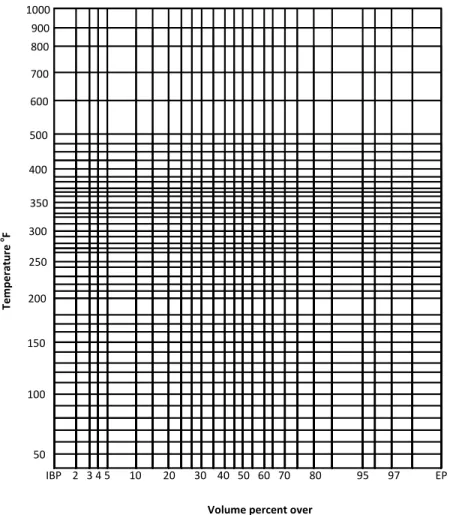
temperatures from any two known values of ASTM temperatures.
38
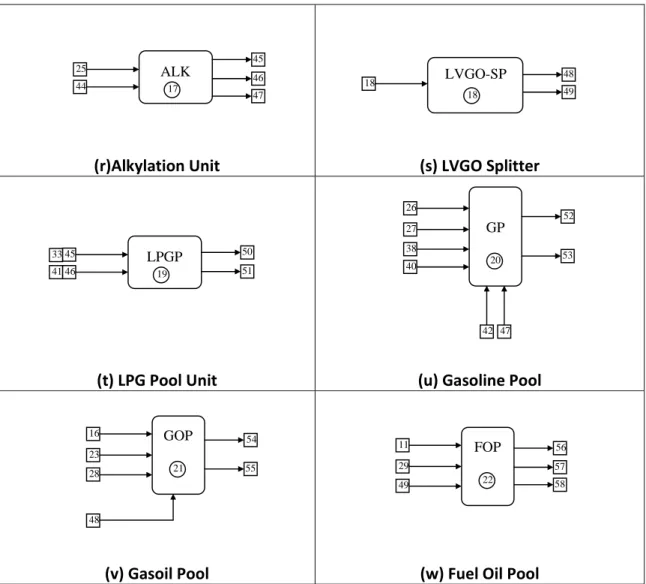
Figure 3.1 Summary of prominent sub‐process units in a typical petroleum refinery complex.
72
Figure 3.2 Refinery Block Diagram (Dotted lines are for H2 stream). 75 Figure 4.1 A Conceptual diagram of the crude distillation unit (CDU)
along with heat exchanger networks (HEN).
122
Figure 4.2 Design architecture of main and secondary columns of the CDU.
123
Figure 4.3 Envelope for the enthalpy balance to yield residue product temperature.
151
Figure 4.4 Heat balance Envelope for condenser duty estimation. 158 Figure 4.5 Envelope for the determination of tower top tray overflow. 159 Figure 4.6 Energy balance envelope for the estimation of reflux flow
rate below the LGO draw off tray.
166
Figure 4.7 Heat balance envelope for the estimation of top pump around duty
174
Figure 4.8
Heat balance envelope for the estimation of flash zone liquid reflux rate.
vii
List
of
Tables
Table 1.1 Analogies between chemical and refinery process design 2 Table 2.1 Tabulated Maxwell’s correlation data for the estimation of
mean average boiling point (Adapted from Maxwell (1950)).
8
Table 2.2 Tabulated Maxwell’s correlation data for the estimation of weight average boiling point (Adapted from Maxwell (1950)).
9
Table 2.3 Tabulated Maxwell’s correlation data for the estimation of molal average boiling point (Adapted from Maxwell (1950)).
10
Table 2.4 Characterization factor data table (Developed from correlation presented in Maxwell (1950)).
19
Table 2.5 Molecular weight data table (Developed from correlation presented in Maxwell (1950)).
20
Table 2.6 Hydrocarbon liquid enthalpy data for MEABP = 200oF and K = 11 – 12.
23
Table 2.7 Hydrocarbon vapor enthalpy data for MEABP = 200oF and K = 11 – 12.
24
Table 2.8 Hydrocarbon vapor enthalpy data for MEABP = 300oF and K = 11 – 12.
25
Table 2.9 Hydrocarbon liquid enthalpy data for MEABP = 300oF and K = 11 – 12.
26
Table 2.10 Table 2.10: Hydrocarbon vapor enthalpy data for MEABP = 400oF and K = 11 – 12.
27
Table 2.11 Hydrocarbon liquid enthalpy data for MEABP = 400oF and K = 11 – 12.
28
Table 2.12 Hydrocarbon vapor enthalpy data for MEABP = 500oF and K = 11 – 12.
29
Table 2.13 Hydrocarbon liquid enthalpy data for MEABP = 500oF and K = 11 – 12.
30
viii
Table 2.15 Hydrocarbon vapor enthalpy data for MEABP = 600 F and K =
11 – 12.
32
Table 2.16 Hydrocarbon liquid enthalpy data for MEABP = 800oF and K = 11 – 12.
33
Table 2.17 Hydrocarbon vapor enthalpy data for MEABP = 800oF and K = 11 – 12.
34
Table 2.18 Vapor pressure data for hydrocarbons. 35 Table 2.19 End point correlation data presented by Good, Connel et. al.
Data sets represent fractions whose cut point starts at 200 oF TBP or lower (Set A); 300 oF (Set B); 400 oF (Set C); 500 oF (Set D); 90% vol temperature of the cut Vs. 90 % vol TBP cut for all fractions (Set E).
37
Table 2.20 ASTM‐TBP correlation data from Edmister ethod. 39 Table 2.21 Blending Index and Viscosity correlation data. 58 Table 2.22 Flash point index and flash point correlation data 60 Table 2.23 Pour point and pour point index correlation data. 62 Table 2.24 EFV‐TBP correlation data presented by Maxwell (1950). 65 Table 3.1 Summary of streams and their functional role as presented in
Figures 3.1 and 3.2.
78
Table 4.1 Packie’s correlation data to estimate the draw off temperature.
147
Table 4.2 Steam table data relevant for CDU design problem. 152 Table 4.3 Variation of specific gravity with temperature (a) Data range:
SG = 0.5 to 0.7 at 60 oF (b) Data range: SG = 0.72 to 0.98 at 60
o F.
164
Table 4.4 Fractionation criteria correlation data for naphtha‐kerosene products.
165
Table 4.5 Fractionation criteria correlation data for side stream‐side stream products.
165
Table 4.6 Variation of Kf (Flooding factor) for various tray and sieve specifications.
1.1
Introduction
Many a times, petroleum refinery engineering is taught in the undergraduate as well as graduate education in a technological but not process design perspective. While technological perspective is essential for a basic understanding of the complex refinery processes, a design based perspective is essential to develop a greater insight with respect to the physics of various processes, as design based evaluation procedures enable a successful correlation between fixed and operating costs and associated profits. In other words, a refinery engineer is bestowed with greater levels of confidence in his duties with mastery in the subject of refinery process design.
1.2
Process
Design
Vs
Process
Simulation
A process design engineer is bound to learn about the basic knowledge with respect to a simulation problem and its contextual variation with a process design problem. A typical process design problem involves the evaluation of design parameters for a given process conditions. However, on the other hand, a typical process simulation problem involves the evaluation of output variables as a function of input variables and design parameters.
For example, in a conventional binary distillation operation, a process design problem involves the specification of Pressure (P), Temperature (T), product distributions (D, B, xB, xD) and feed (F, xF) to evaluate the number of stages (N), rectifying, stripping and feed stages (NR, NS, NF), rectifying and stripping section column diameters (DR and DS), condenser and re‐boiler duties (QC and QR) etc. On the other hand, a process simulation problem for a binary distillation column involves the specification of process design parameters (NR, NS, NF) and feed (F, xF) to evaluate the product distributions (D, xD, B, xB). For a binary distillation system, adopting a process design procedure or process simulation procedure is very easy. Typically, Mc‐Cabe Thiele diagram is adopted for process design calculations and a system of equations whose total number does not exceed 20 are solved for process simulation. For either case, generating a solution for binary distillation is not difficult.
For multi‐component systems involving more than 3 to 4 components, adopting a graphical procedure is ruled out for the purpose of process design calculations. A short cut method for the design of multi‐ component distillation columns is to adopt Fenske, Underwood and Gilliland (FUG) method. Alternatively, for the rigorous design of multi‐component distillation systems, a process design problem is solved as a process simulation problem with an assumed set of process design parameters. Eventually commercial process simulators such as HYSYS or ASPEN PLUS or CHEMCAD or PRO‐II are used to match the obtained product distributions with desired product distributions. Based on a trail and error
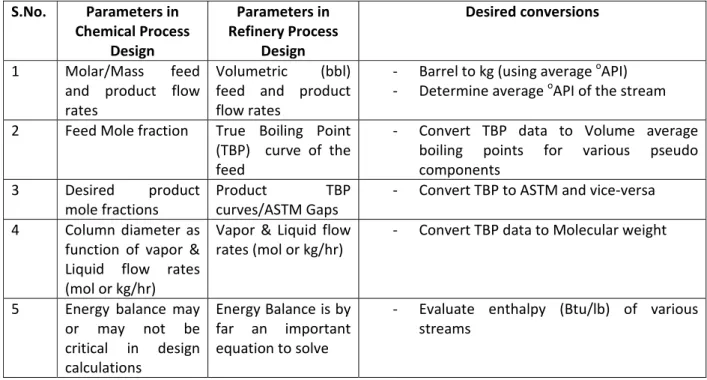
2 S.No. Parameters in Chemical Process Design Parameters in Refinery Process Design Desired conversions 1 Molar/Mass feed and product flow rates
Volumetric (bbl) feed and product flow rates
‐ Barrel to kg (using average oAPI) ‐ Determine average oAPI of the stream
2 Feed Mole fraction True Boiling Point (TBP) curve of the feed
‐ Convert TBP data to Volume average boiling points for various pseudo components
3 Desired product mole fractions
Product TBP curves/ASTM Gaps
‐ Convert TBP to ASTM and vice‐versa 4 Column diameter as
function of vapor & Liquid flow rates (mol or kg/hr)
Vapor & Liquid flow rates (mol or kg/hr)
‐ Convert TBP data to Molecular weight
5 Energy balance may or may not be critical in design calculations Energy Balance is by far an important equation to solve
‐ Evaluate enthalpy (Btu/lb) of various streams
Table 1.1 : Analogies between chemical and refinery process design
approach that gets improved with the experience of the process design engineer with simulation software, process design parameters are set. In summary, it is always a fact that a multi‐component process design problem is very often solved as a process simulation problem, as it necessarily eases the solution approach.
1.3
Analogies
between
Chemical
&
Refinery
Process
design
In a larger sense, a refinery process design procedure shall mimic similar procedures adopted for chemical process design. However, a chemical engineer shall first become conversant with the analogies associated with chemical and refinery process design. Table 1.1 summarizes these analogies in the larger context. It can be observed in the table that refinery process design calculations can be easily carried out as conventional chemical process design calculations when various properties such as VABP, TBP to ASTM conversion and vice‐versa, molecular weight, oAPI and enthalpy have to be evaluated for various crude feeds and refinery intermediate and product streams. Once these properties are estimated, then knowledge in conventional chemical process design can be used to judiciously conduct the process design calculations.
There are few other properties that are also required to aid process design calculations as these properties are largely related to the product specifications. A few illustrative examples are presented
3
below to convey that the evaluation of these additional properties is mandatory in refinery process design:
a) Sulfur content in various intermediate as well as product streams is always considered as an important parameter to monitor in the entire refinery. Therefore, evaluation of sulfur content in various streams in the refinery complex is essential.
b) The viscosity of certain heavier products emanating from the fuel oil pool such as heavy fuel oil and bunker oil is always considered as a severe product constraint. Therefore, wherever necessary viscosity of process and product streams needs to be evaluated at convenience. For such cases, the evaluation of viscosity from blended intermediate stream viscosities is required. c) In similarity to the case evaluated for the above option (i.e., (b)), flash point and pour point need
to be evaluated for a blended stream mixture.
d) Equilibrium flash vaporization (EFV) curve plays a critical role in the design of distillation columns that are charged with partially vaporized feed. Therefore, the determination of EFV from TBP is necessary.
1.4
Refinery
Property
Estimation
The following list summarizes the refinery process and product properties required for process design calculations:
1. True boiling point curve (always given) of crude and intermediate/product streams 2. Volume (Mean) average boiling point (VABP)
3. Mean average boiling point (MEABP) 4. Weight average boiling point (WABP) 5. Molal average boiling point (MABP) 6. Characterization factor (K)
7. Vapor pressure (VP) at any temperature 8. Viscosity at any temperature
9. Average sulfur content (wt %) 10. oAPI
11. Enthalpy (Btu/lb)
12. ASTM conversion to TBP and vice‐versa 13. Viscosity of a mixture using viscosity index 14. Flash point of a mixture using flash point index 15. Pour point of a mixture using pour point index 16. Equilibrium flash vaporization curve
For many of these properties, the starting point by large is the crude assay which consists of a TBP, sulfur and oAPI curve using which properties of various streams are estimated. In the next chapter, we address the evaluation of these important properties using several correlations available in various literatures.
2.
Estimation
of
Refinery
Stream
Properties
2.1
Introduction
In this chapter, we present various correlations available for the property estimation of refinery crude,
intermediate and product streams. Most of these correlations are available in Maxwell (1950), API
Technical Hand book (1997) etc. Amongst several correlations available, the most relevant and easy to
use correlations are summarized so as to estimate refinery stream properties with ease.
The determination of various stream properties in a refinery process needs to first obtain the crude
assay. Crude assay consists of a summary of various refinery properties. For refinery design purposes,
the most critical charts that are to be known from a given crude assay are TBP curve, oAPI curve and
Sulfur content curve. These curves are always provided along with a variation in the vol % composition.
Often, it is difficult to obtain the trends in the curves for the 100 % volume range of the crude. Often
crude assay associated to residue section of the crude is not presented. In summary, a typical crude
assay consists of the following information:
a) TBP curve (< 100 % volume range)
b) oAPI curve (< 100 % volume range)
c) Sulfur content (wt %) curve (< 100 % volume range)
d) Average oAPI of the crude
e) Average sulfur content of the crude (wt %)
An illustrative example is presented below for a typical crude assay for Saudi heavy crude oil whose
crude assay is presented by Jones and Pujado (2006). A complete TBP assay of the Saudi heavy crude oil
is obtained from elsewhere. Figures 2.1, 2.2 and 2.3 summarize the TBP, oAPI and sulfur content curves
with respect to the cumulative volume %. Amongst these, the oAPI and % sulfur content graphs have
been extrapolated to project values till a volume % of 100. This has been carried out to ensure that the
evaluated values are in comparable range with the average oAPI and sulfur content reported for the
crude in the literature. These values correspond to about 28.2 oAPI and 2.84 wt % respectively.
Volume % 0 20 40 60 80 100 Temperature o F -200 0 200 400 600 800 1000 1200 1400 1600
Figure 2.1: TBP Curve of Saudi heavy crude oil.
Volume % 0 20 40 60 80 100 o AP I 0 20 40 60 80 100
Volume % 0 20 40 60 80 100 Su lf u r c o n te n t (w t %) 0 1 2 3 4 5 6
Figure 2.3: Sulfur content assay for heavy Saudi crude oil.
2.2
Estimation
of
average
temperatures
The volume average boiling point (VABP) of crude and crude fractions is estimated using the
expressions:
(1)
(2)
The mean average boiling point (MEABP), molal average boiling point (MABP) and weight average
boiling point (WABP) is evaluated using the graphical correlations presented in Maxwell (1950). These
are summarized in Tables 2.1 – 2.3 for both crudes and crude fractions. Where applicable, extrapolation
of provided data trends is adopted to obtain the temperatures if graphical correlations are not
presented beyond a particular range in the calculations. We next present an example to illustrate the
STBP o
F/vol%
Differentials to be added to VABP for evaluating MEABP for various
values of VABP 200 oF 300 oF 400 oF 500 oF 600+ oF 0.8 0.092 1 ‐0.946 1.2 ‐2.157 ‐0.211 1.4 ‐3.411 ‐0.674 1.6 ‐4.977 ‐2.043 1.8 ‐6.370 ‐3.324 ‐0.237 2 ‐8.210 ‐4.821 ‐1.366 2.2 ‐9.853 ‐6.171 ‐2.607 ‐0.738 ‐0.832 2.4 ‐11.664 ‐7.709 ‐3.696 ‐1.635 ‐1.633 2.6 ‐13.525 ‐9.125 ‐5.037 ‐2.490 ‐2.349 2.8 ‐15.411 ‐11.074 ‐6.476 ‐3.393 ‐3.267 3 ‐17.171 ‐12.564 ‐7.763 ‐4.231 ‐4.369 3.2 ‐19.428 ‐14.336 ‐9.238 ‐5.174 ‐5.250 3.4 ‐21.479 ‐16.119 ‐10.731 ‐6.177 ‐6.277 3.6 ‐23.378 ‐18.015 ‐12.184 ‐7.313 ‐7.182 3.8 ‐25.665 ‐19.904 ‐13.958 ‐8.525 ‐8.306 4 ‐27.863 ‐21.882 ‐15.558 ‐9.794 ‐9.621 4.2 ‐30.137 ‐23.866 ‐17.390 ‐11.497 ‐10.623 4.4 ‐32.447 ‐26.153 ‐19.135 ‐13.157 ‐12.039 4.6 ‐34.585 ‐28.059 ‐21.121 ‐14.815 ‐13.083 4.8 ‐37.252 ‐30.509 ‐23.220 ‐16.502 ‐14.627 5 ‐39.713 ‐32.746 ‐25.268 ‐18.452 ‐16.232 5.2 ‐34.931 ‐27.320 ‐20.564 ‐17.263 5.4 ‐37.337 ‐29.452 ‐24.538 ‐18.956 5.6 ‐39.988 ‐31.934 ‐31.482 ‐20.741 5.8 ‐42.004 ‐34.231 ‐34.134 ‐22.164 6 ‐45.231 ‐36.770 ‐36.644 ‐23.843 6.2 ‐39.325 ‐39.224 ‐25.438 6.4 ‐41.766 ‐41.605 ‐27.517 6.6 ‐44.287 ‐44.536 ‐29.529 6.8 ‐47.027 ‐47.392 ‐31.390 7 ‐50.345 ‐50.612 ‐33.442 7.2 ‐53.459 ‐35.723 7.4 ‐56.580 ‐37.580 7.6 ‐59.714 ‐39.817 7.8 ‐42.204 8 ‐44.253 8.2 ‐46.637 8.4 ‐48.916 8.6 ‐51.513 8.8 ‐53.958 9 ‐56.606 9.2 ‐59.260 9.4 ‐62.025 9.6 ‐64.491 9.8 ‐67.463 10 ‐70.073
Table 2.1: Tabulated Maxwell’s correlation data for the estimation of mean average boiling point
STBP o
F/vol%
Differentials to be added to VABP for evaluating weight
average boiling point
200 oF 300 oF 400 oF 500 oF 1 0.385 1.2 0.871 1.4 1.562 0.4252 1.6 1.731 0.6859 1.8 2.385 1.1478 2 2.860 1.4331 0.428 2.2 3.372 1.9128 0.869 2.4 3.801 2.3559 1.364 0.084 2.6 4.603 2.7724 1.770 0.705 2.8 5.096 3.3327 2.241 1.149 3 5.288 3.9349 2.623 1.356 3.2 5.992 4.3339 3.063 1.598 3.4 6.471 4.8098 3.556 2.094 3.6 7.242 5.2685 3.979 2.690 3.8 7.874 5.9560 4.527 3.164 4 8.392 6.5961 5.281 3.528 4.2 9.103 7.1566 5.850 3.977 4.4 9.822 7.7964 6.378 4.707 4.6 10.406 8.5729 7.051 5.431 4.8 11.149 9.3378 7.698 5.997 5 12.309 9.8381 8.530 6.699 5.2 10.5521 9.450 7.525 5.4 11.3710 10.120 8.340 5.6 12.3187 10.843 9.355 5.8 13.0148 11.766 10.155 6 13.7419 12.818 11.036 6.2 13.806 12.062 6.4 14.651 12.825 6.6 15.504 13.641 6.8 16.619 14.862 7 17.854 16.076 7.2 17.383 7.4 18.437 7.6 19.485 7.8 20.817 8 21.718 8.2 23.035 8.4 24.437 8.6 25.806 8.8 27.236 9 28.498 9.2 29.729 9.4 31.481 9.6 32.713 9.8 34.373 10 35.656
Table 2.2: Tabulated Maxwell’s correlation data for the estimation of weight average boiling point
STBP o
F/vol%
Differentials to be added to VABP for
evaluating weight average boiling point 200 oF 300 oF 400 oF 1.2 ‐0.198 1.4 ‐1.528 1.6 ‐4.137 ‐0.808 ‐0.808 1.8 ‐6.243 ‐2.103 ‐2.103 2 ‐7.736 ‐3.865 ‐3.865 2.2 ‐9.942 ‐5.853 ‐5.853 2.4 ‐12.190 ‐7.855 ‐7.855 2.6 ‐14.412 ‐10.056 ‐10.056 2.8 ‐16.720 ‐12.286 ‐12.286 3 ‐19.183 ‐14.513 ‐14.513 3.2 ‐22.225 ‐16.907 ‐16.907 3.4 ‐24.354 ‐19.439 ‐19.439 3.6 ‐27.572 ‐22.195 ‐22.195 3.8 ‐30.467 ‐25.215 ‐25.215 4 ‐33.302 ‐27.810 ‐27.810 4.2 ‐36.718 ‐30.893 ‐30.893 4.4 ‐40.485 ‐33.998 ‐33.998 4.6 ‐43.955 ‐37.582 ‐37.582 4.8 ‐47.289 ‐40.966 ‐40.966 5 ‐51.589 ‐44.487 ‐44.487 5.2 ‐55.380 ‐48.548 ‐48.548 5.4 ‐59.634 ‐52.525 ‐52.525 5.6 ‐63.603 ‐56.417 ‐56.417 5.8 ‐68.993 ‐60.733 ‐60.733 6 ‐73.650 ‐65.524 ‐65.524 6.2 ‐70.237 ‐70.237 6.4 ‐75.367 ‐75.367 6.6 ‐80.412 ‐80.412 6.8 ‐86.654 ‐86.654 7 ‐91.941 ‐91.941 7.2 ‐98.218 ‐98.218 7.4 ‐104.912 ‐104.912
Table 2.3: Tabulated Maxwell’s correlation data for the estimation of molal average boiling point
(Adapted from Maxwell (1950)).
Q 2.1: Using the TBP presented in Figure 2.1 and graphical correlation data (Table 2.1 – 2.3), estimate
the average temperatures of Saudi heavy crude oil.
Solution:
a. Volume average boiling point
Tv
=
t
20+t
50+t
80/3
=
(338+703+1104)/3=
715
0
F
b. Mean average boiling point (from extrapolation)
Slope
=
t
70‐
t
10/
60
=
965
‐
205/60=
12.67
From Table 2.1 ∆ T (400,12.67) = ‐116.15 0
F
∆ T (500,12.67) = ‐102.48 0
F
∆ T (715,12.67) = ‐73.08950
F
(from extrapolation)
Mean average boiling point =
T
v+
∆
T
=715 – 73.0895 = 641.91 0F
c. Weight average boiling point (from extrapolation)
Slope
=
t
70‐
t
10/
60
=
965
‐
205/60=
12.67
From Table 2.1 ∆ T (400,12.67) = 43.515 0
F
∆ T (500,12.67) = 41.515 0
F
∆ T (715,12.67) = 37.215 0
F
(from extrapolation)
Weight average boiling point =
T
v+
∆
T
=715 + 37.215 = 752.21 0F
d. Molal average boiling point (from extrapolation)
Slope
=
t
70‐
t
10/
60
=
965
‐
205/60=
12.67
From Table 2.2 ∆ T (400,12.67) = ‐212.96 0
F
∆ T (600,12.67) = ‐191.62 0
F
∆ T (715,12.67) = ‐179.3495 0
F
(from extrapolation)
Molal average boiling point =
T
v+
∆
T
=715 – 179.3495 = 535.65 0F
2.3
Estimation
of
average
o
API
and
sulfur
content
2.3.1
Psuedo
‐
component
concept
Many a times for refinery products the average oAPI needs to be estimated from the oAPI curve of the
crude and TBP of the crude/product. The estimation of oAPI is detrimental to evaluate the mass
balances from volume balances. Since oil processing is usually reported in terms of barrels (bbl), the
average oAPI of the stream needs to be estimated to convert the volumetric flow rate to the mass flow
rate. In a similar context, sulfur balances across the refinery is very important to design and operate
various desulfurization sub‐processes in the refinery complex. Henceforth, the average sulfur content of
both crude and its CDU products needs to be evaluated so as to aid further calculations in the
downstream units associated to the crude distillation unit.
In order to estimate the average oAPI and sulfur content of a crude/product stream, it is essential to
characterize the TBP curve of the crude/product using the concept of psuedocomponents. It is well
known that a refinery process stream could not represented using a set of 50 – 100 components, as
crude oil constitutes about a million compounds or even more. Therefore, to aid refinery calculations,
the psuedocomponent concept is being used. According to the conception of the psuedocomponent
representation of the crude stream, a crude oil is characterized to be a constituent of a maximum of 20
– 30 psuedocomponents whose average properties can be used to represent the TBP, oAPI and % sulfur
content of the streams. A pseudo‐component in a typical TBP is defined as a component that can
represent the average mid volume boiling point (and its average properties such as oAPI and % sulfur
content). Therefore, in a typical TBP, a pseudo‐component is chosen such that within a given range of
volume %, the pseudo‐component shall provide equal areas of area under and above the curves (Figure
2.4). In a truly mathematical sense, this is possible, if the chosen area for the volume cuts corresponds
to a straight line, with the fact that for a straight line exactly at the mid‐point, the area above the
straight line and below the straight line need to be essential equal. However, since huge number of
straight segments are required to represent a non‐linear curve, the calculation procedure is bound to be
tedious. Henceforth, typically a crude/product stream is represented with no more than 20 – 30
psuedo‐ components.
The temperature corresponding to the pseudo‐component to represent a section of the crude volume
on the TBP is termed as mid boiling point (MBP) and the corresponding volume as mid volume (MV).
Therefore, in summary, a graphical representation of the TBP is converted to a tabulated data
comprising of psueudo‐component number, section temperature range, section volume range, MBP and
MV. A similar projection of mid volume with the oAPI and sulfur content curves also provides the mid
volume oAPI and %sulfur content properties. These can be then used to estimate the average oAPI and
% sulfur content of the crude/refinery product.
We next present an illustration with respect to the pseudo‐components chosen to represent the heavy
Saudi crude oil.
Q 2.2: Using the TBP, oAPI and % sulfur content presented in Figure 2.1 and pseudo‐component concept,
summarize a table to represent the TBP, oAPI and % sulfur content in terms of the chosen pseudo‐
components.
Solution:
The following temperature and volume bands have been chosen to represent the TBP in terms of the
pseudo‐components. Psuedo‐ component No. Range Differential volume (%) Cumulative volume (%) 1 -12-80 4 0 - 4 2 80-120 2 4 - 6 3 120-160 1.5 6 – 7.5 4 160-180 1.5 7.5 – 9 5 180-220 2 9 – 11 6 220-260 3 11 – 14 7 260-300 3 14 – 17 8 300-360 5 17 – 22 9 360-400 3 22 – 25 10 400-460 5 25 – 30 11 460-520 5.1 30 – 35.1 12 520-580 4.9 35.1 – 40
13 580-620 3 40 – 43 14 620-660 3 43 – 46 15 660-760 8.5 46 – 54.5 16 760-860 7.5 54.5 – 62 17 860-900 3.5 62 – 65.5 18 900-940 2.5 65.5 – 68 19 940-980 3 68 – 71 20 980-1020 3 71 – 74 21 1020-1060 2.5 74 - 76.5 22 1060-1160 7.5 76.5 – 84 23 1160-1280 8.5 84 – 92.5 24 1280-1400 7.5 92.5 -100
For these chosen temperature zones, the pseudo‐component mid boiling point and mid volume (that
provide equal areas of upper and lower triangles illustrated in Figure 2.4) evaluated using the TBP curve
are summarized as:
Psuedo‐
component No.
Mid Boiling point Mid volume
1 35 2 2 100 5 3 140 6.75 4 170 8 5 200 9.75 6 240 12.5 7 280 15.5 8 330 19.5 9 380 23.5 10 430 27.5 11 490 32.5 12 550 37.5 13 600 41.75 14 640 45 15 710 50.75 16 810 58.5 17 880 63.75 18 920 66.75 19 960 69.5 20 1000 72.5 21 1040 75.25 22 1110 80.25 23 1220 88.25 24 1340 96.25
The mid volume (MV) data when projected on the oAPI and % sulfur content curves (Figures 1.2 and 1.3)
would provide mid oAPI and mid % sulfur content for corresponding pseudo‐components. These are
summarized as
Psuedo‐
component No.
Mid volume Mid oAPI % sulfur content
1 2 89.1 0.641432 2 5 81.9 0.663074 3 6.75 77.7 0.676386 4 8 75 0.68523 5 9.75 69 0.705736 6 12.5 64.5 0.721939 7 15.5 59 0.742782 8 19.5 53 0.766938 9 23.5 49 0.783934 10 27.5 45 0.8017 11 32.5 40.5 0.822674 12 37.5 35.5 0.847305 13 41.75 33 0.860182 14 45 30 0.876161 15 50.75 25.5 0.901274 16 58.5 22 0.921824 17 63.75 19 0.940199 18 66.75 18 0.946488 19 69.5 17 0.952862 20 72.5 16 0.959322 21 75.25 15 0.96587 22 80.25 13 0.979239 23 88.25 10 1 24 96.25 6.5 1.025362
2.3.2
Estimation
of
average
o
API
and
%
sulfur
content
The average oAPI of a refinery crude/product stream is estimated using the expression:
av. S. G. ∑
∑ (3)
av. %sulfur content ∑
∑ (4)
where [Ai], [Bi] and [Ci] correspond to the pseudo‐component (i) differential volume, mid volume S.G. for pseudo‐component (i) and mid sulfur content (wt %) for pseudo‐component (i) respectively.
An illustrative example is presented to evaluate the average oAPI and % sulfur content of a crude
stream.
Q 2.3: Estimate the average oAPI and % sulfur content of heavy Saudi Crude oil and compare it with the
value provided in the literature.
Solution: Psuedo‐ component Number Differential Volume % A Mid volume oAPI Mid volume S.G B Wt. factor A B Mid volume sulfur wt % C Sulfur wt. factor A B C 1 4 89.1 0.641432 2.56573 0 0 2 2 81.9 0.663074 1.326148 0 0 3 1.5 77.7 0.676386 1.014579 0 0 4 1.5 75 0.68523 1.027845 0 0 5 2 69 0.705736 1.411471 0 0 6 3 64.5 0.721939 2.165816 0 0 7 3 59 0.742782 2.228346 0 0 8 5 53 0.766938 3.834688 0.05 0.191734 9 3 49 0.783934 2.351801 0.2 0.47036 10 5 45 0.8017 4.008499 0.35 1.402975 11 5.1 40.5 0.822674 4.19564 0.7 2.936948 12 4.9 35.5 0.847305 4.151796 1.35 5.604925 13 3 33 0.860182 2.580547 1.7 4.38693 14 3 30 0.876161 2.628483 2 5.256966 15 8.5 25.5 0.901274 7.660828 2.6 19.91815 16 7.5 22 0.921824 6.913681 2.75 19.01262 17 3.5 19 0.940199 3.290698 3.05 10.03663 18 2.5 18 0.946488 2.366221 3.2 7.571907 19 3 17 0.952862 2.858586 3.35 9.576263 20 3 16 0.959322 2.877966 3.55 10.21678 21 2.5 15 0.96587 2.414676 3.7 8.934301 22 7.5 13 0.979239 7.344291 3.9 28.64273 23 8.5 10 1 8.5 4.3 36.55 24 7.5 6.5 1.025362 7.690217 4.7 36.14402 Sum 100 ‐ ‐ 87.58476 ‐ 207.045
av. S. G. ∑ A B ∑ A 87.58476 100 0.8758 av. API 141.5 0.874 131.5 30.0577 av. %sulfur content ∑
∑
.
. 2.6393
The literature values of average oAPI and average sulfur content (wt %) are 28.2 oAPI and 2.84 wt %
respectively.
2.4
Characterization
factor
The refinery stream characterization factor (K) is required for a number of property evaluations such as
molecular weight, enthalpy etc. Therefore, graphical correlations to evaluate characterization factor are
mandatory to evaluate the characterization factor. Maxwell (1950) presents a graphical correlation
between crude characterization factor (K), oAPI and mean average boiling point (MEABP). The
correlation is presented in Table 2.4 which can be used to estimate the characterization factor for both
crude and other refinery process streams.
Q 2.4: Estimate the characterization factor for Saudi heavy crude oil.
Solution:
Mean average boiling point = 641.9105 0
F;
0API = 30.3834770 From Table 2.4, characterization factor is 11.75.
VABP o F Characterization factor for various values of API 90o 85o 80o 75o 70o 65o 60o 55o 50 o 45 o 40 o 35 o 30 o 25 o 20 o 15 o 10 o 5 o 0 o 100 12.889 12.607 12.302 12.018 11.711 11.414 11.121 10.863 10.571 10.249 9.951 9.687 9.399 120 13.040 12.755 12.451 12.157 11.859 11.564 11.255 10.983 10.695 10.382 10.080 9.802 9.504 9.202 140 13.183 12.902 12.586 12.295 11.988 11.693 11.388 11.113 10.822 10.502 10.191 9.925 9.622 9.314 160 13.331 13.042 12.725 12.426 12.125 11.831 11.519 11.236 10.938 10.627 10.319 10.042 9.728 9.419 180 13.465 13.177 12.855 12.550 12.252 11.955 11.641 11.355 11.062 10.748 10.432 10.148 9.836 9.527 9.199 200 13.600 13.314 12.995 12.686 12.391 12.086 11.759 11.474 11.181 10.859 10.541 10.257 9.937 9.631 9.317 220 13.735 13.447 13.130 12.819 12.514 12.205 11.879 11.587 11.264 10.969 10.645 10.360 10.036 9.727 9.419 240 13.863 13.577 13.255 12.941 12.624 12.330 11.998 11.692 11.396 11.079 10.757 10.466 10.133 9.826 9.515 260 13.982 13.703 13.382 13.069 12.744 12.440 12.118 11.796 11.501 11.186 10.858 10.564 10.230 9.919 9.612 9.188 280 13.828 13.504 13.187 12.854 12.555 12.221 11.904 11.601 11.286 10.948 10.655 10.325 10.003 9.703 9.301 300 13.946 13.622 13.308 12.968 12.663 12.334 12.014 11.697 11.383 11.048 10.748 10.414 10.102 9.789 9.402 320 13.742 13.428 13.082 12.780 12.444 12.117 11.792 11.481 11.138 10.840 10.497 10.193 9.879 9.486 340 13.854 13.535 13.192 12.883 12.553 12.219 11.897 11.577 11.230 10.927 10.589 10.273 9.966 9.575 9.239 360 13.959 13.650 13.298 12.977 12.655 12.320 11.992 11.671 11.326 11.018 10.677 10.353 10.047 9.666 9.324 380 13.749 13.401 13.084 12.756 12.418 12.083 11.762 11.410 11.104 10.761 10.431 10.126 9.754 9.406 400 13.854 13.514 13.181 12.862 12.514 12.183 11.855 11.498 11.184 10.843 10.524 10.206 9.833 9.489 420 13.964 13.614 13.281 12.961 12.612 12.273 11.946 11.582 11.273 10.924 10.608 10.288 9.915 9.573 9.183 440 13.724 13.386 13.056 12.712 12.364 12.030 11.665 11.358 11.002 10.682 10.365 9.996 9.649 9.283 460 13.821 13.490 13.156 12.809 12.460 12.112 11.760 11.436 11.079 10.758 10.436 10.072 9.726 9.365 480 13.929 13.585 13.259 12.899 12.547 12.202 11.842 11.519 11.158 10.835 10.506 10.145 9.798 9.444 500 13.677 13.347 12.988 12.635 12.292 11.929 11.595 11.236 10.912 10.579 10.212 9.867 9.521 520 13.769 13.452 13.081 12.725 12.375 12.013 11.670 11.313 10.988 10.655 10.280 9.934 9.591 9.231 540 13.861 13.533 13.173 12.806 12.460 12.087 11.752 11.392 11.063 10.724 10.355 9.995 9.665 9.303 560 13.956 13.628 13.261 12.903 12.543 12.162 11.830 11.470 11.140 10.788 10.425 10.068 9.736 9.371 580 13.717 13.348 12.985 12.627 12.256 11.902 11.541 11.218 10.863 10.489 10.137 9.810 9.426
VABP o
F
Characterization factor for various values of API
90o 85o 80o 75o 70o 65o 60o 55o 50 o 45 o 40 o 35 o 30 o 25 o 20 o 15 o 10 o 5 o 0 o
600 13.816 13.437 13.074 12.711 12.331 11.989 11.611 11.294 10.937 10.552 10.196 9.876 9.495 620 13.160 12.789 12.404 12.063 11.688 11.368 10.995 10.618 10.256 9.929 9.549 640 13.248 12.873 12.482 12.132 11.763 11.442 11.060 10.684 10.322 9.992 9.611 660 13.331 12.952 12.558 12.208 11.835 11.509 11.128 10.744 10.384 10.054 9.674 680 13.415 13.030 12.644 12.289 11.908 11.570 11.192 10.804 10.443 10.113 9.728 700 13.481 13.112 12.718 12.362 11.984 11.642 11.256 10.865 10.498 10.173 9.781 720 13.194 12.787 12.428 12.058 11.715 11.322 10.925 10.557 10.224 9.839 740 13.258 12.863 12.505 12.125 11.774 11.384 10.988 10.613 10.280 9.891 760 13.344 12.935 12.574 12.192 11.839 11.442 11.050 10.670 10.337 9.940 780 13.417 13.004 12.640 12.260 11.907 11.504 11.111 10.728 10.389 9.990 800 13.492 13.076 12.710 12.329 11.966 11.569 11.170 10.786 10.444 10.039 820 13.145 12.781 12.391 12.021 11.631 11.224 10.845 10.491 10.092 840 13.208 12.850 12.456 12.081 11.687 11.279 10.901 10.546 10.145 860 13.276 12.916 12.526 12.145 11.741 11.341 10.955 10.599 10.193 880 13.352 12.980 12.591 12.205 11.797 11.404 11.015 10.645 10.241 900 13.415 13.047 12.648 12.262 11.858 11.455 11.067 10.696 10.295 920 13.471 13.114 12.708 12.323 11.922 11.516 11.115 10.742 10.341 940 13.181 12.771 12.384 11.983 11.573 11.169 10.792 10.388 960 13.245 12.832 12.440 12.035 11.625 11.224 10.841 10.440 980 13.306 12.891 12.494 12.080 11.685 11.286 10.893 10.487 1000 12.548 12.141 11.739 11.328 10.898 10.520
Table 2.4: Characterization factor data table (Developed from correlation presented in Maxwell (1950)).
MEABP
(o F)
Molecular weight at various values of API
90 80 70 60 50 40 30 20 10 0 120 82.591 140 89.244 85.349 81.759 160 95.864 92.216 87.806 83.893 180 103.115 99.154 94.260 90.304 86.542 81.845 200 110.109 106.048 100.836 96.991 92.552 87.991 83.332 220 117.449 113.544 108.021 103.568 98.771 93.936 89.166 84.078 240 121.106 115.309 110.680 105.248 100.249 95.244 89.326 260 129.009 122.453 117.796 112.231 107.030 101.472 95.365 280 137.114 130.197 125.128 118.714 113.839 108.131 101.448 300 138.353 132.882 126.099 120.332 114.305 107.771 320 146.115 140.272 133.574 127.402 120.794 113.873 330 150.445 144.292 137.140 130.788 124.406 117.517 340 154.371 148.429 141.234 134.569 127.900 120.713 360 156.558 149.198 142.287 134.598 127.437 380 164.892 156.783 149.607 142.029 134.712 400 173.686 165.470 157.656 149.630 141.480 420 182.652 174.068 165.958 157.072 148.654 440 191.989 182.885 174.128 164.891 155.945 460 192.032 182.646 172.888 163.835 480 201.319 191.174 181.139 171.254 161.127 500 211.605 200.591 189.715 179.456 169.110 520 222.386 210.830 199.031 187.685 176.365 540 232.797 221.373 208.761 196.571 184.444 560 232.206 219.068 206.019 192.562 580 244.280 229.410 216.033 201.881 600 256.867 241.053 226.386 211.664 620 270.206 252.796 237.329 221.746 640 284.579 265.535 249.244 231.901 660 299.640 279.937 262.088 243.147 680 314.428 294.088 274.070 254.362 700 330.525 308.992 286.731 266.284 720 346.094 324.137 302.034 279.799 256.350 740 362.792 339.010 317.470 293.587 269.871 760 378.761 356.110 331.730 307.285 282.406 780 396.112 371.811 347.474 321.642 295.480 800 414.225 388.517 362.886 336.861 308.755 820 431.710 404.926 378.024 350.271 322.104 840 448.263 422.817 394.631 366.309 336.478 860 467.186 439.000 411.105 381.136 350.167 880 485.253 456.069 426.951 397.625 365.202 900 504.444 473.298 443.368 412.016 380.935 920 521.642 491.813 460.804 427.960 396.645 940 540.431 508.462 477.082 443.855 413.040 960 526.999 493.824 460.293 428.276 980 543.180 511.031 476.876 444.464 1000 561.388 528.021 492.335 459.824 1020 579.708 545.854 510.006 474.981 1030 589.010 554.911 518.720 484.254 1040 597.408 563.222 526.663 492.425 1060 580.517 544.863 510.209 1080 599.227 561.993 526.436 1100 579.496 542.104 1120 596.069 558.957 1140 573.783
2.5
Molecular
weight
The molecular weight of a stream is by far an important property using which mass flow rates can be
conveniently expressed in terms of molar flow rates. Typically molar flow rates are required to estimate
vapor and liquid flow rates within distillation columns. A graphical correlation between molecular
weight of a stream, its characterization factor (K) and MEABP presented by Maxwell (1950) in data
format in Table 2.5. An illustrative example is presented below to elaborate upon the procedure
involved for molecular weight estimation.
Q 2.5: Estimate the molecular weight of heavy Saudi crude oil.
Solution:
0API = 30.05, Mean average b.pt=641.91 oF
From Table 2.5, molecular weight of the Saudi heavy crude oil = 266.
2.6
Viscosity
The correlations presented in API Technical Handbook (1997) are used to estimate the viscosity (in
Centistokes) of crude/petroleum fractions. The correlations are presented as follows:
a) The viscosity of a petroleum fraction at 100 oF is evaluated as the sum of two viscosities namely
correlated and reference i.e.,
µ µ µ
where the correlated viscosity is estimated using the expressions
µ 10
A 34.9310 0.084387T 6.73513 10 T 1.01394 10 T
A 2.92649 6.98405 10 T 5.09947 10 T 7.49378 10 T
K √T S. G.
And the reference viscosity is estimated using the expressions
µ 10 . . .
b) The viscosity of a petroleum fraction at 210 oF is estimated using the viscosity at 100 oF with the
following correlation
µ 10 . . . µ
In the above expressions, T refers to the mean average boiling point (MEABP) expressed in oR.
Next, the estimation of viscosity is presented for the heavy Saudi Crude oil.
Q 2.6: Estimate the viscosity of heavy Saudi crude oil using viscosity correlations presented in API
Technical data book and compare the obtained viscosity with that available in the literature.
Solution:
At 100oF, the viscosity is estimated using the following expressions:
S. G. of crude = 0.8758 0API = 30.05 K √T S. G. √1102 0.874 11.81 A 34.9310 0.084387T 6.73513 10 T 1.01394 10 T 5.6842 A 2.92649 6.98405 10 T 5.09947 10 T 7.49378 10 T 0.4193 µ 10 5.6325 Cst µ 10 . . . 3.6364 Cst µ µ µ 9.269 Cst µ 10 . . . µ 2.465
The literature viscosity values are significantly different from those obtained using viscosity correlation.
The literature viscosity at 100 oC is 18.9 which is almost twice that obtained from the correlation. The
predicted viscosity matches with that reported in the literature for medium heavy Saudi crude oil.
2.7
Enthalpy
The
estimation
of
petroleum
fraction
enthalpy
is
required
for
good
number
of
reasons.
Without
knowing
the
enthalpy
of
petroleum
vapor/liquid
fractions,
it
is
not
possible
to
estimate
the
condenser
and
re
‐
boiler
duties
and
conduct
energy
balances.
Maxwell
(1950)
presents
about
13
graphs
that
can
be
conveniently
used
to
estimate
the
enthalpy
of
vapor/liquid
fractions
as
functions
of
refinery
stream
characterization
factor
and
system
temperature
(in
o
F).
These
graphical
correlations
are
tabulated
and
presented
in
Tables
2.6
–
2.17.
Using
these
tables,
the
enthalpy
of
refinery
process
streams
is
estimated
using
interpolation
and
extrapolation
procedures.
Next,
an
illustrative
example
is
presented
for
the
estimation
of
enthalpy
of
Saudi
heavy
crude
oil.
Q 2.7: Estimate the enthalpy of saturated Saudi heavy crude oil liquid at its volume average boiling
point.
Solution:
Volume average boiling point = 715 oF
MeABP 600 800 K 11 12 11 12 Enthalpy of liquid stream (Btu/lb) at 715 oF 400 427 385 406
Saudi Crude MEABP = 642 oF
K value for Saudi Crude = 11.75 oF
Liquid stream enthalpy at 600 oF and 11.75 oF = 400 + (11.75‐11) x (427‐400) = 420.25 oF
Liquid stream enthalpy at 800 oF and 11.75 oF = 385 + (11.75 – 11) x (406 – 385) = 400.75 oF
Crude oil enthalpy at 715 oF whose MEABP = 642 oF = 420.25 +42/200*(420.25‐400.75) = 424.395 oF.
T (oF) Hydrocarbon Enthalpy (Btu/lb) for various values of K
11 11.2 11.4 11.6 11.8 12 0 0.49 0.41 0.33 0.24 0.16 0.07 20 8.12 8.34 8.56 8.78 9.00 9.22 40 17.98 18.29 18.60 18.91 19.22 19.54 60 27.90 28.32 28.74 29.16 29.58 30.00 80 37.59 38.15 38.71 39.27 39.82 40.38 100 47.38 48.16 48.94 49.71 50.49 51.27 120 57.74 58.76 59.79 60.81 61.83 62.85 140 68.52 69.61 70.70 71.79 72.88 73.96 160 78.81 80.25 81.69 83.13 84.56 86.00 180 88.86 90.77 92.68 94.60 96.51 98.42 200 99.60 101.54 103.47 105.40 107.33 109.27 220 110.37 112.46 114.55 116.64 118.73 120.82 240 122.05 124.37 126.70 129.03 131.36 133.68 260 133.69 136.21 138.72 141.23 143.75 146.26 280 144.74 147.54 150.35 153.15 155.95 158.75 300 156.43 159.66 162.90 166.13 169.36 172.59 320 168.98 172.47 175.95 179.43 182.91 186.39 340 180.43 184.26 188.09 191.92 195.75 199.59 360 192.85 197.02 201.18 205.34 209.51 213.67 380 207.06 211.34 215.62 219.91 224.19 228.47 400 220.58 225.00 229.42 233.84 238.26 242.67 420 234.17 238.93 243.69 248.45 253.21 257.97 440 247.78 253.05 258.32 263.59 268.86 274.13 460 262.39 268.04 273.68 279.33 284.98 290.62 480 277.45 283.60 289.75 295.91 302.06 308.21 500 293.22 300.01 306.80 313.59 320.38 327.17
Table 2.6: Hydrocarbon liquid enthalpy data for MEABP = 200oF and K = 11 – 12.