Effect of Angle of Incidence on Stability
Derivatives of A Wing
Asha Crasta 1, S. A. Khan2
1. Research Scholar, Department of Mathematics, Jain University, Bangalore,
2. Department of Mechanical Engineering, Beary’s Institute of technology, Mangalore,
Abstract: In the Present paper effect of angle of incidence on pitching derivatives of a delta wing with curved leading edges of a attached shock case is been studied. A Strip theory is used in which strips at different span wise location are independent. This combines with similitude to give a piston theory. From the results it is found that stiffness and damping derivatives in pitch increasing linearly up to angle of attack 250 and then non-linearity creeps in. The Present theory is valid only for attached shock case. Effects of wave reflection and viscosity have not been taken into account. Results have been obtained for hypersonic flow of perfect gases over a wide range of angle of attack and Mach number.
Keywords: Angle of incidence, Attached shock wave, Curved leading edges, delta wings, Hypersonic, Pitching derivatives
1. INTRODUCTION
The analysis of hypersonic flow over flat deltas (with straight leading edge and curved leading edge) over a considerable incidence range is of current interest with the advent of space shuttle and high performance military aircrafts. The knowledge of aerodynamic load and stability for such types there is a need for simple but reasonably accurate methods for parametric calculations facilitating the design process. The dynamic stability computation for these shapes at high incidence (which is likely to occur during the course of reentry or maneuver) is of current interest. When descending shock waves which are usually strong and can be either detached or attached.
Pike [1] and Hui [2] have given theories for steady delta wings in supersonic/hypersonic flow with attached shocks. For 2-D flow exact solutions were given by Carrier [3] and Hui [4] for the case of an oscillating wedge and by Hui (1978) for an oscillating flat plate, which is valid uniformly for all supersonic Mach numbers and wedge angles or angles of attack with attached shock wave. Hui [5] calculated pressure on the compression side of a flat delta.
The role of dynamic stability at high incidence during re-entry or maneuver has been pointed out by Orlik-Ruckemann [6]. The shock attached relatively high aspect ratio delta is often preferred for its high lift to drag ratio.
Hui and Hemdan [7] have studied the unsteady shock detached case in the context of thin shock layer
theory. Liu and Hui [8] have extended Hui’s [5] theory to a shock attached delta wing in pitch. Light hill [9] has developed a “Piston Theory” for oscillating airfoils at high Mach numbers. A parameter δ is introduced, which is a measure of maximum inclination angle of Mach wave in the flow field. It is assumed that M∞ δ is less than or equal to
unity (i.e. M∞ δ ≤ 1) and is of the order of maximum
deflection of a streamline. Light hill [9] likened the 2-D unsteady problem to that of a gas flow in a tube driven by a piston and termed it “Piston Analogy”.
Ghosh [10] has developed a large incidence 2-D hypersonic similitude and piston theory. It includes Light hill’s [9] and Mile’s [11] piston theories. Ghosh and Mistry [12] have applied this theory of order of ¢2 where ¢ is the angle between the attached shock and the plane approximating the windward surface. For a plane surface, ¢ is the angle between the shock and the body. The only additional restriction compared to small disturbance theory is that the Mach number downstream of the bow shock is not less than 2.5.
Ghosh [13] has obtained a similitude and two similarity parameters for shock attached oscillating delta wings at large incidence. Crasta & Khan [14] have extended the Ghosh similitude to supersonic flows past a planar wedge. Crasta & Khan have obtained stability derivatives in pitch and roll of a delta wing with curved leading edges for supersonic flows [15] and Hypersonic flows [16]. In the present analysis the effect of angle of incidence on the stability derivatives in
pitch for hypersonic flows has been studied and results are obtained. The pressure on the lee surface is assumed zero. 2. Analysis:
To get a curved leading edge we superpose a full sine wave and or half sine wave on a straight leading edge. X-axis is taken along the chord of the wing and the Z-axis is perpendicular to the chord in the plane of the wing.
Equation of x-axis is z = o
Equation of full and half sine wave are Fsin(2 )
x Z a c And H sin (1) x Z a c
Equation of straight L.E Z xcot (2) Where a
F & aH are the amplitudes of the full & half sine waves and c is chord length of the wing. Hence the equation of the curved leading edge is
2
cot Fsin x Hsin x (3)
Z x a a c c
Area of the wing: Area ABD = 0 C Zdx
, Let k c .Hence, the wing Area = 2 4
(cot AH)
C
2.1 Strip theory:
A thin strip of the wing, parallel to the centerline, can be considered independent of the z dimension when the velocity component along the z direction is small. This has been discussed by Ghosh’s [13]. The strip theory combined with Ghosh’s large incidence similitude leads to the “piston analogy” and pressure P on the surface can be directly related to equivalent piston Mach number Mp. In this case both Mp and flow deflections are permitted to be large. Hence light hill piston theory [9] or miles [11] strong shock piston theory cannot be used but Ghosh’s piston theory will be applicable.
1 2 2 2 1 P P( P ) P AM AM B M P Where Pis
free stream pressure… (4) 2.2 Pitching moment derivatives:
Let the mean incidence be 0 for the wing oscillating in pitch with small frequency and amplitude about an axis X0. The
piston velocity and hence pressure on the windward surface remains constant on a span wise strip of length 2z at x, the pressure on the lee surface is assumed to be zero. Therefore, the nose up moment is given by
2 . .( 0) (5) 0
c
m
p z xx dx2.3 Stiffness derivative:
The stiffness derivative is non-dimensionalized by dividing with the product of dynamic pressure, wing area and chord length. H 2 m ( ) 4A q 2 3 U C (cot ) 0 q 0 Cm (6)
Where
andU
are density and velocity of the free stream, and q is the rate of pitch (about x = x0) definedpositive nose up.
2 sin 0cos 0 ( 1)
( cot sin 2 sin )
4 3 0 (co t ) 0 c f S Cm x aF kx aH kx d x A c x x H (7) By solving the above equation, we get
1 sin 0cos 0 ( ) 2 1 [( ) cot .2.(2 1) 4 3 (cot H) f S Cm h AF AH h A (8) Where 1 1 1 1 1 1 ( 1) 2 2 2 ( ) (2 ( 2 ) ( ) ) (9) 2 f S S B S B S S by using above expression for stiffness derivative calculations have been carried out and some of the results have been shown.
The damping derivative is non-dimensionalzed by dividing with the dynamic pressure, wing area, chord length and characteristic time factor ( C ).
U 0 q 0 m q H 2 C 4 A 4 U C (co t )
m
q
(10) Since m is given by integration to find ( m) q differentiation within the integration is necessary. 1 1 1 0 1 ( 0) 2) 2 2 (2 ( 2 ( ) ) 0 P x x p A S B S B S q a q ( 11)
Substituting the value of the integral in the above equation
0 1 sin ( ) 4 (cot ) ( ) q H f S C m A x g h where 4 1 1 4 2 2 ( ) [( ) cot (2 1) 2(2 2 1) ] 2 3 2 g h h h h AF h h AH (12)
RESULTS AND DISCUSSIONS
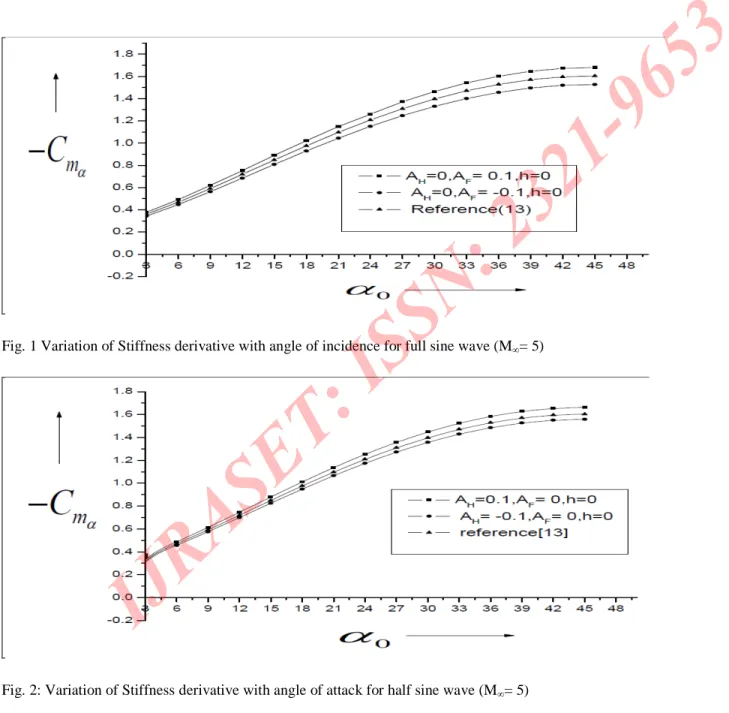
From figure 1 it is seen that stiffness derivative increases with angle of attack, since the stiffness derivative is considered at the nose (i.e. for h = 0) for Mach number M = 5. From the figure it is found that for full sine wave when AF =
0.1 there is a increase in the area of the wing near the leading edge where as at the trailing edge the area will decrease but when AF = -0.1 the wing area at the nose is decreased and at
the trailing edge it will increase this may be the reason for the change in the magnitude of the stiffness derivative for full sine wave when the amplitude is positive and negative. Figure 2 shows the similar results but the magnitude is less compared to the full sine wave. This trend may be due to the magnitude of area being shifted towards the leading edge and the trailing
edge. Figures 3 and 4 represent the similar results for Stiffness derivatives for Mach number M = 10. Due to the increased value of Mach number there is increase in the magnitude however, the trends remain the same.
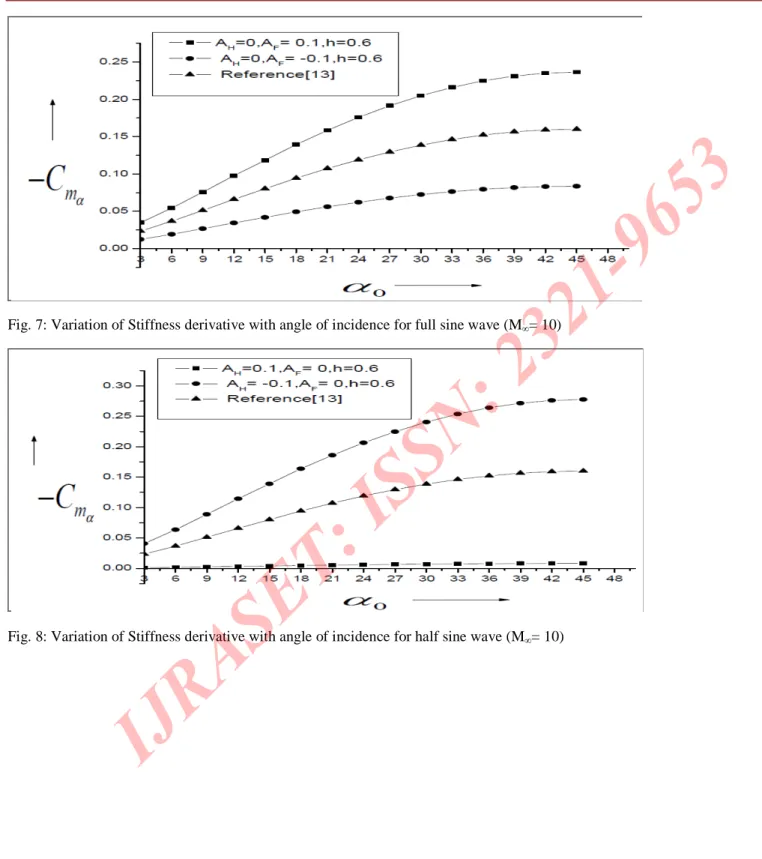
Stability derivatives in pitch for Mach 5 and 10 for pivot position = 0.6 as a function of angle of attack are shown in figures 5 to 8. From Figures 5 and 6 which represent the results for Mach 5 for full and half sine wave respectively. It is seen that the magnitude is very small compare to that when it was considered for h = 0 or h = 0.6., the reasons for this behavior may be due to its lower values for this particular value of the pivot position or in other words this location also happens to be very close to the centre of pressure. For half sine wave for AH = 0.1 the value is very small and it
independent of angle of attack this means this point happens to be the aerodynamic centre where pitching moment becomes independent of angle of attack, however, for AH= - 0.1, and
for straight leading edges the trend is similar to that of figure 5. Similar results are shown in figures 7 and 8 for Mach = 10. Here once again the trend is similar to that of for Mach 5 except due to the increase in the Mach number the magnitude has changed.
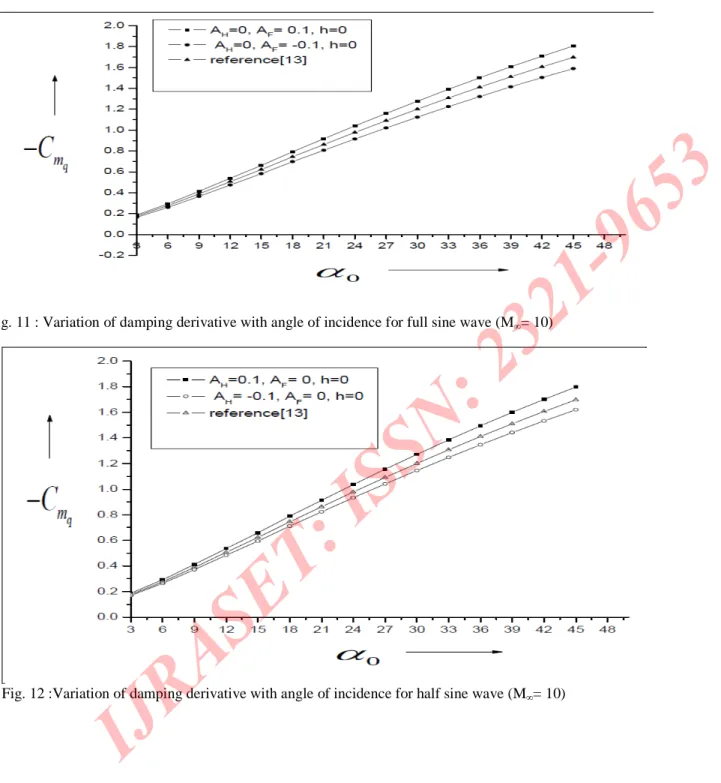
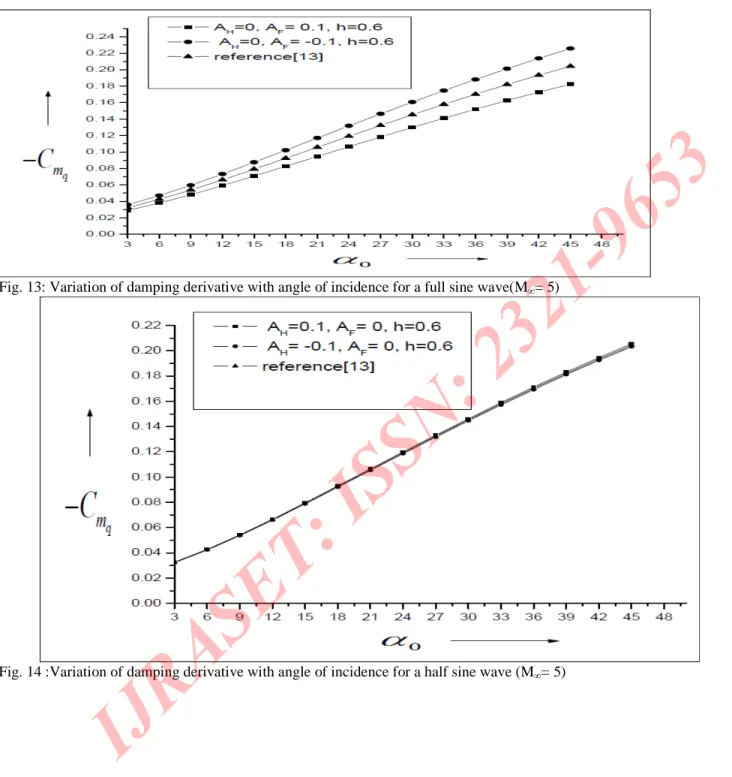
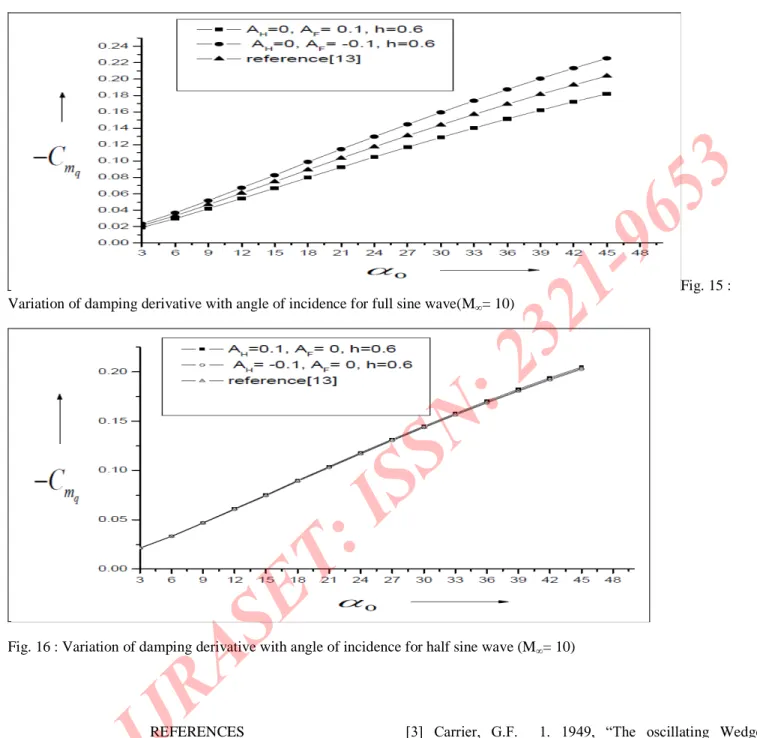
Results for damping derivatives are shown in figures 9 to 16. Figures 9 and 10 represent the results for Mach 5 for full sine wave and half sine wave for h = 0. There is linear increase in the damping derivative throughout and non-linearity does not crept in as in the case of stiffness derivatives. The similar trends are observed in figures 11 and 12 for Mach 10. Figures 13 to 16 present the results for Mach 5 and 10 at h = 0.6 for full and half sine wave respectively. The results for full sine wave are on the similar lines as discussed earlier however, there no effect half sine wave superimposed on the straight leading edge and they exhibit almost the same results for Mach 5 and 10 with and without curved leading edge. The reason for this behavior may be due to the pivot location which 60 % from the leading edge which also happens to be the centre of pressure of the wing.
CONCLUSION
In the present theory, the similitude, and the piston theory have been extended to a flat wing with curved leading edges. The linear dependence of the stiffness derivative is seen for all parameters of the present study, however for higher angle of
attack the non-linearity in the stiffness derivative is observed. When the stiffness and damping derivatives are considered for h = 0.6 which also happens to be the center of pressure and for some cases the aerodynamic center the independency with angle of attack has been observed. The present theory is valid for large angle of incidence and Mach number. The present theory is simpler than both Lui and Hui and Hui et al and
brings out explicit dependence of the stability derivatives on the similarity parameter. The present theory is not valid for a detached shock case. Future research can be done by taking into account the effects of shock motion, viscosity, wave reflections and the real gas effects.
Fig. 1 Variation of Stiffness derivative with angle of incidence for full sine wave (M∞= 5)
Fig. 3 Variation of Stiffness derivative with angle of incidence for full sine wave (M∞= 10)
Fig. 5 :Variation of Stiffness derivative with angle of incidence for full sine wave (M∞= 5)
Fig. 7: Variation of Stiffness derivative with angle of incidence for full sine wave (M∞= 10)
Fig. 9 :Variation of damping derivative with angle of incidence for full sine wave (M∞= 5)
Fig. 11 : Variation of damping derivative with angle of incidence for full sine wave (M∞= 10)
Fig. 13: Variation of damping derivative with angle of incidence for a full sine wave(M∞= 5)
Fig. 15 : Variation of damping derivative with angle of incidence for full sine wave(M∞= 10)
Fig. 16 : Variation of damping derivative with angle of incidence for half sine wave (M∞= 10)
REFERENCES
[1] Pike. J, “The pressure on flat and anhydral delta wings with attached shock waves”, The Aeronautical Quarterly, November 1972, XXIII, Part 4, pp. 253-262.
[2] Hui, W.H., “Stability of Oscillating Wedges and Caret Wings in Hypersonic and Supersonic Flows”, AIAA Journal, Vol. 7, Aug. 1969, pp.1524-1530.
[3] Carrier, G.F. 1. 1949, “The oscillating Wedge in Supersonic stream”, Journal of Aeronautical Sciences, Vol. 16, No. 3, pp. 150-152, March.
[4] Hui, W. H., “Supersonic/hypersonic flow past on oscillating flat plate at high angles of attack”, ZAMP, Vol. 29, 1978, pp. 414-427.
[5] Hui, W. H., “Supersonic and hypersonic flow with attached shock waves over delta wings”, Proc of Royal Society, London, 1971, A. 325, pp. 251-268.
[6] Orlik-Ruckemann, K. J., “Dynamic stability testing of aircraft needs versus capabilities”, Progress in the Aerospace Sciences, Academic press, N.Y., 1975, 16, pp. 431-447. [7] Hui, W. H. and Hemdan, H. T., “Unsteady hypersonic flow over delta wings with detached shock waves”, AIAA Journal, April 1976, 14, pp. 505-511.
[8] Lui, D. D. and Hui W. H., “Oscillating delta wings with attached shock waves,” AIAA Journal”, June 1977,15, 6, pp. 804-812.
[9] Light Hill, M. J., “Oscillating Aerofoil at High Mach Numbers”, Journal of Aeronautical Sciences, Vol. 20, June 1953, pp. 402-406.
[10] Ghosh K, “A new similitude for aerofoil in hypersonic flow”, Proc of the 6th Canadian congress of applied mechanics”, Vancouver, 29th May 3rd
June, 1977, pp. 685-686.
[11] Miles, J. W., “Unsteady flow at hypersonic speeds, Hypersonic flow”, Butterworths Scientific Publications, London, 1960, pp. 185-197.
[12] Ghosh, K and Mistry B. K., “Large incidence hypersonic similitude and oscillating non-planar wedges”, AIAA Journal, August 1980, 18, 8, pp. 1004-1006.
[13] Ghosh K., “Hypersonic large deflection similitude for oscillating delta wings”, The Aeronautical journal”, Oct.1984, pp. 357-361.
[14] Asha Crasta and Khan S. A., “High Incidence Supersonic similitude for Planar wedge”, International Journal of Engineering research and Applications, Vol. 2, Issue5, Sep-Oct 2012, pp. 468-471.
[15] Khan S. A. and Asha Crasta, “Oscillating Supersonic delta wings with curved leading edges”, Advanced Studies in Contemporary mathematics, Vol. 20(2010) , No.3, pp.359-372.
[16]Asha Crasta and S. A. Khan, “Estimation of Stability derivatives of an Oscillating Hypersonic delta wings with curved leading edges”,Vol.3, Issue3,Dec 2012pp.483-492