Publication date 2016
Original citation Dong, D. 2016. Content-aware compression for big textual data analysis. PhD Thesis, University College Cork.
Type of publication Doctoral thesis
Rights © 2016, Dapeng Dong.
http://creativecommons.org/licenses/by-nc-nd/3.0/
Embargo information No embargo required
Item downloaded
from http://hdl.handle.net/10468/2697
Content-aware Compression for
Big Textual Data Analysis
Dapeng Dong
MSC
Thesis submitted for the degree of Doctor of Philosophy
N AT I O N A L U N I V E R S I T Y O F I R E L A N D, C O R K
FACULTY OF SCIENCE
DEPARTMENT OF COMPUTER SCIENCE
May 2016
Head of Department: Prof. Cormac J. Sreenan
Supervisors: Dr. John Herbert
Contents
Contents
List of Figures . . . iv
List of Tables . . . vii
Notation . . . viii
Acknowledgements . . . x
Abstract . . . xi
1 Introduction 1 1.1 The State of Big Data . . . 1
1.2 Big Data Development . . . 2
1.3 Our Approach . . . 4
1.4 Thesis Structure . . . 8
1.5 General Convention . . . 9
1.6 Publications . . . 10
2 Background Research 11 2.1 Big Data Organization in Hadoop . . . 11
2.2 Conventional Compression Schemes . . . 15
2.2.1 Transformation . . . 15
2.2.2 Modeling . . . 17
2.2.3 Encoding . . . 22
2.3 Random Access Compression Scheme . . . 23
2.3.1 Context-free Compression . . . 23
2.3.2 Self-synchronizing Codes . . . 25
2.3.3 Indexing . . . 26
2.4 Emerging Techniques for Big Data Compression . . . 29
2.4.1 Probabilistic Data Structures . . . 31
2.4.2 Data De-Duplication . . . 32
2.4.3 Domain-specific Compression . . . 32
2.5 Summary . . . 34
3 Content-aware Partial Compression (CaPC) 36 3.1 Compression Scheme . . . 37 3.1.1 Compression Model . . . 39 3.1.2 Coding Scheme . . . 40 3.1.3 Sampling Strategy . . . 42 3.1.4 Algorithm Efficiency . . . 43 3.2 Evaluation . . . 44 3.2.1 Performance . . . 46 3.2.2 Further Compression . . . 48 3.2.3 Summary . . . 50 3.2.4 CaPC Characteristics . . . 50 3.3 Conclusion . . . 51
4 Approximated Huffman Compression (AHC) 53 4.1 Compression Scheme . . . 55
4.1.1 Compression Model . . . 56
4.1.2 Huffman Tree Upgrading . . . 57
4.1.3 Algorithm Efficiency . . . 59
Content-aware Compression for Big Textual Data Analysis
4.1.4 AHC Block Packaging . . . 65
4.1.5 AHC Hadoop Extension . . . 68
4.2 Evaluation . . . 68 4.2.1 Performance . . . 69 4.2.2 Effectiveness of Sampling . . . 71 4.2.3 Upgrading Effect . . . 72 4.2.4 Further Compression . . . 73 4.2.5 AHC Characteristics . . . 74 4.3 Conclusion . . . 76
5 Record-aware Compression (RaC) 78 5.1 Compression Scheme . . . 81
5.2 Evaluation . . . 85
5.2.1 Performance . . . 88
5.2.2 Compression Speed and Ratio . . . 91
5.2.3 Further Compression . . . 95
5.3 Conclusion . . . 96
6 Record-aware Partial Compression (RaPC) 97 6.1 Compression Scheme . . . 99
6.1.1 RaPC Layer-1 Compression Scheme . . . 99
6.1.2 RaPC Layer-2 Compression Scheme . . . 101
6.2 RaPC on Hadoop . . . 107
6.3 Evaluation . . . 109
6.3.1 Performance . . . 109
6.3.2 RaPC-L2 Block Size Effect . . . 122
6.3.3 Further Compression . . . 125 6.3.4 RaPC Characteristics . . . 126 6.3.4.1 Compression Ratio . . . 126 6.3.4.2 Compression Speed . . . 128 6.4 Conclusion . . . 130 7 Conclusion 132 7.1 Contributions . . . 133 7.2 Future Directions . . . 136 7.3 Epilogue . . . 137 A Experimental Environment A1
B AHC Codeword Example B1
C MapReduce with RaPC Demonstrated C1
D ASCII Table D1
E Efficient Cloud Server Consolidation Supported by Online Data Analysis
Services E1
E.1 System Architecture . . . E2
E.2 Problem Formulation . . . E3
E.2.1 SLA Violation Minimization . . . E5
Contents
E.3.1 Algorithm Performance . . . E8
E.3.2 RDSS System Performance . . . E11
E.4 Conclusion . . . E14
Content-aware Compression for Big Textual Data Analysis
List of Figures
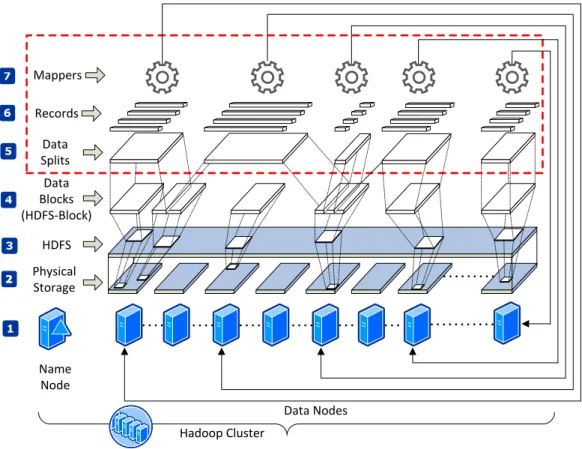
1.1 An illustration of compression as employed by Hadoop and MapReduce. 4
1.2 An illustration of the conceptual architecture. . . 6
2.1 Data organization in HDFS and Map processing of MapReduce. . . 12
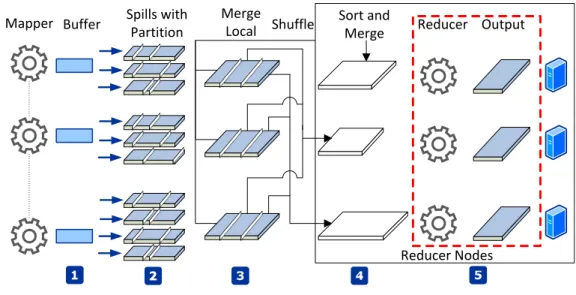
2.2 Data organization in HDFS and Reduce processing of MapReduce. . . 14
2.3 An example of Burrows-Wheeler transformation. . . 16
2.4 An example of Burrows-Wheeler inverse transformation. . . 16
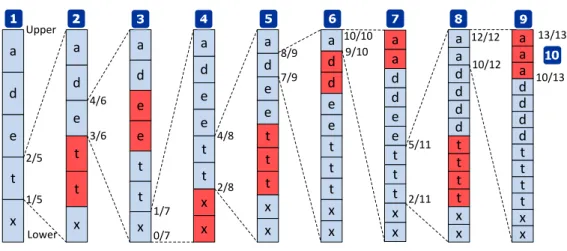
2.5 An example of adaptive arithmetic coding step-by-step. . . 19
2.6 An example of adaptive arithmetic model evolution. . . 19
2.7 Classification of context-free compression schemes. . . 24
2.8 An example of Signature File indexing. . . 27
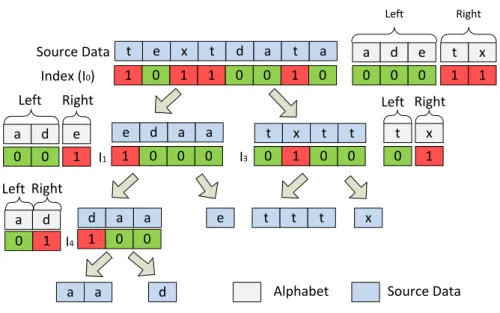
2.9 An example of usingRankandSelectfor random access in Wavelet Tree. 28 3.1 Content-aware Partial Compression architecture overview . . . 38
3.2 Examples of using CaPC in a MapReduce program. . . 38
3.3 An example of CaPC compressed data comparing to the original data. 39 3.4 An illustration of CaPC data sampling strategy. . . 43
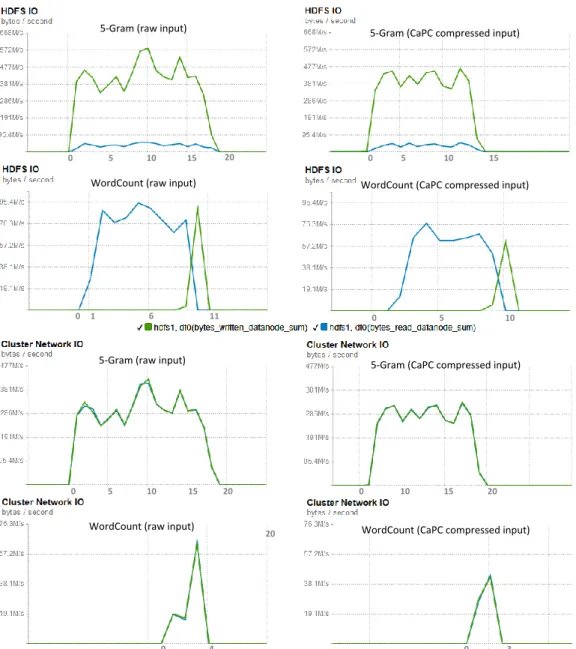
3.5 Statistics on HDFS I/O and network I/O for5-GramandWordCountjobs with original data and CaPC compressed data, respectively. . . 47
3.6 Statistics on Disk I/O and CPU utilization (DataNodes) for 5-Gramand WordCount jobs with original data and CaPC compressed data, respec-tively. . . 49
3.7 Applying compression on original data and CaPC compressed data. . . 50
4.1 An example of a Huffman code table generated based on a semi-static compression model through a full-scan. . . 58
4.2 An example of Huffman code table generated based on a semi-static compression model through sampling. . . 59
4.3 An example of the upgraded Huffman code table generated based on a semi-static compression model through sampling. . . 60
4.4 An illustration of AHC lookup-table with Huffman tree. . . 63
4.5 An example of AHC lookup-table. . . 64
4.6 An illustration of broken codes in AHC. . . 66
4.7 AHC block-packaging scheme. . . 67
4.8 Comparison of AHC compression speed using sampling methods with the default sampling rate and full-scan methods. . . 71
4.9 Sampling rate effects on compression ratio. . . 72
4.10 Huffman upgrading effects on compression ratio. . . 72
4.11 Evaluation of the impacts on applying a further compression to the AHC compressed data. . . 73
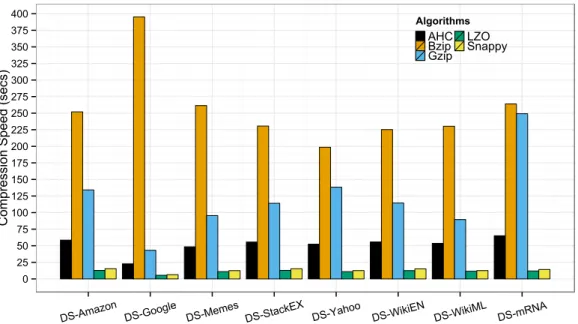
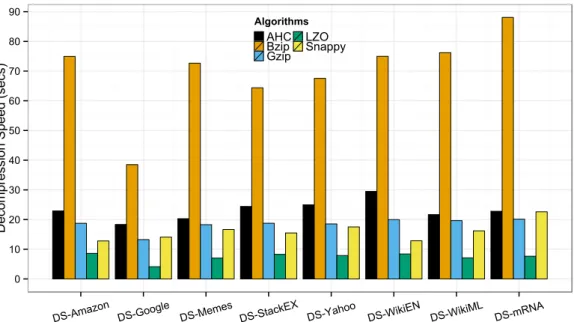
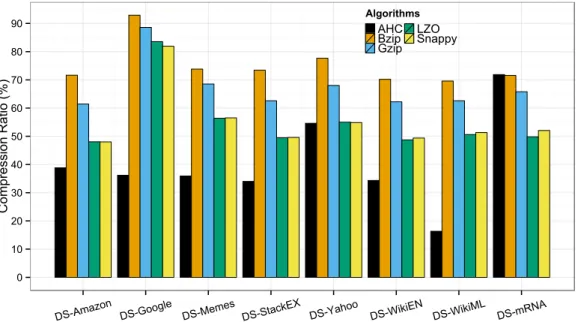
4.12 AHC compression speed comparing to Hadoop supported algorithms with the default compression level configured forBzip,GzipandLZO. 74 4.13 AHC decompression speed comparing to Hadoop supported algorithms with the default compression level configured forBzip,GzipandLZO. 75 4.14 AHC compression ratio comparing to Hadoop supported algorithms with the default compression level configured forBzip,GzipandLZO. . . . 76
List of Figures
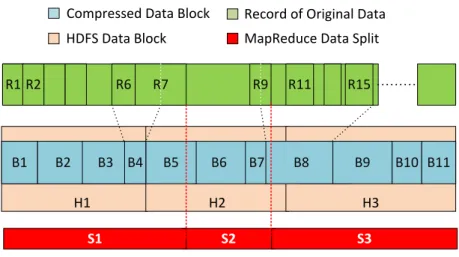
5.1 An illustration of the issues with none content-aware compression in
HDFS. . . 80
5.2 An illustration of the default work-flow of MapReduce. . . 82
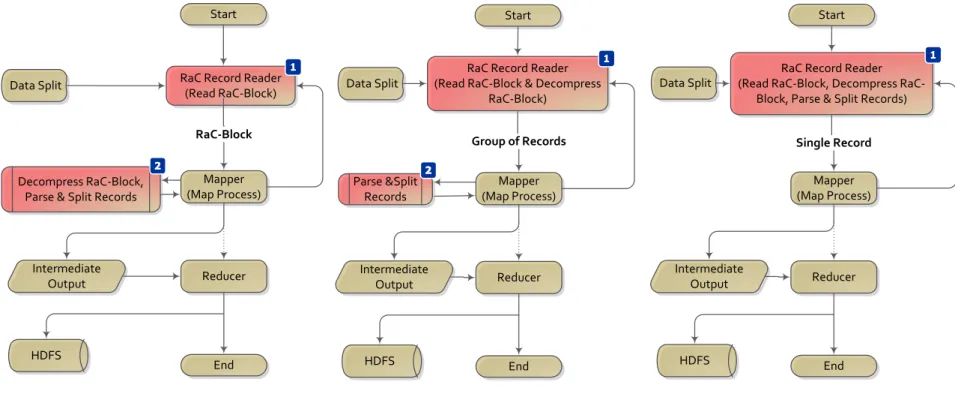
5.3 Three strategies designed for using RaC compressed data with MapRe-duce programs. . . 83
5.4 RaC block-packaging scheme. . . 85
5.5 Aggregated CPU time and total time consumed by both Map and Reduce tasks. . . 89
5.6 Averaged time allocation for MapReduce Map, Shuffle, Merge, and Re-duce tasks. . . 90
5.7 RaC compression speed comparing to Hadoop supported algorithms with highest compression level configured forBzip,GzipandLZO. . . 91
5.8 RaC compression speed comparing to Hadoop supported algorithms with default compression level configured forBzip,GzipandLZO. . . . 92
5.9 RaC decompression speed comparing to Hadoop supported algorithms with highest compression level configured forBzip,GzipandLZO. . . 92
5.10 RaC decompression speed comparing to Hadoop supported algorithms with default compression level configured forBzip,GzipandLZO. . . . 93
5.11 RaC compression ratio comparing to Hadoop supported algorithms with highest compression level configured forBzip,GzipandLZO. . . 94
5.12 RaC compression ratio comparing to Hadoop supported algorithms with default compression level configured forBzip,GzipandLZO. . . 94
5.13 Applying Further compression to RaC compressed data. . . 95
6.1 RaPC Layer-1 encoding template. . . 99
6.2 An illustration of the default compression work-flow ofDeflatealgorithm (specification 1.3). . . 102
6.3 An illustration of RaPC Layer-2 block-packaging. . . 103
6.4 RaPC Layer-2 data organization using hierarchical structures. . . 104
6.5 RaPC Layer-2 record-aware compression scheme. . . 105
6.6 RaPC Layer-2 block-packaging scheme. . . 105
6.7 RaPC Layer-2 block size verses compression ratios . . . 106
6.8 The Data Preprocessing job generates highly skewed records causing a disk I/O burst due to swapping. . . 118
6.9 Number of Mapper processes configured for each job with original, RaPC-L2 compressed, and RaPC-L2(L1) compressed data, respectively. 120 6.10 RaPC-L2 block-size verses analysis performance and memory consump-tion. . . 122
6.11 RaPC-L2 block-size verses analysis performance and memory consump-tion for theWord Countjob. . . 123
6.12 Further compression on RaPC-L1 compressed data using general pur-pose compressors with default compression level configured for Bzip, GzipandLZO. . . 125
6.13 RaPC compression ratio comparing to Hadoop supported algorithms with highest compression level configured forBzip,GzipandLZO. . . 126
6.14 RaPC compression ratio comparing to Hadoop supported algorithms with default compression level configured forBzip,GzipandLZO. . . . 127
6.15 RaPC compression speed comparing to Hadoop supported algorithms with highest compression level configured forBzip,GzipandLZO. . . 129
Content-aware Compression for Big Textual Data Analysis
6.16 RaPC compression speed comparing to Hadoop supported algorithms with default compression level configured forBzip,GzipandLZO. . . . 129 6.17 RaPC decompression speed comparing to Hadoop supported algorithms
with highest compression level configured forBzip,GzipandLZO. . . 130
6.18 RaPC decompression speed comparing to Hadoop supported algorithms with default compression level configured forBzip,GzipandLZO. . . . 130
A.1 Experimental environment: Hadoop cluster topology . . . A2
E.1 The proposed rDSS system architecture. . . E2
E.2 Server power-models used in the experiments. . . E8
E.3 Experimental results from real-world server-workload and randomly generated workload. . . E9
E.4 Evaluation of the proposed F1PaBFD algorithm. . . E12
E.5 Evaluation of F1PaBFD performance . . . E13
E.6 Evaluation of performance on single node rDSS system with multi-core
processors using automatic ARIMA algorithm. . . E13
E.7 Evaluation of performance on single node rDSS system. . . E14
List of Tables
List of Tables
3.1 A table of signature characters used in CaPC compression scheme. . . 41
3.2 A summary of MapReduce jobs used for evaluating the CaPC compres-sion scheme. . . 45
3.3 Comparing CaPC with state-of-the-art compression algorithms. . . 51
4.1 A summary of MapReduce jobs used for evaluating the AHC compression scheme. . . 69 5.1 A summary of MapReduce jobs used for evaluating the RaC compression
scheme. . . 86 6.1 A summary of MapReduce jobs used for evaluating the RaPC
compres-sion scheme. . . 110 6.2 Examples of the intermediate outputs (results for the Map processes)
from parsing theMemetracker memesdataset. . . 113
6.3 Comparison of the number of Map input records with respect to the
original, RaPC-L2 compressed, and RaPC-L2(L1) compressed data. . . 116
6.4 Performance of the Hadoop-LZO compression. . . 121
A.1 Experimental environment: hardware specification. . . A1
A.2 List of public and private datasets used for evaluating the Content-aware
compression schemes. . . A3
B.1 Codeword generated for datasetDS-WikiEN using the AHC compression. B1
B.2 Unused symbols in AHC compression. . . B3
D.1 Standard ASCII code table. . . D1
Content-aware Compression for Big Textual Data Analysis
Notation
H(T) Shannon’s information entropy of the given textT.
Θ(·) Indicating the average growth rate of the function.
O(·) Indicating the upper bound on the growth rate of the function.
Pr(T[i]) Probability of occurrence of symboliin textT.
ΣS+ Observed symbols from a given text.
ΣS− Non-observed symbols from a given text.
Σ Alphabet of a given text.
T A given text.
ϕ Compression ratio.
dxe The smallest integer greater than or equal tox.
bxc The largest integer less than or equal tox.
I, Dapeng Dong, certify that this thesis is my own work and has not been submitted for another degree at University College Cork or elsewhere.
Dapeng Dong
Content-aware Compression for Big Textual Data Analysis
Acknowledgements
First of all, I am grateful to my supervisor, Dr. John Herbert, who allowed me the freedom to explore my own ideas, guided me towards research goals, motivated me, and most importantly, kept confidence in me when nothing seemed to progress. You have been a tremendous mentor for me. I am also thankful to my co-supervisor, Prof. Cormac J. Sreenan, for offering advice to my project. I would like to extend my thanks to Prof. John P. Morrison for giving suggestions for the thesis.
I would like to thank my collogues, Dr. Thuy T. Truong, Dr. Xiuchao Wu, Dr. Bingchuan Yuan, Dr. Jason Quinlan, Stefan Mayer, Mohammad Hashemi, and Rezvan Pakdel, for their thoughtful suggestions. I have enjoyed many interesting discussions with the members of the Mobile & Internet Systems Laboratory (MISL) and the Boole Centre for Research in Informatics (BCRI) during my four years of research. I owe much thanks to the MISL administrative manager, Mary Noonan, for her support, and IT staff of the Computer Science department who provided me with equipment for part of my work. My work would not have been possible without the financial support provided by the Telecommunications Graduate Initiative (TGI) program which is funded by the Higher Education Authority and co-funded under the European Regional Development Fund (ERDF).
Finally, I must express my gratitude to my father, Yanzhi Dong, my mother, Yanling Song, my mother-in-law, Zhenshu Xu, and my wife, Yinhua Fang, who have always supported me in pursuing my interests. Without their love, encouragement, patience, and understanding, this thesis would not have been possible. A special thank you to my son, Runlin Dong, who keeps me moving forward in life during the hardest times.
Abstract
Abstract
A substantial amount of information in companies and on the Internet is present in the form of text. The value of this semi-structured and unstructured data has been widely acknowledged, with consequent scientific and commercial exploitation. The ever-increasing data production, however, pushes data analytic platforms to their limit. This thesis proposes techniques for more efficient textual big data analysis with an emphasis on content-aware compression schemes suitable for the Hadoop platform. In current big data analysis environments, the main purpose of data compression is to save storage space and reduce data transmission cost over the network. Since modern compression methods endeavour to achieve higher compression ratios by leveraging meta-information and contextual data, this context-dependency forces the access to the compressed data to be sequential. Processing such compressed data in parallel, such as desirable in a distributed environment, is extremely challenging. Even though information retrieval systems have developed algorithms that allow operations on com-pressed data without decompression, they are not sufficiently efficient or flexible in accommodating data updates for big data processing.
This research explores the direct processing of compressed textual data. The focus is on developing novel compression methods with a number of desirable properties to support text-based big data analysis in distributed environments. The novel contri-butions of this work include the following. Firstly, a Content-aware Partial Compres-sion (CaPC) scheme is developed. CaPC makes a distinction between informational and functional content in which only the informational content is compressed. Thus, the compressed data is made transparent to existing algorithms and software libraries which often rely on functional content to work. Secondly, a context-free bit-oriented compression scheme (Approximated Huffman Compression) based on the Huffman al-gorithm is developed. This uses a hybrid data structure that allows pattern searching in compressed data in linear time. Thirdly, several modern compression schemes have been extended so that the compressed data can be safely split with respect to logical data records in distributed file systems (Record-aware Compression). Furthermore, an innovative two layer compression architecture is used, in which each compression layer is appropriate for the corresponding stage of data processing (Record-aware Par-tial Compression). Peripheral libraries are developed that seamlessly link the proposed content-aware compression schemes to existing analytic platforms and computational frameworks, and also make the use of the compressed data transparent to developers. The compression schemes have been evaluated for a number of standard MapReduce analysis tasks using a collection of public and private real-world datasets. In compari-son with existing solutions, they have shown substantial improvement in performance and significant reduction in system resource requirements.
Content-aware Compression for Big Textual Data Analysis
Introduction
Big data is now at the frontier of research, innovation, business, and productivity
[JPHS10] [MMCJBB11] [MCB+11]. The term big data is understood to be datasets:
whose size (Volume) is beyond the ability of traditional database software tools to
capture, store, and manage; whose rate of production (Velocity) exceeds the speed
of current systems to process; whose complexity in mixed type and format (Variety)
challenges existing algorithms to perform efficiently and effectively. These three di-mensions1ofVolume,Velocity, andVarietytogether characterize big data [Lan01].
1.1
The State of Big Data
The value hidden in big data is the driver that pushes research inbig data. Indepen-dent research [MMCJBB11] [Fra15] [AtS15] and much evidence [Joh15] [WVF15]
[Ama13] have shown the real-world value of big data. This has led to big data
starting to play an essential role in a wide range of applications. Examples include: banking (through analyzing customers’ transaction and propensity models [DD13]); healthcare (through analyzing patients’ behaviour and sentiment data, clinical data, and pharmaceutical data [PGK13]); education (through collaborative online social media [KRB13]); government (through utilizing new sources of data, engaging pub-lic talent, institutionalizing pubpub-lic and private partnerships [Mor15]); social science (through machine learning and causal inference [Gri14]).
As a valuable asset, data is constantly being collected and accumulated from almost
all aspects of life. The term datafication 2 was coined to capture this phenomenon.
1There is also a need to include other dimensions, such asveracitywhich indicates the quality and
trustworthiness of source data and data source, andvariabilitywhich denotes the variation in data over time from the same source [ZCJW14], that have been evident from real-world applications by industrial practitioners from diverse backgrounds.
2Datafication was first coined by [Ken13]. It is defined as a process of turning all aspects of the world
1. INTRODUCTION 1.2 Big Data Development
It is predicted that the global datafication process will generate 44 zetabytes of data by 2020 compared to 4.4 zetabytes in 2013 [VTM14]. The social media giant
Face-book was producing over 60 terabytes data per day, as reported in 2010 [TSA+10],
and Twitter has scaled out their analytical infrastructure from the initial 30 nodes to several thousand nodes, capable of analyzing 100 terabytes of data every day, as re-ported in 2013 [LR13a]. It should also be noted that a substantial amount of data being collected is semi-structured or unstructured3, primarily in text format [Rus07].
The sheer volume of data and the aggressive speed of growth(velocity) are
present-ing challenges to all aspects of big data analysis from analysis platforms to scalable algorithms. Furthermore, the wide variety of data sources often generate data in var-ious formats at different speeds. Consider the rise of the IoT (Internet of Things) as
an example. Billions of different things are being connected to the Internet such as
pnalersonal wearable devices, smart phones, home appliances, and smart sensors. It is estimated that there are 200 billionthingson the planet at present, over 25% of them producing data [VTM14]. The IoT creates additional challenges in big data analysis, such as in correlation and regression analysis.
1.2
Big Data Development
In order to deal with the challenges brought by big data, there is very active ongoing development of new tools, algorithms, computational frameworks, analytic platforms and deployment provisioning strategies. These provide a basis for solutions to big data analysis. In this section, we discuss current trends toward solutions for big data. We aim to identify the research gaps, propose our solutions and contextualize our work in the field.
• Scalable algorithms. The main goals of big data analysis are to extract knowledge and summarize actionable intelligence [CCS12] [FDCD12] from data, and then deliver meaningful results, based on a data-driven ap-proach [ZCJW14] [JGL+14]. Many traditional algorithms in statistical inference, machine learning and data mining are inadequate for big data in terms of par-allelism and algorithmic efficiency [MM15]. They are either hard to implement in parallel, for example, Markov chain Monte Carlo (MCMC) simulation for ap-proximating posterior distributions of non-conjugative functions in Bayesian in-ference, or they need to be redesigned for parallel processing, for example, Matrix Factorization (Collaborative Filtering), Naive Bayes (Classification) andk-means (Clustering), as seen in Apache Mahout [Apaf]. There are also developments in approximation and sub-linear algorithms for quickly gaining an insight into big 3"In semi-structured data, the information that is normally associated with a schema is contained within
the data, which is sometimes called self-describing" [Sem97], whereas unstructured data is not organized by pre-defined schemes.
Content-aware Compression for Big Textual Data Analysis
data [WH15].
• Computational Frameworks and Paradigms. Currently, computational frameworks
developed for big data analytics are mainly designed for processing stream or
batch data. Stream processing is designed to capture, analyze, and act on real-time (near real-time or time framed) data streams, such as when monitor-ing sensors. Widely recognized open-source stream processmonitor-ing frameworks in-clude Apache Storm [Apag], Yahoo! S4 [NRNK10] and Massive Online Analysis
(MOA) [BHKP10]. In contrast, batchprocessing is designed for analyzing large
datasets offline. MapReduce [DG08], Spark [Apa15] and Dryad [IBY+07] are
several frameworks widely used at present. There are also stream-processing enabled versions of MapReduce and Spark.
Additionally, the paradigm of parallel computation can be split into
computation-centric and data-computation-centric aspects. Computation-centric parallelism
endeav-ours to seek better ways of splitting tasks (e.g., Message Passing Interface (MPI) [Ope] [MPI]), whereas data-centric parallelism looks for optimal parti-tioning of data.
• Analytic Platforms. As data volume increases, a distributed file system and stor-age system are desirable, and analysis based on parallel computing is inevitable.
Apache Hadoop [Apad] is thede factodominant, open-source analytic platform
currently in use. It provides a unified solution that addresses various aspects of the data analysis life-cycle and includes a distributed file system (HDFS [Apad]), computational frameworks (MapReduce and Spark) and task coordination ser-vices (e.g., ZooKeeper [Apaj]). More features are constantly being integrated into the umbrella Hadoop project. Several other analytic platforms exist, such as
Microsoft Dryad [IBY+07] and R [The]. In comparison with Hadoop, Microsoft
Dryad development has been discontinued and the R framework is primarily fo-cused on statistical computing and graphical techniques. R was not developed for massive parallel data processing and R lacks data life-cycle management in a distributed environment.
• Deployment Strategy. Traditionally, the deployment of big data analytic platforms such as Hadoop requires a cluster of servers. An on-site deployment faces scalabil-ity constraints. As cloud computing becomes widely available, it has become the main enabling technology for big data analysis due to its dynamic provisioning of resources, cost-efficiency, scalability and elasticity [LQ14] [Col14] [RWZ+15]. Many existing big data solutions are already using cloud computing such as Open-Stack Sahara [Sta] and Amazon Elastic MapReduce (EMR) [Ama].
Current solutions attempt to react to big data by scaling up/out analytic
plat-forms [TSA+10] [LR13a] [GSZS14] [RD15] and/or using approximation
1. INTRODUCTION 1.3 Our Approach
source data. This aspect of leveraging compression for big data analysis in distributed environments has not been given much attention.
Scope of this thesis: Our research sets out to explore new approaches using novel compression schemes for mitigating the challenges for big data analy-sis created by the unprecedented volume of data. We focus on data-centric batch-processing on textual data using the MapReduce computational frame-work in the Hadoop data management ecosystem.
1.3
Our Approach
Compressed Input Data (Hadoop HDFS)
Full Decompression (Sequencial)
Map Process (Mapper) (MapReduce: Map Phase)
Compression (Intermediate Data)
Distributing Intermediate Data (MapReduce: Shuffling Phase)
Decompression (Intermediate Data)
Reduce Process (Reducer) (MapReduce: Reduce Phase)
Compression (Final Output Data)
Final Output Data (Hadoop HDFS)
Figure 1.1: An illustration of compression as employed by Hadoop and MapReduce. The main purpose of employing compression in Hadoop is to reduce data size in order to save storage space and lower the data transmission cost over the network. Currently, compressed data cannot be directly involved in MapReduce-based analysis [Whi15]. In order to carry out an analysis, the compressed data must firstly be decompressed fully in a sequential manner, as shown in Figure 1.1 (label 1). This is due to the fact that modern compression schemes often employ data transformation and/or contextualiza-tion techniques which create strong dependencies within the compressed data. The data decompression requires the underlying storage system to maintain sufficient free space for holding the decompressed data, and thereafter a MapReduce program can be initiated. Additionally, depending on the compression algorithms, decompression speed varies largely. This can delay considerably the delivery of analysis results when the data volume is large. It should also be noted that previous research has identified that the Input and Output (I/O) system is often the bottleneck for data-centric
analy-sis in a distributed environment [DH15a] [PPR+09] [JOSW10]. We can improve this
I/O efficiency by compressing data as much as possible so that the latency created by loading data from persistent storage to memory can be minimized.
Content-aware Compression for Big Textual Data Analysis
Research Question 1: the first question that arises here is, when data is
compressed by modern compression schemes such asGzipandLZO, whether
we can perform decompression in memory as data is being consumed at each computational node of Hadoop (parallel decompression in memory) so that the total decompression time can be reduced in proportion to the number of parallel processes, the data loading time can be kept to a minimum, and the use of extra storage space can be avoided.
If we are to decompress data in memory, in parallel, in a distributed environment, we will have to ensure that the compressed data is splittable and that each data split is self-contained. It also requires maintaining the logical completeness, with respect to the data contents, for each data split. This is because computational frameworks, such as MapReduce and Spark, process data in parallel on a per split basis, independently; each data split is further broken into a group of logical records 4; a parallel process then deals with a single record at a time.
Our solution to Research Question 1 is to make the compression process aware of the organization of the data contents, control the use of contextual data, and develop appropriate packaging mechanisms so that compressed data is splittable to the underlying file/storage systems and maintains the logical completeness of each data split to the computational frameworks, without sacrificing much compressibility.
During analysis, intuitively, a MapReduce program will process data in its original for-mat. This is because MapReduce developers can understand the logic and organization of the original data contents to be processed. Also, many existing algorithms and soft-ware packages are designed to work with specific data formats, for example, Apache Xerces [Apai] and Apache Commons CSV [Apac] are commonly used software libraries for parsing eXtensible Markup Language (XML) and Comma Separated Values (CSV) formatted documents, respectively.
Research Question 2: the second question is whether we can compress data in such a way that the compressed data can be directly processed in MapRe-duce without decompression, while ensuring the compressed data is compat-ible with existing algorithms and software packages as well as transparent to MapReduce program developers.
However, manipulating compressed data poses non-trivial technical challenges, espe-cially in a distributed environment. Traditional solutions to this question are mainly 4What constitutes arecordis data- or application-specific. For example, a record can be a sentence in
1. INTRODUCTION 1.3 Our Approach
Analytics Source Data
Developers
Source Data Compression Compressed Data Analytic Platform Translation
public class SentaMapper extends MapReduceBase implements
Mapper<Object, Text, Text, DoubleWritable> { ………...
public void map(Object key, Text value, utputCollector<Text, DoubleWritable> output, Reporter reporter) ……...
MapReduce Program (As programmed with source data)
Figure 1.2: An illustration of the conceptual architecture.
based on indexing techniques [DHL92] [FM00] [WMB99] [CWC+15] [Fal85]. They
are developed for information retrieval systems and focus on random access to, and querying of, immutable data content with a cost of high complexity and constraints on being application or domain specific. Since big data analysis often requires manipulat-ing data (for example, extractmanipulat-ing columns and re-formmanipulat-ing data records), this requires a special way of compressing data so that the element of information (a character or a word) being compressed is independent of its context, thus the compressed data can be freely manipulated. In other words, we need to develop a context-free (referring to [WMB99]) scheme for compression. Although, context-free schemes in general re-sult in moderate compression ratios, the unprecedented volume of big data offers an opportunity for the context-free compression schemes to show their advantages. At the same time, we also need to take several non-functional requirements into consideration including data compatibility, transparency, and accessibility.
• Compatibility. Since many existing algorithms and software packages rely on spe-cific data formats and/or pre-defined functional characters to work, we need to compress data in such a way that the original data format and functional contents can be preserved.
• Transparency. As data is in compressed format, source information is replaced by codewords. For example, if a developer is to search for a phrase "big data" in the source data, they will have in a Java program something like "contains("big data")". In order to search for the phrase in the compressed data, they will have to know the corresponding codewords that are used for replacing the phrase in
Content-aware Compression for Big Textual Data Analysis
the compressed data. This makes the compressed data opaque to MapReduce de-velopers. We need to bridge this gap between the developers and the compressed data so that the developers can implement analysis logic as if source data is used. This conceptual idea is illustrated in Figure 1.2.
• Accessibility. Traditional compression algorithms organize compression model(s) (Section 2.2.2) as a header to the compressed contents. In a distributed environ-ment, data splits are generally processed independently. This requires the pression model(s) to be available to all data splits that belong to the same com-pressed file. We must separate the compression model(s) from the comcom-pressed contents in order to support the requirement on transparency.
Our solution to Research Question 2 is to develop a context-free com-pression scheme that can partially compress data in which the informational contents are compressed whereas functional contents are left intact to meet the compatibility requirement, and to provide translation functions as an extension to Hadoop and MapReduce for supporting data transparency and accessibility. Hence, the scheme proposed here is in fact a full solution for Hadoop and MapReduce to work with compressed data rather than a once-off application-specific compression scheme.
Following the work-flow of MapReduce, as shown in Figure 1.1, a Mapper often pro-duces intermediate output data, and this data needs to be temporarily stored in the local hard disks until the MapReduce framework decides to deliver it to the correspond-ing Reducers for further processcorrespond-ing. In order to efficiently distribute the intermediate output data over the network, data can be compressed by one of those general purpose compressors (includingBzip,Gzip,LZO,SnappyandLZ4) that are currently supported by Hadoop. On arrival, the compressed data is then decompressed and fetched into the Reducers. Eventually, the final output data can be optionally compressed for storage in HDFS. This is shown in Figure 1.1 (Label 2).
Positive effect of the solution for Research Question 2. If a MapReduce program can perform analysis with compressed data without decompression, the Mappers will also produce intermediate data in the compressed format, and applying the aforementioned general purpose compression schemes to the compressed data can further reduce the time required for compression as well as data size.
Note that we can achieve high compression ratios by employing customized modern compression schemes, thus data decompression and loading time can be reduced; us-ing context-free compression schemes allows MapReduce programs to manipulate com-pressed data directly without decompression, thus improving analysis performance and
1. INTRODUCTION 1.4 Thesis Structure
further reducing cost of data transmission over the network.
Research Question 3: the third question is whether we can combine the two approaches to take advantage of both.
The fact is that we cannot apply two different compression schemes to a single dataset at the same time. However, observations have indicated that the first and second re-search goals can be employed at different stages of the MapReduce processing.
Our solution to Research Question 3 is to design a layered architecture so that a MapReduce program can, at different stages, take advantage of the corresponding layers. In other words, we firstly compress data using our context-free compression scheme and then apply our customized mod-ern compressor to the compressed data. As a result, we can achieve data
compression ratios close to the Bzip compressor and gain a substantial
im-provement on analysis performance (up to 72%) over using original data.
The research questions together set up the hypotheses for this thesis. Our contributions lie in the solutions to the research questions and their concrete implementations. As a result, we present Content-aware Compression (CaC) schemes suitable for big data analysis in the Hadoop distributed environment.
In addition, cloud computing platforms provide a very suitable environment for par-allel processing of big data, and often support Hadoop/MapReduce frameworks. The efficiency and management of the underlying cloud computing environments are con-cerns that have also been addressed in this research, and solutions have been developed that improve on the pre-existing techniques. This work is described in Appendix E and is not addressed in the main thesis. Improvements in cloud computing efficiency are independent of, and complementary to, the source data analysis improvements. The cloud computing environment solutions can be ported to other analysis frameworks, especially those that are derived from the MapReduce/Hadoop paradigm. In summary, the Content-aware Compression techniques to improve source data analysis efficiency and the management techniques to improve underlying cloud computing efficiency, can separately, and in combination, contribute to better use of resources to cope with the challenge of big data analysis.
1.4
Thesis Structure
In this chapter, we have discussed the importance of big data and how it influences many aspect of our lives. We have explained the challenges related to big data and current trends toward solutions for big data analysis. We have clarified our research
Content-aware Compression for Big Textual Data Analysis
direction of leveraging novel data compression schemes to mitigate big data issues and contextualized our work in the field. The remaining chapters are organized as follows. • In Chapter 2, we explain data organization in Hadoop. We then analyze conven-tional and various ad-hoc compression methods that are important for big data. • In Chapter 3, we present Content-aware Partial Compression (CaPC) [DH14a]
which is our initial attempt towards accelerating textual big data analysis us-ing compression. CaPC focuses on separation of informational and functional contents, and providing complete transparency between analytic platforms, com-putational frameworks and developers.
• In Chapter 4, we introduce Approximated Huffman Compression (AHC) which was established at an early stage of our research. AHC allows flexible compressed-string searching in linear time using hybrid data structures.
• In Chapter 5, we present Record-aware Compression (RaC) [DH15a]. RaC em-ploys modified higher-order compression methods that can drastically reduce data size while ensuring the compressed data is splittable to the underlying dis-tributed file system. Additionally, RaC is made aware of logical records during compression.
• In Chapter 6, we present Record-aware layered Partial Compression (RaPC) [DH15b]. RaPC uses two different compression schemes that are layer-specific to the corresponding stage of data analysis in MapReduce. RaPC achieves
com-pression ratios comparable to modern general purpose compressors such asBzip.
• In Chapter 7, we present conclusions and discuss future work.
1.5
General Convention
Several definitions and conventions are used throughout this thesis as listed below. • Compression ratioϕis given as a percentage and is defined as:
ϕ= So−Sc
So
∗100
where,So is source data size andScis compressed data size.
• The terminologysource data,raw data,original data, anduncompressed dataare interchangeable.
• Compressed data, by default, indicates compressed textual data, unless indicated otherwise.
1. INTRODUCTION 1.6 Publications
• Several compression schemes are introduced in this thesis. We use the term Content-aware Compression (CaC) to refer in general to all these devised schemes.
• In the context of MapReduce, the terms Map output and intermediate data are interchangeable.
1.6
Publications
The publications associated with this thesis are listed below.
• The Content-aware Partial Compression (CaPC) scheme for textual big data analysis acceleration in Hadoop was presented at the6thIEEE International Con-ference on Cloud Computing Technology and Science (CloudCom 2014), Singapore, in December 2014 [DH14a].
• The Record-aware Compression (RaC) scheme was presented at the 2015 IEEE
International Conference on Big Data (IEEE BigData 2015), Santa Clara, CA, USA, in October 2015 [DH15a].
• The Record-aware layered Partial Compression (RaPC) scheme was presented at the7thIEEE International Conference on Cloud Computing Technology and Science (CloudCom 2015), Vancouver, Canada, in December 2015 [DH15b].
In addition to the main contributions given in chapter 3∼6, several studies on efficient management of underlying cloud platforms conducted at an early stage of our research are listed below.
• An efficient server consolidation algorithm for clouds was presented at the 13th IEEE/ACM International Symposium on Cluster, Cloud and Grid Computing (CCGrid 2013), Delft, The Netherlands, in May 2013 [DH13b].
• A reference architecture for automation of private cloud management was
pre-sented at the 6th IEEE International Conference on Cloud Computing (CLOUD
2013), Santa Clara, CA, USA, in June 2013 [DH13c] and a journal version of
this paper has been published by the International Journal of Cloud Computing
(IJCC)[DH13a].
• A File System as a Service (FSaaS) solution for data management in clouds was presented at the 38th Annual IEEE International Computers, Software & Applica-tionsConference (COMPSAC 2014), Västerås, Sweden, in July 2014 [DH14b].
Content-aware Compression for Big Textual Data Analysis
Background Research
“Some people see the glass half full. Others see it half empty. I see a glass that’s twice as big as it needs to be.”
—George Carlin
We have witnessed a rapid evolution of research and development on big data tech-nologies. Important current concerns include efficient algorithms [Apaf] [Spa],
paral-lel computational frameworks [DG08] [Apa15] [Apag] [NRNK10] [IBY+07],
compre-hensive analytic platforms [Apad] [Clo] [IBMa], scalable deployment strategies [Sta]
[Ama], and auxiliary services [Apaj] [HCG+14] [Apae] [Apah] that contribute to an
effective big data ecosystem. However, related literature on incorporating compression schemes with big data analysis is limited. Current emerging techniques for compressing big data are mostly ad-hoc approaches optimizing for data-specific and domain-specific datasets. They are not provided as principled solutions. In this context, we firstly analyze how big data is organized in modern distributed file systems, specifically the Hadoop Distributed File System (HDFS), followed by explaining how big data is pro-cessed using the MapReduce computational framework [DG08] [Apad]. We aim to identify where and how compression can be used with existing analytic platforms to mitigate big data issues. We then analyze various conventional compression schemes and investigate several important ad-hoc algorithms to discover their potential and limitations for use in big data analysis. We also discuss recent literature on emerg-ing techniques includemerg-ing splittable compression, probabilistic data structures, data de-duplication and domain-specific compression. Finally, we summarize the background analysis provided as a foundation to our content-aware compression schemes.
2.1
Big Data Organization in Hadoop
Hadoop is a widely adopted data analysis ecosystem. It consists of several components that together provide a platform for managing and analyzing data on a large scale.
2. BACKGROUNDRESEARCH 2.1 Big Data Organization in Hadoop
A brief history of the development of Hadoop is given in [Whi15]. Many existing big data solutions are based on the Hadoop ecosystem of technologies for example, Cloudera [Clo], OpenStack Sahara [Sta] and IBM BigInsights [IBMa], to name just a few. In this section, we explain how data is organized in the HDFS distributed file system and how data is processed in the MapReduce framework.
Hadoop Cluster Data Nodes Name Node HDFS Data Blocks (HDFS-Block) Physical Storage Data Splits Records Mappers
Figure 2.1: Data organization in HDFS and Map processing of MapReduce. Figure 2.1 illustrates a typical organization of a Hadoop cluster from the physical layer to the MapReduce application layer. At the bottom, a Hadoop cluster consists of a group of physical servers in which one of the servers acts as a controller of the cluster, namely the NameNode, and the other servers provide storage space and computation power,
namelyDataNodes, as shown in Figure 2.1 (Label 1). TheNameNodeis responsible for
coordinating MapReduce jobs and managing HDFS meta-data. TheDataNodesare
re-sponsible for storing data and providing computation power for MapReduce programs. EachDataNodecontributes a part of its local storage space (a partition of the local hard disk) to HDFS, as illustrated in Figure 2.1 (Label 2). Thus, HDFS is a virtualized storage system that is comprised of a number of geographically distributed physical hard disks, as shown in Figure 2.1 (Label 3). A file stored in HDFS is split into a series of fixed-size blocks (HDFS-Blocks), as shown in Figure 2.1 (Label 4). HDFS-Blocks are often
dis-Content-aware Compression for Big Textual Data Analysis
tributed acrossDataNodes, but are virtually continuous in HDFS. Unlike the traditional
organization of storage systems such as NTFS 1and Ext3 2using 4KB data block size,
HDFS uses a very large data block size (HDFS-Block size is128MB by default) chosen
for better hard-disk read/write performance. A HDFS-Block is the minimum storage unit in HDFS. It cannot be broken further into smaller pieces.
HDFS only provides a logical view and hides the complexity of organizing data in the underlying distributed storage system. It is an independent service (file system service) provided as a part of Hadoop for data organization and management. Data analysis
is carried out by the MapReduce3 computational framework. As the name implies, a
MapReduce program consists of two phases: Map and Reduce. The Map phase operates on a set of key/value pairs. The Reduce phase reduces the outputs from the Map phase by values which share the same key. However, the Map phase can also perform the Reduce logic locally, thus there is no clear separation of responsibility for the Map phase and Reduce phase. It may be better to understand the MapReduce paradigm by an intuitive example. For instance, given a job of finding the maximum value(s) in a large financial report dataset, the dataset will be firstly broken into a series of data blocks, and each data block will be processed independently by a dedicated Map process (Mapper, as indicated in Figure 2.1 <Label 7>) to find the local maximum value(s). The results from all Mappers will then be aggregated to a Reduce process
(Reducer) to find theglobalmaximum value(s).
As described, each Mapper will be assigned to a HDFS-Block. Within a HDFS-Block, data will be further broken into logical records (this depends on the dataset, for exam-ple a logical record can be a sentence in a text file or a row in a database table), as indicated in Figure 2.1 (Label 6). The record parsing process is done by the MapReduce Record Readercomponent. A Mapper will process a record at a time. However, HDFS simply splits data by size. It is very likely that a HDFS-Block will contain incomplete records at the boundaries. To ensure record completeness, MapReduce further orga-nizes HDFS-Blocks intodata splits, (Figure 2.1 <Label 5>). Essentially, adata splitis a logical view of a data block which is guaranteed to contain a set of complete records as shown in Figure 2.1.
Intermediate output data from each Mapper is firstly cached in an in-memory buffer, as indicated in Figure 2.2 (Label 1). When the utilization of the caching buffer reaches a certain threshold, all cached data in the buffer will be materialized to persistent storage (local hard disks). This process is calledSpillingin the context of MapReduce. Data in aspillwill then be sorted by keys and partitioned according to the number of Reducers 1NTFS stands for Microsoft®New Technology File System. NTFS has default4KB block size for storage
volume less than16TB on Windows®7or above.
2Ext3 is Linux Third Extended File System. It commonly uses4KB block size to address 16TB storage
volume.
3http://hadoop.apache.org/. A comprehensive introduction to MapReduce can be found in
2. BACKGROUNDRESEARCH 2.1 Big Data Organization in Hadoop
Mapper Spills with Partition
Buffer MergeLocal Shuffle Sort and
Merge Reducer Output
Reducer Nodes
Figure 2.2: Data organization in HDFS and Reduce processing of MapReduce.
configured for the job, as indicated in Figure 2.2 (Label 2 and 3). Upon completion of the Map processes, each sorted partition will be distributed to a corresponding Reducer over the network. At each Reduce computational node (the physical server that runs the Reduce phase of the program), the received partitions will be sorted again and merged into a single data block, and then fetched to the Reducer, indicated in Figure 2.2 (Label 4). The final results (Reduce output data) will be stored in HDFS eventually, as indicated in Figure 2.2 (Label 5).
Questions arise when using compressed data in Hadoop.
1. If source data is compressed using general purpose compression schemes such as Gzip[Gzi] and Bzip[Bzi], after splitting the compressed data into HDFS-Blocks, can we ensure that each HDFS-Block is still independently de-compressible?
2. If data is in compressed format, how can we organize HDFS-Blocks indata splits
and guarantee record completeness?
3. If data is in compressed format, can we break adata splitinto records efficiently? 4. Can we process data in compressed format without sacrificing performance? 5. How can we distribute the Map output data (intermediate data) to corresponding
Reducers more efficiently?
These questions set requirements on compression schemes suitable for big data analy-sis in Hadoop. The criteria we focus on are whether the compressed data is splittable, directly consumable4, and aware of source data contents. In the following sections, we 4There are two scenarios in big data analysis. In the first case, data will be analyzed by existing
algorithms without modification (read-only) throughout the analysis. In the second case, data will be
Content-aware Compression for Big Textual Data Analysis
discuss related work by examining existing conventional and random access compres-sion algorithms for textual data, and recent emerging techniques specifically designed for dealing with big data.
2.2
Conventional Compression Schemes
Data compression originated in communication systems. Since the invention of the Morse code [ITU09] in the early nineteenth century to the development of informa-tion theory [Sha48] and several subsequent important compression related coding schemes [Sha49] [Huf52] in the middle of twentieth century, the research and de-velopment on data compression had developed slowly due to absence of demand. The rise of the Internet and information explosion prompted a rapid development of data compression methods from the simpleLZ77(Lempel-Ziv) [ZL77] in1977to the
state-of-the-artLZMA2 (Lempel–Ziv Markov Chain) [Igo15] at present. Over the years,
numer-ous general purpose and specialized data compression methods have been developed. It is infeasible to examine all of them. In this section, we examine several important compression techniques which are often used as building blocks for modern compres-sors. As a typical compression scheme often consists of three phases: Transformation, Modeling, andEncoding, we discuss commonly employed techniques for each phase. A representative algorithm is thereafter selected to further evaluate the benefits and lim-itations of their use in the context of big data. The emphasis is on textual data related compression methods.
2.2.1 Transformation
Transformation is selective and often used as a preprocessor for compression. It in-volves reordering data. It does not compress data. But it leads to interesting results where the same characters or a similar set of characters tend to be grouped together. The repetitiveness can then be captured by subsequent modeling and coding schemes, and thereby it supports higher compression ratios. Generally, transformation is per-formed on a per data block basis, thus it is also known as block sorting. There are sev-eral common methods for data transformation operating at the character level includ-ing Burrows-Wheeler Transform (BWT) [BW94], Symbol Rankinclud-ing [Fen97] and Lexical Permutation Sorting Algorithm (LPSA) [AM97]. Data transformation has also been ex-tended to word level [IM01] with extra cost in terms of complexity on parsing words from a given text, but based on the same principles. Among these transformation
tech-niques, BWT is one that is widely used, such as in the well-knownBzip[Sew00]. We
use BWT as a case study to further examine the suitability of using transformation
modified and processed, for example, extracting columns and re-forming database records. In the context of this thesis, if compressed data is directly consumable, it must fulfill the requirements for both scenarios.
2. BACKGROUNDRESEARCH 2.2 Conventional Compression Schemes
techniques for compressing big data with regards to splittable and directly consumable data. Rotation t e x t d a t a 0 1 2 3 4 5 6 7 Index t e x t d a t a t e x t d a t a t e x t d a t a t e x t d a t a t e x t d a t a t e x t d a t a t e x t d a t a * t e x t d a t a t e x t d a t a t e x t d a t a t e x t d a t a t e x t d a t a t e x t d a t a t e x t d a t a t e x t d a t a * Sorting lexicographically L I* BWT(L, I*) F
Figure 2.3: An example of Burrows-Wheeler transformation.
The BWT transformation starts by taking a block of data in a row. Imagine we fit the block of data into a cyclic queue and move the first element of the queue to the end of the queue until all of the characters in the block have been moved once. For example, if we are trying to perform BWT transformations on the given text "textdata", by recording the rotation steps, we will have a matrix generated for the text "textdata" as illustrated in Figure 2.3 (left). When we sort the matrix by the first column in a lexicographical or-der, we will have a second matrix shown in Figure 2.3 (right). This rotation and sorting do not shrink data size. It produces an interesting result. If a symbol occurs frequently in the block, after sorting the first columnF, the prefix character of the symbol which is now in the last column,L, tend to group together. This result makes other compres-sion methods, for example, Move-To-Front (MTF) coding [BSTW86], more effective.
Most importantly, the transformation process is reversible by only knowingL and the
starting indexI∗. a d a t t x e t L t a t a d t x e F 1 2 3 4 5 6 7 0 4 5 6 0 7 1 3 2 T i L [ T [ i ] ] ß L [ i ] a L[ T[1] = 4 ] = “a” ß L[1] = “t” Input Sort L L[I* = 6] = “a” a t a a t a d a t a t d a t a x t d a t a e x t d a t a t e x t d a t L[ T[4] = 0 ] = “d” ß L[4] = “a” L[ T[6] = 1 ] = “t” ß L[6] = “a” L[ T[0] = 2 ] = “t” ß L[0] = “d” L[ T[2] = 5 ] = “x” ß L[2] = “t” L[ T[5] = 7 ] = “e” ß L[5] = “x” L[ T[7] = 3 ] = “t” ß L[7] = “e” I* Starting Point = I*
Figure 2.4: An example of Burrows-Wheeler inverse transformation.
Content-aware Compression for Big Textual Data Analysis
The inverse process firstly sortsLlexicographically. The outcome is in fact the column
F we have seen during the transformation phase. Once we haveLandF, we need to
build a transformation index vectorT that indicates the relationship betweenLandF. The relationship is as follows. Theith value ofT is the index of theith character ofL
inF, as illustrated in Figure 2.4 (left). After calculating vectorT, the original message can be retrieved from L using the relationship defined by L[T[i]] ⇐ L[i] in reverse order. The last character of the original message is given byL[I∗]. In this example,I∗
= 6, this indicates that the last character of the original text is the6thcharacter in the columnL, which is the character "a" (note that the index ofLstarts from zero). This is illustrated in Figure 2.4 (right).
Given a block size n, the rotation phase takes O(n) time and the sorting process re-quires as leastO(n·log(n))time assuming we use quick-sort or merge-sort algorithms.
A biggernpotentially improves the compression ratio, but it consumes more time. A
compression scheme that employs block-sorting techniques needs to consider this
over-head. For example, Bzip uses BWT as a preprocessor. In comparison with Gzip, Bzip
is much slower both in compression and decompression speed but with slightly higher compression ratios. In principle, a BWT enabled compressor can produce a series of self-contained outputs. By knowing the block size, the compressed data is splittable to the HDFS. However, subsequent compression processes determine whether inter-block connections are created. In addition, the permutation of characters (rotation and sorting) prevents random access to information in the internal blocks without special indexing techniques as will be explained in Section 2.3.3.
2.2.2 Modeling
Generally, a text compressor is either an implementation of a statistical or dictionary method. Statistical methods are based on the principle that a symbol with a higher probability of occurrence can be represented by fewer bits subject to Shannon’s
the-orem [Sha48]. It is also referred to as symbolwise compression [WMB99]. In digital
computers, compression aims to use a minimum binary alphabet sequence to represent
a given message. In information theory, if a messageX consists ofnindependent
sym-bols5 {x
1, x2, ...xn}, the probability of occurrence of each symbol xi inX is given by
P r(xi), then the expected number of bits needed forXis given by Equation 2.1.
H(X) =− n X
i=1
P r(xi)log2P r(xi) (2.1)
In the context of statistical compression, the function of a model is defined as:
2. BACKGROUNDRESEARCH 2.2 Conventional Compression Schemes
“The function of a model is to predict symbols, which amounts to providing a
proba-bility distribution for the next symbol that is to be coded.” [WMB99]
There are three basic categories of modeling techniques: static, semi-static, and adap-tive. A static model is built based on prior knowledge or experience gained from similar data. It is often a subjective choice. For example, a static list of characters can have pre-assigned probability for each character. Using static models often results in poor compression ratios and is rarely used by modern compressors. However, static models can be useful when the data contents are known or well-defined. For example, social media data such as Facebook posts often contain commonly used English words. A simple static word list can be an effective model for such type of data. Especially for big datasets, constructing model(s) on the fly can be very time consuming.
In contrast, building semi-static models requires scanning through data contents, hence an accurate symbol probability distribution table can be constructed. This implies that compression schemes based on semi-static models require two passes over the data. The first pass is used to build a model(s) and the second pass carries out the actual compression. There are two basic issues with the use of semi-static models. Firstly, in the big data context, traversing large datasets twice can be extremely in-efficient. Secondly, when data size becomes larger, potentially, the probability dis-tribution of symbols become smoother. This implies that codes for symbols (assume using character-based compression) tend to have length similar to the standard ASCII codes, thus resulting in poor compression. To overcome these issues, many applica-tions [Sew00] [lGA] [Igo15] [FMMN04] [ZL77] [Deu96] employ block-wise compres-sion. Dedicated models are built for each block of data. It is not necessary for each
block to have the same size. For example, the Deflate algorithm [Deu96] uses two
dedicated Huffman trees [Huf52] (compression models built from the Huffman algo-rithm) for encoding symbols of a single data block. The size of each data block is decided by the usage of the internal buffer and the efficiency of the associated Huff-man trees. Nevertheless, the variable-length input data blocks result in variable-length compressed output data blocks, thus splitting compressed data in HDFS requires the
recording of block boundaries. It is even more challenging to form higher leveldata
splits for MapReduce. Additionally, using multiple models for a single dataset makes accessing compressed data very problematic in distributed environments. This will be further elaborated in the following chapters.
An adaptive model6starts with a flat probability distribution. For example, consider-ing an arbitrary text file that contains standard ASCII codes and extended ASCII codes, such as multi-language articles, there are in total 256 characters, and each character will be given a probability of 2561 initially (there are other ways for the initial probability 6Adaptive models and adaptive coding should not be confused. An adaptive model evolves with new
contents. Adaptive coding implies changes caused by new inputs to a model at a sender can be dynamically updated in the model at a receiver [LR81], as used in data communication systems.
Content-aware Compression for Big Textual Data Analysis
d e t x a a a d d d a d t t t t x x d e t t x a d e e t t a x d e e t t a x x d e e t t a t x x d d e e t a t t x x a d d e e a t t t x x a d d d d a t t t t x x 2/5 1/5 4/6 3/6 1/7 0/7 4/8 2/8 8/9 7/9 10/10 9/10 5/11 2/11 12/12 10/12 13/13 10/13 Upper Lower
Figure 2.5: An example of adaptive arithmetic coding step-by-step.
Upper: Lower: 1.000000000000000000000000000000000 0.000000000000000000000000000000000 0.400000000000000000000000000000000 0.200000000000000000000000000000000 0.333333333333333333333333333333333 0.300000000000000000000000000000000 0.304761904761904761904761904285710 0.300000000000000000000000000000000 0.302380952380952380952380952142860 0.301190476190476190476190476071430 0.302248677248677248677248677023810 0.302116402116402116402116401904760 0.302248677248677248677248677023810 0.302235449735449735449735449511900 0.302241462241462241462241462017310 0.302237854737854737854737854514070 0.302241462241462241462241462017310 0.302240860990860990860990860766770 0.302241462241462241462241462017310 0.302241323491323491323491323267190 0.01001101010111111011001001001011110100101000001000110010111111 0.01001101010111111010111111110111111001010001111000100000001111 Upper: Lower: Upper: Lower: Upper: Lower: Upper: Lower: Upper: Lower: Upper: Lower: Upper: Lower: Upper: Lower: Upper: Lower: Floating-point to Binary
Figure 2.6: An example of adaptive arithmetic model evolution.
assignment [WMB99]). Regardless of what the first character is in the given text, the estimated probability for the first character is given by 2
257. Based on Shannon’s theo-rem as given in Equation 2.1, we can calculate the minimum number of bits needed to encode the first character. When compression moves forward in the text file, the model evolves accordingly. This is also known as an order-zero model. Adaptive Arithmetic coding [LR81] and Adaptive Huffman coding are two widely used schemes based on order-zero models. We use Adaptive Arithmetic coding to further examine the potential and limitations of using order-zero models with respect to splittable and random access in big data analysis.
Using the same example given in Section 2.2.1, in order to encode the message "text-data" using an Adaptive Arithmetic coder, we assume the alphabet {a, d, e, t, x} is known. Then, we need to assign an initial probability to each character with equal
2. BACKGROUNDRESEARCH 2.2 Conventional Compression Schemes
weights as shown in Figure 2.5. The algorithm treats the message to be encoded as a stream. When a new character is encountered, the probability assignments for all characters in the model are adjusted accordingly as shown in Figure 2.6 (step <1 – 10>). For each step forward, the previous probability interval indicated by upper and lower bound will be proportioned by the evolving model. For example, "t" is the first character in the given message. Initially, a flat probability of 0.2 is given to each char-acter (five distinct charchar-acters in the alphabet share the entire interval [0, 1], and are sorted in lexicographical order). The probability given to character "t" is allocated an interval [0.2, 0.4]. Moving forward, the second character is "e". Within the interval assigned for the first "t", the new probability distribution for "e" is then calculated as the interval assigned for "t" divided by six since the character "t" was observed before "e". Thus, the new interval is [0.3, 0.33] as shown in Figure 2.6 (step 3). The process moves on until the last character is reached. This implies that message decoding must start from the beginning of the compressed message in order to identify the initial in-terval. When the compression reaches the last character, the final interval becomes very narrow (depending on the length of the message) and constrained by upper and lower bounds in real numbers. In fact, these real numbers in decimal can be very long. They do not provide any obvious compression. To achieve compression, these real numbers are converted into binary real numbers7as shown in Figure 2.6 (step 10). In principle,
any number between the final upper and lower bound can be used as the compression result. Therefore, it is unnecessary to use the full length of the binary real numbers. Just the common part of the upper and lower bound (as indicated in Figure 2.6 by <Label A>) plus a single bit in difference (as indicated in Figure 2.6 by <Label B>) are sufficient to decode the original message. The remaining part of the binary real number (as indicated in Figure 2.6 by <Label C>) can be ignored. From this exam-ple, we can see that the Adaptive Arithmetic coding is very efficient as it uses only 20 bits to encode 8 characters (64 bits in the ASCII encoding scheme). However, due to the stream-based processing, we cannot split the compressed data nor have random access to it. Thus, a common shortcoming when using an adaptive model is lack of random access. Further explanation and variations of Arithmetic coding can also be found in [Sal08] [WMB99] [Ris76] and [MT02].
There are higher-order models based on various prediction techniques such as finite-context, finite-state and neural networks. Prediction by Partial Matching (PPM) is a representative algorithm [CW84] that uses finite-context prediction. PPM maintains several models from lower order (order-zero) to higher order (order-4 is common). A higher order model uses longer contextual data. For example, using the same mes-sage "textdata", an order-zero model calculates probability for the last character "a" by counting how many "a" occurred previously, an order-1 model counts how many "ta" 7Floating-point to binary arithmetic is defined in IEEE 754 standard (the most recent version is defined
in IEEE 754-2008). http://grouper.ieee.org/groups/754/
Content-aware Compression for Big Textual Data Analysis