Precision medicine in diffuse large B-cell lymphoma: hitting the target
Joost S. Vermaat,1Steven T. Pals,2Anas Younes,3Martin Dreyling,4Massimo Federico,5Igor Aurer,6John Radford,7and Marie José Kersten,1on behalf ofEHA Lymphoma Group, a Scientific Working Group of the European Hematology Association (www.ehalyg.org)
1Department of Haematology, Academic Medical Center, Amsterdam, The Netherlands; 2Department of Pathology, Academic Medical
Center, Amsterdam, The Netherlands; 3Lymphoma Service, Memorial Sloan Kettering Cancer Center, New York, USA.; 4Department of
Medicine III, LMU University of Munich, Germany; 5Medical Oncology, University of Modena and Reggio Emilia, Italy; 6Division of
Hematology, Department of Internal Medicine, University Hospital Center Zagreb and Medical School, University of Zagreb, Croatia; and 7Institute of Cancer Sciences, the University of Manchester, and the Christie NHS Foundation Trust, Manchester Academic Health
Science Centre, Manchester, UK.
E-mail: [email protected] doi:10.3324/haematol.2015.128371
A short history of precision medicine
Precision medicine (PM) is certainly not a novel concept, but recent technological improvements have given it a huge boost. Although immunochemotherapy has advanced results of lymphoma treatment enormously, it remains a toxic thera-py that does not benefit every patient and may result in seri-ous lasting side-effects. Current clinical research tries to address this conundrum by striving to develop targeted ther-apies with significant efficacy and reduced side-effects, and to identify biomarkers which can accurately predict therapeutic responsiveness. Since the approval of the molecularly target-ed agent all-trans retinoic acid for acute promyelocytic leukemia and the tyrosine kinase inhibitor imatinib for chron-ic myeloid leukemia, the therapeutchron-ic arsenal for hematologchron-ic malignancies has expanded considerably.
Here, we intend to briefly discuss available targeted thera-pies for diffuse large B-cell lymphoma (DLBCL), current issues in clinical research, and challenges in the implementation of novel techniques and targeted agents in routine patient man-agement.
Improvement of therapy is warranted
The World Health Organization (WHO) lymphoma classi-fication recognizes more than 50 different subtypes, with DLBCL being the most common one.1DLBCL is a biologically
and clinically heterogeneous entity.1-3 Since the 1970s, the
front-line chemotherapy regimen for DLBCL has consisted of CHOP (cyclophosphamide, doxorubicin, vincristine and prednisone). A significant improvement in overall survival (OS) was achieved with the incorporation of the CD20 mon-oclonal antibody rituximab in front-line chemotherapy regi-mens.4,5 Today, modern rituximab-containing chemotherapy
regimens cure approximately 60% of patients with DLBCL. Therefore still a considerable percentage of patients will have refractory disease or will relapse.6 Standard treatment for
refractory or relapsed DLBCL (RR-DLBCL) is salvage with platinum-based immunochemotherapy followed by high-dose chemotherapy and autologous stem cell transplantation.4However, the results in R-CHOP pre-treated
patients, especially in those relapsing early (<1 year) after first-line treatment are disappointing. In addition, this inten-sive regimen is only feasible in younger, fit patients. There are no curative options for elderly RR-DLBCL patients.7
Improving current treatment strategies and the development of novel therapeutic approaches are imperative to improve the outcome of these patients.8
Lymphomagenesis: is it all about genetics?
Lymphoma, like any other type of cancer, is characterized by genetic alterations leading to a disturbed balance between proliferation and apoptosis. B lymphocytes are particularly prone to DNA damage during the physiological germinal cen-ter reaction, as the immunoglobulin genes undergo somatic hypermutation and class-switch recombination.7The
biologi-cal heterogeneity of DLBCL has been comprehensively inves-tigated, resulting in further sub-categorization. Based on gene expression profiling (GEP), DLBCLs are often classified according to the cell-of-origin principle into the germinal cen-ter B-cell-like (GCB, 50%), activated B-cell like (ABC, 30%), primary mediastinal B-cell lymphoma and unclassifiable sub-types, with ABC-type DLBCL clearly carrying an inferior prognosis.2,5,9Cytogenetic studies have furthermore identified
MYC translocation in a subset of (mostly GCB-type) DLBCL patients, which is associated with a poor prognosis, especially in the presence of a concurrent BCL2translocation (“double-hit” lymphoma).6Overexpression of MYC and BCL2 by other
mechanisms is also seen in ABC-type DLBCL (“double-expressors”).
Recent advances in molecular high-throughput methodolo-gies have elucidated multiple genetic aberrations in lym-phoma such as single gene mutations, translocations, copy number alterations, amplifications, rearrangements and loss of functions.10These genetic changes affect cell surface
recep-tors, intracellular oncogenic and non-oncogenic signaling pathways, transcription factors, and epigenetic proteins, thereby influencing a whole range of cellular mechanisms (Figure 1): cell growth, metabolism, proliferation, differentia-tion, apoptosis, survival, immune reguladifferentia-tion, DNA damage response and angiogenesis.2,5,8-10In DLBCL, pathways
involv-ing the B-cell receptor (BCR), Toll-like receptor (TLR), growth factor receptor (GFR) and cytokine receptor are most com-monly affected.11,12The complex interactive network of
intra-cellular cascades, including crosstalk between parallel path-ways and negative or positive feedback loops, has been extensively reviewed elsewhere.2,6,8,9
Importantly, DLBCL demonstrates high genetic complexity and heterogeneity with on average 90 alterations per patient.11,13 Consequently, several signaling pathways are
altered, making the development of customized targeted ther-apy in DLBCL challenging.1,11,14-16Identifying which mutations
are driver mutations is of the greatest importance. The land-scape of mutations found in the GCB and ABC/non-GCB sub-types has recently been reported by several independent
©
Ferrata
Storti
groups. ABC-type lymphomas are enriched for mutations
in TNFAIP3, CD79A/B, CARD11, MYD88,BCL10, MALT1
and BCL6, associated with active BCR and/or TLR signal-ing pathways and resultsignal-ing in activation of the transcrip-tion factor NFκβ, a pivotal player in lymphomagenesis (Table 1). GCB subtypes have been shown to predomi-nantly contain genetic alterations implicated in histone modification such as MLL2, EZH2, CREBBP, EP300
together with PTEN, BCL2 and BCL6.2,6 Notably, the
majority of these genetic alterations are not exclusive to either of the subtypes. Furthermore, several oncogenic sig-naling pathways, such as the JAK/STAT, RAS/MAPKand
the PI3K/AKT/mTOR, can be activated in both subtypes
by inflammatory cytokines or growth factors produced by cells present in the tumor microenvironment in the absence of genetic alterations in the tumor cells.8A brief
summary of possible affected genes, involved pathways and potential drugs in DLBCL is presented in Table 1.
Development of novel targeted therapies
The availability of a large number of signal transduction inhibitors that can selectively target unique cellular pro-teins and kinases has provided an unprecedented opportu-nity to improve the precision of cancer therapy. Based on the above mentioned dissimilarities between GCB- and non-GCB type DLBCL, the outcome of targeted strategies are also expected to be different.2Both the BCR- and the
TLR pathway, important in non-GCB DLBCL and leading to NFκβactivation, are amenable to therapeutic interven-tions at almost every level in the intracellular signaling cas-cade.7,11The BCR pathway can be blocked upstream by
dasatinib (LYN-inhibitor), ibrutinib (BTK-inhibitor), fosta-matinib (SYK-inhibitor) or enzastaurin (PKCβ-inhibitor). So far, BTK seems to be the most promising target; in a phase I/II study ibrutinib showed an ORR of 41% in ABC-type, whereas it was only 5% in GCB-DLBLC.1,2,17
Currently, ibrutinib is being investigated as addition to
Figure 1. Main pathways involved in lymphomagenesis in B-cell non-Hodgkin lymphoma. These signaling cascades can be inhibited by novel drugs at several levels, from cell surface receptors, intracellular proteins to transcription factors. Importantly, crosstalk between the different pathways is present precluding black-and-white conclusions from pathway-driven analyses of targeted therapies and offering an explanation for some of the drug resistance which can be encountered when using targeted agents. (Blue lines implicate activation, red (dashed) lines indicate inhibition and black (dashed) lines denote direct effects in the nucleus).
©
Ferrata
Storti
first-line R-CHOP treatment in a randomized phase III trial for which only patients with non-GCB DLBCL are eli-gible. Inhibitors targeting the IRAKkinases, downstream
of MYD88 are being developed. Downstream of these
pathways, indirect NFκβ-inhibition with the proteasome inhibitor bortezomib is also expected to be more effective in ABC-subtype DLBCL. The same holds true for the immune modulator lenalidomide, which affects IRF4and has demonstrated more efficacy in non-GCB RR-DLBCL compared to GCB-subtype [overall response rate (ORR) 53% and 9%, respectively].17 Promising targets in
GCB-DLBCL include the PI3k/AKT/mTOR pathway (activated through PTEN inactivation), BCL6 and the methyltrans-ferase EZH2. Overexpression of MYC (through transloca-tion in GCB-type DLBCL or by other mechanisms in ABC-type DLBCL) can be indirectly targeted by epigenetic manipulation with a BET bromodomain inhibitor. Histone modifying agents (e.g. vorinostat) hold promise for lym-phomas with CREBBP/EP300mutations, with an ORR in unselected RR-DLBCL of 20%-30%.7,8Finally,
overexpres-sion of the anti-apoptotic protein BCL2 can be targeted with BH3 mimetics, such as GDC-199. Overall, these examples justify the importance of developing prospective clinical trials based on DLBCL subtype and/or mutational status.18
Because lymphoma cells frequently utilize several onco-genic signaling pathways to promote their growth and survival, rational mechanism-based combinations of tar-geted agents will be needed to improve treatment efficacy; however, this will probably also lead to more toxicity.
Challenges and pitfalls of precision medicine
Progress in targeted therapies in DLBCL will shift treat-ment paradigms from broad-spectrum
poly-chemothera-py towards more mechanism-based therapeutic combina-tions. The highest unmet need in treatment now lies in high-risk DLBCL patients, especially RR-DLBCL. To make the next step possible, several hurdles need to be over-come.
1) Translational research is needed to further elucidate lymphomagenesis and to identify driver mutations in lym-phoma subtypes.
2) The problem of clonal diversity and clonal evolution needs to be addressed. The selective evolutionary process-es can lead to different (sub)clonprocess-es each with their own characteristic profile of mutated genes.16 This complex
heterogeneity is reflected by differences amongst DLBCL patients, between the primary disease and the relapse, and by differences in mutational profiles within patients when synchronously sampled at different lymphoma localiza-tions. The enormous capacity of NGS technology blue-printing of all lymphoma-associated genes, thereby disen-tangling the entire ‘DLBCL mini-genome’ has become fea-sible.1Moreover, the genetic defects in the
microenviron-ment contributing to lymphomagenesis and therapeutic resistance can likewise be evaluated.10
3) As NGS is increasingly being used in clinical practice, there is an urgent need to standardize the sequencing meth-ods used in clinical assays so results can be compared across different clinical trials and centers. Recommendations and the advantages and disadvantages of different NGS plat-forms for whole-exome sequencing or targeted sequencing strategies have recently been discussed elsewhere.2,14,15,19-22
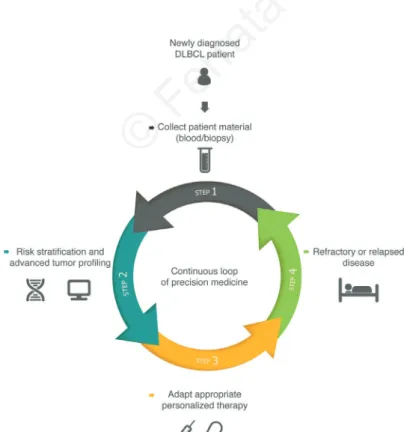
4) As presented in Figure 2, we anticipate the possibility of a continuous loop of adaptive PM in which all DLBCL patients both at diagnosis and at relapse can enter the cycle of advanced tumor profiling (with NGS, immunohis-tochemistry, GEP and proteomics), risk stratification and
Figure 2. Scheme representing the circle (continuous loop) of adaptive precision can-cer medicine. For newly diagnosed diffuse large B-cell lymphoma (DLBCL) patients, after collection of patient material specific tumor profiles acquired by several high-throughput technologies together with risk stratification will guide precision therapeutic strategies. When patients are confronted with refractory or relapsed DLBCL disease, tumor profiling and risk stratification will be redone, resulting in redirection of the original therapeutic approaches. As DLBCL is an evo-lutionary genetic disease, this procedure can be repeatedly used to serially repress the lymphoma in view of specific evolved sub-clones, thereby optimizing PM at every dis-ease stage of the patient.
©
Ferrata
Storti
subsequent therapy adjustment based on druggable genes and pathways. Hundreds of compounds have so far been identified that have the potential to inhibit cancer cells at virtually every level of entire signaling pathways.4, 5 The
majority of tested compounds have demonstrated low response rates (<30%) and little durability of responses (<6 months) in phase I/II studies in unselected patients. In addition, the majority of lymphomas will not harbor only one genetic defect, which partly explains the modest effi-cacy of monotherapy with targeted drugs. New rationally designed biomarker-driven clinical trials with pre-selected patient populations are warranted to investigate the true value of novel targeted drugs.2,4,5,8
5) Pharmacogenomics, -kinetics, -dynamics, and thera-peutic drug monitoring will be necessary to optimize the dose and dosing schedule of these novel drugs. Studies are ongoing to determine whether it is possible to combine targeted therapies in order to impede signaling cascades at several levels, for example also blocking negative/positive feedback loops.2
6) Predictive biomarkers are warranted to pre-select patients to improve ORR.1Prior to incorporation of
bio-markers in clinical settings it is necessary to adequately define sensitivity and specificity. With the substantial reduction of costs of NGS over the past years, this tech-nique can be applied in the search for predictive biomark-ers.19,20,22Predicting response or resistance to a specific
ther-apy will not only expedite the introduction of the most
effective therapy to the patients, but will also likely reduce the overall treatment costs.1
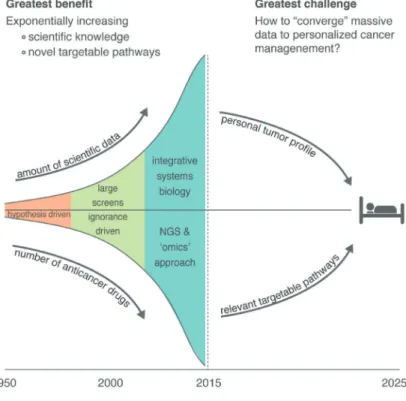
7) How to manage the sheer quantity of data yielded by high-throughput technological studies is in itself an emerging field (Figure 3). Interpretation and integration of the data, followed by translation into potential druggable targets applicable for clinical use, are crucial steps in PM.23
If not adequately dealt with, this increasing complexity of information could result in an escalating divergence of sci-ence, drifting away from the patient. Pathway-driven analysis by computational systems biology methods might be the logical step to do this.24However, crosstalk
between pathways might complicate black-and-white conclusions also from pathway-driven analyses and to overcome drug resistance mechanisms it might be impor-tant to parallel ‘co-target’ accessory pathways.25
8) Finally, lymphomagenesis is not only explained by genetics. Therefore, to obtain a global overview and com-prehensive understanding of tumor evolution, thereby optimizing treatment strategies, it will be necessary to integrate genomic data together with proteomic, metabolomics knowledge and functional studies using an integrative systems biology approach.23,25
Conclusions
With high-throughput technological improvements, genetic cancer research has moved beyond single gene analysis to the investigation of hundreds of genes and Table 1. Overview of affected genes and associated pathways and their corresponding putative therapeutic agents in diffuse large B-cell lym-phoma (DLBCL).
Affected gene Pathway Molecular subtype Therapeutic agent
SYK BCR/NFκβ ABC SYK-inhibitors, e.g. fostamatinib
BTK BCR/NFκβ ABC BTK-inhibitors, e.g. ibrutinib, ACP-196, ONO-4059, CC-292 PKCβ BCR/NFκβ ABC PKC-inhibitors, e.g. enzastaurin, sotrastaurin
IKK BCR/NFκβ ABC IKK-inhibitors, e.g. PS-1145, MLX015
NFκβ BCR/NFκβ ABC proteasome inhibitors, e.g. bortezomib, carfilzomib SPIB Microenvironment/NF ABC immune modulators, e.g. lenalidomide
IRF4 Microenvironment/NF ABC immune modulators, e.g. lenalidomide MYD88 Toll-like receptor ABC IRAK inhibitors
IRAK Toll-like receptor ABC IRAK inhibitors MALT1 Toll-like receptor/CBM ABC MALT-inhibitors, e.g. MI 2
JAK2/3 JAK/STAT ABC JAK-inhibitors, e.g. pacritinib, ruxolitinib, lestaurtinib STAT3/6 JAK/STAT ABC STAT-inhibitors
PI3K PI3K/AKT/mTOR GCB PI3K-inhibitors, e.g. idelalisib, buparsilib, rigosertib AKT PI3K/AKT/mTOR DLBCL** AKT-inhibitors, e.g. MK2206, perifosine
mTOR PI3K/AKT/mTOR DLBCL** mTOR inhibitors, e.g. temsirolimus, everolimus, ridaforolimus, silvesterol ERK PI3K/AKT/mTOR DLBCL** ERK-inhibitors, e.g. surafenib
MYC Apoptotic signaling GCB, ABC BET-bromodomain inhibitors
BCL2 Apoptotic signaling GCB, ABC BCL2-inhibitors, e.g. GDC-199 (venetoclax) BCL6 Apoptotic signaling GCB, ABC BCL6-inhibitors, e.g. 79-6
CREBBP histone modification GCB, ABC HDAC-inhibitors, e.g. vorinostat, panobinostat, entinostat, mocetinostat EP300 histone modification GCB, ABC HDAC-inhibitors, e.g. vorinostat, panobinostat, entinostat, mocetinostat MLL2 histone modification GCB, ABC HDAC-inhibitors, e.g. vorinostat, panobinostat, entinostat, mocetinostat EZH2 histone modification GCB, ABC EZH2-inhibitors, e.g. non-selective EZH2 inhibitor (DZNep), GSK126, E7438
ABC: activated B-cell-like DLBCL; GCB: germinal center B-cell-like DLBCL; DLBCL**: diffuse large B-cell lymphom (unspecified); CBM: molecular complex consisting of CARD11,
BCL10and MALT1.
©
Ferrata
Storti
entire signaling pathways simultaneously. We anticipate that this will lead to identification of druggable targets and to predictive biomarkers in DLBCL. PM will hopefully improve the outcome of lymphoma patients. The main challenges, however, will be to design and execute innova-tive biomarker-driven clinical trials demonstrating efficacy of PM, to implement these high-throughput techniques in clinical practice, and to keep this approach financially viable.
Acknowledgments
The authors wish to acknowledge Sanne Tonino and Arnon Kater for critically reviewing the manuscript.
Financial and other disclosures provided by the author using the ICMJE (www.icmje.org) Uniform Format for Disclosure of Competing Interests are available with the full text of this paper at www.haematologica.org.
References
1. Intlekofer AM, Younes A. Precision therapy for lymphoma--current state and future directions. Nat Rev Clin Oncol. 2014;11(10):585-596. 2. Roschewski M, Staudt LM, Wilson WH. Diffuse large B-cell
lym-phoma-treatment approaches in the molecular era. Nat Rev Clin Oncol. 2014;11(1):12-23.
3. Martelli M, Ferreri AJ, Agostinelli C, Di Rocco A, et al. Diffuse large B-cell lymphoma. Crit Rev Oncol Hematol. 2013;87(2):146-71. 4. Younes A. XIV. The rationale for combining targeted and biological
anti-lymphoma drugs. Hematol Oncol. 2013 ;31 (Suppl 1):81-83. 5. Younes A, Berry DA. From drug discovery to biomarker-driven clinical
trials in lymphoma. Nat Rev Clin Oncol. 2012;9(11):643-653. 6. King RL, Bagg A. Genetics of diffuse large B-cell lymphoma: paving a
path to personalized medicine. Cancer J. 2014;20(1):43-47.
7. Young RM, Staudt LM. Targeting pathological B cell receptor signalling in lymphoid malignancies. Nat Rev Drug Discov. 2013;12(3):229-243. 8. Leslie LA, Younes A. Targeting oncogenic and epigenetic survival
path-ways in lymphoma. Leuk Lymphoma. 2013;54(11):2365-2376. 9. Sehn LH, Gascoyne RD. Diffuse large B-cell lymphoma: optimizing
outcome in the context of clinical and biologic heterogeneity. Blood. 2015;125(1):22-32.
10. Puvvada S, Kendrick S and Rimsza L. Molecular classification, pathway addiction, and therapeutic targeting in diffuse large B cell lymphoma. Cancer Genet. 2013;206(7-8):257-265.
11. Blombery PA, Dickinson M, Westerman DA. Molecular lesions in B-cell lymphoproliferative disorders: recent contributions from studies utilizing high-throughput sequencing techniques. Leuk Lymphoma. 2014;55(1):19-30.
12. Rossi D, Ciardullo C, Gaidano G. Genetic aberrations of signaling path-ways in lymphomagenesis: revelations from next generation sequenc-ing studies. Semin Cancer Biol. 2013;23(6):422-30.
13. Zhang J, Grubor V, Love CL, et al. Genetic heterogeneity of diffuse large B-cell lymphoma. Proc Natl Acad Sci USA. 2013;110(4):1398-403. 14. Johnsen JM, Nickerson DA, Reiner AP. Massively parallel sequencing:
the new frontier of hematologic genomics. Blood. 2013;122(19):3268-3275.
15. Mullighan CG. Genome sequencing of lymphoid malignancies. Blood. 2013;122(24):3899-3907.
16. Landau DA, Carter SL, Getz G, Wu CJ. Clonal evolution in hematolog-ical malignancies and therapeutic implications. Leukemia. 2014;28(1):34-43.
17. Cai Q, Westin J, Fu K, et al. Accelerated therapeutic progress in diffuse large B cell lymphoma. Ann Hematol. 2014;93(4):541-556.
18. Barton S, Hawkes EA, Wotherspoon A, Cunningham D. Are we ready to stratify treatment for diffuse large B-cell lymphoma using molecular hallmarks? Oncologist. 2012;17(12):1562-1573.
19. Macconaill LE, Garraway LA. Clinical implications of the cancer genome. J Clin Oncol. 2010;28(35):5219-5228.
20. Badalian-Very G. Personalized medicine in hematology - A landmark from bench to bed. Comput Struct Biotechnol J. 2014;10(17):70-77. 21. Simon R, Roychowdhury S. Implementing personalized cancer
genomics in clinical trials. Nat Rev Drug Discov. 2013;12(5):358-369. 22. Garraway LA. Genomics-driven oncology: framework for an emerging
paradigm. J Clin Oncol. 2013;31(15):1806-1814.
23. Hawkins RD, Hon GC, Ren B. Next-generation genomics: an integra-tive approach. Nat Rev Genet. 2010;11(7):476-486.
24. Medvedev P, Stanciu M, Brudno, M. Computational methods for dis-covering structural variation with next-generation sequencing. Nat Methods. 2009;6(11 Suppl):S13-20.
25. Ocana A, Pandiella A. Personalized therapies in the cancer "omics" era. Mol Cancer. 2010;9:202.
Figure 3. Schematic view of the develop-ment of cancer research, high-throughput technologies and precision cancer medi-cine. The amount of data these studies yield is exponentially increasing and the major challenge in the near future is to converge these data to precision cancer management. As mentioned, improve-ment of precision medicine is a multifac-torial process, which includes: 1) Increasing knowledge of lymphomagene-sis and 2) clonal evolution, 3) incorporat-ing high-throughput technologies into clin-ical standard care, 4) adapting the circle of precision medicine by advanced tumor profiling for every patient (Figure 2), 5) optimizing therapy by pharmacological competence, 6) propelling investigation of predictive biomarkes, 7) using path-way-driven analysis and system biology methods to process the quantity of data, and 8) integrating data produced by diverse research platforms (genomics, protemics, metabolomics, immunohisto-chemistry, etc.).