WORKING PAPER
No 23
Qualifications at
level 5: progressing
in a career or to
higher education
Qualifications at level 5:
progressing in a career or to
higher education
A great deal of additional information on the European Union is available on the Internet.
It can be accessed through the Europa server (http://europa.eu). Cataloguing data can be found at the end of this publication. Luxembourg: Publications Office of the European Union, 2014
ISBN 978-92-896-1630-0 ISSN 1831-2403
doi: 10.2801/77593
Copyright ©European Centre for the Development of Vocational Training (Cedefop), 2014
The European Centre for the Development
of Vocational Training (Cedefop) is the European Union’s
reference centre for vocational education and training. We provide information on and analyses of vocational education and
training systems, policies, research and practice. Cedefop was established in 1975 by Council Regulation (EEC) No 337/75.
Europe 123, 570 01 Thessaloniki (Pylea), GREECE PO Box 22427, 551 02 Thessaloniki, GREECE Tel. +30 2310490111, Fax +30 2310490020 E-mail: [email protected] www.cedefop.europa.eu
James J. Calleja, Director Barbara Dorn, Chair of the Governing Board
Foreword
This study examines qualifications at level 5 of the European qualifications framework (EQF) (1).
It shows that EQF level 5 qualifications play an important role in providing access to employment and career advancement, as well as enabling further learning and progression to higher education. This double function makes them attractive to learners and employers. Although the extent to which countries use qualifications at EQF level 5 differs, their importance is growing in all countries investigated for several reasons. First, they are developed as response to increased needs for advanced technical and/or management skills in a rapidly changing labour market and ageing workforce. Second, the data show that EQF level 5 qualifications are especially attractive to students with vocational education and training (VET) backgrounds and those already in employment. They contribute to lifelong learning by being accessible and attractive for adults and non-traditional learners. Third, they are seen as valuable and relevant by employers, as most include some form of work-based learning.
The development of comprehensive NQFs – including qualifications at all levels and of all types – in most European countries has shed new light on the potential of EQF level 5 qualifications. By acting as a bridge between education and training institutions and subsystems, these qualifications support permeability (vertically and horizontally), allowing learners to move more easily between different types of education (such as academic and vocational) and between different levels (such as VET and higher education), as they decide. The study also shows that EQF level 5 is increasingly being used as a platform for developing new types of qualifications, whether initial (IVET) or continuing vocational education and training (CVET) qualifications or short-cycle higher education (SCHE) qualifications.
(1) The study maps and analyses qualifications according to the level of learning outcomes in the 15 countries which had referenced their national qualifications frameworks (NQFs) to the EQF by June 2012. The countries are: Belgium (Flanders), the Czech Republic, Denmark, Estonia, Ireland, France, Croatia, Latvia, Lithuania, Luxembourg, Malta, the Netherlands, Austria, Portugal and the United Kingdom (England, Wales and Northern Ireland (EWNI) and Scotland).
The study aims to stimulate policy discussion on the types, purposes and potential of qualifications at EQF level 5 in contributing to and addressing current and future policy challenges, such as improving the relevance of qualifications for the rapidly changing labour market, workforce upskilling and reskilling, and helping people change or progress in their career or opening doors for further learning though validation of work experience and non-formal and informal learning.
Joachim James Calleja Director
Acknowledgements
This report is the result of a team effort and reflects the contribution of all who have worked on it.
The study was coordinated, supervised and drafted by Slava Pevec Grm and Jens Bjørnåvold, Cedefop senior experts.
A research consortium led by Panteia and 3s – represented by Simon Broek and Karin Luomi-Messerer – conducted the research. Additionally, the following national experts provided detailed country-specific information: Monika Auzinger, Mike Coles, Mariya Dzhengozova, M’Hamed Dif, Sonja Lengauer, Gert-Jan Lindeboom, Sean o’Reilly, Vidmantas Tutlys and Lubomir Valenta (*). We also thank representatives of ministries, national experts, teachers, learners, employees and employers interviewed in the countries studied, who contributed to the knowledge base of this work.
Finally, thanks also go to Cedefop colleagues Joanne Basiakou (administrative assistance) and Evangelia Bara (technical support).
(*) The research was carried out by Panteia in consortium with 3S under Cedefop service contract AO/ECVL/JBSPEV/Qualifications_EQF_level_5/001/12.
Table of contents
Foreword ... 1
Acknowledgements ... 3
Table of contents ... 4
Executive summary ... 9
1. Aim of the study, conceptual framework and research questions ... 18
1.1. Background to the study ... 18
1.2. Key research questions ... 19
1.3. Conceptual framework ... 20
1.4. Description of methodology ... 21
1.4.1. Country overviews and analysis ... 22
1.4.2. Case studies ... 22
1.5. Outline of the report ... 24
2. Diversity of EQF level 5 qualifications ... 25
2.1. Bridging general education, VET and higher education ... 25
2.2. Qualifications and learning pathways: the learning contexts ... 27
2.3. Overview of level 5 qualification types ... 28
2.4. Country differences in level 5 use ... 32
2.4.1. Qualifications outside the formal system linked to EQF level 5 ... 32
2.4.2. Countries with single qualification type linked to level 5 ... 33
2.4.3. Higher education and VET qualifications linked to EQF level 5 ... 34
2.4.4. Countries with a diversified landscape ... 37
3. Progress in EQF level 5 qualifications importance ... 42
3.1. Countries where EQF level 5 is important ... 43
3.2. Countries with EQF level 5 having average importance ... 46
3.3. Countries with EQF level 5 having some importance ... 47
3.4. Countries with EQF level 5 having little importance ... 48
3.5. Qualifications outside NQFs but relevant to EQF level 5 ... 51
4. Access and progression for education and employment ... 53
4.1. Introduction ... 53
4.1.1. Qualifications as currency ... 53
4.1.2. Purposes of qualifications ... 53
4.2.1. EQF level 5 as initial education qualification ... 55
4.2.2. Employment-oriented routes, same/similar occupation ... 57
4.2.3. Mixed education-employment routes for career switch ... 58
4.2.4. Qualifications used for different routes ... 58
4.2.5. Overview of different routes ... 60
4.2.6. System permeability ... 62
4.3. Perceived differences in labour market relevance ... 63
4.3.1. No level 5 qualifications or only recently introduced ... 64
4.3.2. A long tradition of level 5 qualifications ... 65
4.3.3. Difficulty in assessing labour market relevance ... 69
5. Heterogeneous learner group ... 70
5.1. Education background ... 70
5.2. Age ... 72
5.3. Work experience ... 73
6. Learning outcomes as work in progress ... 76
6.1. Qualifications and learning outcomes ... 76
6.1.1. Scope of learning outcomes descriptions ... 76
6.1.2. Terminology used in describing learning outcomes ... 79
6.2. Educational programmes: input variables and mode of delivery ... 85
6.2.1. Study intensity/volume/duration ... 85
6.2.2. Mode of delivery ... 86
7. Assigning qualifications to the NQF and linking to the EQF ... 89
7.1. Introduction ... 89
7.1.1. Referencing national qualification levels to the EQF ... 89
7.2. Cross-country analysis ... 89
7.2.1. Qualifications, NQF levels and EQF referencing ... 90
7.2.2. Quality assurance function of the NQF ... 91
7.2.3. Allocating individual qualifications or types ... 93
7.2.4. Level 5 descriptors and range of qualifications linked ... 96
7.2.5. Identifying the appropriate level ... 97
7.2.6. Other criteria used to allocate qualifications to levels ... 99
7.2.7. Categories for level descriptors and qualifications ... 100
7.2.8. Allocating qualifications from other learning contexts ... 101
7.2.9. Allocation inconsistencies ... 104
8. Conclusions and recommendations ... 106
8.1. Key conclusions ... 106
List of abbreviations ... 113
References ... 116
Bibliography ... 123
ANNEX 1. List of working definitions ... 139
ANNEX 2. List of interviewees ... 144
ANNEX 3. Available data on EQF level 5 qualifications ... 147
ANNEX 4. Key purposes and functions of qualifications ... 157
ANNEX 5. Further material on learning outcome descriptions of qualifications . 168 ANNEX 6. Duration and mode of delivery ... 172
List of tables, figures and boxes
Tables
1 Overview of qualifications examined in the case studies ... 23
2 Overview of qualifications ... 29
3 Overview of graduates in two studies in Austria ... 43
4 The evolution of BTS students within public and private providers from 2009/10 to 2011/12 in France ... 44
5 Overview of the evolution of DUT students by main sector of activity from 2009/10 to 2011/12 in France ... 45
6 Evolution of awarded DUT students by main sector of activities in the period 2009-10 ... 45
7 Number of regular students and adult learners in SCHE programmes in Denmark ... 46
8 Overview of the number of higher, advanced higher, HNC or HND qualifications in Scotland ... 47
9 Programmes and students per area of study in Belgium (Flanders) ... 48
10 Number of CET students and graduates in Portugal ... 49
11 Number of AD students and in the professional bachelor for full-time and part-time studies in the Netherlands ... 50
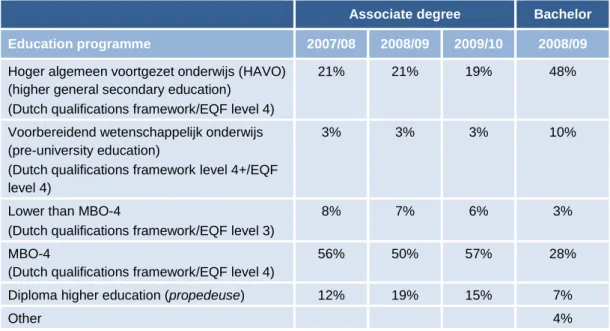
12 Education background of AD/bachelor students in the Netherlands ... 70
13 Participation in supplementary courses (for adult learners) at SCHE (level 5 EQF) by highest education completed and year in Denmark ... 71
14 Age distribution of HBO5 students in Belgium (Flanders) ... 72
15 Overview of previous activities of AD students ... 73
16 Core competences: professional profile management in health care and health care service in the Netherlands ... 82
17 HBO5 qualifications in Belgium (Flanders): type of teaching ... 87
18 Descriptors for levels and qualifications ... 102
19 UK statistics: all students by level and mode of study 2011/12 ... 155
20 Assessment criteria for vocational competence ... 168
21 Programme learning outcomes for the higher certificate in culinary arts in Ireland ... 169
Figures
1 Overview of qualification types ... 112 Conceptual framework study qualifications at EQF level 5 ... 21
Boxes
1 Examples of qualifications linked to EQF level 5 ... 31
2 Five qualifications frameworks used among the four jurisdictions of the UK ... 38
3 AD management in health care in the Netherlands ... 65
4 Vocational qualifications in the Czech Republic ... 66
5 Advanced certificate and higher certificate in Ireland ... 67
6 Colleges of business administration in Austria ... 68
7 DUT in management of enterprises and administrations in France ... 69
8 Examples of learners taking the CVET pathway to the VET colleges qualification in Austria ... 72
9 Students in the AD management in health care programme in the Netherlands ... 74
10 DUT-GEA core common competence... 79
11 Indicators for allocating the Austrian qualification VET college of business administration to level 5 ... 98
12 Procedures for allocating qualifications to levels in the Flemish qualifications framework ... 100
Executive summary
EQF level 5 qualifications play an important role in providing access to employment and career advancement, as well as enabling further learning and progression to higher education. They appeal to both learners and employers.
This is one of the main conclusions of the Cedefop study which explored the key functions and purposes of EQF level 5 qualifications in 15 countries (2). It also examined how learning outcomes and ‘best fit’ approaches have been applied for assigning qualifications to the EQF level 5 across countries.
The study is innovative in mapping and analysing qualifications according to the level of learning outcomes, not institutional type or education and training subsystems. As countries have been working to link comprehensive NQFs to the EQF, it became evident that qualifications at level 5 are very diverse and developing dynamically. The study provides an overview of the diverse landscape of qualifications operating at this level, analysing the roles they play in relation to the labour market and further learning. It offers an opportunity to understand better how the learning outcomes approach is applied in qualifications design and qualifications frameworks across Europe, using level 5 as a reference point. The study addressed the following specific questions:
which qualifications have been referenced to level 5 of the EQF; to what (a)
extent do countries differ in their use of level 5?
what are the key purposes and functions of qualifications assigned to EQF (b)
level 5? What is their ‘currency’ on the labour markets and/or in further learning?
what is the profile – expressed in terms of learning outcomes – of (c)
qualifications assigned to EQF level 5?
how have the learning outcomes and ‘best fit’ approaches been applied for (d)
assigning qualifications to EQF level 5 across countries? What were the main challenges and opportunities faced by countries? Which other criteria have been used for placing qualifications at level 5?
Desk research and interviews with relevant stakeholders were brought together to produce 15 country reports that paint a picture of qualifications linked via NQFs to EQF level 5. Their main functions and purposes were researched,
(2) The 15 countries selected were those that had completed referencing their national qualification levels to the EQF by June 2012: Belgium (Flanders), the Czech Republic, Denmark, Estonia, Ireland, France, Croatia, Latvia, Lithuania, Luxembourg, Malta, the Netherlands, Austria, Portugal, the United Kingdom (EWNI and Scotland).
including how they help people progress to further learning and the labour market, along with overall characteristics and profiles in terms of learning outcomes. Six case studies (3) were also carried out, along with a series of interviews with learners/employees, employers and training providers linked to specific qualifications. These focused on how institutions, learners/employees and employers use qualifications linked to EQF level 5.
EQF level 5: bridging general education, VET and
higher education
Traditionally, education and training systems have distinct subsystems ‒ general, vocational and higher education (academic and professional) ‒ which are organised and regulated separately. Usually they are related to one another in a hierarchical manner. EQF level 5 operates across these subsystems, with a heterogeneous mix of qualifications awarded by a wide range of VET and higher education institutions. Half of the qualification types (4) identified at level 5 are regulated by higher education or delivered under the responsibility of higher education institutions. Most are awarded through SCHE programmes.
When focusing on the learning outcomes of these qualifications, the distinction between VET and higher education is not always clear-cut: for instance, in Portugal, the technological specialisation diploma (diploma de especialização tecnológica) (DET) is registered as NQF/EQF level 5 VET qualification. However, the programme leading to this qualification, technological specialisation courses (cursos de especialização tecnológica) (CETs), is provided by public and private higher and non-higher education institutions.
Diversity of EQF level 5 qualifications
The study identifies 31 qualification types linked to EQF level 5 in the 15 countries (see Table 2); the extent to which level 5 is used also varies across countries. Lithuania currently has no qualifications at this level, but legislation is
(3) The case studies come from the Czech Republic, Ireland, France, Lithuania, the
Netherlands and Austria.
(4) A group or cluster of qualifications within a country that share specific characteristics (e.g. subsystem they belong to, legal regulations and regulatory body, objectives, duration of related programmes, access requirements or level of labour market entry). Within a qualification type, there can be many different individual qualifications in different fields (such as engineering, social and health care, business).
being prepared to introduce them. Two countries (the Czech Republic (5) and Estonia (6)) currently link to EQF level 5 only those qualifications from outside formal education and training. Latvia and the Netherlands link only SCHE qualifications to EQF level 5. The Austrian qualification type allocated to this level is awarded in five-year upper secondary programmes or CVET. A number of countries such as Belgium (Flanders) (7), Denmark, Ireland, Croatia and Luxembourg, link (post-)secondary VET and SCHE qualifications to EQF level 5. In France, Malta and the United Kingdom, the EQF level 5 qualification landscape is even more diverse, as it includes sectoral, private and/or general education qualifications.
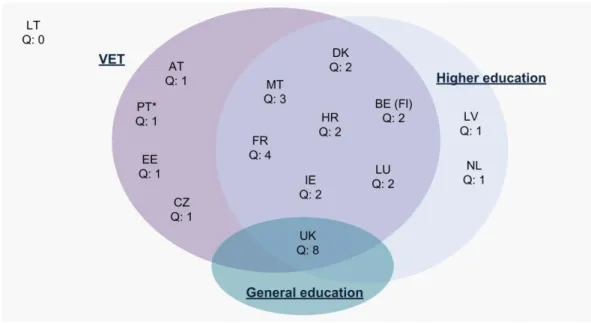
Figure 1 maps the countries and subsystems to which the qualification types belong in the 15 countries. More detailed information can be found in Table 1.
Figure 1 Overview of qualification types
Source: Cedefop.
(5) In the Czech Republic, higher education qualifications at this level are foreseen
within the qualifications framework for higher education.
(6) In Estonia the new VET Act (adopted in 2013) provides the legal basis for IVET and CVET qualifications at NQF/EQF level 5.
(7) In Belgium (Flanders) two types of qualifications are included: educational and professional. Professional qualifications are not only part of educational qualifications, but can be obtained independently, for example through validation of prior learning (Vlaams Ministerie van Onderwijs en Vorming, 2013).
Increasing importance of qualifications at EQF level 5
Countries differ significantly in the number of programmes, students enrolled and qualifications awarded at level 5. Numbers also vary in relation to different types of qualification within a country, as does availability of data across countries and types of qualifications and programmes, making comparisons difficult. However, two main groups of countries can be distinguished:(a) those where level 5 qualifications have a long tradition, are firmly embedded in the education and training system and attract an important number of students, as in France (8) and Austria (9);
(b) those where level 5 qualifications have been established more recently, such as the Czech Republic, the Netherlands and Portugal.
The BTS in France continuously attracts more learners, in particular to qualifications for the service sector which made up about 75% of all awarded BTS in 2011. The number of students acquiring the university diploma of technology (diplôme universitaire de technologie) (DUT), which also focuses on the services sector, has been slightly decreasing, mainly due to the increased weight of the more labour-market-focused BTS.
Although still reaching only a limited number of students, the number of associate degrees (ADs) awarded in the Netherlands has been rising steadily. The corresponding programmes were introduced in 2006 via a pilot scheme: they are two-year higher education programmes within the four-year professional bachelor programmes. The aim is that 20% of the students at universities of applied sciences should be students enrolled in these AD programmes. In 2011, the share was 1.7%.
Access and progression for education and employment
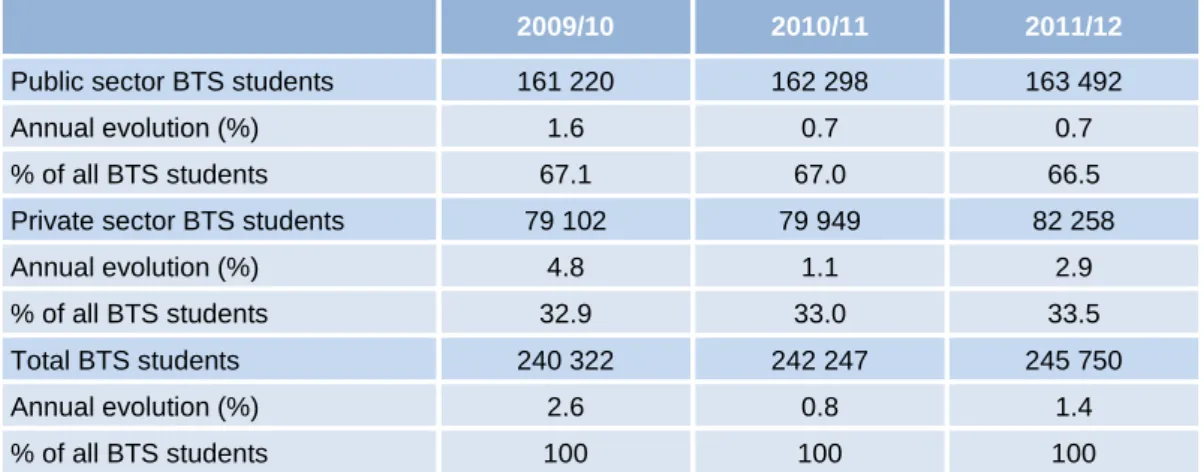
EQF level 5 qualifications offer various access and progression routes from and to employment and to higher education. Among the 31 qualification types identified in the study, 14 are primarily oriented towards the labour market:(8) The number of students following their higher technician certificate (brevet de technicien supérieur) (BTS) studies has been increasing during the past three years, rising from 240 322 students during the academic year 2009/10 to 245 750 students during 2011/12. The number of awarded BTS qualifications has also increased from 113 505 in 2010 to 114 914 in 2011.
(9) In Austria, 26% of all learners in their 10th year of schooling attend a VET college. In the school year 2011/12, more than 137 000 students attended a VET college. A total number of 24 471 students graduated from a VET college in 2011.
examples include the Czech Republic and Estonia, the vocational degree (Erhvervsuddannelse) (EUD) in Denmark, further vocational training certificates (brevets de maîtrise) (BM) in France, and master craftsman qualification in Croatia and Luxembourg. A total of 12 qualification types have a double function, valued as entry qualifications for both the labour market and higher education (in some cases with the possibility for credit transfer): these include the higher vocational education 5 in Belgium (Flanders), the VET college Reifeprüfung certificate and the VET diploma in Austria, the DUT in France, and the diploma of first level professional higher education in Latvia. Eight level 5 qualification types provide clearly articulated entry and progression opportunities into bachelor programmes, including the higher certificate in Ireland, the AD in the Netherlands and the higher education certificate or diploma in the UK. The explicit use of learning outcomes supports progression. Some qualifications at EQF level 5 are solely seen as a preparation for further higher education studies, as in the advanced higher certificate or baccalaureate in Scotland (see Annex 4).
Distinct professional profile and labour market relevance
Most EQF level 5 qualifications are clearly linked to occupations/professions. This is also the case for most of the qualifications awarded within higher education. They are not only considered an intermediate step towards a bachelor degree, but also independent qualifications with distinct professional profiles and labour market relevance. In countries where currently no qualification is linked to level 5, this is identified as an important gap, for instance by employers in the industrial sector in Lithuania.
Level 5 qualifications provide advanced VET skills and competences, potentially responding quickly to new labour market demands. Cedefop’s analysis shows that qualifications are available for all major economic sectors with a strong focus on services in some countries, as is the case in France where DUT qualifications are predominately linked to the service sector. In Austria, level 5 curricula and qualifications are developed in a range of different economic sectors, including agriculture and forestry, material goods production, transport, tourism, and business-related services. VET colleges also have the opportunity to develop their own school specialisations to respond to regional needs.
In countries in which EQF level 5 qualifications have existed for a long time, such as France and Austria, they are more widely accepted by employers than in those in which they have been developed more recently. As newly developed qualifications sometimes compete with a range of others, gaining employer trust may take time; the example of the human resources (HR) generalist qualification in the Czech Republic demonstrates this.
Trust is built more easily when employers are involved in provision of the programme. As the Irish example shows, employers who offer internships as part of the programme leading to the advanced certificate are those who understand this qualification best. They appreciate the practical experience that learners acquire and tend to recruit graduates of the advanced certificate rather than those with a higher certificate placed at the same level.
Upskilling the employed
Many EQF level 5 qualifications are designed to upskill people already in employment and provide them with advanced technical and/or management skills, as is the case in the Netherlands management and health care AD programme. Almost all students seek to upgrade their management competences to enable them to perform team leader roles. The trend towards leaner organisation requires that an increasing number of people have operational management competences.
EQF level 5 qualifications can be obtained through validation of work experience, as is the case in the Czech Republic or in Estonia. Validation of non-formal and innon-formal learning generally plays an important role at this level in many countries. It enables people to acquire a qualification or it shortens the duration of a programme that leads to the award of a qualification. In France, BTS and DUT qualifications can also be obtained through the validation of prior experiential learning (validation des acquis de l’expérience) (VAE). In 2010, 66% of higher education qualifications acquired through validation were at EQF level 5, most as BTS.
Progression to higher education
Level 5 qualifications can help progress to higher education. Many EQF level 5 qualifications are awarded through SCHE programmes, which in the Bologna process were dedicated to providing an intermediate step towards bachelor degrees. When the qualification is part of, or closely related to, a bachelor degree programme, progression (including credit transfer) is generally guaranteed. This is the case in Ireland, the Netherlands and the UK. However, the opportunity to progress is used differently, as the French example shows. DUT graduates are more likely to continue their studies than holders of a BTS degree.
The Austrian case is different as it is not a SCHE programme. It is a double qualification granting access to higher education and the labour market. Approximately 50% of VET college graduates progress to higher education.
In cases of CVET qualifications primarily oriented towards the labour market (as in the Czech Republic or Estonia), progression to higher education is not an explicit goal.
A heterogeneous group of learners
Learners enrolled in programmes leading to an EQF 5 qualification are a heterogeneous group as regards their education, age and/or work experience. However, in many countries, quantitative data on student background are unavailable. Indicative data show that EQF level 5 qualifications are especially attractive to students with a VET background and those already in employment. In the Netherlands, in 2009-10, 63% of students enrolled in the AD programme came from upper secondary VET, while 22% had general upper secondary education and 15% had started higher education before. The dominance of learners with vocational background clearly underlines the potential of short-cycle programmes to support further learning. In Denmark, one third of the participants in SCHE in supplementary courses (for adult learners) in 2011 already had a qualification higher than, or at the same level as, the EQF 5 qualification they want to acquire. This may indicate the potential of short-cycle programmes to offer specific competences desired by the labour market. It also suggests that people in their career feel the need to acquire a (new) qualification to change their career or to complement their skills. The other participants also include non-traditional learners with low formal qualifications who have acquired access through validation of working experience.
Learning outcomes as work in progress
Qualifications at EQF level 5 are progressively described in terms of learning outcomes. In some countries, for example Austria and Portugal, this is still work in progress. The way learning outcomes are used and structured differs across qualification types and countries. First, learning outcomes of a degree programme are rather broadly formulated while those in modules or units are more operationalised to guide the design of assessment. Second, the terminology used differs across qualifications and countries. Some of the qualifications include categories comparable with EQF (knowledge, skills and competence) through the use of NQF descriptors. In the case of SCHE, they need to reflect the Dublin descriptors (10). However, other learning outcome categories are also used. Evidence suggests that, in most cases, the learning outcomes described are developed from a professional/occupational profile
(10) The Dublin descriptors, developed within the joint quality initiative, from 2001 and onwards, are part of the framework for qualifications of the European higher education area (EHEA). They include level descriptors for short-cycle qualification.
agreed on with labour market stakeholders and are therefore often related to or expressed in competences.
Assigning qualifications to NQF level(s)
As EQF level 5 qualifications exemplify, countries either assign individual qualifications (as in Belgium (Flanders) or the Czech Republic), or types of qualifications (as in Luxembourg and the Netherlands) to their NQFs. The latter approach is usually taken in the initial phase of the NQF. Newly developed or revised qualifications will be assigned to levels individually.
The appropriate level can be identified by comparing the descriptors of qualifications and levels (as in Denmark, Estonia or Luxembourg) and/or by taking into account how qualifications are regarded in society (as in Austria). Sometimes other (additional) criteria are used, such as the duration of a programme or the workload associated with it (as in Denmark, Malta or the Netherlands).
Comprehensive and learning-outcomes-based NQFs, which include all types and levels of qualification, provide us with the opportunity to understand better how different subsystems of education and training – and the qualifications awarded by them – interact with each other. This interaction is critical to the ability of education and training to promote lifelong learning and for learners to progress across institutions and systems.
Policy messages
The Cedefop study demonstrates that EQF level 5 qualifications play an important role; in particular, they help achieve a range of policy objectives in response to challenges EU countries are facing:
they allow people to acquire advanced technical and/or management (a)
competences improving their job prospects and helping them change or progress in their careers. This is in line with Cedefop skills forecasts (Cedefop, 2012c), demonstrating the increased demand for skills of this type;
their double function – combining labour market-orientation with progression (b)
opportunities to/within higher education – makes them attractive to learners; they demonstrate the importance of vocationally- and professionally-oriented (c)
qualifications in tertiary, higher education and training;
qualifications at level 5 contribute to lifelong learning by being attractive and (d)
in many countries, access to programmes and qualifications at level 5 can (e)
be acquired through validation of work experience and non-formal and informal learning;
they are seen as valuable and relevant by employers, reflecting that most of (f)
them include some form of work-based learning;
they seem to be attractive for people who have already acquired some kind (g)
of higher education degree, offering possible labour market specialisation. This illustrates that progression can go in many directions, vertically as well as horizontally;
by acting as a bridge between education and training institutions and (h)
subsystems they can promote interaction (vertically and horizontally) between VET and higher education. This is important as it highlights the added value of VET at all qualification levels, contributing to the overall attractiveness and image of VET;
further exploring the different types and purposes of qualifications at EQF (i)
level 5 in European countries could help policy-makers identify gaps in their own qualifications landscape and use this level as a platform for developing new qualifications.
The Cedefop study of qualifications at EQF level 5 also provides important lessons for the implementation of learning outcomes and NQFs:
describing qualifications in learning outcomes is work in progress. The study (a)
suggests stimulating the use of the learning outcomes approach for describing individual qualifications and assigning them to NQF levels on the basis of this description;
the study evidence also identifies the need to improve the transparency of (b)
procedures for assigning qualifications – obtained in formal, non-formal and informal learning contexts – to NQF levels.
CHAPTER 1.
Aim of the study, conceptual framework and
research questions
1.1.
Background to the study
Education and training play a crucial role in Europe’s economy and society because economic welfare strongly depends on the knowledge, skills and competences of the workforce. Implementation of the EQF, allowing for a systematic comparison of national qualifications from a learning outcomes perspective, has demonstrated the critical role played by qualifications operating at the crossroads of general, vocational and academic sectors. These qualifications, in many cases placed at EQF level 5, are growing in importance and provide interesting examples of how European education and training is adapting to changing labour market needs and requirements.
The EQF, adopted by the European Parliament and Council in April 2008 (European Parliament and Council of the EU, 2008), is a common European reference framework acting as a translation device to make qualifications acquired within different education and training systems in Europe more readable and understandable. The core of the EQF is its eight reference levels described in terms of learning outcomes (11). This enables the EQF to serve as a bridge between national qualification systems and the different subsystems these build on (general, vocational or higher education) and learning contexts (formal, non-formal and innon-formal learning) (12).
To use the EQF as a translation and comparison device, countries are asked to link the levels of their national qualifications systems or frameworks to the EQF
(11) Learning outcomes means statements of what a learner knows, understands and is able to do on completion of a learning process, which are defined in terms of knowledge, skills and competence (European Parliament and Council of the EU, 2008).
(12) The establishment of the EQF and the development of NQF can be considered a global phenomenon. According to the ETF et al. (2013), frameworks are either established or being developed in 142 countries around the globe.
levels. By June 2012, 15 countries (13) had finalised this process and presented their EQF referencing report (14).
During this process it became evident that qualifications at level 5 play a more important role than previously understood. While not fully integrated into the three cycles of the Bologna-process, their position in relation to IVET is in many cases unclear and difficult to judge. This institutional ‘invisibility’ hides a landscape of diverse and dynamic qualifications playing (increasingly) important roles in relation to the labour market and further education and training.
The purpose of the study is to open up this landscape. Our initial assumption is that level 5 is used differently in national contexts. It might accommodate a variety of different qualifications since it operates at the crossroads of general, vocational and academic education and training. In some countries, EQF level 5 qualifications might be a very recent phenomenon.
1.2.
Key research questions
The purpose of this study is to acquire better understanding of the roles and functions of qualifications referred to level 5 of the EQF, for further learning as well as for employment. The study also aims to strengthen our understanding of the way in which the learning outcomes approach is applied in the design of qualifications and qualifications frameworks across Europe, using level 5 as a reference point. The detailed research questions are listed below:
which qualifications have been referenced to level 5 of the EQF; to what (a)
extent do countries differ in their use of level 5?
what are the key purposes and functions of qualifications assigned to EQF (b)
level 5? What is their ‘currency’ on the labour markets and/or in further learning?
what is the profile – expressed in terms of learning outcomes – of (c)
qualifications assigned to the EQF level 5?
how have the learning outcomes and ‘best fit’ approaches been applied for (d)
assigning qualifications to EQF level 5 across countries? What were the
(13) Belgium (Flanders), the Czech Republic, Denmark, Estonia, Ireland, France, Croatia, Latvia, Lithuania, Luxembourg, Malta, the Netherlands, Austria, Portugal, the United Kingdom (EWNI and Scotland).
(14) By the end of 2013, 21 countries had linked their national qualification levels to the EQF. Referencing reports are available at:
main challenges and opportunities faced by countries? Which other criteria have been used for placing qualifications at level 5?
1.3.
Conceptual framework
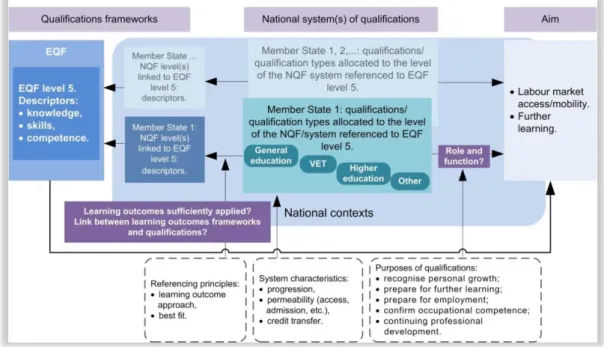
The study’s conceptual framework includes the following building blocks:
the context in which EQF level 5 qualifications play a role differs from (a)
country to country. This has many reasons, including the existing qualifications system and their organisation, traditions, cultural attitudes towards these types of qualifications, and labour market dynamics;
the level descriptors for EQF level 5 are the common reference for all (b)
countries and so provide a basis for comparison;
the NQF/national qualification system and NQF level descriptors related to (c)
EQF level 5. The qualifications are allocated to the national levels and the descriptors of these levels determine – in abstracto – the learning outcomes related to a level 5 qualification;
level 5 qualifications can be delivered in different subsystems and each (d)
subsystem can have different rules, regulations and rights attributed to the qualification. While the level of the qualification might be the same, its value (for further learning or at the labour market) can be different, and use of learning outcomes as a reference point for the development, quality assurance and provision of qualifications can also differ. Therefore, the characteristics of these qualifications and qualification types can be quite different;
the aim of the implementation of the EQF and NQFs is to foster (labour) (e)
mobility and lifelong learning. This is pursued through making qualifications systems more transparent, coherent and comparable.
A number of principles determine whether qualifications at EQF level 5 lead to better (labour) mobility, access to the labour market and lifelong learning:
referencing (to the EQF) process and the principles applied. This includes (a)
the levelling of qualifications within a country, the methods applied and the factors that play a key role in this context (such as political factors and stakeholder perception of a specific qualification or qualification type); the general characteristics of the qualifications system include that it is (b)
permeable, meaning that: i. progression is possible;
ii. it includes validation of non-formal and informal learning procedures; iii. credit transfer is stimulated.
The characteristics of the qualifications system and the employment regimes determine whether the qualifications at EQF level 5 indeed lead to better (labour) mobility, access to the labour market and lifelong learning; in other words, whether qualifications systems are indeed closely related to labour market needs and whether there is strong involvement of labour market stakeholders in education and training;
the qualifications/qualification types are described in terms of learning (c)
outcomes.
Through mapping and analysing the relationship between these building blocks questions on the role and function of EQF level 5 qualifications in the different countries are asked and answered. The use of learning outcomes in designing qualifications and assigning them to the NQF levels is also explored. Figure 2 provides an overview of the key concepts discussed.
Figure 2 Conceptual framework study qualifications at EQF level 5
Source: Cedefop.
1.4.
Description of methodology
The methodology included several research activities carried out in two phases. The first phase provided an overview of EQF level 5 qualifications within national qualification systems, their characteristics and purposes, including how they help
progress to further learning and in the labour market. The 15 country reports create a picture of qualifications linked via NQFs to EQF level 5.
The second phase focused on six case studies and a series of interviews with learners/employees, employers and training providers linked to specific EQF level 5 qualifications. These focused on how institutions, learners/employees and employers use qualifications linked to EQF level 5.
1.4.1. Country overviews and analysis
The country reviews and analysis were prepared from desk research and semi-structured interviews conducted with at least four key stakeholders and experts in most of the countries examined (ministries of education, qualifications agencies, quality assurance bodies and social partners).
To ensure compatibility of information and analyse the data set, a common template was developed focusing on two aspects:
analysis at country level explored key characteristics of the context and (a)
national qualification system, conceptualisation of qualification levels and learning outcomes, implementation of the NQF and referencing to the EQF, and positioning of qualifications referenced to EQF level 5 within the national qualification system;
analysis at qualification/qualification type level focused on the qualifications (b)
linked to EQF level 5, their key design feature, purposes and functions, involvement of stakeholders in their design and governance features, plus relevance for labour market and further learning.
1.4.2. Case studies
The comparative overview is supported by six case studies, which analyse how specific qualifications linked to EQF level 5 are used by institutions, individuals and labour markets. Particular attention is paid to: whether and how qualifications are defined through learning outcomes; the principles according to which these definitions and descriptions of learning outcomes are made; and the extent to which these definitions point to problems in parity of esteem and equivalences.
The following countries were selected for more in-depth study: the Czech Republic, Ireland, France, Lithuania, the Netherlands and Austria. Several criteria supported selection: they represent different types/traditions of qualifications systems (e.g. Ireland, France, Austria); they provide geographical coverage (east European country, Anglo-Saxon country, western countries and the Baltics); and there are countries with and without frameworks for subsystems (the Czech Republic (with), the Netherlands (without)). The study includes not only those qualifications already assigned to the EQF level 5 but also some that could, or will be linked to level 5 (in Lithuania and the Netherlands). These are included to
gather information on the rationale for introducing level 5 qualifications as well as reasons why these qualifications are not (yet) linked to level 5 and on procedures for linking them.
Table 1 Overview of qualifications examined in the case studies
Country Type
(national language/English translation)
Name of specific example
CZ Profesní kvalifikace/vocational qualification
Vocational qualification HR generalist Vocational qualification tour guide Vocational qualification bereavement counsellor
IE Advanced certificate
Advanced certificate in professional cookery
Higher certificate Higher certificate in culinary arts
FR
Diplôme universitaire de
technologie/university diploma of technology
University diploma of technology in the management of enterprises and administrations (DUT-GEA)
NL Associate degree Management in health care
AT
Reife- und Diplomprüfung der berufsbildenden höheren schule
(BHS)/VET college Reifeprüfung certificate
and VET diploma
VET college of business administration
VET college of engineering (the electronics and technical computer science speciality is selected)
Qualifications currently not linked to level 5
LT
Two potential level 5 qualifications – paramedic and sewing designer – planned to be provided in IVET school have been analysed.
Two potential short-cycle study qualifications – accountant and technician of mechatronics (automated operation) – planned to be provided by higher vocational education colleges have been studied.
NL
The way a private provider is struggling to apply the learning outcome approach to get the qualification included in the Dutch qualifications framework at level 5: corporate account manager in one of the largest banks.
Source: Cedefop.
The in-depth case studies were based on a combination of desk research and site visits. Desk research included policy documents, studies, evaluation reports, academic studies on the topic, brochures, curriculum plans of particular studies, descriptions of learning outcomes, statistics on job entry, and learning pathways (if available). Site visits included interviews with at least three groups of stakeholders:
graduates/employees having a qualification linked to level 5, those enrolled (a)
in study programmes leading to the qualification (or in case of validation of prior learning learners, those taking part in the respective procedure);
employers recruiting people with level 5 qualifications, encouraging (b)
employees to develop through taking up such qualifications;
providers/associations of providers that provide qualifications linked to EQF (c)
level 5 in different subsystems (general, vocational, higher and private sectors).
A total of 10 institutions were visited where qualifications linked to EQF level 5 are offered. Approximately 150 people contributed to the knowledge base of this study (see Annex 2).
1.5.
Outline of the report
After the introduction of the study context, aims and methodological approach in Chapter 1, Chapter 2 provides a detailed overview of qualifications at EQF level 5 and how countries use this level. Quantitative data on students, qualifications, and programmes linked to EQF level 5 are presented in Chapter 3. Chapter 4 discusses purposes and functions of qualifications at EQF level 5 and provides a detailed account of diversity of routes to/from employment, from/to education. Although quantitative data on student background are unavailable in many countries, Chapter 5 provides some indicative data on the education background, age and work experience of learners at EQF level 5. Chapters 6 and 7 study the use of learning outcomes in describing qualifications and assigning them to NQF levels. The report concludes with Chapter 8, conclusions and key policy messages.
CHAPTER 2.
Diversity of EQF level 5 qualifications
2.1.
Bridging general education, VET and higher
education
Education and training systems traditionally have separate and distinct subsystems (general, vocational and academic/higher education) which are usually related to one another in a strict hierarchy of primary, secondary and tertiary education (Cedefop, 2012a). This works well as long as learners follow a predefined route in their chosen area and subsystem. However, the segmentation can also create institutional barriers to switching between subsystems and could introduce dead-ends. Countries differ as regards how permeable (not segmented or compartmentalised) their education and training systems are. This depends on the path of institutional development and actual reforms. Given the emphasis on lifelong and life-wide learning and learning/labour mobility, countries are increasingly addressing the need to build bridges and pathways across education and training subsystems.
As demonstrated by this study, EQF level 5 operates across VET, higher and general education, with a heterogeneous range of qualifications awarded by a wide range of VET and higher education institutions. Half of level 5 qualification types are regulated by the higher education system or delivered under the responsibility of higher education institutions (in Belgium (Flanders), Denmark, Ireland, France, Croatia, Latvia, Luxembourg, Malta, the Netherlands and the UK) (15). Most of the level 5 qualifications included in the higher education system are awarded through SCHE programmes. There are also countries that have assigned VET qualifications to level 5. This is the case in the Czech Republic, Denmark, Estonia, Ireland, France, Luxembourg, Malta, Austria, Portugal and the UK. In addition, there are general education qualifications linked to the EQF level 5 in the UK (Scotland).
As already indicated by the European Association of Institutions in Higher Education (Eurashe) study (Eurashe, 2011) qualifications at level 5 remain quite blurred. When focusing on the learning outcomes of these qualifications, the distinction between VET and higher education is not always clear-cut. Also ties between institutions and qualification types are becoming looser. For instance,
(15) See Table 2 for full overview.
the Maltese VET higher diploma is increasingly offered by higher education as the basis of a(n) (undergraduate) degree programme. In Portugal, the DET is registered as NQF/EQF level 5 VET qualification. However, the CETs leading to the qualification are provided by public and private higher education and non-higher education institutions. Also, the mode of acquisition of EQF level 5 qualifications is, in many cases, very flexible. For instance, the French DUT-GEA qualification based on the learning outcomes approach can be acquired though very different routes:
mainly through the university institutes of technology (institut universitaire de (a)
technologie) (IUT) school-based system combining theoretical and practical educational and training courses, including internship periods within private enterprises and/or public institutions;
apprenticeship systems where students spend over two thirds of their time at (b)
the workplace as remunerated employees within the enterprises/ organisations and the remaining time is devoted to their courses with the IUT;
continuing vocational training (CVT) for working students through the use, (c)
for instance, of the professionalisation contract scheme (contrat de professionnalisation) (CP);
through the VAE. (d)
The varied use of EQF level 5 in Europe and the variety of qualifications linked to EQF level 5 suggest that this level has the potential to play a very significant role in bridging subsystems in the transferability of qualifications and the promotion of lifelong learning. EQF level 5 can, for instance, provide the opportunity to strengthen the connection between higher education and VET and adult education, as well as for widening access to higher education. However, EQF level 5 could also represent a second choice for students who do not have access to traditional academic routes or who have failed in it and so could appear to be at a dead end (European Commission and EUCEN, 2009, p. 32). The EQF PRO project has identified three different situations regarding the opportunities offered in countries for continuity and progression between levels 5 and 6 (EUCEN, 2009, p.3):
in some countries (France, Slovenia, UK) there are bridges between levels 5 (a)
and 6 and between institutions, so if students or learners holding qualifications at level 5 wish to have access to bachelor programmes, they are entitled to enrol without any additional conditions;
in other countries (Belgium, Germany) students and learners are allowed to (b)
programmes (of varying length). However, this implies extending the learning process;
in a third category of countries (such as Poland) students and learners have (c)
to start bachelor programmes from the beginning, without recognition of what they have done in other programmes.
EQF level 5 is often considered as the zone of overlap between vocational and higher education, although all levels of the EQF (i.e. also levels 6 to 8) are supposed to be open to qualifications acquired outside the higher education context. In this role of zone of overlap, level 5 can provide a missing link between secondary and higher education (Eurashe, 2011).
Where previous studies focused on only one type of level 5 qualifications, namely the SCHE qualifications, this Cedefop study covers all types of level 5 qualifications governed by different subsystems.
2.2.
Qualifications and learning pathways: the learning
contexts
Learning-outcome-oriented level descriptors enable the EQF to connect different national systems and to serve as a bridge between qualifications systems, different segments and learning contexts. For learning contexts, a distinction is made between formal, non-formal and informal learning. The concepts of formal and non-formal learning can sometimes lead to confusion, especially when they are discussed in relation to qualifications.
Learning pathways can include different learning contexts but may lead to the same results: a qualification. The EQF indicates the levels of learning outcomes of qualifications obtained irrespective of the learning context. However, in many countries there are close links between qualifications and education pathways and input variables (such as duration or location of learning, teaching content or teacher and trainer qualifications) which are considered as important quality assurance aspects. Confusion arises when the concepts of formal and non-formal are used to indicate a characteristic of a qualification or when it is used to provide an indication of who governs the qualification: the publicly governed system (formal) or privately governed system (non-formal). According to the EQF recommendation, ‘qualification means a formal outcome of an assessment and validation process which is obtained when a competent body determines that an individual has achieved learning outcomes to given standards’ (European Parliament and Council of the EU, 2008).
In this context, formal indicates that the qualification is issued by a competent body in relation to a given standard and has a social value (rights and
obligations) both in the labour market, education system and society at large. However, this formal qualification can be obtained through learning taking place in formal, non-formal and informal learning contexts.
The distinction between the qualification and the education programme related to it needs to be discussed. In many countries, the title of a qualification indicates both the qualification/title awarded and the education programme leading to this qualification: no distinction is made between the outcomes of the learning process and the learning pathway. This relates to the difference between qualifications framework (focusing on outcomes), and education system (focusing on organisational aspects). As in many countries, this is not clear-cut, blurring the distinction between qualification as proxy of someone’s competences (focusing on outcomes) and qualification as an education programme (focusing on organisational aspects).
2.3.
Overview of level 5 qualification types
The focus of this study is qualifications linked to EQF level 5. Individual qualifications, however, are grouped in qualification types.
A qualification type is a group of titles/diplomas and/or certificates within a country, sharing similar characteristics in terms of level, duration of related education pathway, and level of labour market entry. Within a qualification type, there can be many different qualifications according to content.
This is reflected in the titles included in the overview Table 2. Examples of qualification types are the advanced certificate (Ireland), the master craftsman diploma (in Luxembourg), and the AD (in the Netherlands). All types of qualifications consist of individual, specialised qualifications.
From Table 2, we can conclude that a diverse mix of qualifications is located at levels of NQFs referenced to level 5 of the EQF. Box 1 provides illustrative examples of specific qualifications from a number of countries.
Table 2 Overview of qualifications
Member States Name
(national language/English translation)
Subsystem (governance)
BE (Fl)
Hoger Beroepsonderwijs 5
(HBO5)/higher vocational education 5 Higher education (SCHE)
Beroepskwalificaties/professional
qualification VET
CZ Profesní kvalifikace/vocational
qualification
Subsystem for recognition and validation of the outcomes of continuing education
DK
Erhvervsakademiuddannelser/academy
profession degree (AP) Higher education (SCHE)
Erhvervsuddannelse/vocational degree VET
EE Kutsed/occupational qualification Occupational/professional
qualification system
IE (16) Higher certificate Higher education (SCHE)
Advanced certificate VET/further education and training
FR
Brevet de technicien supérieur/higher
technician certificate Higher education (SCHE)
Diplôme universitaire de
technologie/university diploma of technology
Higher education (SCHE)
Certificats de qualification professionnelle (CQPs)/vocational qualification certificates
CQPs are sector-specific qualification integrating within related CVET system Brevets de maîtrise/master craftsman
diploma VET
HR
Majstorski Ispit/master craftsman exam A form of post-secondary adult
professional education (CVET) Stručni Studij/short-cycle professional
study Higher education (SCHE)
LV
Pirmā līmeņa profesionālās augstākās izglītības diploms/diploma of first level professional higher education
Higher education (SCHE)
LU
Brevet de maîtrise/master craftsman
diploma CVET
Brevet de technicien supérieur/higher
technician certificate Higher education (SCHE)
(16) There are also international qualifications (such as those from Microsoft) allocated to the NQF level that is referenced to EQF level 5; they are admitted to the NQF as special purpose awards. However, there are few private qualifications of significance coming forward for recognition in the framework.
Member States Name
(national language/English translation)
Subsystem (governance)
MT
Undergraduate diploma (17) Higher education (SCHE)
Undergraduate certificate Higher education (SCHE)
VET higher diploma VET (18)
NL Associate degree (19) Higher education (SCHE)
AT
Reife- und Diplomprüfung der BHS/VET
college Reifeprüfung certificate and
VET diploma IVET/CVET PT Diploma de especialização tecnológica/technological specialisation diploma Post-secondary non-higher education, but can be considered SCHE and are provided by higher education and non-higher education institutions
UK (EWNI)
Foundation degree Higher education (SCHE)
Professional qualification (government
regulated) (20) VET
UK (EWNI/Sco)
Certificate or diploma of higher
education Higher education (
21
) Higher national diploma (HND) and
higher national certificate (HNC) VET
UK (Sco)
Advanced higher General education
Scottish baccalaureate General education
Professional development awards VET
UK Professional qualification (unregulated)
(international) (22) VET
Source: Cedefop.
(17) Interchangeably used with foundation degree.
(18) Increasingly offered by higher education as the basis of a degree programme. It can be classified as SCHE since it can provide exemption from some of the requirements of a three-year bachelor programme.
(19) The name is in English.
(20) In EWNI, the national vocational qualification (NVQ) has now been made redundant. Instead there are unitised regulated occupational qualifications that cover the same occupational standards, included in QCF. In Scotland, however, the NVQ still exists and is called Scottish vocational qualification (SVQ).
(21) This qualification is managed by universities, but is designed with employers and involves work placements and employer input to the assessment regime.
(22) These qualifications are awarded by the body concerned and not regulated by government (but by professions or professional bodies).
Box 1 Examples of qualifications linked to EQF level 5
Denmark
A concrete example of the AP is the AP degree in logistics management, offered by the Lillebaelt Academy of Professional Higher Education in Vejle, which is directed at students who completed an equivalent of Danish upper secondary education or students with a previous vocational training programme within trade and office administration. The AP degree in logistics management is focused on several occupation-specific competences with regards to running a business in the logistics sector.
Ireland
The Higher certificate in business programme (Dublin Business School) is designed to equip students with a range of knowledge and practical skills, which will form the basis for commencing a career in general business or for progressing to higher-level academic qualifications.
The Irish course Advanced certificate in agriculture has been developed to provide the education and training needed by future farmers and skilled workers in the agri-industry. In addition to careers in farming, people completing this course can aspire to jobs in farm management, environmental management and monitoring, agri-industry, sales and marketing, and quality control.
Luxembourg
BTS (specialised) assistant de direction (23) prepares learners as a secretary for the board, by providing general competences and competences specifically required for an administrative career in the private or public sector. Theoretical concepts are related to the perspective of the economic and legal position of Luxembourg. As such, it is primarily a preparation for employment.
The Netherlands
The AD Small business and retail management (dual), offered by Fontys Hogeschool, aims at employees working in retail and fast-food who would like to grow towards a managerial function within their work. The AD has more tactical-operationally directed content, aimed at implementing strategic plans (marketing, sales communication) towards working at the level of middle management (Fontys hogeschool, 2013). Portugal
An example is the qualification DET in quality, environmental and safety management (técnico/a especialista em gestão da qualidade, ambiente e segurança). This qualification has recently been introduced (September 2012) into the national qualifications catalogue (NQC) (24). The general description of this qualification includes the following competences: to be able to plan, coordinate, promote and ensure the implementation and continuous improvement of the management of quality systems, environment and safety, in accordance with the relevant standards and legislation, contributing to the efficiency and competitiveness of organisations.
(23) Assistant de direction, offered by the Technical High School of Business and Management (Lycée technique école de commerce et de gestion) (LTECG) (LTECG, 2013).
(24) http://www.catalogo.anqep.gov.pt/Qualificacoes?Page=&Designacao=
gestao+da+qualidade%2C+ambiente+e+seguran%C3%A7a&AreasFormacaoId=&C odigoArea=&Nivel=5&RVCC=false [accessed 16.12.2013].
The UK (Scotland)
The Advanced higher chemistry is made up of four mandatory units. The course develops the underlying theories of chemistry and the practical skills used in the chemical laboratory. The study of chemistry at advanced higher level develops the candidate’s knowledge and understanding of physical and natural environments. The course also develops the skills of independent study and thoughts that are essential in a wide range of occupations.
The Scottish baccalaureate in expressive arts, languages, science and social sciences consists of a coherent group of current higher and advanced higher units in science and languages. What makes a Scottish baccalaureate unique is the interdisciplinary project, which is an advanced higher unit in which subject knowledge is applied in realistic contexts. This is likely to involve working outside school in a college or university, or in a community or workplace setting. The Scottish baccalaureate is aimed at enabling academic school students who have a clear commitment to an area of study.
Source: Cedefop.
2.4.
Country differences in level 5 use
Level 5 qualifications status differs across countries. Some have no qualifications linked to the equivalent level 5 of the EQF, others have recently introduced level 5-type qualifications, and a further group have a diversified landscape of level 5 qualifications. Table 2 provides an overview of the level 5 qualifications identified in this study.
2.4.1. Qualifications outside the formal system linked to EQF level 5
There are two countries with only qualifications from outside the formal system linked to EQF level 5: the Czech Republic and Estonia. In the Czech Republic, level 5 is currently not present within initial education. Level 5 does not constitute a distinctive degree of education, and cannot accommodate any form of comprehensive qualification. Upper secondary graduates with either general or VET qualification at level 4 (maturita) progress directly to level 6 programmes; these may be tertiary vocational programmes (or artistic programmes in conservatories) leading to the level 6 degree of certified specialist (diplomovaný specialist), but not granting access to level 7 programmes, or university and college, though bachelor programmes are also linked to level 6 and grant access to the master cycle at level 7 (25). The concept of SCHE has not yet been
(25) In certain educational fields, for example medicine, the bachelor cycle is missing and instead the students enrol in a long master programme (five to six years) at level 7 directly after graduating from a level 4 programme.
introduced in the Czech system. Its establishment is being considered as one of the next steps of higher education reform as the short-cycle has already been foreseen at level 5 of the national framework for higher education (Q-Ram). Therefore, the only Czech subsystem currently accom