1
Published by Research & Innovation Initiative, 3112 Jarvis Ave, Warren, MI 48091, USAEntrepreneurship Review 1(1), 2020
ISSN 2692-5133
FinTech
and Micro, Small and Medium
Enterprises Development: Special Reference to
Indonesia
Dirga Lestari
1Dio Caisar Darma
2*& Muliadi Muliadi
21Department of Management, Faculty of Economics and Business, Mulawarman University, Samarinda, Indonesia 2Department of Management, Sekolah Tinggi Ilmu Ekonomi Samarinda, Samarinda, Indonesia
*Corresponding author: [email protected]
https://riiopenjournals.com/index.php/entrepren-review
Citation: Lestari, D., Darma, D.C. & Muliadi, M. (2020). FinTech and Micro, Small and Medium Enterprises Development: Special Reference to Indonesia. Entrepreneurship Review, 1(1), 1-9.
Research Article Abstract
Purpose: The ease of service provided by FinTech enables Micro, Small and Medium Enterprises
(MSMEs) to run business operations to overcome problems such as capital and financial convenience. This study will describe the loan and payment services by using FinTech as a solution to the survival and growth of MSMEs in Indonesia.
Method: To make it easier, we combine descriptive and qualitative research methods to explore the problem, research objectives, and affirmation of conclusions.
Results: The study has illustrated how the service of financial technology works for the survival of MSMEs. There are two facilities offered by FinTech for MSMEs in Indonesia, i.e ease in obtaining loans and ease of conducting business transactions. It adds to the opportunity for business people who use FinTech in the process of financial transactions with consumers because it can increase people's purchasing power for MSMEs products.
Implications: In payment transactions, FinTech offers convenience, innovation, security, cost-effective, and speeder transections for both sellers and buyers related to MSMEs.
Keywords: FinTech, MSMEs, Development, Entrepreneurship, Indonesia
1. Introduction
In the past decade, the financial industry has experienced many changes and developments. Traditional banks have changed significantly over the past decade and, at the same time, new financial service concepts have emerged. FinTech, as a new term in the financial industry, emerged as a form of transformation of the financial technology sector in a variety of industrial operations, service providers and other public and private organizations. FinTech is the use of innovative technology to provide financial services and products that offers a convenient and user-friendly way to manage finances for producers to consumers compared to traditional
2
Published by Research & Innovation Initiative, 3112 Jarvis Ave, Warren, MI 48091, USAmethods (Ansari et al., 2018). FinTech is also referred to as the future of banking and finance which only provides technology for financial services.
The financial industry, without doubt, becomes a very important part of society in everyday life throughout the world. The emergence of FinTech as a "buzzword" is a challenge that must be considered related to the financial industry and information technology. According to disruptive innovation theory, FinTech can be classified in two categories, namely (1) "Sustainable
FinTech", which is for established financial service providers to protect their market position by
using information and technology through additional innovation, and (2) "Disruptive FinTechs" which is for new companies that challenges the established competitors by offering new products and services. These businesses have a new business model that promises flexibility, security, efficiency, and opportunities than traditional financial services (Milian et al., 2019). For the Micro, Small and Medium Enterprises (MSME) sector unit in Indonesia, the presence of
FinTech is a breath of fresh air. At present, the problem faced by MSMEs in Indonesia related to
finance is the lack of access to loans. Juwita (2016) from her study explained that the lack of access to capital/loans experienced by MSMEs is an oft-quoted barrier. This refers to the results of a survey from the World Bank in 2009 which showed that access to finance was the biggest investment obstacle for developing MSMEs in Indonesia. In addition to these obstacles, it appears that MSMEs only receive bank loans of Rp 579.3 trillion or only account for 18.8% of the total outstanding loans (Asian Development Bank, 2015).
Another problem that is still faced by the MSMEs is inefficiency in conducting cash transactions and payments through traditional banks. In Southeast Asia, Indonesia is a country with a relatively low level of non-cash transactions, namely 0.6% of total retail non-cash transactions while the country of Thailand has reached 2.8%, Malaysia 7.7%, and Singapore which reached 44.5% (Sutarmin & Susanto, 2017).
The ease of service provided by FinTech allows MSMEs to carry out business operations using intelligent agents in overcoming these problems. The FinTech offers more efficient and economical services compared to traditional business models. With all financial services provided by FinTech, it can help the MSMEs sector to compete in the global economy through mobile payments, money transfers, and loans. FinTech is considered innovative because it can easily connect all business lines into one platform.
Recognizing the important role of FinTech in MSMEs sustainability in Indonesia, discussion of FinTech services that can support MSMEs sustainability is very important. Therefore, this study will describe loan and payment services by utilizing FinTech as a solution for the development of Indonesia's MSMEs.
2. Literature Review
Financial Technology (FinTech) is an industry that moves very quickly and dynamically where there are many different business models. Financial Technology also referred to as
FinTech, is a new financial service model developed through information technology
3
Published by Research & Innovation Initiative, 3112 Jarvis Ave, Warren, MI 48091, USAtechnology and finance where this service provides innovation to businesses, such as MSMEs.
There are three types of financial technology, namely (1) Third-party payment systems, (2) Peer-to-Peer Lending (P2P) and (3) Crowdfunding. Third-party payment systems, which are examples of payment systems through third parties, i.e crossborder EC, Online -To-Offline (O2O), mobile payment systems, and payment platforms that provide services such as bank payments and transfers. Then, Peer-to-Peer Lending (P2P) is a platform that brings lenders and borrowers through the internet. P2P provides a credit and risk management mechanism. This platform helps lenders and borrowers meet their individual needs and generate efficient use of money. Also, there is Crowdfunding which is a type of FinTech where a concept or product such as design, program, content, and creative work is published publicly and for people who are interested and want to support the concept or product can provide financial support. Crowdfunding can be used to reduce entrepreneurial financial needs, and predict market demand (Hsueh, 2017).
In the last few decades, several previous studies on micro, small, and medium enterprises (MSMEs) have attracted attention, because this business sector has a fundamental contribution to economic performance. In total, there are 90 - 99% of companies in various parts of the world are small and medium enterprises (MSMEs), including most small or micro-businesses. Business trends so far, such as flexible production, downsizing, outsourcing, and franchising, MSME support, and, as a result, MMSME plays a more important role in stability, creating employment and economic development of a country (Gutierrez et al., 2015 ).
Loan management by MSMEs is also still a problem (Hwarire, 2012). This is caused by several challenges faced by MSMEs such as lack of collateral, business environment, and poor asset management procedures (Naidu & Chand, 2012). Although there are currentl y institutions that provide services and guidance on managing credit or loans, there are still many MSMEs that experience difficulties in managing loans. This is due to the high cost of training, and the lack of awareness of MSMEs managers about the importance of training (Addotei, 2012).
With the financial financing for MSMEs through the FinTech system, it is expected to be able to increase the thud of business. The system as a set of elements that are combined for a common goal (Murdick et al., 1993). System quality is a characteristic of inherent information about the system itself where the quality of the system refers to how well the hardware, software, and policy policies of the information system can provide the information needs of users (Delone & McLean, 1992). A quality system must be able to provide enough information to support decision making in a company (Seddon, 1997).
3. Method
We use descriptive and qualitative study models to explore the role of FinTech in developing MSMEs in Indonesia. Please note, this type of descriptive qualitative research is a combination of descriptive and qualitative research. This type of descriptive qualitative research is a research
4
Published by Research & Innovation Initiative, 3112 Jarvis Ave, Warren, MI 48091, USAmethod that utilizes qualitative data and is described in descriptive form. This type of descriptive qualitative research is often used to analyze events, phenomena, or social circumstances. Qualitative research as a research procedure that produces descriptive data in the form of words written or spoken from people and behaviors that can be observed (Bogdan & Taylor, 1992; Moleong, 2010).
4. Result and Discussions
For MSMEs, it becomes complicated and time-consuming when it comes to maintaining financial processes. With the development of FinTech, all processes will be run with an online system. Indonesia has implemented various regulations and programs to encourage the use of FinTech. For example, as stated in the Financial Services Authority Regulation Number 77/POJK.01/2016 concerning Information Technology-Based Money Loan Services, Republic of Indonesia Financial Services Authority (OJK) Regulation Number 13 of 2018 concerning "Digital
Financial Innovation". The existence of these regulations is so that the speed of technological
progress in the digital financial industry can be managed which will be able to provide maximum benefits for the community.
The Indonesian government sees the potential of the Indonesian economy resting on MSMEs. The MSMEs sector is the savior of Indonesia from inflation and the global crisis. In the last five years, the contribution of the MSMEs sector to gross domestic product (GDP) increased from 57.84% to 60.34% (Prasetyo, 2017). With the large contribution of MSMEs to the state, the government is also pushing MSMEs towards digital to further expand the market reach of MSMEs businesses. The Ministry of Communication and Information of the Republic of Indonesia specifically targets the economic vision of Indonesia 2020, namely "The Digital Energy
of Asia" with a target growth of e-Commerce transactions of USD 130 billion (Ministry of
Communication & Information of the Republic of Indonesia, 2017). The steps taken by the government began to be seen from several programs and facilities prepared by both the central and regional governments in supporting the growth of MSMEs and community entrepreneurial interests. At present, at the City and Regency level, incubation facilities for centralized micro-businesses such as Technopark, Creative Houses, and Regional Business Development Centers have been provided.
According to research conducted by the Center for Digital Society (CFDs) of Gadjah Mada University from 12 cities in Indonesia, several local governments have collaborated with local technology companies and digital communities to provide additional facilities such as Wi-Fi, machines, computers, and prepare human resources digital literacy. On a national scale, the Ministry of Communication and Information of the Republic of Indonesia cooperates with PT Kreasi Bisnis Indonesia launches the "1000 Start-Up Movement" which encourages the growth of entrepreneurial interest in society by utilizing technology as a driver of its business.
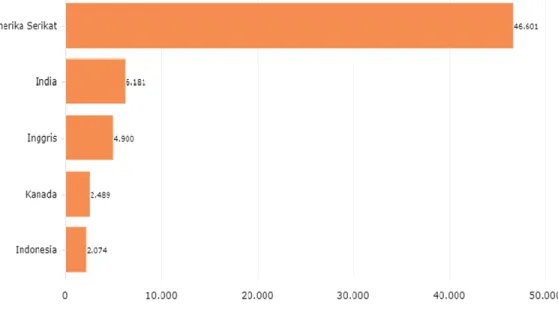
Based on the Startup Ranking website as of March 21, 2019, the number of Indonesian startups (technology-based startups) reached 2,074. The number puts Indonesia in the fifth position as the country with the most startups in the world. The country with the most
5
Published by Research & Innovation Initiative, 3112 Jarvis Ave, Warren, MI 48091, USAstartups is the United States, which reached more than 46 thousand. Then followed by India having 6,181 startups, then Britain totaling 4,909, and Canada with 2,489 startups.
Fig. 1: Five Countries with the most startups in the World, 2019
Source: Startup Ranking (2019)
The best startup in the world according to startup ranking is Medium. An American site that provides reading, writing, and ideas for everyone gets a score of 90 and 91. Meanwhile, the best startup from Indonesia is Bukalapak with a score of 87.71 and is ranked 18th in the world today (see Figure 1). For example, there are initiatives from government and non-government organizations to promote a business. There are also educational institutions that are intended for exclusive entrepreneurship education, such as in India. However, the outcome which is an entrepreneurial conversion rate is very low, because risk and family background are the limiting factors (Senthamil, 2020).
Apart from payment, credit and loan issuance are other core functions of the modern financial system. However, its weakness is that traditional banking services are inadequate for many segments of society (Chen & Sergi, 2018). The problem is that not all MSMEs can meet so many requirements that are proposed for obtaining loans to the lack of credit for small and medium enterprises. Since its appearance, FinTech has disrupted the traditional lending market. More efficient and economical services are offered, generating growth opportunities for the most promising segments, such as the credit industry. In this case, the service provided by FinTech is not only an innovation but also inclusion. Attractive services are an alternative for those who need fast and cheap financing for company maintenance, which as a result will result in increased expectations for the survival rates of micro and small businesses (Pinochet et al., 2019).
The FinTech loan platform, which was first created around the financial crisis, has
developed rapidly. They are often referred to as crowdfunding, marketplace loans (MPL), or peer-to-peer (P2P) loans (Jigtiani & Jhon, 2018). Peer to peer lending is a marketplace,
6
Published by Research & Innovation Initiative, 3112 Jarvis Ave, Warren, MI 48091, USAvirtual e-commerce space, which offers loans rather than products. As a form of financial disintermediation, disruptive technology driven by the internet, economic collaboration, or even as a platform that provides loans to people who are excluded from the traditional system, P2P presents the potential to solve the problems of formal lending markets, such as credit rationing, lack of financing or even obtaining financing. at a high level due to a lack of supply (Pinochet et al., 2019).
Unlike traditional lenders, FinTech lenders utilize large data and complex alternative data to make fast (almost instantaneous) credit decisions. FinTech lenders have joined the shadow banking sector in offering banking and other financial services, pro viding convenience and services that are faster than traditional companies without having to comply with the same regulations as traditional companies. FinTech lenders have provided challenges as well as challenges for traditional financial institutions an d consumer opportunities (Jigtiani & Jhon, 2018).
OJK Regulation Number 77 the Year 2016 which contains digital-based loan services regulates how the loan mechanism is between the borrower and the loan provider. At least, there are several points listed in the regulation including the mechanism of recording and registration, monitoring and supervision, the establishment of a lending ecosystem, security, and sanctions.
There are several utilities offered by FinTech with loans offered including the perception of convenience concerning credit services, transactional distance, privacy, trust, social influence, and innovation (Pinochet et al., 2019).
One of the core functions of traditional financial institutions is to facilitate payments. Banks as financial institutions have become intermediary payment agents between payers and payees. However, along with the development of the payment system needs through traditional banks are notoriously slow, inefficient, and expensive.
Today's consumers will prefer the convenience of doing all transactions, such as in the digital market. In the digital market, which is supported by smartphones where so many business transactions including transactions carried out by MSMEs are done via smartphones, such as payment transactions, investments, or online purchases. Smartphones have become a front-end device for digital markets where customers, suppliers, and investors conduct business transactions directly or indirectly and are also used as a tool to manage business remotely (Ansari et al., 2018). Because of the large number of business transactions carried out with smartphones, business organizations should embrace cellular technology by developing cellular business platforms. The digital market as a platform acts as a business intermediary that connects all business people. Digital payment is one solution to the inefficiency of payment systems through traditional banks. Through digital payments provided by FinTech companies business transaction processes become faster, safer, and easier for business people. The superiority of the digital transaction process will be able to attract more consumers to provide business benefits for MSMEs players.
7
Published by Research & Innovation Initiative, 3112 Jarvis Ave, Warren, MI 48091, USAChen (2018) in his research stated that in China, AliPay as a payment service launched by e-commerce giant (Alibaba), which was launched in 2012 has attracted 451 million active users and has around 153 million daily transfer actions. According to a recent report by the Alibaba Group, many Chinese do not have access to banking services, AliPay al lows them to buy goods or services for the first time without using cash. In India, a similar service PayTM has been launched and has developed a similar service. Founded in 2010, the company received a large capital injection from the Alibaba group at the beginning of its operation. Indian society has relied heavily on cash transactions, which are plagued by counterfeiting and taxes. With PayTM, even rickshaws in the country can be paid electronically, practically, and cell phones are the main banking tool for the average large number of Indians.
Seamless transactions refer to benefits related to transactions using FinTech (for example payment transactions). A smooth transaction process is an important characteristic of FinTech transactions that eliminates traditional financial institutions in the financial process. This allows users to manage transactions on a platform that is cost -effective, simple, and fast. Furthermore, financial providers (ie, IT companies) can create and offer something new, innovative, and customer-friendly in financial services to users. They directly provide products and services through unlimited transactions. The seamless transaction induces that FinTech companies can develop new and innovative financial products and services to compete with traditional financial institutions (Ryu, 2017).
FinTech has the potential to benefit underserved consumers worldwide. The existence of benefits provided such as completing the financial transaction chain. This can be a golden opportunity for MSMEs business people who use FinTech in the process of payment transactions with consumers because it can increase the purchasing power of the community for MSMEs products.
5. Conclusions
This study illustrates how the service of financial technology for the survival of MSMEs. There are two facilities offered by FinTech for MSMEs in Indonesia, namely the ease of obtaining loans and the ease of doing business transactions (payments). The loan services provided by FinTech are not only an innovation but also inclusion. Attractive services are an alternative for those who need fast and inexpensive financing for company maintenance, which as a result will lead to increased expectations for the survival rate of MSMEs.
In payment transactions, FinTech can provide convenience, innovation, security, cost-effective, simple, and fast for both sellers and buyers with its services. They directly provide products and services through unlimited transactions. FinTech has the potential to benefit underserved consumers worldwide. The existence of benefits provided such as completing the financial transaction chain. This can be a golden opportunity for MSMEs business people who use FinTech in the process of payment transactions with consumers because it can increase the purchasing power of the community for MSMEs products. For additional information,
8
Published by Research & Innovation Initiative, 3112 Jarvis Ave, Warren, MI 48091, USAcommunication, learning, entrepreneurship, and technical skills are significant skills needed by entrepreneurs for their sustainability.
Acknowledgements: The authors owe deeply to Prof. Dr. Hj. Syarifah Hudayah, SE, M.Si (Dekan Fakultas Ekonomi dan Bisnis, Universitas Mulawarman) dan Drs. H. Muhammad Lutfi, ASK, M.T (Head of Sekolah Tinggi Ilmu Ekonomi Samarinda) for motivation and funding for carrying out this research.
Author Contributions: Dirga Lestari conceived the idea and collected data; Muliadi Muliadi analyzed the data; Dio Caisar Darma wrote the paper,communication with journal publishers, and dealing with article revisions.
Conflict of interest: The authors declare no conflict of interest.
REFERENCES
Addotei, C. (2012). The challenges of Financing Small and Medium Scale Enterprises (SMEs) in the Ashanti Region:
A Case study of Stanbic Bank (GH) Ltd. Thesis. Institute of Distance Learning, Kwame Nkrumah University
of Science and Technology. http://hdl.handle.net/123456789/4292
Anshari, M., Almunawar, M., Masri, M., & Hamdan, M. (2019). Digital Marketplace and FinTech to Support
Agriculture Sustainability. Energy Procedia, 156, 234-238. https://doi.org/10.1016/j.egypro.2018.11.134
Anonymous. (2019). Startup Rangking. Retrieved from https://www.startupranking.com/countries. [Accessed April
27, 2020].
Asian Development Bank. (2015). Asia SME Finance Monitor 2014. Cataloging-In-Publication Data. Mandaluyong
City, Philippines: Asian Development Bank. https://www.adb.org/sites/default/files/publication/173205/asia-sme-finance-monitor2014.pdf
Bogdan, R. C., & Taylor, S. J. (1992). Introduction to Qualitative Research Methotds: A Phenomenological Approach
in the Social Sciences. In: Furchan, A (John Wiley & Sons). Surabaya: Usaha Nasional.
Chen, K. (2018). Financial Innovation and Technology Firms: A Smart New World with Machines. Banking and
Finance Issues in Emerging Market, 25, 279-292. https://doi.org/10.1108/S1571-038620180000025012
Chen, K., & Sergi, B. S. (2018). How Can FinTech Impact Russia’s Development?. Exploring the Future of Russia’s
Economy and Markets. Emerald Publishing Limited, 1-11. https://doi.org/10.1108/978-1-78769-397-520181001
Dorfleitner, G., Hornuf, L., Schmitt, M., & Weber, M. (2017). Definition of FinTech and Description of the FinTech
Industry. In: FinTech in Germany. Springer, Cham. https://doi.org/10.1007/978-3-319-54666-7_2
Delone, W. H., & McLean, E. R. (1992). Information Systems Success: The Quest for the Dependent Variable. Journal
of Management Information Systems 3(4), 60-95. https://doi.org/10.1287/isre.3.1.60
Gutierrez, A. P., Yáñez, J. M., Fukui, S., Swift, B., & Davidson, W. S. (2015). Genome-wide association study
(GWAS) for growth rate and age at sexual maturation in atlantic salmon (salmo salar). PLoS ONE, 10(3),
e0119730. https://doi.org/10.1371/journal.pone.0119730
Hsueh, S., & Kuo, H. (2017). Effective Matching for P2P Lending by Mining Strong Association Rules. ICIBE 2017:
Proceedings of the 3rd International Conference on Industrial and Business Engineering. August, 2017, 30–33. https://doi.org/10.1145/3133811.3133823
Hwarire, C. (2012). Loan Repayment and Credit Management of Small Businesses: A Case Study of a South African
Commercial Bank. A Paper Presented at the African Development Finance Workshop, 7-8 August 2012. Cape Town,
South Africa. https://www.econrsa.org/system/files/workshops/presentations/2012/hwarire-loan-repayment-presentation.pdf
Jigtiani, J., & Jhon, K. (2018). FinTech: The Impact on Consumers and Regulatory Response. Journal of Economics and
9
Published by Research & Innovation Initiative, 3112 Jarvis Ave, Warren, MI 48091, USAJuwita, V. (2016). Pemanfaatan Sistem Informasi Akuntansi pada Usaha Mikro, Kecil, dan Menengah (UMKM)
Sektor Jasa Perdagangan di Padang, Sumatera Barat. Jurnal Riset Akutansi Terpadu, 9(1), 120-137.
http://dx.doi.org/10.35448/jrat.v9i1.4291
Milian, E. Z,, Spinola, M. M., & Calvalho, M. M. (2019). Fintechs: A Literature Review and Research Agenda.
Electronic Commerce Research and Aplication, 34, 39100833. http://dx.doi.org/10.1016/j.elerap.2019.100833
Ministry of Communication and Information of the Republic of Indonesia (2017). Go Digital! Gerakan Nasional
UMKM Go Online. https://kominfo.go.id/content/detail/11346/siaran-pers-no-216hmkominfo112017-tentang-go-digital-gerakan-nasional-umkm-go-online/0/siaran_pers. [Accessed March 18, 2020].
Moleong, L. J. (2010). Metodologi Penelitian Kualitatif. Bandung: Remaja Rosdakarya.
Murdick, R. G., Ross, J. E., & Claggett, J. R. (1993). Sistem Informasi Untuk Manajemen Modern. Jakarta: Erlangga.
Naidu, S., & Chand, A. (2012). A comparative study of the financial problems faced by micro, small and medium
enterprises in the manufacturing sector of Fiji and Tonga. International Journal of Emerging Markets, 7(3),
245-262. https://doi.org/10.1108/17468801211236974
Nazir, M. (2011). Metode Penelitian. Jakarta: Ghalia Indonesia.
Pinochet, L., Diogo, G., Lopes, E., Herrero, E., & Bueno, R. (2019). Propensity of contracting loans services from
FinTech’s in Brazil. International Journal of Bank Marketing, 37(5), 1190-1214.
https://doi.org/10.1108/IJBM-07-2018-0174
Prasetyo, A. (2017). UMKM Sumber Ekonomi Baru Indonesia.
http://mediaindonesia.com/news/read/118207/umkm-sumber-ekonomi-baru-indonesia/2017-08-18. [Accessed April 25, 2020].
Ryu, H. (2018). What makes users willing or hesitant to use Fintech?: the moderating effect of user type. Industrial
Management & Data Systems, 118(3), 541-569. https://doi.org/10.1108/IMDS-07-2017-0325
Seddon, P. B. (1997). A Respecification and Extension of the DeLone and McLean Model of IS Success. Journal of
Information Systems Research, 8(3), 240-253. http://dx.doi.org/10.1287/isre.8.3.240
Senthamil, D. R. (2020). Do Management Students have Entrepreneurial Intentions? An Institutional Case Study.
International Journal of Disaster Recovery and Business Continuity, 11(1), 920-925.
Sumathy, M., & Velmurugan, R. (2020). Skill Sets for Rural Entrepreneurs Sustainability in Central District of
Tamilnadu. International Journal of Disaster Recovery and Business Continuity, 10, 75 -80.
Sutarmin, S., & Susanto, A. (2017). Potensi Pengembangan Transaksi Non Tunai di Indonesia. Sustainable
Competitive Advantage, 7, 292-302.
Venkateswaran., A., & Sundaramoorthy, S. (2020). The Impact of Social Media Marketingtrends on Digital
Marketing. International Journal of Disaster Recovery and Business Continuity, 11(1), 985-990.
© 2020 by the authors. Licensee Research & Innovation Initiative, Michigan, USA. This article is
an open-access article distributed under the terms and conditions of the Creative Commons Attribution (CC BY) license (http://creativecommons.org/licenses/by/4.0/).