Brain-Computer Interface: A Review
.
White Rose Research Online URL for this paper:
http://eprints.whiterose.ac.uk/164887/
Version: Accepted Version
Article:
Zhang, Y, Xie, SQ, Wang, H et al. (2 more authors) (2020) Data Analytics in Steady-State
Visual Evoked Potential-based Brain-Computer Interface: A Review. IEEE Sensors
Journal. ISSN 1530-437X
https://doi.org/10.1109/JSEN.2020.3017491
© 2020 IEEE. Personal use of this material is permitted. Permission from IEEE must be
obtained for all other uses, in any current or future media, including reprinting/republishing
this material for advertising or promotional purposes, creating new collective works, for
resale or redistribution to servers or lists, or reuse of any copyrighted component of this
work in other works. Uploaded in accordance with the publisher's self-archiving policy.
[email protected] https://eprints.whiterose.ac.uk/ Reuse
Items deposited in White Rose Research Online are protected by copyright, with all rights reserved unless indicated otherwise. They may be downloaded and/or printed for private study, or other acts as permitted by national copyright laws. The publisher or other rights holders may allow further reproduction and re-use of the full text version. This is indicated by the licence information on the White Rose Research Online record for the item.
Takedown
If you consider content in White Rose Research Online to be in breach of UK law, please notify us by
Data Analytics in Steady-State Visual Evoked
Potential-based Brain-Computer Interface: A Review
Yue Zhang, Shane Xie,
Senior Member, IEEE
, He Wang,
Member, IEEE
, Zhiqiang Zhang,
Member, IEEE
Abstract—Electroencephalograph (EEG) has been widely ap-plied for brain-computer interface (BCI) which enables paralyzed people to directly communicate with and control of external devices, due to its portability, high temporal resolution, ease of use and low cost. Of various EEG paradigms, steady-state visual evoked potential (SSVEP)-based BCI system which uses multiple visual stimuli (such as LEDs or boxes on a computer screen) flickering at different frequencies has been widely explored in the past decades due to its fast communication rate and high signal-to-noise ratio. In this paper, we review the current research in SSVEP-based BCI, focusing on the data analytics that enables continuous, accurate detection of SSVEPs and thus high infor-mation transfer rate. The main technical challenges, including signal pre-processing, spectrum analysis, signal decomposition, spatial filtering in particular canonical correlation analysis and its variations, and classification techniques are described in this paper. Research challenges and opportunities in spontaneous brain activities, mental fatigue, transfer learning as well as hybrid BCI are also discussed.
Index Terms—Brain-computer interface (BCI), steady state visual evoked potential (SSVEP), healthcare application, data analytics, canonical correlation analysis.
I. INTRODUCTION
Brain-computer interface (BCI) is a communication system that enables paralyzed people to directly communicate with and control of external devices without body movement via analysing the user’s brain activities [1], [2], and it has been widely explored in the past years, as illustrated by the fast increment of the numbers of BCI related publications in the Fig. 1. There are a wide variety of applications of BCI systems, ranging from wheelchairs, robot and prosthetic arms control to character spelling, games and entertainment [3]–[5].
BCI systems normally rely on different modalities of functional neuro-imaging, such as electroencephalography (EEG) [7], functional near-infrared spectroscopy (fNIRS) [8], functional magnetic resonance imaging (fMRI) [9], and mag-netoencephalography (MEG) [10]. Among the various modal-ities, EEG is the most commonly employed one due to its portability, high temporal resolution, ease of use and low cost
This work was supported in part by Engineering and Physical Sciences Research Council (EPSRC) (Grant No. EP/S019219/1) and in part by China Scholarship Council (CSC) (Grant No. 201906460007). (Corresponding au-thor: Yue Zhang)
Yue Zhang and Zhiqiang Zhang are with Institute of Robotics, Au-tonomous System and Sensing, School of Electrical and Electronic Engi-neering, University of Leeds, LS2 9JT, UK. (e-mail: [email protected]; [email protected]). Shane Xie is with the School of Electronic and Elec-trical Engineering, University of Leeds, Leeds LS2 9JT, UK, and collaborates with the Institute of Rehabilitation Engineering, Binzhou Medical University, Yantai, China (email: [email protected]). He Wang is with School of Com-puting, University of Leeds, LS2 9JT, UK. (email:[email protected]).
Figure 1. Cumulative number of publications referring to BCI indexed by IEEE Xplore, Web of Science, PubMed and Scopus, and it is obvious the research on BCI is increasing year by year.
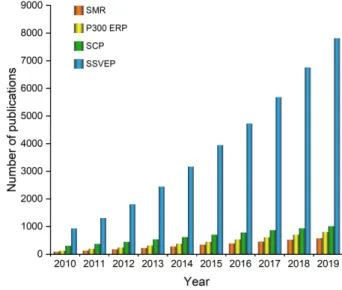
Figure 2. Distribution of published papers in subareas of EEG-based BCI systems.
[11]–[14], as shown in the Table. I. Four typical paradigms in the EEG signal, namely P300 event related potential (ERP), slow cortical potential (SCP), sensorimotor rhythms (SMR), and steady-state visual evoked potential (SSVEP) are used to analyse brain activities [15], and Fig. 2 outlines a rapid surge of interest in EEG-based BCI in recent years in terms of the number of publications using different type of paradigms.
Table I
THE COMPARISON OFEEGAND THE OTHER NEURO IMAGING TECHNIQUES
Neuro imaging techniques SSVEP P300 ERPEEG SMR SCP fNIRS fMRI MEG
ITR (bits/min) 24.7∼325.33 4.47∼20.1 4.47∼17 N.A 3.18∼8.23 ∼5 13.1∼19.6
SNR(dB) 8.97∼25 0.87∼8.18 -16∼5 17.5∼42.8 26.48∼31.93 1.07∼161.2 2∼35
Temporal resolution millisecond millisecond second millisecond
Spatial resolution centimeter millimeter millimeter millimeter
Cost low moderate high very high
(a) Scheme of the experimental paradigm.
(b) Stimulus design of the 40-target BCI system.
Figure 3. The redraw of the experimental paradigm and stimulus design in [6], which represented the setting for one of the highest numbers of stimuli.
It is obvious that SSVEP-based BCI has received extensive research interests in the past decades due to its fast commu-nication rate and high signal-to-noise ratio (SNR).
The SSVEP-based BCI usually utilizes several visual os-cillating stimuli, such as LEDs or boxes on a computer screen, which are generally modulated at different frequencies and phases [16], [17]. A typical experimental paradigm of a SSVEP-based BCI system generally contains M blocks each containing N trials corresponding to N visual stimuli which flicker at a random order. For example, Fig. 3(a) shows a typical stimulated experiment in [6], which represented the setting for one of the highest numbers of stimuli. The user interface is a 5×8 matrix of visual stimuli including 40 targets
which were modulated by linearly increasing frequencies and phases, as shown in Fig. 3(b). In each experimental block, subjects were required to gaze at each visual stimulus for 0.5 s, and completed 40 trials corresponding to all 40 targets. Each trial began with a 0.5 s visual cue that shows the target stimulus produced by the stimulus program. During the target cue period, users were required to shift their attention to the
flickering target on the screen as quickly as possible. The subjects rested for a few minutes between two consecutive blocks to relieve visual and mental fatigue. Besides, to de-crease artifacts generated by eye movements, subjects should avoid eye blinks during the experimental period. SSVEPs are periodic neural responses generated in occipital scalp areas of the brain, and the stimulus frequency will determine the response frequency content, which contains activities not only at the stimulus frequency but also at its higher harmonics [18]. Signal processing algorithms are applied to analyze the charac-teristics of SSVEP responses and identify the subject’s intent to control the peripheral equipment. As a result, subjects can output desired commands by gazing at different target stimuli sequentially [16].
Recent surveys of the BCI system used in computer in-terface spellers [19] [20], and hybrid BCI [21] [22] have signified the importance of SSVEP-based technologies. These surveys focus mainly on the various applications of SSVEP rather than its technical novelty and challenges. In other surveys, Zhuet al. [23] reported the different repetitive visual stimulus choices in terms of rendering devices, properties (e.g., frequency, color), and their potential effects on BCI performance, user comfort and safety. Zerafa et al. [24] compared the different training requirements of feature extrac-tion methods for SSVEP-based BCIs. They divided SSVEP feature extraction methods into three categories according to training requirements, namely training-free, subject-specific and subject-independent training approaches. Different to pre-vious surveys, this review focuses on technical challenges and developments in SSVEP data analytics including signal pre-processing, spectrum analysis, signal decomposition, spa-tial filtering in particular canonical correlation analysis and its variations, and classification techniques. Three databases, Google Scholar, IEEE Xplore and Web of Science, were used for the literature search. A combination of keywords, such as BCI, SSVEP, classification, spatial filtering and canonical correlation analysis, were used as search terms. Publications from 2010-2020 were preferred, but this range was extended in some cases.
The remainder of this paper is organized as follows. Section II briefly introduces the typical healthcare applications of SSVEP-based BCI system. Data analytics and signal pro-cessing algorithms for SSVEP identification are detailed in Section III. Section IV presents some new emerging challenges and opportunities of SSVEP. Discussion and conclusion are provided in Section V and VI.
II. HEALTHCAREAPPLICATIONS
In this section, we will use healthcare as the exemplar to illustrate SSVEP-based BCI systems’ wide spectrum of applications. Clinically, SSVEP-based BCI systems have been applied for diagnosis of various diseases and health issues, such as migraine [25], autism [26], cognitive aging [27], as well as the abnormal nervous system in patients with bipolar disorder [28] and schizophrenia [29], via comparing differences between the patients and healthy people on certain physiological indexes such as brain complexity described by inherent fuzzy entropy and the amplitude/power of SSVEP responses, when they look at certain visual stimuli. In addition to the diagnostic applications, the SSVEP-based BCI systems also show great potential in providing commands to control rehabilitation or assistive devices for people with disability. For patients with impaired mobility, restoring their lost abil-ities, or at least helping them adapt to suffered disabilabil-ities, is essential for them to live with dignity. The SSVEP-based BCI system can output the patient’s desired commands and control the external devices, which can thus restore/rebuild the function of damaged muscles to efficiently accelerate the rehabilitation procedure. For instance, the operation process for rehabilitation is that BCI system analyses the SSVEP responses generated from the scalp when the user looks at different visual stimuli. Then, intentions are translated into various commands to trigger the peripheral devices, e.g. upper extremity rehabilitation [30], ankle rehabilitation robot [31], which can stimulate impaired muscles to perform more precise motion tasks that the patient cannot perform on his/her own. Assistance applications have the same working principle with rehabilitation equipment, but their output commands are used to control aided peripheral experiment like wheelchair [4], speller [5] or meal assistance robot [32].
SSVEP-based BCI systems also have made pragmatic progress in the smart home scenarios, which provides disabled people more direct interactions with the environment. It performs mainly in two aspects, controlling household appliances and undertaking housework. SSVEP-based BCI offers people the possibility to recognize various commands and control corresponding devices in their houses by watching different stimuli [33]. By means of the quick response technology QR code, Abdul et al. [34] designed an augmented reality smart glasses to control items in the environment, such as lights, coffee machines and elevators, by focusing on different SSVEP stimuli displayed on the glasses. Similarly, based on SSVEP-based BCI technology, a hand-free control smart home has been created in [35], which can control six devices. The SSVEP-based BCI system also assists in reducing domestic pressure and improving home conditions by helping people accomplish heavy housework. Shao et al. [36] designed a novel EEG-based intelligent teleoperation system for a mobile wall-crawling cleaning robot, which uses the crawler type instead of the traditional wheel type for window or floor cleaning. The developments of SSVEP-based BCI in smart environment field may offer the prospect of greatly improving the quality of life for disabled people out clinics, and considerably increase their
independence, autonomy, mobility, and ability, which also leads to reduced social costs.
III. DATAANALYTICS FORSSVEP IDENTIFICATION
The data analytics of a standard SSVEP-based BCI system generally includes signal pre-processing and SSVEP recogni-tion. The purpose of signal pre-processing is to improve the quality of EEG signals by removing background noises, while the SSVEP recognition is to make the characteristics contained in the SSVEP responses emerge and then use them to identify the stimuli. In this section, we will elaborate on the details of signal pre-processing and SSVEP recognition.
A. Signal pre-processing
The EEG potentials gathered by electrodes are coming from the brain, which can be easily contaminated by muscles acti-vation, eyes movement and external artifacts [37]. Therefore, it is necessary to pre-process the raw EEG signal to achieve higher SNR before the SSVEP recognition step. Thus far, there are mainly two types of pre-processing method: filtering and blind source separation (BSS).
Band pass and notch filter are the most common pre-processing filtering to remove the noises (i.e., eye move-ment, head movemove-ment, power noise) whose frequencies are not overlapped with SSVEP responses. The band pass is utilized to retain the pertinent parts of the EEG signal, which correspond to the stimulation frequencies as well as harmonics. The SSVEP signal is divided into different frequency bands, and just the sub-band signal in the given frequency can be collected. Many works about SSVEP-based BCI have adopted band pass as the signal pre-processing algorithm, such as [6], [18], [38]. In most countries, the frequency of power frequency interference is commonly concentrated near 50 Hz or 60 Hz [39], [40]. The notch filter is utilized to eliminate power line interference, but it is prone to induce waveform distortion [40]. Besides, these time-domain filtering methods require that the correlated and uncorrelated signals are in different frequency bands, which are not suitable for overlapping.
BSS is a popular way to enhance SSVEP responses if the frequency range of some artifacts (i.e., EMG) and the EEG overlap to a high degree. The BSS represents a group of methods that recover underlying useful signals and reject harmful artifacts through exploring the statistical indepen-dent criteria [41], [42]. For example, indepenindepen-dent component analysis (ICA) returns independent sources which form the measured EEG signal under the assumption that they are linearly mixed [41]. Therefore, it is flexible to reconstruct the EEG signal with non-artifact components to improve the quality of signals, thus enhance the stimulation frequency identification accuracy [43].
B. SSVEP recognition and classification
SSVEP-based BCIs are generally divided into two typical classes, named frequency-coding and phase-coding, decided by the modulation procedure and feature variable employed
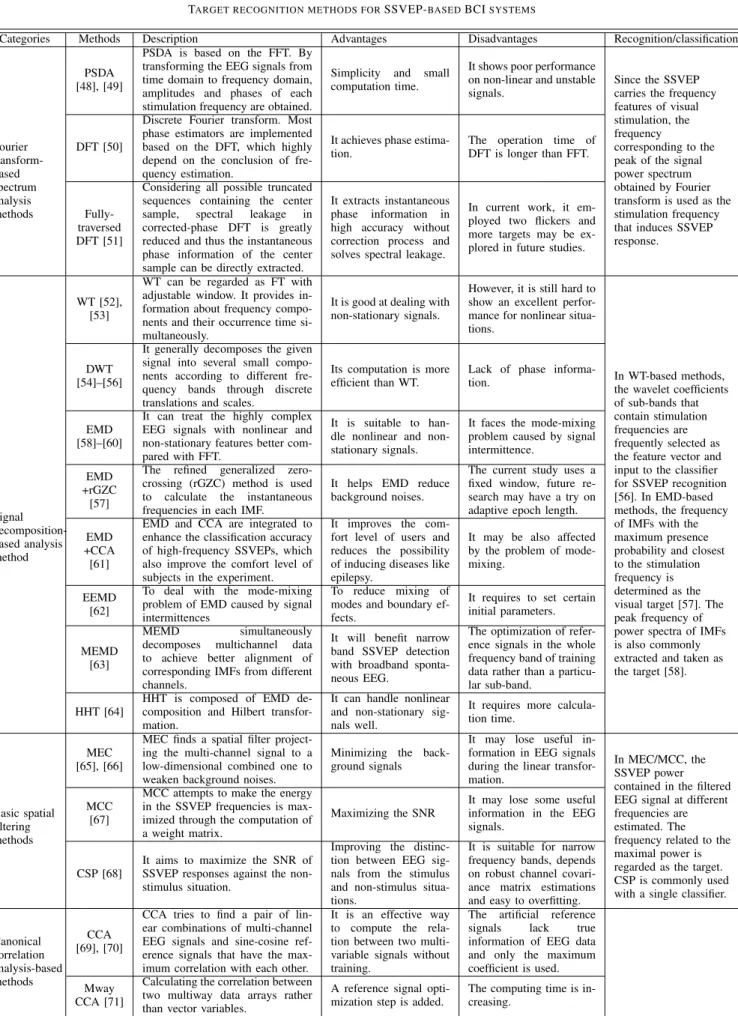
for classification [39]. Frequency coding system, which has the same number of stimuli and targets, uses visual stimuli with different frequencies and then examines the spectral peaks in the recorded spectrum for recognizing targets [44], [45]. Phase coding systems, designing visual stimuli with the same frequency but different phases, compare phase lags between SSVEP responses and reference ones to detect gazed target [46], [47]. Thus far, the frequency coding is often combined with phase coding to generate a high number of commands. Recognizing the frequency and phase of the SSVEP with superior accuracy in a short time window (TW) is the main task for exploiting high performance BCI sys-tems. Many frequently used SSVEP recognition algorithms, such as Fourier transform-based spectrum analysis, signal decomposition-based analytics, basic spatial filtering methods and CCA-based methods are all reported in this subsection. The advantages and disadvantages of most techniques are also discussed, as shown in the Table. II. Moreover, many classifiers utilized in the context of SSVEP identification are also presented in this subsection.
1) Fourier transform-based spectrum analysis methods:
The simplest detection approach for SSVEP-based BCIs is power spectral density analysis (PSDA) which is based on the fast Fourier transform (FFT). By transforming the time domain EEG signals to frequency domain, amplitudes and phases information of each stimulation frequency are obtained for further target identification procedure [86]. Many works [48], [49] about SSVEP-based BCIs employ Fourier transform due to its small computation time and simplicity. Estimating the phase of EEG signals is another fundamental issue of SSVEP-based BCI systems. Currently, most phase estimators are implemented based on the discrete Fourier transform (DFT), which highly depend on the conclusion of frequency estimation [87]. Many efforts are dedicated to compensating above drawback, such as the work based on energy [88] or based on interpolated FFT [89]. However, they all fail to remove the bias produced by frequency acquisition, which will bring uncertainty to the phase estimation [90]. To solve this limitation, Huang et al. [51] present a novel idea to estimate phases based on fully-traversed DFT which enables consider-ing all possible truncated DFT spectra to achieve direct phase extraction and extracts instantaneous phase information in high accuracy without any correction process.
Most current Fourier-based analysis methods require a long window length to obtain a sufficiently high frequency resolution. Moreover, when DFT is used to estimate phase information, the data length needs to contain an integer number of cycles, which may limit practical applications. Furthermore, the magnitude and distribution of SSVEPs are quite different across subjects, leading to the problem that PSDA is not robust to real-time BCIs [91]. Some efforts attempt to solve this issue by optimizing parameter, such as electrode and time length selection [92], [93], which may increase the additional work. The FFT is a linear method based on a predefined basis function, which generally requires an assumption of stationary, so it is unable to treat the highly complex EEG signals with nonlinear and non-stationary features well [63].
The Fourier transform-based methods normally achieve
stimulus target recognition utilizing spectrum. To be specific, since the SSVEP carries the frequency characteristics of visual stimulation, the frequency corresponding to the peak of the signal power spectrum obtained by Fourier transform is deter-mined as the stimulation frequency that induces the SSVEP response.
2) Signal decomposition-based analysis methods: Wavelet transform (WT) can be regarded as FT with adjustable window [52], which is good at dealing with non-stationary signals like SSVEP responses. WT has gained many focuses due to its ability to provide the information about frequency components presented in the signal, and their occurrence time simultane-ously. For example, Rejeret al. [53] employed wavelet analy-sis to detect both frequency and time information of SSVEP re-sponses through translation and dilation of the mother wavelet. In many practical application scenarios, the discrete wavelet transform (DWT) that uses discrete translations and scales is generally employed to decompose the given signal into several small components according to different frequency bands, and then components with corresponding frequencies will be extracted for further analysis [54], [55], [63]. In WT-based methods, the wavelet coefficients of sub-bands that contain stimulation frequencies are frequently selected as the feature vector and input to the classifier for SSVEP recognition [56]. WT shows high quality in processing non-stationary signals, but it is still hard to demonstrate excellent performance for highly complex SSVEPs which show nonlinear dynamics and chaos.
Huang [59] proposed the idea of Hilbert-Huang transform (HHT), including Empirical mode decomposition (EMD) and Hilbert transform (HT). EMD as a nonlinear technique is appropriate to process dynamic and complicated signals. EMD enables to adaptively decompose signals into a group of intrinsic mode functions (IMFs) which show oscillation feature in the non-stationary signals [39], satisfying the requirements of HT. Besides, IMFs are analytical, self-constructed and well-defined functions with time-varying amplitudes and frequen-cies, indicating that EMD is an entirely data-driven approach because it is based on original features of the signal [60].
Currently, many studies have employed EMD successfully to achieve frequency recognition and enhance classification accuracy in SSVEP-based BCIs, such as [57] and [61]. Besides, ensemble empirical mode decomposition (EEMD) was employed to deal with the mode-mixing problem caused by signal intermittences [62]. Considering another obstacle in EMD technique named mode misalignment in multiple-channel decompositions, Chenet al. [63] proposed multivari-ate empirical mode decomposition (MEMD) to better align the corresponding IMFs of multi-channel signals. Compared with FFT and WT, HHT has better universality to handle nonlinear and non-stationary signals. It not only absorbs the advantages of multi-resolution of WT but also overcomes the difficulty of selecting an appropriate wavelet base which is a key issue of wavelet analysis. However, HHT requires complicated calculations, thus the calculation time is increased.
In the EMD-based methods, target identification requires further analysis of IMFs. In [57], SSVEP-related IMFs are selected through calculating the instantaneous frequency, and
Table II
TARGET RECOGNITION METHODS FORSSVEP-BASEDBCISYSTEMS
Categories Methods Description Advantages Disadvantages Recognition/classification
PSDA [48], [49]
PSDA is based on the FFT. By transforming the EEG signals from time domain to frequency domain, amplitudes and phases of each stimulation frequency are obtained.
Simplicity and small computation time.
It shows poor performance on non-linear and unstable signals.
Since the SSVEP carries the frequency features of visual stimulation, the frequency
corresponding to the peak of the signal power spectrum obtained by Fourier transform is used as the stimulation frequency that induces SSVEP response. Fourier transform-based spectrum analysis methods DFT [50]
Discrete Fourier transform. Most phase estimators are implemented based on the DFT, which highly depend on the conclusion of fre-quency estimation.
It achieves phase estima-tion.
The operation time of DFT is longer than FFT.
Fully-traversed DFT [51]
Considering all possible truncated sequences containing the center sample, spectral leakage in corrected-phase DFT is greatly reduced and thus the instantaneous phase information of the center sample can be directly extracted.
It extracts instantaneous phase information in high accuracy without correction process and solves spectral leakage.
In current work, it em-ployed two flickers and more targets may be ex-plored in future studies.
WT [52], [53]
WT can be regarded as FT with adjustable window. It provides in-formation about frequency compo-nents and their occurrence time si-multaneously.
It is good at dealing with non-stationary signals.
However, it is still hard to show an excellent perfor-mance for nonlinear situa-tions.
DWT [54]–[56]
It generally decomposes the given signal into several small compo-nents according to different fre-quency bands through discrete translations and scales.
Its computation is more efficient than WT.
Lack of phase
informa-tion. In WT-based methods,
the wavelet coefficients of sub-bands that contain stimulation frequencies are frequently selected as the feature vector and input to the classifier for SSVEP recognition [56]. In EMD-based methods, the frequency of IMFs with the maximum presence probability and closest to the stimulation frequency is determined as the visual target [57]. The peak frequency of power spectra of IMFs is also commonly extracted and taken as the target [58]. EMD
[58]–[60]
It can treat the highly complex EEG signals with nonlinear and non-stationary features better com-pared with FFT.
It is suitable to han-dle nonlinear and non-stationary signals.
It faces the mode-mixing problem caused by signal intermittence. Signal decomposition-based analysis method EMD +rGZC [57]
The refined generalized zero-crossing (rGZC) method is used to calculate the instantaneous frequencies in each IMF.
It helps EMD reduce background noises.
The current study uses a fixed window, future re-search may have a try on adaptive epoch length. EMD
+CCA [61]
EMD and CCA are integrated to enhance the classification accuracy of high-frequency SSVEPs, which also improve the comfort level of subjects in the experiment.
It improves the com-fort level of users and reduces the possibility of inducing diseases like epilepsy.
It may be also affected by the problem of mode-mixing.
EEMD [62]
To deal with the mode-mixing problem of EMD caused by signal intermittences
To reduce mixing of modes and boundary ef-fects.
It requires to set certain initial parameters.
MEMD [63]
MEMD simultaneously
decomposes multichannel data to achieve better alignment of corresponding IMFs from different channels.
It will benefit narrow band SSVEP detection with broadband sponta-neous EEG.
The optimization of refer-ence signals in the whole frequency band of training data rather than a particu-lar sub-band.
HHT [64]
HHT is composed of EMD de-composition and Hilbert transfor-mation.
It can handle nonlinear and non-stationary sig-nals well.
It requires more calcula-tion time.
MEC [65], [66]
MEC finds a spatial filter project-ing the multi-channel signal to a low-dimensional combined one to weaken background noises.
Minimizing the back-ground signals
It may lose useful in-formation in EEG signals during the linear transfor-mation.
In MEC/MCC, the SSVEP power contained in the filtered EEG signal at different frequencies are estimated. The frequency related to the maximal power is regarded as the target. CSP is commonly used with a single classifier. Basic spatial
filtering methods
MCC [67]
MCC attempts to make the energy in the SSVEP frequencies is max-imized through the computation of a weight matrix.
Maximizing the SNR
It may lose some useful information in the EEG signals.
CSP [68]
It aims to maximize the SNR of SSVEP responses against the non-stimulus situation.
Improving the distinc-tion between EEG sig-nals from the stimulus and non-stimulus situa-tions.
It is suitable for narrow frequency bands, depends on robust channel covari-ance matrix estimations and easy to overfitting.
Canonical correlation analysis-based methods CCA [69], [70]
CCA tries to find a pair of lin-ear combinations of multi-channel EEG signals and sine-cosine ref-erence signals that have the max-imum correlation with each other.
It is an effective way to compute the rela-tion between two multi-variable signals without training.
The artificial reference signals lack true information of EEG data and only the maximum coefficient is used. Mway
CCA [71]
Calculating the correlation between two multiway data arrays rather than vector variables.
A reference signal opti-mization step is added.
The computing time is in-creasing.
L1-Regularized
MCCA [72]
L1-regularization is implemented on trial-way array optimization of MwayCCA .
Removing obstruction trials.
The increase in computing time.
P-CCA [73]
The SSVEP response phases are estimated based on the physiologi-cally apparent latency.
SSVEP response phase is placed to the reference signal as a constraint.
It improves the standard CCA method in compli-cated ways that may be difficult to understand and implement in real practice. MsetCCA
[74]
MsetCCA extracts common fea-tures shared by the real EEG sig-nals to optimize reference sigsig-nals.
The performance are better than MwayCCA and CCA.
It may treat background noises as common fea-tures.
MCM [18]
In order to avoid extracting the background noise as common fea-tures, the MCM adopts superiori-ties of both CCA and MsetCCA.
It further improves SSVEP recognition accuracy by designing three-layer of correlation maximization steps.
It shows relative poor per-formance with a short time window.
Fuzzy ensemble
system [75]
The advantages and disadvantages of the MLR and MsetCCA are in-vestigated using expert knowledge, and the rules are developed for their strategic combination to im-prove the overall performance.
It can become 2.5% higher than the best re-sponse between these two methods in the best condition in detecting frequency.
A successful fuzzy ensem-ble system needs sufficient and correct expert infor-mation on the subsystem.
FBCCA [76]
It includes three major steps: filter bank analysis, CCA between sub-band components and sinusoidal reference signals, and target iden-tification.
It incorporates fundamental and harmonic frequency components together for target detection.
The reference signals are sine-cosine waves, which may need further improve-ment.
In the CCA-based methods, correlation coefficients can be calculated between a SSVEP response and reference signals at each stimulus frequency [18]. The frequency related to the maximal correlation coefficient is determined as the target. Canonical correlation analysis-based methods FBCCA +BF [77]
A combination of the training-free feature extraction capabilities of FBCCA with the accurate physio-logical representation capability of the spatiotemporal beamforming.
It can describe
the variational and individually different physiological SSVEP-based BCIs better.
The stimulation time ef-fects the experimental re-sults. Too long or too short stimulation time will cause ITR to become worse.
IT-CCA [78]
The reference signal is individ-ual template acquired by averaging multiple training trials.
It is proposed to de-tect temporal features of EEG signals.
The screen refresh rate in-fluences the system per-formance. A combi-nation method of CCA and IT-CCA [79], [80]
Three weight vectors are applied as spatial filters which form four correlation vectors as recognition features.
It alleviates the interfer-ence from spontaneous background EEG activi-ties by incorporating in-dividual SSVEP training data.
The ITCCA-based method requires precise time syn-chronization between a stimulation program and EEG recording.
KCCA [81], [82]
The kernel is applied to project the data to high-dimension space to solve the problem that CCA is infeasible for nonlinear relation ex-isting in the real signals.
Linear CCA-based
methods may be
insufficient given the complexity of EEG signals. KCCA provides a nonlinear method to solve the frequency detection problem.
How to choose the ap-propriate kernel is still a question worth thinking about.
DCCA [83]
In DCCA, deep networks are used to process input data before CCA procedure.
DCCA improves the performance of SSVEP-based BCI with higher SNR and detection accuracy compared to those of CCA.
DCCA only considers the nonlinear correlation between EEG signals and reference templates rather than the information within the real signals.
DMCCA [38]
It can extract more real informa-tion within the EEG signals than DCCA.
The DMCCA-based method effectively improves the accuracy at short time windows.
The background noises contained in the SSVEP are also nonlinear, which may be represented with real useful information by neural networks. CORRCA
[84], [85]
CORRCA can calculate same spa-tial filters for two multichannel sig-nals.
It remedies the limita-tion that standard CCA method requires spatial filters to be orthogonal.
It requires individual training data, which is cumbersome and time-consuming.
TRCA [6]
TRCA extracts task-related com-ponents efficiently by maximizing the reproducibility of time-locked activities across trials.
TRCA has the potential to eliminate the back-ground unrelated activi-ties from EEG.
It also needs training data, which might resort to the transfer learning method to obtain the spatial fil-ters with existing datasets from other subjects.
then the frequency with the maximum presence probability and closest to the stimulation frequency is determined as the visual target. Moreover, the power spectra of IMFs that contain stimulation frequencies are also used for SSVEP recognition. The peak frequency is commonly extracted and taken as the target [58]. In addition, the EMD can also combine with CCA where the IMFs contain almost all the energy are selected and input into CCA for SSVEP detection [61].
3) Basic spatial filtering methods: The combination of signals collected from different electrodes is called spatial filtering [39]. In the past few years, multi-channel-based frequency recognition methods have received much attention, because they overcome inter-subject variations which cannot be solved by single-channel SSVEPs [16], [69]. By optimizing the combination of data from multiple electrodes with less parameter optimizations, the algorithm’s anti-noise capability is greatly enhanced than unipolar or bipolar systems. Minimum energy combination (MEC) and maximum contrast combi-nation (MCC) are two common spatial filtering algorithms, but they have different objective functions. The core idea of MEC is to find a spatial filter that projects the original multi-channel signal to obtain a low-dimensional combined one in order to weaken the noise and other artifact signals [65], [66]. However, MCC approach attempts to make the energy in SSVEP frequencies maximized through computing a weight matrix [67]. Therefore, one advantage of spatial filters is computational time reduction by combining signal preprocessing and feature selection. For each reference signal, MEC or MCC can obtain a spatial filter which is applied over the original EEG data. And then the total SSVEP power contained in the cleaned EEG signal at each stimulation frequency is estimated. The target frequency should be the frequency of the reference signal that maximizes the SSVEP power [94].
Common spatial pattern (CSP) [68], [95] is another spatial filter to improve the distinction between EEG signals from stimulus and non-stimulus situations. There are two distri-butions in a C-dimensional space where C is the number of known channels, and CSP attempts to find projections minimizing the variance of one class but maximizing the variance of the other one. In SSVEP-based BCIs, it aims to maximize the SNR of SSVEP responses against the non-stimulus situation [68]. CSP as a spatial filtering method that enhances the SSVEP is generally combined with the sepa-rate feature extraction and classification steps to distinguish different stimulation frequencies [24]. For example, in [68], the amplitude estimations of the filtered SSVEPs at different stimuli were extracted and then linear discriminant analysis (LDA) performed classification task.
The above three spatial filters reduce artifacts and noise signals by extracting spatial features. However, for the algo-rithms based on MEC and MCC, performance may decrease due to some useful information contained in the signal also eliminated during the linear transformation.
4) Canonical correlation analysis-based methods: The canonical correlation analysis (CCA) method is used to find the relationship between two sets of data, which can be used as a feature extraction algorithm in SSVEP-based BCIs. The
CCA-based spatial filter, first presented by Lin et al. [69], has attracted many interests in recent years due to better SNR, higher recognition accuracy, well usage of harmonic frequencies, and lower inter-subject variability [24]. The CCA attempts to find a pair of linear combinations of the multi-channel signals and the artificial reference signals, generally sine and cosine waves, that have the correlation maximization at each stimulus frequency. Then, the frequency related to the maximal correlation coefficient is determined as the target [69], [70]. Nowadays, many improved CCA-based methods are proposed due to higher requirements of performance indexes such as SNR and ITR, or the drawbacks of CCA, e.g. the artificial reference signals lack true information of EEG data, and multi-channel signals are easily influenced by background noise such as spontaneous EEG.
a) Multiway canonical correlation analysis (MwayCCA):
Before introducing MwayCCA, the concept of tensor should be firstly referred. A tensor is a multiway array of data, and its order is the number of dimensions, also called models or ways [96]. Tensor CCA is a development of standard CCA, which concentrates on calculate the correlation between two multiway data arrays, rather than two sets of variables based on vector [97]. Based on this concept, MwayCCA optimizes the reference signals through maximizing the correlation between third-order EEG data tensor (channel × time × trial) and
pre-constituted sine-cosine reference signal matrix (harmonic
× time) [71]. Then, target frequency can be recognized by
applying multiple linear regression (MLR) or CCA between test EEG data and optimized reference signals [71]. In Mway-CCA, EEG tensor is constructed by multiple trials where some trials may contain more artifacts which generally have negative contribution to the reference signal optimization. Therefore, L1-regularization is implemented on trial-way array optimization of MwayCCA to remove obstruction trials [72]. MwayCCA and its variation add a reference signal optimiza-tion procedure, so that the reference signal is enriched with more real information of EEG signals, thereby improving the performance of standard CCA. The disadvantage is that the consequent increase in computing time.
b) Phase constrained canonical correlation analysis (p-CCA): Except the amplitude information, phases of SSVEPs are also important for improving target frequency detection accuracy [98], which have been used to add the number of visual stimuli. Wanget al. [17] provided a benchmark SSVEP dataset with a 40 targets BCI speller which was coded using a JFPM method.
In study [73], phase constrained CCA (p-CCA) is proposed for recognising the phase of SSVEP responses based on the apparent latencyLthat means the delay of SSVEP responses caused by the transfer time of visual pathway.L is fixed for a specific subject but unknown for all the stimulus frequencies [99] and it can be estimated using SSVEP phasesΦs, that is defined as the phase lag between the fundamental component and the closest prior stimulus [73]. Then Φs is calculated through the EEG training data of a subject, andLcan be solved through an exhaustive search process using the results ofΦs [24]. It is presented in [73] that for a specific subject, SSVEP response phases Φr are derived from the apparent latency L
and proportional to the different stimulus frequencies. Finally, Φr as a constraint condition is placed to the preconstructed sine-cosine reference signals which is further used for calcu-lating canonical correlation with test data.
The p-CCA optimizes the reference signal from the phase perspective, and can distinguish SSVEP responses of different phases at the same frequency, thereby increasing the diversity of visual stimulus coding. Therefore, compared with ordinary CCA, p-CCA is more universal and comprehensive.
c) Multiset canonical correlation analysis (MsetCCA):
The original constructed reference signals with sine-cosine waves are generally short of real information of EEG data, which go against SSVEP frequency recognition. Multiset canonical correlation analysis (MsetCCA), proposed by Zhang
et al. [74], considers common features shared by EEG signals may be more real and natural compared with predefined signals. For a specific subject, some common characteristics contained in a set of trials at a certain stimulus frequency, which can be used to construct optimal reference signals to achieve a higher detection accuracy. To be specific, MsetCCA learns multiple linear transforms that maximizes the overall correlation among canonical variates from multiple sets of random variables [74]. Therefore, in the SSVEP-based BCIs, the optimal reference signals can be determined by MsetCCA through the joint spatial filtering of multiple sets of EEG training dataset for each stimulus frequency [100]. Jiao et al. [18] further presented a three-layer model based on MsetCCA, named multilayer correlation maximization (MCM) which adopts superiorities of both CCA and MsetCCA to avoid extracting the background noise as common features. Ziafatiet al. [75] proposed a fuzzy ensemble system which encompasses the benefits of all the subsystems, i.e. multivariate linear regression (MLR) and MsetCCA. The new SSVEP frequency detection architecture shows more flexibility in performance compared with MLR and MsetCCA.
MsetCCA produces fully optimized reference signals based on the EEG signal training set. It turns out that the averaged classification accuracy and ITR of MsetCCA are better than them of MwayCCA and CCA [100]. However, one drawback is that it may treat background noises as common features, so it need to be used with other denoising algorithms.
d) Filter bank canonical correlation analysis (FBCCA):
Considering that harmonic SSVEP components are not be em-ployed for frequency recognition, Chenet al. [76] incorporated fundamental and harmonic frequency components to propose a new method, called filter bank canonical correlation analysis (FBCCA). The FBCCA method contains three steps, firstly, a filter bank analysis implemented sub-band decomposition from EEG signals with multiple filters that have different pass-bands. And then, CCA is employed to calculate the correlation between the sub-band components and the constructed refer-ence signals with sine-cosine waves related to all stimulation frequencies. Finally, a weighted sum of squares of the corre-lation for all sub-band components are combined as the final feature for frequency identification. In order to compensate the deficiency that the reference signals are sine-cosine waves, Ge
et al. [77] proposed a bimodal decoding algorithm, absorbing the advantages of the training-free recognition of FBCCA and
the data-driven adaptive features of spatiotemporal beamform-ing (BF), which can describe the variational, complicated and individually different physiological SSVEP-based BCIs better. FBCCA was often combined with current innovative meth-ods in [85], [101], thereby further optimizing them and achiev-ing higher detection performance. It can be seen that FBCCA is expected to become a new standard paradigm after CCA.
e) Individual template canonical correlation analysis-based methods: The individual template based CCA (IT-CCA) was first proposed in [78] to optimize the reference signals with sine-cosine waves by detecting temporal features of EEG data. The IT-CCA calculates the canonical correlation between test data and individual template signals acquired by averaging multiple training trials. Nakanishiet al. [79], [80] developed it and proposed a combination method of CCA and IT-CCA, that applies three weight vectors as spatial filters for enhancing the target detection, they are spatial filter between test data and the individual template, spatial filter between test data and preconstructed reference signals, and spatial filter between the individual template and preconstructed reference signals, respectively. Then four correlation vectors as recognition fea-tures are obtained by above spatial filters, and an ensemble classifier is employed to combine four vectors to form a weighted correlation coefficient as the final feature [100].
Two limitations of individual template-based SSVEP detec-tion algorithms may need to be noticed and researched in the future work [2]. The first problem is that they require precise time synchronization between a stimulation program and EEG recording procedure in order to exert the superiority of JFPM coding. Moreover, the stability of stimulus performance may affect the outcome of the ITCCA-based methods.
f) Nonlinear extensions of CCA: The transformation of CCA maximizes the mutual information between extracted multi-dimension features, but it is infeasible to deal with non-linear relations existing in real signals [93]. Considering the kernel method used in SVM is applicable for linear situations, Akahoet al. [81] proposed a kernel CCA (KCCA) method. For asynchronous SSVEP-based BCIs, Zhanget al. [82] presented a KCCA based idle-state detection method, which provided a practicable way to extract nonlinear characteristics of multi-dimension EEG signals. However, there are two limitations of KCCA method, firstly, its representation is restricted by the fixed kernel, besides, its training time changes with the size of training dataset. Andrewet al. [83] further developed deep CCA (DCCA) which can compensate the above drawbacks of nonlinear models. DCCA processes input data through deep network before calculating their correlations. Liu et al. [38] proposed an extension of DCCA, named deep multiset CCA (DMCCA) for SSVEP frequency recognition, that extracts the information within the real EEG signals to attain better detection accuracy.
The above nonlinear frequency recognition algorithms are more in line with the characteristics of original EEG signals, leading to better results than the CCA. For KCCA, how to choose the appropriate kernel is still a question worth think-ing about. DMCCA achieved better recognition performance by combining nonlinear method DCCA and linear method MsetCCA, which provides us a potential research direction.
g) Correlated component analysis (CORRCA): The CCA requires spatial filters to be orthogonal, however, it is an impractical condition for EEG signals. In addition, CCA distributes two projection vectors for two multi-dimension signals, which contributes the number of free parameters doubling, thus the detection performance is impaired [84]. Dmochowski et al. [102] proposed correlated components analysis (CORRCA) that calculates same spatial filters for two multichannel signals based on maximizing the linear components of the two. In 2018, Zhang et al. [85] introduced the CORRCA to learn spatial filters with multiple trials of individual training data for SSVEP-based BCI systems, which is a potential technique to reduce background EEG activities. Zhang et al. [84] further developed CORRCA to a two-stage architecture, that utilizes all the spatial filters obtained from all stimulus frequencies to improve the approach accuracy.
Compared with CCA, CORRCA reduces the number of parameters and improves the identification accuracy. In order to further improve performance, the two-stage CORRCA intro-duced an ensemble spatial filtering strategy. In a SSVEP-based BCI system, the Nf visual stimuli generate Nf individual training data, resulting in Nf spatial filters. These spatial filters should be similar in ideal conditions, because the mixing coefficients from the source of SSVEP responses to the scalp EEG signals can be considered similar in a narrow frequency range [103], [104], which shows the possibility of further development by assembling Nf spatial filters.
h) Task-related component analysis (TRCA): Many tech-niques [105], [106] have been developed to extract task-related source signals from scalp recordings based on the idea that cortical source activities can be rebuilt through a weighted linear summation of EEG signals from multiple electrodes. Tanaka et al. [107], [108] proposed task-related component analysis (TRCA) which achieves better performance com-pared with other task-related methods due to maximize the reproducibility of time-locked activities across trials. In 2017, Nakanishiet al. [6] introduced TRCA-based analysis to EEG study especially SSVEP-based BCI systems, which success-fully enhanced the SNR of EEG signals through eliminating the background noises and showed great capacity for dif-ferent applications in communication and control. SSVEPs are time-locked photic-driving responses related to repetitive visual stimuli. Therefore, TRCA-based techniques have a great possibility to achieve higher SNR of EEG signals [2], [16].
In the CCA-based methods, correlation coefficients can be calculated between a SSVEP response and reference signals at each stimulus frequency [18]. The frequency related to the maximal correlation coefficient is determined as the target.
5) Traditional pattern recognition methods: In addition to the aforementioned target identification methods, some traditional pattern recognition methods involving classic clas-sifiers such as LDA, SVM and k-nearest neighbour (kNN) are also usually used for SSVEP classification scheme [44], [109]. Features corresponding to different visual stimuli are regarded as the feature vector to train the classifier based on training data. Then, the experiment is conducted on the testing data with the trained classifier to determine targets. For example, in [110], the power spectral density in all
possibly evoked frequency bands is extracted from the SSVEP responses to facilitate the discrimination task. In this work, three classifiers, namely LDA, SVM and extreme learning machines (ELM) are performed at the target detection stage and the ELM shows more promising classification capacity in the context of SSVEP. Therefore, it proves the good generalization performance of neural network-based methods for SSVEP classification. The convolutional neural network (CNN) is another popular classifier for SSVEP-based BCIs. For instance, Kwaket al. [111] explored a CNN architecture with a spatial convolutional layer and a temporal one which uses band power features from two EEG channels, resulting in classification rates of 99.28% and 94.03% in the static and ambulatory scenario, respectively. With this background, neural network-based classifiers seem to be more potential and efficient options to achieve higher accuracy with a mass of EEG data. Meanwhile, it is worth noting that wider knowledge and more time or more data are needed for adjusting related parameters and training feasible models [112].
IV. CHALLENGES ANDOPPORTUNITIES
Although significant achievements in SSVEP data analytics have been made in the past decades, some new emerging issues need to be further explored, such as the pre-trained model, the spontaneous EEG signals, mental fatigue, transfer learning and hybrid BCIs. In this section, we briefly describe these directions and current development. The underlying challenges and some potential ideas are also illustrated.
A. The pre-trained model for EEG classification
The big data generated by the human brains maintains long period neural recordings of a great number of subjects under various conditions. Due to the considerable large volume of data, the SSVEP-based BCI system requires an efficient method to compress, analyze and classify the collected signals. Recently, data-driven methods based on deep learning were applied in dealing with EEG signals. For example, Gao
et al. [113] designed a convolutional neural network with long short-term memory (CNN-LSTM) architecture, which extracts the spectral, spatial as well as temporal features of SSVEPs in order to achieve the high classification performance. However, Ditthapronet al. [114] stated that it is complicated and costly to collect a large number of EEG signals for training CNN-LSTM architecture, so a pre-trained model called event-related potential encoder network (ERPENet) was proposed to classify the attended and unattended event. Generally, the pre-trained model can be fine-tuned and then employed to a novel related scenario to solve insufficient data and detection accuracy problem [5]. For instance, Embrandiri et al. [115] employed denoising autoencoder to pre-train the network and then the network was trained by back-propagation to maximize contrast/SNR, which proves the feasibility of pre-trained model in SSVEP detection. Therefore, the advanced ERPENet in [114] proposed for ERP/P300 classification may provide potential direction for SSVEP-based BCI systems, which can ease the pressure of
store and analyze large-scale data.
B. The spontaneous EEG signals
According to the cited papers about CCA, we know that many methods have considered the reference signal opti-mization procedure, like MwayCCA, MsetCCA and MCM [18], [71], [74]. With these approaches, the performance of target detection in SSVEP-based BCI systems has been highly enhanced compared with the CCA. MsetCCA and MCM alleviate the interference from spontaneous brain activities and improve the SNR of SSVEPs through incorporating real information existing in EEG signals. The result of [6] also indicates that TRCA increases the gap between target and non-target feature by removing background EEG signals. However, these researches have not paid enough attention to the correla-tion between SSVEP responses and spontaneous EEG signals. No matter how large or small the correlation coefficient is, it always has the special but meaningful implication for frequency detection. Meanwhile, limited studies consider the nature of spontaneous EEG [116], which may be a new view for solving background noises issues.
C. Mental fatigue
The SSVEP-based BCI systems have been successfully applied in many fields, but mental fatigue is still a tough problem for both users and researchers. Most publications mentioned focus on the performance of frequency recognition, but the accuracy of classification may be damaged due to the appearance of fatigue symptoms in the operation [117]. The fatigue can induce many severe problems, such as signal qual-ity declining, recognition abilqual-ity deterioration and even risk of photosensitive epileptic seizures [118], pushing SSVEP-based BCI systems to higher development [119]. Zhanget al. [120] studied how much metal fatigue subjects have through the change of oxygen saturation obtained by near-infrared spectrum approach when they use an intelligent artificial limb. Some researches [61], [121] attempted to reduce subjects fatigue by employing visual stimuli in higher frequencies, however, they cannot be adaptive according to the state of mental fatigue. Recently, Talukdar et al. [122] proposed an adaptive structure for the CSP based on the mental fatigue of the subjects for motor-imagery BCI, which can adapt the CSP through employing LDA, providing a potential solution for SSVEP-based BCI systems.
D. Transfer learning
Another limitation of most methods in Section III is that they need to collect training data from each subject and then proceed a long calibration process. The reason is that high dimensional EEG signals contain much background noises, and they are highly non-stationary due to large variations across the subject or within subjects psychological and mental states, experimental circumstances [2]. Therefore, the trained classifier obtained from previous trials may show poor per-formance on new trials or new subjects [123]. Many studies
have tried to short calibration time through transfer learning, where data collected from existing users or trials can be used to new ones [124]. Chiang et al. [123] proposed a cross-subject transfer approach combined least-squares transforma-tion (LST) and TRCA, which largely reduces the variability of SSVEP signals across individuals. Unsupervised transfer learning [125], [126]have also gained much attention, for example, Waytowichet al. [125] presented a transfer approach named spectral transfer using information geometry (STIG), learning single-trial detection successfully in ERP-based BCI without the existence of calibration data, which provides a creative and practical idea for SSVEP-based BCIs.
E. Hybrid BCIs
One of the drawbacks of SSVEP-based BCI is the require-ment of the constant attention to the light source, which may be difficult and annoyed for some patients. Hybrid BCIs that improve the quality of BCIs systems with single modality through combining two or more BCI paradigms could provide potential solutions for this problem [127]. To be specific, in hybrid paradigms, the number of control commands can be increased through decoding the brain activities simultaneously [128]. For example, in a Tetris game [129], rotating command requires a continuous gaze of visual stimulus to evoke SSVEP potentials. Meanwhile, the active motor imagery (MI) is em-ployed to output two control commands, which are used to move bricks toward left and right. This multi-modality system avoids long gazing stimuli, which cause discomfort. Besides, hybrid BCIs are capable of enhancing system classification accuracy. For instance, Wang et al. [130] designed a new hybrid paradigm (shape-changing and flickering-hybrid) based on P300 and SSVEP, which improves performance for some subjects. The works on the hybrid BCI are increasing in the past few years, but the portable, wearable and low-cost related products that can be employed for the public need further commercialization [128]. Moreover, the target detection al-gorithm adopted in many SSVEP-based hybrid systems is standard CCA [129]–[131], which can be further improved by the advanced signal analysis methods illustrated in Section III in order to achieve higher performance.
V. DISCUSSION
In this review, we mainly targeted the SSVEP systems that use frequency/phase to modulate visual oscillating stim-uli. However, the stimuli patterns/colors may also affect the SSVEP identification accuracy. Besides, there are also some systems using amplitude coding or without gazing. In this section, we will provide a brief overview of these areas.
A. Stimulus design
In general, in addition to multiple target coding and target identification methods, the performance of an SSVEP-based BCI is also attributed to the stimulus design [2], including the choice of light source, stimulus color and the color of background, etc. Zhu et al. [23] reported that the computer screen and LED are the most frequently used stimulation
types. Furthermore, compared with systems using computer screens, the SSVEP-based BCIs that employ LED for stimulus design have higher bit rates. Besides, LEDs can be controlled by waveform generators which are easy to create various frequencies, so LEDs are preferable in most applications. Meanwhile, the color of visual stimuli is also an important factor that affects the SSVEP system. Chuet al. [132] investi-gated the influence of 10 stimulus colors on SSVEPs and found that colors with a longer wavelength, such as red and orange, have better SSVEP responses. However, the choice of color depends not only on the SNR value or the accuracy of BCI, but also on the comfort of the subject. Through parallel analysis of SNR and comfort, Jukiewicz et al. [133] presented that green is perceived the most friendly color for users. Another factor is the background color. The selection rule is that higher contrast between the stimulus color and background color invokes higher potentials, visibility and brightness. The most employed background color is black [134], but it is known that the dynamic scene condition may be inevitable in most practical usages. Therefore, how to choose the appropriate stimulus color and light source, while compensating for the performance degradation caused by the dynamic scene, is a problem that requires to be considered in future research.
B. Amplitude modulation
In general, SSVEP-based BCI systems are designed based on frequency-coding and phase-coding, but many works fo-cused on amplitude modulation [135], [136]. It is widely useful and critical for a SSVEP-based BCI system to predict various modes of amplitude modulations, especially for stable control of future neural rehabilitation tasks. Autthasan et al. [137] pointed out that the SSVEP amplitude changes as a function of stimulus luminance contrast and then proposed an integrated architecture to predict the frequency and contrast-related amplitude modulations of the SSVEP signal simulta-neously. Moreover, except for luminance contrast, attention generally enhances rhythmic brain responses at the frequency of the stimulus. For example, Gulbinaiteet al. [138] explored the effect of attention on the amplitude of SSVEPs in a wide range of temporal frequencies (3-80 Hz). The research results showed that such influence is frequency-dependent, namely different flicker frequency bands like theta, gamma and alpha have various relationships with amplitudes. However, there are still some limitation of current amplitude coding related works, such as the eye fatigue effect in [137]. An amplitude-modulated visual stimulation for reducing eye fatigue proposed by Changet al. [136] that achieved a similar manner to high-frequency stimuli may provide a flexible way to solve this issue. To further confirm this investigative idea, online/real-time experiments are required.
C. SSVEP-based BCI without gazing
SSVEP-based BCIs generally require the subject changing his/her gaze direction to focus on different target stimuli, which is difficult for those patients with severe motor impair-ment, because they are unable to control gaze optionally [23]. Therefore, it is essential to design gaze-independent BCIs in
order to satisfy more users’ need. The BCI in [139] utilized visual spatial attention mechanisms to classify binary trials as left-attended or right-attended. Except for spatial attention, people can modify the energy of the evoked response without gazing at the stimulus with the aid of selective attention. A SSVEP-based BCI design was proposed in [140], in which the energy difference between SSVEP responses induced under attend and ignore conditions was maximized, resulting in higher classification accuracy. Moreover, a visual stimulus used in [141] combined these two designs, where visual selectivity through the perception and neural mechanism of spatial attention was confirmed. Although the SSVEP-based BCI system without gazing is more robust and friendly in the face of individual differences, there is still a complicated problem that hinders its development, namely the limited targets. For example, there are only two targets in [140] and [141]. Further research may focus on increasing the number of targets by employing spatial attention and selective attention together.
VI. CONCLUSION
This study performed a comprehensive review of the SSVEP-based BCI system, mainly focusing on signal ana-lytics. The healthcare application of the SSVEP-based BCI system was also briefly introduced. The state-of-the-art devel-opments of data pre-processing, spectrum analysis, classifier, spatial filtering such as CCA and its extensions as well as their limitations were presented in order to provide feasible references for future research. Besides, some novel emerg-ing directions of SSVEPs includemerg-ing the pre-trained model, spontaneous EEG signals, mental fatigue, transfer learning and hybrid BCIs were also introduced. Finally, this work discussed some innovative and unconventional aspects including ampli-tude modulation, SSVEP-BCIs without gazing and stimulus design.
ACKNOWLEDGMENT
This work was supported in part by Engineering and Physical Sciences Research Council (EPSRC) (Grant No. EP/S019219/1) and in part by China Scholarship Council (CSC) (Grant No. 201906460007).
REFERENCES
[1] L. F. Nicolas-Alonso and J. Gomez-Gil, “Brain computer interfaces, a review,”Sensors, vol. 12, no. 2, pp. 1211–1279, 2012.
[2] T. Tanaka and M. Arvaneh,Signal processing and machine learning for brain-machine interfaces. Institution of Engineering & Technology, 2018.
[3] U. Chaudhary, N. Birbaumer et al., “Brain–computer interfaces for communication and rehabilitation,”Nat. Rev. Neurol., vol. 12, no. 9, p. 513, 2016.
[4] X. Deng, Z. L. Yu et al., “A bayesian shared control approach for wheelchair robot with brain machine interface,”IEEE Trans. Neural Syst. Rehabil. Eng., 2019.
[5] J. J. Podmore, T. P. Breckonet al., “On the relative contribution of deep convolutional neural networks for SSVEP-based bio-signal decoding in BCI speller applications,”IEEE Trans. Neural Syst. Rehabil. Eng., vol. 27, no. 4, pp. 611–618, 2019.
[6] M. Nakanishi, Y. Wanget al., “Enhancing detection of SSVEPs for a high-speed brain speller using task-related component analysis,”IEEE Trans. Biomed. Eng., vol. 65, no. 1, pp. 104–112, 2017.
![Figure 3. The redraw of the experimental paradigm and stimulus design in [6], which represented the setting for one of the highest numbers of stimuli.](https://thumb-us.123doks.com/thumbv2/123dok_us/9957531.2488276/3.918.78.449.124.665/figure-experimental-paradigm-stimulus-represented-setting-highest-numbers.webp)