Food Networks
Per Engelseth and Anniken Karlsen
Ålesund University College,6025 Ålesund,Larsgaardsvn.2, Norway [email protected] [email protected]
Paper prepared for presentation at the 110th EAAE Seminar ‘System Dynamics and Innovation in Food Networks’ Innsbruck-Igls, Austria
February 18-22, 2008
Copyright 2008 by [Engelseth, Karlsen]. All rights reserved. Readers may make verbatim copies of this document for non-commercial purposes by any means, provided that this copyright notice appears on all such copies.
A Provisional Framework for Studying Information Connectivity in Food
Networks
Per Engelseth and Anniken Karlsen
Ålesund University College,6025 Ålesund,Larsgaardsvn.2, Norway
[email protected] [email protected]
Abstract
Through a discussion of peculiarities of food supply, involving focus on information connecti-vity, a preliminary framework is sought that underlines joint responsibility in a complete supply chain of actors working in network context to achieve safe, quality and economic provision of products to end-use.
Key words: Food chains and networks, Complete chain and network approach, Information connectivity, Enterprise modelling, Product traceability
Purpose and Introduction
Through combining research approaches within information and communication technology (ICT), marketing channels, supply chain management (SCM) and logistics research, develop-ment of a provisional framework for studying information connectivity in food networks is ex-hibited. The reason for this endeavour has been motivated by an emerging awareness that food supply differs fundamentally in several aspects from supply of industrially manufactured goods (Engelseth 2007b). A basic assumption is taken that information represents a form of “organi-sational glue”. Information, accordingly, is viewed as binding various supply network actors with a core purpose to economically supply safe and quality foods to end-users. Attention is ac-cordingly directed to peculiarities of flows of foods, and with specific attention to complexities regarding how information connects various supply-related actors with a purpose of directing flows of goods. Discussions are based on empirical findings from preceding case studies. Based on this, a framework for approaching food supply networks is provided through a step by step discussion starting with information connectivity, followed by the need for a complete supply network approach. This discussion creates basis for an extended way of thinking when working with the development of complete food supply networks; thinking in terms of orchestration, in-teroperability and integration based upon a holistic and systemic point of view. Holistic thin-king, systems orchestration and inter-operability are emphasized as keys to enterprise integration and information connectivity to develop efficiencies regarding information ex-change and goods identification. Enterprise modelling (EM) is proposed as a technique to en-sure a comprehensive view when developing information systems to efficiently support business processes both within and among enterprises; different actors in a network, closely lin-ked to the assumption that “enterprises are complex entities whose contents require multiple pictures or views to understand” (Miller & Berger 2001, p.50). This should therefore be an ap-propriate view also having SCM, logistics, and marketing channels relevance, since these busi-ness approaches all concern in a focal manner product supply involving multiple actor coordination dependent on information.
Directing Attention to the Peculiarities of Food Supply
Foods are physical goods. In a supply network logistics activities are, in accordance with Lamming et al. (2000), viewed as impacted by product characteristics. Products being foods is a product attribute that accordingly may impact on how logistics is designed and operated. Sup-plies of food may accordingly involve what may be regarded as peculiarities; foods as a product group has overall features that distinguish them for supplying other types of mainly industrially manufactured components and products. Caixeta-Filho (1999), Van der Vorst et al. (2002), Gupta et al. (2003), Hameri and Pálsson (2003), Salin and Nayga (2003), Bijman et al. (2006), have taken into consideration specificities of food supply networks in empirical studies. These specificities include; importance and vulnerability of food safety and quality, low use of infor-mation and communication technology (ICT) upstream in the chain, weak integration of supply network actors impacting on features of product traceability securing product safety and quality aims, high degrees of uncertainties both in the supply and demand of goods, and that goods are at least in one part of the supply network fresh and highly perishable products impacting on the time allowed to distribute the goods.
In a study of a supply network for fresh seasonal strawberries and frozen North Sea herring (En-gelseth 2006, En(En-gelseth and Nordli 2006, En(En-gelseth 2007) empirical evidence showed how sup-ply intermediaries adapted their goods transforming logistics and production activities to variations in both supply and demand constraints. The study showed that in the case of distri-buting fresh strawberries, no part of the supply network could be managed based on principles of leanness (to achieve economies of scale and waste reduction) due to food perishability limi-ting the potential usefulness of storage. Distribulimi-ting this type of seasonal goods within a time limit of 48 hours daily, combined with pressures of variations in supply and demand, require flexible organisation and physical resources. In its entire scope, this supply network was also characterised by excess organisational and physical capacity used to buffer between variations in supply and demand. In the case of frozen North Sea herring (Engelseth and Nordli 2006), freezing these goods transformed them into packed goods with standardised physical features making planning and control of these goods more applicable in this upstream-centre part of this supply network; between customer (in the Netherlands) and producer storage facilities (in Nor-way). Transforming products impacted the applicability of logistical planning tools. This part of the supply network became through production of fresh fish raw material accordingly a de-finable logistical sub-system where logistical planning opportunity was created. In practice, however, fish producers did not seek to efficiently align production, dependent on relatively un-predictable supplies of perishable raw material, with the following logistics activities that could have been subject to goods optimisation logic in accordance with speculation (Bucklin 1965, Pagh and Cooper 1998) strategy (production to inventory in accordance with economies of scale principles). This example also exhibits how production determines features of following logi-stics activities in the supply network. Instead of achieving leanness in logilogi-stics activities follo-wing production, distribution activities in this case could better be described as an “un-lean push”, selling volumes of processed and packed foods, determined through production of fresh and perishable raw-material, at a market generated price. Transforming fish into more durable packed goods did not dismantle the use of the market mechanism in distribution of this product in the more upstream part of the supply network.
In a more downstream retail setting, foods are in most cases low-value fast moving consumer-packed goods (FMCG), where demand variations are impacted by promotional effects, long-term predictable trends, seasonal changes, and fluctuations due to repeated variations in
con-sumption of the foods regarding the day of the week (Engelseth 2007). These variations, down-stream in food network, are relatively predictable, and in many cases variations are limited from, on a daily, or even a weekly basis. Therefore simple forecast techniques based on histo-rical data are used to provide guidance in distributing foods from distribution centres/producers to retailers. Forecasting practice in food industry involves taking into account how repeated sa-les volumes of the most popular food products from year-to-year are adjusted with features of trends such as annually diminishing milk consumption, and annual increasing consumption of tropical fruits. In addition, new industrially manufactured packed food products are introduced and withdrawn based on demand increasing product uncertainty at the retail level. In this setting efficient consumer response (ECR) systems may also easily be used. In food chains, between the pressures of unpredictability in supply and demand (Engelseth 2006), supply actors strive to create a predictable environment.
A dualistic view of food chains involves an understanding that one upstream part is managed in accordance with principles of leanness and a downstream part is managed in accordance with principles of agility (using economies of scope involving flexible resources to efficiently adapt to changing customer demands) (Christopher and Towill 2001). A clearly indicated materials decoupling point, positions a borderline where a flow of goods is managed in accordance with principles of leanness or managed by principles of agility (Mason-Jones and Towill 1999). This overall dualistic view of supply networks did not fit the empirical findings provided through case studies of food supply (Engelseth 2007b). In most cases, food supply network actors did not even understand the notion of a postponement or speculation strategy. Therefore it was dif-ficult to uncover through interviews with informants postponement or speculation as supply net-work strategies in conscious use by these actors (Engelseth and Nordli 2006, Engelseth 2007, Engelseth and Abrahamsen 2007). Finally, “Postponement” or “speculation” was not revealed as an active part of actor terminology in these studied food supply networks. Food supply net-work actors, in the studied cases, were not exceptionally logistical planning oriented with the exception of retailers of FMCG. They were mainly concerned with limiting the impact of secu-ring raw-material supply volume and sufficient quality upstream through unpredictable purchasing by pushing goods downstream through repeated individual sales actions, only to a very limited degree being aware of fluctuations in aspects of end-user behaviour. Studied upst-ream parts of food chains were accordingly not as concerned with strategic-level planning as the further downstream part dominated by retailers managing supply, storage, and sales in stores of a complex assortment of consumer-packed food merchandise.
Information in Food Supply Networks
Another distinct feature of food supply is how information exchange between actors is carried out. Fishing vessels or farms, producers, logistics service providers and distributors are linked with each other primarily through relatively manual modes of communication (Engelseth and Nordli 2006, Engelseth 2007). It is especially the upstream farmers and fishermen that exhibit a relatively low degree of administrative capability. There are, however signs of development of internal information systems and information exchange between these types of actors and the rest of the chain based on government imposed requirements regarding food product traceabi-lity. In the case of distributing pelagic fish (e.g. herring and mackerel) from Norway, fishing vessels, the fish sales monopoly (Norges Sildesalgslag) and producers are working to establish an electronic marketplace involving electronic interlinking of these actors’ information systems (Engelseth and Nordli 2006). In the case of agricultural products, producers and distributors are seeking to help farmers to further develop basically manual food production control systems
(Kvalitetssikring i Landbruket –KSL) into electronic systems through learning how to imple-ment and use relatively simple forms of ICT (information and communication technology) (En-gelseth 2007). This will enable farmers to become electronically interlinked with their customers and logistics service providers.
In this supply network scenario, the demand for food product traceability has become a key fac-tor of information exchange within food supply networks. The grounds for implementing tra-ceability of food products was evoked in industry due to recent implementation of EU rules regarding food product safety and quality. Traceability is in accordance with ISO 8402:1994 standards defined as “…the ability to trace the history, application, or location of an entity by means of recorded information.” The EU General Food Law Regulation (178/2002, article 18) defines food product traceability as the ability to trace and follow a food, feed, food-producing animal or substance through all stages of production, processing, and distribution. Foods must meet government imposed product safety and quality requirements since they are used as hu-man nourishment. In addition, foods are vulnerable to contamination in a flow of goods impac-ting of food safety and quality measures. The information flow plays an important role in a food chain to secure food safety and quality through securing product control and traceability. Stan-dardised systems used to secure food control in production and distribution includes the widely used HACCP (hazard analysis critical control point) standards (www.cfsan.fda.gov). Supply network actors usually implement this system on an individual basis. Only through efficient lin-kages between these individual systems is chain traceability achieved.
Product traceability, serving to secure product safety and quality, is a latent organisational re-source that is intermittently used upon demand (Engelseth 2007). Product traceability is depen-dent on preceding goods idepen-dentification, control and registrations into an information system. A key feature of food control is comparing features of measurable goods with quality standards, and then recording these events for future use. Controlling goods in relation to production and logistics activities provides a basis for informing about goods in the future; the focal essence in securing product traceability using goods identification and control for later informational pur-poses. If product discrepancies are detected, or there is a query regarding detailed product fea-tures, since goods are transformed through the processes of multiple supply network logistics and production activities, multiple information records concerning the goods in question need to be traced to provide the required complete history of goods transformation. It is an actor ca-pability to be able to “navigate” through supply network information systems when tracing a product. In many cases when goods have been traced, there is a need to recall faulty goods through tracking the current location of goods (Engelseth 2007).
Within studied food supply networks the actor horizon is usually limited to business relati-onships with suppliers, customers and logistics service providers; “one-step” relatirelati-onships, all being actors in the immediate “vicinity” of a given or “focal” supply network actor. Government imposed traceability requirements also involve a “one-step” perspective, being able to inform about where the goods came from and to where the have been delivered. Since tracking and tra-cing goods involves a coordinated effort of multiple supply network actors, the quality of these information gathering activities may be regarded as a supply chain management capability (En-gelseth 2007c). Achieving product traceability has opened a new awareness of how food supply is to be managed. The ability to track and trace food products is of importance in relation to mar-keting these products. Product traceability is based on registrations of logistical food material transformations. The provision of this information may also be used to support logistics activi-ties. Securing food product traceability involves coordinated actions dependent on organising by multiple supply chain actors. Achieving efficiency in product traceability, and likewise the
ability to track the current location of foods, demands a complete food chain or network ap-proach.
Information Connectivity and Food Supply
Achieving resource flexibility is the basis for achieving actor responsiveness in an increasingly volatile global market (Christopher and Peck 2004) and is a basic feature of an agile supply net-work context (Christopher and Towill (2001). Agility is accordingly considered a potentially important feature of food chains and networks. Information connectivity plays in an agile sup-ply network framework, according to Closs et al. (2005), a decisive role in achieving “suc-cessful” logistics programs, directing attention in a study to how resource flexibility provides value in “…economies of scope in production and distribution of differentiated goods” (Closs et al. 2005). These authors conceptualise flexible logistics programmes and information con-nectivity as vital foundations for reaching logistics aims through an agile supply network ap-proach. Closs et al. (2006) apply a managerial perspective in their study of the roles of flexibility and information connectivity in supply networks. They conducted a survey regarding manageri-al perceptions regarding the role of information connectivity in making flexible logistics pro-grams successful. This represents a study into actor perceptions of flexibility and information connectedness in the supply network. In this study, logistics flexibility is regarded by supply network actors as “… an essential component of logistics strategy, critical to align flexible lo-gistics programs, information connectivity, and performance goals” (Closs et al. 2005). Moreo-ver, Closs et al. (2005) suggest further research; to “…develop a detailed conceptualization of logistics flexibility”. These authors also mention that their study should provide “…motivation to examine the implications of individual resources on logistics flexibility.” This may be achie-ved through developing understandings of the detailed features of the flows of goods and infor-mation and how these flows are interconnected. This represents moving focus from the actor level to the technical features of the supply network flows. Greis and Kasarda (1997) also direct focus to actor cooperation in product supply and express a need for “enterprise logistics” invol-ving increased organisations of company operations based on real-time information provided through efficient information exchange between supply network actors. “Enterprise logistics” may accordingly be regarded as dependent on the level of realised supply network integration. According to Greis and Kasarda (1997) “…the ability to produce quality products at competiti-ve prices became a qualifier and not a guarantor of commercial success; focus in the current competitive market becomes thereby directed to a ‘drive for speed’ as opposed to continuous search for cutting costs to achieve economies of scale of a lean supply chain management para-digm”. Agility is achieved through the use of flexible resources, as discussed in the preceding part, when supply network actors seek to manoeuvre in a supply network environment through cooperation with other actors. In addition to the previously discussed need to achieve economies of scope in an agile supply network environment, Greis and Kasarda (1997) point to the need to achieve what they conceptualise as ”economies of conjunction”. They thereby direct focus to features of goods transformations and information exchange between supply network actors, both those owning goods, and logistics service providers.
In a case study of supply networks for fresh foods (Engelseth 2007) it is shown how information not only is used to direct the flow of goods based on a combination of orders and forecasts, but that the flow of goods impacts on the flow of information through the registration of controlling how goods are transformed. In order to achieve sufficient information quality concerning goods, empirical evidence (Engelseth 2007) suggests that information connectivity includes creating updated information about goods based on goods registrations of control information exchange
interconnecting actors. Information connectivity is also important in relation to securing the tra-ceability of products and tracking goods, two activities dependent on information exchange bet-ween supply network actors. Logistics programs (at the actor level) interact with the flow of goods (described as combinations of resources used through activities). Information exchange involves both intra and inter-firm cooperation. According to Stock et al. (1999) achieving ef-ficient product supply involves 1) internal and 2) external processes. This directs attention to two aspects of supply integration. Information connectivity therefore should conceptually spea-king involve both goods identification (internal) and information exchange (external). These two forms are viewed as interdependent; involving on one hand, coordinating different logistics activities with each other within a single firm setting, and involving on the other hand how lo-gistics activities are integrated across firm boundaries. Features of internal resource flexibility may, accordingly, impact on features of flexibility in information connectivity between differ-ent actors in a supply network. Product traceability and tracking goods are informational pro-cesses or activities dependent on information connectivity from both an internal and external perspective. This is the core feature of information connectivity form an individual supply chain
perspective.
In the studied food supply networks, empirical findings (Engelseth and Nordli 2006, Engelseth 2007) revealed how information content about goods is sought standardised and information ex-change is sought made routine through simplifying information connectivity. It is the manageri-al perception of food networks that is simplified in order to enable individumanageri-al supply responsible actors to manage a complex network of interacting actors, resources and activities; a chaos that case study findings exhibit that these actors do not even attempt to develop. When these food supply networks are viewed from a holistic or complete perspective, strategic planning of the supply network as a complete entity is accordingly lacking. Supply network actors are, from this view, collectively responsible for controlling the safety and quality features of foods. In addition they are demanded to be able to individually and collectively inform about food quality and safety to secure product traceability, a capability demanding collective efforts of integration. Reduction of supply network complexity is, however, revealed as the applied approach in food supply networks to achieve product traceability. This is done by keeping manually readable re-cords handy for potential future queries. In case of “an unlikely” query, manual routines for in-formation exchange, mainly involving phone conversations and potential communication of documents by fax or e-mail attachments. This directs attention to widening the scope of infor-mation connectivity to also encompass networks of interacting firms.
In this setting, controlling the safety and quality of foods and informing about foods emerges as a collective responsibility and cooperative task involving all supply network actors (Engelseth 2007c) managing different chains of product supply. There is also an aspect of economising supply in relation to marketing and logistics aims through business processes. Flexible informa-tion resources are required to achieve both aims of leanness and agility in daily food supply, but also in relation to tracking goods and tracing products, since these are latent organisational re-source that is used only upon intermittent demand. In addition, informing to supply, track goods and trace products are interrelated since they are based on the same type of information (Engel-seth 2007). These informational activities are fundamentally dependent on product information. Informing about products involves, accordingly in food supply networks, a joint responsibility of all supply actors. Therefore a complete supply chain combined with a network approach is demanded in regards to securing safe, quality and economic food product supply. A framework is needed to guide research efforts concerning food supply involving a complete supply chain and network. In this picture attention is directed to the role of information connectivity as the “glue” in a food network; to coordinate business actor demands (marketing and logistics) and
uncertainties (supply and demand):
Figure 1. Food supply networks embedded in an unpredictable environment.
Food Supply Chains, Networks, and Integration: the Need for a Complete Approach
Attention is directed to the feature of coordinating multiple actors responsible for sequentially interlinked food transforming activities. Supply networks are business entities where multiple actors are required to cooperate to achieve an overreaching of economic and quality product supply to end-users. There are many ways to approach product supply depending of the applied field of science. SCM is commonly considered the main area of research where attention is di-rected to product supply involving coordinating efforts between multiple actors involved in a common goods supply (e.g. Lambert et al. 1998). However, the exact nature of SCM is still unclear. From a food chain perspective Obersojer and Weindlmaier (2006, p.152) regard SCM as a “…management philosophy that aims to integrate all processes that products, services and information have to undergo from the source of supply to the consumer.” Within business logi-stics, focus has been commonly directed to studies regarding a focal actor receiving and sending goods omitting taking into consideration a wider impact of other actors on product supply (Pers-son 2004). Although logistics studies did place focus on interactions between flows of goods and information and economising these processes, logistics studies in practice encompassed only parts of a supply chain (Seuring 2006). Within marketing a channels approach, mainly the role of intermediaries in relation to product transactions, is considered (Rosenbloom 1995, Gripsrud 2004). However, early functional approaches within marketing took in a detailed man-ner into consideration flows of goods and supporting flows of information (Alderson 1965, Bo-wersox 1969). At this time the borderline between marketing was relatively unchartered providing a research approach with focus on supply flows of 1) title, 2) goods, and 3) informa-tion were regarded as key components in a systems approach (Alderson 1965). Systems approa-ches are still dominant within logistics (Gammelgaard 2004), however, logistics has still to rediscover approaches that encompass studies of complete supply networks. This rediscovery accordingly may in line with Gripsrud et al. (2006) be termed as a “back to the future” approach. This involves taking into consideration a complete supply network, as stated in the CSCMP (prev. CLM) “Logistics Management” definition (www.cscmp.org), from raw-material source, to consumption.
This “back to the future” approach also encompasses taking into consideration interactions bet-ween the different flows of title, goods and information. This means in practice that the border-line between logistics and marketing again should be considered fuzzy. Arlbjørn and Halldorsson (2002) consider flows in supply networks as the core of logistics. This view is
wi-INFORMATION CONNECTIVITY IN A COMPLETE FOOD SUPPLY NETWORK Impact of unpredictable supply Impact of unpredictable demand Impact of food safety and quality demands Impact of logistics and marketing
dened to encompass also aspects of marketing. The functional boundaries need to be widened, and therefore also the labelling of this approach. Therefore it is proposed to link this research with SCM, although at present still a crude theoretical context for research. Studies of food pro-duct supply, demanding a complete chain or network approach, and taking into consideration interacting marketing, logistics and ICT functions is proposed more accurately termed as “sup-ply chain and network” studies. The chains indicate a possibility to follow a product through a flow from point-of-origin to point-of-consumption in a system of interacting components. A “supply network” indicates here that actors managing product supply are required to manage multiple supply chains in a network. Chains are viewed accordingly as different from networks; they are embedded in a network context. A third aspect of information connectivity emerges in addition to encompassing goods identification and information exchange in supply chains. The-re emerges a need to take into account issues The-regarding information connectivity in a network context. This directs attention to how different products are informed about using a single in-formation systems used by a specific actor managing multiple supply chains. This part accor-dingly indicates our understanding of what are regarded as “business processes” in relation to developing information systems through enterprise modelling. This is the term we use when dis-cussing enterprise modelling to further understand features of developing information connec-tivity to interlink goods and information systems actors, and different products embedded in different supply chains; all related to the core supply network purpose of economic, safe, and quality flows of goods.
A Holistic Approach to Developing Information Connectivity in Food Supply Networks
According to Vernadat (2007) interoperable enterprise systems, be they supply chains, extended enterprises or any form of virtual organizations, must be designed, controlled, and appraised from a comprehensive and systemic point of view. Enterprise modeling is about understanding and representing how enterprises (or parts of them) work, to capitalized acquired knowledge and know-how for later reuse, to rationalize and secure information flows, to design (or rede-sign) and specify a part of the enterprise, to analyze some aspects of the enterprise, to simulate the behaviour of some part(s) of the enterprise, to make better decisions about enterprise opera-tions and organization, or to control, coordinate, or monitor some parts of the enterprise (i.e. some processes) (Vernadat, 1996).
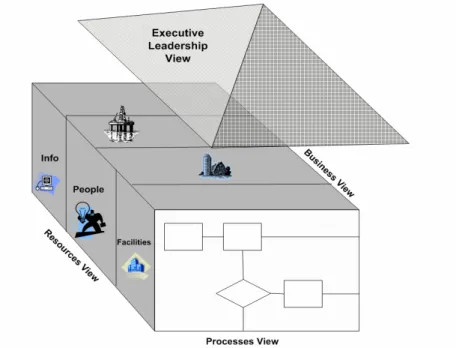
A figure by Miller & Berger (2001, p. 51) shows how enterprise views relate to each other in general:
Figure 2. How enterprise views relate to each other
Each reference plane in figure 2 stresses different enterprise interrogatives - the who, what, where, when, why and how of enterprise. The figure illustrates how each question must be answered simultaneously and that all views act as constraints on the others (Miller and Berger 2001). Understanding means not only knowing what elements the enterprise consists of and how they are related from different aspects, but also how the elements work together in the enterprise as a whole (Kirikova, 2000).
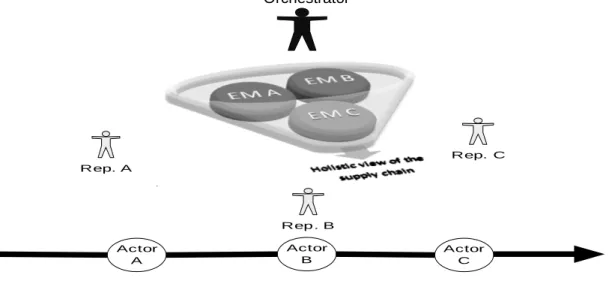
EM has often been studied by looking at one enterprise per se. The picture gets a bit more chal-lenging when trying to get a holistic view of several actors and their interrelationship in a net-work. Concerning food networks to develop information connectivity we build upon the thoughts of Fung et al. (2008) and proposes a need for a network orchestrator, who instead of viewing single firms in isolation looks at the network, who controls through empowerment and who works to create value through integration of the actors in the food network. To ensure the involvement of the different actors in the network, the orchestrator can have the function of a project leader; and the project team can be assembled by representatives from the different net-work actors. The following figure illustrates how the enterprise models of each actor are used as basis to get a holistic view of the whole situation (in this case a single supply chain); by seeing each enterprise model in relation to the other enterprise models (EMs), one gets a comprehen-sive picture:
Figure 3. Coordinating different enterprise models (EM), to make a holistic view of the situation
The picture gets of course more complicated when involving more actors and chains, but our proposed principle is the same; representatives from the different actors in the network creates a project group and by using enterprise models in a coordinated effort they acquire a more com-prehensive view of how the food network is organized; how its information flows, its product flows etc. This can give valuable insight in necessary changes in how the chain or network should be designed and trigger further developed.
According to Senneset et al. (2007) manual systems are predominant for information exchange between companies in the fish farming industry, systems which these authors regard as labour-intensive and error prone. A solution to this is of course the introduction of ICT in these com-panies, something that calls for systems interoperability as the key to enterprise integration, which recommends that the ICT architecture and infrastructure be aligned with business process organization and control. At large interoperability is the ability of performing interoperation between two or more different entities; be they pieces of software, processes, systems, business units (Vernadat 2007). To ensure that applications have the ability “to talk” with each other open standard should be considered. Vernadat (2007) calls for the use of XML, and simple transport protocols (XML/SOAP on TCP/IP, SMTP, or HTTP, web portals among others) as essential building blocks to build interoperable enterprise systems. Again EM have its relevan-ce; a technique that is both connected to the understanding of complex systems and to the assis-tance of groups to ‘pool their expertise and knowledge constructively in making effective decisions and creating new knowledge’ as Dawson (1999) expresses it.
In Conclusion: Towards a Model of Food Supply Networks
The preceding discussion is in conclusion followed with a few understandings emergent for the exercise this paper represents. Possibly the most fundamental proposition is that food supply chains need always to some degree take into consideration a complete chain, and potentially also a network view. This “farm-to-fork” or “sea-to-plate” view is often referred to in matters regar-ding food product traceability. However, this complete “chain”-based approach should encom-pass more than providing information concerning food product history in chain or wider network. Food supply is proposed, at an actor-level, in all aspects as a collective responsibility
Orchestrator Actor A Actor B Actor C Orchestrator Rep. A Rep. C Rep . B
of those involved in food supply. Food supply is complex as it involves serial goods transfor-mations, mixing of ingredients from various sources, and use of logistics services; all impacting on a food product. Food supply is also embedded in a societal and natural environment context constraining foods provision to end-use. In addition there is the vital aspect that supply chains are business entities. Supply chains are embedded in a business context of other supply chains, in a network setting. This food supply network atmosphere may to varying degrees actually ex-hibit actor interdependencies regarding: cooperation, competitiveness, and/or indifference. Economics is as always a basic rationality or force driving food supply from initiating produc-tions (farming, fishing, aquaculture, hunting wild game etc.) to consumers. This is what we mean when stating that food supply chains involve at core business processes. However, this rationality of economics must be pared with the other core ethically-weighted rationality of food supply: product safety and quality aims.
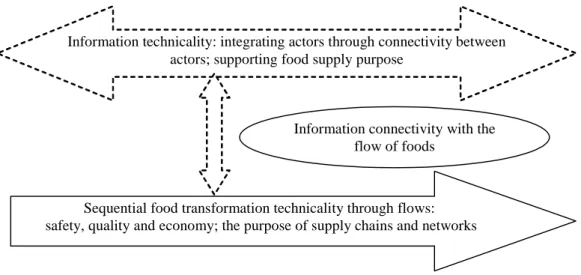
In this framework attention is directed to features of information in supporting safe and quality food supply in an economic manner. A view is taken that loosens the chains of the systems per-spective dominant in understanding supply chains. Focus is directed to interactions between in-formation and food supply business processes embedded in wider network context where managing food supply is carried out in a wider, more “open-minded”, network context. The nor-mative aspect of this framework is a view that information and flows of foods are embedded in this supply network context. Supply network actors are viewed as managing in a context of sup-ply business, societal and natural environment constraints, exhibiting bounded rationality, as they strive to adapt to these ever-changing contextual factors. Agility is fundamental in food supply chains. However, the need for leanness is also important. In this setting information con-nectivity between actors and between the flow of goods and actors is proposed as the fundamen-tal tool to support safe and quality food supply in an economic manner. This view is illustrated in the following preliminary model encompassing information connectivity from a supply chain
perspective:
Figure 4. information connectivity from a supply chain perspective
In addition, this model needs to be further developed to encompass features of information con-nectivity from a supply network perspective. This describes predominately technical features of product supply. The actor layer involving organisational challenges is still not accounted for. Also the level of technical detail in this model may be developed. Also, more detailed features of contextual factors and interdependencies regarding how foods are transformed in relation to how information is adapted to this feature need to be accounted for. This involves how
infor-Information technicality: integrating actors through connectivity between actors; supporting food supply purpose
Information connectivity with the flow of foods
Sequential food transformation technicality through flows: safety, quality and economy; the purpose of supply chains and networks
mation connectivity is designed through collective action involving cooperative efforts of sup-ply network actors through enterprise modelling. Information connectivity is regarded as a core technical feature supporting food product supply purpose. How this product supply is achieved is dependent on supply actors understanding how to design information systems. This is the ba-sis for, in a shorter-term view, of how supply actors manage operations transforming time, place and form features, and inform about the past, present and future features of foods in the context of volatile supply networks. This view is about how ICT enables not managing food supply chains, but managing in them by developing mutually interacting physical, informational, and organisational layers of structures and processes that are the context for value creation. Enter-prise modelling emerges in this picture as an organisational development tool that should be viewed by the supply network developers as interwoven with marketing and logistics purpose (business processes). The view set forth here is that the purpose of food network research is to describe and interpret food supply processes embedded in changeable structures, rather than predict the processes based on predetermined managerial objectives. A view is proposed that value creation be understood from studying the technical layers of product supply, and then re-late this to the organisational (actor) layer. Between these layers information binds actors with technical goods supply processes. This is a “bottoms-up” approach to organisational change where the unpredictability of flows of goods and flows of information, and how they interact is a research challenge. In upcoming studies patterns of interaction between information, physical logistical resources, and actors as organisational knowledge resources is sought.
References
Alderson, W. (1965). “Dynamic Marketing Behaviour, A Functionalist Theory of Marketing”. Richard D. Irwin, Homewood, IL.
Arlbjørn, J.S. and A. Halldorsson (2002). “Logistics Knowledge Creation: Reflections on Con-tent, Context and Process.” International Journal of Physical Distribution and Logistics Management. Vol. 32, No1:22-40.
Bijman, J., S.W.F. Omta, J.H. Trienkens, J.H.M. Wijnands, and E.F.M. Wubben (2006). “ Inter-national Agri-Food Chains and Networks. Management and Organization”. Wageningen Academic Publishers, Wagengingen, NL.
Bowersox, D. J. (1969), Physical Distribution Development, Current Status, and Potential.
Journal of Marketing, Vol. 33: 63-70.
Bucklin, L. P. (1965). “Postponement, Speculation and the Structure of Distribution Channels”.
Journal of Marketing Research, Feb. pp. 26-31.
Caixeta-Filho, J.V. (1999). “Losses in the Transportation of Fruits and Vegetables: A Brazilian Case Study”. International Journal of Logistics: Research and Applications, Vol. 2, No. 3, pp. 325-341.
Christopher, M. and D. Towill (2001). “An Integrated Model for the design of Agile Supply Chains”. International Journal of Physical Distribution and Logistics Management, Vol. 31. No.4, pp. 3499-3518.
Christopher, M. and H. Peck (2004). “Building the Resilient Supply Chain”. The International Journal of Logistics Management, Vol.15, No.2, pp.1-13.
Closs, D.J., M. Swink and A. Nair (2005). “The role of information connectivity in making lo-gistics programs successful”. International Journal of Physical Distribution and Logistics Management, Vol. 35, No. 4, pp. 258-277.
Dawson, R.(1999). “How Marvellous Minds Make Money”, Executive Excellence – Australia Edition, Vol 16, No 12, December 1999.
Engelseth, P. and A. Nordli (2006). “Using the TraceFish code in a frozen fish supply chain”. Proceedings of the 7th. International Conference on Management in AgriFood Chains
and Networks, Wageningen, The Netherlands.
Engelseth, P. (2006). “The Impact of Freezing Foods on Information Exchange in the Supply Chain”. Proceedings from the NOFOMA conference, Oslo, Norway.
Engelseth, P. (2007). “The Role of the Package as an Information Resource in the Supply Chain, A Case Study of Distributing Fresh Foods to Retailers in Norway”. The Norwegian School of Management BI, Oslo. Series of dissertations, No.1.
Engelseth, P. (2007b). “Information Connectivity, Selecting Global Supply Chain Strategies, and Agility in “Complete” Food Supply Chains”. Proceedings from the NOFOMA confe-rence, Reykjavik, Iceland.
Engelseth, P. (2007c). “Tracking Goods and Tracing Products in Food Chains: -A Supply Chain Management Capability”. Proceedings of the International Conference on Agricultural Economics, Rural Development and Informatics, 20-21st March. University of Debrecen, Centre of Agricultural Sciences, Faculty of Agricultural Economics and Rural Develop-ment, Hungary.
Engelseth, P. and M. Abrahamsen (2007). “The Demise of Traditional Fish Distribution Struc-tures in Japan? -a case study of fish supply chains from Norway to Japan”. Proceedings of the 23rd IMP conference. Manchester UK.
Fung, V.K., Fung, W.K. and Wind, Y. (2008). “Competing in a Flat World. Building Enterpri-ses for a Borderless World”. Wharton School Publishing by Pearson Education Inc, New Jersey, U.S.
Gammelgaard, B. (2004), “Schools in logistics research? A methodological framework for ana-lysis of the discipline”. International Journal of Physical Distribution and Logistics Ma-nagement. Vol. 34, No. 6.
Greis, N.P. and J.D. Kasarda (1997). “Enterprise logistics in the information era”. California Management Review. Vol. 39, No. 4, pp. 55-78.
Gripsrud, G. (2004). “The marketing discipline and distribution research: time to regain lost ter-ritory?”In Håkansson, H,. D. Harrison and A. Waluszewski (eds.), Rethinking marketing: developing a new understanding of markets.Chichester UK: Wiley.
Gripsrud, G., Jahre, M., and, Persson, G. (2006). “Supply Chain Management? Back to the fu-ture?”, International Journal of Physical Distribution and Logistics Management. Vol. 38,No.8, pp.643-659.
Gupta, Y., P.S. Sundararaghavan, and M.U. Ahmed (2003). “Ordering Policies for Items with Seasonal Demand”. International Journal of Physical Distribution and Logistics Mana-gement. Vol. 33, No. 6, pp. 500-519.
Hameri, A.P. and J. Pálsson (2003). “Supply Chain Management in the Fishing Industry: The case of Iceland”. International Journal of Logistics: Research and Applications. Vol. 6, No. 3, pp. 137-149.
Kirikova, M. (2000). ”Explanatory capabilities of enterprise models”. Data & Knowledge En-gineering. Elsevier, 33, pp. 119-136
Lambert, D.M., M.C. Cooper, and J.D. Pagh (1998), “Supply Chain Management: Implemen-tation Issues and Research Opportunities”. The International Journal of Logistics Mana-gement. Vol. 9, Issue 2, pp.1-19.
Lamming, R, T. Johnsen, J. Zheng and C. Harland (2000). “An initial classification of Supply Networks”. International Journal of Operations and Production Management. Vol. 20. No. 6, pp. 675-691.
Miller, T. E. and Berger, D. W. (2001): “Totally Integrated Enterprises: A Framework and Me-thodology for Business and Technology Improvement”,Raytheon Professional Services LLC, St. Lucie Press, p.50.
Obersojer, T. and Weindlmaier, H. (2006). “About the Preparedness of Dairy Companies for ECR”, in J. Bijman, Omta, S.W.F., Trienkens, J.H., Wijnands, J.H.M., and Wubben,
E.F.M. “International Agri-Food Chains and Networks. Management and Organizati-on”. Wageningen Academic Publishers, Wagengingen NL.
Pagh, J.D. and M.C. Cooper (1998). “Supply Chain Postponement and Speculation
Strategies: How to choose the right strategy.” Journal of Business Logistics. Vol 19, No. 2, pp. 13-33.
Gripsrud, G. (2004). “The marketing discipline and distribution research: time to regain lost ter-ritory?”In Håkansson, H,. D. Harrison and A. Waluszewski (eds.), Rethinking marketing: developing a new understanding of markets. Chichester UK: Wiley.
Persson, G. (1995). “Logistics Process Redesign: Some Useful Insights.” The International Journal of Logistics Management. Vol. 6, No. 1; 13-26.
Rosenbloom, B. (1995). “Channels of Distribution.” In M. Baker (ed.), Companion Encyclope-dia of Marketing. London: Routledge.
Senneset, G. and Forås, E. (2007): ”Challenges regarding implementation of electronic chain traceability”. British Food Journal, Vol. 109, No. 10, pp. 805-818.
Salin, V. and R.M. Nayga (2003). “A Cold Chain Network for Exports to Developing Coun-tries”. International Journal of Physical Distribution and Logistics Management, Vol. 33, No. 10, pp. 918-933.
Seuring, S. (2006). "The rigor of case study research in supply chain management". Proceedings from the NOFOMA conference, Oslo, Norway.
Stock, J.R., N.P. Greis, and J.D. Kasarda (1999). “Logistics, Strategy, and Structure: A Concep-tual Framework”. International Journal of Physical Distribution and Logistics Manage-ment. Vol. 29, Issue 4:224-237.
Van der Vorst, J.A.J., S. van Dongen, S. Nougier, and R. Hilhorst (2002). ”E-Business Initiati-ves in Food Supply Chains; Definition and Typology of Electronic Business Models”. In-ternational Journal of Logistics: Research and Applications. Vol. 5, No. 2, pp. 119-138. Vernadat, F.B.(1997). “Enterprise Modeling and Integrations, principles and applications”.
Chapman & Hall, London, UK.
Vernadat, F. B. (2007). “Interoperable enterprise systems: Principles, concepts and methods”.