CHAPTER 6
Casting, Forming, and Forging
GEAR MANUFACTURE depends on ma-chinery available, design specifications or requirements, cost of production, and type of material from which the gear is to be made. There are many methods for manufacturing gears including:
•
Metal removal processes (hobbing, shaping, milling, shaving, grinding, honing, and lap-ping) as discussed in Chapter 5•
Various casting processes for both produc-tion of gear blanks and near-net shape gears•
Stamping and fine blanking•
Cold drawing and extrusion•
Powder metallurgy (P/M) processing as dis-cussed in Chapter 7•
Injection molding (applicable to plastic gear materials as discussed in Chapter 4)•
Gear rolling•
Forging for production of gear blanks and precision-forged near- and net-shape gears Most of the processes listed are suited to gears for low wear requirements, low power transmis-sion, and relatively low accuracy of transmitted motion (Ref 1). When the application involves higher values of one or more of these character-istics, forged or cut/machined gears are used. Table 1 lists the tolerances in terms of American Gear Manufacturers Association (AGMA) quality numbers for various gear manufacturing processes (Ref 2).Casting
Although the casting process is used most often to make blanks for gears which will have cut teeth (Fig. 1 and 2), there are several varia-tions of the casting process that are used to make toothed gears with little or no machining.
Table 1 Recommended tolerances in terms of AGMA quality numbers for various gear manufacturing processes
Highest quality number Process Normal With extra care
Sand mold casting 1 3
Plaster mold casting 3 5
Permanent mold casting 3 5
Investment casting 4 6
Die casting 5 8
Injection and compression molding 4 8
Powder metallurgy 6 9 Stamping 6 9 Extrusion 4 6 Cold drawing 6 9 Milling 6 9 Hobbing 8 13 Shaping 8 13 Broaching 7 12 Grinding 10 15 Shaving 9 14 Honing 10 15 Lapping 10 15 Source: Ref 2
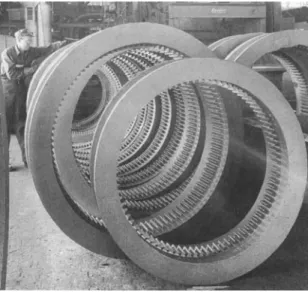
For example, cast tooth internal gears (Fig. 3) are produced in several sizes up to 1633 kg (3600 lb). They are heat treated to strength lev-els of 689 MPa (100 ksi) and machining is not required on these gears. In circumstances where machining is necessary, the machining expense is reduced by casting close to final shape.
Another example of a cast tooth gear is the pinion gear produced from cast high-manganese (Hadfield) steel for an electric mining shovel shown in Fig. 4. It was not necessary to machine the gear teeth.
Specific Casting Processes. Most casting processes have been used to produce gear blanks or cast tooth gears including sand cast-ing, shell moldcast-ing, permanent mold castcast-ing, centrifugal casting, investment casting, and die
Fig. 2 Large machined cast steel gear. Source: Ref 3
Fig. 1 Cast steel gear blank. Weight: 478 kg (1053 lb). Source: Ref 3
casting. Cut gears have also been produced from continuously cast bars. Some of the commonly employed processes will be briefly reviewed below. More detailed information on these processes can be found in Casting, Volume 15 of the ASM Handbook.
Sand casting is used primarily to produce gear blanks. In recent times there has been only very limited use of gears with teeth made by sand casting (Ref 4). In some instances gears for farm machinery, stokers, and some hand-oper-ated devices have used cast teeth. The draft on the pattern and the distortion on cooling make it difficult to obtain much accuracy in cast iron or cast steel gear teeth. Table 1 shows that sand cast gears have the lowest AGMA quality levels of the major gear manufacturing methods.
The shell molding process is particularly suited to castings for which:
•
The greater dimensional accuracy attainable with shell molding (as compared with con-ventional green sand molding) can reduceFig. 3 Cast tooth internal gears. Weights up to 1633 kg (3600 lb). Source: Ref 3
the amount of machining required for com-pletion of the part
•
As-cast dimensions may not be critical, but smooth surfaces (smoother than can be obtained by sand casting) are the primary objective. An example of a cast tooth bevel gear with an excellent surface finish pro-duced by shell molding is shown in Fig. 5. The investment casting process has also had limited use in gear manufacture. Its most appar-ent value lies in the making of accurate gear teethout of materials which are so hard that teeth can-not be readily produced by machining (Ref 4). The process can be used with a variety of steels, bronzes, and aluminum alloys. With machinable materials, the process is still useful if the gear is integral with some complicated shape that is very difficult to produce by machining.
Large quantities of small, low-cost gears are made by the cold chamber die casting process (die cast gears are usually under 150 mm (6 in.) in diameter and from 10 to 48 diametral pitch, DP). Complicated gear shapes which would be quite costly to machine can be made quickly and at low cost by the die casting process. The main disad-vantage of the process is that the low-melting point metals suitable for die casting—aluminum, zinc, and copper—do not have high enough hard-ness for high load-carrying capacity.
Many different types of gears can be die cast, such as spur, helical worm, clusters, and bevel gears. Applications for these types of gears include toys, washing machines, small appli-ances, hand tools, cameras, business machines, and similar equipment.
Forming
Stamping and Fine Blanking. Stamping is a metalworking technique that has been com-pared to using a cookie cutter. In this process, a sheet of metal is placed between the top and bot-tom portions of a die; the upper die is pressed into the lower section and “removes” or cuts the gear from the sheet. This is a low-cost, very efficient method for producing lightweight gears for no-load to medium-duty applications. Stamping is restricted by the thickness of the
Fig. 4 Cast tooth pinion gear for an electric mining shovel. Fig. 5
Cast tooth bevel gear produced by the shell molding process to obtain excellent surfaces and close
toler-Table 2 Recommended stock thicknesses for stamped gears
Thickness
Pitch range mm in.
20–36 0.51–1.98 0.020–0.078 38–60 0.38–1.57 0.015–0.062 62–72 0.25–1.02 0.010–0.040 74–90 0.25–0.89 0.010–0.035 92–120 0.25–0.64 0.010–0.025 Source: Ref 6
workpiece and is used primarily for spur gears and other thin, flat forms (Ref 5). Stamped gears range in size from 20 through 120 DP and 0.25 to 3 mm (0.010 to 0.125 in.) thick (Ref 6). As the pitch becomes finer, the materials specifica-tion must become thinner. Table 2 shows rec-ommended stock thicknesses for various pitches that are commonly used and require no special care in die maintenance. As shown in Table 1, tolerances for stamped gears are good and AGMA quality class 9 can be achieved with extra care.
A wide range of materials can be processed by stamping, including all the low and medium car-bon steels, brasses, and some aluminum alloys. Nonmetallic materials can also be stamped. Gears manufactured by this process are used in toys, clock and timer mechanisms, watches, small appliances such as mixers, blenders, toast-ers, and can opentoast-ers, as well as larger appliances such as washers and dryers.
Fine blanking (also known as fine-edge blanking) is actually more akin to cold extrusion than to a cutting operation such as stamping. The process takes metal from a sheet like stamp-ing but differs from it in that it uses two dies and forms the workpiece by pressing it into the desired shape. The metal is extruded into the die cavities to form the desired shape. Also unlike stamping, fine blanking offers the designer a limited three-dimensional capability and can thus be used to create bevels, multiple gear sets, and other complex forms (Ref 5). Fine blanked gears can be found in a wide range of applica-tions including the automotive, appliance, office equipment, hydraulic, and medical equipment industries.
Cold Drawing and Extrusion (Ref 6). This process requires the least tool expenditure for mass production of spur gear toothed gear ele-ments and is extremely versatile in that almost any tooth form that can be desired can be
pro-duced. As the name implies, a bar is pulled (drawn) or pushed (extruded) through a series of several dies, the last having the final shape of the desired tooth form. As the material is run through these dies it is actually squeezed into the shape of the die. Since the material is dis-placed by pressure, the outside surface is work hardened and quite smooth.
The bars that are “blanks” for this process are usually 3 to 3.7 m (10 to 12 ft) in length. After passing through the dies, they are known as pin-ion rods, and often are put into screw machines that finish the individual gears. Experience has shown that it is more economical to slice a seg-ment off an extruded bar than to cut an individ-ual gear. In some cases it would be impossible to produce the desired shape of pinion in any other way. Pinion rods from 16 to 100 DP can be obtained, but as the pitch becomes finer, it becomes more difficult to obtain the close toler-ances that are sometimes desired on fine-pitch pinions. Any material that has good drawing properties, such as high-carbon steels, brass, bronze, aluminum, and stainless steel, may be used for the drawn pinion rod.
Gears and pinions manufactured by this pro-cess have a large variety of applications and have been used on watches, electric clocks, spring-wound clocks, typewriters, carburetors, magne-tos, small motors, switch apparatus, taximeters, cameras, slot machines, all types of mechanical toys, and many other parts for machinery of all kinds.
Gear Rolling (Ref 1). Spur and helical gears, like splines, are roll formed. Millions of high-quality gears are produced annually by this process; many of the gears in automobile trans-missions are made this way. As indicated in Fig. 6, the process is basically the same as that by which screw threads are roll formed, except that in most cases the teeth cannot be formed in a single rotation of the forming rolls; the rolls are gradually fed inward during several revolutions. Because of the metal flow that occurs, the top lands of roll-formed teeth are not smooth and perfect in shape; a depressed line between two slight protrusions can often be seen. However, because the top land plays no part in gear tooth action, if there is sufficient clearance in the mat-ing gear, this causes no difficulty. Where de-sired, a light turning cut is used to provide a smooth top land and correct addendum diameter. Rolling produces gears 50 times as fast as gear cutting and with surfaces as smooth as 0.10 µm (4 µin.). Not only does rolling usually need
Fig. 6 Method for forming gear teeth and splines by cold
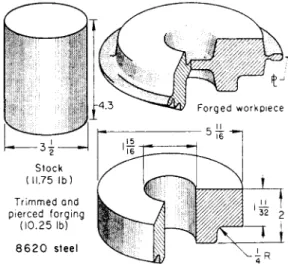
Fig. 7 Gear blank that was closed-die forged in four hammer blows from pancaked stock (not shown), and then trimmed and pierced in one press stroke. Dimensions are given
no finish operation, but rolling refines the mi-crostructure of the workpiece.
Production setup usually takes only a set of rolling dies and the proper fixture to equip the rolling machine. By either the infeed (plunge) method or the throughfeed method, the rolling dies drive the workpiece between them, forming the teeth by pressure.
Limits. Spur gears can be rolled if they have 18 teeth or more. Fewer teeth cause the work to roll poorly. Helical gears can be rolled with fewer teeth if the helix angle is great enough.
It is usually impractical to roll teeth with pressure angle less than 20°. Lower angles have wide flats at root and crest that need more pres-sure in rolling. Lower angles also hinder metal flow. Although 0.13 mm (0.005 in.) radius fil-lets can be rolled, 0.25 mm (0.010 in.) is a bet-ter minimum. For greabet-ter accuracy, gear blanks are ground before rolling. Chamfers should be 30° or less.
Steels for gear rolling should not have more than 0.13% S and preferably no lead. Blanks should not be harder than 28 HRC.
Forging
Forging has long been used in the manufac-ture of gears. This is particularly true for the production of gear blanks which would subse-quently be cut/machined into the final desired configuration. Gear blanks have been produced
by open-die forging, closed-die forging (Fig. 7), and hot upset forging. During the past thirty-five years there has been considerable research and development aimed at producing near-net or net-shape gears by precision forging. Today precision forged gears requiring little or no fin-ish machining are commonly used in the auto-motive, truck, off-highway, aerospace, railroad, agriculture, and material handling industries, as well as the energy and mining fields.
High-Energy Rate Forging
One of the first forging processes for manu-facturing near- or net-shape gears was the high-energy rate forging process which is a closed-die hot or cold forging process in which the work metal is deformed at unusually high veloc-ities. Ideally, the final configuration of the forg-ing is developed in one blow, or at most, a few blows. Velocity of the ram, rather than its mass, generates the major forging force.
It is possible to produce gears with a con-toured grain flow that follows the configuration of the teeth using high-energy-rate forging. In the case of spur gears, this is achieved by pan-caking to cause lateral flow of the metal in a die containing the desired tooth configuration at its periphery. Contoured grain increases the load-bearing capacity without increasing the tooth size. In addition, the process minimizes the machining required to produce the finished gear. Although spur gears are the easiest to forge, helical and spiral-bevel gears can also be
Fig. 8 Near-net shape cluster gear made by high-energy rate
forging. Dimensions are given in inches. Fig. 9
Near-net shape automotive flywheel made by high-energy rate forging. Dimensions are given in inches.
forged if their configurations permit ejection of the gear from the die cavity. Gears have been forged from low-alloy steel, brass, aluminum alloys, stainless steel, titanium, and some of the heat-resistant alloys.
Gears with a DP of 5 to 20 are commonly forged with little or no machining allowance. The die life decreases significantly when forg-ing finer-pitch gears.
The forging of 5 DP gears with an involute tolerance of 0.013 mm (0.0005 in.) and total composite error of 0.08 mm (0.003 in.) has been reported. These gears were forged with a tooth-to-tooth spacing deviation of about 0.025 mm (0.001 in.) and a total accumulated deviation of 0.089 mm (0.0035 in.). Over-the-pins dimen-sions were held to ±0.05 mm (0.002 in.) on these gears, and the total composite error was about 0.20 mm (0.008 in.).
Holding gear dimensions to extremely close tolerances may eliminate finish machining, but the savings may be exceeded by higher die mak-ing/maintenance costs. Consequently, most forged gears have an allowance for machining.
A surface finish of 0.5 to 1.5 µm (20 to 60 µin.) on gear teeth is practical. However, even with a 0.5 µm (20 µin.) finish, local imperfec-tions can increase the average to 1.5 µm (60 µin.) or greater. Therefore, it would be difficult to maintain a good surface finish on gear teeth without grinding.
Typical Gear Forgings. The 4.5 kg (10 lb) gear shown in Fig. 8 was forged from 8620 steel billet 75 mm (3 in.) in diameter by 124 mm (4.9 in.) in length. An energy level of 353,000 J (260,000 ft · lbf) was needed to forge the gear in one blow at 1230 °C (2250 °F). The web on the gear was forged to final thickness; the teeth
were forged with 0.51 mm (0.020 in.) of stock for finish machining.
The die inserts originally used to forge this gear were made of H11 or H13 tool steel. This steel typically softened after producing 20 gears because of its temperature rising above the 565 °C (1050 °F) tempering temperature of H13 steel. The use of Alloy 718 (UNS N07718) was found to improve the die insert life.
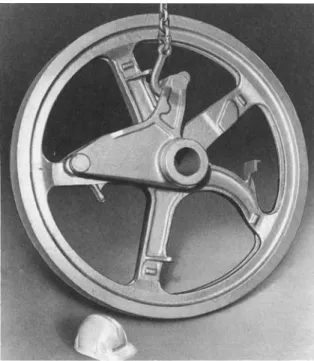
The automotive flywheel shown in Fig. 9, 272.49 mm (10.728 in.) in diameter over the teeth and weighing 11 kg (24 lb), was forged from a machined blank cast from class 40 gray iron (generally considered unforgeable). The machined preform, a section of which is shown in Fig. 9, was heated to 955 °C (1750 °F) and forged at an energy level of 271,000 J (200,000 ft · lbf). This part had the smallest tolerance specification. The diameter over the teeth and the thickness of the body had a tolerance of +0.00 mm, –0.18 mm (+0.000 in., –0.007 in.). The largest tolerance on the part was ±1.02 mm (±0.040 in.) on the diameter of a recess. Toler-ances on the other recesses were ±0.18 mm (±0.007 in.) and +0.48 mm, –0.00 mm (+0.019 in., –0.000 in.). This gear was forged to the fin-ished dimensions.
Various gears with teeth as an integral part have been forged. These have ranged in outside diameter from 64 to 267 mm (2.5 to 10.5 in.) and in weight from 0.54 to 11 kg (1.2 to 24 lb). Most have been made with 0.13 to 0.51 mm (0.005 to 0.020 in.) of stock on the flank of each tooth for finish hobbing and grinding. Gears forged with integral teeth normally have longer
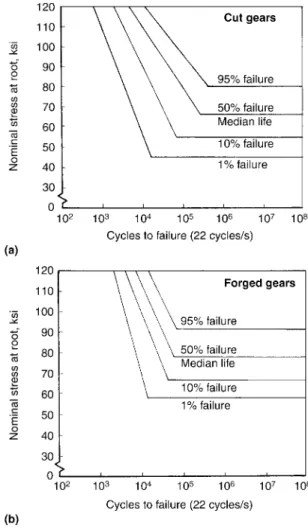
Fig. 11 Fatigue data for (a) cut gears and (b) near-net shape forged gears. Source: Ref 8
fatigue and wear life than those made from a conventionally forged blank on which the teeth are hobbed, shaped, or milled.
Precision Forging
The term “precision forging” does not spec-ify a distinct forging process but rather de-scribes a philosophical approach to forging. The goal of this approach is to produce a net shape, or at least a near-net shape, in the as-forged con-dition.
The term net indicates that no subsequent machining or finishing of a forged surface is required. Thus, a net shape forging requires no further work on any of the forged surfaces, although secondary operations may be required to produce minor holes, threads, and other such details. A near-net shape forging can be either one in which some but not all of the surfaces are net or one in which the surfaces require only minimal machining or finishing. Precision forg-ing is sometimes described as close-tolerance forging to emphasize the goal of achieving, solely through the hot forging operation, the dimensional and surface finish tolerances required in the finished part.
In recent years, computer-aided design and manufacturing (CAD/CAM) techniques have been applied to various forging processes (Ref 7). This computerized approach is applicable to precision hot forging of spiral bevel, spur, and helical gears in conventional presses in that it allows the die designer to examine the effects of various process variables (loads, stresses, and temperature) on the die design.
Precision hot-forged gears have the same advantages over cut gears as other molded gears (cast, P/M processed, injection molded) in that there is little or no material lost (Fig. 10). This is a cost savings from the standpoint of both the cost of the material itself and, more importantly, the cost of machining. In addition, precision forged gears also have the advantage over cut gears of increased load-carrying capacity. This added strength in the form of increased fatigue strength is due to the difference in grain flow be-tween gears cut from bar stock and forged gears. The grain flow in cut gears is determined by the hot rolled orientation of the bar stock and has no relationship to gear tooth contour. On forged specimens, the grain flow follows the tooth con-tour in every gear tooth. Figure 11 compares the fatigue properties of cut and forged gears (Ref 8).
Fig. 10 Material/weight savings using the near-net shape forging process. The large spur gear weighs 25 kg (55 lb) as a blank (left side). As a forged tooth gear (right side) with 1 mm (0.04 in.) of stock allowance on the tooth profile for finish machining, it weighs 17 kg (37 lb). Source: Presrite Corporation
Near-Net Shape Quality Gears. The ma-jority of forged gears produced today are near-net shape configurations. Gear teeth are forged with an envelope of material (stock allowance) around the tooth profile. This envelope is
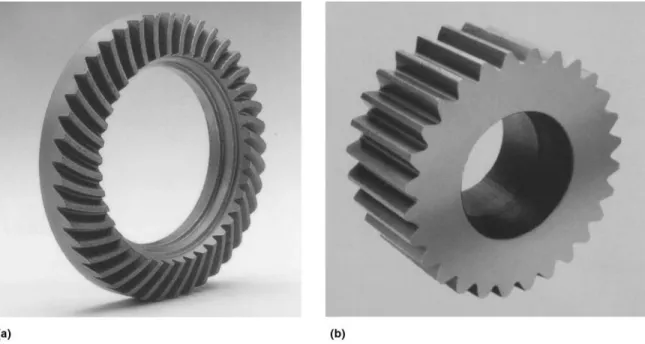
subse-Fig. 12 Examples of near-net shape forged gears. (a) Spiral bevel gear with a 0.5 mm (0.02 in.) stock allowance developed for use on gears with a DP less than 7. (b) Coarse-pitch (less than 5 DP) spur gear with a stock allowance of 1 to 2 mm (0.04 to 0.80 in.). Source: Presrite Corporation
quently removed by the forging house or the cus-tomer purchasing the forged gears.
The manufacturing process begins with steel bar stock, usually turned and polished to improve the surface, and cut to the exact weight. The exact weight is critical because the amount of steel must completely fill the die to produce the complete gear profile. Prior to forging, bil-lets are heated between 925 and 1230 °C (1700 and 2250 °F) in an electrical induction furnace that is controlled by an optical pyrometer to ±14 °C (25 °F).
In a single stroke, standard mechanical forg-ing presses, rangforg-ing from 14,235 to 53,375 kN (1600 to 6000 tonf), form near-net shape gears with the complete allowable stock allowance. The purpose of this first operation, which forms a “pancake,” is to break the scale off of the billet and size the outside diameter to just under the size of the root diameter in the gear die. Next, an operator positions the billet into the finish die. After forging, a hydraulic knockout system immediately extracts the gear from the finish die. After the raw forged gear is hydraulically ejected from the die, it is placed in a trimming nest where the hole is punched. It is then allowed to cool to ambient temperature, which usually takes up to 24 h. Once cooled, it is ready for fin-ish machining.
Near-net shape gears can be produced using any carburizing or induction hardening steel in five basic configurations: spiral bevel, helical, straight bevel, spur gears with a 1 mm (0.04 in.) stock allowance, and spur gears with a 0.1 to 0.3 mm (0.004 to 0.012 in.) stock allowance. The near-net shape gears can be produced in diame-ters up to 425 mm (17 in.) with stock allowances ranging from 0.1 to 1.5 mm (0.004 to 0.06 in.). The specifications for various gear configura-tions include:
•
Spiral bevel gears can be produced up to 425 mm (17 in.) in diameter, with 0.5 mm (0.02 in.) minimum stock per flank. A maximum spiral angle of 35° and a pitch range of less than 7 DP can be achieved.•
Straight bevel gears have configurations/ properties similar to spiral bevel gears•
Helical gears can be produced up to 250 mm (10 in.) in diameter and up to 40 kg (90 lb) in weight, with a 0.5 mm (0.02 in.) mini-mum stock per flank. A maximini-mum helix angle of 25° and a pitch range of 4 to 12 DP can be achieved.•
Spur gears with a 1 mm (0.04 in.) stock allowance can be produced up to 400 mm (16 in.) in diameter and up to 135 kg (300 lb) in weight, with a 1 mm (0.04 in.) minimumstock allowance per flank. A pitch range of less than 5 DP can be achieved. This type of gear requires a finish process of hobbing, hobbing and shaving, or hobbing and grind-ing, or skiving.
•
Spur gears with a 0.1 to 0.3 mm (0.004 to 0.012 in.) stock allowance can be produced up to 250 mm (10 in.) in diameter and up to 150 mm (6 in.) maximum face width, with a 0.1 to 0.3 mm (0.004 to 0.012 in.) stock allowance per flank. A pitch range of 4 to 12 DP can be achieved. This type of gear re-quires a finish process of grinding or skiv-ing. A net root is possible.Figure 12 shows examples of precision forged near-net shape gears.
REFERENCES
1. T.T. Krenzer and J.W. Coniglio, Gear Manufacture, Machining, Vol 16, ASM Handbook, ASM International, 1989, p 330–355
2. J.G. Bralla, Handbook of Product Design for Manufacturing, Vol 16, McGraw-Hill Book Company, 1986, p 355
3. M. Blair and T.L. Stevens, Ed., Steel Cast-ings Handbook, Sixth Edition, Steel Founders’ Society and ASM International, 1995, p 2–34
4. D.W. Dudley, Gear-Manufacturing Meth-ods, Handbook of Practical Gear Design,
McGraw-Hill Book Company, p 5.86 5. C. Cooper, Alternative Gear
Manufactur-ing,Gear Technol.,July/Aug 1998, p 9–16 6. D.P. Townsend, Ed., Gears Made by Dies,
Dudley’s Gear Handbook: The Design, Manufacture, and Application of Gears,
Second Edition, McGraw Hill Book Com-pany, 1992, p 17.1–17.21
7. D.J. Kuhlmann and P.S. Raghupathi, Man-ufacturing of Forged and Extruded Gears,
Gear Technol.,July/Aug 1990, p 36–45 8. T. Russell and L. Danis, Precision Flow
Forged Gears, Gear Manufacture and Per-formance, American Society for Metals, 1974, p 229–239