Predictive Knowledge Discovery by Multiobjective Genetic Fuzzy
Systems for Estimating Consumer Behavior Models
∗Jorge Casillas, Oscar Delgado Dept. Computer Science and Artif. Intell.
Univ. Granada, 18071 Granada, Spain [email protected]
Francisco J. Mart´ınez-L´opez Marketing Department
Univ. Granada, 18071 Granada, Spain [email protected]
Abstract
The paper introduces a novel problem based on causal modeling in marketing where knowledge discovery is able to provide useful results (as shown in a real-world application). The problem features (with uncertain data and available expert knowledge) and the proposed multiobjective op-timization approach makes genetic fuzzy systems to be a good framework to deal with that. Keywords: knowledge discovery, genetic fuzzy systems, multiobjective optimization, causal modeling in marketing.
1 Introduction
In knowledge discovery in databases (KDD) we can distinguish between two different ap-proaches [6]: predictive induction and descriptive induction. The difference lies in the main objec-tive pursued and, therefore, the learning method used to attain that. On the one hand, predic-tive induction looks for generating legible models that describe with the highest reliability the data set that represent the analyzed system. In that case, the goal is to use the obtained model to sim-ulate the system, thus getting an explanation of its complex behavior. On the other hand, de-scriptive induction looks for particular (interest-ing) patterns of the data set. In that case, we do not get a global view of the relationships among variables but we discover a set of rules (different enough among them) statistically significant. This paper focus on predictive induction to ex-tract useful knowledge from causal models used in marketing. Association fuzzy rules (with in-∗Work supported in part by the Spanish Ministry
of Science and Technology under Project TIC2002-04036-C05-01 and by the European Regional Development Fund
put and output variables previously fixed) are used. The extraction is performed by means of ge-netic fuzzy systems. Two questions arise at this stage: why fuzzy rules? and why genetic algo-rithms (GAs)?
The use of fuzzy rules (instead interval rules, deci-sion trees, etc.) is justified mainly due to the kind of data set we are dealing (see Section 3.1). In our case, each variable is composed of a set of para-meters (items) that add uncertainty to the data, since each of them provide partial information to describe the variable. Moreover, we are able to easily transform the available expert knowledge to linguistic semantics. Finally, the obtained fuzzy models can be linguistically interpreted, an im-portant issue in KDD.
Regarding the use of GAs to derive these fuzzy models instead other well-known machine learn-ing techniques, its application is justified by the following points. Firstly, since there are contra-dictory objectives to be optimized (such as accu-racy and interpretability), we perform multiobjec-tive optimization. It is one of the most promising issue and one of the main distinguishing marks of GAs compared to other techniques. Furthermore, we consider a flexible representation of fuzzy rules that can be properly developed by GAs.
The paper is organized as follows. Section 2 briefly describes the dealt problem based on con-sumer behavior models. Section 3 introduces the different KDD steps of the proposed methodol-ogy. Section 4 shows some obtained experimental results. Finally, Section 5 concludes.
2 Causal Modeling in Marketing Marketing academics and practitioners have em-phasized the need for knowing and explaining the consumer’s behavior patters in a manner
increas-ingly efficient. This is mainly due to firms focused on final markets are immersed in highly compet-itive systems in which it is needed that their de-cision processes to be as correct as possible. In this sense, models of consumer behavior are con-sidered as a specific case of marketing manage-ment support system, and throughout the time have demonstrated to be a source of transcenden-tal relevance for the development of marketing sci-ence [8].
Notwithstanding, current models of consumer be-havior do not seem to cover all the necessities that it should supposedly satisfy a model which aims to aid on the marketing decision making. Thus, as the main problem that actually face firms ori-ented to consumer markets is not the availabil-ity of information (data), but the possession of appropriate levels of knowledge to take the right decisions, the use of avant-garde knowledge dis-covery techniques able to exploit it may represent an essential source of competitive advantage. In this respect, we focus our paper on the mod-eling estimation techniques and its improvement, presenting the potentials that methods of estima-tion based on fuzzy rules present in order to ob-tain estimated models of behavior more exhaus-tive, complex, flexible, interactive and which of-fer much more quantity of qualitative information than preceding estimation techniques used in this field [3, 8].
3 A Knowledge Discovery Method for Consumer Behavior Modeling with Fuzzy Rules
This section introduces the proposed KDD method to estimate consume behavior. Basically, it consists on preparing the data and on fixing the scheme we follow to represent the knowledge existing in the data. Once defined these aspects, a machine learning method based on GAs is pro-posed to automatically extract fuzzy models. 3.1 Data Gathering
First step is to collect the data related to the vari-ables defining the theoretical model of consumer behavior proposed. In this sense, as it has been
traditionally done in marketing, data are obtained by means of a questionnaire in a similar way to the models estimated by structural equation mod-eling. Thus, at first, attention should be paid to how consumer behavior modelers face and develop the measurement process of variables which com-plex behavioral models contain.
It can be said that measuring streams for these la-tent variables in consumer modeling can be clas-sified into two groups depending on if they de-fend that these constructs can or cannot be per-fectly measured by means of observed variables (indicators)—i.e., the existence or not of a one-to-one correspondence between a construct and its measurement. Certainly, though consumer be-havior modelers tended to make use in the begin-ning of what was known as theoperational defini-tion philosophy, a more convenient and reasonable position is that ulterior based on thepartial inter-pretation philosophy which distinguished between unobserved (constructs) and observed (indica-tors) variables. This later approach of measure-ment, being currently predominant in the mar-keting modeling discipline, poses to jointly con-sider multiple indicators—imperfect when consid-ered individually, though reliable when considconsid-ered altogether—of the subjacent construct to obtain valid measures.
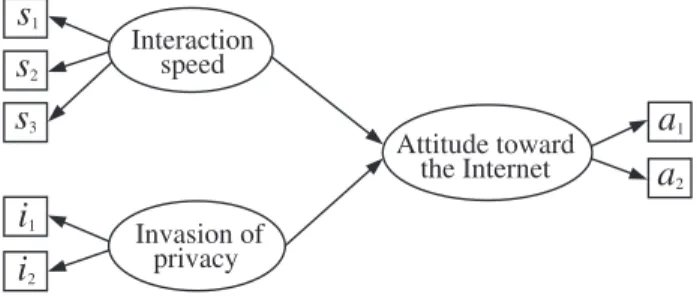
For instance, we can consider a simple measure-ment model depicted in Figure 1, compounded by three construct or latent variables, two exoge-nous and one endogeexoge-nous, where: (1) interaction speed: the consumer’s perception about the Inter-net’s capacity in general, and, more particularly, of different web-sites, to give a response when re-quired; (2) invasion of privacy: the consumer’s opinion regarding the invasion of his intimacy by the various agents with which he interacts in In-ternet applications; and (3) attitude towards the Internet: the consumer’s overall about this com-munications medium. Likewise, with respect to the measurement scales, imagine, in one hand, that the first and second construct have been mea-sured by means of several nine-points Likert scales ranging from 1: strongly disagree to 9: strongly agree. On the other, differential semantic scales with 9 points have been used for the third. Specif-ically, in Table 1 we show a hypothetical example
of the set of items that could have been used for measuring each one, while Table 2 shows an ex-ample of data available for this problem.
Interaction speed Invasion of privacy
s
1s
2s
3i
2i
1 Attitude toward the Interneta
2a
1Figure 1: Example of a simple measurement (structural) model
Table 1: Example of a questionnaire associated to the measurement model shown in Figure 1
Interaction speed
s1: Interaction with web pages is fast and
stimulating
s2: The internet is quick
s3: Web pages that I usually visit download
quickly enough Invasion of privacy
i1: When I surf the Internet, I feel my privacy
has been invaded
i2: Online firms do not respect the visitor’s
intimacy
Attitude toward the Internet a1: Negative 1 2 3 4 5 6 7 8 9 Positive
a2: Unfavourable 1 2 3 4 5 6 7 8 9Favourable
3.2 Data Processing
Secondly, it is necessary to adapt the collected data to a scheme easily tractable by fuzzy rule learning methods. Therefore, our methodological approach should be aware of the special features of the available data (with several items or indi-cators to describe a specific variable) when adapt-ing the observed variables to a fuzzy rule learnadapt-ing method. An intuitive approach could directly re-duce the items of a specific variable to a single value (e.g., by arithmetic mean). Another possi-bility would be to expand any multi-item example (the result of a questionnaire filled by a consumer) to several single-item examples and subsequently
Table 2: Example of four consumers’ responses about the items shown in Table 1
Speed of Invasion Attitude interaction of privacy Internet s1 s2 s3 i1 i2 a1 a2
2 3 2 6 7 2 2
6 6 7 3 2 8 7
8 8 9 2 3 9 9
5 5 5 4 4 4 4
reduce the data size with some instance selection process.
The problem of these approaches is that the data are transformed, so relevant information may be lost or strained. We propose a more sophisticated process that allows working with the original for-mat without any pre-processing stage: the multi-item fuzzification. Thus, a T-conorm operator (e.g., maximum), traditionally used in fuzzy logic to develop the union of fuzzy sets, is applied to ag-gregate the partial information given by each item during the inference process. Since it is not a pre-processing data but a component of the machine learning design, the details of that treatment of the items is described in Section 3.4.2.
3.3 Fuzzy Model Structure from Expert Knowledge
Several issues should be tackled at this step: the set of variables to be modeled, the transforma-tion of marketing scales used for measuring such variables into fuzzy semantic, and the fuzzy rule structure (relations among constructs). As men-tioned, the expert is able to provide its knowl-edge about the problem by a measurement struc-tural model like shown in Figure 1 (of course, a real problem would work with a more complex model). From this information, we can deduce the variables and the direction (in terms of an-tecedents and consequents) of the relationships existing among them. Therefore, we can easily fix the input and output variable of the analyzed relationship. For example, from the measurement model of Figure 1, the fuzzy rule structure have the following form:
IFInteractionSpeed isA1andInvasionPrivacy isA2
THENAttitudeInternet is B.
With respect to the fuzzy semantic used for each variable, it is also possible to fix it according to expert knowledge. Indeed, when she/he build the questionnaire in order to collect data, she/he fixes the kind of scale and precision (number of points) used to measure each variable. From this infor-mation it is possible to define a fuzzy semantic. At this point, several marketing scale types can be used for its measurement. With the aim of sim-plifying the problem, in this paper we focus on interval scale (i.e., Likert differential semantic or rating scale), which is one of the most commonly used in marketing.
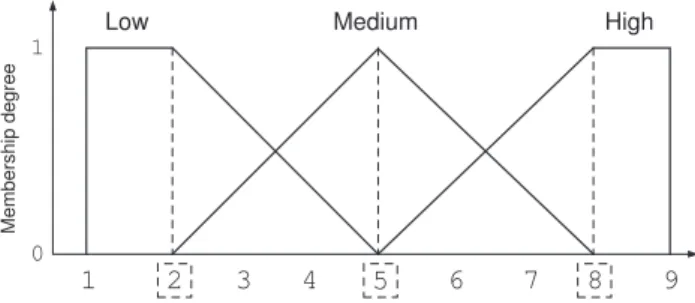
We suggest to transform these scales to Ruspini’s strong fuzzy semantics with uniform density of the fuzzy membership functions to statistically unbias the significance of every linguistic term. Thus, we define the membership function shapes such as, given the setS ={min, . . . , max} defin-ing an interval variable, they hold the followdefin-ing condition: X k∈S µAi(k) = max−min l , ∀Ai ∈ A, with l being the number of linguistic terms and A={A1, . . . , Al} the set of them.
Figure 2 shows an example based on the transfor-mation of a nine-point rating scale (a typical mar-keting scale used to measure the observed vari-ables related to a construct) into a fuzzy semantic with the three linguistic termsLow,Medium, and High. Low 1 2 1 3 4 5 6 7 Medium High 0 Membership degree 8 9
Figure 2: Transformation of a nine-point rating scale into a fuzzy semantic
At this stage, one could think about using some mechanism to automatically generate fuzzy
parti-tions from data [5], or design a tuning method to adapt uniformly initialized fuzzy semantics [1], or both of them. However, in the analyzed problem we are not (more accurately, the expert is not) interested on generating fuzzy semantics that ac-curately cover data. It is because of the faith-fully way to interpret the semantic considered by each consumer that filled the form is the uniform one. If we apply any automatic process to gen-erate/tune fuzzy membership functions, we are adapting to the context, i.e., the answers of the consumer, but not to the meaning of the variables. Therefore, in this problem the KDD process is focused on the relationship among the variables (fuzzy rule surface structures).
3.4 Data Mining Process
Once fixed the linguistic variables that prop-erly represent the tackled information, a machine learning process must be used to automatically extract the knowledge existing in the considered data. This process is, without any doubt, the most important issue from the KDD point of view. As mentioned in Section 1, in this paper we are in-terested on predictive induction. Of course, since we are performing knowledge discovery, the ob-tained model should not be only accurate enough but also be easily legible in order to be able to linguistically describe the real system. As it is known, accuracy and interpretability are two tradictory properties. To address that, we con-sider multiobjective genetic fuzzy system thanks to their good behavior to deal with multiple, con-tradictory objectives. Next subsections describe the main components of the proposed method. 3.4.1 Fuzzy Rule Structure
In data mining is crucial to use a learning process with a high degree of interpretability. Therefore, we opt by a compact description based on the disjunctive normal form (DNF) [4]. This kind of fuzzy rule structure has the following form:
IF X1 is Af1 and. . .and Xn is Afn THENY is B where each input variableXitakes as a value a set
of linguistic terms Afi ={Ai1∨. . .∨Aili}, whose
members are joined by a disjunctive (T-conorm) operator, whilst the output variable remains a
usual linguistic variable with a single label asso-ciated. We use thebounded sum (min{1, a+b}) asT-conorm. The structure is a natural support to allow the absence of some input variables in each rule (simply making Afi to be the whole set
of linguistic terms available). 3.4.2 Multi-item Fuzzification
In order to properly consider the set of items available for each input/output variable (as dis-cussed in Section 3.2), we propose an extension of the membership degree computation, the called multi-item fuzzification. The process is based on a union of the partial information provided by each item. Given Xi and Yj measured by
the vectors of items ~xi = (x(1i), . . . , x(hi)
i, . . . , x (i)
pi)
and~yj = (y1(j), . . . , yt(jj), . . . , yq(jj)), respectively, the
fuzzy propositions “Xi isAfi” and “Yj isBj” are respectively interpreted as follows:
µAi(~xi) = min n 1,Wpi hi=1 P A∈AeiµA(x (i) hi) o , µBj(~yj) = Wpj hj=1µBj(y (j) hj),
with ∨ being a T-conorm (the maximum in this paper).
3.4.3 Coding scheme
Each individual of the population represents a set of fuzzy rules (i.e., Pittsburgh style). Each chro-mosome consists of the concatenation of a number of rules. The number of rules is not fixeda priori so, the chromosome size is variable-length. Each rule (part of the chromosome) is encoded by a bi-nary string for the antecedent part and an integer coding scheme for the consequent part. The an-tecedent part has a size equal to the sum of the number of linguistic terms used in each input vari-able. The allele ‘1’ means that the corresponding linguistic term is used in the corresponding vari-able. The consequent part has a size equal to the number of output variables. In that part, each gene contains the index of the linguistic term used for the corresponding output variable.
For example, assuming we have three linguistic terms (S, M, and L) for each input/output vari-able, the fuzzy rule [IF X1is S and X2is{M or L}
THEN Y is M] is encoded as [100|011||2]. There-fore, a chromosome would be the concatenation of a number of these fuzzy rules, e.g., [100|011||2 010|111||1 001|101||3] for a set of three rules. 3.4.4 Objective Functions
We consider two objective functions to assess the quality of the generated fuzzy systems, the for-mer (approximation error) to improve the accu-racy and the latter (linguistic complexity) to im-prove the interpretability.
Approximation Error: Since the output vari-able is a composition of several items (see Ta-ble 2 and Section 3.2), we have adapted the root mean square error (RMSE) computation to con-sider that. As mentioned before, the aggregation of items is made by the union. So, let us sup-pose that the output variable is comsup-posed by two items and the prediction had a success degree of S1 for the first item andS2 for the second. The
total success degree would be S1∨S2. From De Morgan’s laws, S1∨S2 =S1∧S2, i.e.,E1∧E2—
with E1 and E2 being the errors (complement of
the success degrees) done over the corresponding items. If the objective of the algorithm is to maxi-mizeS1∨S2, the complement will be to minimize
E1 ∧E2. Therefore, the objective function (for
minimization) in a MISO (multiple-input, single-output) system is as follows:
F1(S) = v u u t1 N N X e=1 q min t=1 ³ F(x(e))−y(e) t ´
with (x(e);~y(e)) being the eth example, x(e) =
(~x(1e), . . . , ~x(ne)) the input item vectors, and~y(e)=
(y(1e), . . . , yq(e)) the output item vector. Notice
that F(x(e)) performs the fuzzy inference
us-ing the multi-item fuzzification described in Sec-tion 3.4.2.
Linguistic Complexity: This second objec-tive intends to assess the linguistic complexity of the generated fuzzy rule set. Firstly, it is clear that higher number of rules, higher complexity. Therefore, we measure the number of rules of the fuzzy system F as C1(F). However, since each
itself, we should also consider this aspect. Then, letC2(F) =PRr∈F
Qn
i=1lri be the complexity of
the fuzzy systemF, withlri being the number of linguistic terms used in the ith input variable of therth DNF-type fuzzy rule. The total number of available linguistic terms is computed when an in-put variable is not considered (i.e. “don’t care”). Therefore, the joint objective (to be minimized) is the combination of both complexities as follows:
F2(S) =C1(F)·C2(F)
We opt for this combined measurement instead considering two independent objectives because both are deeply related and assess the same con-cept (complexity of the system).
3.4.5 Evolutionary Scheme
A generational approach with the multiobjective NSGA-II replacement strategy [2] is considered. Binary tournament selection based on the crowd-ing distance in the objective function space is used.
3.4.6 Genetic Operators
Thecrossover operator randomly chooses a cross point between two fuzzy rules at each chromosome and exchanges the right string of them. There-fore, the crossover only exchanges complete rules, but it does not create new ones since it respects rule boundaries on chromosomes representing the individual rule base. In the case that inconsistent rules appear after crossover, the ones whose an-tecedent is logically subsumed by the anan-tecedent of a more general rule are removed. Redundant rules are also removed.
The mutation operator randomly selects an in-put or outin-put variable of a specific rule. If an input variable is selected, one of the three follow-ing possibilities is applied: expansion, which flips to ‘1’ a gene of the selected variable;contraction, which flips to ‘0’ a gene of the selected variable; or shift, which flips to ‘0’ a gene of the variable and flips to ‘1’ the gene immediately before or after it. The selection of one of these mechanisms is made randomly among the available choices (e.g., con-traction can not be applied if only a gene of the
selected variable has the allele ‘1’). If an output variable is selected, the mutation operator sim-ply increases or decreases the integer value. In the same way, specific rules appeared after muta-tion are subsumed by the most general ones and redundant rules are removed.
4 Experimental Results and Interpretation
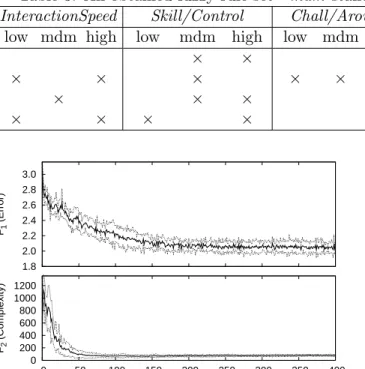
The consumer behavior model we have used for the experimentation is based on analyzing the consumer’s flow state in interactive computer-mediated environments. Data have been obtained from the survey used in [7] to test a concep-tual model previously presented by the same au-thors. To illustrate the flow state concept, it is achieved when the consumer is so deeply in-volved in the process of navigation on the Web that “nothing else seems to matter” [7]. Training data is composed by 1,154 examples (consumers’ responses). Because of paper space limitations, we focus the analysis on a specific relationship among the six relationships with a total of 12 variables available in the data set. The four con-structs used as input variables of the system ( in-teraction speed, skill/control, chall/arousal, and telepress/time distortion) are considered as pri-mary antecedents of the consumer’s flow state. In this sense, it is been hypothesized that they are positively related to this central construct. We have run 10 times the proposed genetic fuzzy system. The fuzzy semantic shown in Figure 2 is considered for all variables. The resulting av-erage convergence plot and joint Pareto-front are depicted on Figures 3 and 4, respectively.
Likewise, Table 3 shows the most accurate ob-tained fuzzy rule set from the Pareto optimal set. According to this example fuzzy model, we can observe that the three first constructs (input variables) seems to exert a poor influence over the consumer’s flow state, even with no repercus-sions depending on the case. However, Telepres-ence/TimeDistortion is, with no doubt, the most relevant construct. As it can be easily seen, it plays a key role to specially determine low and high levels of flow state and shows a positive (di-rect) relationship with it.
Table 3: An obtained fuzzy rule set—mdm stands formedium. F1(F) = 1.617885,F2(F) = 272
InteractionSpeed Skill/Control Chall/Arousal Telepress/TimeDistortion Flow low mdm high × × × × × low mdm high × × × × × × × low mdm high × × low mdm high × × × × × × × low mdm high × × × × 1.8 2.0 2.2 2.4 2.6 2.8 3.0 F1 (Error) 0 200 400 600 800 1000 1200 0 50 100 150 200 250 300 350 400 F2 (Complexity) Generations
Figure 3: Convergence plot (solid lines) of mean error (top) and mean complexity (bottom) of the Pareto set. Dotted lines show ¯x±σ.
5 Concluding Remarks
The paper has introduced a novel problem— causal modeling in marketing—where KDD by ge-netic fuzzy systems can help to generate highly understandable fuzzy models for predictive in-duction. The problem provides a specific kind of uncertain data set that justifies the use of fuzzy rules. We develop multiobjective optimiza-tion to obtain accurate and legible fuzzy mod-els. The proposed KDD methodology has been appropriately applied to a real-world causal mod-eling problem that analyzes interactive computer-mediated environments.
References
[1] J. Casillas, O. Cord´on, M. del Jesus, and F. Her-rera. Genetic tuning of fuzzy rule deep structures preserving interpretability and its interaction with fuzzy rule set reduction. IEEE Trans. Fuzzy Sys-tems, 13(1):13–29, 2005.
[2] K. Deb, A. Pratap, S. Agarwal, T. Meyarevian, A fast and elitist multiobjective genetic algorithm:
1 1.5 2 2.5 3 3.5 0 50 100 150 200 250 300 F1 (Error) F2 (Complexity) #Rdnf = 1 #Rdnf = 2 #Rdnf = 3 #Rdnf = 4
Figure 4: Joint Pareto-front. Each symbol type represents fuzzy models with a specific number of DNF-type fuzzy rules—C1(F)
NSGA-II, IEEE Trans. Evolutionary Computa-tion, 6(2):182–197, 2002.
[3] H. Gatignon, Commentary on P. Leeflang and D. Wittink’s “Building models form marketing deci-sions: past, present and future.”, Int. J. Research in Marketing, 17:209–214, 2000.
[4] A. Gonz´alez and R. P´erez. Completeness and con-sistency conditions for learning fuzzy rules. Fuzzy Sets and Systems, 96(1):37–51, 1998.
[5] S. Guillaume and B. Charnomordic. Generating an interpretable family of fuzzy partitions from data.
IEEE Trans. Fuzzy Systems, 12(3):324–335, 2004. [6] N. Lavrac, B. Cestnik, D. Gamberger, P. Flach, Decision support through subgroup discovery: three case studies and the lessons learned, Ma-chine Learning, 57(1-2):115–143, 2004.
[7] Y. Novak, D. Hoffman, Y. Yung, Measuring the customer experience in online environments: a structural modelling approach,Marketing Science, 19(1):22–42, 2000.
[8] G. van Bruggen, B. Wierenga, Broadening the perspective on marketing decision models, Int. J. Research in Marketing, 17:159–168, 2000.