1099
©IJRASET: All Rights are Reserved
A Comparative Analysis for Forecasting the Future
Duration of Construction Projects
Akshaykumar Devkar1, Snehal Bobade2
1
Student of Master of Engineering, 2Guide of Master of Engineering,
1,2
RMD Sinhgad School of Engineering, Warje, Pune (India), 1,2Savitribai Phule University Pune (India)
Abstract: Construction Project Management involves planning, controlling and scheduling of a construction project from initiation to completion. Construction Project Management aims to complete the construction project in scheduled time and budget. Project completion time is a major factor because time overruns results into cost overruns, thereby affecting the overall economy of the construction project. The problems of time overruns are critical and severe. To resolve the issues of time and cost overruns, construction projects should be properly monitored and controlled. Project managers should have capability to make reliable predictions about the final duration of projects starting from project initiation. Such predictions need to be revised and compared with the project’s objectives and actual performance to obtain early warnings against potential problems. Therefore, the effectiveness of project control systems relies on the capability of project managers to make reliable forecasts in a timely manner. This study focuses on a comparative study between different project duration forecasting methods to evaluate their accuracy in forecasting. For this purpose Earned Value Method, Earned Schedule Method and Regression Method are used to forecast the project completion time with a hypothetical case study and the results are compared with actual completion time of the project.
Keywords: Forecasting, construction, project management, Earned Value, Earned Schedule, Regression Analysis
I. INTRODUCTION
A. Overview
Forecasting of construction duration guides the project owners to permit the contractors to complete the assigned works within scheduled time. On the other hand, the contractors should prepare realistic and practical detailed schedule at the minimum costs within the time boundaries. Construction sector plays an important role in economic development and growth of the country. It contributes to Gross Domestic Products (GDP) and employment rate across the country.
It also creates number of job opportunities to skilled, unskilled and semiskilled labours throughout the nation. It helps to generate income sources in the nation. Over the years, the Indian construction industry has seen significant growth and development. After agriculture, construction sector is the secondary employment generating sector in the country. The construction sector contributes approximately 6%-8% to nation’s Gross Domestic Products (GDP) and 78% to gross capital formation. In addition to this, construction sector employs approximately 31 Million people throughout the country.
Time and cost are critical parameters in every construction projects. The success or failure of any construction projects based on two major factors i.e. time and cost. But these parameters are often overseen. Indian construction projects are popular for cost and time overruns. According to Ministry Of Statistics and Program Implementation (MOSPI), in 2017 as many as 287 infrastructure projects of worth Rs. 150 crore and above have been delayed due to various issues and seen cost overruns of Rs. 1.66 lakh crore. The causes for delays and cost overruns not studied that much seriously.
The successful execution of construction projects within estimated budget and schedule, rely on adopting methodology with good engineering judgments. So the project duration forecasting needs to be effectively performed during execution phase of construction projects in order to avoid or minimize the time and cost overruns. It is the prime responsibility of project managers to forecast project duration at respective time intervals or phases of projects. Many researchers have developed various methods to forecast duration of construction projects.
B. Aim
1100
©IJRASET: All Rights are Reserved
C. Objective
1) To collect, analyze and present the information of three project duration forecasting methods.
2) To compare and evaluate the forecasting capabilities of three methods i.e. Earned Value Method (EVM), Earned Schedule Method (ESM) And Regression Analysis Method (RAM) with the help of hypothetical case study.
3) To find out which method is the most reliable method at what stage of construction project among these three methods of forecasting project duration.
II. LITERATURE REVIEW
Tania Deena Alex et.al. , Forecasting Project Performance using Earned Value Analysis, (February 2015) hinted that, this study deals with planning, scheduling and cost management of multi storied building. The problems of time and cost overrun can be rectified by Earned Value Analysis (EVA). This technique helps to measure project progress and compare budgeted cost with actual cost of work .In this study Primavera P6 software is used for Earned Value Analysis (EVA) calculations. Primavera P6 software is used for the calculation of Earned Value (EV), Schedule Variance (SV), Cost Variance (CV), Schedule Performance Index (SPI) and Cost Performance Index (CPI). Mathieu Wauters1et.al. ,study Of The Stability Of Earned Value Management Forecasting, (November 10, 2014) mentioned that, this study focus on the stability of Earned Value Management (EVM) forecasting methods. The study describes the forecasting accuracy as well as a trade-off between accuracy and stability made easier. It is also shown that the new stability metric can be used in practical environments using two real-life projects. Ashif A R et.al. , Earned Value Management as a Project Management Tool, (October 2014) says that, Earned Value Management (EVM) has a potential to integrate cost, schedule and technical performance. This study focused to improve effectiveness of Earned Value Management in control of big construction projects. T.Subramani et.al. , Analysis of Cost Controlling In Construction Industries by Earned Value Method Using Primavera, (June 2014) ,explained that, Earned Value Analysis (EVA) gives early indications of project performance to highlight the need for eventual corrective action. This study deals with the major parameters included for performing the Earned Value Analysis to achieve cost management in civil construction projects. In this study Earned Value Analysis software is developed in Visual Studio 2008, SQL server 2005 and comparison of selected parameters done among M.S.Project 2007, Primavera P6 and developed software. Ankur Verma et.al. , Earned Value Analysis of Construction Project at Rashtriya Sanskrit Sansthan, Bhopal, (April 2014) told that, This study deals with the scheduling and project monitoring process. This study discusses various major parameters involved in the calculation of Earned Value Analysis in cost management of construction projects. Walt Lipke, Speculations on Project Duration Forecasting, (March 2012) explained that, Earned Schedule Method (EVM) is used for project duration forecasting. This study shows that Earned Schedule Method (ESM) is best for project duration forecasting and also important to improve effectiveness Earned Schedule forecasting. Stephan Vandevoordeet.a1.says that, Earned value project management is a well-known management system that integrates cost, schedule and technical performance. It allows the calculation of cost and schedule variances and performance indices and forecasts of project cost and schedule duration. The purpose of this study is
To differentiate the original earned value performance indicators SV and SPI from the newly developed earned schedule performance indicators SV(t) and SPI(t).
TO present a generic schedule forecasting formula applicable in different project situations and compare the three methods from literature to forecast total project duration.
III. RESEARCH METHODOLOGY
This study focuses on a comparative study between three project duration forecasting methods i.e. Earned Value Method (EVM), Earned Schedule Method (ESM) and Regression Analysis Method (RAM). For this comparison hypothetical case study being considered.
1101
©IJRASET: All Rights are Reserved
Method (EVM), Earned Schedule Method (ESM) and Regression Analysis Method (RAM) in forecasting future duration of construction projects.
A. Earned Value Method
Earned Value Method (EVM) is used to predict the future completion duration of project at any stage of project. This method provides an important tool to control the progress of project. This method is used in determining the project current status and any variation from the plan.
B. Input Data
Earned Value Analysis (EVA) uses the following project parameters to evaluate project performance:
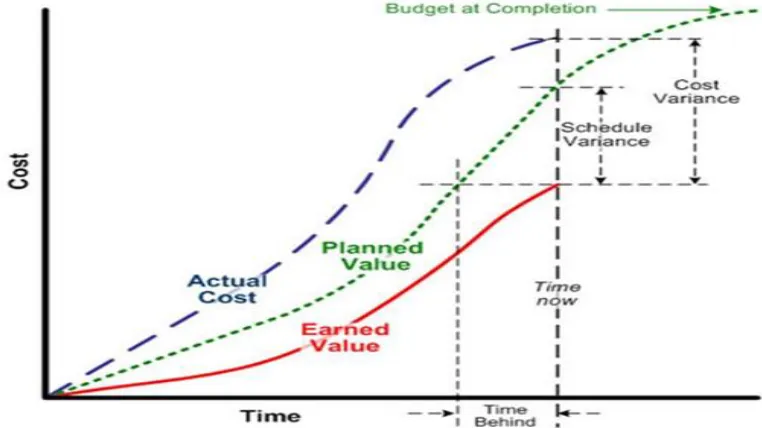
1) BCWS = Budgeted Cost of Works Scheduled (Planned value) the baseline for the analysis, cumulated planned costs related to
time of their occurrence.
2) BCWP = Budgeted Cost of Work Performed (Earned value) a measure of physical progress of works expressed by cumulated
planned cost of works actually done related to time, it is also called Earned Value.
3) ACWP = Actual Cost of Work Performed (Actual cost) cumulated amount payable for works done related to time.
[image:3.612.109.490.287.501.2]4) BAC = Budget At Completion project total planned cost.
Fig. 1.Earned value analysis project parameters
C. Project Status Indicator
*PC=Percentage Complete= EV/BAC *CV = Cost Variance = AC-EV *CV percentage= CV/EV*100 percentage
*SV = Schedule Variance = EV-PV *CPI = Cost Performance Index = compares the planned and actual value of works done = EV/AC *SPI = Schedule Performance Index = EV/PV
D. Project Duration Forecasting
An estimate of duration at completion (EDAC) can be calculated from the following formula: *EDACt= PD/SPI
Where,
*PD = Planned duration *SPI = schedule performance index at time t.
E. Earned Schedule Method
1102
©IJRASET: All Rights are Reserved
been earned. Afterwards, time-dependent indicators can be established to issue schedule variance and performance efficiency management information.
F. Performance Indicator
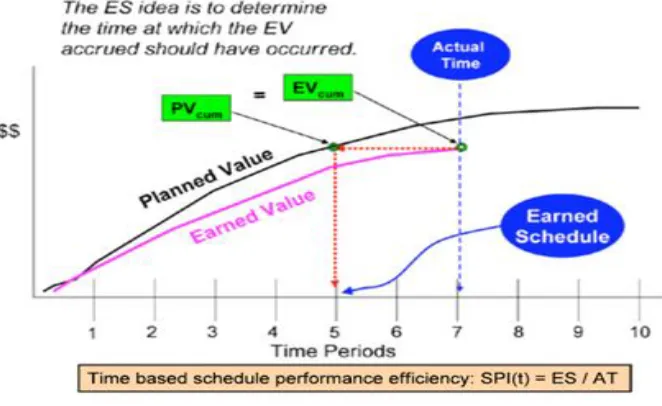
The Earned Schedule (ESt), is calculated by projecting the Earned Value (EV) data point onto the Planned Value (PV) curve to determine where Earned Value (EV) equals the Planned Value (BCWS) for the program. This point on the planned value curve is then projected on x-axis to determine the time at which the Earned Value (EV) accrued should have occurred.
G. Schedule Performance Index
It is a representation of how efficiently a program is performing to schedule. Lipke derived it from the ratio between actual time expended (ATE) and earned schedule. The following equation was used to calculate SPI (t): SPI (t) =ES/ATE
H. Final Duration Forecast
Just as with Earned Value Method (EVM), earned schedule performance metrics can also be used to forecast final duration. The major difference between the two methods is that Earned Schedule (ES) incorporates time with the Planned Duration (PD) and Schedule Performance Index [ SPI(t)] values in the equation: EAC(t)=PD/SPI(t)
[image:4.612.146.477.284.487.2]Where, PD = Planned duration of project
Fig. 2 Earned schedule analysis project parameters
I. Regression Analysis Method
Regression analysis is a statistical technique for determining the relationships among variables. It consists of several techniques to model and analyze many variables, for determining the relationship between a dependent variable and one or more independent variables. In this study simple linear regression analysis is used for forecasting the future duration.
The equation of trend line is: Y = a+b*X,
Where, ‘a’ & ‘b’ can be found out using the following relations:
In this study Y represent cumulative cost (Earned value) in rupees and X represents time in days.
J. Percentage Error
1103
©IJRASET: All Rights are Reserved
Where,
(EDAC) t = Estimated Duration at Completion when forecasted at time “t”
(EDAC) cpm = Estimated Duration at Completion when forecasted with respect to Critical Path Method (CPM)
IV. CASE STUDY
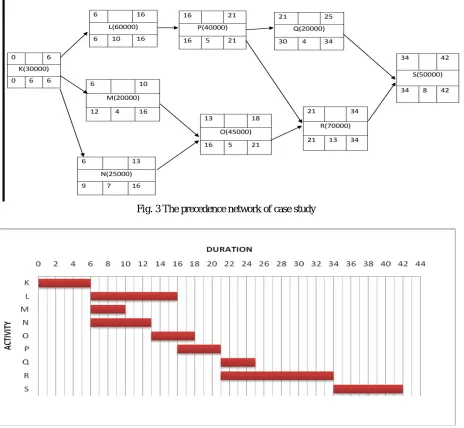
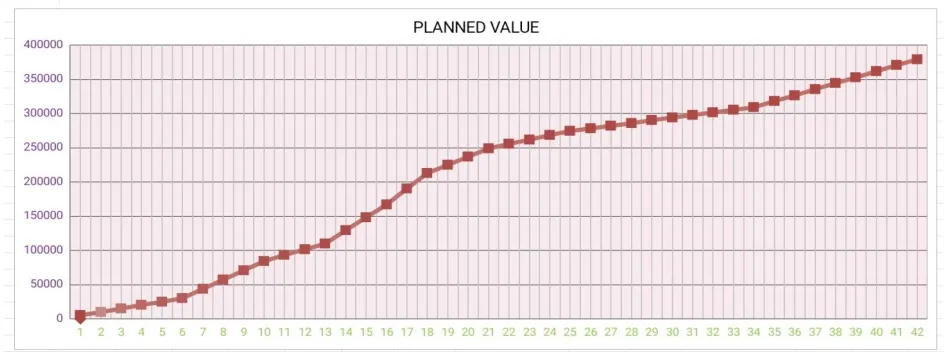
[image:5.612.80.544.291.719.2]A hypothetical case is listed here to compare the result of three models against the results of the CPM and facilitate the validation process for the three models. Fig 3 shows the precedence network of the case study, the activity duration, early dates and the budgeted cost of each activity. The actual reporting data are also indicated in tables. Each table shows the actual percentage completion at the end of that particular monitoring date. The earned value for each activity is calculated and cumulative earned value cost is then calculated by summation of earned value costs of each activity. Similarly planned values are also calculated for each activity. The project is updated at each given data date based on the actual reporting data. The forecasted durations by CPM and the methods is not approximated to the nearest integer number because this approximation will badly affect the validation process.
Fig. 3 The precedence network of case study
[image:5.612.85.541.299.488.2]1104
©IJRASET: All Rights are Reserved
Fig. 5 Planned value curve of case study
Table 1 Cost details of the case study
ACTIVITY STARTING DAY TIME REQUIRED TOTAL COST COST PER DAY
K 0 6 30000 5000
L 6 10 80000 8000
M 6 4 20000 5000
N 6 7 40000 571
O 13 5 55000 11000
P 16 5 60000 12000
Q 21 4 10000 2500
R 21 13 50000 3846
S 34 8 70000 8750
7th day monitoring
[image:6.612.212.398.489.723.2]Table 2 7th day monitoring data
Table 3 Planned and earned values (7th day)
Actual project data at the end of 7th day
Activity % Work complete
K 100
L 10
25
N 14.28
O 0
P 0
Q 0
R 0
1105
©IJRASET: All Rights are Reserved
Critical Path Method When the network is updated using CPM for the given 7th day monitoring data, the updated duration comes out
[image:7.612.86.520.113.258.2]to be 42 days. Earned Value Method
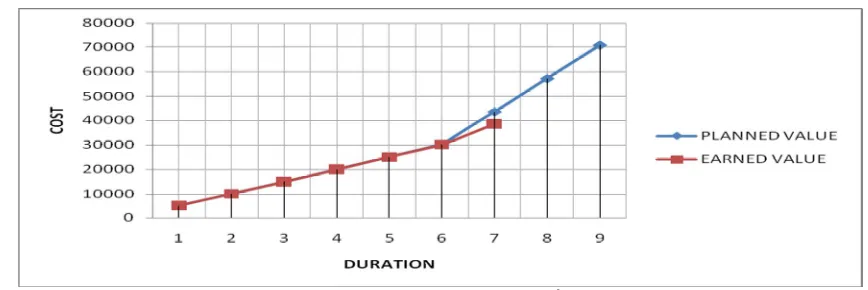
Fig. 6 S-curve for case study on 7th day
Budgeted cost of project = 360000₹, Cumulative planned value = 43571₹, Cumulative earned value = 38571₹,
= 38571/43571 = 0.88, Estimated project duration at complete = PD/SPI = 42/0.88 = 47.72days.
Earned Schedule Method The earned schedule value (ES) is nothing but the time at which the earned value occurred (at the time of forecasting) should have been occurred according to our plan. According to the EV and PV curves this value can be obtained from the following interpolation:
PV TIME
43571 7
38571 ES
30000 6
The earned schedule value comes out to be 6.63 days,
= 6.63/7 = 0.95, Estimated project duration at complete = PD/SPI = 42/0.95 = 44.21 days. Regression Analysis
Performing linear regression analysis on Earned value curve, we have: Equation of line: Y = a+b*X,
Where, Y= Cumulative earned value in Rupees, X= Time in days.
Table 4 Regression analysis for 7th day
PERIOD
PERIOD
VALUE CUM PV
7TH DAY
EV CUM EV
1 5000 5000 5000 5000
2 5000 10000 5000 10000
3 5000 15000 5000 15000
4 5000 20000 5000 20000
5 5000 25000 5000 25000
6 5000 30000 5000 30000
7 13571 43571 8571 38571
8 13571 57142
1106
©IJRASET: All Rights are Reserved
After solving these equations the equation of trend line obtained is: Y = -202.91 + 5381.18*X,
For Y=360000₹, X comes out to be 66.94 days
So the forecasted project duration at complete = 66.94 days. Percentage errors
For Earned Value Method
= = 13.61%,
For Earned Schedule Method
= = 5.26%,
For Regression Analysis Method
= = 59.38%,
V. RESULTS
[image:8.612.124.488.310.585.2]Results of forecasted duration for case study using the three selected methods are shown in table 5
Table 5 Forecasted project durations
Table 6 Percentage errors
FIG.7GRAPHICAL REPRESENTATION OF THE FORECASTED DURATIONS
X Y XY X2
1 5000 5000 1
2 10000 20000 4
3 15000 45000 9
4 20000 80000 16
5 25000 125000 25
6 30000 180000 36
7 38571 269997 49
TOTAL
28 143571 724997 140
Time of Forecast(days) EVM ESM RAM CPM
0 42 42 42 42
[image:8.612.112.510.601.727.2]1107
©IJRASET: All Rights are Reserved
VI. CONCLUSIONS
This study involves comparison of three duration forecasting methods i.e. Earned Value Method, Earned Schedule Method and Regression Analysis. These methods are used to forecast duration for two case studies and results were analysed. Based on this analysis the following conclusion can be drawn.
Earned value method and Earned schedule method gives better forecasting results when compared with Regression analysis. Duration forecasting helps project managers to assess the condition of construction projects.
Duration forecasting helps to minimize time and cost overruns in construction projects.
A. Future Scope and Recommendations
From above study it is helpful in future to work on developing mobile applications which will directly compare the methods of project duration forecasting and gives the forecasted project durations during execution phase of construction projects.
REFERENCES
[1] Tania Deena Alex and Sahimol Eldhose, Forecasting Project Performance using Earned Value Analysis, International Journal Of Innovations in Engineering And Technology, Vol.5, Issue 1 February 2015
[2] Mathieu Wauters and Mario Vanhoucke, Study Of The Stability Of Earned Value Management Forecasting, Journal of Construction Engineering and Management ASCE, November 10, 2014.
[3] Ashif A R, Basil Paul, Charly Ouseph, Johns Abraham, Jeevan Jacob, Earned Value Management as a Project Management Tool, International Journal of Civil and Structural Engineering Research ISSN 2348-7607 (Online) Vol. 2, Issue 2, October 2014 - March 2015.
[4] T. Subramani, D. S. Stephan Jabasingh, J. Jayalakshmi, Analysis of Cost Controlling In Construction Industries by Earned Value Method Using Primavera, International Journal of Engineering Research and Applications , Vol. 4, Issue 6( Version 1), June 2014.
[5] Ankur Verma1, K.K. Pathak and R K Dixit, Earned Value Analysis of Construction Project at Rashtriya Sanskrit Sansthan, Bhopal, International Journal of Innovative Research in Science, Engineering and Technology, Vol. 3, Issue 4, April 2014.
[6] Walt Lipke, Speculations on Project Duration Forecasting, PM World Today Vol. XIV, Issue III , March 2012.
[7] Adel ALSHIBANI and Osama MOSELHI, Stochastic method for forecasting project time and cost, Construction Research Congress ASCE, 2012.
[8] Ming Lu and Hoi-Ching Lam , Critical Path Scheduling under Resource Calendar Constraints, Journal of construction engineering and management ASCE, Vol. 134, January 1, 2008.
[9] Gerg J. Hoffmanl ,Alfred E. Thal Jr., Timothy S. Web and Jeffery D. Weir, Estimating Performance Time For Construction Projects, Journal Of Management In Engineering ASCE, October 2007
[10] Patricia D. Galloway , Survey of the Construction Industry Relative to the Use of CPM Scheduling for Construction Projects, Journal of construction engineering and management ASCE Vol. 132, No. 7, July 1, 2006 .
[11] Stephan Vandevoorde, Mario Vanhoucke, A comparison of different project duration forecasting methods using earned value metrics, International Journal of Project Management, 14 October 2005