Fire and Rescue Service
Operational guidance
Contents
1 Foreword 2 2 Preface 3 3 Introduction 4 4 Legal framework 9 5 Strategic perspective 176 Data and information management- continual 21 improvement
7 Security of information 23
8 Practical considerations 26
9 Competency and training 36
10 Provision of operational risk information system 39
11 Appendices 59
A: PORIS - Risk assessment matrix 59
B(1): Likelihood table 60
B(2): Firefighter severity life/health table 61 B(3): Societal and individual severity table 62
B(4): Environmental severity table 63
B(5): Community/social severity table 64
B(6): Heritage severity table 65
B(7): Economic and other severity table 67
B(8): Comparison of levels of risk 68
C: Data capture fields 74
D: Comparison scoring between PORIS score for 94 individual and societal life risk and IRMP Guidance
Note No 4
12 Acknowledgements 95
13 References and bibliography 97
SECTION 1
Foreword
The availability of relevant and timely information is recognised as critical to the successful management of all operational incidents attended by any Fire and Rescue Service in England.
The Fire and Rescue Service Operational Guidance – Operational Risk Information provides robust yet flexible guidance on developing and maintaining a consistent approach to managing, processing and using strategic and tactical operational risk information that can be adapted to the nature, scale and requirements of the individual Fire and Rescue Service.
It is anticipated that this guidance will promote common principles, practices and procedures that will support national resilience and interoperability and enable the Fire and Rescue Service and other emergency responders to resolve operational incidents safely and efficiently.
The Chief Fire and Rescue Adviser is grateful for the assistance in the
development in this guidance from a wide range of sources, including the Fire and Rescue Service and other emergency responders.
SECTION 2
Preface
The objective of the Fire and Rescue Service Operational Guidance – Operational Risk Information is to provide a consistency of approach that forms the basis for common operational practices, supporting interoperability between Fire and Rescue Services and other emergency responders. These common principles, practices and procedures are intended to support the development of safe systems of work on the incident ground and to enhance national resilience.
Operational Guidance issued by the Department for Communities and Local Government promotes and develops good practice within the Fire and Rescue Service and is offered as a current industry standard. It is envisaged that this will help establish high standards of efficiency and safety in the interests of employers, employees and the general public.
The Guidance, which is compiled using the best sources of information known at the date of issue, is intended for use by competent persons. The application of the guidance does not remove the need for appropriate technical and managerial judgement in practical situations with due regard to local circumstances, nor does it confer any immunity or exemption from relevant legal requirements, including by-laws. Those investigating compliance with the law may refer to this guidance as illustrating an industry standard.
It is a matter for each individual Fire and Rescue Service whether to adopt and follow this operational guidance. The onus of responsibility for application of guidance lies with the user. The Department for Communities and Local Government accept no legal liability or responsibility whatsoever, howsoever arising, for the consequences of the use or misuse of the guidance.
SECTION 3
Introduction
3.1 Fire and Rescue Authorities have a responsibility for the health, safety and welfare of their employees. This runs parallel to a responsibility to mitigate the risk from fire (and other emergencies) to the community and to the society that it serves, and the environment within which it operates.
3.2 As part of these responsibilities, the Fire and Rescue Authority must have in place appropriate policies and procedures to address the issues concerned in achieving these objectives and, through training and development, to provide appropriate knowledge, skills and understanding to enable its employees to operate safely
.
3.3 The Fire and Rescue Services Act 2004, states that a Fire and Rescue Authority must make provision for the purposes of:
• extinguishing fires in its area
• protecting life and property in the event of fires in its area
• rescuing and protecting people in the event of a road traffic accident,
and
• rescuing and protecting people in the event of emergencies.
3.4 Section 7(2)d of this Act places a responsibility on the Fire and Rescue Authority to make arrangements for obtaining information needed for that purpose. Sections 8(2)d, and 9(3)d place a similar responsibility on the Fire and Rescue Authority in respect of road accidents and other emergencies. 3.5 In support of these legislative responsibilities, The Fire and Rescue National
Framework places a requirement on all Fire and Rescue Authorities to have in place effective arrangements for gathering risk information and making it readily available to operational crews. These arrangements should include an effective audit and review system to ensure that the information is current. 3.6 Identifying and managing risk, whether through the pre-planning and
management of emergencies, fire safety, crime and disorder initiatives,
training or undertaking other day-to-day activities, is part of the integrated risk management planning process.
and reports, etc. Fire and Rescue Services vary in the extent of the data collected and held and the policies and processes related to the use, storage and dissemination of this data and information. However, data and information may be stored in isolation and the consequent data integration issues may affect efficient operational pre-planning and incident
management.
3.8 Most operational risks are foreseeable; however the risks posed by events such as adverse weather conditions or civil contingencies, are not easily quantifiable. A combination of operational risk information with available generic risk assessments, local knowledge, and professional judgement, will help ensure appropriate risk management processes can be put in place.
3.9 An operational risk information management system should:
bring together the outputs from existing and established systems develop and support a common approach to the strategic and dynamic analysis of risk; and
determine the appropriate application of resources and processes to address those risks which impact on the firefighter, other emergency responders, members of the public, environment, etc.
3.10 The 2003 Chief Fire Officer’s Association national study into the provision of mobile data examined the information requirements for the roles that
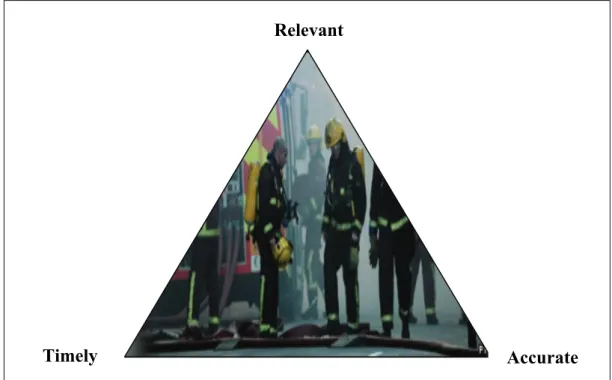
support incident ground operations. This study identified that the provision of accurate, relevant and timely operational information was critical to all personnel, in the operational environment. These three elements are reflected in the data information triangle shown in Figure 1. The study also highlighted that the provision of too much information could put the recipient in ‘information overload’ and this situation may be equally as serious as an under provision of information.
FIGURE 1: CHIEF FIRE OFFICER’S ASSOCIATION DATA INFORMATION TRIANGLE
Relevant
Accurate Timely
3.11 All three elements shown at the apexes of the triangle must be satisfied to ensure effective information is exchanged, if this is not achieved then the following problems may occur:
Relevant and Timely but NOT Accurate
= Misleading or misinformation Relevant and Accurate but
NOT Timely
= Potentially too late to be of any value
Timely and Accurate but NOT Relevant
= Information overload
3.12 To assist the Fire and Rescue Service to meet their statutory duties and responsibilities in relation to operational risk information, this guidance introduces a model approach. The model, entitled Provision of Operational Risk Information System (PORIS), provides a strategic framework that is compatible with other relevant data and information systems such as the Incident Recording System, Fire Service Emergency Cover Toolkit, generic risk assessments, fire safety data, and security guidance. The model
provides a common methodology and approach to managing the
identification, gathering, analysis, provision, audit and review of operational data, whilst allowing individual Fire and Rescue Services the flexibility to
3.13 Individual Fire and Rescue Services are free to develop their own systems for the management of operational risk information. However, it is
suggested that departure from the principles contained in this guidance should only be undertaken following a risk based assessment of an alternative, the outcome of which clearly illustrates that the legal responsibilities of the Fire and Rescue Authority have been met.
3.14 Identifying and managing risk is at the heart of the role and responsibility of the Fire and Rescue Service, whether this is risk to its employees, the environment in which it operates, or the society that it serves. The
gathering, providing, sharing, maintaining and protecting of operational risk information is a significant challenge for Fire and Rescue Authorities.
3.15 This responsibility is specifically identified in a number of different elements of legislation, including: The Fire and Rescue Services Act 2004, and the
Management of Health and Safety at Work Regulations 1999. There is also a range of other legislation that places responsibilities on Fire and Rescue Authorities in respect of the collection, use, storage and sharing of data.
3.16 This operational guidance summarises the principal areas of legislation that impinge on these responsibilities, including: legislative duties imposed on the Fire and Rescue Service; relevant duties imposed on other persons; the management of data and information; and identifies examples of other relevant guidance that has been issued.
3.17 Guidance is provided on: the security of information; the relationship with the UK Government’s anti-terrorism strategy (CONTEST); the guidance produced by the Centre for the Protection of the National Infrastructure (CPNI), together with other guidance concerning protective marking of certain risk information.
3.18 Generic risk assessments and standard operating procedures will often form the backbone of the information required to address specific risks. While a range of information will be used to support dynamic risk assessment, it is recognised that the information gathered on site specific risks as part of the pre-planning process is critical to assist the Incident Commander in making effective and timely decisions on the incident ground.
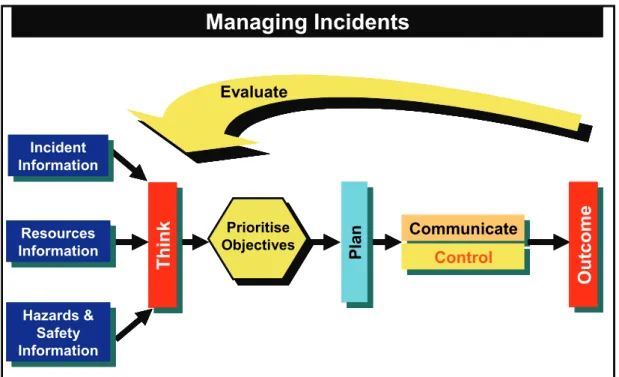
3.19 This process is clearly identified in the Managing Incidents Decision-making System described within the Fire Service Manual: Volume 2 - Operations Incident Command.
3.20 The importance of using a harmonised approach is highlighted by the need to ensure that operational risk information can be shared and understood across Fire and Rescue Services in England and other parts of the United Kingdom. This is emphasised by the increasing integration of operational response, through the continuing expansion of intraoperability through mutual aid arrangements and national resilience capabilities.
3.21 Fire and Rescue Services should ensure that they have at a strategic level, clearly defined responsibility for policies and procedures for the
management of operational risk information as part of an integrated approach to managing the risk and ensuring safe systems of work for all employees.
3.22 A Fire and Rescue Service’s Information Technology strategy for the
management of critical risk information should include tools and techniques for security, storage, information sharing, audit and review, and delivery of data to support effective and efficient management of operational incidents. The strategy should also include formalised data sharing protocols with other Category 1 and 2 responders to ensure timely and efficient exchange of accurate data within a secure system and to support interoperability at incidents.
Operational guidance review protocols
3.23 This operational guidance will be reviewed for its currency and accuracy three years from date of publication. The Operational Guidance Programme Board will be responsible for commissioning the review and any decision for revision or amendment.
3.24 The Operational Guidance Programme Board may decide that a full or partial review is required within this period.
SECTION 4
Legal framework
Introduction
4.1 This section does not contain detailed legal advice about the legislation. It is a summary of the relevant legislation, as applied to Fire and Rescue Authorities. It is recognised that the range of legislation and guidance that could impact on the operational responsibilities of the Fire and Rescue Authority is extensive and each Authority should seek guidance from their own legal advisors. 4.2 When considering the legal framework it is essential to recognise that any
definitive interpretation of the legal roles and responsibilities imposed by legislation can only be given by a court of law.
4.3 The adoption of the principles set out in this guidance will assist Authorities in achieving suitable and sufficient risk control measures such as those referred to in this and other similar documents. !
Primary fire and rescue service legislation
FIRE AND RESCUE SERVICES ACT 2004
4.4 This provides that Fire and Rescue Authorities must make arrangements for obtaining necessary information for the purposes of: extinguishing fire and protecting lives and property from fires in its area (Section 7); rescuing and protecting people from harm from road traffic accidents in its area (Section 8); or for dealing with any other emergency function other than fires and road traffic accidents in its area, conferred upon them under Section 9. It is, therefore, worthy of particular note that this guidance is not solely directed towards information for fire fighting.
4.5 Section 45 provides the powers of entry for an Authorised Officer to enter a premises at any reasonable time for the purposes of obtaining information needed to discharge the functions of Sections 7, 8 or 9 or if there has been a fire in the premises. Where an Authorised Officer enters a premises he may: take with him any other persons, and any equipment, that he considers
necessary; or require any person present on the premises to provide him with any facilities, information, documents or records, or other assistance, that he may reasonably request.
The Fire and Rescue Services (Emergencies) (England) Order 2007
4.6 Article 4 (c) of the order requires that arrangements are made for obtaining necessary information for the purposes of the duties imposed by the Order, including: (Article 2) removing chemical, biological, or radio-active
contaminants from people and the containment of water used for these purposes and to ensure that reasonable steps are taken to prevent or limit serious harm to the environment: (Article 3), rescuing people who may be trapped in the event of such incidents as collapsed buildings or structures or emergencies involving a train, tram or aircraft and protecting them from serious harm. The Order also obliges Authorities to use their specialist CBRNE (Chemical, Biological, Radiological, Nuclear and high- yield Explosives) or USAR (Urban Search And Rescue) resources outside their own areas to an extent reasonable for dealing with a CBRNE (chemical, biological, radiological, nuclear and high- yield explosives) or USAR (urban search and rescue) emergency (Article 5).
Civil Contingencies Act 2004
4.7 Under the provisions of the Act, Fire and Rescue Authorities are designated as Category 1 responders and have the duty to: assess the risk of an
emergency (as defined by the Act) occurring; and assessing the risk and considering whether plans should be modified in light of the risk assessment as often as necessary.
4.8 Section 2(1) states, among other things, that Fire and Rescue Authorities shall maintain plans for the purpose of ensuring that if an emergency occurs or is likely to occur the Authority is able to perform its functions so far as necessary or desirable for the purpose of preventing the emergency, reducing, controlling, mitigating its effects or taking other action in connection with it.
4.9 The Act should be read together with The Civil Contingencies Act 2004
(Contingency Planning) Regulations 2005 (no. 2042), which provide guidelines to local responders as to the content of their duties and how those duties can be carried out
The Civil Contingencies Act 2004 (Contingency Planning) Regulations 2005
4.10 The Regulations state that Fire and Rescue Authorities may facilitate cooperation by entering into protocols with each other (Regulation 7), that Authorities may perform duties under Section 2(1) jointly with one another and make arrangements with one another for the performance of that duty (Regulation 8).
4.11 These Regulations also set out clear responsibilities for Category 1 and Category 2 responders to participate in local resilience forums, to co-operate and share relevant information with Fire and Rescue Authorities.
Primary health and safety at work legislation
Corporate Manslaughter and Corporate Homicide Act 2007
4.12 Fire and Rescue Authorities will be criminally liable for the death of an employee if the way in which they manage or organise themselves.
amounts to a gross breach of the duty of care owed to employees, and
the gross breach causes an employees death.
Health and Safety at Work etc Act 1974
4.13 This Act applies to all employers in relation to health and safety. It is a wide ranging piece of legislation but in very general terms, imposes the general duty on Fire and Rescue Authorities to ensure, so far as is reasonably practical, the health, safety and welfare at work of all of their employees.
Management of Health and Safety at Work Regulations 1999
4.14 These Regulations require employers to: make a suitable and sufficient assessment of the risks to their employees and others (Regulation 3); provide appropriate procedures (Regulation 8); and provide employees with information on the assessment of the risks, the preventative and protective measures and the procedures provided (Regulation 10).
4.15 Regulation 9 requires the employer to ensure that any necessary contacts with external services are arranged, particularly as regards first-aid,
emergency medical care and rescue work. In practice, few employers or responsible persons fully understand these duties and discharge them adequately, so as to enable Fire and Rescue Authorities to satisfy their duty under the 2004 Act to make suitable arrangements to obtain the necessary information.
4.16 Regulation 10, require an employer is required to provide his employees with, among other things, comprehensible and relevant information on: the risks to their health and safety identified by the assessment; the
preventative and protective measures; the procedures for serious and imminent danger and for danger areas; the identity of those persons
nominated to implement the above mentioned procedures and evacuations etc; and any risks drawn to the attention of the employer by virtue of co-operation with other employers under Regulation 11.
4.17 Assessments of risk must involve an assessment of the hazards that may be encountered. In many cases commonly occurring or easily identifiable hazards can be dealt with using generic or standard operating procedures without recourse to “site specific” information. Where this is not the case, site specific information must form part of the risk assessment, and the risks, procedures and protective and preventative measures must be provided to employees.
Other health and safety legislation
Provision and Use of Work Equipment Regulations 1999
4.18 Fire and Rescue Authorities are required to ensure that work equipment is constructed or adapted as to be suitable for the purpose for which it is used or provided. Fire and Rescue Authorities have to have regard to the working conditions and to the risks to the health and safety of employees which exist in the premises in which the equipment is to be used and any additional risk posed by the use of that equipment. The Regulations also contain
provisions about maintenance, inspection, specific risks, information and instructions and training regarding work equipment.
Control of Asbestos Regulations 2006 and Control of Asbestos Regulations 2012
4.19 Fire and Rescue Authorities must ensure that adequate information, instruction and training is given to those of employees who are or who are liable to be exposed to asbestos, or who supervise such employees .
4.20 Regulation 4 of the regulations places a number of requirements on the person who has the duty (i.e. the "dutyholder") these includes:
(9) The measures to be specified in the plan for managing the risk shall include adequate measures for –
(c) ensuring that information about the location and condition of any asbestos or any such substance is –
(ii) made available to the emergency services.
4.21 The Health and Safety Executive Approved Code of Practice relating to Regulation 4 provides guidance to the duty person
.
106. Information on the location and condition of any known, or presumed, asbestos-containing materials must be made available to the emergency services. The fire services in particular need to be made aware that asbestos-containing materials are in the premises so that they can take the appropriate precautions in an emergency.
107. The fire services are the most likely of the emergency services to disturb asbestos-containing materials or come into contact with disturbed asbestos, so they should be contacted to see what information they want, in what form they would like it, and if they would like the information to be sent to them.
Regulatory Reform (Fire Safety) Order 2005
4.22 Article 16 of the Order requires that where dangerous substances are in or on premises, in certain circumstances the responsible person must ensure that information on emergency arrangements is available and made
available to relevant accident and emergency services to enable those services to prepare their own response procedures and precautionary measures.
4.23 Article 37 of the Order requires that where luminous tube sign cut off switches must be placed, coloured or marked so as to satisfy the fire authority. The responsible person must give suitable notice to the fire authority showing the cut-off switch location, colour and marking.
4.24 Article 38 of the Order requires that in order to safeguard the safety of firefighters in the event of a fire, the responsible person must ensure facilities, equipment and devices used by or used for the protection of fire-fighters are maintained and in good repair.
The management of data and information
Data Protection Act 1998
4.25 The Act prescribes appropriate arrangements for storing, obtaining, holding, use or disclosure of personal information of individuals. Personal data may be obtained directly for example by: obtaining contact information for
individuals in respect of specific sites, or contact details on lists of specialist advisors or indirectly, by listing premises or locations where the
circumstances of the individuals may identify personal information, such as persons residing in a vulnerable persons refuge, or for example, where their form of medical treatment results in the Fire and Rescue Authority holding information such as involving medical gases and that information may be regarded as personal information. Fire and Rescue Authorities gathering information that includes personal data appear to be data controllers, as defined by the Act and have duties in relation to that data.
The Freedom of Information Act 2000
4.26 This Act is complementary to the Data Protection Act. Fire and Rescue Authorities are listed in Schedule II of the Freedom of Information Act as a public authority to which the Act applies. Any person making a request for information to a public authority is entitled to be informed in writing by the public authority whether it holds information of the description specified in the request, and if that is the case, to have that information communicated to him/her.
4.27 There is significant guidance in relation to the security of information and this matter is covered more comprehensively in Section 4 of this guidance. In the context of the Freedom of Information Act, there are clear exceptions to disclosure. Section 30(1) states that information is exempt where it is obtained in relation to a public authority’s functions as conferred by an enactment.
4.28 Fire and Rescue Authorities should take legal advice as to whether the exemption provisions in the Data Protection Act provide gateways for disclosure, and conversely under the Freedom of Information Act for non-disclosure in specific circumstances where applications for information are made to such Fire and Rescue Authorities.
Related guidance
4.29 The breath of legislation which may impact on the gathering, storing and use of operational risk information is wide ranging. In support of legislation there is in general a range of further guidance and information published by Government or other agencies. Fire and Rescue Authorities should take into account this guidance when planning and undertaking their various
legislative responsibilities.
4.30 The listing below highlight some of the related guidance, the list is not exhaustive:
National Operational Guidance for the Fire and Rescue Service:
- Fire Service Manual Volume 2 (3rd edition) Incident Command
- Health and Safety Guidance for Managers - Generic risk assessments
- Fire Service Manual Volume 3 Building Construction
Integrated Risk Management Plan (IRMP) Guidance Notes:
- Integrated Risk Management Planning Steering Group Integrated Risk Management Planning: Policy Guidance – Wildfire
- Integrated Risk Management Planning Steering Group Integrated Risk Management Planning: Policy Guidance - Business Continuity
Management
- Integrated Risk Management Planning Steering Group Integrated Risk Management Planning: Policy Guidance - Environmental Protection - Integrated Risk Management Planning Steering Group Integrated Risk
Management Planning: Policy Guidance - Protection of Heritage Buildings and Structures.
Building Regulations 2000
- Regulation 38 requires that where building work is undertaken involving the erection or extension of a relevant building, fire safety information should be given to the responsible person at the completion of the project, or when the building is first occupied.
- Section B5 of Approved Document B to the Building Regulations provides detailed guidance on the passive and active systems that should be provided in new or materially altered buildings to assist firefighters.
Health and Safety
- Health and Safety Guidance note 65 - Successful health and safety management
http://www.hse.gov.uk/pubns/books/hsg65.htm Data and Information Management
- Data Protection & Sharing – Guidance for Emergency Planners & Responders
4.31 The Fire Service College maintain a bibliography of technical guidance to which Fire and Rescue Services can refer (Fire Service manuals, Fire Service circulars, Dear Chief Officer Letters, technical bulletins, British and European Standards, Approved Codes of Practice, Health and Safety Executive guidance). In addition, technical guidance is available on the Department for Communities and Local Government website.
SECTION 5
Strategic perspective
5.1 The commitment and leadership of the strategic management team is essential to the success of any management system. The overarching policy should set a strategic direction demonstrating how the duty for the provision of operational risk information is linked to the duties of the work force and other emergency responders and the communities they serve.
5.2 Policies and procedures need to be in place to reflect that all the service activities are part of an integrated approach to managing the risk; thereby ensuring safe systems of work for all employees; that all relevant
information is available for those who have a legitimate need for access to the information; and that these policies and procedures are ‘owned’ at strategic management level.
5.3 In developing the policy, the organisation should consider:
its legislative duties, outlined in Section 4 of this guidance the co-ordination with other ‘core’ function policies, notably health and safety, integrated risk management, fire safety enforcement and civil resilience
the needs of those working in the organisation and the hazards they face
the historical and current performance of the organisation in respect of the provision of operational risk information and the impact on health and safety and community safety
the opportunities and needs for continual improvement the views of interested parties including other emergency responders; and
confirmation / establishment of realistic and achievable objectives.
5.4 The policy aims and objectives should include:
the prevention of injury and ill health of firefighters and other emergency responders
management and mitigation of risks in the community
compliance with the legal duties on Fire and Rescue Authorities in relation to operational risk information
compliance with formal guidance and “best practice” models; and
audit and review mechanisms.
5.5 The policy should take into account the legal responsibilities placed on the Fire and Rescue Authorities in particular the requirement that all relevant data held by the Fire and Rescue Service should be available and used to reduce and manage the risk – whether this be to firefighters, other service staff, or to others for which the Fire and Rescue Authority have
responsibility.
5.6 The Fire and Rescue Service should ensure that it has, at a strategic level, clearly defined responsibility for policies and procedures for the management of operational risk information as part of an integrated approach to managing the risk and ensuring safe systems of work for all employees including a responsibility to:
determine specific responsibility for operational risk information and with a defined role in terms of establishing, implementing and maintaining processes, including audit and review in line with the approach advocated by HSG 65
determine and make available those resources required to implement, maintain and develop these processes
ensure there is clarity of responsibility between partner
organisations, different functions in the Fire and Rescue Service and that the roles and responsibilities of managers are clearly defined
ensure that there are clear documentation, document control and security procedures in place
ensure that the allocation of the roles and responsibilities takes account of the competency, level of authority and capacity of individual employees
ensure a systematic review of all aspects of data and information management (in relation to the provision of
information for operational pre-planning, incident management and post-incident analysis) is undertaken
ensure the continuing monitoring of the performance of relevant personnel, including assessments of their competency and use of the system; and that any gaps in the effective management of the system are identified; and
ensure that there are effective communication and data sharing protocols within the organisation, and between the partner organisations involved in supplying and receiving operational risk information and intelligence.
5.7 Organisational planning should establish, implement and maintain procedures for ongoing hazard identification, risk assessment and determination of the necessary risk reduction controls. In the context of operational risk information the hazard identification and risk assessment processes should take into account the:
range of possible activities related to fire fighting, attending road traffic collisions and other emergencies and the exposure to hazards that this may involve
range of employees who may be involved in the use of the operational risk information at incidents, including those who may be working under the control of the Fire and Rescue Service
capabilities, and likely behavioural responses, of those employees and other persons who are likely to be involved incident command system and management procedures that are used; and
protective equipment, vehicles, rescue and fire fighting equipment and any limitations of employees and their equipment.
5.8 As part of the integrated risk management plan and Firelink requirements, the policy should include provision of an effective Information technology strategy; including an integrated data / information management strategy, for:
obtaining analysing storing
security, and
distributing (including to neighbouring Fire and Rescue Services and partner organisations),
the information and data that is likely to be required within an operational environment for pre-planning, incident management and post-incident analysis purposes.
5.9 In order to judge the implementation and effectiveness of the
arrangements for the provision and management of operational risk information, procedures should be in place to monitor and measure performance on a regular basis. The procedures should:
provide qualitative and quantitative measures of performance for each stage of the procedures, including post incident reviews or “debriefs”
regularly monitor and report on the measures provided relating to the performance of the plan; and
record and communicate the results of the monitoring; to provide information on how the system operates in practice, to identify areas where corrective action is required, to provide a basis for continual improvement and provide feedback and motivation.
5.10 Strategic managers must ensure that policies and procedures developed for managing all aspects of operational risk information are consistent and supportive of data protection and information system security (See Section 7 Security of Information).
5.11 The management of operational risk information must also take into account the existing and future needs for interoperability and mutual aid between neighbouring Fire and Rescue Services and other Category 1 responders, together with an assessment of the financial, human and other resources specific to operations, including a plan for appropriate technology that takes into account the future functionality requirements and the appropriate expertise and training of staff.
5.12 To be effective, new management systems should be capable of integrating with existing management systems or disciplines within the organisation, in particular, the management of health and safety. Fire and Rescue Services should consider the integration of fire safety and
operational data capture forms and ensure that the organisational skills are appropriately applied at this critical stage in the risk management
SECTION 6
Data and information management –
continual improvement
6.1 The guidance given in this section focuses on the provision of a structured management system for the effective management of operational risk information and may be used to support a review of existing systems and / or to implement revised arrangements.
6.2 This operational guidance has been designed is to assist Fire and Rescue Authorities to develop a framework of continual improvement in respect of risk information management - this could be achieved by utilising the approach promoted by ISO 9001 and the British Standard Occupational health and safety management systems – requirements. The provision of operational risk information is an essential component of employee health and safety; therefore, there would be considerable benefit in following these Standards.
6.3 The development and implementation of an operational risk information management system must be recognised as a ‘shared’ process, involving a wide range of staff in the various stages of information gathering,
assessment and risk mitigation. Particularly important are ‘end users’, the firefighters, first responders and those other personnel who may
subsequently command and support operations. It is therefore important that the implementation of an operational risk information management system is both owned and led by a member of the senior management team of the Fire and Rescue Service.
6.4 An initial status review should be conducted to provide information on the scope, adequacy and potential gaps within the Fire and Rescue Service’s current systems. The review should include identification of existing management arrangements in place in respect of the policy, planning, implementation, operation and audit and review processes that support continual improvement.
6.5 Arrangements should also be made to review the circumstances where non-conformity is identified, either as a result of training, at incidents or through regular supervision of the arrangements. The reasons for non-conformity should be communicated so that lessons learned by one part of the organisation can benefit the entire organisation and feed the process of continual improvement. It is recommended that these findings are shared with other Fire and Rescue Services and other emergency
6.6 Fire and Rescue Services should ensure that those involved in
undertaking the operational risk information processes are competent to: accurately identify hazards to firefighters, society, environment, community, heritage or other risk groups
are capable of making professional judgements taking account of the availability of information, the severity and likelihood of risk being assessed and the critical nature of the risk
management options
understand the range of risk management options available to mitigate the risk
understand their responsibility for the safety of others and the effect of their actions on the effectiveness of the safety system understand the legislative framework within which the Fire and Rescue Service operates
are appropriately motivated and encouraged to work in a safe manner; and
are supported in addressing any competency gaps that are identified.
SECTION 7
Security of information
7.1 Security of information is a much wider subject than the provision and use of operational risk information. There is a range of legislation this is
relevant to the gathering, dissemination, storage and protection of information. Fire and Rescue Authorities and their Fire and Rescue Services will need to ensure that security policies, protocols, procedures and systems are in place in relation to operational and other information and compliance with the appropriate legislation.
7.2 The UK Government’s anti-terrorism strategy (CONTEST) is built upon four key elements: pursue, prevent, protect and prepare. Fire and Rescue Service activity is a part of the “protect” and “prepare” elements.
7.3 The Centre for the Protection of National Infrastructure (CPNI) is the Government authority which provides protective security advice to businesses and organisations across the national infrastructure.
7.4 The Centre for the Protection of the National Infrastructure has produced guidance that provides a single source of policy and guidance on the Information Assurance (IA) risk management and accreditation of Information Systems (IS). The Centre for the Protection of the National Infrastructure guidance draws the different strands together and places Information Assurance in core business; providing advice and guidance on the process of risk management; targeting a wide audience (not just
security specialists and central government).
7.5 Of particular relevance is the strand of work under the “Protect” element which relates to the protection of high profile targets for terrorism. These include Critical National Infrastructure (CNI) (those infrastructure assets (physical or electronic) that are vital to the continued delivery and integrity of the essential services upon which the UK relies) and crowded places, for which there are separate procedures for the assessment of risk and sharing and protecting information with partner agencies. “Site specific” information on these items will require particular care in dealing with security of the information that will be required for dealing with an emergency.
7.6 An integrated protective security strategy for the UK has been jointly
developed by the Office of the Chief Fire and Rescue Adviser and the Chief Fire Officer’s Association and covers three key elements:
• Personnel security
• Physical security
• Information security.
7.7 Assistance with information security will be provided in the form of advice,
guidance, policies and procedures to reduce the vulnerability of the Fire and Rescue service to unauthorised access to hard copy and electronic data, as well as assistance concerning the protective marking of materials.
7.8 Arrangements made for the security of operational risk information must be
consistent with the Protective Marking Framework. Any site specific risk information imported into a command and control system will need to be assessed in order to identify its security (protective) marking. The information usually falls into groups or levels of importance depending upon the level of risk identified. National guidance is currently in development with the office of the Chief Fire and Rescue Advisor. The following levels are identified in
HMG’s Security Policy Framework: !
www.cabinetoffice.gov.uk/national-security V4.0 December 2010: • TOP SECRET • SECRET • CONFIDENTIAL • RESTRICTED • PROTECT
• Unmarked material is considered ‘unclassified’. The term
‘UNCLASSIFIED’ or ‘NON’ or ‘NOT PROTECTIVELY MARKED’ may be used to indicate positively that a protective marking is not needed. These markings can be applied to any government assets, although they are most commonly applied to information held electronically or on paper documents. The method used to assess these principles within information systems is expressed in business impact levels.
7.9 Site specific risk information may need to be security assessed to ensure it is suitable for use via mobile data terminals.
7.10 There may be sites that will not allow Fire and Rescue Services to have copies
of floor plans or other information due to their security requirements. In this instance an agreement may be made where the information required will be provided upon arrival of the Fire and Rescue Service in the event of an incident. Operational crews responding to these sites should be made aware of these arrangements
7.11 Further guidance regarding the protective marking of specific risk information
is contained in the Cabinet Office publication Security Vetting and Protective
SECTION 8
Practical considerations
Terminology
8.1 A common standard for terminology and symbology is critical to effective interoperability between emergency responders and other supporting organisations. Without a common standard of approach and dialogue it would prove extremely difficult to maintain any real level of interoperability between the Fire and Rescue Services and other emergency responders and supporting organisations. This includes the technical aspects of communications across the emergency services.
8.2 Without agreed standard terminology and symbology there is a risk of misunderstanding between emergency responders and supporting
organisations. At best this can lead to delays in obtaining support services and at worst people could be put at serious risk.
8.3 Terminology and symbology issues include:
words, phrases, symbols or graphics with different meanings or context
words, phrases, symbols or graphics with no meaning within other organisations.
8.4 The guidance issued in relation to the Civil Contingencies Act on common terminology has sort to provide some standardisation for interoperability. See : www.cabinent office.gov.uk/cplexicon
Address and location identifiers
8.5 A key factor with regard to the identification and cross-mapping of
premises / site risk information between systems, organisations, etc is the provision of a unique identifier in relation to its location / address.
8.6 The Local Land and Property Gazetteer has been designed to help in the identification of address intelligence and provides a reference on how data should be captured in a consistent manner across England and Wales and also in the context of the DNA-Scotland initiative.
8.7 The Local Land and Property Gazetteer forms a central or corporate address list providing a unique and unambiguous identifier for each entry. This central address list is made up from key creating authority service areas responsible for the official street naming, numbering and revenue collection processes. Additional Address Change Intelligence is also introduced from other local authority statutory functions such as building and development control, planning and land charges which affect the real world objects included in the gazetteer.
8.8 The locality and town data contained in the Local Land and Property Gazetteer is not based on postal localities and post towns as defined by Royal Mail, but reflects geographic identifiers which assist in the
identification through a series of geographic instructions or real world locations in common use.
8.9 The Local Land and Property Gazetteer custodian provides continual updates through the National Land and Property Gazetteer which provides a definitive unique national address list of land and property that conforms to BS 7666.
8.10 A National Address Gazetteer is being developed that aims to combine all local authority Local Land and Property Gazetteer data, and central
government data that is linked to Ordnance Survey address products. This will provide a single definitive database and reduce missed or mismatched addresses. Further information may be found on the Geoplace website:
www.geoplace.co.uk.
8.11 Therefore, as premises based information is held within numerous
systems within each Fire and Rescue Service and in order to ensure that both accurate and relevant information is used in an operational
environment, consideration should be given to the production of unique premises identification and that data is synchronised where necessary.
Data / information capture and use
8.12 Information may be sought and gathered or reviewed directly through inspection or site visits, or indirectly by collecting information from responsible persons, competent persons, occupiers, owners or other agencies. Information may be supplied from external sources without the Fire and Rescue Service proactively seeking information. Appropriate procedures should be in place for gathering and reviewing such information, and ensuring that relevant information, irrespective of its source and the reason why it was collected.
8.13 In particular, Fire and Rescue Services should ensure the integration of fire safety and operational data capture is incorporated into the process and ensure that the organisational skills are appropriately applied at this critical stage. An example ‘data capture fields’ template is included as Appendix C.
8.14 Analysis of the information will inform decisions made about how and when the information should be used, and how it should be supplemented with other information, such as generic risk assessments, standard
operating procedures etc. In addition, following the analysis, the
information may be used for training or planning, and may be shared with other emergency services or local authorities.
8.15 Operational risk information can be used at many levels of planning such as local premises site specific pre-planning, generic risk and tactical plans, major incident plans, multi-agency plans, integrated risk management plans. In addition, operational risk information should take into account the plans and resources of other Category 1 & 2 responders and other agencies.
8.16 It is considered that where operational risk information is captured, stored and displayed by use of electronic systems the management of large quantities of data is possible and can be structured to give immediate access to key information and prevent information overload for the users. However for those Fire and Rescue Services using paper based systems to manage and deliver their operational information the quantity of data that will be available will be limited and therefore careful consideration must be given to the prioritisation and presentation of relevant information to support operational crews on the incident ground.
Data and information sources
8.17 One of the many challenges facing the Fire and Rescue Services in collecting operational risk information is how to process a potentially very large number of sites, (buildings, and other places where they may attend incidents) in order to identify those where the availability of accurate, relevant and timely information may be of value for any reasonably foreseeable incident. Many buildings, or other risks, may not require detailed site specific information to be held by the Fire and Rescue Service in order to expect a safe and successful outcome to operational interventions.
8.18 However, where the availability of such information is critical, the challenge for each Fire and Rescue Service is how to identify and prioritise for operational risk information purposes the large quantity of information that they, or their partners, hold and manage, without excluding any sites that may pose a risk.
8.19 Internal sources of information include the Fire Service Emergency Cover toolkit, fire safety management systems, incident data, local operational intelligence and community safety data.
8.20 External sources of information may include the Health and Safety Executive, planning and building control authorities, health authorities, Environment Agency, local strategic partnerships, and through local area agreements other organisations such as English Heritage, transport and utility companies.
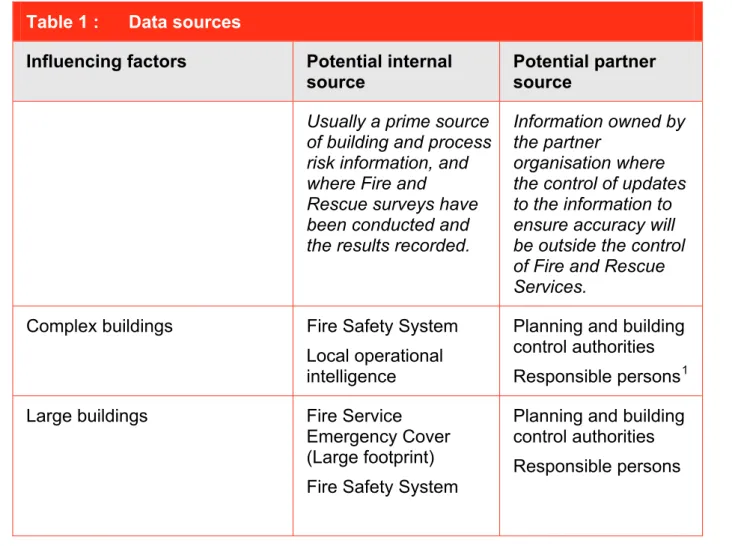
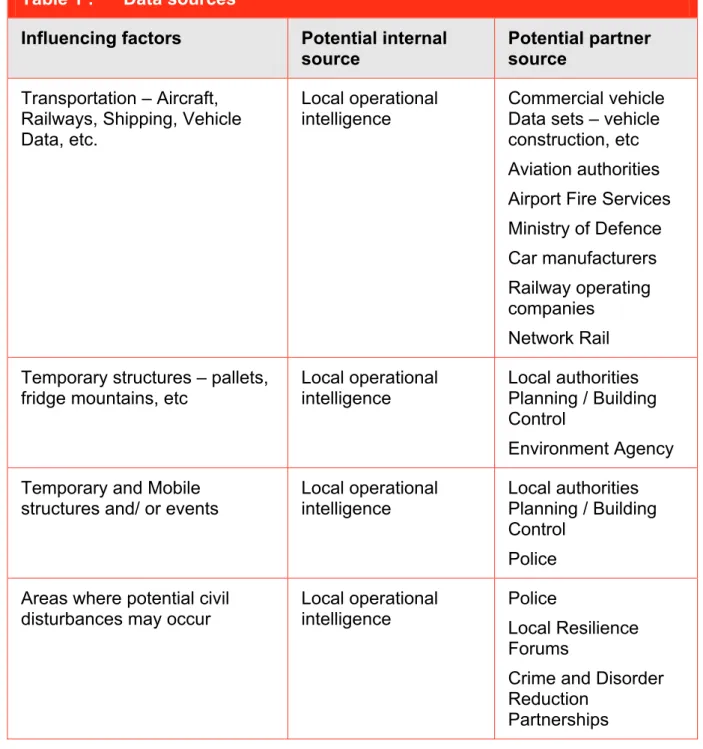
8.21 Examples of data sources are listed in Table 1 below.
Table 1 : Data sources
Influencing factors Potential internal source
Potential partner source
Usually a prime source of building and process risk information, and where Fire and
Rescue surveys have been conducted and the results recorded.
Information owned by the partner
organisation where the control of updates to the information to ensure accuracy will be outside the control of Fire and Rescue Services.
Complex buildings Fire Safety System Local operational intelligence
Planning and building control authorities Responsible persons1 Large buildings Fire Service
Emergency Cover (Large footprint) Fire Safety System
Planning and building control authorities Responsible persons
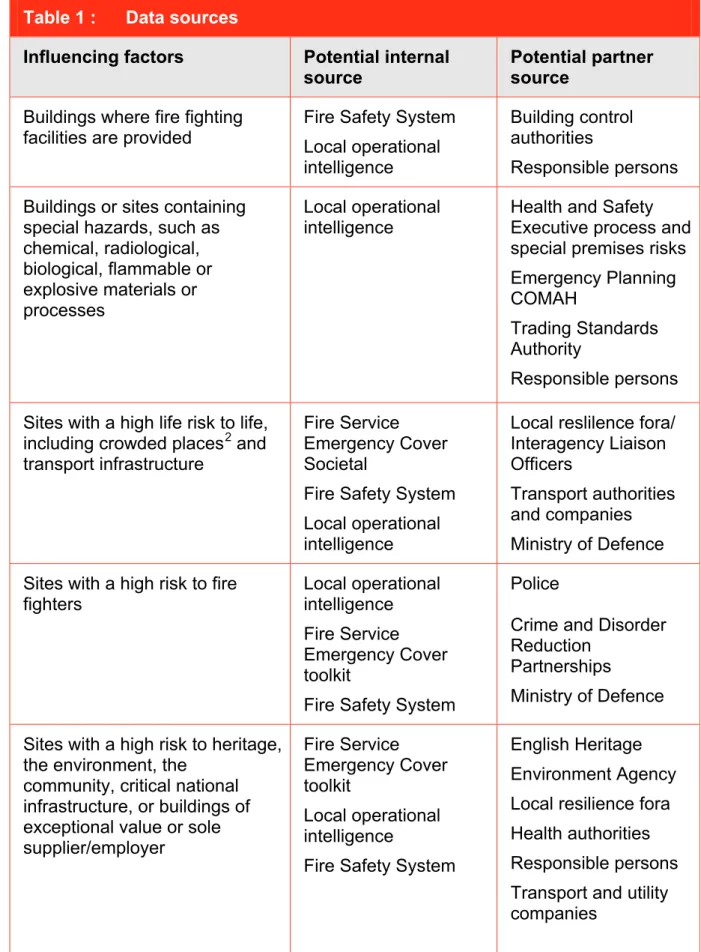
Table 1 : Data sources
Influencing factors Potential internal
source Potential partner source
Buildings where fire fighting
facilities are provided Fire Safety System Local operational intelligence
Building control authorities
Responsible persons
Buildings or sites containing special hazards, such as chemical, radiological, biological, flammable or explosive materials or processes
Local operational
intelligence Health and Safety Executive process and special premises risks Emergency Planning COMAH
Trading Standards Authority
Responsible persons
Sites with a high life risk to life, including crowded places2 and transport infrastructure
Fire Service Emergency Cover Societal
Fire Safety System Local operational intelligence
Local reslilence fora/ Interagency Liaison Officers
Transport authorities and companies Ministry of Defence Sites with a high risk to fire
fighters Local operational intelligence Fire Service Emergency Cover toolkit
Fire Safety System
Police
Crime and Disorder Reduction
Partnerships
Ministry of Defence
Sites with a high risk to heritage, the environment, the
community, critical national infrastructure, or buildings of exceptional value or sole supplier/employer Fire Service Emergency Cover toolkit Local operational intelligence
Fire Safety System
English Heritage Environment Agency Local resilience fora Health authorities Responsible persons Transport and utility companies
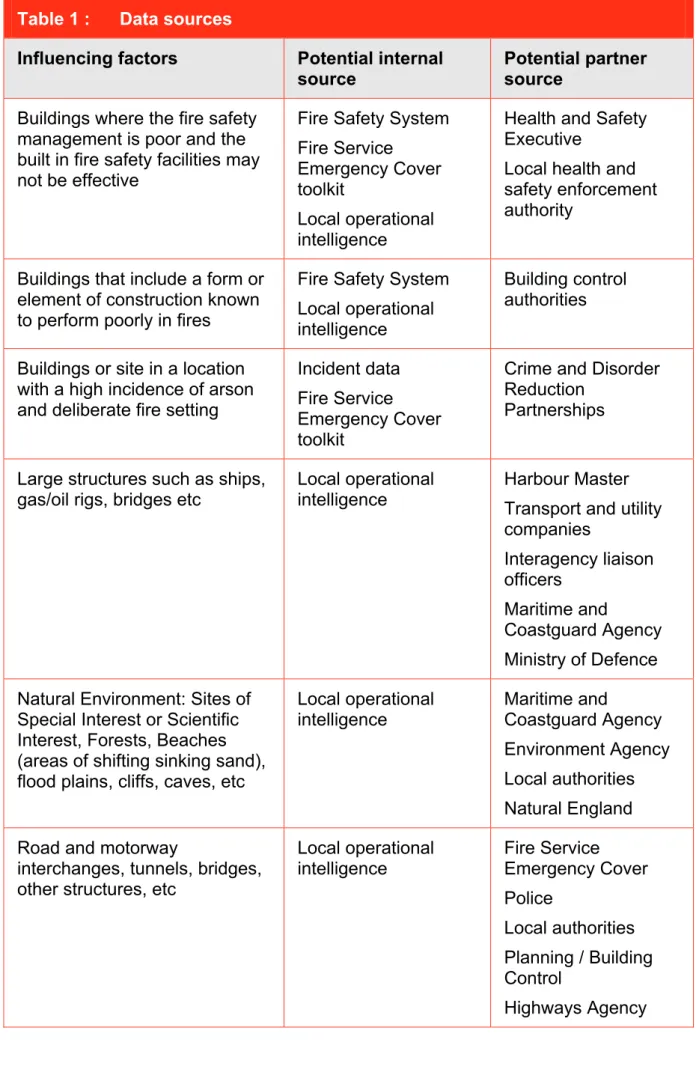
Table 1 : Data sources
Influencing factors Potential internal
source Potential partner source
Buildings where the fire safety management is poor and the built in fire safety facilities may not be effective
Fire Safety System Fire Service
Emergency Cover toolkit
Local operational intelligence
Health and Safety Executive
Local health and safety enforcement authority
Buildings that include a form or element of construction known to perform poorly in fires
Fire Safety System Local operational intelligence
Building control authorities
Buildings or site in a location with a high incidence of arson and deliberate fire setting
Incident data Fire Service Emergency Cover toolkit
Crime and Disorder Reduction
Partnerships
Large structures such as ships, gas/oil rigs, bridges etc
Local operational intelligence
Harbour Master Transport and utility companies Interagency liaison officers Maritime and Coastguard Agency Ministry of Defence Natural Environment: Sites of
Special Interest or Scientific Interest, Forests, Beaches (areas of shifting sinking sand), flood plains, cliffs, caves, etc
Local operational intelligence Maritime and Coastguard Agency Environment Agency Local authorities Natural England
Road and motorway
interchanges, tunnels, bridges, other structures, etc
Local operational
intelligence Fire Service Emergency Cover Police
Local authorities Planning / Building Control
Table 1 : Data sources
Influencing factors Potential internal
source Potential partner source
Transportation – Aircraft, Railways, Shipping, Vehicle Data, etc.
Local operational
intelligence Commercial vehicle Data sets – vehicle construction, etc Aviation authorities Airport Fire Services Ministry of Defence Car manufacturers Railway operating companies
Network Rail Temporary structures – pallets,
fridge mountains, etc
Local operational intelligence Local authorities Planning / Building Control Environment Agency Temporary and Mobile
structures and/ or events
Local operational intelligence Local authorities Planning / Building Control Police Areas where potential civil
disturbances may occur
Local operational intelligence
Police
Local Resilience Forums
Crime and Disorder Reduction
Fire Service Emergency Cover Model
8.22 Some idea of the scale of the issue can be obtained from looking at the number of “Other Buildings3” contained in the Fire Service Emergency Cover toolkit. A trial search in a small sample of medium to large sized Fire and Rescue Services indicated that there are 35,000 to 45,000 Other Buildings in the database.
8.23 The “Other Buildings” module in the Fire Service Emergency Cover toolkit holds information that can identify buildings with a high societal risk and those presenting a high potential property loss. The Fire Service Emergency Cover Toolkit also contains information on road interchanges, tunnels, bridges, rail infrastructure, river sites, flood plains, cliffs and areas of shifting sinking sand where it is reasonably foreseeable that rescues or other emergency activities may take place. In addition where surveys have been conducted and the results recorded, Fire Service Emergency Cover toolkit records may contain “flags” that identify that the building or site is:
• a risk to firefighters
• a risk to or from the environment • a heritage risk
• a critical national sole supplier
• of exceptional value (higher than expected for the type of building)
• where hazardous materials are stored or used.
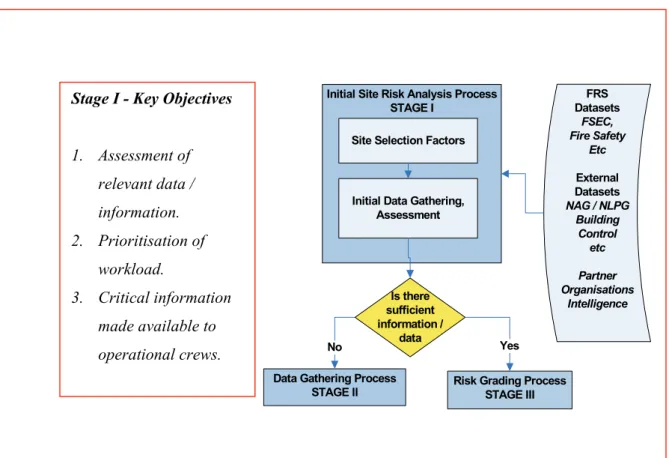
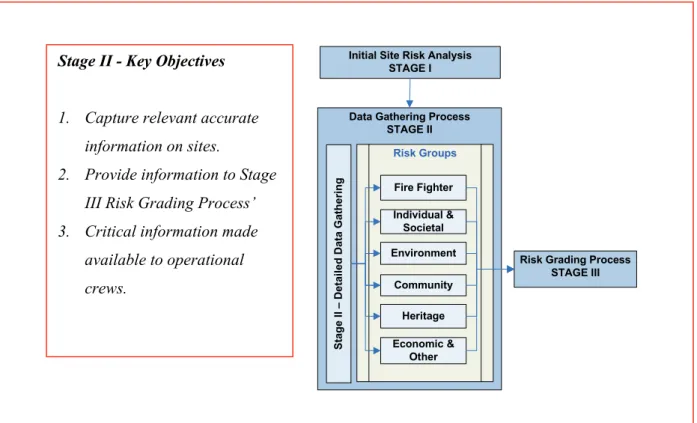
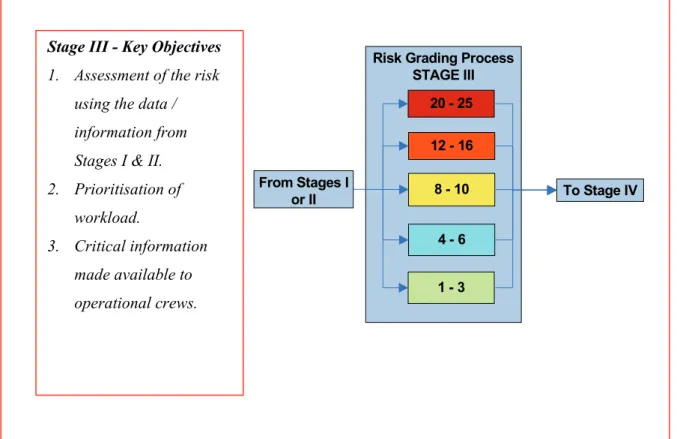
8.24 The Fire Service Emergency Cover Toolkit www.fsec.org has been modified to enable it to undertake the risk analysis elements in Stages I, II and III of the Provision of Operational Risk Information System.
Fire safety data bases
8.25 Fire and Rescue Services also hold databases of fire safety records relating to premises, where some fire safety regulatory or advisory activity may have been undertaken. There may be an overlap between the Fire Service Emergency Cover toolkit database and local fire safety databases.
8.26 Structured queries of fire safety databases may be able to provide lists of premises such as:
complex buildings large buildings
buildings where fire fighting facilities are provided
buildings or sites containing special hazards, such as chemical, radiological, biological, flammable or explosive materials or processes
sites with a high life risk to occupiers
sites where a specific risk to firefighters has been identified sites with a high risk to heritage, the environment, the
community, or buildings of exceptional value or sole supplier / employer
buildings where the fire safety management is poor and / or the built-in fire safety facilities may not be effective
buildings that use or include a form or element of construction known to perform poorly in fires.
8.27 Appendix D outlines the Risk Scores and Qualitative Risk Bands given in Integrated Risk Management Planning Guidance Note No. 4, for
comparison with the scoring of the Individual and Societal Life Risk Groups, to assist in the subsequent management of visits for combined technical fire safety and operational risk information audit purposes.
Performance management
8.28 Periodic audit is a useful means to enable a deeper and more critical appraisal of the elements of the operational risk information system. The audits should be planned to determine whether the system has been properly implemented and maintained and is effective in meeting the organisation’s policy and objectives. The results of the audit should be reviewed to support continual improvement and to address weaknesses in the policy or organisation. Independent third party audit and validation should also be considered to ensure a robust review programme.
8.29 Performance indicators for qualitative and quantitative monitoring of organisational performance may be used as part of an on-going review process of the operational risk management system.
General
8.30 Each Fire and Rescue Service should ensure that there is a clearly defined protocol for the management of all risk data, and that those who are tasked with developing and implementing operational risk systems and databases have easy and immediate access to all of their ‘Internal’ data sources; and that they have established systems for readily obtaining and sharing data from, and with, ‘External’ organisations.
8.31 Fire and Rescue Services must decide what information should be given to operational crews when attending an incident.
8.32 The 2003 Chief Fire Officer’s Association (CFOA) national study into the provision of mobile data examined the information requirements for the roles that support incident ground operations. This identified the need to give operational crews accurate, timely and relevant information that related directly to the specific stages of the incident. The research
indicated that full consideration of the requirement to meet the demands of the various operational phases must be given in order to prevent
information overload for all those personnel involved in command and incident management, notably Incident Commanders.
8.33 Fire and Rescue Services that use electronic methods of capturing and storing operational site specific information should also give careful consideration to electronic file sizes. This is crucial as it is technically extremely difficult and sometimes impractical to send very large data files to appliances on the incident ground within acceptable time limits.
SECTION 9
Competency and training
Introduction
9.1 The guidance in this section is intended to assist in achieving a consistent approach within individual Fire and Rescue Services and between Fire and Rescue Services. This will enable the provision of operational risk information with a continuing emphasis on quality, founded upon common understanding and underpinning knowledge and improved intraoperability with other Fire and Rescue Services. Emphasising a consistent quality approach in turn
introduces the underlying requirement that those involved at the various
judgemental stages in the operational evaluation of risk information must have operational competency.
9.2 The guidance in this section is not intended to set out specific individual competencies or training methodologies. Rather it provides some principles which may be used to support the development of skill and knowledge acquisition.
9.3 Irrespective of whatever operational risk information management system is used, the provision of timely, accurate and relevant information is highly dependent on the competency of all those who have accountability and responsibility for operational risk reduction and safety.
9.4 The assessment of operational risk requires careful integration with other Fire and Rescue Service risk recording and assessment activities. It is therefore important that the assessment of operational risk is recognised as an essential element of the Integrated Personal Development System and the associated National Occupational Standards.
9.5 All of the personnel involved should be competent and have the appropriate skills to undertake risk assessment and utilise the outputs provided by the operational risk information management system. Individuals should be able to interpret and translate, information provided prior and during any incident into decisions and action. For some of those decisions, the outcome will have life safety implications and for many other decisions, these will be made in the pressured environment that results from time restrictions and scarcity or complexity of information.
9.6 This will ensure that those personnel involved have the necessary competencies to undertake their responsibilities, and will help create within the organisation a culture of awareness of the importance of the provision of risk information. This awareness should aim to encourage all staff to note deficiencies or changes that may affect operational
effectiveness and safety and to ultimately raise these matters within to enable appropriate action to be taken.
9.7 There are many tasks in an operational risk information management system where it may not be a relevant for all staff involved to have operational competence – for instance information communication technologists and non-operational community safety or technical fire safety staff. When utilising individuals, who are not required to have an operational competence as part of their role, it is important to recognise the limitations of their knowledge, skills or understanding of operational issues. The credibility and justification of the process will only be achieved if those who will use the operational risk information management system outputs have confidence in the process’s integrity and robustness.
9.8 Similar quality controls will need to be applied when utilising the information to gain familiarisation and execute planning assumptions. This activity, which also provides essential feedback, again requires
supervision and oversight by individuals having competency in operational tasks and incident command.
9.9 The overriding value of having accurate, timely and relevant information is to support Incident Command, decision making including selection and implementation of safe systems of work. It is therefore essential that staff at all levels become central participants in obtaining and selecting the information that they judge will ultimately be useful to them at incidents.
9.10 In addition to the skills and competencies related to operational decision-making, there are numerous other processes and activities where the assessment of the risk and likely outcomes in the event of a fire, or other emergencies, will benefit from the experience and knowledge of non-operational professionals. Building construction, building systems, fire protection arrangements, occupancy, use, manufacturing processes, etc, are common examples of areas of expertise that are not exclusively within the operational Fire and Rescue Service domain. It may be determined that a service’s own fire safety staff have sufficient capability, capacity and competency to meet local circumstances, whilst in other cases it may be decided that the services of other specialists or partner organisations should be utilised.
9.11 Competency standards chosen should be supported by reference to evidence or justification statements together with any other material used in choosing the standard. This material should be retained to demonstrate the rigor of the consideration and task matching undertaken.
9.12 Operational risk information should be used during all training and exercises to ensure that operational personnel are able to develop their skills in using the information in the operational environment. Further reading regarding incident command may be found in Fire and Rescue Manual: Volume 2 - Fire Service Operations Incident Command.
SECTION 10
Provision of operational risk
information system
Introduction
10.1 This section introduces a model approach, entitled Provision of
Operational Risk Information System (PORIS). This model provides a strategic framework that is compatible with other relevant data and
information systems such as the Incident Recording System, Fire Service Emergency Cover toolkit, generic risk assessments, fire safety data, and security guidance. The model provides a common methodology and approach to managing the identification, gathering, analysis, provision, audit and review of operational data, whilst allowing individual Fire and Rescue Services the flexibility to integrate its processes into their own systems.
10.2 Individual Fire and Rescue Services are free to develop their own systems for the management of operational risk information. However, it is
suggested that departure from the principles contained in this model should only be undertaken following a risk based assessment of an alternative, the outcome of which clearly illustrates that the legal responsibilities of the Fire and Rescue Authority have been met.
10.3 The Provision of Operational Risk Information System seeks to provide a common approach to operational planning and management of risk and has been developed to assist Fire and Rescue Services to:
meet their legislative responsibilities
maintain and where necessary improve their effectiveness and efficiency
manage the risk to their personnel
maintain interoperability with neighbouring Fire and Rescue Services and other Category 1 & Category 2 responders manage and mitigate other risks in the communities that they serve.
10.4 The Provision of Operational Risk Information System has been specifically designed to utilise existing data sets and supporting
information and constructed to enable a flexible working framework where principles, rather than hard and fast rules, are used to underpin the
methodology.
10.5 The Provision of Operational Risk Information System takes account of the need to identify and assess information, and its relevance to the operational pre-planning and management of risk to six risk groups.
These groups are summarised in Table 2.
Table 2 : The Provision of Operational Risk Information System - RISK GROUPS
Firefighter safety
The direct impact on the safety of firefighters (or other emergency responders working under the direction of the Fire and Rescue Services) who may be affected. Encompassing fatalities, injuries, illness or injury or damage to health.
Individual and societal
The personal safety of persons other than firefighters, or other emergency responders working under the direction of the Fire and Rescue Services, who may be directly affected (fatalities, injuries, illness, or injury or damage to health) or indirectly affected because of the strain on the health service.
Environment
The consequences from an onsite event which would result in
contamination or pollution of land, water or air with harmful biological / chemical / radioactive matter or oil, flooding, disruption or
destruction of plant or animal life.
Community
Encompassing the social consequences of an event, including availability of social welfare provision; disruption of facilities for transport; damage to property; disruption of the supply of money, food, water, energy, or fuel; disruption of an electronic or other system of communication; homelessness, evacuation, avoidance of behaviour; and public disorder due to anger, fear, and / or lack of trust in the authorities.