ISSN (e): 2250-3021, ISSN (p): 2278-8719
Vol. 07, Issue 09 (September. 2017), ||V1|| PP 37-44
Comparative Analysis and Simulation of a Hybrid PV/Diesel
Generator/Grid System for the Faculty of Engineering Main
Building, Rivers State University, Port Harcourt Nigeria.
*
Sigalo, Marvin Barivure
1, Nugha, Barivare Tee
2, Rilwan Usman
3Centre for Electrical Power System Research, Dept. Of Elecetrical Engineering, River State University Port Harcourt
Dept. Of Elecetrical Engineering, Modibbo Adama University Technology Yola Corresponding Author: Sigalo, Marvin Barivure
Abstract: The hybrid power system (HPS) is considered an effective option in terms of low cost of power
generation, reduced noise and gas emission, improved and reliable power supply using PV as the main power source and having diesel generator or the grid as a back-up power sources. An economic feasibility study and a complete design of hybrid system consisting of photovoltaic system (PV), a diesel generator and the grid as back-up, for the faculty of engineering of the Rivers State University main building using Homer software, has been presented in this paper. Other scenarios where also analysed in this paper to ascertain which one of them is appropriate, which was found to be PV/grid based on COE and other environmental factors. A simulation program was developed to optimize the sizes of the different components. Specifications of the hybrid components are then determined according to the optimized values. Solar radiation data are first considered, cost of different components, hourly solar radiation obtained from the solar GHI, temperatures and other design considerations are inputs of the Homer simulation program.Keywords
: Hybrid PV Systems, Diesel Generator, Grid System, Solar Radiation.--- --- Date of Submission: 17-08-2017 Date of acceptance: 08-09-2017 --- ---
I.
INTRODUCTION
Energy requirement has become a prerequisite to enhance income, improved life quality for individuals no matter their locations (Bahta, 2013). Frequent electricity outages, cost, poor, unreliable and unsecure supply of electricity has thus become a common trend with the Nigerian power distribution companies today. Developing countries in the line of a growing economy are in a much demand for electricity, to facilitate their industrial growth, sustainable economic growth of such countries, as electricity is the pivot of every growing economy. Hence, the quest for a better supply and availability of electricity has led to the need for a renewable energy.
Harnessing an abundance renewable energy sources using versatile hybrid power systems can offer the best, low-cost and reliable energy service with reduced emissions and pollution and provide continuous power supply, increased operational life, and an alternative efficient means of power (Othman., 2005)
THE HYBRID SYSTEM (TECHNOLOGY)
The hybrid system incorporates multiple energy sources which are renewable energy (photovoltaic energy or solar energy), diesel generator, and battery storage system. It combines one or more resources of renewable energy such as solar, wind, micro/mini-hydropower and biomass with other technologies such as batteries, diesel generator and the grid. It offers a clean and efficient power that will in many cases be more cost-effective than a standalone diesel generating set (Othman., 2005)
Therefore, the renewable energy options have increasingly become the preferred-solution to an inadequate power system. In this paper, the hybrid system is modeled using the HOMER (hybrid optimization model for electric energy renewable)software.
THE COMPONENT OF THE HYBRID SYSTEM
This acts alongside with the battery storage system as a backup. The system controller, which interfaces with the diesel generator through interconnections with the diesel generator control system which enables automatic operation and selection of power sources.
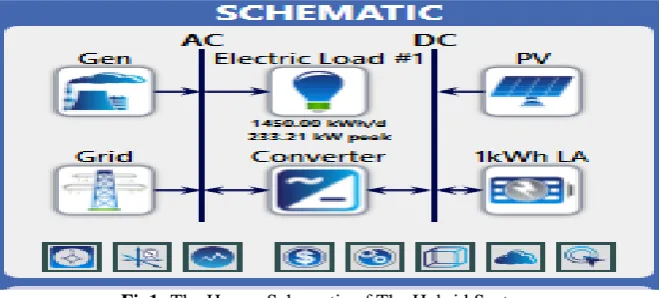
Fig1: The Homer Schematic of The Hybrid System
SIGNIFICANCE AND MOTIVATION OF STUDY
Electricity is the pivot of every growing economy. In Nigeria today, there is constant increase in our population, and as such much demand is placed on electrical energy.On the contrary, the Nigerian power sector over the years is characterised by constant power outages and therefore creating and ill effect on our economy. In achieving a suitable and constant power supply, the hybrid PV/Diesel-generator/Grid/Battery system should be considered, where there will be reduced burning of fossil fuel, reduced emission of dangerous gases which is responsible for the depletion of the ozone layer therefore causing global warming, it also offers clean, effective, cheap, very easy to maintain and a more reliable power sector.
II.
RESEARCH METHODOLOGY AND RESULT ANALYSIS
ELECTRICAL LOAD ASSESMENT FOR THE FACULTY OF ENGINEERING MAIN BUILDING.
Table 1: Appliances used in The Faculty Building and Their Wattage.
Component Size Wattage
Lighting bulb (Energy saving bulb.)
30
Fan 75
Computers (Desktop)
200
A.C 1.5/2hp 1119/1492
T.V set. 32 Inches plasma 80
Photocopier 250
Building Capacity. Number of offices = 122, Number of Classrooms = 12, Number of conference rooms = 2. Faculty Reception =1, Library =1, Rest Rooms=12.
Table 2: Number of Appliances in Offices, Classrooms, Receptions, Library, Rest Rooms.
S/N Location Lighting Points Fans Sockets Computers A.C
1 Office 4 1 3 1 122(1.5hp) each
2 Class Rooms
9 4 2 _ 12(2hp) each
3 Conference Rooms
6 4 4 _ 3(2hp) each
4 Reception 6 1 4 _ 1(2hp) each
5 Library 12 8 8 1 2(2hp) each
Exceptions:
T.V randomly distributed in faculty=22 Photocopier =30.
LOAD CALCULATION.
Lighting Points:
Locations of lighting point × number of lighting points...1.1 (122 × 4) + (12 × 9) + (2 × 6) + (1 × 6) + (1 × 12) (12 × 4) = 674 points. Rating of each bulb = 30watts.
Lighting point × wattage...1.1.2
(674 × 30) = 20.220kw
Therefore, the power consumption by lighting point in kW = 20.22kw.
Fan
Location of fan × number of fan... ...1.2
(122 × 1) + (12 × 4) + (2 × 4) + (1 × 1) + (1 × 8) = 187 Fan rating = 75w
Total number of fan × fan rating...1.2.1
(187 × 75) = 14025w = 14.025kw Power consumed = 14.025kw
Air Conditioners Total = 140
For 1.5hp (1hp = 746watts)
1.5 × 746 = 1119watts
122 × 1119 = 136,518w
For 1.5hp
We therefore have that 136.518kw is the power consumed by 1.5hp air conditioners For 2hp
1 hp = 746 watts
2 × 746 = 1492watts
18 × 1492 = 26,856watts
In kilowatts
Power consumed = 26.856kw.
Hence, total power consumed by air conditioner is; Summation of 1.5hp and 2hp a.c. .i.e.
1.5hp a.c + 2hp a.c...1.3
(136.518 + 26.856) kW = 163.374kw
Computers
Total numbers = 123 Rating = 200w
Power consumed by the desktop computers
Total number of computers × ratings of computers...1.4
123 × 200 = 24600w
In Kilowatts, power consumption = 24.6kw TV Sets
Total numbers = 22 The ratings = 80w
Total number of television × ratings of televisions...1.5
Power consumption in watts = 22 × 80 = 1760w In kilowatts = 1.76kw
Photocopiers
Total numbers = 30 Power rating = 250w
Number of photocopiers × ratings...1.6 Power consumed = 30 × 250 = 7500w
In kilowatts = 7.5kw
Simulation Result and Analysis.
In this research paper, the economic analysis is done base on the life cycle costing method where all types of costs for different components (initial costs, maintenance costs, fuel, operational costs, and replacement costs, etc) are considered. Cost of energy, (COE) which is the cost required to produce 1kwh, is the indicator used in the optimization process. It is the ratio between the total annual cost and the total annual energy required by the load. Different economic factors that affect the value of money over the life of the project also are considered. The life cycle period of the project is considered for 25years. It is the life cycle of the component that has maximum life time.
Analysis of the Photovoltaic System (PV) Data.
Fig 2: Monthly Average Solar GHI.
Analysis of the available hourly PV data for a year, shows that yearly average daily solar radiation on a horizontal surface (GHI), amount to 4.60kwh/ /day. This is as shown in fig 2 above.
Simulation Results.
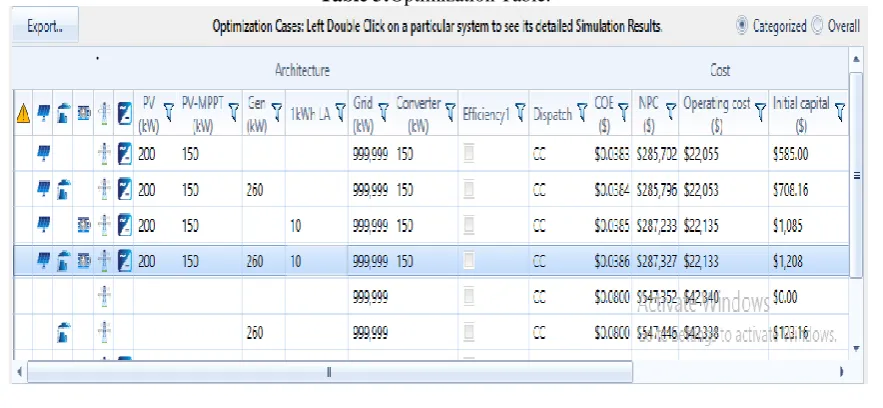
The result of the simulation program shows that the lowest cost of energy (COE) obtained is 0.03856$/kwh achieved at 46.71% PV contribution and 0.099-hour autonomy days (AD) as shown on table 3 below. This result further indicates that the total NPC (Net present cost) is $287,327.10 and having an operating cost of $22,133.
The contribution of the PV modules, and the grid as modelled by Homer depending on which of the power sources of either grid or the generating set was available and more optimal when combined with the PV, as at the time in supplying the load in months of the year.
Fig 3: Monthly Average Electric Production.
It is very clear that the PV power supply, are much more produced from June to December depending on the solar global horizontal irradiance (GHI) earlier shown on figure 2.
The figure below shows the renewable penetration time series plot by Homer.
Fig5: PV output Power.Fig 6: Energy purchased from the Grid
The time series plot shown above indicate the energy purchased from the grid. The system converter has information such as the capacity, the mean output, the minimum output, the maximum output capacity factor for both inverter and rectifier respectively
Figure 7: Inverter/Rectifier Output.
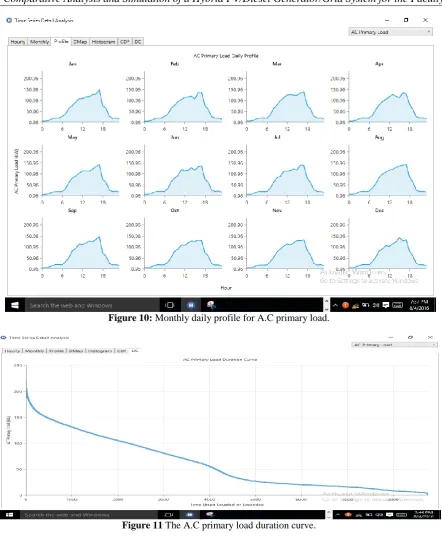
Figure 10: Monthly daily profile for A.C primary load.
Figure 11 The A.C primary load duration curve.
III.
CONCLUSION
REFERENCES
[1]. Anayochukwu, A. V. (2013). Simulation of photovoltaic/diesel hybrid system with energy storage and supervisory control. International journal of renewable energy research.
[2]. Batha, S. T. (2013). Design and analyses of an off-grid hybrid renewable energy system to supply electricity for rural area,Atsbi District, North Ethiopia.
[3]. Enefiok, O. E. (2015). PV-Diesel hybrid power system for small village in Nigeria. International journal of scientific research.
[4]. Gupta, J. B (2013). Non-conventional methods of power generation.
[5]. Lena, G. (IED) (2013). Rural electrification with PV hibrid system . IEA International energy agency. [6]. Ismail, M. S.,Moghavvenmi, and Mahlia, T. M. I (2011). PV/diesel stand alone hybrid system for a
remote community in Palestine. Journal of Asian scientific research. , 599-606.
[7]. Ahmad, A. S.and Nayar, C. V. (2005). Design of hybrid power system for a remote Island in Maldives, Australia.
[8]. Sopian, K. and Othman, M. Y. (2005). Performance of photovoltaic diesel hybrid system in Malasia.p 37-39.
[9]. Theunissen, D. (2013). Photovoltaic-Diesel hybrid system for the off-grid and remote site. [10]. Belectric (2013) Available: http://www.belectric.com/en/home/ Last accessed 08/08/2013 [11]. Pachori, A. (2004). Modeling and simulation of photovoltaic/wind/diesel/battery.
[12]. Hrayshat, E. S. (2009). Techno-economic analysis of autonomous hybrid photovoltaic-diesel-battery system. Energy for sustainable development vol. 13, No.3, pp. 143-150.
[13]. Khatib, T.A., Mohamed, K. S. and Mahmoud, M. (2009). "Optimal Sizing of Building Integrated Hybrid PV/Diesel Generator System for Zero Load Rejection for Malaysia." Energy and Building vol. 43, No.12, pp. 3430-3435.
[14]. Twaha, S.H., Idris, M. A. and Khairuddin, A. (2012). "Applying grid connected photovoltaic system as alternative source of electricity to supplement hydro power instead of using diesel in Uganda."
[15]. Bhandari, R. and Stadler, I. (2011) "Electrification using solar photovoltaic systems in Nepal" Applied Energy vol. 88, No.2, pp.458-465.
[16]. Daud, A. K. and Ismail, M. S. (2012) "Design of isolated hybrid systems minimizing costs and pollutant emissions." Renewable Energy vol.44, pp.215-224.
[17]. Kamalapur, G.D. and Udaykumar, R. Y. (2011) "Rural Electrification in India and Feasibility of Photovoltaic Solar Home Systems" International Journal of Electrical Power and amp; Energy Systems vol.33, No.3, pp.594-599.