Duke Law Journal
VOLUME 67 NOVEMBER 2017 NUMBER 2
THE BOOTSTRAP TRAP
SARA STERNBERG GREENE†
ABSTRACT
In the mid-1990s, Congress fundamentally altered the public safety net when it passed the Personal Responsibility and Work Opportunity Reconciliation Act (PRWORA) of 1996, otherwise known as welfare reform. Under the PRWORA, cash assistance was no longer an entitlement for income-qualifying families; instead, recipients faced work requirements and lifetime limits on receiving benefits. Bipartisan reformers sought to transform welfare from a program believed to trap poor mothers in a “culture of dependence” into a program that would promote a culture of “self-sufficiency” and “personal responsibility.” This shift in culture, it was argued, would ultimately lead to upward mobility. This Article shows how, ironically, over twenty years after welfare reform, the private safety net that many struggling families rely on—the credit system—disincentivizes the very self-sufficient behavior that welfare reformers had hoped to promote. Using the sociological concept of narratives, the Article shows how parents who have most internalized narratives of self-sufficiency are particularly at risk of financial ruin under the new regime. On a broader scale, this Article argues that, to better understand the relationship between law,
Copyright © 2017 Sara Sternberg Greene.
inequality, and poverty, we need to further investigate how people experience and internalize structural conditions and how these structural conditions become sources of personal meaning and determinants of behavior. Such inquiries can lead to unexpected connections between seemingly disparate areas of law and policy, and ultimately to innovative policy interventions.
Finally, this Article moves to the prescriptive. It argues for a public financial services program, Financial Services for Family Security (FSFS). FSFS would provide services such as financial advising, no-interest small loans, and debt management help, all aimed at increasing the financial resilience of struggling families.
TABLE OF CONTENTS
Introduction ... 235
I. Welfare’s End: The Era of Personal Responsibility and Self-Sufficiency ... 243
A. Welfare Reform, Dependency, and Responsibility ... 244
B. Where Are They Now? ... 252
II. The Increasing Importance of Credit ... 254
A. The Surprising History of Credit Reports and Scores ... 254
B. A Brief Primer on Current Credit Report and Score Mechanics ... 259
C. Credit Histories as Gatekeepers ... 260
D. Credit as a Safety Net ... 262
III. Perverse Disincentives and Downward Mobility: The Accidental Interaction of Credit Histories and Self-Sufficiency ... 263
A. Data ... 264
B. Broken Bootstraps: When Self-Sufficiency Fails ... 267
C. A Surprising Catalyst of Downward Mobility and the Reproduction of Poverty and Inequality: Repairing Credit Through Self-Sufficiency ... 272
D. Seeking out Lifelines: The Deserving Recipient Narrative ... 279
E. Narrative Ruptures ... 284
IV. Existing Proposed Reforms ... 286
A. Reducing the Collateral Consequences of the Credit System ... 286
1. Banning the Use of Credit Reports in Hiring ... 286
2. Changing Credit Report and Score Reporting Measures. ... 289
1. Insurance-Based Plans ... 292
2. Savings-Based Plans ... 293
3. Postal Banking and Other Financial Services ... 294
C. Proposals for Providing Direct Cash Benefits to Struggling Families ... 295
1. Universal Basic Income, Universal Child Allowance, and Other Cash-Based Programs ... 295
2. Increasing Funding for TANF, Food Stamps, and Other Public Benefits ... 296
V. A New Safety Net: Financial Services for Family Security ... 297
A. Financial Planning/Advising ... 301
B. Debt Management Services ... 303
C. No-Interest Small Loans... 304
D. Financial Emergency Crisis Counseling ... 305
E. Other Considerations ... 306
F. Potential Counterarguments to FSFS Proposal ... 307
1. FSFS Services Will Not Work for the Very Poor and Perpetually Unemployed ... 307
2. FSFS Will Be Very Expensive ... 307
3. A Program Similar to FSFS Could Be Run Through TANF ... 308
4. People Will Take Advantage of the Small-Loan Programs ... 309
5. FSFS Would Be Better Run Through Private Bank Partnerships Than by the Government ... 309
Conclusion ... 310
INTRODUCTION
In 1996, public benefits law was transformed, fundamentally altering the safety net for poor parents in the United States.1
Congress
1. See David A. Super, Offering an Invisible Hand: The Rise of the Personal Choice Model for Rationing Public Benefits, 113 YALE L.J. 815, 818 (2004) (“The widespread embrace of the personal choice model represents a sea change in American public benefits law. . . . This personal choice model of public benefits law differs fundamentally from any that came before it.”); see also
KATHRYN J.EDIN &H. LUKE SHAEFER, $2.00 A DAY: LIVING ON ALMOST NOTHING IN
passed the Personal Responsibility and Work Opportunity Reconciliation Act (PRWORA) of 1996,2
whichended a sixty-year-old program that had entitled qualifying families to cash assistance. Despite debate about the specifics of the PRWORA, there was widespread, bipartisan agreement that change was needed because the existing welfare program’s structure unintentionally disincentivized work and promoted dependency.3 President Bill Clinton said when he
announced the welfare reform bill, “Today the Congress will vote on legislation that gives us a chance . . . to transform a broken system that traps too many people in a cycle of dependence to one that emphasizes work and independence, to give people on welfare a chance to draw a paycheck, not a welfare check.”4
Indeed, one of the four stated statutory goals of the PRWORA was to “end the dependence of needy parents on government benefits by promoting job preparation, work, and marriage.”5
The new program designed to meet this and other statutory goals, Temporary Assistance for Needy Families (TANF), imposed lifetime limits on receiving aid, subjected able-bodied participants to work requirements, incentivized states to cut welfare rolls, and transformed welfare into a block grant program that gave states wide flexibility in how they spend welfare funds.6
By 2016, the number of welfare
2. Personal Responsibility and Work Opportunity Reconciliation Act of 1996, Pub. L. No. 104-193, 110 Stat. 2105 (1996) (codified in scattered sections of 42 U.S.C.).
3. See Anne L. Alstott, The Earned Income Tax Credit and the Limitations of Tax-Based Welfare Reform, 108 HARV.L.REV. 533, 537–38 (1995) (describing “bipartisan consensus on work-based welfare reform,” “widespread dissatisfaction with traditional welfare administration,” and “an apparent political consensus in support of reforms that in some way link welfare and work”). Alstott also notes that a “common criticism” of the existing welfare system was that it “rewards the ‘dependent’ poor but provides too little assistance to the working poor.”
Id. at 538. Research had found that single mothers who chose to work instead of receive welfare experienced more material hardship than their counterparts who remained on welfare. See
KATHRYN EDIN &LAURA LEIN,MAKING ENDS MEET:HOW SINGLE MOTHERS SURVIVE
WELFARE AND LOW-WAGE WORK, at xix, 220 (1997) (describing research supporting the proposition that mothers who worked and received low wages were generally worse off than their counterparts who received welfare).
4. President William J. Clinton, Remarks on Welfare Reform Legislation and an Exchange with Reporters (July 31, 1996), in 32 WEEKLY COMP.PRES.DOC.1379, 1379 (1996).
5. 42 U.S.C. § 601(a) (2012).
6. See Alana Semuels, The End of Welfare as We Know It,ATLANTIC (Apr. 1, 2016), https://www.theatlantic.com/business/archive/2016/04/the-end-of-welfare-as-we-know-it/476322/ [https://perma.cc/3477-GHKE] (describing the changes the TANF program brought to welfare);
https://www.cbpp.org/sites/default/files/atoms/files/8-7-recipients had fallen to only 2.7 million7 from a peak of 14.2 million
recipients in 1994,8
a drop of 81 percent. Now, twenty years after welfare was reformed, the public safety net is by many accounts dead.9
The idea behind TANF was that parents would work and, if their income was below a specified level,10
their earnings would be supplemented by the Earned Income Tax Credit (EITC).11 Thus, a
robust cash assistance program for people who were not working would no longer be needed.12 When President Clinton signed the
welfare reform bill into law, he said “The best antipoverty program is still a job.”13 He promised that welfare reform would “reward the work
of millions of working poor Americans by realizing the principle that if you work 40 hours a week and you’ve got a child in the house, you will no longer be in poverty.”14
But whether or not parents found a job, periods of financial
12tanf.pdf [https://perma.cc/QN7U-AFNZ] (providing an overview of how states have used their TANF block grants).
7. TANF Caseload Data 2016, OFF. FAM. ASSISTANCE (Jan. 12, 2016), https:// www.acf.hhs.gov/ofa/resource/tanf-caseload-data-2016 [https://perma.cc/U7XK-FDLP]. 8. Caseload Data 1994 (AFDC Total), OFF.FAM.ASSISTANCE (Dec. 19, 2004), https:// www.acf.hhs.gov/ofa/resource/caseload-data-afdc-1994-total [https://perma.cc/7VC8-PQCA]. 9. See EDIN &SHAEFER,supra note 1, at 33 (“What is known, though, is that the way things turned out, the 1996 reformers didn’t merely ‘replace’ welfare. They killed it.”); Potts, supra note 1. Reports of localities actively discouraging parents from applying for and receiving public benefits are common, and have even been the subject of litigation. In Reynolds v. Giuliani, 118 F. Supp. 2d 352 (S.D.N.Y. 2000), the plaintiffs attacked so-called “diversion” tactics of New York’s welfare agencies, contending that the policies and practices of agencies associated with distributing cash assistance programs like TANF and other federal benefits wrongfully denied eligible people of these benefits.
10. In 2016, for a person with two children filing as “Single, Head of Household or Widowed,” the earnings cutoff for the EITC was $44,648. For a person with two children filing as “Married, Filing Jointly,” the earnings cutoff for the EITC was $50,198.2016 EITC Income Limits, Maximum Credit Amounts and Tax Law Updates, INTERNAL REVENUE SERV.(Sept. 18, 2017), https://www.irs.gov/credits-deductions/individuals/earned-income-tax-credit/eitc-income-limits-maximum-credit-amounts [https://perma.cc/TDP3-9VVM].
11. The EITC is a refundable tax credit that supplements earnings of low-income workers. It is the “largest cash-transfer program for low-income workers with children.” Anne L. Alstott,
Why the EITC Doesn’t Make Work Pay, 73 LAW &CONTEMP. PROBS. 285, 285 (2010). Additionally, the EITC has been called the “largest federal anti-poverty program.” Lawrence Zelenak, Redesigning the Earned Income Tax Credit as a Family-Size Adjustment to the Minimum Wage, 57 TAX L.REV. 301, 301 (2004). The EITC is only available to people who work. 12. See supra note 11.
13. President William J. Clinton, Statement on Signing the Personal Responsibility and Work Opportunity Reconciliation Act of 1996 (Aug. 22, 1996), in WEEKLY COMP.PRES.DOC.,
supra note 4, at1487, 1489.
distress were common,15 and parents were left to find alternative forms
of support. For many parents, this alternative support was credit.16
Just as welfare was reformed and the public safety net diminished, credit cards were becoming newly available to low-income families. Changes in state usury laws17 allowed lenders to extend credit to riskier
borrowers while utilizing higher interest rates to make up for the increased risk.18 Credit card companies then began targeting
low-income consumers who just a decade before would not have qualified for credit cards.19
15. While work certainly provides some stability for families, the assumption that families can weather life events causing economic insecurity without an alternative safety net ignores two key issues. First, even if a person works forty hours per week, the wages former welfare recipients earn are not, by and large, enough to cover any unexpected life event such as a needed car repair, dental problem, or medical condition. For example, one study found that only 23.9 percent of families earning less than $20,000 per year and only 32.6 percent of families earning between $20,000 and $29,999 per year reported that they would certainly be able to or probably be able to come up with $2,000 in 30 days to cover an emergency expense. Annamaria Lusardi, Daniel Schneider & Peter Tufano, FINANCIALLY FRAGILE HOUSEHOLDS: EVIDENCE AND
IMPLICATIONS, Brooking Papers on Econ. Activity, Spring 2011, at 83, 93 (2011), https:// www.brookings.edu/wp-content/uploads/2011/03/2011a_bpea_lusardi.pdf [https://perma.cc/8AY A-YK5T]; see also Sara Sternberg Greene, The Broken Safety Net: A Study of Earned Income Tax Credit Recipients and a Proposal for Repair,88 N.Y.U. L. REV. 515, 545–47 (2013) (reporting a study of families receiving the EITC and documenting their difficulties covering unexpected financial emergencies). Second, during the booming economy of the 1990s, many former welfare recipients were able to find work. However, once the economy slumped during the economic downturn that started in 2007, the unemployment rates among families increased, as did the number of families in poverty and deep poverty. Policy Basics: And Introduction to TANF,CTR.
ON BUDGET &POL’Y PRIORITIES 5–7 (June 15, 2012), https://www.cbpp.org/sites/default/files/ atoms/files/7-22-10tanf2.pdf [https://perma.cc/5F7Z-AJQV]. However, TANF rates responded only modestly to these changes in unemployment. Id. The bottom line is that TANF was created with the idea that almost anyone who wants a job can get one, but this is not the case during economic downturns. TANF does little to respond to changes in the economy and thus rates of unemployment and poverty. For example, between 2006 and 2015 the number of families in poverty nationwide rose by 7 percent, but the national TANF caseload fell by 21 percent. Ife Floyd, LaDonna Pavetti & Liz Schott,Policy Brief: TANF Reaching Few Poor Families,CTR. ON
BUDGET &POL’Y PRIORITIES 2(Apr. 5, 2017), https://www.cbpp.org/sites/default/files/atoms/ files/4-5-17tanf.pdf [https://perma.cc/7WDH-TRZV].
16. See Greene, supra note 15, at 547; see also Angela Littwin, Beyond Usury: A Study of Credit-Card Use and Preference Among Low-Income Consumers, 86 TEX.L.REV. 451, 457–59 (2008) (“The most common explanation study participants gave for wanting to maintain access to credit cards was their usefulness in emergencies.”).
17. State usury laws that protected borrowers by regulating high interest rates were weakened. Katherine Porter, Driven by Debt, Bankruptcy and Financial Failure in American Families, in BROKE:HOW DEBT BANKRUPTS THE MIDDLE CLASS 1, 4 (Katherine Porter ed., 2012).
18. David A. Lander, “It ‘Is’ the Best of Times, It ‘Is’ the Worst of Times”: A Short Essay on Consumer Bankruptcy After the Revolution, 78AM.BANKR.L.J.201, 204–05 (2004).
Credit has become a lifeline for poor families, but many of them also find themselves in an enduring cycle of unmanageable debt.20
These cycles of debt can wreak havoc on credit histories and scores.21
And though credit histories were once tools used primarily by the financial industry to decide whether and how much money to loan consumers, they have taken on a new importance. In 2017, an increasing number of industries use credit histories to aid in their decisions about whether to grant access to a wide range of economic resources: rental housing, insurance, utilities, and jobs.22 A low credit
score and flawed report can mean restricted access to institutions necessary for economic stability, and thus, the collateral consequences
regulation also meant substantially increased debt for middle-class Americans. Porter, supra note 17, at 4–5.
20. See J. Michael Collins, Paying for the Unexpected: Making the Case for a New Generation of Strategies to Boost Emergency Savings, Affording Contingencies, and Liquid Resources for Low-Income Families, in A FRAGILE BALANCE: EMERGENCY SAVINGS AND LIQUID
RESOURCES FOR LOW-INCOME CONSUMERS 1,2(J.Michael Collins ed., 2015) (“Without savings, low-income households may have no choice but to turn to credit to make ends meet. . . . In theory, this sort of borrowing is a reasonable substitute for savings. However, emerging research suggests that using high-cost credit could make families worse off overall . . . .”); Greene, supra note 15, at 547–57 (discussing the benefits and drawbacks of the use of credit by financially struggling families); Ronald J. Mann, Patterns of Credit Card Use Among Low- and Moderate-Income Households, inINSUFFICIENT FUNDS:SAVINGS,ASSETS,CREDIT, AND BANKING AMONG LOW -INCOME HOUSEHOLDS 257,263–78(Rebecca M. Blank & Michael S. Barr eds., 2009) (“The credit card also provides a remarkably flexible safety net that can be deployed in response to unexpected financial crises. That protection is particularly important in the United States, where the public safety net is more porous than it is in many peer nations.” (citations omitted) (first citing RONALD
J.MANN,CHARGING AHEAD:THE GROWTH AND REGULATION OF PAYMENT CARD MARKETS
(2006); then citing Jacob S. Hacker,THE DIVIDED WELFARE STATE:THE BATTLE OVER PUBLIC AND PRIVATE SOCIAL BENEFITS IN THE UNITED STATES (2002); and citing CHRISTOPHER
HOWARD,THE WELFARE STATE NOBODY KNOWS:DEBUNKING MYTHS ABOUT U.S.SOCIAL
POLICY (2007)).
21. For a description of how credit scores are determined and what information is included in credit reports, see infra Part II.
22. CATHY O’NEIL, WEAPONS OF MATH DESTRUCTION: HOW BIG DATA INCREASES
INEQUALITY AND THREATENS DEMOCRACY 147–50, 164–66 (2016); see also SHAWN FREMSTAD
&AMY TRAUB,DISCREDITING AMERICA:THE URGENT NEED TO REFORM THE NATION’S
of bad credit are profound.23
This Article utilizes data from in-depth, semistructured interviews to unpack a previously undetected conflict in what remains of the safety net: the conflict between the goal of self-sufficiency and the risks that adhere when low-income families realize that goal. The post-welfare reform public safety net promotes and even requires one type of behavior—self-sufficiency—but the new private safety net, which encompasses the credit reporting and scoring systems and accompanying regulations, is a danger to those who are both financially unstable and attempting to be self-sufficient. Those families that best adhere to the very behavior encouraged by the public safety net, then, end up at particular risk for long-term economic hardship.
President Clinton promised that welfare reform would “give[] us a better chance to give those on welfare what we want for all families in America, the opportunity to succeed at home and at work.”24 This
Article’s first contribution is detailing how welfare reform policy has interacted in a surprising way with our credit reporting system to deny many families who have “succeeded” in climbing out of a “culture of dependence,” “the opportunity to succeed at home and at work.” Unpacking the conflicts between the behavior promoted by the public safety net and the behavior necessary to succeed in the private credit market—the new private safety net—ideally will lead to new insights about what kind of safety net structure might be necessary to support families, rather than thwart them in their journeys toward self-sufficiency and financial resilience. The tension in the existing safety net ultimately leads to the conclusion that a new public safety net program is needed. From a public policy perspective, the existing safety net penalizes the very behavior many policymakers across the political spectrum say that they want to encourage and incentivize.25 And from
an equality standpoint, the current safety net works to exacerbate poverty and inequality, rather than to reduce it.
To that end, this Article’s second contribution is the exploration
23. See FREMSTAD & TRAUB, supra note 22, at2–3 (noting that insurance agencies, employers, and other actors increasingly consider credit reports in their decisionmaking, with negative effects for those with negative credit history); Amy Traub, Discredited: How Employment Credit Checks Keep Qualified Workers out of a Job, DĒMOS 3–4 (2013), http://www.demos.org/sites/default/files/publications/Discredited-Demos.pdf [https://perma.cc/ BF3H-SU4J] (describing how poor credit can negatively affect one’s employment prospects). For examples of the collateral consequences of bad credit, see Part III.B.
24. Clinton, supra note 4, at 1379.
of how a public safety net program might be designed to promote financial resilience in families by helping them to avoid the pitfalls of the punishing credit system. This Article argues that the existing safety net fails many families and that a new program is needed—one that allows families to adhere to their desire to be self-sufficient, but also provides families with the financial guidance and tools necessary to weather financial instability. This Article proposes a program called Financial Services for Family Security (FSFS), which would embrace the reality of rising financial instability for families in the United States26
and equip parents with a comprehensive set of tools to overcome financial emergencies and continue on their road to upward mobility.
Finally, this Article and the methods employed provide a useful case study to help define a broader research agenda for scholars of law, poverty, and inequality. Recently, there has been a renewed focus among legal scholars on the connection between law, inequality, and poverty.27
Much of this work has fallen into two distinct categories. Several scholars have made great strides in theorizing the role of the Constitution as it relates to economic inequality, often from a historical perspective.28 Other scholars have paid a great deal of attention to the
ways in which structural conditions related to specific legal rules and systems can worsen or accentuate some of the vicious cycles of
26. See Collins, supra note 20, at 4–5 (describing increased volatility in both income and expenditures for low-income households and describing studies that support this proposition).
27. As Professor Olatunde C.A. Johnson wrote, the “new economic inequality discourse has preoccupied economists, garnered its own ‘beat’ in leading publications, led to bestselling books, transfixed current political debates, and now (finally) seduced legal academia.” Olatunde C.A. Johnson, Inclusion, Exclusion, and the “New” Economic Inequality, 94 TEX.L.REV. 1647, 1648 (2016). For examples of work from legal scholars that is focused on law, poverty, and inequality, see infra notes 28–29.
28. Seegenerally GANESH SITARAMAN,THE CRISIS OF THE MIDDLE CLASS CONSTITUTION
disempowerment associated with poverty and inequality.29 These lines
of research are important and contribute to our understanding of law’s relationship to inequality and poverty. What is often absent from these existing accounts, however, is what we can glean only by engaging in in-depth interviews with those directly affected by the legal rules, systems, and processes we study: an understanding of how, in their actual social contexts, these actors experience, understand, and internalize the relevant legal rules and structures, and how these structures become sources of personal meaning and determinants of behavior.
Indeed, by employing these methods, researchers are able to engage in “process tracking,” which helps to “discern how processes emerge and evolve.”30
These methods also allow researchers to understand how changes in structural conditions can interact with cultural mores to lead to unexpected outcomes. Such projects can, in turn, provide fruitful areas for further inquiry, large-scale data collection efforts, and ultimately innovative policy solutions.31
29. See generally MEHRSA BARADARAN,HOW THE OTHER HALF BANKS:EXCLUSION, EXPLOITATION, AND THE THREAT TO DEMOCRACY (2015) (documenting the role banks have played in widening economic exclusion and inequality for poor Americans); Michelle Wilde Anderson, Colorblind Segregation: Equal Protection as a Bar to Neighborhood Integration, 92 CALIF.R.REV. 841 (2004) (discussing the structure and potential consequences of a colorblind segregation regime in public housing); Johnson, supra note 27 (arguing from empirical data that geography is the key to class-based and race-based inequality).
30. Michele Lamont & Patricia White, Workshop on Interdisciplinary Standards for Systematic Qualitative Research, NAT’L SCI.FOUND. 10 (2005), https://www.nsf.gov/sbe/ses/soc/ ISSQR_workshop_rpt.pdf [https://perma.cc/BW2K-5DSE].
31. Sociologists regularly engage in in-depth, semistructured qualitative studies and ethnographies in their study of poverty and inequality. SeeEDIN &LEIN,supra note 3, at 220; see generally MARIO LUIS SMALL,VILLA VICTORIA:THE TRANSFORMATION OF SOCIAL CAPITAL IN A BOSTON BARRIO (2004) (analyzing how poorer residents of a subsidized housing complex in Boston maintained social capital); MARY C. WATERS, BLACK IDENTITIES: WEST INDIAN
IMMIGRANT DREAMS AND AMERICAN REALITIES (1999) (studying West Indian immigrants and how their culture and identities are “changed by conditions in America”). However, sociologists rarely focus on laws and legal systems as their primary area of inquiry. Qualitative methods are not new to legal academia, and indeed, there have been several influential law review articles and books based on qualitative methods. See generally ROBERT C.ELLICKSON,ORDER WITHOUT
This Article proceeds as follows. Part I explores the history of public benefits and welfare in the United States. It describes the cultural and accompanying policy shift in American society that emphasized personal responsibility and work as the basis for a reduced safety net. This Part not only shows how this ideology influenced policy and law surrounding safety net programs, but also shows how these programs were designed to penetrate the value systems of poor families. Finally, this Part explores existing research about how families have fared post-welfare reform. Part II discusses the rise of credit scores and credit reports in America. It begins by telling an often neglected, but vitally important, history of credit reporting in America. It then discusses how credit histories act as the new gatekeepers to many economic resources in the United States.
Part III uses original data to show how the interaction of the culture prescribed by welfare reform and the rules of the credit system work together to produce counterproductive results: those families who have most internalized the culture promoted by welfare reformers are also at particular risk of financial failure under the new safety net. This Part explores the features of the current credit reporting system that perpetuate this counterproductive reality. Part IV discusses existing policy proposals that may help alleviate this counterproductive safety net structure and details some of the limitations of these proposals. Finally, Part V discusses the contours of the new program proposed, FSFS. FSFS is a government financial services agency that would provide families with tools to increase their financial resilience and stability, allowing them to continue on the road to upward mobility, rather than be thwarted by small emergencies.
I. WELFARE’S END:THE ERA OF PERSONAL RESPONSIBILITY AND SELF-SUFFICIENCY
In the 1980s, the existing welfare regime offered more stability for poor families than did most work available to them.32 However, the
financial and cultural landscape for poor Americans changed dramatically over the next fifteen or so years, concluding with the
between law and inequality.
PRWORA, a major transformation in public benefits law.33 This Part
details a brief history of aid to poor families in America, highlighting the cultural shifts that culminated in the passage of the PRWORAin 1996. It then provides an overview of what existing research reveals about the current state of former welfare recipients and poor parents.
A. Welfare Reform, Dependency, and Responsibility
Just over twenty years ago, “welfare as we [knew] it”34 ended. The
1996 welfare reform bill, the PRWORA, replaced the program known as Aid to Families with Dependent Children (AFDC) with a new program, TANF. AFDC was a cash assistance entitlement program.35
Poor women with children received a monthly stipend meant to provide children with “assistance at least great enough to provide, when added to the income of the family, a reasonable subsistence compatible with decency and health.”36
AFDC recipients were generally eligible for the cash benefits indefinitely, so long as they continued to have minor children and their incomes remained below a certain amount each month. TANF, on the other hand, has strict time limits that, once reached, make families ineligible for further aid.37
At the heart of TANF is an emphasis on “personal responsibility” and “self-sufficiency”—the goal is for parents to work and provide for themselves, rather than rely on the government to help keep their families afloat.38
Welfare reform represented a major shift in American social welfare policy—a shift that was decades in the making.39 The complete
33. See Super, supra note 1, at 818 (“The widespread embrace of the personal choice model represents a sea change in American public benefits law. . . . This personal choice model of public benefits law differs fundamentally from any that came before it.”).
34. When President Clinton enacted welfare reform by signing TANF into law, he said “[t]oday, we are ending welfare as we know it.” Barbara Vobejda, Clinton Signs Welfare Bill Amid Division, WASH.POST, Aug. 23, 1996, at A1.
35. Stephen B. Page & Mary B. Larner, Introduction to the AFDC Program,7FUTURE OF
CHILDREN 20, 21 (1997), https://www.princeton.edu/futureofchildren/publications/docs/ 07_01_01.pdf [https://perma.cc/W99Z-99A2] (“AFDC was a federally mandated program that guaranteed cash assistance to families with needy children.”).
36. Susan W. Blank & Barbara B. Blum, A Brief History of Work Expectations for Welfare Mothers, 7 FUTURE CHILD. 28, 30 (1997).
37. TANF-ACF-IM-2005-01 (Adherence to the Federal Five-Year Time Limit Provisions for FY 2003) for FY 2003 (2005), OFF.FAM.ASSISTANCE (Jan. 24, 2005), https://www.acf.hhs.gov/ ofa/resource/policy/im-ofa/2005/im-2005-01 [https://perma.cc/L9BX-X6KW].
38. Clinton, supra note 13, at 1487–88 (discussing the goals of TANF, including self-sufficiency rather than reliance on the government for monthly income).
political story of welfare reform has been ably told elsewhere.40
However, to understand the changing economic landscape that contributed to the importance of credit for the poor, it is vital to understand both the cultural and structural changes promoted by welfare reform.
Welfare began as mostly state-run programs for widowed mothers who had lost their husbands to the Civil War.41
Many states created mothers’ aid programs, which were designed to allow these mothers to take care of their children in their homes rather than put them in orphanages.42 During the Progressive Era of the 1930s, local mothers’
pension programs expanded and became part of an emerging national policy for women-led families.43 During the Great Depression, though,
localities ran out of money to support such programs and the federal government stepped in to fill the void.44 In 1935, Aid to Dependent
Children (then called ADC) was created as a federal solution to provide for the mothers who had previously been supported by localities.45
It was one of many social welfare programs created under the new Social Security Act of 1935,46 and the goal was to provide for
children whose fathers were deceased, absent, or unable to work.47
ADC was celebrated because it would allow poor single mothers to take care of their children full-time, rather than feel pressured to work.48
As enacted, the program was not limited to children of widows,49 but the focus was on families who had tragically lost a
40. See generally REBECCA M. BLANK, IT TAKES A NATION: A NEW AGENDA FOR
FIGHTING POVERTY (1997) (describing in detail the story of welfare reform); Alstott, supra note 3 (explaining the history of the EITC reforms); EDIN &SCHAEFER, supra note 1, at 1–33 (discussing the hsitory of welfare and welfare reform); Vicki Lens, Public Voices and Public Policy: Changing the Social Discourse on “Welfare,” 39 J.SOC.&SOC.WELFARE 137 (2002) (discussing the politicized language that comprised the discourse on welfare reform);
41. See EDIN &SHAEFER,supra note 1, at 11; GWENDOLYN MINK,WELFARE’S END 1 (1998) (“During the second decade of the twentieth century, progressive women activists invented welfare to provide mothers and their children a means to survive when breadwinning fathers either died or abandoned their families.”).
42. EDIN &SHAEFER,supra note 1, at 11. 43. MINK,supra note 41, at 1.
44. EDIN &SHAEFER,supra note 1, at 11. 45. Id.
46. Social Security Act of 1935, Pub. L. No. 74-271, §§ 401–405, 49 Stat. 620, 627–29 (1935) (codified as amended at 42 U.S.C.).
47. Blank & Blum, supra note 36, at 29. 48. MINK,supra note 41, at 1.
breadwinner, with the idea that the mother should not be forced into paid work due to bad luck or tragedy. At the time, the overarching belief was that mothers belonged at home with their children.50 ADC’s
designers believed that the program would be temporary for most families, and that once male breadwinners paid into Social Security— a program created at about the same time as ADC—their widows would receive these benefits rather than welfare benefits and the program could slowly dissolve.51
After Survivors Benefits were added to mainstream Social Security in 1939, there was a sense that the most “deserving” mothers (widows) were taken care of, leaving the second-class single mothers to the ADC caseload.52 In the early years of ADC, states had wide
discretion to determine ADC eligibility, and they could, for example, decide that only children living in “suitable homes” would receive benefits.53
Some states used these requirements to exclude families deemed “undesirable,” such as black families or children of never-married mothers.54
Indeed, by the 1950s, nineteen states had moved to deny eligibility to any child born to an unwed mother.55 Caseworkers
had the power to investigate clients and cut off families they deemed undeserving for any number of reasons.56 Potential recipients were
evaluated based on their child-rearing and housekeeping abilities and their children’s attendance at church and school.57 There was great
variation by state regarding who was able to receive benefits and the
children, with no restriction on how their household ended up without a breadwinner, and no restriction on the race of the families who received aid. Further, the program was originally designed to operate with the “highest social work standards,” providing mothers with personal casework in addition to cash stipends. The original crafters wanted to reduce any stigma associated with receiving help and to provide families headed only by a mother with guidance, since they believed those families were at risk. Linda Gordon & Felice Batlan, Aid to Dependent Children: The Legal History, SOC. WELFARE HIST. PROJECT: VCU LIBR. (2011), http://socialwelfare.library.vcu.edu/public-welfare/aid-to-dependent-children-the-legal-history [https://perma.cc/LKU5-87VQ].
50. EDIN &SHAEFER,supra note 1, at 11; Blank & Blum, supra note 36, at 29–30. 51. EDIN &SHAEFER,supra note 1, at 11.
52. See CHRISTOPHER SANDY JENCKS, RETHINKING SOCIAL POLICY:RACE,POVERTY,
AND THE UNDERCLASS 2–3 (1992). 53. Blank & Blum, supra note 36, at 30. 54. Id.
55. Id.
56. Id.
57. Suzanne Mettler, Social Security Act of 1935, in 2 POVERTY IN THE UNITED STATES:AN
amount of the benefit they received.58 In states with large black
populations, the cash benefits single mothers received were significantly less than in largely white states.59
By 1962, the ADC caseload had grown from only a few hundred cases in the late 1930s to 3.6 million.60
In 1964, President Lyndon Johnson announced his “War on Poverty,” and called for increased federal oversight and programs aimed at overcoming poverty. Following President Johnson’s announcement, ADC rolls continued to expand and increase.61
At the same time, however, other cultural, demographic, and policy shifts were taking place.62 An increasing number of women had
entered the paid workforce during World War II, placing their children in childcare while they were away at work.63 The number of women in
the paid workforce with children in childcare had continued to grow during the 1950s and 1960s, bringing about a larger cultural shift in beliefs about women, work, childcare, and whether the government should be in the business of helping mothers stay home with their children.64
These changes led to legislation at the federal level aimed at encouraging mothers to work, such as the Work Incentive Program established in 1967.65
However, funding for such programs was tight, and the programs were implemented only on a limited basis.66
Also impacting mainstream perceptions of welfare was the increasing number of unmarried women having children. In 1960, about 5 percent of births were by unmarried women; by the 1970s this percentage doubled, and in the next decade, the number doubled again.67 Public commentary on this issue largely blamed welfare for this
upward trend, reasoning that mothers were choosing to receive welfare
58. EDIN &SHAEFER, supra note 1, at 11. 59. Id.
60. Id.
61. Id. at 12–13.
62. See Blank & Blum, supra note 36, at 31. 63. Id.
64. Id. at 30.
65. Act of Jan. 2, 1968, Pub. L. No. 90-248, § 204, 81 Stat. 821, 884–92, amending 42 U.S.C. § 602(a) (1964) (codified at 42 U.S.C. §§ 602(a)(8), (19) (Supp. V. 1970)). Although enacted on Jan. 2, 1968, the Act is entitled the “Social Security Amendments of 1967.”
66. See Blank & Blum, supra note 36, at 31 (“[A]s would often be the case for federal welfare-to-work programs, limited resources permitted only partial translation of the mandate into practice.”).
rather than choosing to have a husband.68 Even though no mainstream
social science study supported this conclusion, welfare critics capitalized on this suggestion and sold it to the public.69
President Ronald Reagan made welfare reform a major campaign issue when he began his campaign for the presidency in the mid-1970s. Reagan brought the infamous, though disproven, image of the welfare queen into the American consciousness. During a 1976 stump speech, Reagan described the welfare queen as follows:
She has eighty names, thirty addresses, twelve Social Security cards and is collecting veterans’ benefits on four non-existing deceased husbands. And she’s collecting Social Security on her cards. She’s got Medicaid, getting food stamps and she is collecting welfare under each of her names. Her tax-free cash income is over $150,000.70
Welfare queens were also primarily portrayed as black (even though the majority of welfare recipients were white), and this image of welfare became embedded in the American consciousness through a combination of political speeches and media representations.71
When Reagan became President, he was not, ultimately, successful in making major changes to the welfare system, despite his calls for significant reform.72 However, his campaign against welfare was not lost, and it
surfaced repeatedly before welfare was finally reformed in 1996.73
By the 1990s, Bill Clinton, who had long been a proponent of changing the welfare system, once again made welfare reform a prime campaign issue. By the time he became President, there was bipartisan support for a work-based welfare program and little support for continuing welfare as an entitlement program.74
Senator Daniel Moynihan said, “Just as unemployment was the defining issue of industrialism, dependency is becoming the defining issue of
68. Id.
69. Id.
70. JULIET M.BRODIE,CLARE PASTORE,EZRA ROSSER &JEFFREY SELBIN,POVERTY
LAW,POLICY, AND PRACTICE 89 (2014).
71. See EDIN &SHAEFER,supra note 1, at 15; MARTIN GILENS,WHY AMERICANS HATE
WELFARE:RACE,MEDIA, AND THE POLITICS OF ANTIPOVERTY POLICY 1–32 (2000) (detailing how the media contributed to the negative public perception of welfare).
72. EDIN &SHAEFER,supra note 1, at 17. 73. Id.
industrial society.”75 Scholar and public intellectual Charles Murray
proclaimed, “‘I know how’ to eliminate the problem of dependency: ‘You just rip away every kind of government support there is.’”76
Meanwhile, the press, which had helped publicize the image of the welfare queen,77 was reporting that “dependency” had reached
“epidemic proportions.”78
Indefinite entitlement programs such as welfare were deemed failures, and “personal responsibility” and “economic self-sufficiency” were key terms of the rhetoric surrounding federal antipoverty programs.79 Welfare was a prime topic of the 1992 presidential
campaign, with both candidates arguing that they were the best candidate to do away with welfare and its perverse disincentives.80
Clinton proposed a time limit to receive welfare: “[T]wo Years and Off to Work,” was one of his campaign slogans.81
Ultimately, TANF imposed a strict five-year time limit on receiving aid, incentivized states to cut welfare rolls, and changed the way welfare was delivered.82 TANF funds are delivered to states in
block grants, which are supposed to give states greater flexibility to
75. Jason DeParle, Washington Memo; In New Social Era, Moynihan Sees ‘New’ Social Ills, N.Y.TIMES (Dec. 9, 1991), http://www.nytimes.com/1991/12/09/us/washington-memo-in-new-social-era-moynihan-sees-new-social-ills.html [https://perma.cc/9WA5-CVYK].
76. FRANCES FOX PIVENS & RICHARD A. CLOWARD,REGULATING THE POOR:THE
FUNCTIONS OF PUBLIC WELFARE 397 (2d ed. 1993) (quoting David Whitman, Welfare:An Agenda for Change, U.S.NEWS &WORLD REPORT, Oct. 5, 1992, at 38).
77. GILENS, supra note 71, at 1–32 (detailing how the media contributed to the negative public perception of welfare).
78. PIVENS & CLOWARD, supra note 76, at 397.
79. See Vicki Lens, Public Voices and Public Policy: Changing the Societal Discourse on “Welfare,” 39 J.SOC.&SOC.WELFARE 137, 144–46 (2002) (discussing how political elites used morally charged language to frame the ideological debate on welfare reform); see also MINK,
supra note 41, at 4 (discussing the view that poverty is a result of “moral failing”); Alstott, supra
note 3, at 538–39 (“In the current political climate, then, work and responsibility are ‘in’ and traditional welfare is ‘out.’”).
80. See generally JASON DEPARLE,AMERICAN DREAM:THREE WOMEN,TEN KIDS, AND A NATION’S DRIVE TO END WELFARE (2004) (discussing welfare as a campaign issue for all presidential candidates and detailing the lives of certain welfare recipients); Jason DeParle, The 1992 Campaign: Issues—Welfare; Talk of Cutting Welfare Rolls Sounds Good, but Progress is Far From Sure, N.Y.TIMES (Oct. 17, 1992), http://www.nytimes.com/1992/10/17/us/1992-campaign-issues-welfare-talk-cutting-welfare-rolls-sounds-good-but-progress.html?pagewanted=1 [https:// perma.cc/CY3V-HYQM] (explaining the specifics of the presidential candidates’ plans).
81. Frances Fox Piven, The Culture of Work Enforcement, in WOMEN AND THE UNITED
help cash assistance recipients find and maintain work.83 Though the
public conversation around TANF at the time of enactment focused on work, TANF allows states to spend welfare money on anything that falls under four broad goals: first, assisting needy families with children; second, promoting job preparation and work; third, preventing out-of-wedlock pregnancies; and fourth, encouraging the formation of two-parent families.84
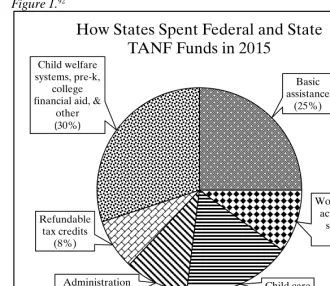
The change in the delivery method of welfare funds meant a tremendous change in the program that perhaps few predicted: rather than spending the bulk of their TANF funds on direct cash assistance to families or even work support for families, states instead spend most of the money on programs quite outside of these realms. Figure 1, below, details the average state distribution of TANF funds in 2015. As the Figure shows, even though the key stated goals of welfare reform were to provide a temporary safety net to families and to prepare recipients for work, states spent only half of their TANF funds on core welfare reform areas such as basic cash assistance, work-related activities and supports, and child care. Twelve states spent less than 30 percent of their TANF funds on such core activities.85
Prior to welfare reform, basic assistance was the single largest use of federal and state AFDC funds.86 By 2014, only 25 percent of TANF
funds went to direct cash assistance, which was the core of the former AFDC welfare program. Seven states spent less than 10 percent of TANF funds on direct cash assistance to families in need.87
Further, the numbers related to helping recipients find work, the heart of welfare reform, are notable—only 10 percent of TANF funds were used for work-related activities.88 Most states do not direct significant money to
job training programs. In fact, the federal government offers additional funding to states that pledge to provide job training or workforce slots for every person facing the welfare time limit. However, only five states
83. Chart Book: TANF at 20, CTR. ON BUDGET &POL’Y PRIORITIES 1 (Aug. 15, 2016), http://www.cbpp.org/research/family-income-support/chart-book-tanf-at-20 [https://perma.cc/ 77H3-6DG2].
84. 42 U.S.C. § 601(a) (2012).
85. Liz Schott & Ife Floyd,How States Use Funds Under the TANF Block Grant,CTR. ON
BUDGET &POL’Y PRIORITIES 7–9(Jan. 5, 2017), http://www.cbpp.org/sites/default/files/atoms/ files/1-5-17tanf.pdf [https://perma.cc/S8D7-UUGL].
86. Liz Schott, LaDonna Pavetti & Ife Floyd,How States Use Federal and State Funds Under the TANF Block Grant,CTR.ON BUDGET &POL’Y PRIORITIES 5 (Oct. 15, 2015), https:// www.cbpp.org/sites/default/files/atoms/files/4-8-15tanf_0.pdf [https://perma.cc/QH4V-SQ2R]. 87. Id. at 2.
have taken the pledge.89
Instead of using TANF funds to further the key stated goals of welfare reform, states spent almost a third of their 2015 TANF funds on services such as child welfare, which includes the organizations that run the foster care system and charge parents with child abuse and neglect; early education; afterschool programs; and college financial aid, in some cases for women who do not have children.90
It is hard to argue that, for example, the child welfare system somehow promotes job readiness—it is an often-punishing system for poor parents that can actually result in parents losing their jobs when their names appear on child abuse registries.91
These shifts in spending have meant a fundamental change for families who qualify for welfare. Post-reform, families are forced to find an alternative safety net.
89. Delphine D’Amora, Welfare Reform Is 20 Years Old and It’s Worse Than You Can Imagine, MOTHER JONES (Aug. 22, 2016, 10:00 AM), http://www.motherjones.com/politics/2016/ 08/welfare-reform-20-years-old-and-its-worse-you-can-imagine [https://perma.cc/NK2Z-8PTF]. 90. Schott & Floyd, supra note 85, at 2.
Figure 1.92
B. Where Are They Now?
If the goal was to reduce the number of families on the welfare rolls, welfare reform was wildly successful. On the eve of welfare reform, roughly seven in ten poor families received welfare. Now, only about two in ten do so.93 Over the last roughly twenty years, TANF
rolls are down to about 2.7 million total recipients including children,94
which is an 81 percent decline from 1994.95
President Clinton and House Republicans were encouraged by the drop in welfare rolls and a steady increase in the number of low-income
92. The data for Figure 1 were collected by the Department of Health and Human Services and presented graphically by Liz Schott and Ife Floyd in Schott & Floyd, supra note 85. Figure 1 is a slightly modified recreation of Schott and Floyd’s graph.
93. Kathryn Edin & H. Luke Shaefer, 20 Years Since Welfare ‘Reform,’ ATLANTIC (Aug. 20, 2016), https://www.theatlantic.com/business/archive/2016/08/20-years-welfare-reform/496730 [https://perma.cc/MBW4-SKXA].
94. TANF Caseload Data 2016, OFF. FAM. ASSISTANCE (Jan. 12, 2017), https:// www.acf.hhs.gov/ofa/resource/tanf-caseload-data-2016 [https://perma.cc/7SUT-GLDG]. 95. Caseload Data 1994 (AFDC Total), OFF.FAM.ASSISTANCE (Dec.19,2004), https:// www.acf.hhs.gov/ofa/resource/caseload-data-afdc-1994-total [https://perma.cc/78TB-EZ6Y].
Basic assistance
(25%)
Work-related activities &
supports (10%)
Child care (17%) Administration
& systems (10%) Refundable
tax credits (8%) Child welfare systems, pre-k,
college financial aid, &
other (30%)
single mothers who worked.96 A year after he signed the welfare reform
bill, Clinton told an audience, “[I]t’s fair to say the debate is over—we now know that welfare reform works.”97 In 2006, ten years later,
Clinton wrote an op-ed for the New York Times entitled How We Ended Welfare, Together.98 In this op-ed, after describing encouraging
statistics about the drop in welfare rolls and simultaneous increase in employment of women who had left welfare, Clinton declared “[w]elfare reform has proved a great success.”99
Welfare as we knew it did end. However, poverty as we knew it did not. The poverty rate for children in 2015 was 19.7 percent.100
Roughly four out of every ten children in the United States, 38.8 percent, are poor for at least one year before they reach their eighteenth birthday, and for black children, 75.4 percent are poor for at least one year of their childhood. Additionally, 10.5 percent of all children and 38.5 percent of black children are poor for at least half of their childhoods.101
Despite these numbers, initial results for welfare reform did look promising, as Clinton suggested. In 1993, 58 percent of low-income single mothers were employed, and this number rose to almost 75 percent by 2000.102
At the time welfare reform hit, the economy was booming and jobs were more readily available than in the 2000s, when the Great Recession hit and rates of employment for mothers dropped significantly.103 Even before the Great Recession, there were two
primary groups of welfare mothers: those who worked and those who were neither receiving welfare nor working. One in five single mothers did not work during the mid-2000s.104
For many years, this group of mothers fell under the radar, but a recent study has shed much light on those in deep poverty—living on roughly $2 per day.105
This Article,
96. EDIN &SHAEFER,supra note 1, at 29–30.
97. Clyde Haberman, 20 Years Later, Welfare Overhaul Resonates for Families and Candidates, N.Y.TIMES (May 1, 2016), https://www.nytimes.com/2016/05/02/us/20-years-later-welfare-overhaul-resonates-for-families-and-candidates.html [https://perma.cc/JGU4-UBLM].
98. Bill Clinton, Opinion, How We Ended Welfare, Together, N.Y.TIMES,Aug. 22, 2006, at A19.
99. Id.
100. BERNADETTE D.PROCTOR, JESSICA L.SEMEGA &MELISSA A.KOLLAR,CENSUS
BUREAU, INCOME AND POVERTY IN THE UNITED STATES:2015,at 12 (2016). 101. Id.
102. EDIN &SHAEFER,supra note 1, at 29–30. 103. Id.
however, focuses on another group of mothers—those who have been able to obtain a job that pays above the poverty line at some point post-welfare reform, but who have also experienced financial troubles at some point along the way. For this group of mothers, income volatility is commonplace, and small shocks that derail years of hard work are the norm.106
II. THE INCREASING IMPORTANCE OF CREDIT
Just as welfare reform took effect in the mid-1990s, credit scores and reports were gaining increased importance as gatekeepers to some of the most important economic institutions in the American economy. The history of credit reporting is often neglected, but it is key to understanding why some of the current proposals to regulate the use of credit reports may fall short. After briefly discussing the history of credit scores and reports, this Part provides a short primer on the mechanics of credit reports and scores, and then takes a detailed look at the expanding importance of credit in providing access to mainstream economic institutions. Finally, this Part discusses the role of credit in the lives of low-income families in a post-welfare-reform era.
A. The Surprising History of Credit Reports and Scores
Civil rights groups in the twenty-first century have advocated for curbing the use of credit reports in hiring and other contexts.107 In the
106. Lily L. Batchelder, Taxing the Poor: Income Averaging Reconsidered, 40HARV.J. ON
LEGIS. 395, 397 (2003) (“[L]ow-income families experience higher income volatility from year to year than middle- and high-income families . . . .”); Greene, supra note 15, at 518 (“While insecurity has increased for all Americans, levels of insecurity are higher among those with low incomes . . . and single parents.”); Jacob S. Hacker et al.,Economic Insecurity and the Great Recession: Findings from the Economic Security Index, ECON.SECURITY INDEX 16–17 (Nov. 2011), http://economicsecurityindex.org/assets/ESI%20Full%20Report%202011.pdf [https:// perma.cc/6JHB-LN7J]; Jacob S. Hacker et al., Econ. Security Index, Economic Security at Risk: Findings from the Economic Security Index, ECON. SECURITY INDEX, at iv (July 2010), http://economicsecurityindex.org/upload/media/Economic_Security_Index_Full_Report.pdf [https://perma.cc/2XMM-NM4W] (noting that the amount of insecurity varies across the population and that the less affluent face the most insecurity).
mid-twentieth century, however, civil rights and women’s rights groups were behind the push to mandate uniform standards of credit.108
The history of credit in the United States helps to explain why.
Credit has long been tied to a promise to repay, and timely repayment is considered a sign of trustworthiness.109
Long before credit bureaus existed, lenders relied on a potential borrower’s personal reputation within a community to decide whether or not to trust the individual with money.110 In the early twentieth century, consumer
financing of goods became increasingly popular, and families who once would have been ashamed to use consumer credit instead came to believe that buying items on credit was financially savvy.111
Indeed, by the late 1920s, most durable goods were bought on installment plans: 65 to 70 percent of automobiles, over 70 percent of furniture, and 80 percent of household appliances.112
Credit and loan-making decisions during this time were almost entirely subjective. As credit expanded, department stores established specialized credit offices that were charged with managing credit applications in a systematic and ordered fashion. Applicants were “interviewed, and assessments of their creditworthiness were made on the basis of the perceived physical demeanor of the applicant—how ‘shifty,’ ‘evasive,’ ‘seedy,’ or ‘flashy’ they looked.”113 Credit analysts
followed their own judgments when deciding whether to grant or deny
National Employment Lawyers Association; National Fair Housing Alliance; National Partnership for Women and Families; National Women’s Law Center; and Women Employed. Letter from the Lawyers’ Committee for Civil Rights under Law to Congressman Steve Cohen (July 17, 2009), http://lawyerscommittee.org/wp-content/uploads/2015/07/Equal-Employment-for-All-Support-Letter.pdf [https://perma.cc/76Y6-9MLM].
108. See generally LOUIS HYMAN, DEBTOR NATION (2011) (discussing the role of the NAACP and other groups in pressuring the Federal Housing Administration to curb their discriminatory mortgage practices); see also Louis Hyman, Ending Discrimination, Legitimating Debt: The Political Economy of Race, Gender, and Credit Access in the 1960s and 1970s, 12 ENTERPRISE &SOC’Y. 200, 202 (2011) (describing the role of activists in negotiating a series of laws in the late 1960s and early 1970s intended to promote credit fairness for all Americans). 109. See, e.g., Bruce G. Carruthers & Jeong-Chul Kim, The Sociology of Finance, 37 ANN. REV.SOC. 239, 240–41 (2011).
110. Bruce Carruthers & Wendy Espeland, Money, Meaning, and Morality,41 AM.BEHAV. SCI. 1384, 1393 (1998) (describing how, throughout history, lenders used personal characteristics and reputations of borrowers in order to decide whether to loan the potential borrower money). 111. See generally Martha L. Olney, Spendthrift, or Sophisticated Borrower?(Nov. 14, 2002) (unpublished manuscript) (on file with the Duke Law Journal) (describing the increasing use of consumer credit in the early twentieth century).
112. Id.
requests, and discrimination based on age, sex, marital status, social class, and ethnicity was rampant, making traditional credit unavailable to many.114
During the 1930s and beyond, the availability of credit continued to expand for most Americans, but poor and minority communities were explicitly excluded from access to low-cost government and other mainstream loans.115
The Home Owners Loan Corporation (HOLC) used an explicitly discriminatory rating system and “residential security maps” to label black communities as “high risk.”116
These practices were continued into the 1950s and 1960s by the Federal Housing Authority, the Veterans Administration, banks, real estate agents, appraisers, and others.117 After World War II, the growth of credit
markets for middle-class white Americans exploded—availability went well beyond the installment department store credit of the 1920s.118
Credit was interwoven into the everyday fabric of life—homes, cars, even clothing was financed. Credit access was the road to the American Dream.
Poor and minority Americans, however, were relegated to fringe lending and paid much more than they would have otherwise.119
Retailers in poor, mostly minority neighborhoods kept their accounts in leather-bound books (a relic of the past), going door-to-door to collect on debts, unlike suburban retailers.120
The prices were much higher in these poor neighborhoods, too. The same exact model of General Electric dryer that cost $238 in more affluent areas cost $270 in poorer areas of Washington, D.C.121 Particularly after World War II,
installment credit gave way to revolving credit for durable goods for most of America,122 but in poor neighborhoods, installment credit was
114. Id.
115. Lisa Rice & Deidre Swensik, Discriminatory Effects of Credit Scoring on Communities of Color, 46 SUFFOLK U.L.REV.935,936(2013).
116. Id.
117. Id.
118. HYMAN, supra note 108, at 135–37 (describing the prevalence of different types of credit for white middle-class Americans in the Postwar suburbs).
119. Id.
120. Hyman, supra note 108, at 201. 121. Id. at 205.
the only way of life, with high interest rates and one-sided terms.123
There was no access to credit cards in these poor neighborhoods and only extremely limited access to mortgages that would allow for mobility.124
Black residents knew they need not apply—even in the early 1970s, a Federal Trade Commission (FTC) report about the practices of a major consumer finance company found that applicants’ race was noted and given point scores on every application. White borrowers got seven points, a “person of Spanish origin” four points, and a black borrower no points at all.125
It was in this context that advocates for disadvantaged groups argued that instead of relying on one loan officer’s individual judgment and biases, universal automated systems would decrease the potential for discrimination because they would be “transparent, consistent, uniform, unbiased, less labor intensive and automatable.”126 As credit
historian Louis Hyman wrote, advocates believed the key to eliminating discrimination was in “increasing automation of decision making, in moving credit evaluation out of the hands of discriminatory loan officers and into the algorithms of objective quantitative credit lending models.”127
Both civil rights groups and women’s rights groups got involved. For example, the National Organization of Women (NOW) issued a press release that called on “Congress [to] amend the fair credit reporting act to require such [credit bureau] agencies to maintain individual files on all consumers without regard to sex or marital status.”128
Congress eventually responded, and beginning in 1974, it passed legislation and a series of targeted amendments that sought to end discrimination in credit evaluations and lending. When President Gerald Ford signed the amendment that targeted racial discrimination, he noted the shared commitment of Congress and his administration to “achieve goals of fairness and equality in a broad range of business transactions [which] millions of American consumers engage in every day of every year.”129
By the late 1970s, creditors were committed to eliminating any
123. Hyman, supra note 108, at 205. 124. Id.
125. Id. at 224.
126. Marron, supra note113, at 113. 127. Hyman, supra note 108, at 223–24. 128. Id. at 225.
possibility of a lawsuit, and thus many of them completely eliminated the role of loan officers in evaluating applicants and accelerated the transition to computer-based credit models.130 Richard Cremer, a
credit executive at Montgomery Ward, said that “traditional credit manager[s] . . . emphasized [their] face-to-face contact with the credit applicant,”131
which clouded judgment. “Biases, prejudices, and even mood” could affect the loan officers’ evaluations—and ultimately hurt profits.132
Thus, Cremer reasoned, credit scoring “encourage[d] a decision motivated by economics alone” and was the “only available method that meets the criterion of fairness.”133
Explicitly discriminatory categories were removed from models’ variables, and thus, the computer models and reports allegedly eliminated human prejudice and replaced it with consistent and “fair” reports that were no longer subject to the whims of individual loan officers.134
Today, FICO scores, which are derived from credit reports and range from 300 to 850, are the basis for most credit scores.135 FICO was
founded in 1956 as Fair, Isaac and Company by the engineer William Fair and the mathematician Earl Isaac.136 The two worked together to
devise a model to evaluate the risk that an individual would default on a loan, based only on a borrower’s finances. Thus, the score was to be race, sex, and even socioeconomic-status neutral.137
FICO went public in 1986, the first general-purpose FICO score was released in 1989, and mortgage companies such as Fannie Mae and Freddie Mac began using FICO scores to help determine mortgage qualification in 1995.138
Currently, the three main credit-reporting agencies use FICO scores as a basis for their credit score models.139
130. Id.
131. Id.
132. Id.
133. Id.
134. Id. at 226–27.
135. Our History, FICO, http://www.fico.com/en/about-us#our_history [https://perma.cc/ 6XDG-7HFA].
136. Id.
137. O’NEIL,supra note 22, at 142. 138. Our History, supra note 135.
B. A Brief Primer on Current Credit Report and Score Mechanics
FICO scores analyze information collected from credit reporting agencies in order to predict likely outcomes for lending money. FICO scores take five main factors into consideration. First, payment history, which considers whether bills were paid on time, accounts for roughly 35 percent of FICO a score. Second, credit utilization, which refers to the amount of credit a person is using compared to the amount of available credit the person has, accounts for about 30 percent of a FICO score. Third, the age of credit accounts makes up roughly 15 percent of a FICO score, with longer histories of on-time payments rewarded. Fourth, recent credit inquiries, which take into account when and how many credit inquiries were made, makes up about 10 percent of a FICO score. It is theorized that recent credit inquiries are a relevant factor because someone who has a lot of recent inquiries is more likely to be in a financial hole and in need of credit, making the person a more risky debtor. Finally, the types of credit a person has determine the remaining 10 percent of a FICO score: FICO scores are helped when a debtor has a variety of credit, including a mix of borrowing and repayment.140 Simultaneously having a student loan, a
credit card, and a mortgage payment, for example, would generally help a person’s credit score, while having just one credit card or just one student loan can bring a score down.141
There are three main credit reporting bureaus: TransUnion, Experian, and Equifax.142 All three of these separate bureaus report
roughly the same information, with some variation. Each bureau will report a slightly different score because each bureau uses a slightly different model for its calculations.143
Credit reports are distinct from credit scores. They are complex documents, often many pages long.144 They contain basic credit card
history—cards opened, cards closed, payment history, etc.—as well as
140. What’s in My FICO Scores, MYFICO, http://www.myfico.com/credit-education/whats-in-your-credit-score/ [https://perma.cc/Y2B9-FWZG].
141. Id.
142. See, e.g., Analysis of Differences Between Consumer- and Creditor-Purchased Credit Scores, CONSUMER FIN.PROTECTION BUREAU 4 (Sept. 2012), http://files.consumerfinance.gov/f/ 201209_Analysis_Differences_Consumer_Credit.pdf [https://perma.cc/GJ33-6Z5N].
143. Id.
payment history on mortgages, car loans, and student loans.145 There
are certain types of delinquencies—such as overdue utility bills, unpaid medical expenses, and owed rent—that show up on a credit report only if they are reported to a debt collector. Positive payment histories in these three areas are not included on a credit report.146
Ultimately, the basic functions of credit reporting and scores described in this Section form the basis for inclusion in, and exclusion from, important economic resources, as described below.
C. Credit Histories as Gatekeepers
On the surface, modern credit scoring appears to be an impartial and fair system for evaluating consumer risk. However, there is an important and growing literature that articulates why the current system may continue to harm disadvantaged groups by potentially replacing explicit discrimination with implicit discrimination. Some have described the potential for algorithms used in systems such as credit scoring to be inherently biased and thus cause disparate impacts on certain groups, despite all appearances of impartiality.147
While not the focus of this Article, these concerns are important when
145. Id.
146. Id.
147. EXEC.OFFICE OF THE PRESIDENT,BIG DATA:AREPORT ON ALGORITHMIC SYSTEMS, OPPORTUNITY, AND CIVIL RIGHTS 11 (2016) (noting that about 30 percent of consumers in low-income neighborhoods are credit invisible, meaning they do not have enough credit history to have a credit score, and thus are ineligible for credit that requires a credit score). This same report also argues that big data can lead to discriminatory results based on poorly selected data, incomplete, incorrect, or outdated data, selection bias, and unintentional perpetuation and promotion of historical biases. Id. at 7–8. Scholars have aired nearly identical concerns. See, e.g., Solon Barocas & Andrew D. Selbst, Big Data’s Disparate Impact, 104CALIF.L.REV. 671, 671, 679 (2016) (discussing the potential of big data to deny historically disadvantaged and vulnerable groups full participation in society because the data algorithms use are frequently imperfect in ways that allows algorithms to inherit the prejudices of prior decision makers); id. at 679 (noting that, in regards to credit scores, “there is no way to directly measure creditworthiness because the very notion of creditworthiness is a function of the particular way the credit industry has constructed the credit issuing and repayment system”); Danielle Keats Citron & Frank Pasquale,