Swift Hardware Processing Unit for Edge
Detection with Comparative Analysis of Different
Edge Detection Approaches
Aprajita Chtaurvedi Ravi Tiwari
PG Scholar Assistant Professor
Department of Electronics & Communication Engineering Department of Electronics & Communication Engineering
Dr.CV Raman University Kota Bilaspur (CG) Dr.CV Raman University Kota Bilaspur (CG)
Abstract
An edge in an image is a contour across which the brightness of the image changes abruptly. In image processing, an edge is often interpreted as one class of singularities. In a function, singularities can be characterized easily as discontinuities where the gradient approaches infinity. However, image data is discrete, so edges in an image often are defined as the local maxima of the gradient. This is the definition we will use here. Edge detection is an important task in image processing. It will use here. Edge detection is an important task in image processing. It is a main tool in pattern recognition, image segmentation, and scene analysis. An edge detector is basically a high pass filter that can be applied to extract the edge points in an image. This topic has attracted many researchers and many achievements have been made. The effectiveness of many image processing also computer vision tasks depends on the perfection of detecting meaningful edges. It is one of the techniques for detecting intensity discontinuities in a digital image. Many researchers provided different approaches based on mathematical calculations which some of them are either robust or cost effective. A new algorithm will be proposed to detect the edges of image with increased robustness and throughput. Using this algorithm we will reduce the time complexity problem which is faced by previous algorithm. I will also propose hardware unit for my proposed algorithm which will reduce the area, power and speed problem.
Keywords: EDGE detection, sobel operator, verilog digital, image processing
________________________________________________________________________________________________________
I. INTRODUCTION
In imaging science, image processing is any form of signal processing for which the input is an image, such as a photograph or video frame; the output of image processing may be either an image or a set of characteristics or parameters related to the image. Most image-processing techniques involve treating the image as a two-dimensional signal and applying standard signal-processing techniques to it.
Image processing usually refers to digital image processing, but optical and analog image processing also are possible.
An image defined in the “real world” is considered to be a function of two real variables, for example, a(x,y) with a as the amplitude (e.g. brightness) of the image at the real coordinate position (x,y).
Modern digital technology has made it possible to manipulate multi-dimensional signals with systems that range from simple digital circuits to advanced parallel computers. The goal of this manipulation can be divided into three categories:
- Image Processing (image in -> image out) - Image Analysis (image in -> measurements out)
- Image Understanding (image in -> high-level description out)
An image may be considered to contain sub-images sometimes referred to as regions-of-interest, ROIs, or simply regions. This concept reflects the fact that images frequently contain collections of objects each of which can be the basis for a region. In a sophisticated image processing system it should be possible to apply specific image processing operations to selected regions. Thus one part of an image (region) might be processed to suppress motion blur while another part might be processed to improve color rendition. Sequence of image processing: Most usually, image processing systems require that the images be available in digitized form, that is, arrays of finite length binary words. For digitization, the given Image is sampled on a discrete grid and each sample or pixel is quantized using a finite number of bits. The digitized image is processed by a computer. To display a digital image, it is first converted into analog signal, which is scanned onto a display. Before going to processing an image, it is converted into a digital form. Digitization includes sampling of image and quantization of sampled values. After converting the image into bit information, processing is performed. This processing technique may be Image enhancement, Image restoration, and Image compression.
Image Enhancement:
manipulation, noise reduction, edge crispening and sharpening, filtering, interpolation and magnification, pseudo coloring, and so on.
Image Restoration:
It is concerned with filtering the observed image to minimize the effect of degradations. Effectiveness of image restoration depends on the extent and accuracy of the knowledge of degradation process as well as on filter design. Image restoration differs fro m image enhancement in that the latter is concerned with more extraction or accentuation of image features.
Image Compression:
It is concerned with minimizing the number of bits required to represent an image. Application of compression are in broadcast TV, remote sensing via satellite, military communication via aircraft, radar, teleconferencing, facsimile transmission, for educational & business documents, medical images that arise in computer tomography, magnetic resonance imaging and digital radiology, motion, pictures, satellite images, weather maps, geological surveys and so on.
Image processing is defined as the manipulation of image representation stored on a computer. Operations on images that are considered a form of image processing include zooming, converting to gray scale, increasing or decreasing image brightness, red-eye reduction in photographs, edge and shape detection of an object and always possible for every customers or students to be able to get this up-to-date information.
II. PREVIOUS WORK
Edge detection refers to the process of identifying and locating sharp discontinuities in an image . Edge detection technique is usually applied on gray–scale image. The discontinuities are abrupt changes in pixel intensity which characterize boundaries of objects in a scene. Classical methods of edge detection involve convolving the image with an operator (a 2-D filter), which is constructed to be sensitive to large gradients in the image while returning values of zero in uniform regions.. Similar work has been already done by many people around the world.
The authors in [2] developed an kind of parallel processing construction of Sobel edge detection enhancement algorithm In this paper author used the old Sobel edge detection concept. In this work author use in the place of square unit he used absolute technique which will reduce some amount of timing and hardware complexity. Drawback of these approach is also present modified old existing approach in hardware. Due to using of modified old approach there is still large hardware unit is require.
The authors in [3] proposed a new approach for detection of edge on noisy image. In this work they combine sobel edge detection and WAVELET THRESHOLD DE-NOISING approach. But drawback of these approach is due to combination of two approach there is large hardware unit with height time complexity is require.
These authors [5] presents the proposed Sobel edge detection operator is model using of Finite State Machine (FSM) which executes a matrix area gradient operation to determine the level of variance through different of pixels In this paper author used the old Sobel edge detection concept.
The authors in [1] use Standard Sobel operators, for a 3×3 neighborhood, each simple central gradient estimate is vector sum of a pair of orthogonal vectors .Each orthogonal vector is a directional derivative estimate multiplied by a unit vector specifying the derivative’s direction. The vector sum of these simple gradient estimates amounts to a vector sum of the 8 directional derivative vectors.
The authors in [4] presents, a dedicated edge detection processor architecture based on field programmable gate arrays is presented. The architecture is an optimization of the Sobel edge detection filter, specifically focusing on the reduction of the computation time. The proposed architecture reduces the number of calculations required for the edge detection process by enhancing the data reuse, i.e. minimizing the frequency of memory access. Direct hardware implementation as proposed by previous works require most image pixels to be read from memory up to six times and transferred into the Sobel edge detection processor. In this work, author try to reduce the number of pixels read therefore affecting tremendous potential speed suitable for the embedded video processing applications.
III. PROPOSED METHODOLOGY
The proposed method is implemented on matlab to thoroughly investigate the required time to detect edges with in an object and compare output image with various parameters . here we will use grayscale image and we will find soble edge detection with improved filter based technique and here for filter we are using approximate 2D Gaussian filter .
Parameter Comparison:
Various parameters are used to evaluate the proposed algorithm at both levels. The various parameters are 1) PSNR (Peak signal-to-noise ratio)
2) SSIM (STRUCTURAL-SIMILARITY-BASED IMAGE QUALITY ASSESSMENT)[16]
PSNR (Peak signal-to-noise ratio)
Peak signal-to-noise ratio, often abbreviated PSNR, is an engineering term for the ratio between the maximum possible power of a signal and the power of corrupting noise that affects the fidelity of its representation. Because many signals have a very wide dynamic range, PSNR is usually expressed in terms of the logarithmic decibel scale.PSNR is most commonly used to measure the quality of reconstruction of lossy compression codecs (e.g., for image compression).
The PSNR is defined as
SSIM (STRUCTURAL-SIMILARITY-BASED IMAGE QUALITY ASSESSMENT)
Natural image signals are highly structured: their pixels exhibit strong dependencies, especially when they are spatially proximate, and these dependencies carry important information about the structure of the objects in the visual scene.
FSIM (Feature Similarity Index for Image Quality Assessment)[19]
The computation of FSIM index consists of two stages. In the first stage, the local similarity map is computed, and then in the second stage, pools the similarity map into a single similarity score. The separation of the feature similarity measurement between f1(x) and f2(x) into two components, each for PC or GM. First, the similarity measure for PC1(x) and PC2(x) is defined as
The methodology consists of two stages
Algorithm Stage:
Stage one: Approximate 2D Gaussian Smooth Filter Methodology[22]
This section is divide in two sections. First section deals with the Mirror short pixel approximation. The proposed algorithm for 3 X 3 & 2D Gaussian Smooth Filter is discussed in second sections respectively.
3X3 Approximate Gaussian Smooth Filter[22]:
Fig. 1: 3X3 2D Gaussian Smooth Filter[22]
Second Stage: Proposed 3X3 Sobel Edge Decetion Technique:
In this technique as initial stage we will pass input image from the 3X3 Gaussian smooth filter. After that we will apply that generated image to our proposed edge detection techniques. As we know edge detection is very usefull application in graphics world. As we already see there is different kind of problem is faced by previous edge detection approach.
Proposed Vertical Mask=
Gy = [
0 0 − 1 0 0 0 1 0 0 ]
Proposed Horizontal Mask=
Gx = [
Overall Proposed mask is following Diamond Structure:-
Gx + Gy = [
−1 0 − 1 0 0 0 1 0 1
]
Gx1=Absolute (Gx) Gy1=Absolute (Gy)
Sobel Edge Pixel = Gx1+Gy1
Here we are using cross logic which will reduce the time complexity issue with good output image quality which is acceptable by human eye. Generated filter mask consists of few values which are to be processed which results in fast computation and low area and power consumption at architectural level. The new filter mask consists of negative and positive values. By applying absolute on the result values and summing up them generates the same conventional function with reduces complexity.
Architectural Stage
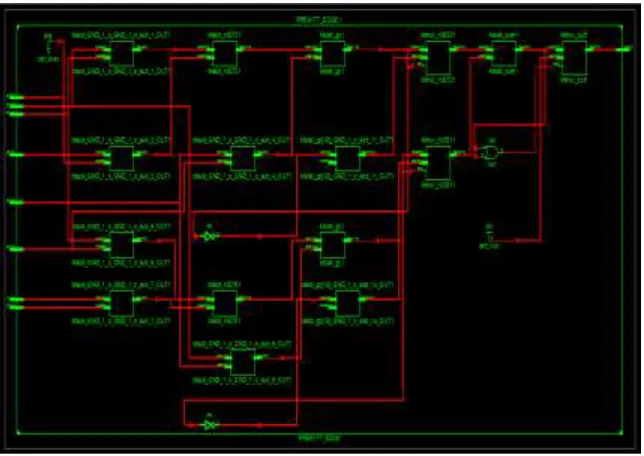
Here we design existing 3X3 Gaussian filter than we will design our proposed architecture is an optimization novel architecture]. The Sobel instance is the basic building block of the Sobel processor and it is able to produce one output pixel. The instances are connected in a way that form one big combinational Sobel block that will exploit FPGA parallelism and I/O capabilities. The processor is multiplier free, the processor based only on simple additions, subtractions and modulus operators. Here we implement our proposed architecture by using of Verilog HDL. Here Implementation Details: In these section we present implementation of some existing edge detection approach like Prewitt Operator [20], Canny edge Detection [11,20], sobel Edge detection [3,20]. Here we also implement our proposed Sobel edge approach.
Implementation of prewitt operation: This approach is implemented by using of matlab. According to that approach we will calculate horizontal and vertical gradient using horizontal and vertical prewitt mask.
Implementation of Canny edge detection [11, 20]:
This approach is implemented by using of matlab. According to that we have to follow these five stpes: 1) Apply Gaussian filter to smooth the image
2) Find the intensity gradients of the image 3) Apply non-maximum suppression. 4) Apply double threshold.
5) Track edge by hysteresis
Implementation of Sobel Edge detection [3,20]:
This approach is implemented by using of matlab. According to these we have to calculate horizontal and vertical gradient by using of sobel mask. At last step we have to calculate modulus by using of square root approach, But in [3] these modulus approach is replaced by using of absolute approach which is present in [3].
Implementation of Improved Sobel Edge detection [8]:
This approach is implemented by using of matlab. According to these we have to reduse noise by using of de-noising algorithm which is known as 2D and WAVELET THRESHOLD DE-NOISING than we have to calculate horizontal and vertical gradient by using of sobel edge detection approach. This approach will generate a good quality output image.
Fig. 2:
2) Canny Based[20]:
Fig. 3:
3) Sobel Absolute[3,20]:
4) Sobel Improved [8]:
Fig. 5:
IV. RESULT
A new algorithm will be proposed and that algorithm will be implemented by using of MATLAb, for image quality measurement I will use some scientific parameters like PSNR, SSIM, and FSIM. I will also propose hardware unit for my proposed algorithm which will reduce the area, power and speed problem. I will compare my proposed algorithm with previous approach hardware implementation will be done by using of Verilog on Xilinx 14.2 simulator. Verification will be done on Model sim.
During first stage the proposed method is implemented on matlab to thoroughly investigate the required time to detect edges with in an object and compare output image with various parameters.
Comparative Result of FPGA:
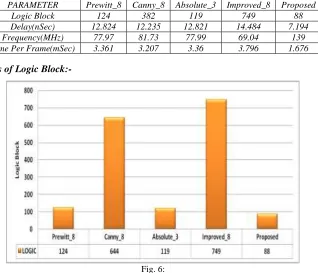
PARAMETER Prewitt_8 Canny_8 Absolute_3 Improved_8 Proposed
Logic Block 124 382 119 749 88
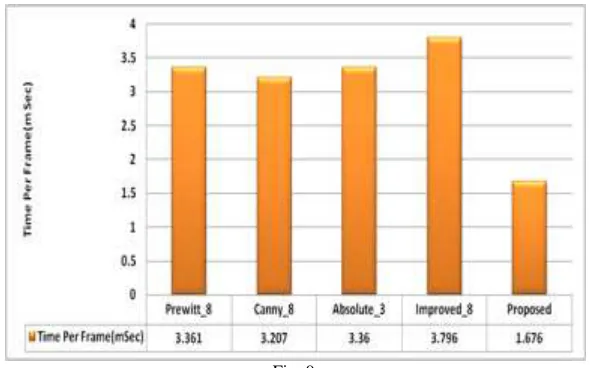
Delay(nSec) 12.824 12.235 12.821 14.484 7.194 Frequency(MHz) 77.97 81.73 77.99 69.04 139 Time Per Frame(mSec) 3.361 3.207 3.36 3.796 1.676
Comparative Analysis of Logic Block:-
Comparative Analysis of Delay:-
Fig. 7:
Comparative Analysis of Frequency:-
Fig. 8:
Comparative Analysis of Time per Frame:-
V. CONCLUSION
According to this thesis we will resolve the previous existing problem which is latency, power, area. The key contribution of this work is to develop a fast Edge detection algorithm. Using this work we will develop a SPAA aware error tolerant Edge detection Unit. This proposed edge detection unit will require less area, power and speed. In this approach I will propose a new approach of approximation which will reduce some amount of accuracy. In proposed approach I will use only 4 pixel. Here we are using cross logic where we will take 2 pixels from horizontal and 2 pixels from vertical mask means basically we will propose a new mask. Using this approach we reduce the timing complexity and hardware complexity with 20-30%.
REFERENCES
[1] Nita, I.; Costachioiu, T.; Lazarescu, V.; Seceleanu, T.,"Multiprocessor real time edge detection using FPGA IP cores," Intelligent Computer Communication and Processing (ICCP), 2011 IEEE International Conference on , vol., no., pp.331,334, 25-27 Aug. 2011
[2] Zhengyang Guo; Wenbo Xu; ZhiLei Chai, "Image Edge Detection Based on FPGA," Distributed Computing and Applications to Business Engineering and Science (DCABES), 2010 Ninth International Symposium on , vol., no., pp.169,171, 10-12 Aug. 2010
[3] Wenshuo Gao; Xiaoguang Zhang; Lei Yang; Huizhong Liu, "An improved Sobel edge detection," Computer Science and Information Technology (ICCSIT), 2010 3rd IEEE International Conference on , vol.5, no.
[4] Osman, Z.E.M.; Hussin, F.A.; Ali, N.B.Z., "Optimization of Processor Architecture for Image Edge Detection Filter," Computer Modelling and Simulation (UKSim), 2010 12th International Conference on , vol., no., pp.648,652, 24-26 March 2010
[5] Zhao Chunjiang; Deng Yong, "A Modified Sobel Edge Detection Using Dempster-Shafer Theory," Image and Signal Processing, 2009. CISP '09. 2nd International Congress on , vol., no., pp.1,4, 17-19 Oct. 2009
[6] Yasri, I.; Hamid, N. H.; Yap, V. V., "Performance analysis of FPGA based Sobel edge detection operator," Electronic Design, 2008. ICED 2008. International Conference on , vol., no., pp.1,4, 1-3 Dec. 2008
![Fig. 1: 3X3 2D Gaussian Smooth Filter[22]](https://thumb-us.123doks.com/thumbv2/123dok_us/7819561.1664623/3.612.166.467.454.585/fig-x-d-gaussian-smooth-filter.webp)