Efficient Surf Tracking by Nearest Neighbor
Classifier
Minglei Tong
School of Computer and Information, Shanghai University of Electric Power, Shanghai 201300, China; [email protected]
Shudong Chen
Institute of Microelectronics of Chinese Academy of Sciences, Wuxi, China Email: [email protected]
Abstract—Visual object tracking is a fundamental problem in many real applications, like video security surveillance, human computer interaction (HCI), video communication and compression, augmented reality, traffic control, medical imaging and video editing. The common challenge towards this task is the ambiguity existing among object and the background. To differentiate object from background, SURF descriptor [12] is applied in this paper to enable the efficient tracking-by-detection. SURF descriptors are extracted only in region of interest in each frame, to ensure the tracker’s high efficiency. Under the recently proposed framework, nearest-neighbor criterion is used to match the corresponding feature points within or out of the object appearance. Efficient sub-window search method is applied to accelerate the searching process while without sacrificing to searching accuracy. Experimental results prove the proposed tracker could be used in a real time tracking scene.
Index Terms—Visual tracking, Feature extraction, Nearest neighbor classifier, Surf
I. INTRODUCTION
Visual tracking is crucial to computer vision not only theoretically such as visual understanding, but also for application like surveillance and robotics. The state of this art has advanced significantly during the past several decades.
Tracking can be regarded as the estimation of states for a time series model. In visual tracking context, it generally involves an appearance based model to describe the target, and matching is conducted to differentiate the object from background based on the appearance variety.
Local invariant features exhibit competitive performance in computer vision and pattern recognition tasks thanks to their appealing representation characteristics. [7] gives a thorough empirical study on the performance of various local features. SIFT [8] outstands among many types of local features including shape context [10], PCA-SIFT [9], etc. The later proposed SURF descriptor [11,12] can be regarded as a variant of SIFT and has been verified for sharing the approximate repeatability, distinctiveness and robustness, yet at a lower computational price.
In this paper, in line with the framework of tracking-by-detection, we leverage the SURF feature descriptors to
represent the target appearance model. Such localized appearance representation allows a set of features to describe the target in the initial frame, in addition with another set of features to describe the background. Our tracker separates target from background in image sequences.
The rest of this paper is organized as follows. Section II reviews the related work. Section III describes the tracking by detection model built on SURF. Section IV gives the tracking algorithm. Experimental results are shown in section V and Section VI concludes this paper.
II. RELATED WORK
During past decades, many algorithms and systems have been proposed for tracking [1,2,3,4,5,6]. Recently, progress among feature representation, object detection and recognition [17,15], etc. have lead to the new framework namely tracking-by-detection [19,20]. Shi and Tomasi [2] adopt search methods in a Newton-Raphson manner to handle object tracking under affine transformations. Their tracker monitors the feature qualities during tracking via a measure of feature dissimilarity.
et al. proposed the Bayesian inference of target location after extracting SURF points in each frame. In this paper, we also build our tracker on this descriptor, whose computational time is faster than SIFT, while maintaining the approximate efficacy. Perhaps the most relevant work is [18] proposed by Gu et al. Following their nearest neighboring framework, our tracker identifies the object target feature points compared with rest points, and updates the appearance model in an online style. Compared with the tracker in [18], our main improvements consist of the adoption of SURF features (SIFT are used in their paper), another improvement is the computation of feature extraction is only limited within the region of interest in the temporal tracking context. These two improvements significantly speed up the computational efficiency of the tracker.
III. PRELIMINARY
A. SURF Descriptors and SURF Localization
In this section, we have a brief review on the SURF detector-descriptor scheme [12]. The performance of SURF can be mainly attributed to the use of the Integral Image [25].
SURF takes advantage of the property of Integral Image to perform quick convolutions of varying size box filters at a near constant time. The SURF detector is based on the determinant of the Hessian matrix.
( (
))
xx xyxy yy
f
f
H f x y
f
f
′′
′′
⎛
⎞
,
=
⎜
⎜
⎟
⎟
′′
′′
⎝
⎠
(1)The determinant of this matrix, also known as the discriminant is calculated as:
det H
( )
=
f
′′ ′′
xxf
yy−
(
f
′′
xy)
2 (2)Translating this mathematics into practice in the context of SURF, one can leverage a Gaussian kernel to calculate the determinant of Hessian for each pixel across the image and detect the points of interest based on the value. Then the scale-space iscreated by varying the size of kernels while leaving the the original image unchanged, without the process of subsampling as done in SIFT [8]. As a result, it provides performance increase. There are three steps for localizing the SURF points in the image. First the responses are threshold such that all values below the predetermined threshold are removed. A non-maximal suppression is performed to obtain a set of candidate. Finally, the neighboring feature points are interpolated to localize them in both space and scale to a sub-pixel accuracy.
The SURF descriptor is similar to the SIFT one [8]. The main difference lies in the adoption of integral images which are applied in conjunction with the Haar wavelets filters. The descriptor extraction can be boiled down into two steps. First a reproducible orientation assignment is performed in order to achieve rotation invariance. Then one should construct a square window around the interest point. More specifically, the descriptor window is divided into
4 4
×
regular sub-regions, and each sub-region contributes four values tothe descriptor vector such that the final descriptor has its dimension of 64. After reduction to unit length, contrast, the resulting SURF descriptor is regarded as invariant to rotation, scale and brightness.
B. The Nearest Neighbor Classifier Tracking Model First, we hereby describe the state-of-the-art tracking-by-detection model proposed by the recent work [18]. Let
V
=
[(
x f
1, ,
1) (
x f
2,
2)
,...,
(
x f
n,
n)]
denote thefeature representation of the set of SURF points where
i
x
indicates thei
th point location, andf
i for thei
thpoint’s descriptor vector. For the resulting tracking rectangle window
W
k in thek
th frame, one set thefollowing criterion for filtering:
1 1
||
v NN
−
Ok−( ) ||
v
<
λ
||
v NN
−
Bk−( ) ||
v
(3)where
NN
Ok−1( ) arg
v
=
min
u O∈ k−1||
u v
−
||
is thenearest neighbor of v in the set of object appearance
1 k
O
− , and similarlyNN v
B( )
corresponds to the case ofbackground
B
k−1.If point v suffices Eq. 3, then v would be taken into the current object appearance model i.e.
1
k k
O
←
O
−∪
v
as such online appearance updating is performed. Similarly the set ofB
k would then be updated asB
k←
B
k−1∪
v
by computing the corresponding criteria. Hereλ
is a selection parameter and in the original surf paper [11] the author claims 0.7 is a good choice for matching, while in the context of tracking, we experimentally find 0.5 is more suitable in order to avoid mismatching.In addition, we keep most recent
T
frames to keep the tracker’s adaption to dynamic environment. The set of features are stored in the k-d tree structure for matching efficiency. For each coming frame, the points meet Eq. 3 would be inserted into the set of points that represent object, while at the same time, a previous frame (current -T
) would be removed.Given the
O
k−1,
B
k−1,
W
k−1, the matching measurementmodel is aimed to guide the window
W
k locating nearthe previous window
W
k−1. As the same with [18], basedon Eq. 3, one can build the following model:
1 1 1
1
(
)
( )
(
)
k k k k
k
S W O
B
W
sign A
κ
W W
− − −
−
;
,
,
=
∑
−
,
(4)where
A
||
v NN
Ok1( ) ||
v
λ
||
v NN
Bk1( ) ||
v
− −
= −
<
−
and( ) 1
sign A
=
ifA
is true and -1 otherwise. The second term is modeled as [18]:1 1 1
(
W W
k k)
( (
s W W
k k) (
t W W
k k))
where
1 1
1 1
(
) ||
||
||
|| ||
||
k k k k
k k k k
s W W
pos
pos
height
height
width
width
′ − ′ −
′ − ′ −
,
=
−
+
−
+
−
1 2 1 2
1 2 1 2
1
(
)
{
h h w w}
k k w w h h
t W W
′,
−=
max
| − |,| − |
penalizes variations in the aspect ratio. A further tuning for parameterγ
is performed as follows: for the initial frame, we setλ
= .
0 075
, and letini_ft_num
denote the number of corresponding feature points across the first two frame. For the following frames, to remove the influence of the variation of detected feature points, letk
ft_num
denote the we set0 075
ft_numkini_ft_num
λ
= .
. Butwe set
λ
cannot be slower than0 025
.
.In terms of window localization, the target window
W
kcan be exhaustively searched by:
1 1 1
arg
(
)
k W k k k
W
=
max S W O
;
−,
B
−,
W
− (6) Since exhibitive search would cost at the price ofm n
2 2where
m
andn
is the image height and width respectively. By laying down the constraint of a rectangle window on target, one can leverage the recently proposed state-of-the-art Efficient Sub-window Search (ESS) method to decrease the computational price. Specifically, one can use the following modified measurement function [18] to achieve near linear searching performance.1
arg
(
)
new old
W k
S
=
S
−
min
κ
W W
,
− (7) IV. PROPOSED METHODOur improvements consist of the adoption of SURF features, another improvement is the computation of feature extraction is only limited within the region of interest in the temporal tracking context. These two improvements significantly speed up the computational efficiency of the tracker.
Detailed algorithm and implementation with respect to the tracker is described as follows.
Algorithm 1 Surf tracking using nearest neighboring classifier
Input:
I.The initial location for tracking
P
0,(here we use two points: lefttop and rightbottom to determine the rectangle location and shape, notice that in this tracker, affine transform is not in consideration to enable the efficiency from EES [16]);II.The initial set of SURF descriptors
S
within the objectrectangle; Tracking:
For t = 1 to number of frames do:
1: Extract SURF feature points and calculate the descriptor vector in region of interest.
2: Search Wk using Efficient Subwindow Search (ESS) method
based on Eq. 6 Eq. 7.
3: Update the object appearance model Ok ← Ok−1∪v that v
suffices the nearest neighboring criterion:Eq. 3 and update the background appearance in a similar way.
Endfor
V. EXPERIMENTAL RESULTS
We implemented the proposed tracker in MATLAB based on the implementation of the tracker from [18]. For SURF features extraction, we leverage the publicly available executable from http://www.vision.ee.ethz.ch/
~surf/download.html [12]. Four sequences [29,30,14,31] are tested to validate the performance of the proposed tracker.
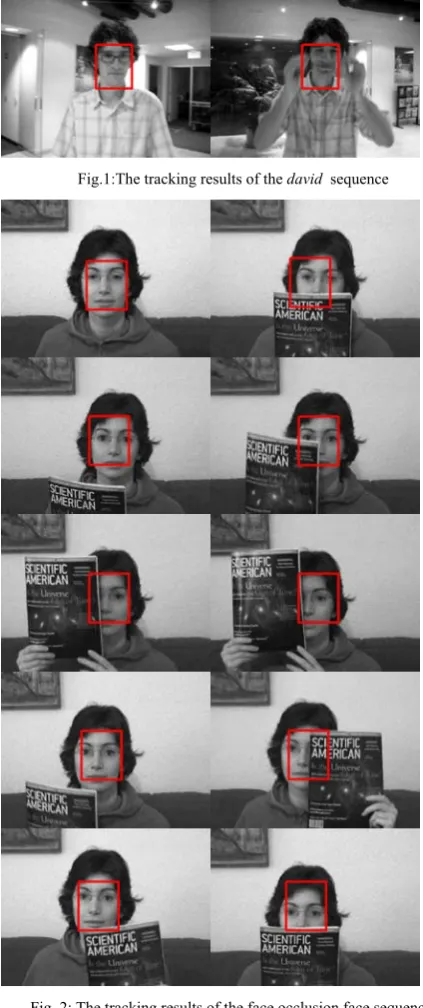
A The david sequences. The first test sequence is downloaded from http://www.cs.toronto.edu/ dross/ivt/ [29], namely david with the length of 462 frames. Figure 1 shows some typical sampling results of the tracking sequence. The challenge of this sequence is the illuminations are variant in different frames. Even though our methods can track the face very accurate and fast.
B occlusion face for a woman. The second (888 frames) sequences are from [31]. In this sequences, the tracking head is under severe occlusions by a book. In the condition of occlusion, the proposed method can work well and track the face successfully in all the frames.
C Occlusion face for a man. The third sequences (816 frames) are from[14]. Figure 2 and Figure 3 respectively demonstrates the efficacy of the proposed tracker on the third and fourth sequence. One can observe the tracker performs robustly towards different tracking scenarios against noise and variation.
Fig.1:The tracking results of the david sequence
Fig. 2: The tracking results of the face occlusion face sequence.
Fig. 3: The tracking results of the face occlusion face sequence.
In this section we also make a comparison of the tracking velocity between our proposed methods and the solution in work [18]. Work [18] takes advantage of SIFT features as the tracking cue. The proposed solution in this paper are faster more than 2 times than the way in [18].
TABLE 1.
THE COMPARISON OF TRACKING COSTS
david woman
face man face girl
proposed
work 21F/S 22F/S 22F/S 19F/S
work in
[18] 8F/S 9F/S 9F/S 6F/S
VI CONCLUSION
In this paper we propose using the SURF feature for visual tracking under a tracking-by-detection framework. Compared with [22], we leverage the efficient nearest neighboring criteria [18] and efficient subwindow search [16] to speed up the tracking process. While compared with [18], we improve the efficiency by using surf feature which has been verified its excellence in visual tracking [22]. On the other hand, we improve the scheme by updating the background appearance model in addition with the online adaptive tuning of parameter that measures the relative weight of tracking temporal spatial continuity. In experiments involving four challenging sequences, the proposed tracker demonstrates competitive performance. Future work would explore the possibility to take the affine transform into consideration while at the same time maintaining the efficiency thanks to the technique of efficient subwindow search. Another perspective is to combine a variety of features representation into a unified framework to compensate current appearance ambiguity in some cases where the SURF features are hardly to extract, e.g. few textures object. At least, current tracker can be extended to specific scenario like face, car detection and tracking, by leveraging on more particular features.
ACKNOWLEDGMENT
This research is supported by the National Nature Science Foundation of China (No. 61105016). the Innovation Program of Shanghai Municipal Education Commission (Grant No.
12YZ139).
REFERENCES
[1] Lucas, B., Kanade, T. An iterative image registration
technique with an application to stereo vision, IJCAI., 1981.
[2] Shi, J., Tomasi, C. Good features to track, CVPR, 1994.
[3] Comaniciu, D., Ramesh, V., Meer, P. Real-time tracking of
non-rigid objects using mean shift, CVPR, 2000.
[4] H. Sidenbladh and M. Black, Stochastic tracking of 3D
human figures using 2D image motion. ECCV 2000.
[5] S. Avidan, Ensemble tracking, CVPR, 2005.
[6] X. Wang, G. Hua, and T.X. Han, Discriminative Tracking
by Metric Learning. ECCV 2010.
[7] K. Mikolajczyk and C. Schmid, A performance evaluation
of local descriptors. In TPAMI, pages 257–263, 2003.
[8] D. G. Lowe, Object recognition from local scale-invariant
features. In ICCV, 1999.
[9] Y. Ke, R. Sukthankar, and R. Sukthankar. Pca-sift: A more
distinctive representation for local image descriptors. In CVPR, pages 506–513, 2004.
[10]S. Belongie, J. Malik, and J. Puzicha. Shape matching and
object recognition using shape contexts. PAMI, 24:509– 522, 2002.
[11]H. Bay, T. Tuytelaars, and L. V. Gool. Surf: Speeded up
robust features. In ECCV, pages 404–417, 2006.
[12]H. Bay, A. Ess, T. Tuytelaars, and L. V. Gool. Speeded-Up
Robust Features (SURF). In CVIU, pages 346-359, 2008(10).
[13]Grabner, H., Leistner, C., Bischof, H.: Semi-supervised
on-line boosting for robust tracking. In: ECCV. (2008) 234– 247
[14]Babenko, B., Yang, M., Belongie, S.: Visual tracking with
online multiple instance learning. In: IEEE CVPR. (2009) 983–990
[15]Felzenszwalb, P., McAllester, D., Ramanan, D.: A
discriminatively trained, multiscale, deformable part model. In: IEEE CVPR. (2008)
[16]Lampert, C., Blaschko, M., Hofmann, T.: Efficient
subwindow search: A branch and bound framework for object localization. IEEE PAMI 31 (2009) 2129–2142
[17]Everingham, M., Gool, L., Williams, C., Winn, J.,
Zisserman, A.: The PASCAL Visual Object Classes Challenge 2009 (VOC2009) Results.
[18]Steve Gu and Ying Zheng and Carlo Tomasi, Efficient
Visual Object Tracking with Online Nearest Neighbor Classifier. ACCV 2010.
[19]M Andriluka, S Roth. People-Tracking-by-Detection and
People-Detection-by-Tracking. CVPR 2008
[20]Michael D. Breitenstein, Fabian Reichlin, Bastian Leibe
Esther Koller-Meier, and Luc Van Gool. Robust Tracking-by-Detection using a Detector Confidence Particle Filter. ICCV 2009.
[21]Wei He, Takayoshi Yamashita, Hongtao Lu, and Shihong
Lao. SURF Tracking. ICCV 2009.
[22]Duy-Nguyen Ta, Wei-Chao Chen Natasha Gelfand Kari
Pulli. Surftrac: Efficient tracking and continuous object recognition using local feature descriptors. CVPR 2009.
[23]Santner, J., Leistner, C., Safiari, A., Pock, T., Bischof, H.:
PROST Parallel Robust Online Simple Tracking. In: IEEE CVPR. (2010)
[24]Viola, P., Platt, J., Zhang, C.: Multiple instance boosting
for object detection. In: NIPS. (2005)
[25]Viola, P., Jones, M.: Rapid object detection using a
boosted cascade of simple features. In: CVPR (1). (2001) 511 – 518
[26]Breiman, L.: Random forests. Mach. Learning 45 (2001)
5–32
[27]Werlberger, M., Trobin, W., Pock, T., Wedel, A., Cremers,
D., Bischof, H.: Anisotropic huber-l1 optical flow. In: BMVC. (2009)
[28]Michael Donoser and Horst Bischof. Efficient Maximally
Stable Extremal Region (MSER) Tracking. CVPR 2006.
[29]J. Limy, D. Rossz, R. Liny and M. Yang, Incremental
[30]S. Birchfield. Elliptical Head Tracking Using Intensity Gradients and Color Histograms. CVPR 1998
[31]A. Adam and E. Rivlin and I. Shimshoni. Robust
Fragments-based Tracking using the Integral Histogram. CVPR 2006
Minglei Tong was born in 1976. He
received the Ph. D. degree in Institute of Image Processing from the Shanghai Jiao tong University, shanghai in 2008. Currently, he is a associate professor at School of Computer and Information in Shanghai University of electric power. His research interests include computer vision,human computer interaction. Dr. Tong is a member of ACM.
Shudong Chen is now a professor in