Research Article
ISSN 2277-3657
Available online at www.ijpras.com
Volume 3, Issue 4 (2014):52-61
International Journal of Pharmaceutical Research &
Allied Sciences
52
Formulation Development and In-vitro Evaluation of Sustained
Release Tablets of Carvedilol Solid Dispersion
Fayeza Tahseen*A.B. Gangurde
Departmentof Pharmaceutics KBHSS Trust’s Institute of Pharmacy, Malegaon Camp, Malegaon.423103
*Email: [email protected]
Subject: Pharmaceutics
Abstract
In the present work, an attempt was made to formulate sustained release tablets of Carvedilol by solid dispersion technique for improving solubility of Carvedilol using Poloxamer 407 and PVP K30. The carvedilol tablets were prepared by direct compression method using HPMC K15 as sustained release polymer in different concentrations. The prepared tablets were evaluated for various physicochemical parameters, In-vitro drug release study was carried out in simulated gastric fluid (0.1 N HCl) for the first 2 hr and in phosphate buffer (pH 6.8) for the next 12 hr following USP Type II paddle apparatus. Increase in HPMC concentrations resulted in a significant decrease in Carvedilol release. For instance, the tablets containing 20mg of HPMC K15 (F1 and F4) shows 97% drug releaseupto12hr when compared to 40mg and 60mg 0f HPMC K15 (F2, F3, F5 and F6)shows 98% drug release upto 14hr. The in-vitro data is fitted in to different kinetic models like Zero order, First order, Korsmeyer and Higuchi’s plot. The release of Carvedilol from tablets containing solid dispersions of Poloxamer 407 and PVP K30 were shown early t50% 6.4hrs (F1 and F4) than it’s plane drug tablet formulation 9.5hrs (F7). From this study, it was clarified that solid dispersion technique was one of the promising sustained release system applying for the poorly water soluble drugs.
Key words:
Carvedilol, Sustained release, HPMC K15, PVP K30.Introduction
Traditional drug delivery system has been characterized by immediate release and repeated dosing of the drug which might lead to the risk of dose fluctuation, this arises the need of a formulation with control release that maintain a near-constant or uniform blood level. Sustain release with the introduction of extended release matrix tablet have proved to be an effective tool to control the release of drug without involving the complex production procedures. By the sustained release method therapeutically effective concentration can be achieved in the systemic circulation over an extended period of time, thus achieving better compliance of patients. Numerous sustain release oral dosage forms such as membrane controlled system, matrices with water soluble/insoluble polymers or waxes and osmotic systems have been developed, intense research has recently focused on the designation of sustained release systems
Available online at www.ijpras.com
53
Materials
Carvedilol was provided as gift sample by Ipca lab, Mumbai. HPMC K15 and PVP K30 was providedas gift sample by Svizera laboratory, Mumbai, Magnesium stearate, Talc of analytical grade was purchased from Vishal chemicals, Mumbai.
Methods
Preparation of Carvedilol Solid Dispersion (SDs)
The solid dispersions of Carvedilol were prepared by the solvent evaporation method. The weighed amount of drug and polymer Poloxamer 407 and PVP K30 were prepared in the ratio of 1:1, 1:2, 1:3 and 1:4 was dispersed in a given volume of methanol. These were stirred for 15 minutes to ensure homogenous mixing and solvent was evaporated at 50oC. The solidified mass after complete evaporation of the solvent was crushed, pulverized and passed through mesh # 60 and stored in a desiccator under vacuum. 3,4
Solubility study of Carvedilol solid dispersion The solubility studies of the solid dispersions from formulation A1 to A6 were carried out in distilled water. Accurately weighed amount of solid dispersion equivalent to 20mg of Carvedilol was dissolved in 100ml of distilled water, sonicated the solution upto 3 hrs. The absorbance of all solutions of 20µg/ml was measured against distilled water as a blank at 241nm by using UV-Visible double beam spectrophotometer (LabIndia3000+). 5 Solid dispersion of Carvedilol was prepared by solvent evaporation method the drug and polymers Poloxamer 407 in the ratio 1:4 and PVP K30 in 1:2 ratio were showed increase in solubility of Carvedilol in comparison to other drug polymer ratios. So that the drug and Polymer ratios Carvedilol: Poloxamer 407 (1:4) and Carvedilol: PVP K30 (1:2) was used for the preparation of tablets.
Formulation of sustained release tablets of Carvedilol solid dispersion
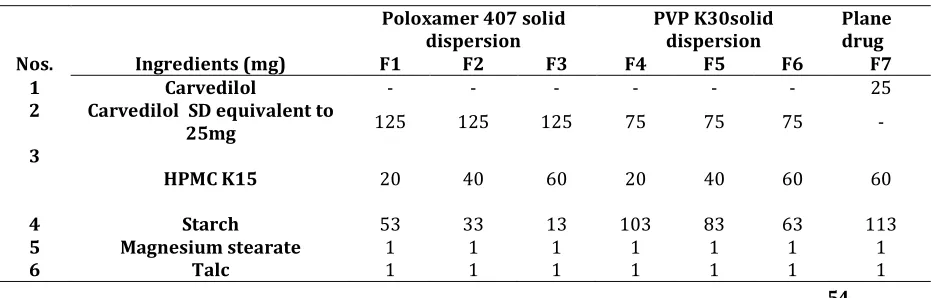
The Carvedilol solid dispersion with Poloxamer 407 (1:4) and PVP K30 (1:2) were taken equivalent to 25 mg of Carvedilol, was blended with different polymers like HPMC K15 (used as sustained release polymer) and potato starch (used as tablet filler) for 10 min using mortar and pestle. Further this mixture was blended with magnesium stearate (as a lubricant) & talc (as a flow promoter) and finally compressed using
7.5mm flat-faced punch of 10 station Rimek compression machine.3
Evaluation of tablets
The matrix tablet of Carvedilol, prepared with and without solid dispersions by direct compression techniques, were evaluated for pre-compression and post-pre-compression parameters such as, angle of repose, compressibility (%), hausner’s ratio and hardness, friability, weight variation, thickness, drug content, the obtained results were tabulated in Table2 and 3respectively.6,7,8
Content Uniformity
5 tablets were taken and powdered. From that, sample equivalent to 25mg of drug was taken and transferred to 100ml volumetric flask.20ml Methanol was added and gently heated on water bath to dissolve the drug, cooled to room temperature and volume was made up to mark with methanol. This was filtered. From that filtrate 1ml was taken and diluted with 0.1N HCl and absorbance of this solution was measured as per analytical method.6
Drug and polymer interaction study (FTIR study)
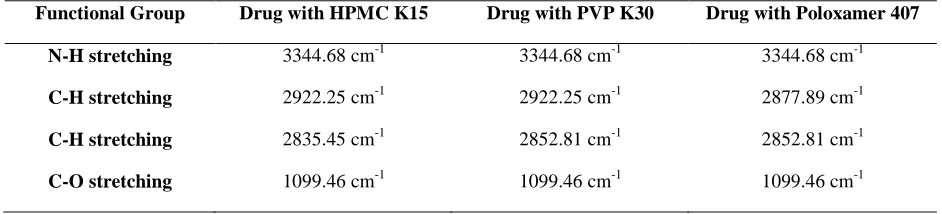
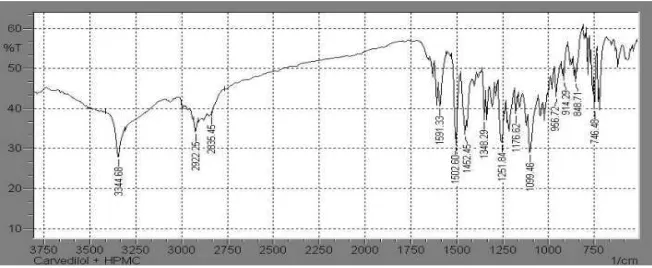
The FTIR spectra of carvedilol alone and it’s combination with polymers are shown in figure. The FTIR spectra of pure carvedilol showed the peaks 3344.68 cm-1 (N-H Streching), 2924.18 cm-1 (C-H Streching), 2835.45 cm-1 (C-H Streching) and 1099.46 cm-1 (C-O Streching). These peaks considerd as characterstic peaks of Carvedilol and were not affected and prominently observed in IR spectra of Carvedilol along with polymers (PVP K30, Poloxamer 407 and HPMC K15) as shown in figure, Indicated no interaction between Carvedilol and polymers. As various polymers were used in those formulations in different amounts.9
In-vitro Dissolution study
Available online at www.ijpras.com
54 The amount of drug released was determined
using respective calibration curves. Dissolution studies for each formulation were performed in triplicates.7,
Drug release kinetics study
To describe kinetics of drug release from the sustained release tablets of, mathematical models, such as zero order, first order and Higuchi square root of time and korsmeyer peppas model were used. The criteria for selecting most appropriate model were based on goodness of fit test. The zero order kinetics describes system in which drug release rate is independent of its concentration, the first order kinetics describes the systems in which drug release rate in concentration dependent, Higuchi described release of drug as a square root of time dependent process on basis of Fickian diffusion.10
Data analysis
To analyze the mechanism of the drug release rate kinetics of the formulations, the data obtained were plotted as:
1. Cumulative % Drug Released vs. Time (Zero order plot)
2. Cumulative % Drug Released vs. Square root of Time (Higuchi plot)
3. Log Cumulative % Drug Remaining vs. Time (First order plot)
4. Log % Drug Released vs. Log Time (Korsmeyer plot)
Results and Discussion
A simple technique of sustained release solid dispersion tablets was used in the present investigation. Solid dispersions were prepared
using polymers like (Poloxamer 407, and PVP K30). Sustained release solid dispersion tablets were prepared using HPMC K15 polymer. Standard graph of Carvedilol in 0.1N HCl showed good linearity. Its ‘R2’ value is 0.999 and hence obeyed Beer Lambert’s law.
The FTIR Spectra of carvedilol with the polymers PVP K30, Poloxamer 407 and HPMC K15 revealed the major functional groups of Carvedilol were same or nearly same, hence there was no probable interaction between drug and polymers.The sustained release tablets of solid dispersion were prepared as described in the methodology. The solid dispersion prepared in the ratio of drug:polymer (1:2 ratio of drug and PVP K30, 1:4 of drug: Poloxamer 407) and also of without solid dispersion Carvedilol tablets.
The formulations were evaluated for hardness, friability, weight variation, drug content, in-vitro dissolution study. The harness of tablets were found to be in the range of 6.8±0.04 to 6.9±0.117kg/cm2.And mean diameter and thickness (n=10) were almost uniform in all formulations and values for tablets ranged from 7.48±0.004 to 7.50±0.034mm and 4.12±0.018 to 4.96±0.007 mm respectively. The friability values ranged from 0.75±0.128 to 0.95±0.130%. The average weight of formulations was found from 199.05±0.24 to 209.2±0.15, shown in Table 8.12. The values were almost uniform and lie within the USP specifications, all the tablets passed weight variation test as the % weight variation was within the Pharmacopoeial limits.The percent drug content of tablets was found to be in between 97.21±0.098 to 99.81±0.023%, which was within acceptable limits (IP 1996).
Table 1: Formulae of Sustained release tablets of Carvedilol Solid dispersion
Poloxamer 407 solid dispersion
PVP K30solid dispersion
Plane drug
Nos. Ingredients (mg) F1 F2 F3 F4 F5 F6 F7
1 Carvedilol ‐ ‐ ‐ ‐ ‐ ‐ 25
2 Carvedilol SD equivalent to
25mg 125 125 125 75 75 75 ‐
3
HPMC K15 20 40 60 20 40 60 60
4 Starch 53 33 13 103 83 63 113
5 Magnesium stearate 1 1 1 1 1 1 1
Available online at www.ijpras.com
55 Table 2: Evaluation of pre-compression parameters
Batch Code
Angle of Repose(ө)
Bulk Density (g cm-3)
Tapped Density (g cm-3)
Carr’s CompressibilityI
ndex (%)
Hausner Ratio (HR)
F1 23.59±0.25 0.371±0.001 0.440±0.002 14.54±0.90 1.187±0.001 F2 24.52±0.3 0.389±0.002 0.455±0.002 14.74±0.53 1.170±0.012 F3 21.6±0.26 0.381±0.003 0.447±0.002 14.21±0.16 1.171±0.007 F4 23.45±0.27 0.387±0.001 0.457±0.002 14.86±0.51 1.164±0.001 F5 25.53±0.30 0.394±0.002 0.449±0.002 12.09±0.51 1.175±0.007 F6 21.40±0.29 0.378±0.002 0.440±0.005 12.79±0.54 1.138±0.006 F7 25.55±0.31 0.381±0.003 0.437±0.002 14.69±0.02 1.145±0.006
All values are expressed as mean ±SD
Table 3: Evaluation of post-compression parameters
Batch
Code Hardness kg/cm (n=10)
Thickness mm (n=10)
Diameter mm (n=10)
Friability % (n=3)
Weight variation %
F1 6.9±0.28 4.36±0.07 7.49±0.008 0.86±0.147 204.4±0.12 F2 6.9±0.073 4.12±0.018 7.48±0.004 0.75±0.128 200.6±0.35 F3 6.8±0.042 4.35±0.016 7.50±0.034 0.94±0.132 199.8±0.24 F4 6.9±0.117 4.32±0.017 7.49±0.004 0.86±0.138 202.7±0.32 F5 6.6±0.063 4.96±0.007 7.48±0.006 0.90±0.144 209.2±0.15 F6 6.8±0.051 4.92±0.228 7.49±0.004 0.84±0.150 199.5±0.24 F7 6.8±0.152 4.26±0.004 7.49±0.005 0.95±0.130 205.3±0.21
All values are expressed as mean ±SD
Table 4: Characteristic peak of Carvedilol with Polymers
Functional Group Drug with HPMC K15 Drug with PVP K30 Drug with Poloxamer 407
N-H stretching 3344.68 cm-1 3344.68 cm-1 3344.68 cm-1
C-H stretching 2922.25 cm-1 2922.25 cm-1 2877.89 cm-1
C-H stretching 2835.45 cm-1 2852.81 cm-1 2852.81 cm-1
Available online at www.ijpras.com
56 Table 5: Values of rate constants (K) and correlation coefficients (R) for release from Carvedilol
solid dispersion tablets
Batch Code
Zero
Order First Order Higuchi’s Korsmeyer Peppas Best Fit Model
(R) (R) (R) (R) n
F1 0.994 0.794 0.928 0.982 0.47 Zero Order
F2 0.988 0.728 0.989 0.993 0.46 Zero Order
F3 0.996 0.780 0.914 0.986 0.47 Zero Order
F4 0.995 0.714 0.924 0.987 0.47 Zero Order
F5 0.983 0.734 0.926 0.990 0.45 Zero Order
F6 0.997 0.775 0.900 0.997 0.46 Zero Order
F7 0.975 0.792 0.855 0.982 0.46 Zero Order
Fig.1: FTIR spectra of Carvedilol drug
Available online at www.ijpras.com
57 Fig.3: FTIR spectra of Carvedilol and Poloxamer 407
Fig.4: FTIR spectra of Carvedilol and PVP K30
Fig.5: Cumulative % drug release VsTime (Zero order kinetics) of F1-F3 0
20 40 60 80 100 120
0 5 10 15
cu
m
u
la
ti
v
e
%
d
ru
g
re
le
a
se
d
Time in Hrs
Zero order
Available online at www.ijpras.com
58 Fig.6: Cumulative % drug release VsTime (Zero order kinetics) of F4-F7
Fig.7: log Cumulative % drug remainingVs Time (First order kinetics) of F1-F3
Fig.8: log Cumulative % drug remaining VsTime (First order kinetics) of F4-F7 0
20 40 60 80 100 120
0 5 10 15
cu
m
u
la
ti
v
e
%
d
ru
g
re
le
a
se
d
Time in Hrs
Zero order
F4 F5 F6 F7
0 0.5 1 1.5 2 2.5
0 5 10 15
lo
g
c
u
m
u
la
ti
v
e
%
d
ru
g
re
m
a
in
in
g
Time in hrs
First order
F1 F2 F3
0 0.5 1 1.5 2 2.5
0 5 10 15
lo
g
c
u
m
u
la
ti
v
e
%
d
ru
g
re
m
a
in
in
g
Time in hrs
First order
Available online at www.ijpras.com
59 Fig.9: Cumulative % drug release Vs Square root of Time (Higuchi’s release Mechanism) of F1-F3
Fig.10: Cumulative % drug release Vs Square root of Time (Higuchi’s release Mechanism) of F4-F7
Fig.11: log Cumulative % drug release Vs log of Time (Korsmeyer Peppas release Mechanism) of F1-F3
0 20 40 60 80 100 120
0 1 2 3 4
cu
m
u
la
ti
v
e
%
d
ru
g
re
le
a
se
d
Square root time in hrs
Higuchi Model
F1 F2 F3
0 20 40 60 80 100 120
0 1 2 3 4
cu
m
u
la
ti
v
e
%
d
ru
g
re
le
a
se
d
Square root time in hrs
Higuchi Model
F4 F5 F6 F7
0 0.5 1 1.5 2 2.5
0 0.5 1 1.5
lo
g
c
u
m
u
la
ti
v
e
%
d
ru
g
re
le
a
se
d
log time in hrs
Korsmeyer's Peppas
Available online at www.ijpras.com
60 Fig.12: log Cumulative % drug release Vs log of Time (Korsmeyer Peppas release Mechanism) of
F4-F7
“Cite this article”
Fayeza Tahseen* A.B. Gangurde “Formulation Development and In-vitro Evaluation of Sustained Release tablets of Carvedilol Solid Dispersion” Int. J. of Pharm. Res. & All. Sci. 2014;3(4):52-61
Conclusion
A satisfactory attempt was made to develop a novel sustained release tablets using HPMC polymer and evaluated for in-vitro
characterization studies Carvedilol tablets containing solid dispersion of Poloxamer 407 and PVPK30 exhibited increase in solubility and improved drug dissolution as compared to the plane carvedilol tablets.In Sustained-release solid dispersion tablets, the release rate of Carvedilol decreased with increasing HPMC K15 concentration. Sustained release tablets prepared using solid dispersions (F1 and F4) were shown early t50% than it’s plane drug tablet formulation (F7). In-vitro drug release study of formulations indicated that Carvedilol was released in sustained release manner up to 14 hours and it shows the zero order drug release. Mechanism of drug release observed was Korsmeyer-peppas with ‘n’ value 0.45 to 0.47 i.e. Fickian diffusion and polymer relaxation.From the studies on carvedilol
solid dispersion, we can conclude that sustained release tablets of Poloxamer 407 and polyvinylpyrrolidone K-30 solid dispersions of carvedilol provides more satisfactory sustain release than pure carvedilol sustain release tablets. Solid dispersion released drug at early t50%upto 12 hrs timeperiode.
References
1. Bhargava A, Rathore RPS, Tanwar YS, Gupta S, BhadukaG: Oral Sustained Rrelease Dosage Form, An Opportunity to Prolong the Release of Drug, International Journal of Advanced Research in Pharmaceutical & Biosciences, 2013, 3(1): 7-14.
2. Ankur RG, Dr. Amelia MA, Mr. Rachit SS, Ms. Tanvee MD: Sustained Release Technology- A Review, International Journal of Universal Pharmacy and Bio Sciences 2(4): July-August 2013.
0 0.5 1 1.5 2 2.5
0 0.5 1 1.5
lo
g
c
u
m
u
la
ti
v
e
%
d
ru
g
re
le
a
se
d
log time in hrs
Korsmeyer's Peppas
Available online at www.ijpras.com
61 3. Pawar DV, Md.Sarfaraz and Pyerole:
Formulation and Evaluation of Controlled Release Matrix Tablet with Solid Dispersion Granules of Aceclofenac, Indian Journal of Novel Drug delivery 2(3), Jul-Sep, 2010: 109-113.
4. Encyclopedia of Pharmaceutical Technology,JamesSwabrick. Third edition, volume I,Informa Healthcare, New York: 774-778.
5. Vivekkumar U, V Vasunaik, Narasimha R, G NagarjunaReddy and KPR Chowdary: Formulation and Evaluation of Modified release Carvedilol tablets, an International journal of advances in pharmaceutical sciences, vol.1 (1) sep-oct-2010.
6. British pharmacopoeia; 1999. Volume1. Controller of Majesty’s stationary office for the department of health on behalf of Health ministers; P. 361.
7. Indian Pharmacopoeia, 1996. Ministeryof Health and Science Welfare. Government of India,New Delhi. 2:735-736.
8. United States Pharmacopoeia, National Formulary 25, United States Pharmacopoeia Convention,2005, 242, 674, 276, 277,731.
9. Analytical profile of drug substances, edited by Klaus and florey, Vol-38;115.
10.Samba MU,Madan Mohan Kumawat, RohitRT, Someshwar K, KumaraswamyD: Formulation of Sustain Release solid Dispersions of Verapamil Hydrochloride using Ethyl Cellulose and Eudragit-RSPO, International Journal of Pharmacy and Pharmaceutical Sciences,Vol 3, Issue1: 116122.
11.Lee TW, and Robinson JR, In Remington: The science and practice of pharmacy, Gennaro, 20th edition, Baltimore, Lippincott Williams and Wilkins, 2000: 903-929.
12.Ansel HC, Allen LV, and Popovich NG: Pharmaceutical dosage forms anddrugdelivery system, 9thedition, Lippincott William & Wilkins, 2005: 257-271.
13.Aulton ME, Modified release peroral dosage forms, Pharmaceutics- The science of Dosage form Design, 2nd edition, Churchill Livingstone, New York: 290.