Study of MIG Welding Process with Different
Type Technique: A Review
Naval Mahore Trapti Sharma
PG Student Research Scholars Assistant Professor
Department of Automobile Engineering Department of Automobile Engineering RJIT, BSF Academy, Tekanpur Gwalior, MP, India RJIT, BSF Academy, Tekanpur Gwalior, MP, India
Ranjeet Singh Assistant Professor
Department of Automobile Engineering RJIT, BSF Academy, Tekanpur Gwalior, MP, India
Abstract
Metal inert gas welding (MIG) is a joining and fabrication process which is used extensively in 25 years due to its advantages such as low heat input, less arc, production efficiency, less heat effective zone and environment friendliness. MIG welding can be used to join different types of ferrous metals and non-ferrous metals that cannot be welded by non-traditional welding processes. This welding process parameters was used during joining of metal and parameter such as welding current, welding voltage, welding speed, nozzle distance, wire feed rate, gas flow rate and torch angle. Result The various technique used in optimization of welding parameter such as regression techniques, taguchi s technique and statistical process in this paper are study of all aspect to relative in improvement for welding quality and strength.
Keywords: MIG welding, Taguchi method, Mild steel, parameter, but joint, tensile test
________________________________________________________________________________________________________
I. INTRODUCTION
Welding is a process for joining two similar or dissimilar metals by fusion. It joins different metals/alloys, with or without the application of pressure and heat or combination of both. The welding is very less cost. And the process is strong joint and use for making permanent joints. The heat may be generated either from combustion of gases, electric arc, electric resistance or by chemical reaction. The welding is widely used as a fabrication and repairing process in industries. Some of the typical applications of welding include the fabrication of ships, machine frame, automobile bodies and chassis, railway wagons, aircraft and ships, welded pipes, etc.
II. CLASSIFICATION OF WELDING
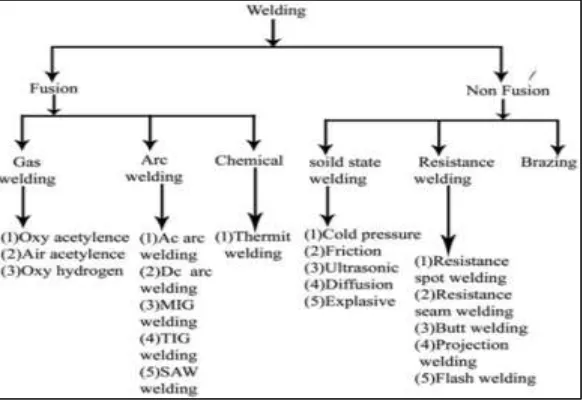
Welding process may be classified on the basis of fusion process which is shown in figure 1. All the detail of classified the welding with type of welding use manufacturing works.
(IJSTE/ Volume 4 / Issue 6 / 001)
Metal Inert Gas Welding (MIG)
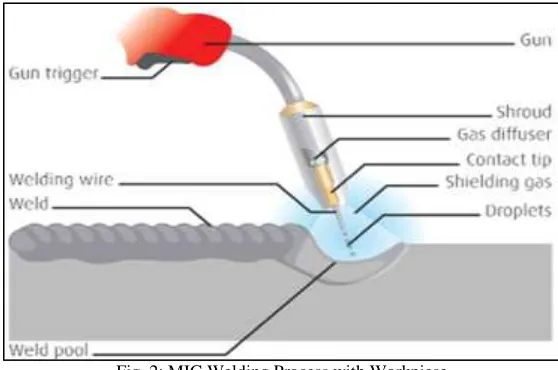
Metal inert gas welding is one of the most significant arc welding processes which is used to fabrication of structure. It is better knowledge and input control of the MIG welding process. Because of the good heat input control, MIG can be used for nonferrous welding. It is a semi-automatic process which is used to continuous welding with helps of wire, high metal depositions rate and high welding speed. The most important gases which have been used in shielding the weld pool are Argon (Ar), Helium (He), CO2. Shielding gases are also use to cool down the gun. MIG welding process is shown in figure 2.
Main component of MIG welding process- 1) MIG Welding machine setup
2) Filler wire 3) Cable of wire feed 4) Negative cable 5) Gas cylinder CO2
Fig. 2: MIG Welding Process with Workpiese
III. LITERATURE REVIEW
Table - 1
S.No. Author Name Matraial Techigne Conclusion
1. S. R. Patil et.al. AISI 1030 mild steel Taguchi method L9
This was observed that welding current and welding speed are major parameters which influence on the tensile strength
of welded joint.
2. S.Utkarsh et. al. low alloy steel
material st-37 L9 orthogonal Array
It was found that an optimal rate of current, voltage speed and gas flow rate which is control the weld quality strength.
3. Sindiri Mahesh
et.al. AISI 1050 mild steel L9 orthogonal Array
It have a worked on welding parameters like welding current, welding voltage, welding speed on ultimate tensile strength
(UTS) .
4. Pradip Kumar Pal et.al.
Austenitic Stainless
Steel AISI 316L L9 Taguchi design
This was observed that influence of the process parameters current, gas flow rate and nozzle to plate distance has been examined visually and also through X-ray radiographic tests.
5. Vikas Chauhan et.al.
Stainless steel (SS-304) and low carbon
steel.
L9 Taguchi method
It have a worked on dissimilar metals are plates a joined by MIG welding successfully. Find out the analysis of signal-to-noise ratio was done using MINITAB-13 software for
higher-the-better quality.
10. prof. s. d. ambekar et.al.
Martensitic Stainless steel AISI 410
L16orthogonal array
It Have a parameters optimizing. It was found that the results closer to the optimize results.
11. jiahun Liu et.al. aluminum
alloy/stainless steel Mathematical
It was found that. X-ray diffraction
(XRD) analysis & Microstructure and with a tensile strength of the lap joint reaching.
12. M.suban et.al. --- Mathematical modal
It is type of sidling gas use MIG welding and it is found that TIME, RAPID, LANFAST PROCESS from high productivity welding. And that the quality of welding joint does not become
impaired.
13. Farhad Kolahan
et.al. --- statistical method
The experiment design to Regression modelling and next stage selected model is implanted into a Simulated Annealing
(SA) optimization algorithm.
14. B. Mishra et.al. AISI 1020 steel Taguchi’s design of experiment (DOE)
It was found that optimal process parameters for effectiveness in the analysis of penetration & S/N ratio.
15. P. Chavda et.al. medium carbon stee Design of Experiment (DOE)
It have a technique use Finite Element Analysis and Design of experiment (DOE) method .from optimizing parameter.
16. Priti Sonasale
et.al. Mild steel
Taguchi method
It is fund that confirmation test is carried out to compare the predicated values with the experimental values confirm its effectiveness in the analysis of bead width, dilution and depth
of HAZ.
17. G hargupal at.al. Aluminium alloy (Al65032)
Taguchi method L9
It was found that. Parameter optimizing with S/N ratio analysis and mean response analysis and ANOVA.
18. E. Hayati at.al. Steel AISI 1020 Taguchi method DOE
It Have a work on Parameter optimizing Regression Analysis, Signal-toNoise Ratio(S/N).
IV. PARAMETER OPTIMIZATION TECHNIQUES
The optimization of welding process.
Taguchi’s Design Method
Taguchi design recognizes the control factors to minimize the effect of Noise factor. Orthogonal array helps to reduce the time and cost of the experiment. The Signal-to-Noise (S/N) Ratio which are log function of required output which is the objective function to be optimized.
Larger is better
S/N=-10*log (∑ (1/Y2)/n) Smaller is better
S/N = -10*log (∑(Y2)/n) Where
y = responses for the given factor level combination n= no of responses in the factor level combination
Statically approaches-This is method step in depend following as.
Approach 1:
Linear regression analysis- Linear regression analysis considering all the terms. A: Bead width (BW)
B: Bead high (BH) C: Bead penetration (BP) D: Weld metal
(IJSTE/ Volume 4 / Issue 6 / 001)
Ŷ =f(x1,x2,x3,x4,x5,x6) b0+b1x1+ b2x2+b3x3+ b4x4+ b5x5+ b6x6+b7x1x2+ b8x1x3+ b9x1x4+ b10x1x5+ b11x1x6+ b12x2x3+ b13x2x4+ b14x2x5+ b15x2x6+ b16x3x4+ b17x3x5+ b18x3x6+ b19x4x5+ b20x4x6+ b21x5x6+ b22x1x2x3+ b23x1x2x4+ b24x1x2x5+ b25x1x2x6+ b26x1x3x4+ b27x1x3x5+ b28x1x3x6+ b29x1x4x5+ b30x1x4x6+ b31x1x5x6+ b32x2x3x4+ b33x2x3x5+ b34x2x3x6+ b35x2x4x5+ b36x2x4x6+ b37x2x5x6+ b38x3x4x5+ b39x3x4x6+ b40x3x5x6+ b41x4x5x6+ b42x1x2x3x4+ b43x1x2x3x5+ b44x1x2x3x6+...(1)eq.
Where is-
Xi is the coded value corresponding to the ith input parameters, and Ŷ is the estimated response (output) value. The coefficients (i.e., b0, b1, and b2... b44) of the above equation can be estimated by using a least-square technique.
Approach 2:
Linear regression analysis considering significant terms only.
In this approach, the insignificant terms are dropped from Eq. (1). For each response, the significant and insignificant terms will be identified with the help of Pareto charts included in the next section. Regression analysis is carried out and predictions are attempted with the help of the resulting equations.
Approach 3:
Linear regression analysis using main factors only.
In this approach, each response is expressed as a function of the main factors only (without considering their interaction terms). Ŷ=f(S,V,F,G,D,A)
Ŷ=α0+α1S+α2V+α3F+α4G+ α5D+ α6A
Where- is α1; α2; . . . : α6are the coefficients to be obtained by using a least-square technique discussed in the subsection given below. Regression analysis is carried out for each response by considering only the main factors.
Approach 4:
Non- linear regression analysis.
Non-linear regression analysis is also carried out to determine the responses - weld bead height (BH), bead width (BW), and penetration (BP), in case of the MIG welding process.
Ŷ=f(S,V,F,G,D,A) Ŷ=α0*Sa1*Va2*Fa3*Ga4*Da5*Aa6 After taking log on both the sides, we get
In(Y)=In(α0)+α1In(S)+ α2In(V)+ α3In(F)+ α4In(G)+ α5In(D)+ α5In(A). Where- α0,α1,α2,α3,α4,α5,α6, are the coefficients of the non-linear model.
V. CONCLUSIONS
The objective of this study was to establish the influence of the MIG welding process, which is used to good quality of joint and high productivity rate. Based on this study of MIG welding the following conclusion may be observed.
1) The welding parameter are the input role of welding process which is control the weld quality and strength 2) Shielding gas is preventing the oxidization during the welding process.
3) The optimization parameter is set on the behalf of different optimization technique like Taguchi method, statistical method, Mathematical method.
4) Design of experiment con be used the important software based in MINI TAB, MATA LAB, and ANSYS.
REFERENCES
[1] R. Patil, C. A. Waghmare "optimization of mig welding parameters for improving strength of welded joints" , patil et al, international journal of advanced engineering research and studies, july-sept., 2013,14-16.
[2] S.utkarsh, P. Neel, mayank T. mahajan, P.jignesh, R. B.prajapati, “experimental investigation of mig welding for st-37 using design of experiment.” international journal advance research in science and engineering , issn- 2250-3153, vol-4(2014)
[3] Sindiri Mahesh et. al. “optimization of mig welding parameters for improving strength of welded joints” (ijitr) international journal of innovative technology and research volume no.5, issue no.3, april – may 2017, 6453-6458.
[4] Pradip Kumar Pal et.al. “Parametric Optimization of Gas metal arc welding process by PCA based Taguchi method on Austenitic Stainless Steel AISI 316” 2016 Elsevier Ltd.
[13] Farhad Kolahan et.al. “A New Approach for Predicting and Optimizing Weld Bead Geometry in GMAW” International Journal of Mechanical Systems Science and Engineering,.
[14] B. Mishra et.al. “Metal inert gas welding parameters optimization.” International Journal of Multidisciplinary and Current Research, volume 2, Issue-June 2014, ISSN 2321-3124.
[15] P. Chavda et.al. “A Review on Parametric optimization of MIG Welding for MediumCarbon Steel using FEA-DOE Hybrid Modeling” International Journal for Scientific Research & Development| Vol. 1, Issue 9, 2013 | ISSN (online): 2321-0613.
[16] Priti Sonasale et.al. “An Approach to Optimize MIG Welding Parameters by Using Design of Experiments” Journal of Mechanical and Civil Engineering (IOSR-JMCE) ISSN: 2278-1684,p-ISSN: 2320-334X, Volume 11, Issue 6 Ver. IV (Nov- Dec. 2014)
[17] G hargupal at.al. Parametric optimization of MIG Welding of Aluminium alloy (Al65032) Taguchi Method,(jisr), Vol. 70oct.2011, ISSN:844-850 [18] E. Hayati et. al. “Parametric Optimization of Gas Metal Arc Welding Process by Taguchi Method on Weld Dilution”, International Journal of Modeling and
Optimization, Vol. 1, No. 3, August 2011.
[19] Rajender singh, A book Introduction to Basic Manufacturing Processes and Workshop Technology “New age international publication” ISBN (10) 81-224-2316-7,vol.2006.