Improved Reversible Data Hiding in
Absolute Moment Block Truncation Coding
Compressed Images
Amita1, Loveleen2
1School of Engineering & Technology, Centre for Computer Science & Technology, Central University of
Punjab, Bathinda 151001, India
2School of Engineering & Technology, Centre for Computer Science & Technology, Central University of
Punjab, Bathinda 151001, India
Abstract-This paper is focused on theinvestigation of the existing reversible data hiding method using AMBTC compressed images.In this method, multilevel histogram shifting technique is used to hide the confidential data. After the implementation ofsame method with same test images, experimental results are differ significantly from the results quoted in the existing paper. The experimental evaluation shows that the PSNR values aredepended to the embedding level, but existing paper reveals that the PSNR values are independent to the embedding level.
Keywords - Absolute moment block truncation coding, Capacity, Reversible data hiding, Embedding level and multilevel histogram shifting
I. INTRODUCTION
With the advancement of computer networks and progress in information technology, an enormous amount of digital data is being exchanged over the network. A major part of transmitted digital data, which is either confidential or private, demands security mechanisms to provide the required protection. Therefore, security has become an important concern during the storage and transmission of digital data. Hence, confidentiality and integrity are necessary requirements to safeguard against unauthorized access. So, there is a significant growth in the field of information hiding, which includes applications such as Copyright Protection, Cryptography, Steganography, Digital Watermarking and Fingerprinting. These techniques have applications for transmitting military messages, E-mails, credit card information, corporate data, and personal files. The word steganography is picked up from the Greek words “stegos” means “cover” and “grafia” means “writing,” defining it as “covered writing”[1]. Nowadays, demand for security is increasing day by day that leads to the use of steganography for information security. It is the mechanism for hiding the original messages from the intruders and only intended receiver have knowledge of the existence of the secret data in the cover media. The ultimate goal of steganography is to avoid drawing suspicion to the transmission of the secret
message between sender and receiver. It is invisible, hence, the detection is not easy [2]. The data hiding techniques are broadly divided into two category: irreversible data hiding and reversible data hiding (RDH). The reversibility means accurately recovered the secret data as well as the cover image. Hence, RDH method applies to the field in which cover image is as important as the secret data i.e. medical imaging system, military imaging system, etc.
Reversible data hiding focused on the two basic mechanisms: Difference Expansion (DE) and Histogram Shifting (HS). Ni et al. proposed the RDH based on the histogram shifting[3]. To further improve, Feng et al. introduce the prediction method into RDH [4]. In [5], Zhao et al. introduce the multilevel histogram shifting to improve the capacity further.
II. RELATEDWORK
In this method, two algorithms are used in which one is used for the compression of the image and other is used for the data hiding.
A. Absolute moment block truncation coding
In AMBTC-compression scheme, an image is first decomposed into some non-overlapping k × k-sized sub-blocks, such as 2 × 2, 3 × 3 or 4 × 4 and so on. The block size, k is often set to be 4 in the conventional AMBTC encoding scheme. For sub-blocks, sample mean pixel value, 𝑥 and sample absolute central moment, ∝ are described in below equation [7].
∝ = 1/m xm i=1 i− x
Where xi denotesthe pixel value of non-overlapping
blocks and m denotes the number of pixels in each block i.e. 4×4.
Quantization levels are calculated from
𝑎 = 𝑥 − (𝛼 /2) ∙ m/(m − q) 𝑏 = 𝑥 + (𝛼 /2) ∙ m/q
Where q denotes the number of pixels larger than the block mean value.
Lastly, the 4×4 bitmap C of the block pixels is written as
C= 1 if xi> x
0 otherwise
The two quantization levels and bitmap {a, b, C} are transferred to the receiver side. On the receiver side, block can be recovered with the help of a, b and C.
B. Multilevel histogram shifting method
The histogram is constructed with the neighbor pixels’ difference values because the adjacent pixels’ value is similar. Multilevel histogram shifting mechanism is used to hide confidential data in embedding levels. In data extraction stage, the confidential data is extracted from the marked sequences of pixels’ differences. Meanwhile, the cover image can be perfectly recovered with an inverse mechanism of multi-level histogram shifting after extracting the secret data from the marked image. This scheme concludes that the embedding capacity is determined by the embedding leveland the peak bins around bin zero. The capacity Cap (bit) can be calculated as
Cap= b0 if f = 0
bk if f > 0 f
k=−f
Here b0 denotes the number of samples falling into the
histogram bin at zero, and f indicates the embedding round. (Zhao & Tang, 2012)
III. RESEARCHAPPROACH
In the work, reversible histogram shifting data hiding method is used in the AMBTC-compressed images. The incentive of multilevel histogram shifting is to
generate stego-images that are of acceptable quality. An integer parameter f represents the level of the data hiding. It is used to control the data hiding capacity. A higher f signifies that more confidential data can be embedded. A set of experiments shows that f should be less than 10 for natural gray level images. The confidential data and cover media can be recovered without distortion in data extraction and image recovery stage by using the inverse of multilevel histogram shifting.
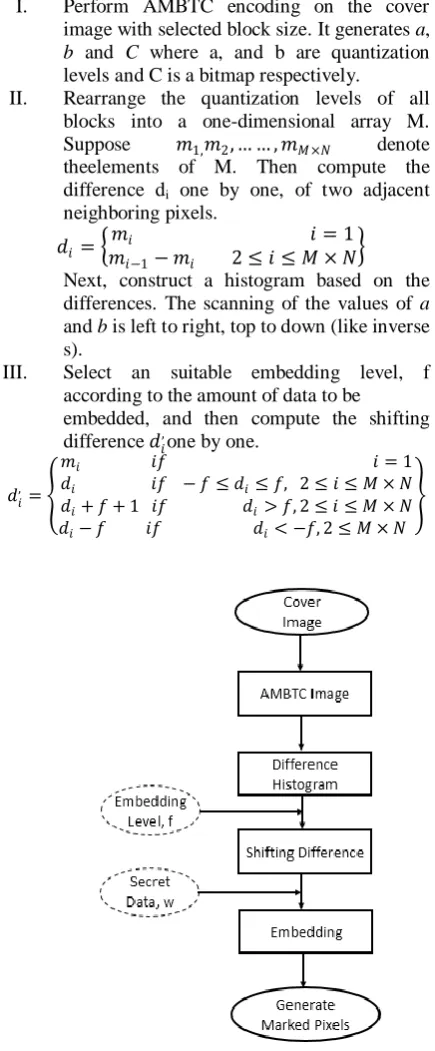
The encoding operations are discussed as shown in figure 1.
I. Perform AMBTC encoding on the cover image with selected block size. It generates a,
b and C where a, and b are quantization levels and C is a bitmap respectively.
II. Rearrange the quantization levels of all blocks into a one-dimensional array M. Suppose 𝑚1,𝑚2, … … , 𝑚𝑀×𝑁 denote
theelements of M. Then compute the difference di one by one, of two adjacent
neighboring pixels.
𝑑𝑖 = 𝑚𝑚𝑖 𝑖 = 1 𝑖−1− 𝑚𝑖 2 ≤ 𝑖 ≤ 𝑀 × 𝑁
Next, construct a histogram based on the differences. The scanning of the values of a
and b is left to right, top to down (like inverse s).
III. Select an suitable embedding level, f according to the amount of data to be embedded, and then compute the shifting difference 𝑑𝑖,one by one.
𝑑𝑖,=
𝑚𝑖 𝑖𝑓 𝑖 = 1
𝑑𝑖 𝑖𝑓 − 𝑓 ≤ 𝑑𝑖≤ 𝑓, 2 ≤ 𝑖 ≤ 𝑀 × 𝑁
𝑑𝑖+ 𝑓 + 1 𝑖𝑓 𝑑𝑖> 𝑓, 2 ≤ 𝑖 ≤ 𝑀 × 𝑁
𝑑𝑖− 𝑓 𝑖𝑓 𝑑𝑖< −𝑓, 2 ≤ 𝑀 × 𝑁
IV. Embed the secret data w by using multilevel histogram shifting. Then, calculate the marked pixels difference sequence𝑑𝑖′′.
𝑑𝑖′′ =
𝑚𝑖 𝑖𝑓 𝑖 = 1 𝑑𝑖′ 𝑖𝑓 − 𝑓 ≤ 𝑑
𝑖
,≤ 𝑓, 2 ≤ 𝑖 ≤ 𝑀 × 𝑁
2 × 𝑓 × 𝑤 𝑖𝑓 𝑑𝑖′= 𝑓, 2 ≤ 𝑖 ≤ 𝑀 × 𝑁 −2 × 𝑓 − 𝑤 + 1 𝑖𝑓 𝑑𝑖= −𝑓, 2 ≤ 𝑀 × 𝑁
V. Generate the marked pixels sequence 𝑚𝑖′.
𝑚𝑖′ =
𝑚𝑖 𝑖 = 1
𝑚𝑖− 𝑑𝑖′′ 2 ≤ 𝑖 ≤ 𝑀 × 𝑁
Repeat I and III step for all blocks. In this way, the original AMBTC-compressed image can be reconstructed.
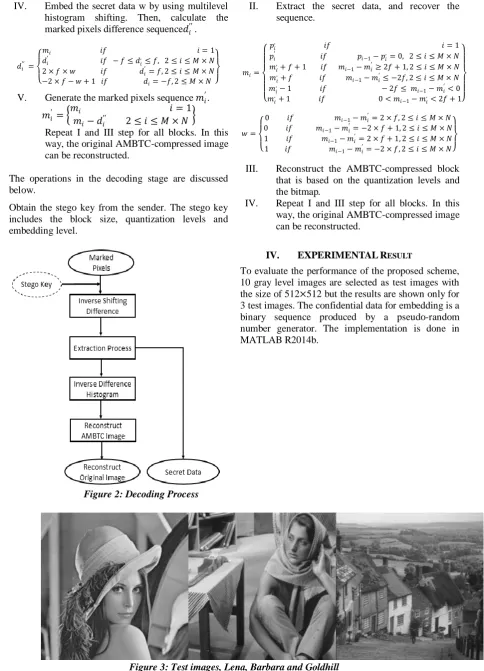
The operations in the decoding stage are discussed below.
I. Obtain the stego key from the sender. The stego key includes the block size, quantization levels and embedding level.
Figure 2: Decoding Process
II. Extract the secret data, and recover the sequence.
𝑚𝑖=
𝑝𝑖, 𝑖𝑓 𝑖 = 1 𝑝𝑖′ 𝑖𝑓 𝑝𝑖−1− 𝑝𝑖,= 0, 2 ≤ 𝑖 ≤ 𝑀 × 𝑁 𝑚𝑖,+ 𝑓 + 1 𝑖𝑓 𝑚𝑖−1− 𝑚𝑖′≥ 2𝑓 + 1, 2 ≤ 𝑖 ≤ 𝑀 × 𝑁 𝑚𝑖,+ 𝑓 𝑖𝑓 𝑚
𝑖−1− 𝑚𝑖′≤ −2𝑓, 2 ≤ 𝑖 ≤ 𝑀 × 𝑁 𝑚𝑖,− 1 𝑖𝑓 − 2𝑓 ≤ 𝑚
𝑖−1− 𝑚𝑖′< 0 𝑚𝑖,+ 1 𝑖𝑓 0 < 𝑚𝑖−1− 𝑚𝑖,< 2𝑓 + 1
𝑤 =
0 𝑖𝑓 𝑚𝑖−1− 𝑚𝑖′= 2 × 𝑓, 2 ≤ 𝑖 ≤ 𝑀 × 𝑁 0 𝑖𝑓 𝑚𝑖−1− 𝑚𝑖′= −2 × 𝑓 + 1, 2 ≤ 𝑖 ≤ 𝑀 × 𝑁 1 𝑖𝑓 𝑚𝑖−1− 𝑚𝑖′= 2 × 𝑓 + 1, 2 ≤ 𝑖 ≤ 𝑀 × 𝑁 1 𝑖𝑓 𝑚𝑖−1− 𝑚𝑖′= −2 × 𝑓, 2 ≤ 𝑖 ≤ 𝑀 × 𝑁
III. Reconstruct the AMBTC-compressed block that is based on the quantization levels and the bitmap.
IV. Repeat I and III step for all blocks. In this way, the original AMBTC-compressed image can be reconstructed.
IV. EXPERIMENTALRESULT
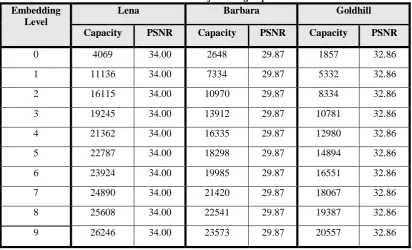
To evaluate the performance of the proposed scheme, 10 gray level images are selected as test images with the size of 512×512 but the results are shown only for 3 test images. The confidential data for embedding is a binary sequence produced by a pseudo-random number generator. The implementation is done in MATLAB R2014b.
Embedding Capacity and PSNR are selected as quality metrics to evaluate the experimental results.
Embedding Capacity: It is defined as the total number of embedded secret bits in the cover image. According to the embedding capacity evaluation, a large value represents that the steganographic scheme has better performance regarding the embedding capacity.
PSNR: It measures image quality mathematically in terms of MSE. In the ideal case, PSNR should be infinite, and MSE should be zero. But this is not possible, so large PSNR and small MSE is desirable.
MSE = 𝑀𝑖=1 𝑁𝑗 =1(𝑜 𝑖,𝑗 −𝑆𝑖(𝑖,𝑗 ))𝑀×𝑁 2
PSNR = 10 𝑙𝑜𝑔10(𝑚𝑎𝑥 ∗𝑚𝑎𝑥 ) 𝑀𝑆𝐸 dB
Where M and N are the size of original image and max=255 for the gray image, (O): original image, (Si): Stego image.
Table 1 shows the results which are quoted in the [8]. These results are observed corresponding to the embedding level f=0,1,2,...9. The PSNR are calculated between the AMBTC-compressed image and the raw version. These results reveals that the PSNR value is independent to the embedding levels.
Table 1: Results of Existing Paper
Embedding Level
Lena Barbara Goldhill
Capacity PSNR Capacity PSNR Capacity PSNR
0 4069 34.00 2648 29.87 1857 32.86 1 11136 34.00 7334 29.87 5332 32.86 2 16115 34.00 10970 29.87 8334 32.86 3 19245 34.00 13912 29.87 10781 32.86 4 21362 34.00 16335 29.87 12980 32.86 5 22787 34.00 18298 29.87 14894 32.86 6 23924 34.00 19985 29.87 16551 32.86 7 24890 34.00 21420 29.87 18067 32.86 8 25608 34.00 22541 29.87 19387 32.86 9 26246 34.00 23573 29.87 20557 32.86
Table 2 shows the results after experimental evaluation of the same method. These results are significantly differ from the one quoted in the [8]. According to the experimental evaluation, it has been seen that PSNR value is decreased slightly as the embedding level increased. Obviously, if there
are doing some alterations in the pixels, it will change the PSNR value. On the other hand, embedding capacity has been increased to the large extent i.e., the experimental results give 36 times (approx.) higher than the existing results at each embedding level.
Table 2: Results after Experimental Evaluation
Embedding Level
Lena Barbara Goldhill
Capacity PSNR Capacity PSNR Capacity PSNR
6 204255 31.14 181951 28.15 183621 30.27 7 209887 30.90 185849 27.97 189193 29.95 8 213878 30.65 188935 27.78 194693 29.65 9 217227 30.42 191100 27.60 199551 29.37
V. DISCUSSION
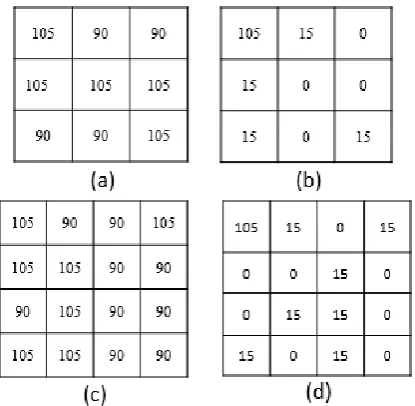
In the AMBTC Compressed image, two quantization values are distributed in the block. In the figure 4, 3×3 and 4×4 block of compressed image are taken and calculated the difference between neighboring pixels respectively.
Figure 4: (a) 3×3 block of compressed image, (b)
difference between neighboring pixels of 3×3
compressed block, (c) 4×4 block of compressed
image, (d) difference between neighboring pixels
of 4×4 compressed block.
As shown in the figure, difference between neighboring pixels is mostly concentrated at 0. There are 4 pixels have 0 difference in 9 pixels (3×3) block, similarly 8 pixels in 16 pixels (4×4) block (approximately half times the total pixels gives 0 pixel difference). The embedding capacity at embedding level 0 is equals to the bin (0), it means embedding capacity depends on the 0 difference pixels and for succeeding levels, capacity of previous levels are added to the current level. In the experimental results, the embedding capacity at embedding level 0 is approximately equals to the bin (0) but results quoted in existing paper have very less embedding capacity as compared to the bin (0). The results are verified using a large number of test images and embedding sequences.
On the other hand, as the embedding capacity increased with the embedding level, PSNR value also effected either it is in small extent or large extent. The experimental results also shows that the PSNR value decreased with small extent as
embedding capacity increased. But existing results reveals that the PSNR is independent to the embedding level.
VI. CONCLUSIONS
In this paper, the reversible data hiding method in AMBTC compressed images is investigated. The experimental results are compared with results which are quoted in [8]. The experimental evaluation gives high embedding capacity with the slight compromise of visual quality.
REFERENCES
[1] Morkel, T., Eloff, J., Olivier, M., 2005:'An overview of Image Steganography', in Fifth Annual Information Security South Africa Conference, South Africa. [2] Kaur, N., & Behal, S., 2014:'A Survey on various types of
Steganography and Analysis of Hiding Techniques'. International Journal of Engineering Trends and Technology, 11(8), 387-91.
[3] Ni, Z., Shi, Y. Q., Ansari, N., & Su, W., 2006: 'Reversible data hiding',Circuits and Systems for Video Technology, IEEE, 16, 354-362.
[4] Feng, G. & Fan, L.,2012: 'Reversible data hiding of high payload using local edge sensing prediction',Journal of Systems and Software, 85, 392-399.
[5] Zhao, Z., Luo, H., Lu, Z. M., & Pan, J. S., 2011: 'Reversible data hiding based on multilevel histogram modification and sequential recovery',AEU-International Journal of Electronics and Communications,65, 814-826. [6] Kashyap, N., & Narayan, S., 2013: 'Review of Image
Compression and Comparison of its Algorithms',International Journal of Application or Innovation in Engineering & Management, 2, 267-272. [7] Kumar, A. & Singh, P., 2011:'Enhanced Block Truncation
Coding for Gray Scale Image',International Journal of Computer Technology and Applications, 2, 525-529. [8] Zhao, Z. & Tang, L., 'High capacity reversible data hiding