
FORMULATION AND EVALUATION OF TRANSDERMAL PATCH OF SERTACONAZOLE NITRATE
5
0
0
Full text
(2) Kansagra Hemang et al. IRJP 2012, 3 (11) of polyvinyl alcohol in petri dish at 60oC for 6h. The matrix was prepared by pouring the homogenous dispersion of drug with different blends of ethyl cellulose with PVPK-30 in chloroform on the backing membrane in petri dish. The above dispersion was evaporated slowly and uniformly at Formulation F1 F2 F3 F4 F5. Polymeric Blend PVP:EC PVP:EC PVP:EC PVP:EC PVP:EC. 40oC for 2h with inverted funnel on the dispersion to achieve a drug polymer matrix patch. The patches were again dried at 60oC for 30 min for complete drying. The dry patches were kept in dessicators until use1-3 [Table 1].. Table 1: Composition of Formulation Ratio of Total weight of Drug %w/w Polymer (W/W) polymer in mg of polymer 1:1 600 10 1:2 600 10 1:3 600 10 1:5 600 10 2:3 600 10. Solubility measurement Solubility of sertaconazole nitrate was determined at several values of pH, viz., 4.0, 5.0, 6.0, 7.4, 8.0, and 9.0. Excess of sertaconazole nitrate was added to 10 mL of buffer solutions. At each level, the samples were stirred in a conical flask for 24h at 37oC. The suspension were filtered using a 0.45 micron Whatman filter paper. The concentration of sertaconazole nitrate in the filtrate was determined spectrophotometrically by measuring at 303 nm 1. Partition coefficient of drug in octanol/water system The partition coefficient of the drug was determined by taking equal volume of 1-octanol and aqueous solution in a separating funnel. In case of water soluble drugs, a drug solution of 25μg/ml was prepared in distilled water and in case of water insoluble drugs, a drug solution of 25μg/ml was prepared in 1-octanol. Twenty-five milliliters of this solution was taken in a separating funnel and shaken with equal volume of 1-octanol/water system for 30 min and allowed to stand for an hour. The mixture was then centrifuged at 2000 rpm for 10 min and concentration of drug in each phase was determined spectrophotometrically by measuring absorbance at 303 nm. The partition coefficient (Kp) was calculated from the following equation1. Partition coefficient (Kp) = Conc. of drug in organic phase/Conc. of drug in aqueous Phase Physicochemical properties of the films Thickness The thickness of the patch was determined using digital vernier calliper (Mitutoyo, Tokyo, Japan), recording mean of 5 determinations2-6. Weight variation Each film was weighed individually and average weight of three films was found out. Percent moisture absorption The percent moisture absorption test was carried out to check the physical stability and integrity of the films at high humid conditions. In the present study the moisture absorption capacity of the films were determined in the following manner. The films were placed in the humidity chamber, keeping the humidity inside the chamber at 75% R.H . After 3 days the films were taken and weighed. The percentage moisture absorption of three films was found by applying following formula2-6. % Moisture absorption= Final weight – Initial weight/Initial weight x 100 Percent moisture content The prepared films were marked, then weighed individually and kept in a dessicator containing activated. Plasicizer dibutyl phthalate 30% 30% 30% 30% 30%. Solvent system Chloroform Chloroform Chloroform Chloroform Chloroform. silica at room temperature for 24h. The films were weighed again and again individually until it showed a constant weight. The percentage of moisture content was calculated as the difference between initial and final weight2-6. % Moisture content= Initial weight – Final weight/Initial weight x 100 Folding endurance Folding endurance of patches was determined by repeatedly folding a small strip of film (2cm x 2cm) at the same place till it is broken. The number of time the film could be folded at the same place without breaking was the folding endurance value2-6. Flatness Longitudinal strips were cut out from each film, one from the center and two from either side. The length of each strip was measured and the variation in flatness was measured by determining percent constriction, considering 0% constriction is equivalent to 100% flatness. % Constriction = l1-l2/ l2 x 100 l1= initial length of each strip. l2 = final length of each strip. In vitro diffusion study Franz’s diffusion cell was used for the study of in vitro release patterns of the prepared patches. The diffusion medium is prepared of buffer of pH 7.4. A cellophane membrane is used as a barrier between the donor and receptor compartment. The films were placed between the donor and receptor compartment in such a way that the drug releasing surface faced the receptor compartment. The receptor compartment was filled with the buffer having pH 7.4 and a small bar magnet was used to stir the medium with the help of a magnetic stirrer. The temperature of the diffusion medium was maintained and controlled at 37oC± 1oC by a thermostatic arrangement. A sample of 5ml was withdrawn at predetermined intervals, being replenished by equal volumes of diffusion medium. Withdrawal of samples was carried out for a period of 24h. The drug concentration in the sampled diffusion medium was determined spectrophotometrically and was calculated with the help of a standard calibration curve and the data was shown in Figures2. Data analysis The pharmaceutical dosage forms that do not disaggregate and release the drug slowly could be represented by a zero- order kinetic equation. Analysis of drug release from transdermal system must be performed with a flexible model that can identify the contribution to overall kinetics. Dissolution data was treated with different release kinetic equations.. Page 110.
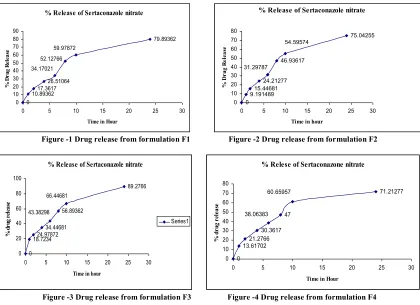
(3) Kansagra Hemang et al. IRJP 2012, 3 (11) % Release of Sertaconazole nitrate. 90 80 70 60 50 40 30 20 10 0. 80 79.89362. 75.04255. 70. 59.97872 52.12766 34.17021 26.51064 17.3617 10.89362. 54.59574. 60. % Drug Release. % Drug Release. % Release of Sertaconazole nitrate. 50. 46.93617. 40 30. 31.29787 24.21277 15.44681 9.191489. 20 10 0. 0 0. 5. 10. 15. 20. 25. 0. 30. 0. 5. 10. 15. Time in Hour. Figure -1 Drug release from formulation F1. 80. 89.2766. 34.44681 24.97872 18.7234. 20 0. % drug release. Series1. 60 50. 38.06383. 40 30. 5. 10. 15. 20. 25. 0. 30. 0 0. Time in hour. 47. 30.3617 21.2766 13.61702. 20 10. 0 0. 5. 10. 15. 20. 25. 30. Time in Hour. Figure -3 Drug release from formulation F3. Figure -4 Drug release from formulation F4. % Release of Sertaconazole nitrate 100. 92.93617021. 76.27659574. 80 % release. % drug release. 56.89362. 43.38298. 71.21277. 60.65957. 70. 66.44681. 40. 30. % Relese of Sertaconazone nitrate. % Release of Sertaconazole nitrate. 60. 25. Figure -2 Drug release from formulation F2. 100 80. 20. Time in hour. 67.21276596. 60. 43.68085106 32.95744681 22.23404255 14.46809. 40 20 0. 0 0. 5. 10. 15. 20. 25. 30. Time in hour. Figure -5 Drug release from formulation F5 Figure 1 to 5 showing the % of sertaconazole release from the formulated patches. Chart showing thickness of different formulation. Chart showing % moisture content of patch 0.2. % Mois ture content. 3.5 3 2.5 2 1.5 1 0.5 0. 0.195 0.19 Thickness 0.185 0.18 0.175 F1. F2. F3. F4. F5. Formulation code. Figure -6 Showing thicknesses of patches. 0.17. F1. F2. F3. F4. F5. Formulation code. Figure -7 Showing Endurances of patches. Page 111.
(4) Kansagra Hemang et al. IRJP 2012, 3 (11) Chart showing % of moisture uptake. C h a r t s h o w in g f o ld in g endurance of patch. 160 140. 6. 120 Folding 100 endurance 80 60 40 20. 5 4 % of moisture 3 uptake 2 1 0. 0. F1. F2. F3. F4. F5. Formulation code. Figure -8 % of moisture content of patches. Figure-10 IR spectrum of sertaconazole nitrate Formulation F1 F2 F3 F4 F5. F1. F2. F3. RESULTS AND DISCUSSION In the present study efforts were made to prepare transdermal patches of sertaconazole nitrate by using different ratios of polymers such as Polyvinyl pyrrolidone (PVP K-30) and ethyl cellulose. Here dibutylphthalate is used as a plasticizer. The prepared formulations were subjected to various physicochemical characteristics such as thickness, weight. F5. Figure -9 % of moisture uptake patches. Figure-11. Table 2: Evaluation of transdermal patches of Sertaconzole nitrate Thickness Folding %Moisture %Moisture Endurance Content Uptake 0.18 ± 0.03 104 ± 3 2.73 ± 0.14 4.98 ± 0.25 0.18 ± 0.02 118 ± 4 2.86 ± 0.42 4.77 ± 0.36 0.19 ± 0.04 129 ± 2 2.34 ± 0.21 5.58 ± 1.03 0.19 ± 0.03 152 ± 2 2.68 ± 0.34 5.22 ± 0.53 0.20 ± 0.02 98 ± 3 3.16 ± 0.32 4.03 ± 0.98. Zero-order release equation Q = kot Higuchi’s square root of time equation Q = kHt1/2 First-order release equation Log Qt = LogQo + Kt/2.303 Korsmeyer-Peppas equation F = (Mt/M) = Kmtn Where Q is the amount of drug release at time t; Mt is drug release at time t; M is the total amount of drug in dosage form; F is fraction of drug release at time t; Ko is zer-order release rate constant; KH is Higuchi square root of time release rate constant; Km is a constant dependent on geometry of dosage form; and n is diffusion exponent indicating the mechanism of drug release. If the value of n is 0.5, it indicates fickian diffusion; if between 0.5 and 1.0, anomalous transport; 1.0 indicates case-ll transport; and higher than 1.0, super case-ll transport1.. F4. Formulation code. Flatness 100 % 100% 100% 100% 100%. variation, percent moisture absorption, percent moisture content, flatness and folding endurance. The release pattern of formulations were studied in Franz’s diffusion apparatus using cellophane membrane. The thickness of the films varied from 17 to 20 mm. The minimum standard deviation values assumed that the process used for preparing the drug delivery system is capable of giving reproducible result. Moisture content and moisture uptake can cause significant changes in properties such as reduced crushing strength, increased pore diameter in the patches containing polymer. But the moisture content in our preparations was found to be low, and it varied very little in the formulations. The little moisture content helps the formulations to be stable and prevents them from becoming a completely dried, brittle product. Low moisture uptake also protects the materials from microbial contamination and avoids bulkiness of the patches. In order to evaluate the flexibility the film were subjected to folding endurance. The values in the range that prepared films were observed batches having capability to withstand the mechanical pressure along with good flexibility. The diffusion studies of patches containing different ratios of polymers were done using Franz’s diffusion cell. The revealed data shows that the drug release pattern of formulation 4 shows drug release in a Page 112.
(5) Kansagra Hemang et al. IRJP 2012, 3 (11) controlled manner, as it fits into the Kosmeyers-peppas rule. The formulation 4 shows cumulative release of drug of 71.21%. CONCLUSION Formulation 4 was found to be the best among all batches because of its consistent release rate and extent of drug release. The formulation 4 has achieved the object to extended release reduced frequency of administration, avoids the first pass effect and thus may improve the patient compliance.. 2. 3. 4.. 5. 6.. ACKNOWLEDGEMENT We are thankful to Biodeal Pharmaceuticals Pvt. Ltd. for their support and kind cooperation for my work. REFERENCES 1. Sadashivaiah R, Dinesh BM, Uma A. Patil BG, Raghu KS. Design and in-vitro evaluation of Haloperidol Lactate transdermal patches. 7. 8.. containing ethyl cellulose- povidone as film former, Asian Journal of Pharmaceutics, 2008. Prashant MS, Suniket F, Auimash KD. Evaluation of Polymerised Rosin for the Formulation and Development of Transdermal drug delivery system; A technical note ,AAPS Pharma Sci Tech , 2005; 6: 81. Reddy AB, Invitro Characterization and Evaluation of Transdermal drug delivery system for Metoprolol Tartarate, JPRHC, 2008; 2: 325-329. Lewis S, Panday S, Udupa N, Design and Evaluation of Matrix type and Membrane controlled Transdermal delivery System f Nicotine suitable for use in Smoking Cessation, Indian Journal of Pharmaceutical Sciences, 2006. Shinde AJ, Gorola KC, More HN, Development and Characterization Transdermal Therapeutics System of Tramadol Hydrochloride, Asian Journal of Pharmaceutics, 2008. Pintu D, Damodharan N, Mallick S, Mukherjee B, Development and Evaluation of Nefopan Transdermal Matrix Patch System in Human Volunteers, PDA Journal of Pharmaceutical Science and Technology, 2009; 63: 537 – 546. Chang SR, Liang F, Lei L, Qiang W, Sihai L, Ligang Z, Zhongee H, Design and Invivo Evaluation of an Indapamide Transdermal Patch, Intrenational Journal of Pharmaceutics, 2009; 37: 129 – 135. http://www.drugbank.co/drugs/DBO1153.. Source of support: Nil, Conflict of interest: None Declared. IRJP is an official publication of Moksha Publishing House. Website: www.mokshaph.com. All rights reserved.. Page 113.
(6)
Figure


Related documents
Conclusions: Our algorithm based on CNN has achieved higher accuracy compared to human ophthalmologists and traditional rules (AGIS and GSS2) in differentiation of glaucoma
Discussion: Better prevention of delirium is expected from the multifaceted program, including a decrease of postoperative delirium, and its consequences (mortality,
Patients and methods: In this cross-sectional study with 225 participants diagnosed with COPD grades II–IV, multiple linear regression analysis was conducted, using sociodemographic
Nanoemulsion had a statistically highly signi fi cant difference showing a lower mean value of the remaining debris surface area when compared to normal particle size material,
Experimental infection of rainbow trout Oncorhynchus mykiss with viral haemorrhagic septicaemia virus isolates from European marine and farmed fishes.. Genetic population
The cytotoxicity of FePt NPs on Vero cells was assessed using an MTT assay, and tumor cell pro- liferation inhibited by individual FePt NPs and FePt NPs combined with X-ray beams
Geht man einerseits davon aus, daß eine postoperative Schilddrüsenunterfunktion nicht mehr als ein potentielles funktionales Rezidiv gesehen werden kann, so ergibt sich bezogen auf
Male Gender Equality Ideology, Empathy, And Prosocial Bystanding Behaviors And Intentions: A Path To Intimate Partner Violence Prevention On College Campuses.. Virginia Diane
