
INTERPOLYELECTROLYTE COMPLEXES AS PROSPECTIVE CARRIERS FOR CONTROLLED DRUG DELIVERY
5
0
0
Full text
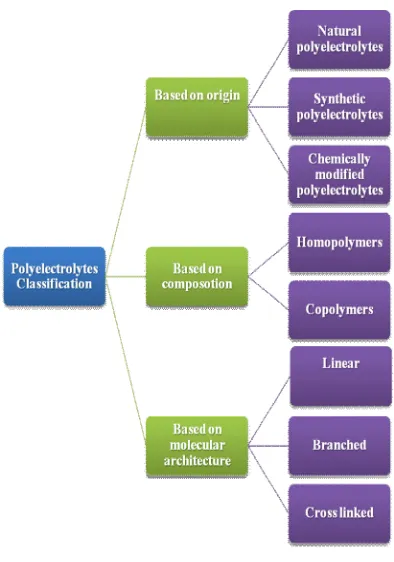
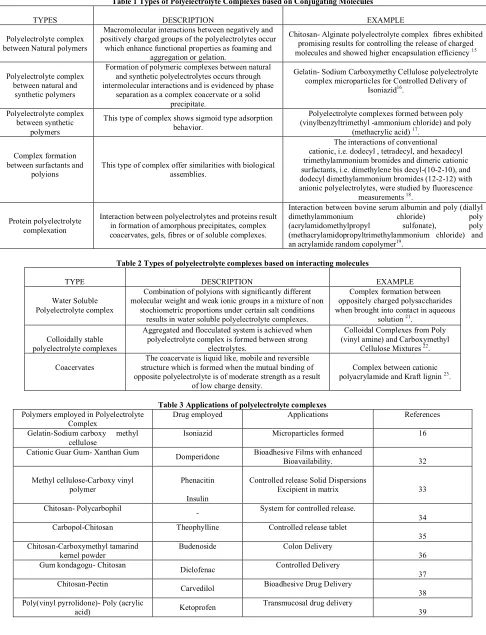
(2) Kaur Jasmeet et al. IRJP 2012, 3 (4). · · · · · · · · · · · · · ·. of both two and three dimensional polyelectrolyte solution in which local polymer concentration is controlled by interactions between substrate and polyelectrolyte chains6. POLYELECTROLYTES CLASSIFICATION Polyelectrolytes can be classified into various types on the basis of their origin, composition and molecular architectute as depicted in Figure 1. Some of the important polyelectrolytes are quoted below: Natural polyelectrolytes: Nucleic Acids, Carrageenan, Alginates Chemically modified polymers: Pectin, Chitin, Cellulose based, Dextran based Synthetic polyelectrolytes: Poly (vinylbenzenetrialkylammonium, Poly ( vinyl sulfonic acid), Poly( acrylic or methaacrylic acid), Poly(styrene sulfonic acid), Poly(acrylamidoalkyl trialkyl ammonium) POLYELECTROLYTE COMPLEX Polyelectrolyte complexes are ionically bonded hydrogels 7. Structurally these are neutral polymer – polymer complexes composed of macromolecules carrying charges of opposite sign causing the macromolecules to bind together by electrostatic interactions. Hydrogen bonding, ion dipole interactions and hydrophobic interactions also play significant role in formation of polyelectrolyte complex which avoid the use of covalent crosslinking agents hence reducing the possible toxicity and undesirable effects of chemical reagents. Depending on variety of factors, it may cause the system to separate into dilute phase and concentrated coacervate phase or compact precipitate like gel. Polymer complexation leads to loss of conformational and translational entropy of polymer chain which has to be counterbalanced if complexation has to occur. The formation and stability of polyelectrolyte complex depend on many factors 8, 9, 10, 11 such as:Degree of ionization of each of oppositely charged polyelectrolyte. Density of the charges on polyelectrolytes. Position of ionic group on polymeric chain. Charge distribution over polymer chains. Temperature of the reaction medium. Ionic strength of the reaction medium Molecular weight of polyelectrolytes. .Concentration of polyelectrolytes. Polymer chain flexibility. Duration of interaction. Nature of ionic groups. pH of the medium Mixing ratio. Mixing order. FORMATION OF POLYELECTROLYTE COMPLEXES Polyelectrolyte complex is formed when a polycation and a polyanion are mixed together in an aqueous solution. In general, an equimolar complex is formed by mixing oppositely charged strong polyelectrolytes. In the case of the complexation of polycations with weak polyacids, the composition and the structure of the polyelectrolyte complexes obtained depend on the degree of neutralization of the polyacid, polymer structure, hydrophobicity, the concentration of the complex, pH, ionic strength, and so on 12 . Complex formation proceeds cooperatively, and the. stability constant increases with the degree of polymerization, i.e., the charge number on one chain. When a polyelectrolyte is added to the polymer complex, a cooperative interpolymer substitution occurs if the adding polymer can interact more strongly with the constituent of the complex. Auxiliary molecules such as catalysts or initiators are not required and reaction is generally performed in aqueous solution. The reaction can only occur at pH values in the vicinity of pKa interval of two polymers. The process of formation of polyelectrolyte complex involves three main steps 13:Primary complex formation Coulomb forces are responsible for this step. Formation process within intracomplexes It involves the formation of new bonds and/or correction of distorted polymer chains. Intercomplex aggregation process It involves the aggregation of secondary complexes mainly through hydrophobic interactions. TYPES OF POLYELECTROLYTE COMPLEXES On the basis of conjugating molecules The different types of polyelectrolyte complexes14 on the basis of conjugating molecules are discussed in Table 1. On the basis of interaction forces 20 On the basis of interaction forces polyelectrolyte complexes can be classified as depicted in Table 2. A polyelectrolyte complex formed should have the following features: · Amorphous aggregates held together by ionic / hydrophobic crosslinks. · Highly dynamic crosslinks. · Highly swollen and permeable gel particles. STRUCTURAL MODELS OF POLYELECTROLYTE COMPLEXES Two structural models for polyelectrolyte complexes are discussed in literatures which are ladder like structures and the scrambled egg model 24. These models have been extensively studied and it was concluded that most experimental structures lie between the two models, though probably closer to the scrambled egg than the ladder type model. The Ladder- like structure The complex formation takes place on molecular level via conformational adaptation. This structure consists of hydrophillic single stranded and hydrophobic double stranded segments. The Scrambled egg model In this, large numbers of chains are incorporated in particle’s architecture. This model refers to the complexes that are product of combination of polyions with strong ionic groups and comparable molar masses yielding insoluble and highly aggregated complexes under strict 1:1 stochiometry. Incorporation Of Active Substance Into The Polyelectrolyte Complex Polyelectrolyte complex have gained much importance in past few years because of their potential applications. The active substance can be incorporated in polyelectrolyte complexes by four ways 25 quoted below: In first case , active substance will be entrapped from solution during precipitation of complex; in second case , active substance will absorb from solution and get incorporated in already formed complex on contact; in third case, active substance may chemically bond to atleast one complex Page 59.
(3) Kaur Jasmeet et al. IRJP 2012, 3 (4) partner and precipitate during complexation; and in last case, active substance may act as polyion and form polyelectrolyte complex and active substance will be released either by solution equilibrium or by ion exchange mechanism or by charge interaction and slow decomplexation. CHARACTERIZATION OF POLYELECTROLYTE COMPLEXES Various methods have been investigated to study polymer interaction. Measurement of turbidity, ionic strength 26, pH, viscosity 27 flow properties, light scattering, infrared spectroscopy, nuclear magnetic resonance, thermal analysis and powder X-ray diffraction can be employed to evaluate polyelectrolyte complexes. Micrometritic and flow properties of polyelectrolyte complexes The particle size analysis of polyelectrolyte complex can be done by sieve analysis using standard set of sieves of sieve numbers #20, #30, #40, #60, #80 and #100. Amount retained on sieve is determined and static angle of repose is measured as per fixed funnel and free standing cone method. Compressibility on tapping can be measured using graduated measuring cylinder. Fourier Transform Infrared Spectroscopy Fourier Transform Infrared (FTIR) spectroscopy can be used to characterize polymer blends, polymer complexes, dynamics, surfaces, and interfaces, as well as chromatographic effluents and degradation products. It provides information about the complexation and interactions between the various constituents in the polymer electrolyte 28. It is capable of qualitative identification of the structure of unknown materials as well as the quantitative measurement of the components in a complex mixture. FT-IR spectra of physical mixture and as well as polyelectrolyte complex can be determined by FT-IR spectrophotometer using KBr disc method in the range of 4000- 250 cm -ˡ. X- Ray Diffraction The diffraction of X rays has become a powerful tool in the study of structure of polymers. X-ray diffraction and scattering experiments involve placing the sample in the path of a monochromatized X-ray beam of low divergence. The scattered X-rays from the regularly placed atoms interfere with each other, giving strong diffraction signals in particular directions. The directions of the diffracted beams are related to the slope and dimensions of the unit cell of the crystalline lattice, and the diffraction intensity depends on the disposition of the atoms within the unit cell. The powder Xray diffraction patterns of both physical mixture and complex can be recorded using automated Siemens D/5000. The samples are irradiated with monochromatized Cu kα radiation between two angles. The time, voltage and current are set up as per depending on case to case. Differential Scanning Calorimetry Differential Scanning Calorimetry (DSC) measures the heat required to maintain the same temperature in the sample versus an appropriate reference material in a furnace. A number of important physical changes in a polymer may be measured by DSC. These include the glass transition temperature, the crystallization temperature, the melt temperature, and the degradation or decomposition temperature. Chemical changes due to polymerization reactions, degradation reactions, complexation and other reactions affecting the sample can be determined.. Thermogravimetric analysis Thermogravimetric analysis provides a quantitative measurement of any mass change in the polymer or material associated with a transition or thermal degradation. TGA can directly record the change in mass due to complex formation, dehydration, decomposition, or oxidation of a polymer with time and temperature. Thermogravimetric curves are characteristic for a given polymer or complex of polymers because of the unique sequence of the physicochemical reaction that occurs over specific temperature ranges and heating rates and are a function of the molecular structure. The changes in mass are a result of the rupture and/or formation of various chemical and physical bonds at elevated temperatures that lead to the evolution of volatile products or the formation of heavier reaction products. Nuclear Magnetic Resonance Spectroscopy Nuclear magnetic resonance (NMR) spectroscopy is a most effective and significant method for observing the structure and dynamics of polymer complexes both in solution and in the solid state. Undoubtedly the widest application of NMR spectroscopy is in the field of structure determination. The identification of certain atoms or groups in a molecule as well as their position relative to each other can be obtained by one-, two-, and three-dimensional NMR 29. Light Scattering Light scattering from solution of polyelectrolyte complexes allows the determination of the molecular parameters (molecular weight, dimensions, and shapes) of the scattering particles and thermodynamic quantities (virial coefficients, chemical potential, preferential adsorption coefficients, and excess free energies of mixing). APPLICATIONS Polyelectrolyte complex has aroused as an emerging way to deliver drug at target sites, controlling the rate of release of drug by acting as carriers and thereby prolonging the therapeutic action. Along with these main functions, these can be used as membranes 30, films and fibers coatings 31, for isolation and fractionation of protein, for isolation of nucleic acids, for binding pharmaceutical products and for preparation of microcapsules . Extensive research has been done to form various polyelectrolyte complex using different polymers. Examples are quoted in Table 3 representing investigated polyelectrolyte complexes and their contribution towards controlled drug delivery. CONCLUSION A wide-ranging research is going on in the area of polyelectrolytes and polyelectrolyte complexes. Polyelectrolyte complexes are capable of merging the unique properties of different polymer without losing their high stability and biocompatibility. We can say that polyelectrolyte complexes will have multiple applications in future in the field biotechnology, medicine, pharmaceutical technology and in the design of novel drug delivery system. REFERENCES 1.. 2. 3.. Kumar V, Yang T, Yang Y. Interpolymer complexation. I. Preparation and characterization of a polyvinyl acetate phthalatepolyvinylpyrrolidone (PVAP-PVP) complex. International Journal of Pharmaceutics. 1999; 188: 221-232. Lowman MA. Complexing polymers in drug delivery In Handbook of Pharmaceutical Controlled Release Technology. Marcel Dekker, New York, 2000, 89-98. Philipp B, Dautzenberg H, Linow K, Kotz J, Dawydoff W. Polyelectrolyte complexes-recent developments and open problems. Progress in Polymer Science. 1989; 14: 91-172.. Page 60.
(4) Kaur Jasmeet et al. IRJP 2012, 3 (4) 4. 5. 6. 7. 8. 9.. 10. 11. 12. 13. 14. 15. 16.. 17. 18. 19.. 20. 21. 22. 23. 24.. 25.. 26. 27.. Lankalapalli S, Kollapalli VRM. Polyelectrolyte Complexes: A review of their applicability in drug delivery technology. Indian Journal of Pharmaceutical Sciences. 2009; 71(5): 481-487. Dautzenberg H, Jaeger W, Kotz J. Philipp B, Seidel C, Stscherbina D. Polyelectrolytes: Formation, Characterization and Application. Polymer International. 1994; 38(1): 106. Dobrynin AV, Rubinstein M. Theory of polyelectrolytes in solutions and at surfaces. Progress in Polymer Science.2005; 30: 1049-1118. Vogel MK, Cross RA, Bixler HJ, Gujman RJ. Medical uses of polyelectrolyte complexes. Journal of Macromolecular science: Part A Chemistry. 1970; 4(3): 675-692. Il”ina AV, Varlamov VP. Chitosan based polyelectrolyte complexes: A Review. Applied Biochemistry and Microbiology.2005; 41: 5-11. Etrych T, Leclercq L, Boustta M, Vert M. Polyelectrolyte complex formation and stability when mixing polyenions and polycations in salted media: A Model study related to the case of body fluids. European Journal of Pharmaceutical Sciences.2005; 2: 281-288. Bhattarai N, Gunn JJ, Zhang M. Chitosan based hydrogels for controlled, localized drug delivery. Advances in Drug Delivery Reviews.2010; 62: 83-99. Park JH, Saravanakumar G, Kim K, Kwon IC. Targeted delivery of low molecular drugs chitosan and its derivatives. Advances in Drug Delivery Reviews. 2010; 62: 28-41. Tsuchida E. Formation of polyelectrolyte complexes and their structures. Journal of Macromolecular Science Part A: Pure and Applied Chemistry. 1994; 31 (1): 1-15. Kokufuta E. Colloid titration behavior of poly (ethyleneimine). Macromolecules.1979; 12: 350-353. Dumitriu S, Chornet E. Inclusion and release of proteins from polysaccharides based polyion complexes. Advances in Drug Delivery Reviews.1998; 31: 223-246. Liao IC, Wan ACA, Yim, EKF, Leong KW. Controlled release from the fibres of polyelectrolyte complex. Journal of Controlled Release. 2005; 104: 347-358. Devi N, Maji TK. Preparation and Evaluation of Gelatin/ Sodium Carboxymethyl Cellulose Polyelectrolyte Complex Microparticles for Controlled Delivery of Isoniazid. AAPS Pharma Science Tech.2009; 10(4). Salamone JC, Poulin S, Watterson AC, Olson JP. Ordered polyelectrolyte complex formation from amorphous polyions. Polymer. 1979; 20(5): 611-614. Bakshi MS, Sachar S. Interraction of monomeric and dimeric cationic surfactants with anionic polyelectrolytes; a florescence study. Colloidal Polymer Science. 2005; 283: 671-76. Kevin W, Mattison, Dubin PL, Issabella J. Complex formation between bovine serum albumin and strong polyelectrolytes: Effect of polymer charge density. Journal of Physical Chemistry.1998; 102(19): 38303836. Tsuchida E, Abe K. Interactions between macromolecules in solution and intermacromolecular complexes. Advances in Polymer Science.1982; 45: 1-130. Shchipunov, Yury A, Postnova, Irina V. Water-Soluble Polyelectrolyte Complexes of Oppositely Charged Polysaccharides. Composite interfaces.2009; 16(4): 251-279. Feng X, Pelton R, Leduc M, Champ S. Colloidal Complexes from Poly (vinyl amine) and Carboxymethyl Cellulose Mixtures. Langmuir. 2007; 23 (6): 2970–2976. Vanerek A, Van de Ven TGM. Coacervate complex formation between cationic polyacrylamide and anionic sulfonated kraft lignin. Colloids and Surfaces A. 2006; 273: 55-62. Michaels AS, Miekka RG. Polycationpolyanion and Properties of Poly-(Vinyt complexes:Preparation benzyltrimethylammonium) Poly-(Styrenesulfonate). The Journal of Physical Chemistry.1965; 65(10):1765-1773. Krone V, Magerstadt M, Walch A, Groner A , Hoffmann D. Pharmacological composition containing polyelectrolyte complexes in microparticulate form and at least on active agent. United State Patent 5700. 1997; 459. Monal A, Cabrera G, Peniche C, Rinaudo M. Conductometric study of the interpolyelectrolyte reaction between Chitosan and Polygalacturonic acid. Polymer. 2000; 41: 2373-2378. Zhang LM. Synergistic blends from aqueous solutions of two cellulose derivatives. Colloid Polymer Science. 1999; 277: 886-890.. 28. Polu AR, Kumar R. Impedence Spectroscopy and FTIR Studies of PEG based Polymer Electrolytes.E- Journal of Chemistry. 2011; 8(1): 347353. 29. Everett JR. Nuclear magnetic resonance spectroscopy applications/ pharmaceutical, Encyclopedia of Analytical Science , Second edition. 2005, 321-332. 30. Senuma M, Kuwabara S, Kaeriyama S, Hase F, Shimura Y. Polymer complex from copolymers of acrylonitrile and ionic vinyl benzyl compounds. Journal of Applied Polymer Science.1986; 31: 1687-1697. 31. Yamamota H, Horita C, Senoo Y, Nishida A, Ohkawa, K. Polyion complex fiber and capsule formed by self assembly of chitosan and gellan at solution interfaces. Macromolecular Chemistry and Physics. 2000; 201: 84-92. 32. Singh M, Tiwary AK, Kaur G. Investigation on interpolymer complexes of cationic guar gum and xanthan gum for formulation of bioadhesive films. Journal of Research in Pharmaceutical Sciences. 2010; 5(2): 7987. 33. Ozeki T, Yuasa H, Okada H. Controlled Release of drug via Methylcellulose- Carboxyvinylpolymer Interpolymer Complex Solid Dispersion. AAPS Pharma Sci Tech. 2005; 6(2). 34. Lu Z, Chen W, Hammam JH, Ni J, Zhai X. Chitosan - Polycarbophil Interpolyelectrolyte complex as an Excipient for Boiadhesive Matrix Systems to Control Macromolecular Drug Delivery. Pharmaceutical Development and Technology.2008; 13: 37-48. 35. Lee MH, Chun MK, Choi HK. Preparation of Carbopol/ Chitosan Interpolymer Complex as a controlled release tablet matrix; Effect of Complex Formation Medium on drug Release Characteristics. Archives of Pharmacal Research. 2008; 31(7): 932-937. 36. Kaur G, Jain S, Tiwary AK. Chitosan- Carboxymethyl Tamarind Kernel Powder Interpolymer Complexation: Investigation for Colon Drug Delivery. Scientia Pharmaceutica 2010; 78: 57-78. 37. Naidu VGM, Madhusudhana K, Sashidhar RB, Ramakrishna S, Khar RK, Ahmed FJ, Diwan PW. Polyelectrolyte complexes of gum kondagogu and chitosan as diclofenac carriers. Carbohydrate Polymers. 2009; 76: 464-471. 38. Kaur A, Kaur G. Mucoadhesive buccal patches based on interpolymer complexes of chitosan- pectin for delivery of carvedilol. Saudi Pharmaceutical Journal. 2012; 20: 21-27. 39. Chun MK, Cho CS, Choi HK. Mucoadhesive drug carrier based on interpolymer complex of poly (vinyl pyrrolidone) and poly (acrylic acid) prepared by template polymerization. Journal of Controlled Release. 2002; 81: 327-334.. Figure 1: Classification of Polyelectrolytes.. Page 61.
(5) Kaur Jasmeet et al. IRJP 2012, 3 (4). Table 1 Types of Polyelectrolyte Complexes based on Conjugating Molecules TYPES Polyelectrolyte complex between Natural polymers Polyelectrolyte complex between natural and synthetic polymers Polyelectrolyte complex between synthetic polymers Complex formation between surfactants and polyions. Protein polyelectrolyte complexation. DESCRIPTION Macromolecular interactions between negatively and positively charged groups of the polyelectrolytes occur which enhance functional properties as foaming and aggregation or gelation. Formation of polymeric complexes between natural and synthetic polyelectrolytes occurs through intermolecular interactions and is evidenced by phase separation as a complex coacervate or a solid precipitate.. EXAMPLE Chitosan- Alginate polyelectrolyte complex fibres exhibited promising results for controlling the release of charged molecules and showed higher encapsulation efficiency 15 Gelatin- Sodium Carboxymethy Cellulose polyelectrolyte complex microparticles for Controlled Delivery of Isoniazid16.. This type of complex shows sigmoid type adsorption behavior.. This type of complex offer similarities with biological assemblies.. Interaction between polyelectrolytes and proteins result in formation of amorphous precipitates, complex coacervates, gels, fibres or of soluble complexes.. Polyelectrolyte complexes formed between poly (vinylbenzyltrimethyl -ammonium chloride) and poly (methacrylic acid) 17. The interactions of conventional cationic, i.e. dodecyl , tetradecyl, and hexadecyl trimethylammonium bromides and dimeric cationic surfactants, i.e. dimethylene bis decyl-(10-2-10), and dodecyl dimethylammonium bromides (12-2-12) with anionic polyelectrolytes, were studied by fluorescence measurements 18. Interaction between bovine serum albumin and poly (diallyl poly dimethylammonium chloride) (acrylamidomethylpropyl sulfonate), poly (methacrylamidopropyltrimethylammonium chloride) and an acrylamide random copolymer19.. Table 2 Types of polyelectrolyte complexes based on interacting molecules TYPE Water Soluble Polyelectrolyte complex. Colloidally stable polyelectrolyte complexes Coacervates. DESCRIPTION Combination of polyions with significantly different molecular weight and weak ionic groups in a mixture of non stochiometric proportions under certain salt conditions results in water soluble polyelectrolyte complexes. Aggregated and flocculated system is achieved when polyelectrolyte complex is formed between strong electrolytes. The coacervate is liquid like, mobile and reversible structure which is formed when the mutual binding of opposite polyelectrolyte is of moderate strength as a result of low charge density.. Polymers employed in Polyelectrolyte Complex Gelatin-Sodium carboxy methyl cellulose Cationic Guar Gum- Xanthan Gum Methyl cellulose-Carboxy vinyl polymer. EXAMPLE Complex formation between oppositely charged polysaccharides when brought into contact in aqueous solution 21. Colloidal Complexes from Poly (vinyl amine) and Carboxymethyl Cellulose Mixtures 22. Complex between cationic polyacrylamide and Kraft lignin 23.. Table 3 Applications of polyelectrolyte complexes Drug employed Applications. References. Isoniazid. Microparticles formed. 16. Domperidone. Bioadhesive Films with enhanced Bioavailability.. 32. Controlled release Solid Dispersions Excipient in matrix. 33. Phenacitin Insulin. Chitosan- Polycarbophil. -. System for controlled release. 34. Carbopol-Chitosan. Theophylline. Controlled release tablet. Chitosan-Carboxymethyl tamarind kernel powder Gum kondagogu- Chitosan. Budenoside. Colon Delivery. 35. Chitosan-Pectin Poly(vinyl pyrrolidone)- Poly (acrylic acid). 36 Diclofenac Carvedilol Ketoprofen. Controlled Delivery 37 Bioadhesive Drug Delivery 38 Transmucosal drug delivery 39. Page 62.
(6)
Figure
Related documents
Here we detail the endosomal mRNA transport machinery components and mRNA targets of the core RNA-binding protein Rrm4.. Extracellular vesicles (EVs) are newly garnering interest
An embedded system based automobile is explained briefly in this paper. With the help of Ultrasonic sensors and IR sensors an obstacle is recognized and the vehicle responds to
As mentioned before, we have developed a track of complementary research initiatives that gradually generated insights into the paradigmatic nature of the strategic
The findings of the online questionnaire survey, which was conducted on the random sample of the Czech secondary school teachers of English and on the sample of the 15 or 16
Basic current mirror , Wilson current mirror , Cascode current mirror , Super Wilson current mirror , Super wilson current mirror with low inputvoltage, High Swing
This indicates that the positive effect of YPS1 overexpression on glucan-deficient/dependent mutants is not due to an idio- syncratic interaction with caspofungin and further
Microsoft Word concept verslag 6 juli uiteindelijke versie doc Manufacturing development of the Voice Producing Element Redesign and manufacturing a cheap and high quality voice
- Computing a matrix vector product of the matrix involved in the algebraic immunity computation can be done using only the binary Mo¨ebius trans- form.. It is an involution
