IJIRT 146997
INTERNATIONAL JO URNAL OF INNOVATIVE RESEARCH IN TECHNOLOGY754
Analysis of Cluster-Based Energy-Dynamic Routing
Protocols in WSN
Mr. V. Narsing Rao
1, Dr.K.Bhargavi
2 1,2Asst. Professor in CSE Dept., Sphoorthy Engineering College, Hyderabad
Abstract- Wireless S ensor Networks (WS Ns) is one of the most rapidly evolving scientific domain, which is mainly due to the development of advanced small and low-cost sensor nodes with capability of sensing various types of physical and environmental conditions, data processing, and wireless communication. WS Ns have many sensor nodes which have restricted battery power and these nodes have to transmit sensed data to the Base S tation which dissipate high energy of these nodes. Therefore reliable routing of packets from sensor nodes to its base station is the most important task for these networks. There are many routing protocols developed for the efficient use of energy resources to improve the network lifetime. Along with some conventional Energy-Efficient routing protocol, some hybrid routing protocols are also proposed for different applications. In this paper, we give a survey of hybrid routing protocols for Wireless S ensor Network and compare their strengths and limitations.
Index Terms- Clustering, Routing, Wireless S ensor Network.
I. INTRODUCTION
Wireless sensor networks (WSNs) have been of interest in a wide range of applications, for example, Home security surveillance, military surveillance, disaster management, environmental monitoring, industrial automation, emergency medical response. A typical WSN consists of a large number of tiny sensor nodes distributed over a large area of interest with one or more powerful sinks or base stations which collect information from these sensor nodes. All sensor nodes are equipped with information sensing, data processing and wireless transmission capabilities, but have limited power supply or source (battery) , so the most critical aspects in WSNs is efficient usage of power source as most of sensor nodes are typically installed in an inaccessible remote area or is hard to replace. In addition to this depletion of battery source of a sensor node can has a
substantial impact on the lifetime of an entire network.
Routing is one of the critical technologies in WSNs. Opposed to traditional ad hoc networks, routing in WSNs is more challenging as a result of their inherent characteristics Firstly, resources are greatly constrained in terms of power supply, processing capability and transmission bandwidth. Second ly, it is difficult to design a global addressing scheme. Thirdly, data collection by many sensor nodes usually results in a high probability of data redundancy, which must be considered by routing protocols. Finally, in time-constrained applications of WSNs, data transmissions should be accomplished within a certain period of time. So latency for data transmissions must be considered.
Categorization of Routing Protocol in WSN
IJIRT 146997
INTERNATIONAL JO URNAL OF INNOVATIVE RESEARCH IN TECHNOLOGY755
Based on network structure, routing protocols in WSNs can be divided into two categories: flat routing and hierarchical routing. In a flat topology, all nodes perform the same tasks and have the same functionalities in the network. Data transmission is performed hop by hop usually using the form of flooding. On the other hand, in a hierarchical topology, nodes perform different tasks in WSNs and typically are organized into lots of clusters according to specific requirements or metrics[4]. Generally each cluster comprises a leader referred to as cluster head (CH) and other member nodes (MNs) and the CHs can be organized into further hierarchical levels. In general, nodes with higher energy act as CH and perform the task of data processing and information transmission, while nodes with low energy act as MNs and perform the task of information sensing. Clustering routing[6] is becoming an active branch of routing technology in WSNs on account of a variety of advantages, such as more scalability, data aggregation or fusion, less load, less energy consumption, more robustness, etc.
In the last few years, a relatively large number of clustering routing protocols have been developed for WSNs. This paper is an attempt to comprehensively review and critically discuss the most prominent hybrid clustering routing algorithms that have been developed for WSNs. The goals of this survey can be summarized as follows:
(1)To make a large audience aware of the existence and of the usually good performance of a number of hybrid clustering routing protocols in WSNs; (2) To highlight their strengths and weaknesses.
II. ROUTING PROTOCOLS
According to the proactivity of clus tering routing, clustering routing methods can be grouped into proactive, reactive, and hybrid ones. Hybrid approaches use a combination of proactive and reactive ideas. These hybrid routing protocol are developed either to improve stability, network lifetime or to reduce traffic levels etc. But all the protocols result in improve energy efficiency. Some of hybrid routing protocols are APTEEN, HRP, HEED, ANHR etc,
2.1 Adaptive Periodic Threshold-Sensitive Energy Efficient Sensor Network Protocol
a) a)Attributes (A): a set of physical parameters in which user has interest.
b) b)Thresholds: a parameter which consist of a hard threshold (HT) value and a soft threshold (ST) value. HT is predefined value of an attribute above this value a node can be transmit data packets. ST is a small deviation in the attribute value which can forces a node to transmit data again.
c) c)Schedule: which assigning a time slot based on TDMA schedule to each MN
d) d)Count Time (Tc): Count Time is the maximum time required to transmit the data from node to CH.
When value is sensed by MN and if that sensed value is equal to HT, then the transmitter is turned on and value is transmitted. A register is used to store this value and is called as sensed value (SV). In a same cluster period, the next transmission is done only, if the SV and current sensing value difference is equal to or greater than ST. Thus APTEEN supports three different query types namely: 1) Historical query, to analyze past data values, 2) One-time query, to take a snapshot view of the network, 3) Persistent queries, to monitor an event for a period of time. The distinctive features of APTEEN is its ability to shift between proactive and reactive modes to transmit data by setting the count time and threshold values.
2.2 Hybrid Energy-Efficient Distributed Clustering 1) To increase network lifetime by distributing
energy consumption among the nodes,
2) Terminating the clustering process within a constant number of iterations,
3) Minimizing control overhead, and
4) Form well-distributed CHs and compact clusters.
2.3Hybrid Routing Protocol
HRP] is a hybrid protocol which divides the network into number of zones, these zones form a hierarchical
protocol as the protocol ZHLS (zone-based
IJIRT 146997
INTERNATIONAL JO URNAL OF INNOVATIVE RESEARCH IN TECHNOLOGY756
hence increasing network performance and service life.
In HRP each zone contains multiple nodes i.e Level node, Level Getaway and Level Cluster Head. Each node deploys a relocation method to find its physical location and determines its zone ID by mapping its physical location to the zone map. Once zone ID is known, then node can start the intra-zone (level of node) clustering and then the inter-zone (level of getaway) clustering procedures to form its routing tables. A link request is broadcasted by each node which gets response from other nodes; other nodes send its zone ID along with its node ID to sender node. Once the reply messages are received, the node LSP is created by each node. The node LSP contains the information about neighbor’s node ID of same zone and neighbor zone ID of different zones. HRP works in rounds, each round is divided into two phases, the Setup phase and the Steady State [11]. A node that has a packet to send first checks whether
the destination is within its local zone. In that case, the packet can be routed proactively. Reactive routing is used if the destination is outside the zone.
2.4A New Hybrid Routing Protocol (ANHR)
A New hybrid routing Protocol [12] combines the simple routing protocols with hierarchical routing protocols and find out the present state of last hop node and the present residual energy according to the received signal strength of the node. Thus this protocol uses two-way query mechanism based on destination node query and source node detection. Each node communicates with the other nodes in the network such that it optimizes effort to send data and help to create an adaptive dynamic cluster head. This protocol has a higher cluster head formation efficiency and reliable data delivery which effectively reduce the network load and energy consumption.
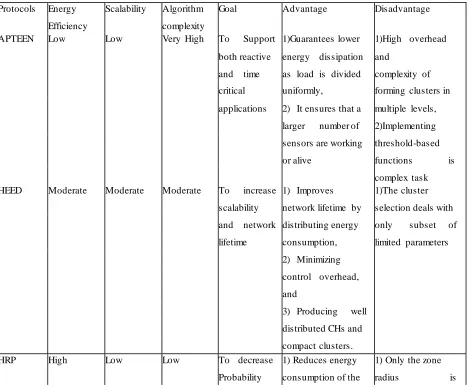
Table 1: Comparision of different Hybrid protocols
Protocols Energy Scalability Algorithm Goal Advantage Disadvantage
Efficiency complexity
APTEEN Low Low Very High To Support 1)Guarantees lower 1)High overhead
both reactive energy dissipation and
and time as load is divided complexity of
critical uniformly, forming clusters in
applications 2) It ensures that a multiple levels,
larger number of 2)Implementing
sensors are working threshold-based
or alive functions is
complex task
HEED Moderate Moderate Moderate To increase 1) Improves 1)The cluster
scalability network lifetime by selection deals with
and network distributing energy only subset of
lifetime consumption, limited parameters
2) Minimizing
control overhead,
and
3) Producing well
distributed CHs and
compact clusters.
HRP High Low Low To decrease 1) Reduces energy 1) Only the zone
IJIRT 146997
INTERNATIONAL JO URNAL OF INNOVATIVE RESEARCH IN TECHNOLOGY757
of nodes HRP relative ZHLS configurable
failure and in heterogeneous parameter
extend settings. 2) Number of
network 2) The Gateways messages
lifetime reduces energy exchanged depends
consumption and on number of nodes
extends the lifetime and the number of
of the cluster heads. zones.
ANHR High Moderate Low To improve 1) successful 1) There may be
Cluster head packet delivery rate chances that cluster
selection and 2) Network load of node may run out of
reduce ANHR is relatively energy
network small.
load.
III. CONCLUSION
Recent developments in wireless communications have trigger the development of low-cost, low-power WSNs for wide range of applications. Minimizing energy consumption and increasing the network lifetime are key requirements in the design of optimum wireless sensor network protocols. Node clustering is a useful energy-efficient approach to reduce the communication overhead and exploit data aggregation in sensor networks.In this survey, we discussed different types of hybrid routing protocols used in WSNs which have certain advantages, and also limitations. APTEEN protocol is appropriate for a time critical application in both proactive and reactive scenario; however increases variety of
overheads and additional complexity in
Implementation. A HEED protocol is employed which reduce control overhead and iteration for cluster formation. HEED has better scalability then others. In HRP, network period is exaggerated by utilizing gateways with the restriction in zone radius. ANHR provide successful packet delivery with small network load
Finally, it can be concluded from this survey that still a new hybrid protocol is needed for higher energy efficiency in order to increase the network lifetime.
REFERENCES
[1] J. Yick, B. Mukherjee, and D. Ghosal, Wireless sensor network survey, Computer Networks, 52(12), 2008, 2292–2330.
[2] I. Akyildiz, W. Su, Y. Sankarasubramaniam, and E. Cayirci, Wireless sensor networks: a survey, Computer Networks, 38( 4), 2002, 393–422. [3] T. Arampatzis, J. Lygeros, and S. Manesis, A
Survey of Applications of Wireless Sensors and Wireless Sensor Networks, In Intelligent Control
Proceedings of the IEEE International
Symposium on, Mediterrean Conference on Control and Automation Intelligent Control, Limassol, Cyprus, 2005, 719– 724.
[4] X. Liu, A Survey on Clustering Routing
Protocols in Wireless Sensor Networks, Journal of Sensors, 12, 2012, 11113-11153.
[5] C. Wei, J. Yang, and Y. Gao, Cluster-based Routing Protocols in Wireless Sensor Networks : A Survey, IEEE International Conference on
Computer Science and Network
Technology(ICCSNT), Harbin, 2011, 1659–
1663.
[6] A. A. Abbasi and M. Younis, A survey on
clustering algorithms for wireless sensor
networks, Computer Commuication, 30 (14–15), 2007, 2826–2841.
IJIRT 146997
INTERNATIONAL JO URNAL OF INNOVATIVE RESEARCH IN TECHNOLOGY758
International Workshop on Parallel and
Distributed Computing Issues in Wireless Networks and Mobile computing , Lauderdale, FL, USA, 2002, 195–202.
[8] A. Manjeshwar and D. P. Agrawal, TEEN : A Routing Protocol for Enhanced Efficiency in
Wireless Sensor Networks, International
Workshop on Parallel and Distributed