Volume 5 Issue 3– July 2016 27 ISSN : 2319-6319
Energy Efficiency Using Load Balancing in
Cloud Data Centers: Proposed Methodology
Rajni
Mtech, Department of Computer Science and Engineering
DCRUST, Murthal, Sonepat, Haryana, India
Kavita Rathi
Assistant Professor, Department of Computer Science and Engineering
DCRUST, Murthal, Sonepat, Haryana, India
Abstract: Cloud computing is becoming an important part of IT world. Cloud resources consume a huge amount of energy and power so it is very important that these resources must be used efficiently and effectively. This paper proposes an algorithm which would help in proper allocation of resources of the server. This paper used PSO (Particle Swarm Optimization) for proper optimization of resources and ESCEL (Equally Spread Current Load Execution) for load balancing of the load allocated to the servers.
Keyword- Cloud computing, Load balancing, Virtualization, Resource allocation, Energy efficiency
I. INTRODUCTION
In recent years cloud computing is becoming a very important part of IT technology. Without cloud computing we can’t even imagine IT world. Everything with internet is connected to cloud now. Cloud provides various services to its clients. Using cloud computing, companies can outsource data, applications, e-mails through virtual platforms with the help of various servers that can be access anytime and anywhere. These servers should be used effectively and efficiently.
Increasing use of cloud also leads us to think about green computing for the maximum utilization of these servers. For this virtualization is the important factor that is used. Virtualization is the key factor that is used now-a-days for running various virtual servers on single server. That helps in fully utilizing physical servers[1]. The paper [2] discussed various techniques which are being used for efficiently allocation of resources.
This paper proposed an algorithm which would help in proper allocation of servers to the client requests. Firstly, optimization algorithm has been used for properly optimization of cloud servers to the client requests. This would help in assigning maximum requests to minimum servers. Then, the assigned requests are balanced so that performance can also be increased.
The paper is organized as follows: In section 2, related work has been discussed. Section 3 presents the work done and discusses it in detail. In section 4 results of work has been discussed. Finally in section 5 conclusion of this paper has been given.
II. RELATED WORK
Volume 5 Issue 3– July 2016 28 ISSN : 2319-6319 In [4] author described live migration technique with the help of greedy algorithm. VMs are selected based on greedy algorithm. In this VMs of a cluster are given priority. This method reduces total migration time of a cluster.
In [5] authors proposed an resource allocation framework that predicts the number of VM requests that will arrive at cloud data centres in near future, the amount of resources associated with these requests, and based on that it will estimate the approximate number of physical machines required for fulfilling the demands.
In [6] author has discussed various load balancing algorithm used. According to this paper based on system load various load balancing algorithms can be divided into three categories: centralized, distributed and mixed approaches. In centralized a single node perform the task of load balancing and in distributed all nodes take participate in this task and in the mixed both are approaches are used at some extends.
In paper [7] author has discussed various load balancing algorithms and also discuss PSO in detail.
In [8], [9] authors discussed ant colony optimization algorithm for load balancing. This algorithm is based on the behaviour of ants in search of food. It helps to determine the shortest path.
III. PROPOSED METHODOLOGY
This paper focus on how to schedule VM requests to cloud server in such a way that the selected server have enough memory to perform the task but don’t as much that it wastes memory. In this paper PSO has been used for optimization of cloud server’s memory. When any client request occurs to the cloud it uses PSO algorithm for the assignment of request to the best possible server in term of least memory is wasted of that server. The main focus is least number of servers are used for handling the maximum number of requests so that remaining servers can be switched to sleep mode for the purpose of saving memory.
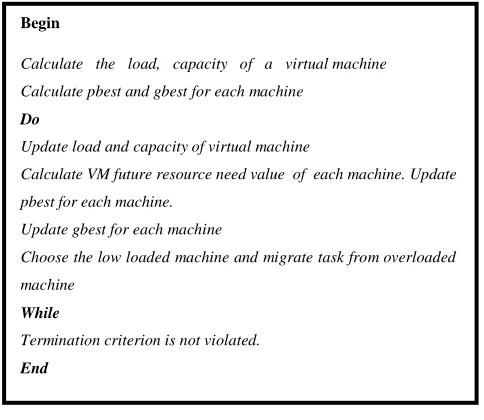
Fig. 1: Steps of PSO algorithm
After the PSO optimization the requests are passed through ESCEL (Equally Spread Current Execution Load) algorithm so that loads can be distributed of different servers for improving the speed. By this no one server would handle the more load than other servers. This will improve the overall work done by the cloud.
Begin
Calculate the load, capacity of a virtual machine
Calculate pbest and gbest for each machine
Do
Update load and capacity of virtual machine
Calculate VM future resource need value of each machine. Update
pbest for each machine.
Update gbest for each machine
Choose the low loaded machine and migrate task from overloaded
machine
While
Termination criterion is not violated.
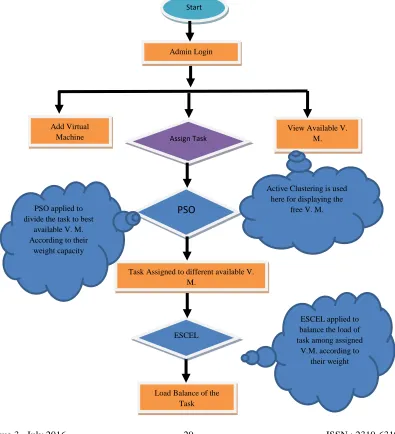
Volume 5 Issue 3– July 2016 29 ISSN : 2319-6319 Fig. 2: Steps to perform ESCEL algorithm
Active Clustering is also used for displaying the free active V.M. With the help of it we can know the free Virtual Machines which can are active and assign requests for those servers only. .
Start
Admin Login
View Available V. M. Add Virtual
Machine
Task Assigned to different available V. M.
Load Balance of the Task Assign Task
PSO
ESCEL
Active Clustering is used here for displaying the
free V. M. PSO applied to
divide the task to best available V. M. According to their
weight capacity
ESCEL applied to balance the load of task among assigned
V.M. according to their weight 1. Find the next available VM
2. Check for all current allocation count is less than max length of VM list allocate the VM
3. If available VM is not allocated create a new one 4. Count the active load on each VM
5. Return the id of those VM which is having least load. 6. The VMLoadBalancer will allocate the request to one of the VM.
7. If a VM is overloaded then the VMLoadBalancer will distribute some of its work to the VM having least work so that every VM is equally loaded.
8. The datacentercontroller receives the response to the request sent and then allocate the waiting requests from the job pool/queue to the available VM & so on.
Volume 5 Issue 3– July 2016 30 ISSN : 2319-6319 Fig. 3: Proposed Working Methodology
The proposed methodology have been implemented in netbeans by developing module in java, we have used cloudsim to simulate the behavior of cloud data center
IV. RESULTS
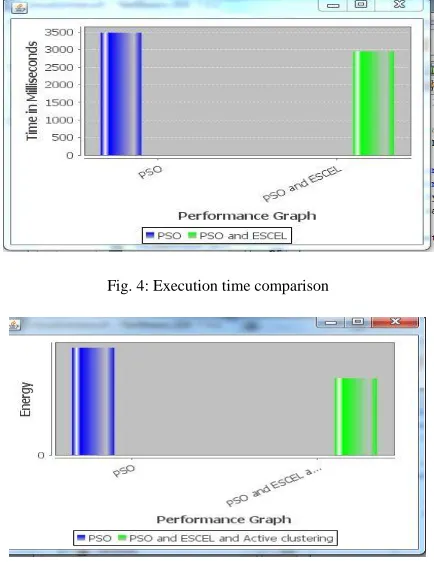
The performance is compared in terms of execution time spent. When PSO algorithm is compared with the methodology presented above, the time of execution decreased considerably. The time is presented in the form graph drawn. Fig. 4 and Fig 5 present the time difference and energy consumption between presented methodology to the existing one.
Fig. 4: Execution time comparison
Fig. 5 Energy Comparison
V. CONCLUSION
This field advances the work of cloud computing in two ways. First it optimized the resources of servers, so that maximum number of requests could be handled by minimum number of servers and energy consumption is decreased. Secondly, execution time is increased, performance is also increased.
REFERENCES
[1] M. Uddin and A. A. Rahman, “Server Consolidation: An Approach to make Data Centers Energy Efficient and Green,” Int. J. Sci. Eng. Res., vol. 1, no. 1, p. 7, 2010.
[2] R. Mittal and K. Rathi, “Energy Efficient Cloud Data Centers: A Review,” Int. J. IT Eng., vol. 4, no. 05, pp. 42–47, 2016.
[3] A. Beloglazov, J. Abawajy, and R. Buyya, “Energy-aware resource allocation heuristics for efficient management of data centers for Cloud computing,” Futur. Gener. Comput. Syst., vol. 28, no. 5, pp. 755–768, 2012.
Volume 5 Issue 3– July 2016 31 ISSN : 2319-6319 [5] M. Dabbagh, B. Hamdaoui, M. Guizani, and A. Rayes, “Energy-Efficient Resource Allocation and Provisioning Framework for Cloud
Data Centers,” IEEE Trans. Netw. Serv. Manag., vol. 12, no. 3, pp. 377–391, 2015.
[6] V. V. D. Bharathi, S. Nivedha, and T. Priyanka, “A Survey on Load Balancing in Public Cloud,” vol. 4, no. 3, pp. 720–722, 2014.
[7] A. Goyal, “A Study of Load Balancing in Cloud Computing using Soft Computing Techniques,” vol. 92, no. 9, 2014.
[8] R. Kumar and G. Sahoo, “Load Balancing Using ANT Colony in Cloud Computing,” Int. J. Inf. Technol. Converg. Serv., vol. 3, no. 5, pp. 1–5, 2013.