Energy Efficient LEACH Algorithm for Maximizing Lifetime of Wireless Sensor
Networks
Lubna Noorie
1and Asif Ali
21Dept. of Electronics & Communication Engineering, Al-Falah University, Dhauj (Faridabad), India. Email: [email protected]
2Assistant Professor, Dept. of Electronics & Communication Engineering, Al-Falah University, Dhauj (Faridabad), India. Email: [email protected]
Article Received: 24 July 2017 Article Accepted: 17 August 2017 Article Published: 20 August 2017
1.INTRODUCTION
Recent years, with the development and advancement of sensor technology, wireless sensor networks (WSNs) have been widely deployed for both civil and military applications [1]. Normally, sensors in such WSNs have resource constraints like limited energy, low storage capacity, and weak computing ability. Furthermore, due to the hazardous working environment, resources, especially the energy of sensors, may not be replaced or recharged. Therefore, the lifetime of the WSN highly depends on the energy consumption of sensors.
In WSNs, we have to save and balance the energy consumption desperately. In order to handle such challenges, Heinzelman proposed a clustering algorithm called LEACH [2] and LEACH-C [3]. In the both methods, energy consumption can be reduced and balanced to prolong the lifetime of network. However, the deviation of cluster numbers and uneven distribution of cluster heads impairs the advantages of clustering algorithms, thus impedes the widely adoption of those algorithms.
This paper targets a WSN application in a port. In our work, the whole network area is partitioned into subareas. In each subarea a head node is elected to receive data from others within the subarea and then forward it to the sink node. Unlike the previous clustering algorithm, our method can distribute cluster heads uniformly in the whole network, thus save and balance the energy consumption for data transmission, resulting in maximization of network lifetime and achieve high quality communication.
In this protocol, the sensor nodes from the entire network is shown in fig. 1, are divided into several clusters, cluster-head nodes communicate with the local base station, then the local base station feed data to the entire network of base stations, and terminal user can access useful information. The distance between the local base stations and the cluster node was very
close, therefore greatly reducing the energy consumption of these nodes send their information to local base station. In view of this, static clustering protocol seems to be a more efficient communication protocol [6]-[11]. However, in the entire network life cycle, these clusters and cluster-head nodes are fixed, and the local base station is assumed as a high-energy nodes situation. In most cases, the local base station is an energy-constrained node. The entire network may die soon because of excessive using about local base station node.
Fig.1. LEACH Protocol
So, we described a novel energy efficient and lifetime increased proposed Circular LEACH protocol as enhanced from normal LEACH protocol. The remainder of this paper we introduce a novel fixed clustering based data gathering approach which is having the node scheduling of active and sleep nodes in each cluster at a period of time in the wireless sensor networks to increase the lifetime with total energy consumed. The paper is organized as follows: A brief introduction with related works of LEACH protocol is presented in Section 2. In Section 3 describes the design of our novel proposed protocol in detail. Simulation and results A B S T R A C T
The Wireless sensor network (WSN) is a type of wireless ad-hoc networks. It consists of a large number of sensors, which are effective for gathering data in a variety of environments. Since the sensors operate on battery design of limited power, it is great challenging aim to design an energy efficient routing protocol, which can minimize the delay while offering high-energy efficiency and long span of network lifetime. In this paper, we proposed the energy efficient distributed clustering routing protocol LEACH (Low Energy Adaptive Clustering Hierarchy) in two cases i.e. rectangular and circular environment, then reduce time delay and energy consumption is computed for both cases. Simulation results using MATLAB demonstrates that the Circular LEACH outperform the rectangular LEACH by reducing energy consumption and increase the total lifetime of the wireless sensor network.
are discussed in Section 4. Finally, conclusions are made in Section 5.
2.LEACHPROTOCOL
LEACH, which was presented by Heinzelman in 2000 [1],[9] is a low-energy adaptive clustering hierarchy for WSN. The operation of LEACH can be divided into rounds. Each round begins with a set-up phase when the clusters are organized, followed by a steady state phase where several frames of data are transferred from the nodes to the cluster head and on to the base station. During the setup phase, each sensor node tries to select itself as a cluster head according to probability model. Fig.2 demonstrates the
Fig.2. LEACH Protocol Phases
For selecting a cluster head, each sensor node generates a random number between 0 and 1. If the number is less than the threshold T (n), the sensor node selects itself as a cluster head for current round, the threshold is presented as follows:
0
1
mod
1
)
(
p
r
p
p
n
T
if n ϵ G (1)Where p is the predetermined percentage of cluster heads (e.g., p = 0.05), r is the current round, and G is (e.g., p = 0.05), r is the current round, and G is the set of nodes that have not been cluster heads in the last 1/p rounds. Using this threshold, each node will be a cluster head at some round within 1/p rounds. After 1/p rounds, all nodes are once again eligible to become cluster heads.
In LEACH, the optimal number of cluster heads is estimated to be about 5% of the total number of nodes. Each node that has elected itself a cluster head for the current round broadcasts an advertisement message to the rest of the nodes in the network. All the non-cluster head nodes, after receiving this advertisement message, decide on the cluster to which they will belong for this round. This decision is based on the received signal strength of the advertisement messages. After cluster head receives all the messages from the nodes that would like to be included in the cluster and based on the number of nodes in the cluster, the cluster head creates a TDMA schedule and assigns each node a time slot when it can transmit.
During the steady-state phase, the sensor nodes can begin sensing and transmitting data to cluster heads. The radio of each non-cluster head node can be turned off until the node’s allocated transmission time. The cluster heads, after
receiving all the data, aggregate it before sending it to the sink.
A. Radio Model for Energy Calculation
In this paper, we use the first order radio model. Here are some assumptions for our mechanism:
1: All sensors are within the wireless communication range when they communicate with each other or with the BS.
2: All sensors have homogeneous sensing, computing and communication capabilities.
3: All sensors are randomly deployed in WSN.
4: BS is located in the center of the sensor networks and BS has infinity energy resource.
5: All sensors in the network have the same initial energy resource and dissipate their energy resource at the same rate.
6: Network lifetime is defined as the time span from the deployment to the instant when the first sensor dies (or when the entire sensors die). According to (5), all the sensors would exhaust their energy resource at the same time.
7: Both the energy dissipation of sensing data and the energy dissipation for clustering are neglected. Compared with the power consumption of CPU and Radio, the power consumption of sensor part is so small that can be neglected. Also, we suppose that all the clustering algorithms are run on the BS and no energy dissipation of clustering on sensor nodes.
8: The time span that BS collects the information from all the sensors once is defined as a round. In a round, each sensor has only one sensed data
9: The sensors that receive the data combine one or more packets to produce a same-size resultant packet, and by this way, the number of data that need to send by radio is reduced. This is reasonable, because it is generally used to the scenario that there is much correlation among the data sensed by the different sensors.
10: The energy dissipation of fusing one bit data is a constant value. Therefore, the equations used to calculate transmission costs and receiving costs for a 1-bit message and a distance d are respectively shown in fig. 3.
Fig.3. Radio Energy dissipation model
Radio energy dissipation model adopted wireless channel models in the reference [11]. Thus, to transmit an 1-bit message a distance d, the radio expends: Transmitter dissipates the energy to run transmit electronics
E
Tx
elec
and power amplifier
E
Tx
amp
. The energy required to transmit a k−bit message to a distance d is given by,
E
Tx
k
,
d
E
Tx
ele
k
E
Tx
amp
k
,
d
(2)The transmitter power loss is controlled by appropriately setting the power amplifier based on the distance between the transmitter and receiver. If the distance is less than a threshold d0, the free space (fs) model is used, otherwise the
multi-path (mp) model. The radio energy model for free space (d2power loss) and multi-path fading (d4 power loss) channel is given below:
0 2 0 4...,
...,
,
d
d
d
f
k
kE
d
d
mpd
k
kE
d
k
E
s elec elecTx (3)
The energy expended by the receiver to run radio electronics to receive this message is given by:
E
Rx
k
E
Rx
elec
(
k
)
kE
elec (4)mp fs
d
0 (5)
The electronics energy (Eelec), depends on factors such as the
digital coding, modulation technique, filtering type, spreading of the signal. The amplifier energy, ǫf 2
d
fs
or 4d
mp
, depends on the distance to the receiver and the acceptable BER (bit error rate). The d0 is the thresholdtransmission distance for the amplification circuit.
B. The Network Initialization
The network includes some of the initial setting of energy parameters and the initialization of the sensor nodes. So it is necessary to generate a random distribution of these nodes in the L * L m2 of the region. Random 100- node topology for a 100 * 100 m2, Sink is located at (50, 50). Fig. 4 demonstrates the wireless sensor network initialization.
Fig.4. Wireless sensor Networks Initialization
3.PROPOSED ALGORITHM
In this section we describe the proposed routing scheme which employs the node scheduling in each cluster in the network. The structure of the proposed routing scheme for wireless sensor networks is shown in fig. 4. Here the same procedure as in the normal LEACH protocol is followed. By taking the number of sensor nodes shown in figure 4, the formation of the clusters is same in this proposed protocol and also the cluster head selection by comparing the residual
energy of the individual in every round[13]. By doing this procedure repeatedly the total energy efficiency ultimately increased because of the proper node scheduling in cluster. In this node scheduling the total available residual energy is equally distributed and the cluster head also elected as per the residual energy comparison. Only thing is whenever the node is under sleep mode in each cluster it consumes very small energy. Here the total rounds are increased by doing both changing of sleeping and active modes and the available energy is distributed in a balanced manner.
Fig.5.The proposed LEACH Protocol
By properly doing the node scheduling in each cluster with proper time interval, the total energy consumed is low and the total lifetime of the wireless sensor network is reduced.
A. Circular LEACH
The operation of the clustering algorithm in circular LEACH is broken up into rounds that consisting cluster heads receiving data packets from its members and sending the fused data to the BS or the upper layer with the TDMA mechanism. Assume the BS is located at (0,0) in circular LEACH. The optimum one-hope transmission distance and the optimum clustering angle can be obtained based on equations:
1
2 amp cpu elec opt E E E
d (6)
cpu elec cpu elec opt E E N E E 2 3 83 (7)
During the cluster set-up phase, BS must be informed about the location and ID of the cluster heads located in the closest clusters, thus it broadcasts an advertisement message that contains the one-hop distance d1hop and its location to the
closer nodes, and decides which node acts as the first cluster head based on the received answer message that contains the location and ID of the closed nodes. To satisfy d1hop ≥ dopt, the
Fig.6. The flowchart of each cluster head gathering data from its member and the lower layer cluster head located in the same clustering angle in circular LEACH
4.SIMULATIONANDRESULTS
In this section, we evaluate the performance of the proposed approach through the simulations. A simulator is designed and implemented in MATLAB in order to investigate the energy efficiency with lifetime extension of the mentioned protocol. We compare the proposed protocol circular LEACH with LEACH protocol.
Table 1
Parameter Values
Network area 100m *100m
Number of nodes 100
BS position 50m * 50m
Eelec 50nJ/bit
fs
10pJ/bits m2mp
0.0013pJ/bit/m4
mp fs
d
sqrt
0
EDA 0.5J
Packet size 40000 bits
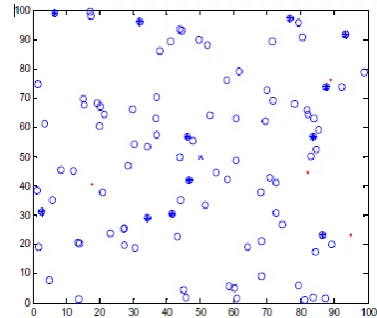
The simulation parameters used in the experiment is shown in Table I. The nodes are randomly distributed between x=0, y=0 and x=100, y=100 with the base station (BS) at location x=50, y=50. The fig. 5 and 6 are shows total number of nodes that remain alive over simulation time of 700 rounds for LEACH protocol and proposed circular LEACH protocol. It
can be seen that nodes remains alive for a longer time (rounds) in proposed protocol than LEACH. Note that further increasing of the number of nodes and the area does improve the network lifetime considerably. Based on the simulation results, we found that an energy saving up to 50% is obtainable. Using the metrics, first node dies (FND) and Half of the nodes alive (HNA) in the proposed protocol is compared with LEACH in terms of network lifetime.
Fig.7 System lifetime using LEACH protocol after 700 rounds Red points are indicates dead nodes (Nearly 50 nodes). Cluster heads indicated as *. Sink node is at center as ×
Fig.8 System lifetime using proposed protocol after 700 rounds Red points are indicates dead nodes (only 4 nodes). Cluster heads indicated as *. Sink node is at center as ×
Fig.9. Dead Node after complete iteration
are under dead position, but in the case of normal LEACH protocol all the nodes are lost their energy nearly 1300 rounds itself. This is clearly giving a good result of the proposed protocol
Fig.10. Total number of live sensor nodes Versus Number of rounds
Fig.11. Network energy per round
The base station is positioned at node (0,0). In circular LEACH circular deployment network have larger coverage area with less number of nodes deployed at equal distances. Hence energy utilization will be less with increase in network lifetime. The proposed model concludes that energy can be efficiently utilized in WSN’s with the circular node deployment as compared to grid deployment network.
Table 2. Simulation Parameter for circular LEACH
Parameter Symbol Value
Simulation Area Circular area of radius
50 meters
Total number of nodes N 100 Base station position (x,y) (0,0)
Packet size P 500 bytes
Number of Tracks T 4
Number of sector S 6
Transmit/Receive electronic
Eelec 50 nJ/bit
Amplifier Constant
fs
10pJ/bit/m2mp
0.00013/pJ/bit/m2Initial Energy E0 2J
Energy for Data aggregation
EDA 5 nJ
Fig.12. Circular LEACH
Fig.13. The networks lifetime of Circular LEACH
5. CONCLUSION
The LEACH is a well-known routing protocol for cluster based wireless sensor networks. This paper analyses the performance of LEACH-based wireless sensor networks in terms of lifetime and throughput. The reasonable number of frames in a LEACH round is deduced to prolong the lifetime.
REFERENCES
[1] Heinzelman WR, Chandrakasan A, Balakrishnan H. Energy efficient communication protocol for wireless microsensor networks. In: Proceedings of the Hawaii international conference on system sciences, vol. 1, Hawaii, USA, 2000. p. 3005–14.C.
[2] Liu JS, Lin CH. Power efficiency clustering method with power limit constraint for sensor networks performance.
In: Proceedings of the 2003 IEEE international performance, computing, and communications conference, vol. 9, Arizona, USA, 2003. p. 129–36. C.
[3] Bandyopadhyay S, Coyle E. An energy efficient hierarchical clustering algorithm for wireless sensor networks. In: Proceedings of the 22nd annual joint conference of the IEEE computer and communications societies, vol. 3, San Francisco, USA, 2003. p. 1713–23.\
selection. In: Fourth IEEE conference on mobile and wireless communications networks, vol. 12, Stockholm, Sweden, 2002. p. 368–72.
[5] Soro S, Heinzelman WB. Prolonging the lifetime of wireless sensor networks via unequal clustering. In: Proceedings of the 19th IEEE international parallel and distributed processing symposium, vol. 13, Colorado, USA,
2005. p. 236–43.
[6] Xue Q, Ganz A. Maximizing sensor network lifetime: analysis and design guides. In: Proceedings of the 2004 military communications conference, vol. 2, Monterey, CA,
2004. p. 1144–50.
[7] Shih E, Cho S, Ickes N, et al. Physical layer driven protocol and algorithm design for energy efficient wireless sensor networks. In: Proceedings of the 7th annual conference on mobile computing and networking, vol. 6, Pisa, Italy, 2001. p. 272–87.
[8] Priscilla Chen BO, Callaway E. Energy efficient system design with optimum transmission range for wireless ad-hoc networks. In: Proceedings of the 2002 IEEE international conference on communications, vol. 2, New York, USA, 2002. p. 945–52.
[9] Heinzelman WB, Chandrakasan AP, Balakrishnan H. An application-specific protocol architecture for wireless microsensor networks. IEEE Transactions on Wireless Communications 2002;1(4):660–70.
[10] Guo B, Li Z. United voting dynamic cluster routing algorithm based on residual-energy in wireless sensor networks. Journal of Electronics & Information Technology
2007;29(12): 3006–10.