*Corresponding Author: Manoj M. Nitalikar Research Scholar,
Department of Pharmaceutical sciences, Suresh Gyan Vihar University, Jaipur (India) Email: [email protected] Cell no: +91-9422543716
Research Article
Development, Characterization and In vitro Evaluation of Meloxicam Gel
*Manoj M. Nitalikar
1, Dinesh M. Sakarkar
2 1Research Scholar, Department of Pharmaceutical sciences, Suresh Gyan Vihar University, Jaipur, India. 2
Department of Pharmaceutics, Sudhakarrao Naik Institute of Pharmacy, Pusad, Dist. Yavatmal, India.
1.0 Introduction
Use of non-steroidal anti-inflammatory drug is well recognized for regional inflammatory disorders such as muscle pain, osteoarthritis and rheumatoid arthritis1,2. Meloxicam is a non-steroidal inflammatory drug from oxicam group that exhibits anti-inflammatory, analgesic and antipyretic activities. Oxicams shows all diverse functions shown by other NSAIDs and it is highly effective class of NSAIDs, mainly used in various arthritic condition and post-operative inflammation. Meloxicam, which is described chemically as 4-hydroxy-2-methyl-N-(5-methyl-2-thiazolyl)-2H-1,2-benzothiazine-3-carboxamide-1,1-dioxide. It is potent, highly selective COX-2 inhibitor from BCS –II class. It has very poor aqueous solubility so its solubility has to be enhanced. There are several methods to enhance solubility. One of the methods of increasing bioavailability is by preparing its inclusion complex with Beta-cyclodextrin.
Cyclodextrins (CD) are known to improve the solubility of insoluble drug by forming inclusion complexes3. Cyclodextrins are widely
used as "molecular cages" in the pharmaceutical, agrochemical, food and cosmetic industries4. Cyclodextrins increase the water
solubility of poorly soluble drugs to improve their bioavailability, light, thermal and oxidative stability of actives can be improved through the formation of cyclodextrin complexes. Cyclodextrins have mainly been used as complexing agents to increase the aqueous solubility of poorly water-soluble drugs and to increase their bioavailability and stability5. The most common cyclodextrins
are α -cyclodextrin, β-cyclodextrin, and γ-cyclodextrin, which consist of six, seven, and eight glucopyranose units, respectively.
Among α-, β-, γ-; β-CD was used for the study, as it has bigger cavity size and is the least toxic am ong the other natural cyclodextrin6.
Cyclodextrins were reported to enhance topical drug delivery in the presence of water. The interior environment of cyclodextrin cavity is hydrophilic; hence it can entrap unionized form of the molecule which too is hydrophilic7.
Several techniques are used to form cyclodextrin complexes such as co-precipitation method, solution method, the neutralization method, the kneading method, the slurry complexation method, and the grinding method8.
For many decades treatment of an acute disease or a chronic illness has been mostly accomplished by delivery of drugs to patients using various pharmaceutical dosage forms, including tablets, capsules, pills, suppositories, cream, gel, ointments, liquids, aerosols and injectable as drug carriers. Delivery of drugs to the skin is an effective and targeted therapy for local dermatological disorders. This route of drug delivery has gained popularity because it avoids first pass effects, gastrointestinal irritation, and metabolic degradation associated with oral administration. Due to the first past effect only 25-45% of the orally administered dose reaches the blood circulation. In order to bypass these disadvantages the gel formulations have been proposed as topical application.
The aim of the present study was to enhance the solubility of Meloxicam by its inclusion complexation with β-cyclodextrin by kneading method, to formulate and develop a topical gel containing complex and its in-vitro release studies.
2.0 Materials and Methods
The materials used include Meloxicam (gift sample from Cipla
Pharmaceuticals, Kurkumbh), β-cyclodextrin (gift sample from Macleods Pharma, Kachigam, Daman), HPMC-E-6 (gift sample from Piramal limited, Ahmedabad). Carbopol 940, DMSO, oleic acid and all others chemicals of analytical reagent grade were procured from S.D Fine Chemicals Ltd, Mumbai.
Abstract
Topical drug delivery systems are gaining increase in popularity and several drugs have been successfully delivered by this route for both local and systemic action. In recent years, most of non-steroidal anti inflammatory drugs have been designed to deliver the drug in the form of topical gels, to avoid gastrointestinal irritation to overcome “first pass” effect and to maximize the drug concentration at the site of action. Meloxicam is a selective Cox-2 inhibitor used as non-steroidal anti inflammatory analgesic drug having poor aqueous solubility so its solubility has to be enhanced. Better method of increasing bioavailability was by preparing its inclusion complex with beta cyclodextrin. Meloxicam– β -Cyclodextrin (β-CD) solid complexes were obtained by kneading method. The complexes were confirmed solubility, FT-IR and DSC studies. Dissolution profile of Meloxicam was improved by complexation with β-CD. The prepared complexes were formulated in the form gel using HPMC E 6 and carbopol 940 with penetration enhancers. In- vitro dissolution studies had shown that the carbopol gels (DCG 2) proved to be better in release and rheological properties.
ISSN (Online) 2249-6084 (Print) 2250-1029
International Journal of Pharmaceutical and
Phytopharmacological Research (eIJPPR)
[ICV-5.09)]
Journal Homepage: www.eijppr.com
Article info
Article History: Received 21 June 2013 Accepted 30 June 2013
Keywords:
2.1 Preparation of Meloxicam- β -Cyclodextrin Complex
2.2 Kneading Method
Calculated amounts of Meloxicam and β-CD were accurately weighed and transferred in a glass mortar, triturated with a small volume of distilled water and methanol (1:1 volume ratio) and then kneaded for 60 minutes. The product was kept at room temperature for 24 hrs. Distilled water and methanol (1:1 volume ratio) was used as wetting agent to achieve better interaction of Meloxicam with β -CD during kneading method. The kneaded formulations were prepared at 1:0.5, 1:1, 1:2, 1:3, 1:4 and 1:5 molar ratios. The complex in the ratio 1:2 showed better complexation, so the complex in ratio 1:2 was used for the formulation of gel.
2.3 Preparation of Gel
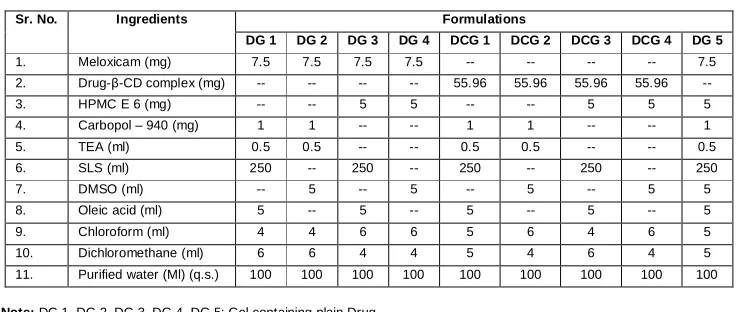
Gels were prepared by using different polymers as shown in table-1. The polymer and purified water I.P. were taken in a mortar and allow soaking for 24 hrs. Meloxicam was dissolved in solvent blend of Chloroform: Dichloromethane and other additives were added. The trituration was continued to get homogenous dispersion of drug in the gel. pH of gel was adjusted with triethanolamine when carbopol gels were prepared. The permeation enhancers like sodium lauryl sulphate and dimethyl sulfoxide were incorporated in different concentrations. Gels containing Meloxicam- β-CD complex were prepared by the same procedure as above by adding complex in place of plain Meloxicam.
2.4 Preformulation Studies
Preformulation studies were performed on free drug and complexes to assess the suitability of the complexes for the dosage forms. Solubility of the drug and the complex in phosphate buffer pH 7.4 were determined. The results were as shown in table 2. FT-IR
studies of the pure drug, β-CD and drug-β-CD complex were recorded using Fourier Transform Infrared (FTIR) spectroscopy (Jasco FT-IR-460 Plus). Thermo grams of the pure drug, β-CD and
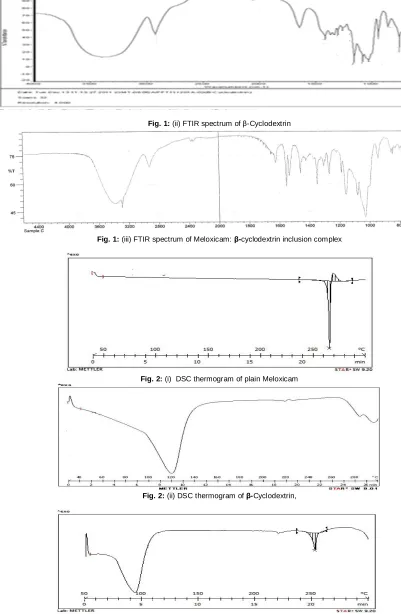
β-CD complex were recorded by analyzing the samples by DSC using METTLER-DSC-30S, Mettler Toledo India Pvt. Ltd., Switzerland, using crucible Al 40µL, at of 10°C /min heating rate, under nitrogen environment. The temperature range used was 0 – 400°C. The DSC therm ograms of Meloxicam exhibited an endothermic peak at 263 corresponding to its melting point. β -cyclodextrin alone showed a broad endothermic representing a loss of water molecule, a dehydration process. The thermograms of complexes are different from the pure drug; thereby giving clear evidence that there is formations of the complex. As the
concentration of the β-cyclodextrin is increased in the in the complex it was observed that the height of endothermic peak at 263 diminished gradually and it disappeared at the concentration of 1:5, indicating complex formation at all these concentrations. However, maximum deflection in the peak height was found to occur while changing the concentration ratio from 1:1 to 1:2, indicating maximum inclusion at this concentration. Hence, other characterizations were performed in complexes bearing drug: β -cyclodextrin, 1:3, 1:4 and 1:5 in molar concentration. The molecular
volume of β-cyclodextrin is 346 Å where as molar volumes of, Meloxicam is 412 Å, which is greater than the molecular volume of
β-cyclodextrin. Therefore two molecules of β-cyclodextrin may be required for making true inclusion complex. Practically, it has been
found that for making inclusions, two molecules of β-cyclodextrin were to enclose one molecule of drug. On the basis of molecular volume itself it is suggestive that drug could not be covered by the
cavity of one molecule of β-cyclodextrin. Therefore for further
studies 1:2, drug: β-cyclodextrin ratio were used. The prepared complexes were studied for its solubility in phosphate buffer pH 7.4.
2.5 Evaluation of Gels
The prepared gels were evaluated for physical appearance, pH, spreadability, extrudabilty, drug content, and in vitro release study across previously soaked cellophane membrane. The physical appearance and homogeneity of the prepared gels were tested by visual observations. Results were mentioned in table 3. The spreadability9 of the gel formulations was determined. The pH of
the gel formulations was determined using a pH meter. For assay of the drug in gels, 1 gm of gel was accurately weighed and transferred to 100 ml volumetric flask to which about 70 ml of 0.1 N NaOH was added, after vigorous shaking the volume made up to 100 ml with 0.1 N NaOH. The content was filtered through a suitable filter paper. An aliquot 1ml was pipette out from the filtrate and suitably diluted in phosphate buffer pH 7 . 4 . The content of Meloxicam was determined by using Systronics 2203 UV/visible spectrophotometer, at 366 nm against blank. The blank solution was prepared in the same manner as above, using gels without the drug. The tests were carried out in triplicate. The viscosity of the gel formulations was determined using Brookfield viscometer model (LVDV-II+) with spindle no.CP52 at the temperature of 370C. The in vitro drug release from gel formulations was studied across cellophane membrane using modified Keshery Chien diffusion cell. The receptor compartment was filled with the solution of 100 ml phosphate buffer of pH 7.4 and maintained at 37 ± 0.50C with constant magnetic stirring. Gel formulation equivalent to 10 mg of Meloxicam was spread uniformly on the surface of cellophane membrane (previously soaked in water for overnight) and was fixed to the one end of tube such that the preparation occupies inner circumference of the tube. The samples (1ml) were collected from the receptor compartment at predetermined time interval and replaced by equal volume of fresh receptor solution to maintain constant volume allowing sink condition throughout the experiment. The am ounts of Meloxicam in the sample were assayed spectrophotometrically by Systronics 2203 UV–visible spectrophotometer at 366 nm. In-vitro cumulative % release from gel containing pure drug and complex was given in table-4.
3.0 Results and Discussion
The present study involves the study of release of drug from gels prepared using inclusion complexes of β-cyclodextrin to increase the solubility of Meloxicam. The solubility of the drug was found to be increased considerably by complexation. The results were as shown in table 2.The drug and complexes were characterized for solubility, DSC, FT-IR studies. The IR spectras were shown in fig. 1. Thermograms of pure drug, β-CD and β-CD complex were shown fig 2. The results of in-vitro drug release across the cellophane membrane using fabricated Keshary-Chien diffusion cell were indicated in table 4and graphically shown as graph 1.
4.0 Conclusion
Dissolution profile of Meloxicam was improved by complexation
Table 1: Formulation table of gels
Sr. No. Ingredients Formulations
DG 1 DG 2 DG 3 DG 4 DCG 1 DCG 2 DCG 3 DCG 4 DG 5
1. Meloxicam (mg) 7.5 7.5 7.5 7.5 -- -- -- -- 7.5
2. Drug-β-CD complex (mg) -- -- -- -- 55.96 55.96 55.96 55.96 --
3. HPMC E 6 (mg) -- -- 5 5 -- -- 5 5 5
4. Carbopol – 940 (mg) 1 1 -- -- 1 1 -- -- 1
5. TEA (ml) 0.5 0.5 -- -- 0.5 0.5 -- -- 0.5
6. SLS (ml) 250 -- 250 -- 250 -- 250 -- 250
7. DMSO (ml) -- 5 -- 5 -- 5 -- 5 5
8. Oleic acid (ml) 5 -- 5 -- 5 -- 5 -- 5
9. Chloroform (ml) 4 4 6 6 5 6 4 6 5
10. Dichloromethane (ml) 6 6 4 4 5 4 6 4 5
11. Purified water (Ml) (q.s.) 100 100 100 100 100 100 100 100 100
Note: DG 1, DG 2, DG 3, DG 4, DG 5: Gel containing plain Drug, DCG 1, DCG 2, DCG 3, DCG 4: Gel containing Drug-β-CD complex
Table 2: Solubility analysis of pure drug and of complex
Solubility (mg/ml) Concentration (mg/10ml) Molar concentration
of Meloxicam. Enhancement in solubility
Plain drug in PBS 0.246 2.460 0.001005 1 fold
Drug- β-CD complex 1.005 10.00 0.002906 4.065
Table 3: Evaluation of Meloxicam gel formulations
Formulation
Code pH
Drug Content
Viscosity (cps)*
Spreadability
(g.cm/sec) ± S.E.* Extrudability Pressure (g/cm
2
) ± S.E*
DG 1 6.8 ± 0.19 98.33 9352 18.37 250 ± 1.59
DG 2 6.3 ± 0.15 98.18 9146 19.00 221 ± 2.41
DG 3 6.1 ± 0.16 99.74 8420 25.53 345 ± 1.35
DG 4 6.6 ± 0.12 98.65 8366 26.71 412 ± 2.796
DCG 1 6.1 ± 0.13 99.48 8530 20.42 232 ± 2.63
DCG 2 6.5 ± 0.11 99.84 8634 19.57 210 ± 1.41
DCG 3 6.9 ± 0.13 98.31 9664 21.71 359 ± 1.33
DCG 4 6.1 ± 0.13 98.51 8258 20.65 410 ± 2.74
DG 5 6.8 ± 0.14 99.32 9282 22.33 396 ± 1.75
Table 4: Percent cumulative release of Meloxicam from gel formulations through cellophane membrane
* Values indicate mean of three determinations
Sr. No. Time(hr)
Percent Cumulative Drug Release ± S.E.*
DG 1 DG 2 DG 3 DG 4 DCG 1 DCG 2 DCG 3 DCG 4 DG 5
1 0 0.00 0.00 0.00 0.00 0.00 0.00 0.00 0.00 0.00
2 01 11.46 0.43 9.43 0.22 14.48 0.44 10.30 0.36 12.74 0.46 6.42 0.12 9.22 0.70 8.42 0.34 14.80 0.78
3 02 16.69 0.54 15.84 0.42 25.46 0.34 16.44 0.54 23.86 0.76 12.66 0.34 17.64 0.46 15.48 0.82 21.24 0.63
4 03 24.73 0.79 23.73 0.43 34.72 0.60 27.46 0.34 39.32 0.52 21.62 0.82 29.46 0.98 26.56 0.40 31.46 0.48
5 04 35.56 0.62 32.18 0.67 40.42 0.34 36.32 0.80 51.48 0.98 32.46 0.24 40.44 0.86 39.83 0.92 46.78 0.30
6 05 41.72 0.44 39.67 0.64 48.31 0.22 49.58 0.68 64.12 0.56 39.98 0.16 52.52 0.42 51.74 0.34 55.44 0.42
7 06 59.86 0.64 58.32 0.53 57.44 0.92 56.26 0.22 78.64 0.48 51.82 0.26 63.58 0.54 62.88 0.83 68.58 0.80 8 07 65.56 0.72 79.62 0.64 68.32 0.86 69.32 0.12 86.54 0.62 69.96 0.48 75.98 0.42 71.48 0.46 77.52 0.32
Fig. 1: (i) FTIR spectrum of plain Meloxicam
Fig. 1: (ii) FTIR spectrum of β-Cyclodextrin
Fig. 1: (iii) FTIR spectrum of Meloxicam: β-cyclodextrin inclusion complex
Fig. 2: (i) DSC thermogram of plain Meloxicam
Graph 1: Graphical representation of In vitro release of Meloxicam from gels formulations through cellophane membrane a) Release from DG 1, DG 2, DG 3, DG 4
b) Release from DCG 1, DCG 2, DCG 3, DCG 4, DG 5
References
1. Roberts M, Cross S. Percutaneous absorption of topically applied NSAIDs and other compounds: role of solute properties, skin physiology and delivery systems.
Inflammopharmacology. 1999,7,339-350.
2. Hadgraft J, Plessin J, et al, The selection of NSAIDs for dermal delivery. Int J Pharm. 2000, 207; 31-37.
3. Bekerso J, Ujtendaal, E V, et al; Cyclodextrins in pharmaceutical field, Drug Dev. Ind. Pharm. 1991,17;1503-49.
4. Roux M, Perly B, et al, Self-assemblies of amphiphilic cyclodextrins. Eur Biophys J. 2007, 36,861–867.
5. Loftsson T, Duchene D., Cyclodextrins and their pharmaceutical applications. Int J of Pharm. 2007, 329,1–11.
6. Challa R, Abuja A, et al, Cyclodextrin in drug delivery.
AAPS Pharm Sci Tech. 6, 2005; 329-357.
7. Thostenin Loftsson, Mar mason; Cyclodextrins in topical drug formulations: Theory and Practice, Inter.J.Pharm. 2001;225;15-30.
8. Loftsson T, Ólafsdóttir BJ, et al, Cyclodextrin
complexation of NSAIDS: physicochemical