E-Service Brand Extensions:
The Role Of Perceived Fit
And Category Usage Level On Adoption
Patrali Chatterjee, Montclair State University, USAABSTRACT
This research examines how differences in consumer traits of self-efficacy and need for service employee interaction impacts perceived fit between core service brand and its e-service extension and adoption by current and prospective customers. Category usage level moderates the impact of self-efficacy on perceived fit and adoption of e-services among current and potential customers. We use data from a store—based service provider that introduced online services. The results of multiple regression analysis show that users with high level of efficacy have higher perceptions of fit and are more likely to adopt e-services and category usage level moderates this effect more for current users than prospective users.
Keywords: brand equity, brand extension, e-services, perceived fit, self-efficacy
INTRODUCTION
irms with established offline service brand names are increasingly leveraging their brand equity to develop e-brand extensions as documented in the business media, e.g., Charles Schwab launch of Schwab-Direct, Encyclopedia Britannica launching its online subscription service (Deleersnyder, Geyskens, Gielens and Dekimpe 2002). However, there are several examples of well-known brands that failed in their attempts to establish a stable and loyal online customer base for their e-brand extensions (Van Riel and Ouwersloot, 2003). Although several studies have investigated consumer adoption of e-services, there is a lack of research investigating how existing consumers’ relationship with core brands affects their adoption of e-service brand extensions and if new e-service brand extensions can cannibalize demand for core offline products and services. Further, it is critical how this impact differs across high vs. low usage consumers since it can impact overall firm profitability.
The strategy of developing online service-based brand extensions by firms with established service brands, is motivated by the desire to reduce costs of serving current marginal customers (light-use customers) (Poirier and Bauer 2000) and attract a new market composed of prospective consumers whose category needs are either met better by competitors (competitive users) or not met by existing product offerings in the industry (non-users in the category). In the case of products, brand extensions have been shown to erode, or even deteriorate the parent's brand's image. While this has been shown to be the case for tangible products (e.g. Loken and John, 1993), it has not been thoroughly investigated in the services sector.
Most published research on e-services is confined to examining consumer’s adoption of e-commerce, online information search or retail purchasing activities. There is relatively scarce research examining consumer adoption or migration from pure services to web-enabled services. Research on the antecedents to e-service adoption suggests that e-service experience has an impact on customers’ perception and evaluation of e-service quality (Rust and Lemon 2001). However, existing research does not examine migration of the parent brand customer base and resulting impact – cannibalization or increasing market coverage for the parent brand. In this research we address the following questions. How do consumers that vary in their self-efficacy of service use and need for service employee differ in their perception of fit of online extensions to the core service product and the resulting impact on
e-service adoption? How does the introduction of e-service extension affect migration behavior of heavy-use and light-use consumers of core service product to e-service extension? Further, do these effects vary across current customers of the parent service brand versus non-users?
CONCEPTUAL FRAMEWORK AND HYPOTHESES
E-services offer the potential for improving a firm's revenue management through the use of Web-enabled dynamic and automated service delivery (Rust and Lemon 2001). The increasing availability of customer information and the sophistication of information technology for capturing, tracking, processing and analyzing information make it possible for service firms to manage the trade-off between productivity and customer satisfaction by launching e-service extensions of their parent brands. The Internet and World Wide Web (web, henceforth) allows service firms to provide highly interactive, customized experiences, respond directly to customer’s information needs while reducing employee interaction, this sustaining long-term customer relationships at a lower cost than has been previously possible in the offline world (Rust and Lemon (2001).
An essential component of e-services is replacement of service provider interaction with web-based interaction and integration, the seamless incorporation of technology and customer-oriented functions within the firm. E-services that replace or automate customer-service provider interaction are similar to self-service technologies (Dabholkar and Bagozzi 2002) and provide consumers the flexibility to consume the service at a time and place of their choosing. Firms use databases, ASPs to deliver service (e.g., legal services, online banking, tutoring, and brokerage services). Since the service delivery is automated, it reduces heterogeneity in service delivery. The ability to capture and save customer online interaction reduces perishability associated with services while supporting simultaneity of production and consumption.
Prior research suggests that the influence of a brand name on evaluations of a brand extension depends on the brand equity and perceptions of how well the extension “fits” the core brand category (Bottomley and Holden 2001). Marketing communications play a dominant role in shaping prospective and new consumers perceptions of dominant attributes of the brand extension, for customers of the parent brand, however the strength of attribute perceptions associated with the parent brand formed through product experience is higher than one formed through exposure to marketing communications alone (Woodside and Walser 2007). Prins and Verhoef (2007) show that parent brand and e-service marketing communications enhance speed of e-service adoption. Hence, current consumers that are satisfied with parent brand are more likely to be familiar with the brand and its core products, and are more likely to consider attributes favorable to the brand to evaluate an e-service extension. Hence, we hypothesize,
H1: Current users of parent service brand will evaluate e-service brand extensions more positively than prospective users.
Role of Consumer Traits on Perceived Fit of E-Service Extensions with Core Service Products
Many researchers have considered fit to be a key factor in moderating the impact of brand equity in brand extension strategy. In general, fit is referred to as the degree to which consumers view the extension product as being similar to the existing products affiliated with the brand (Aaker and Keller, 1990). According to categorization theory, the degree to which brand associations are transferred from a brand portfolio to its extension brands depends on the level of perceived fit between the two (e.g., Boush and Loken, 1991). High perceived fit of a brand extension results when consumers can establish attribute-based (physical, or benefits) or non-attribute-based (image or context) explanatory links that connect the parent brand and the extension. Extensions are poorly rated when the parent brand's dominant association was inconsistent with the extension's dominant association.
way for customers to avoid declining service and produce and consume services on their own, at their own convenience. Self efficacy refers to a person’s belief in his or her capabilities to successfully complete a specific task and achieve certain outcomes. Self-efficacy beliefs are theorized to affect an individual’s motivation, affect, achievement-related behavior, and performance (Bandura 1997).
H2: Consumers with high levels of self-efficacy will (a) perceive higher fit, and (b) be more likely to adopt the e-service brand extension compared to consumers with low levels of self-efficacy.
Through e-services, a firm is better able to involve the consumers as co-producers of the service. This increases the role that consumers play in the service-production and delivery processes. One benefit of engaging the customer in the coproduction process is that it allows the firm to be more efficient in the way it manages its customers. Higher margins can accrue from e-services sold to marginal customers than core offline services through reductions of costs and better fit between customers' needs and services offered.
However, co-production inherent in e-services suggests that not all consumers of core offline service brands have similar levels of competence in usage. Some consumers tend to avoid self-service technologies, such as automated teller machines (ATMs) or self-service fuel dispensing, though they have been available for over 30 years and are now at a mature stage (Lee, Lee, and Eastwood, 2003).The need for human contact in service delivery is important to some service customers. Prior research (Jain and Kannan 2002) shows that among consumers who utilize online services, there are differences in their abilities to reap the benefits of the service provided online. Hence, we hypothesize,
H3: Consumers with high need for service employee interaction will (a) perceive lower fit, and (b) be less likely to adopt the e-service extension, than consumers with low need for service employee interaction.
Moderating Effect of Category Usage Level
Prior studies indicate that heavy use consumers who have high familiarity with core products process product information, and evaluate these products differently from those who use it less frequently and are less familiar (Prins and Verhoef 2007). Light users may have low service category need or distribute their category need across competing firms. High-use consumers develop strong knowledge structures or schema about the core product as they become more familiar with the product, and the relative degree of liking for the core product becomes well-established and stable (Park and Lessig 1981). As familiarity increases, the amount of cognitive effort needed to process product-relevant information decreases (Park and Lessig 1981). According to Meyer-Levy and Tybout (1989), a positive attitude is generated in the categorization process when consumers familiar with the brand encounter brand extension with a high-fit. However, these high-use consumers are likely to change the assessment of an extended product with low level of fit as the effort involved in categorization increases, or status-quo bias. Alternatively, preexisting attitudes may be either unformed or weak for light-use consumers, making the categorization process more difficult for both types of extensions when consumers have no or low familiarity with products (Meyer-Levy and Tybout 1989). Hence,
H4: Category usage level will moderate the impact of self-efficacy on perception of fit of e-service extension and likelihood of adoption. That is, high -use consumers with high levels of self-efficacy will (a) perceive lower fit, and (b) be less likely to adopt the e-service brand extension than light-use consumers with high levels of self-efficacy.
EMPIRICAL CONTEXT
Clickstream Data
Usable survey, attraction and parsed clickstream data on 3,403 customers who registered at the website for access to the e-service was made available for this study. Upon registration, all customers were invited to answer a short survey, to collect perceived fit of e-service, measures of self-efficacy for using web-based tutoring service, need for service provider (i.e., tutor) interaction, and demographic details. Non-users and lapsed users of the parent offline service reported usage of several online and offline competing tutoring services. Usage information for current and lapsed consumers was collected from the transactional database. After the free month trial period was over consumers were asked if they wanted to enroll to the paid e-tutoring service.
Measurement of Variables
Data on three dependent variables representing three events of interest were extracted from the clickstream of consumer activity: a binary variable indicating if the consumer subscribed to the e-service after the trial period was over; continuous variables for brand extension evaluation and perceived fit of e-service brand extension for each customer. Perceived brand extension fit was measured by asking consumers to rate the e-tutoring service on similarity in form (physical, functional and contextual), competence (attribute) and image using the 7-point scales proposed in Batra et al. (1993). Brand extension evaluation was measured by summing three-item, 7-point semantic differential scales (α=0.91) adapted from Pryor and Brodie (1998). The semantic differential scales were anchored with the polar adjective “extremely” followed by likeable/not likeable, good/bad, and high quality/poor quality.
Self efficacy in using e-tutoring service was measured using a two-item 7-point semantic differential scale (α=0.86) based on Bandura (1977). Need for interaction with a service employee (i.e., tutor) was measured using the four-item 7-point Likert-type scale (α=0.77) developed and validated by Dabholkar and Bagozzi (2002). Usage level was operationalized as logarithm of number of hours consumer was enrolled in the current (parent and competing) center-based tutoring services.
RESULTS
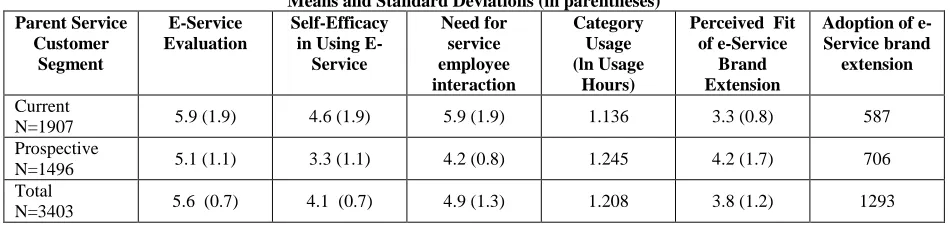
Table 1 displays descriptive statistics for all variables in the study and provides some evidence of differences in perceived fit and adoption of e-service brand extensions among 3,403 current and prospective consumers in the sample. Since differences between current and prospective consumers are of interest, statistics for each consumer group are presented separately. 28% of 6,812 parent offline service brand users that were informed about the e-service free trial offer signed up during the study period. Response rate to free trial offer for prospective users is not provided because of the difficulty in ensuring that all respondents obtained from the direct marketing list are valid. Current users evaluated the e-service extension more favorably than prospective users, (5.9 vs. 5.1) however the difference is insignificant (p>0.05) thus not supporting H1. Overall, 1,293 consumers or 38 percent of the consumers who used the e-service free trial adopted the e-service brand extension. Significantly more prospective consumers who signed up for free trial adopted e-service extensions than current customers (0.47 vs. 0.31, p<0.01) lending support to the contention that e-service brand extensions can increase market coverage for offline service firms. This may be due to the fact that this was among the first e-tutoring services offered for the target student group in the US.
Table 1: E-Service Extension Fit and Adoption by Customer Segment – Descriptive Statistics Means and Standard Deviations (in parentheses)
Parent Service Customer Segment E-Service Evaluation Self-Efficacy in Using
E-Service Need for service employee interaction Category Usage (ln Usage Hours)
Perceived Fit of e-Service
Brand Extension
Adoption of e-Service brand
extension
Current
N=1907 5.9 (1.9) 4.6 (1.9) 5.9 (1.9) 1.136 3.3 (0.8) 587
Prospective
N=1496 5.1 (1.1) 3.3 (1.1) 4.2 (0.8) 1.245 4.2 (1.7) 706
Total
N=3403 5.6 (0.7) 4.1 (0.7) 4.9 (1.3) 1.208 3.8 (1.2) 1293
The regression coefficients support the positive effect of self-efficacy on perceived fit and propensity to adopt e-service brand extension for both current and prospective users, thus supporting H2a and H2b. The positive impact of self-efficacy on perceived fit of e-service extension is stronger for prospective users, thus supporting our contention that current users have more resistant schema of parent offline brand dominant associations relative to prospective users. Consistent with hypothesis H3, we find that need for service employee interaction has a negative impact on perceived fit and adoption of e-service brand extension. The regression coefficient for perceived fit though negative is insignificant for prospective users, thus partially supporting H3a. H3b is supported for both current and prospective consumers, with the effect stronger for current users than prospective users.
While we did not specify any hypothesis for the main effect of category usage level on perceived fit and e-service adoption, we have to account for it in our estimation to prevent confounding results from the self-efficacy X category usage level interaction. Category usage level has a marginally significant negative effect on perceived fit and e-service adoption for current users but not for prospective users. This suggests the presence of status-quo basis among heavy users of offline services. As expected, category usage level has a moderating impact on the relationship of self-efficacy on adoption of e-service extension but not on perceived fit. High-use category users with high self-efficacy do not perceive the e-service brand extension to have significantly lower fit than light-users with high self-efficacy but they are significantly less likely to adopt the e-service extension, hence H4a is rejected, but H4b is supported. Further, usage level reduces the positive impact of self-efficacy on adoption more for current users than prospective users. This may be due to the fact that the data is from a service category (tutoring services) where e-service brand extensions were just being introduced in the US and consumers perceive a high level of risk.
Table 2: Estimation Results for Perceived Fit and E-Service Adoption
Variables Perceived Fit E-Service Adoption
Parent Service Customer Segment → Current user Prospective user Current user Prospective user
Intercept -2.21** -1.72** -1.9*** -4.13**
Self-efficacy 0.36* 0.57** 1.05* 0.82*
Need for service employee interaction -0.37* -0.17 -0.68** -0.54**
Category Usage Level -0.22* -0.11 -0.24* -0.18
Self-efficacy X Category Usage level -0.14 -0.12 -0.47* -0.35*
E-Service Evaluation -0.09 0.18 0.31* 0.49*
CONCLUSION
Our empirical analyses indicate that firms with bricks-and-mortar business models, considering extending their brands to the online marketplace, have to redefine how value will be provided in the new channel. Customers of the core brand are likely to adopt online brand extensions that are perceived to have a high level of fit more than consumers who perceive the e-service extension to have low level of fit. Our empirical analyses shows that existing consumers with high levels of self-efficacy and light usage are more likely to switch to e-services than heavy users of the parent brand who value their interaction with service employees. Further, firms have to recognize that nonusers of the parent offline service brand especially competitor’s customers are attractive prospective customers of the extended online brand. They are more likely to patronize online extensions, especially those with high levels of self-efficacy. The moderating impact of category usage level on high-self-efficacy is much lower for prospective customers than current users. As growth strategies, online brand extensions can be used as a market development strategy increase the brand franchise by attracting new customers with new products and services.
The empirical context in this study has external validity unlike other brand extension studies, it is a commercial service, and the financial dimension of the consumer relationship is of importance to the firm. The value of a brand-consumer relationship at a free or ad-supported website may not have a direct financial component in terms of subscription or purchase. Other behaviors, such as frequency of use, number of customer referrals may play an important role. The online brand extension examined in this research is among the first ones introduced in the industry. The impact of competition as other firms extend to the online marketplace is a topic that warrants attention. The effectiveness of online brand extensions in building revenues for core products in the brand family is an important issue, but we could not explore it here. Since most prospective consumers are attracted by low-fit brand extensions, preference for the core products in the brand is likely to build slowly over time, if ever. Datasets over a longer interval of time can address these issues. This can yield interesting insights for retailers that build content and destination features at their websites (e.g., Amazon.com).
AUTHOR INFORMATION
Dr. Patrali Chatterjee is Associate Professor of Marketing at the School of Business, Montclair State University. She holds a Ph.D. in Marketing from Owen School of Management, Vanderbilt University. Prof. Chatterjee's research interests are online advertising and promotions, clickstream data modeling, and customer relationship management. Dr. Chatterjee's research has appeared in several books and academic journals including Advances in Consumer Research, Journal of Business Research, Journal of Computer-Mediated Communication, Journal of Electronic Commerce Research, Marketing Science and the Review of Economics and Statistics.
REFERENCES
1. Aaker, D.A.; Keller, K.L. (1990), “Consumer Evaluations of Brand Extensions,” Journal of Marketing, Vol. 54, No. 1, pp. 27-41.
2. Bandura, Albert (1977), “Towards a unifying theory of behavior change,” Psychological Review, 84, 1999-215.
3. Batra R. Lehmann D.R. and Singh D. (1993), “The brand personality component of brand goodwill: some antecedents and consequences,” in Aaker and Biel editor. Brand equity and advertising. Hillsdale, NJ: Lawrence Erlbaum Associates. pp. 83-96.
4. Biyalogorsky, Eyal, and Prasad Naik (2003), “Clicks and Mortar: The Effect of Online Activities on Offline Sales,” Marketing Letters 14 (1), pg. 21-32.
5. Blattberg, Robert C., Gary Getz, and Jacquelyn S. Thomas (2001), Customer Equity: Building and Managing Relationships as Valuable Assets. Boston: Harvard Business School Press.
6. Bolton, Ruth N. (1998), "A Dynamic Model of the Duration of the Customer's Relationship with a Continuous Service Provider: The Role of Satisfaction," Marketing Science, 17 (Winter), 45-65. 7. Bottomley, P.A. and Holden, S.J. (2001), “Do we really know how consumers evaluate brand
extensions? Empirical generalizations based on secondary analysis of eight studies,” Journal of Marketing Research, 38 (4), pp. 494–500.
9. Dabholkar, P. A. and R. P. Bagozzi (2002), “An Attitudinal Model of Technology-Based Self-Service: Moderating Effects of Consumer Traits and Situational Factors,” Journal of the Academy of Marketing Science, 30 (3), 184-201.
10. Deleersnyder, Barbara, Geyskens Inge, Katrijn Gielens and Marnik G. Dekimpe (2002), “How
Cannibalistic is the Internet Channel? A Study of the Newspaper Industry in the United Kingdom and the Netherlands,” International Journal of Research in Marketing, 19 (4), 337-348.
11. Keller, K.L. (1993), “Conceptualizing, measuring, and managing customer-based brand equity,” Journal of Marketing, 57(1), pp. 1–22.
12. Lee, E., J. Lee, and D. Eastwood (2003), “A two-step estimation of consumer adoption of technology-based service innovations,” The Journal of Consumer Affairs, 37(2), 256-282.
13. Meuter, M.L., Ostrom, A.L., Rountree, R.I. and Bitner, M.J. (2000), “Self-service technologies: Understanding customer satisfaction with technology-based service encounters”, Journal of Marketing, Vol. 64, pp. 50-64.
14. Meyer-Levy, J. and A.M. Tybout (1989), “Schema congruity as a basis for product evaluation,” Journal of Consumer Research, 16, pp. 39–54.
15. Park, C.W. and P.F. Lessig (1981), “Familiarity and its impact on consumer decision biases and heuristics,” Journal of Consumer Research 8, pp. 223–230.
16. Poirier, C. C. and M. J. Bauer (2000), E-Supply chain: Using the Internet to revolutionize your business, San Francisco: Berrett-Koehler.
17. Prins, Remco and Peter C. Verhoef (2007), “Marketing communication drivers of adoption timing of a new e-service among existing customers,” Journal of Marketing, 71 (April), 169–83.
18. Pryor, K. and R. J. Brodie (1998), “How advertising slogans can prime evaluations of brand extensions: Further empirical results,” Journal of Product & Brand Management, Vol. 7 No. 6, 497-508.
19. Rust, Roland T., Katherine N. Lemon (2001), “E-Service and the consumer,” International Journal of Electronic Commerce, 5 (3), 83-99.
20. Van Riel, A. and H. Ouwersloot (2003), “Extending electronic portals with new services: effects of fit on consumer evaluations of the extension,” Journal of Service Research, 5 (3), 220-31.